-
Welcome!
Thanks for swinging by my vintage Barbie fan site, where you’ll find articles on Barbie’s built environment, Barbie illustrations, vintage rival and clone dolls and playsets, and miscellaneous musings/deep dives. What are you looking for?
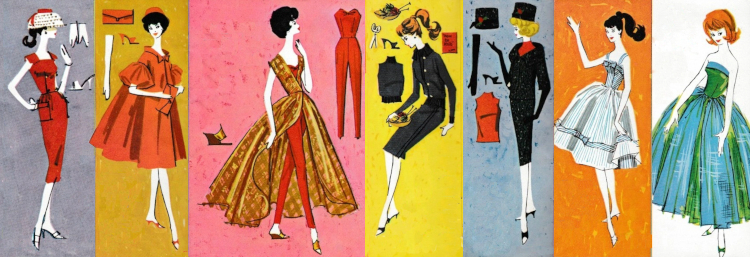
Vintage Barbie Illustrations
- Mattel fashion booklets, 1960-67 (approximately)
- Basic and Dressed Doll Boxes, 1959-64
- Doll Carrying Cases, 1961-72
- Jumbo Trading Cards, 1962
- Gift set art, 1960-70
- Illustrated fashion packaging, also about 1960-70
- Random House books (plus some from other publishers), 1962-65
- Dell Comics, 1962-63
- Whitman Paper Dolls, 1962-65 and 1967-73
- Whitman Coloring Books, 1962-65 (A mod sequel post is possible but not planned at this time.)
- More crafts and hobbies, 1963-1971
- Queen of the Prom board game, 1961-63
- Keys to Fame board game, 1963
- Sew-Free Fashion Fun Kits, 1965
- Sewing Patterns, 1962-?
- The Barbie World of Fashion board game, 1967
- Barbie’s best friend has a post of her own, mostly showcasing illustrations: Visions of Midge.
Plus the illustration “sidebars,” short entries on niche topics:
- Busy Gal fashion sketches, 1960
- Barbie Sings!, 1961
- Go-Together furniture sets, illustrated
- Color Magic, 1965-66
- Mattel fashions for Julia, 1968-69
- All the Barbie and friends illustrations on mod house exteriors like the one below
- Miss Lively Livin’ board game, 1970
- Window shopping, illustrated
- Barbie’s Baggage, illustrated (not super short, but surveys many illustration categories examined in other posts)
- Vintage dress-up and other child-size items for the boudoir
- The illustration component of the 1964 Little Theatre and travel costumes entry is sidebar-sized.
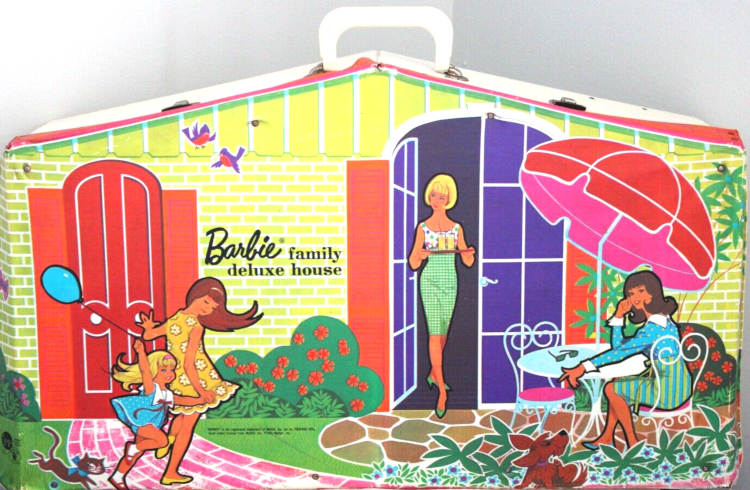
Barbie’s Built Environment
- Entries by year for many of Barbie’s early abodes: 1962, 1964, 1965, 1966, 1967-68, 1969, 1970.
- Barbie’s ’70s Travelogue:
- Mattel Modern and Susy Goose furniture, 1958-1966
- Barbie on TV, a roundup of some of Barbie’s early toy TV sets (this post also has a strong “illustration” component)
- Barbie’s Fashion Shop, 1963
- and a detour into Mannequins and Dress Forms, ’63-’73
- The Deluxe Reading Dream Kitchen, 1963 (note, this is not a Mattel product)
- The Little Theater, 1964
- Skipper’s Schoolroom, 1965
- Penthouse apartments, 1964-76
- Beauty parlors, 1964-77
- Japan-exclusive furniture, 1967
- Unique Boutique and Cafe Today, both 1971
- The Sears Karosel Kitchen, 1971-1976 (note, this is not a Mattel product)
- A roundup of fireplaces in Barbie and Barbie-sized houses, 1963-79
- The “built” environments of Whitman Barbie paper dolls, which real Barbie dolls can also use; 1963-1973.
- The built environments of mini vintage Barbies
- Seventies furniture and rooms not listed elsewhere
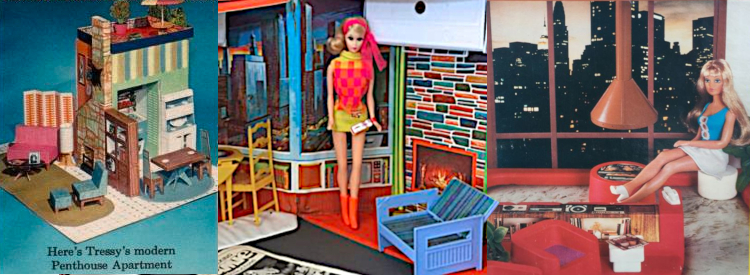
Articles relating to clones, rivals, and off-brand Barbie-style products
- Rival fashion booklets
- The Two Abodes of Tammy covers the living spaces of one of Barbie’s most notable rivals
- Barbie’s ’70s Travelogue, Part II: Unofficial Adventures is about non-Mattel playsets suitable to Barbie and Barbie-sized dolls
- Clones are recommended in the “existing alternatives” section of the musing, Three Nostalgic Black Barbies We Need (and a few existing alternatives).
- Clone kitchens: The Deluxe Reading Dream Kitchen, The Sears Karosel Kitchen
- Clone washrooms are prominent in Barbie’s ’70s Travelogue: Part IV.
- The pieces on penthouses, beauty parlors and fireplaces include non-Mattel offerings.
- Not Barbie on TV: Barbie and friends’ early TV sets that were tuned to other programs
- The entry on Mattel Modern and Susy Goose furniture includes some offbrand furniture items of the 70s and 80s.
- We wrote about clone carrying cases, including some created for competitor dolls.
- Certain of the sewing patterns are for generic fashion dolls, as are the Sew Simple and Cut ‘n’ Sew craft kits.

Miscellaneous Musings and Deep Dives
- A Chronicle of Barbie shoes, 1959-67
- Barbie’s Seventies Travelogue: the Appendix reviews vintage and nostalgic Barbie and Barbie-sized luggage options
- When Barbie Turned 21 in Manhattan, 1980
- Three Nostalgic Black Barbies We Need (and a few existing alternatives)
- Great Books for Vintage Barbie Fans
- The piece on Skipper’s Schoolroom includes “play sets that never were”: Barbie’s Sixties careers for which environments were not produced.
- Visions of After Five (1962) and Solo in the Spotlight (1960)
- Who wore it best? pairs vintage and mod Barbie and Francie fashions with their likely or confirmed inspirations. The Airborne edition does the same for vintage flight attendant uniforms, while the Mary Quant one highlights Francie fashions that appear influenced by Swinging London designer Mary Quant.
- Millennium Mod catalogs Barbie’s returns to the late Sixties youth-driven zeitgeist between 1980 and 2020.
- We tackle an age-old mystery with our investigation into Sew Free? Sew Magic? Sew Simple? Cut ‘n’ Sew??
- Fashions that weren’t, 1959-1970 looks at some possible rejected designs for Barbie and friends’ fashions.
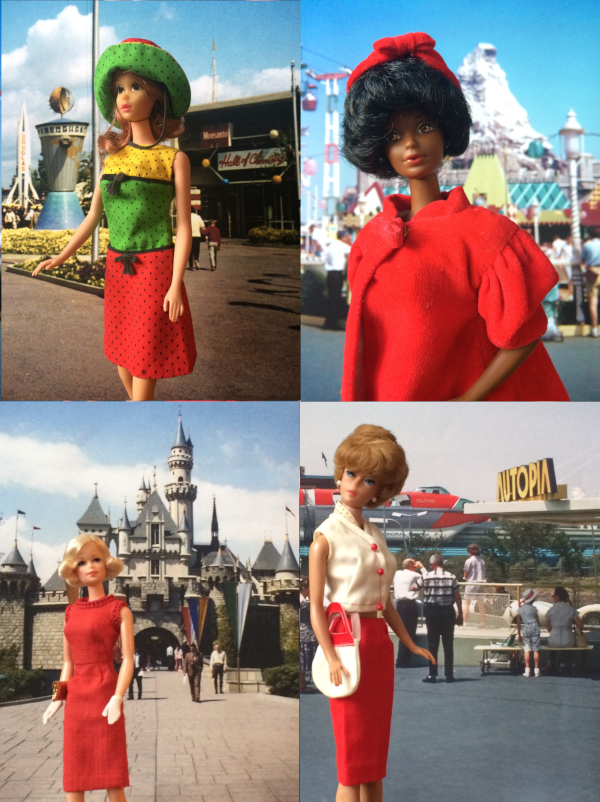
There’s still more to come, but before you scroll off into the distance, here’s the first image ever posted to this blog back in 2022: some of my dolls, dressed in vintage or vintage reproduction, in front of vintage Disneyland backgrounds belonging to Bill Cotter:
-
Fashions that weren’t (1959-1970)
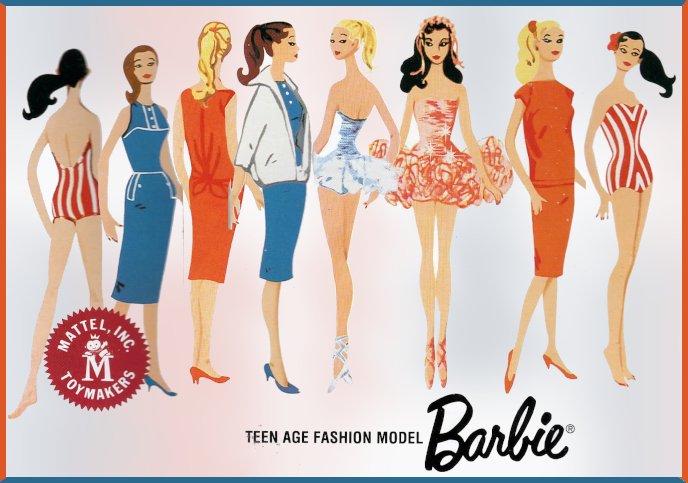
Barbie’s early clothing designs, with their period detail and high-fashion perspective, never fail to fascinate. Buried within the illustrations and other ephemera that we browse here are a smattering of alternate-reality Barbie fashions that never quite made it to production or perhaps were never slated for production at all. Almost all that we’ll review here have been featured previously in other posts on this blog; today just felt like time for a roundup.
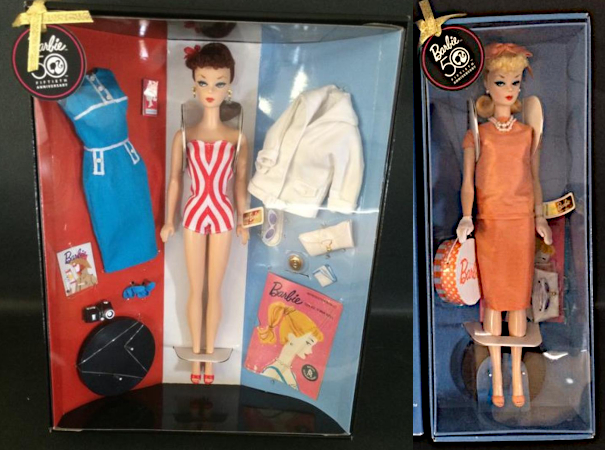
via Apple Tree Auctions. We led off with a collage of sketches from the box in which some of the first Barbies were retailed. While the box art included many of the iconic, original 1959 ensembles, like Gay Parisienne, Evening Splendour, and Easter Parade, about four of the depicted sets weren’t offered. We include the Ballerina fashion in this list because that ensemble didn’t hit the streets ’til 1961, and the box art seems uncertain of the outfits’ eventual color palette and styling. Three others went unproduced until becoming convention exclusives in 2009, shown above. One, a red-striped, strapless bathing suit, I conjecture morphed into Barbie’s well-known black-and-white striped suit. The alignment of the fabric to form a chevron pattern is reminiscent, and a second such swimsuit in the earliest slate of fashions would have been beyond repetitive. Regarding the teal sheath with baggy jacket, if I’m right in thinking it’s got some nautical flavor, it may have been supplanted by Cruise Stripes/Roman Holiday, which are absent from the box art. (An aside: I think Mattel designer Robert Best tried to recreate this bizarre parka-and-pencil-skirt combo during his Project Runway season. The judges weren’t having any of it.)
The disappearance of the peachy-colored, drop-waisted chemise, on the other hand, may have quite a different explanation: when the ’20s-style silhouette was revived and updated by the French couture in 1957 it was widely lauded, but its subsequent decline and fall was so sharp that fashion designer and fit-and-flare aficionado Anne Fogarty delivered a postmortem just two years later in Wife Dressing (1959), claiming the easy-wearing garment’s popularity was quashed by dismayed husbands who required their wives’ curves to be always on display. The following year Eve Merriam devoted a full chapter of Fig Leaf (1960) to the sack dress phenomenon, attributing its fall from favor to overhype and oversaturation. Whatever the reason, by Barbie’s 1959 debut the chemise had met its demise. (It was really just ahead of its time, as the shift dress was integral to Swinging London and the Youthquake felt ’round the world.)
Before moving on, it would be irresponsible of me not to point out that the box illustrations show closed-toed shoes almost exclusively. (The image atop this post teases but a sampling.)
1959’s Commuter Set is also not included on the retail box art, but it was depicted on some of the Ponytail carrying cases with (c) date of 1961, after Commuter Set had already been retired. Below left, we see the fashion booklet rendering of Commuter Set alongside a matching image from a carrying case.
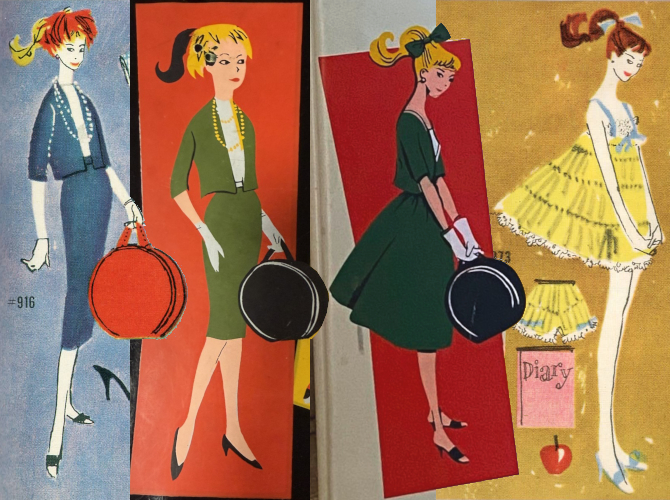
1961 carrying case graphics via eBayers Maries resale and mezquitecoins. Other carrying cases, as above-near-right, instead show a similar fashion but with full skirt and a pose that seems based on that used for Sweet Dreams in the booklet (above right). I imaginatively dubbed this the Carrying Case Fashion in an earlier post. Was it a planned Barbie ensemble? Unless Commuter Set infringed on someone’s copyright or something, which seems impossible, I see no other reason to have swapped its illustration out. The fact that the new fashion evidently doesn’t have its own pose, though, might argue that this offering was never planned. We may never know for certain.
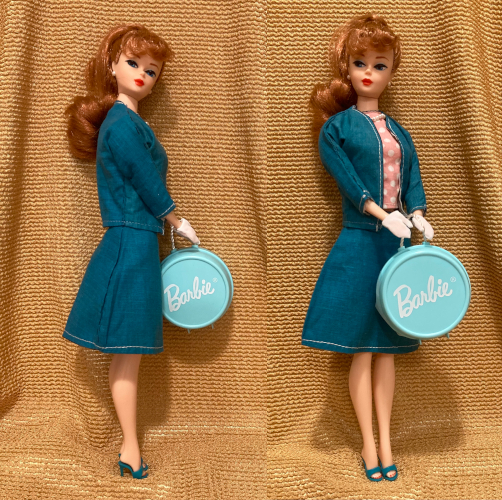
Officially, Barbie may not have had a full-skirted suit like the Carrying Case Fashion; a cut and sew ensemble stands in. Barbie’s paper doll sets were full of fashions both real and imagined. In my review of the pre-1966 paper dolls, I pointed out an interesting After Five variant, below left, in a set that otherwise showed real, produced Barbie fashions. Could this adjusted style have been conceived and considered for the real fashion? It’s worth pointing out that BillyBoy* noted the compelling similarity between the official After Five and a Dior design that has no sheer overskirt and which may have inspired After Five exactly as manufactured.
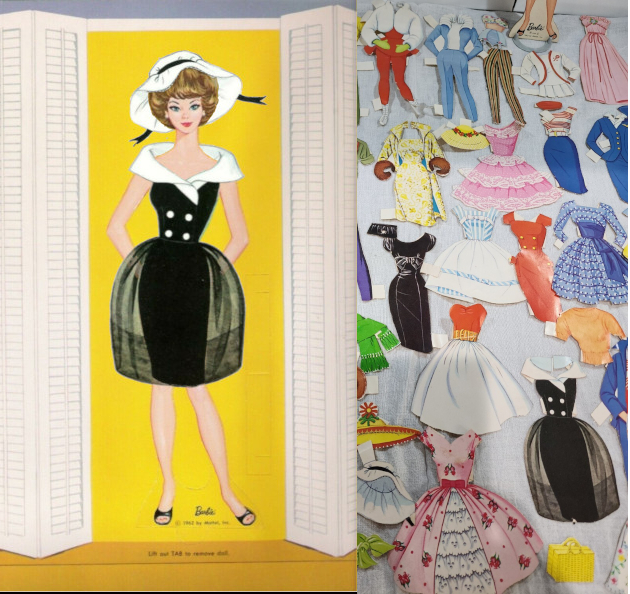
Left, the questionable After Five overlaid on a paper doll of the same vintage. Right, many of the set’s fashions via Reminisce Toy Company on eBay. Most are known, but I also don’t recognize that bow-fronted black cocktail dress. Another paper-doll-based possible variant arose for Midge, among mostly real and accurate ensembles, when Sorority Meeting was rendered in baby blue. However, there are so many, many paper doll sets that include no actual Barbie ensembles, or a clear mixture of the real and fantastic. It’s possible that no paper doll set ever teased an unproduced Mattel design, either considered and changed or considered and discarded; these may simply be flights of fancy.
The first advertisements for Barbie’s celebrity friend Julia, appearing in fashion booklets dated 1968, didn’t show her in her nurse’s uniform, nor in the later Mattel fashions for Julia, but instead in this unknown, sparkly pink dress.
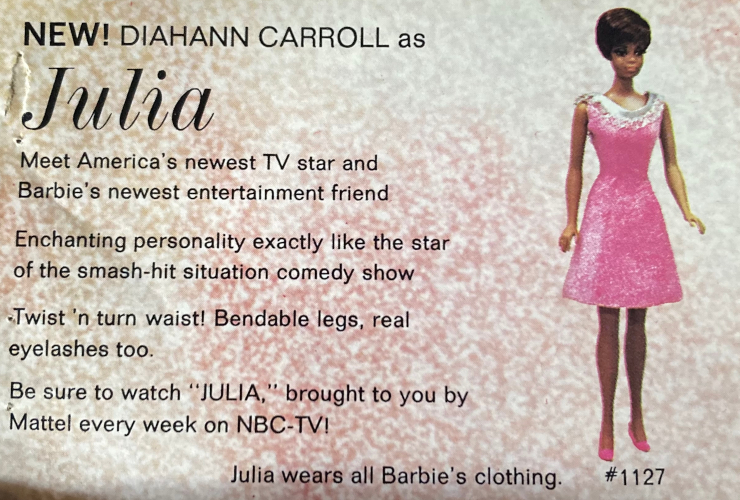
Unlike carrying case and paper doll fashions, this design certainly did exist as a prototype doll outfit since we have its photograph. It may share some DNA with the dress from Velvet Venture, always stunning on Julia and Christie. However, that dress is more salmon and gold than bubblegum and silver, and its high neckline has but the narrowest metallic trim.
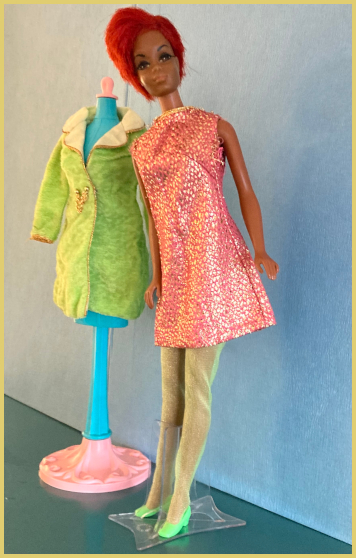
Julia’s mystery dress, evolved? Next up is a cool new-to-the-blog fashion that wasn’t, from a mod-era carrying case dated 1968. The photo below shows Barbie doll in a fan-made version of the dress drawn for the accompanying case. Theriault’s recently auctioned off the doll and its casespiration as a lot.
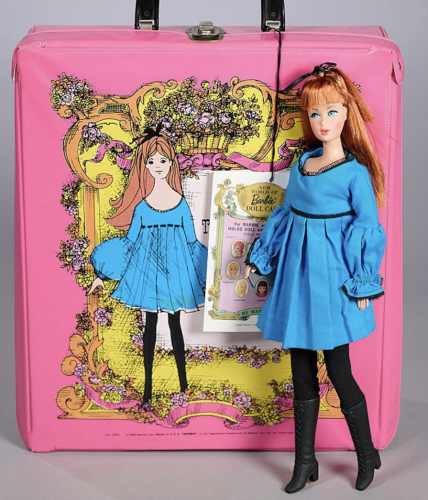
source: Theriault’s Of all the fashions herein, this is the one I’ve suspected most strongly was never planned for production. The below collage shows other carrying cases and case rooms, all from 1968, all in the same art style, all with fabricated fashions…
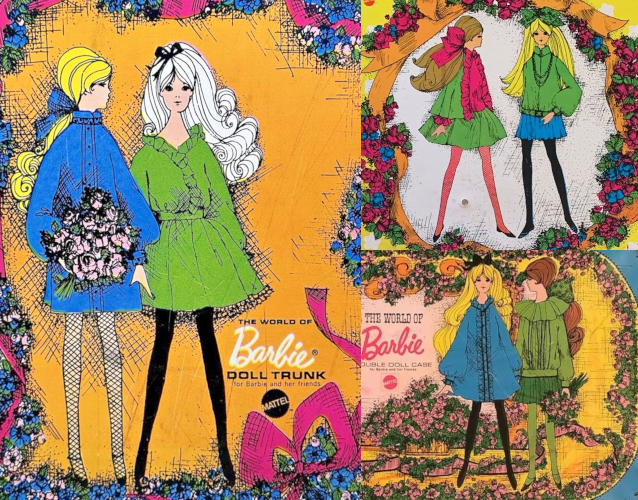
Case details via various eBay sellers. …with the glaring exception of Fancy Dancy, worn by Stacey in the top right image. That ensemble’s presence raises a big cloud of uncertainty around all the rest. The date of these cases coincides with a time when Barbie was getting a major fashion overhaul, so it may be that the illustrations do represent early design concepts.
What about this Jamie case room from 1970, illustrated in a totally different style? Jamie’s clearly wearing her genuine attire, while Barbie is wearing… nothing I recognize. A planned fashion or the illustrator’s creative license?
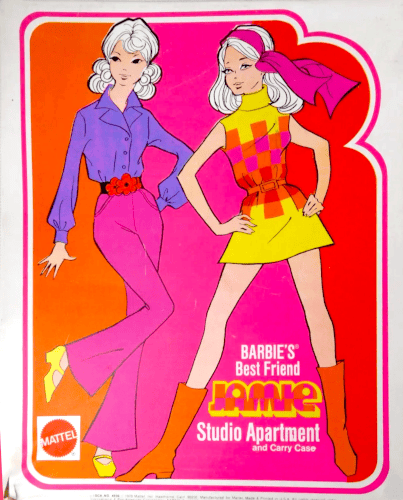
About half the time when I think I’ve spotted a fashion-that-wasn’t on a carrying case, in a catalog, etc., it turns out to be a real Mattel fashion shown without a coat or other outer layer, or else just something I couldn’t place; this design in particular seems like one I could have overlooked. Any leads?
Before we finish up, here’s one semi-fashion-that-wasn’t for Francie, from the 1966 Montgomery Ward Christmas catalog:
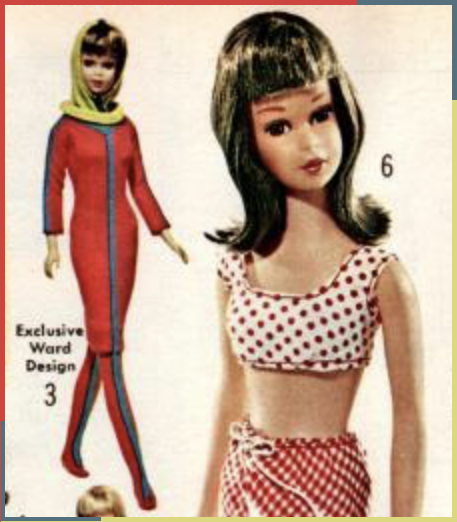
via christmas.musetechnical.com Yes, Swingin’ Skimmy did and does exist, but for some reason the one photographed for this catalog–perhaps the only place to see it advertised for the US market, since it was a store exclusive–shows added trim, like that running down the front of the shift, also adorning the stockings and sleeves.
Is this a prototype, or could someone have restyled the doll for catalog photography? (If so, why!?) In Japan Swingin’ Skimmy was not a store exclusive and is accurately represented in the ’67 Japanese fashion booklets. Furthermore, Joe Blitman, via Miller’s Magazine, has shown a production sample with differently-colored trim, but without any extra trimming. On that topic…
Today we’ve focused on designs that were customer-facing, on packaging, advertising, and licensed products, but didn’t see the light of day as realized Barbie clothing for whatever reason. The overall subject of unproduced designs is much richer than just these few examples: collectors have unearthed many over the years. The book Barbie in Japan by Keiko Kimura Shibano includes factory samples that were retailed in that market, while Sarah Sink Eames’ guides show heaps of samples made by Mattel’s designers that subsequently underwent changes or were scrapped completely. More have popped up in magazines like Miller’s, at auction, and in various other places. Carol Spencer’s book even shows the sample costumes she made for her Mattel job interview, which apparently were never considered for production (such a shame!).
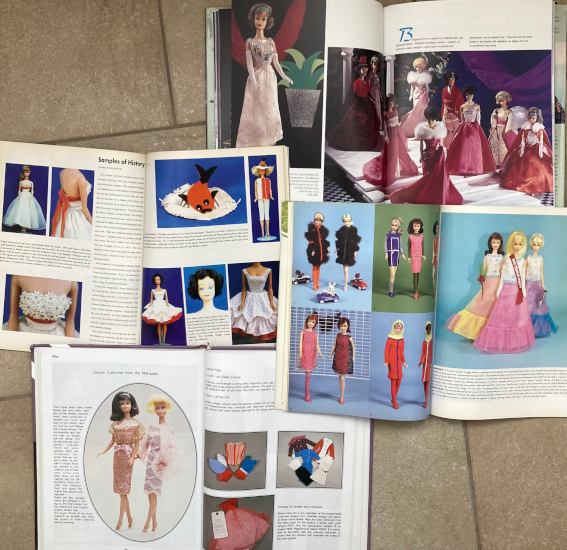
Top to bottom: A mix of sample costumes, variants, and Japan exclusives photographed for Barbie in Japan; Miller’s Magazine features on Barbie samples (L) and Francie’s, including the Swingin’ Skimmy color variation sans extra trim; and an array of sample costumes catalogued in Sarah Sink Eames’ first book. Where to next? This post is the most recent of our miscellaneous musings. The top post in this category is the one about shoes, also linked above. Other top posts are one on fashion booklets and some from the Many Abodes of Barbie series. Or swing by the table of contents to choose from other options.
-
Seventies furniture and rooms
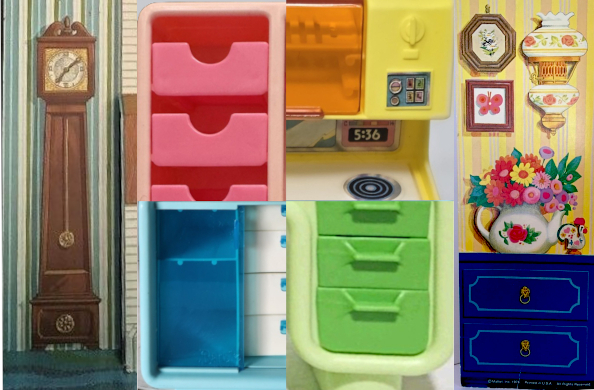
The “built environment” component of this blog, one of the major drivers of its creation, is drawing to a close: this may be our last survey of Barbie’s environs, ever. At the end of the Many Abodes of Barbie series, in the entry on 1970, we announced that we’d never visit the A-Frame or Townhome; their lore is just too extensive. We did see assorted Seventies Barbie destinations in the Travelogue, including covering Barbie-sized dolls’ plumbing revolution during that decade. But before we close the book on Barbie Homes and Gardens, let’s take a moment to review some of the exciting changes that came to Barbie’s environment, that weren’t quite a house nor quite a destination.
Rooms for Lively Living (1970)
We touched on Barbie’s first Seventies “rooms” in the Many Abodes of Barbie finale. They are breathtakingly rare, so there’s not much more to say about them today. A Lively Livin’Room was sold on eBay a few years ago, as we shared in the earlier post.
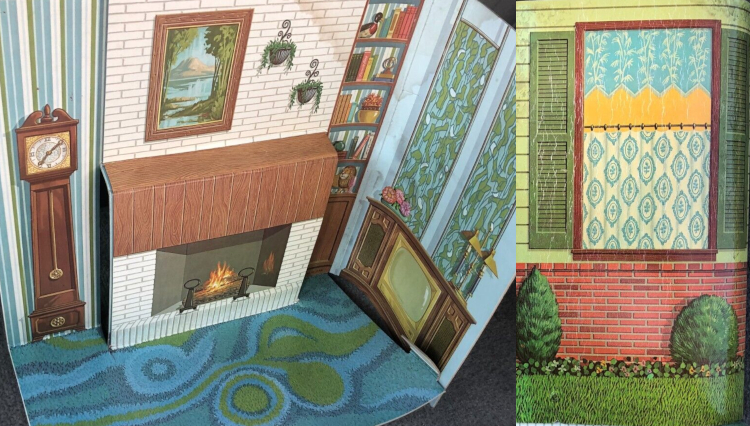
1970 Barbie Lively Livin’Room interior walls and floor (L) and exterior (R). Source: wonderwoman13 on eBay. As we noted at that time, the three rooms were originally offered for sale alongside the Lively Livin’ House, but they have their own design. The structures are simplicity itself: two walls and a floor, with a little variety added by making some elements dimensional: a dresser in the bedroom, the kitchen sink, and the living room fireplace pop out of the wall into the space. The physical furniture is limted: the bedroom included a lightweight plastic bed form with a coverlet, while the kitchen had a table and two chairs that were pretty typical for the era (similar pieces occurred in the Lively Livin’ home). The bedroom also offered a clothing rod and hangers that attached to the screened-on wardrobe. Other elements, like frying pans and flower vases, could be punched out of the cardboard packaging, guaranteeing hours of fun. The walls were printed on two sides, showing the room interior as well as the building exterior.
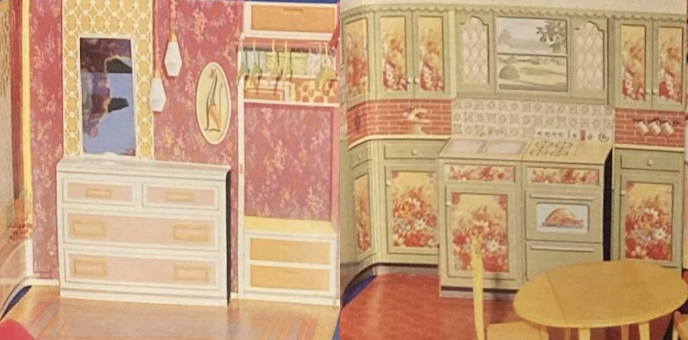
Excerpted from Marl Davidson’s book on Barbie Structures and Furniture, above are the interior walls of the bedroom (L) and kitchen, both quite restrained in style compared to the Lively Livin’ House. What did their exteriors look like? (I suspect that these sets, or pieces from them, do surface from time to time but go unidentified as so little information about them is available. Maybe the above borrowed images will help as people reverse image search their finds.)
Room-fulls (1975)
In contrast to the Rooms for Lively Livin’, the Room-fulls spread far and wide and are not too hard to track down today. Their contents were also a bit more interesting: they had color, and style, and calico and gingham and patchwork quilting, as was the fashion at the time.
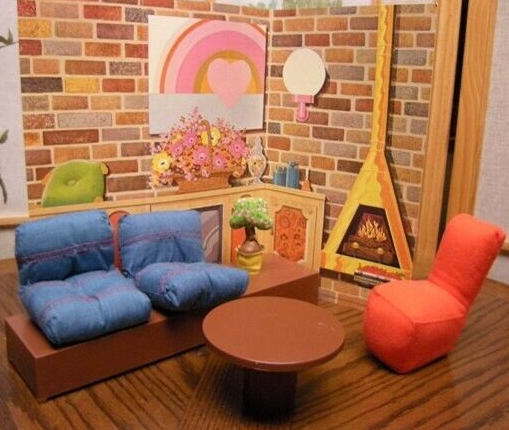
So what if those are denim couch cushions? The Firelight Living Room, via motown-girl on eBay, is loaded with appeal. 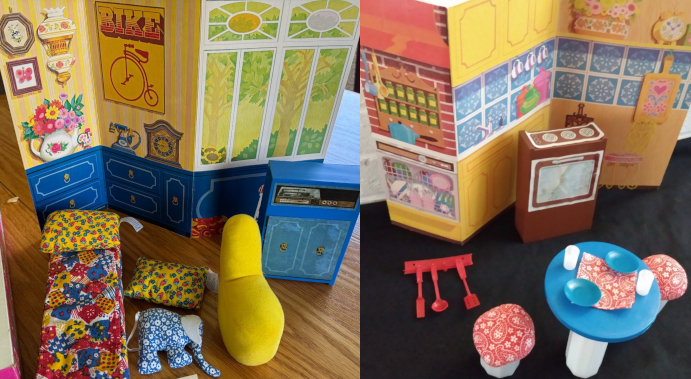
The Studio Bedroom (via Isetta88) and Country Kitchen, shown here sans paisley table cloth via fue-4145, also have fine qualities–particularly those elaborate details on the bedroom wall. We talked about a fourth planned Room-full, the shower, in an earlier post. Evidence indicates that this final set was never produced.
Dream Furniture (1979)
Although we cover the A-Frame only in passing, its gorgeous furniture deserves a nod. There has been nothing like it, before or since. The original A-Frame was not the pink structure many know from the 80s; it was released before Barbie had fully boarded the pink train, and its furniture, sold separately, reflects the transition of Barbie’s environs from kid-appropriate realism to full toyishness in the following years. For the original Dream Furniture a spectrum of hues were used, all in gorgeous two-tone color schemes.
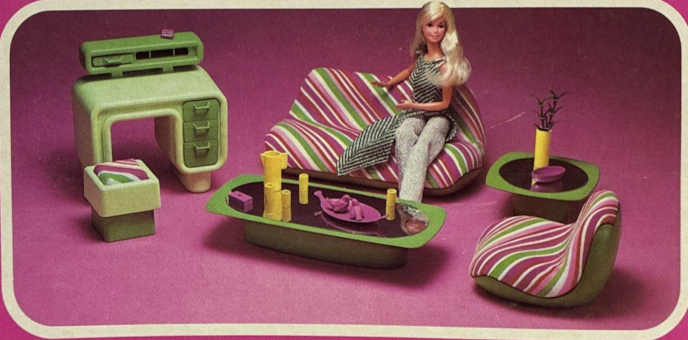
product packaging via aeb1 on eBay. 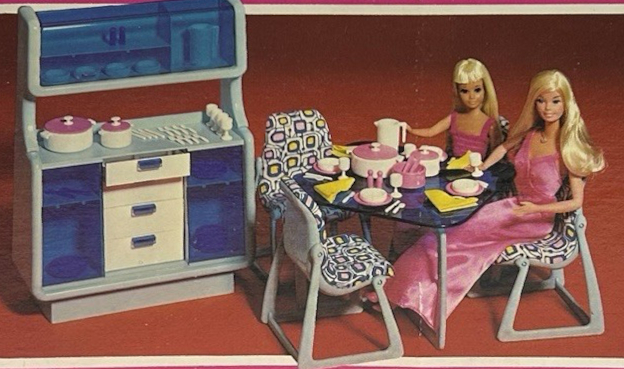
via grandpasdrawers 😐 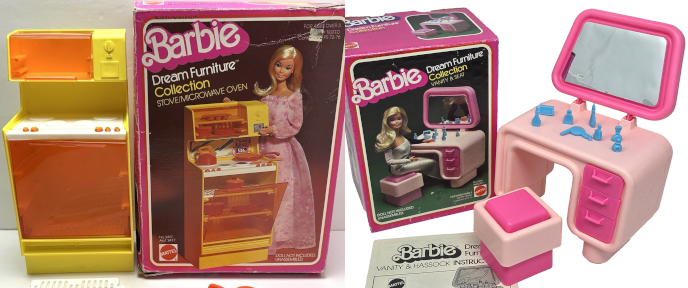
Kitchen appliance and bedroom vanity via grandpasdrawers and Vintage_Toys_And_Treasures. Okay, so there was always a bit of pink in the mix, demonstrated by some pieces above. By ’83 this furniture would ALL be pink.
Puff ‘n’ Play furniture
These inflatable furniture sets were not Mattel but are often identified as such, sometimes even advertised as Dream House or Town Home furniture–probably because they were so popular and can be found along with the houses in decent condition. (Incredibly, some of these pieces still stay inflated.) If it’s a Seventies aesthetic you seek, you could certainly do worse.
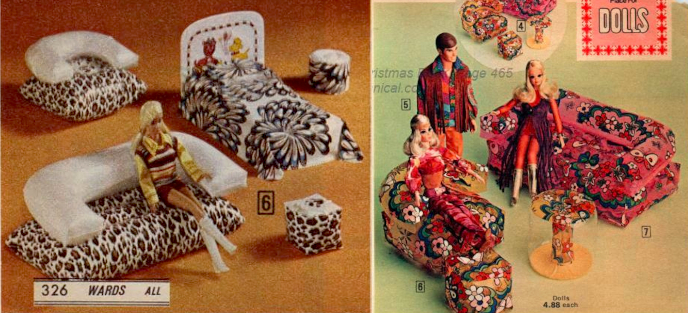
via Christmas.musetechnical.com, Puff ‘N’ Play sets in the ’71 JC Penney Christmas catalog (R) and ’75 Montgomery Ward. At the height of the festivities in 1977, JC Penney offered three “houses,” each consisting of one room full of inflatable furniture.
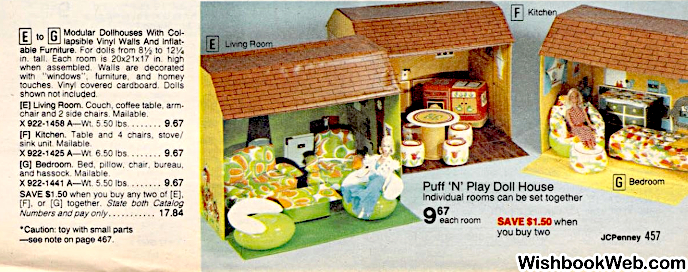
’77 JC Penney catalog via WishbookWeb. These sets were available throughout the decade, at least from ’71-’79 and probably beyond. The patterns were ever-changing, so there’s sure to be a set to suit almost any ’70s interior.
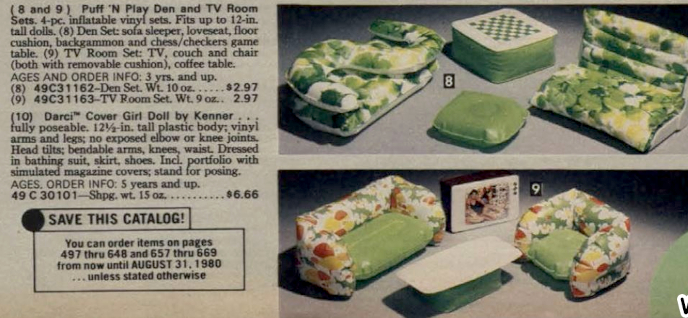
’79 Sears Wishbook, again via WishbookWeb. Kitchens by Martin Fuchs
Since we covered a different Martin Fuchs room on a previous outing, let’s pause to appreciate the kitchens. Imported from West Germany, in the US they were sold as Montgomery Ward exclusives. A variety of colorways were offered and can be found in the wild today. The following images all come from Christmas.musetechnical.com, our trusted source for Montgomery Ward catalog scans.
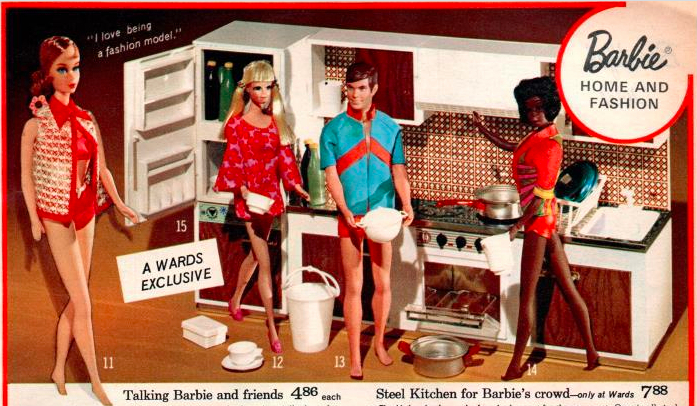
From the 1971 Montgomerty Ward Christmas catalog We hit the ground running with this Steel Kitchen in 1971; by ’72 the kitchen was folding, and “a great place for the young set to congregate.”
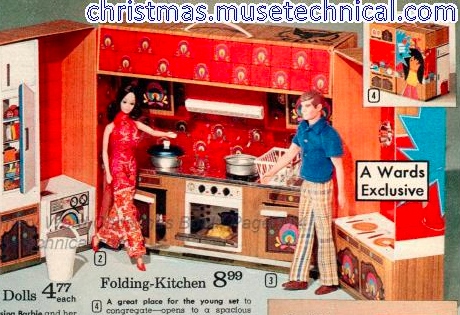
1972 Throughout the decade, Fuchs offered kitchen makeovers for Barbie almost yearly–the suburban dream in 1960, perhaps just a bit passe by the ’70s.
By ’74 we’re growing facial hair in a “Big new kitchen” with “Florentine design” on its walls. It no longer folds.
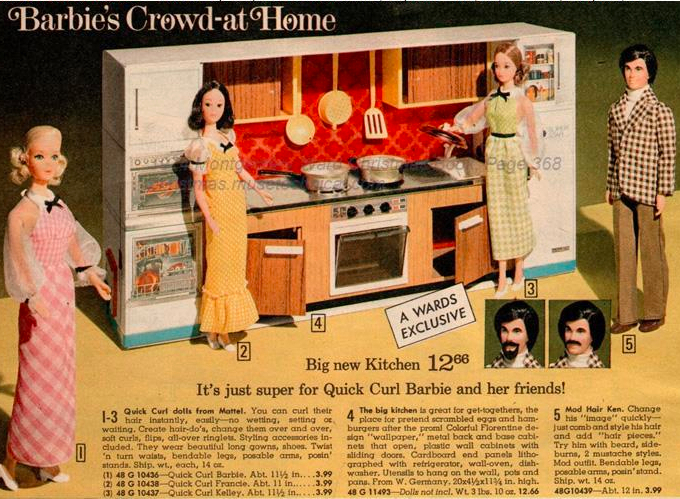
1974 In ’75, below left, “the kitchen is where teens gather,” and by ’76 it’s clear Barbie is matching her fashion to her kitchen decor.
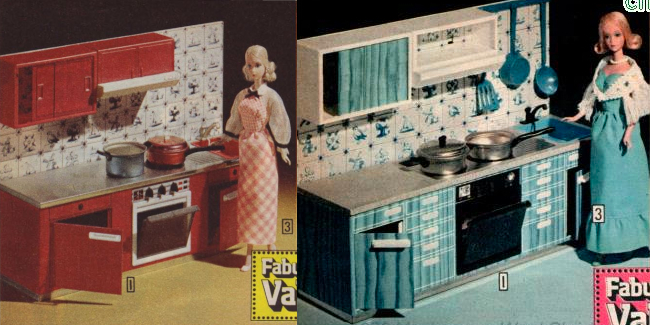
1975-76 ’77’s set, while restrained, could really make the right colorful cookware pop.
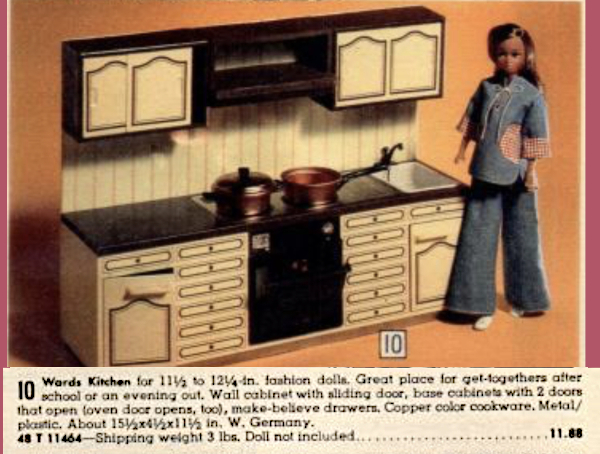
1977 Sears Kitchens (1979)
Finally, we’ll toss in this Tabletop Kitchen Center from 1979, advertised in the Sears Wishbook alongside some of the uglier Puff ‘n’ Play furniture.
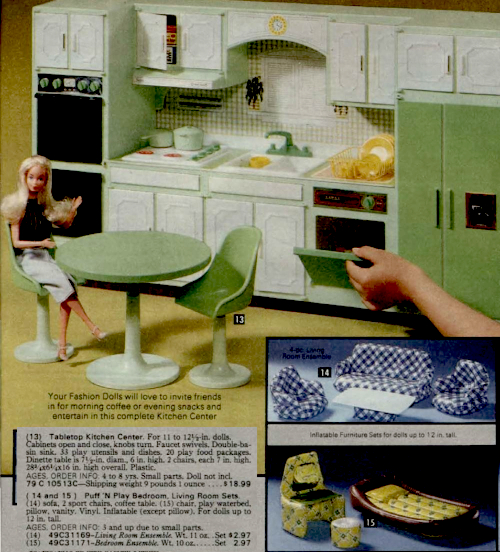
1979 Sears Wishbook via WishbookWeb This set may have been manufactured by Wolverine–it’s at least highly similar to one with an orange/brown/cream color scheme sold under Wolverine’s Sunny Suzy label. In the advertised avocado shade shown here, these appliances and the tulip table and chairs make a worthy addition to your midcentury Barbie home.
But be wary of this more-common, less-stylish Sears kitchen which is also dated 1979, with its lawn-appropriate chairs and diminished fridge.
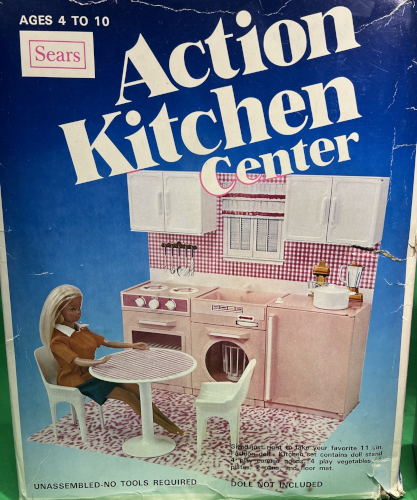
Product packaging via crown_point_toys on eBay. This particular example was marked $7.99 retail, compared to the advertised price of $18.99 for the avocado green set; a satisfactory explanation for the relative commonness of this wallet-friendly offering.
Where to next? This is our most recent post on Barbie’s built environment, possibly forever! Important 70s-room addenda are found in the entries on the Karousel Kitchen, bathrooms, and carrying cases. Way back in the ’60s, rooms and furniture also included the Deluxe Reading Dream Kitchen, Go-Together sets and Susy Goose furniture. You can always head up to the Table of Contents to check out other options.
-
Visions of Midge
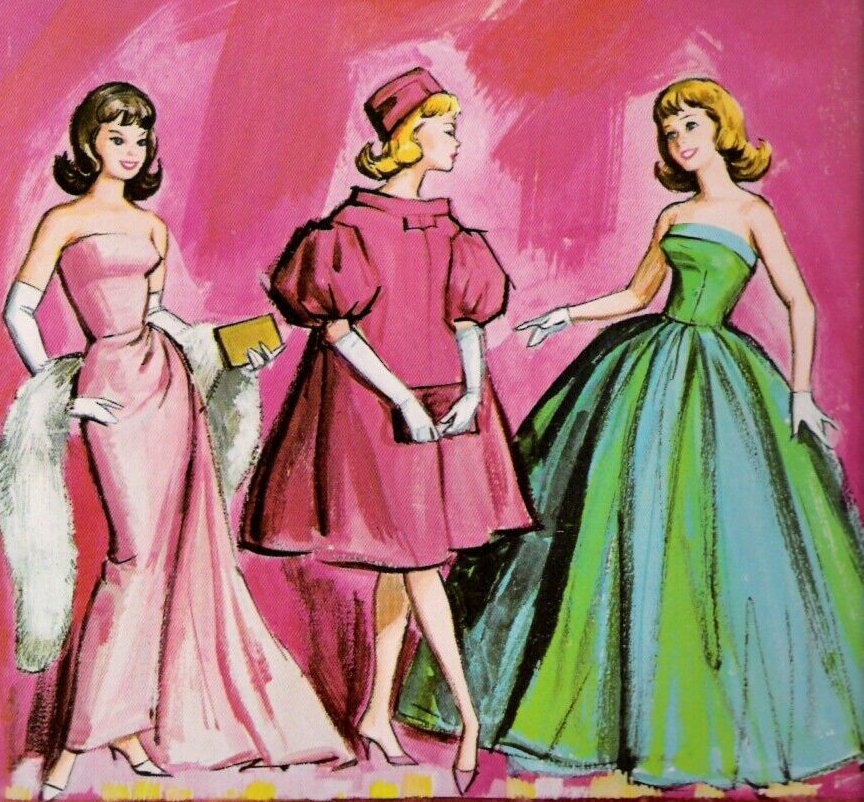
Midges adorning a 1963 Whitman paper doll set 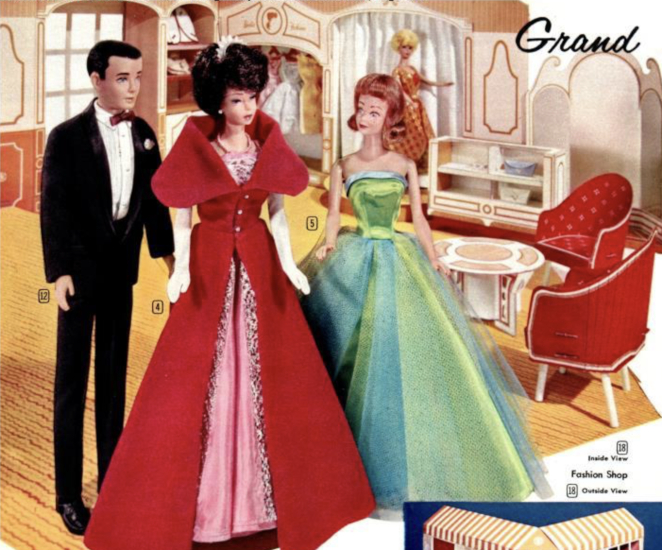
At the Fashion Shop’s grand opening in a 1963 Montgomery Ward catalog (via christmas.musetechnical.com). 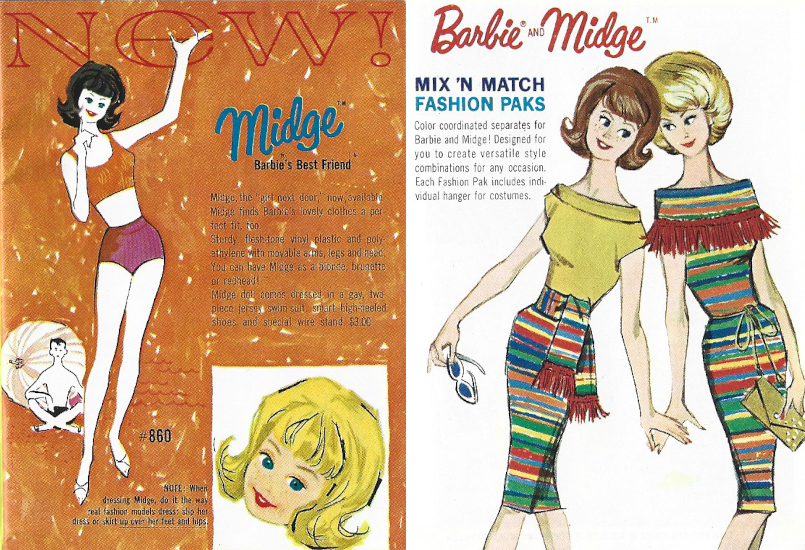
Midge introduced in the 1962-dated Barbie, Ken and Midge booklets 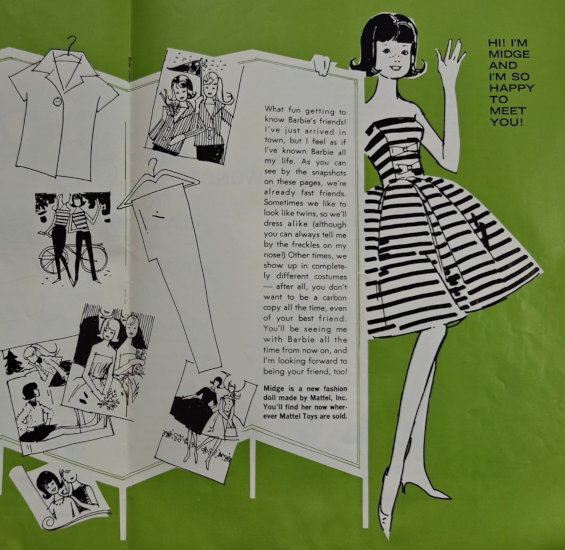
Precious little inset “photos” in Midge’s 1963 Barbie Magazine debut, via jcschneider06 on ebay 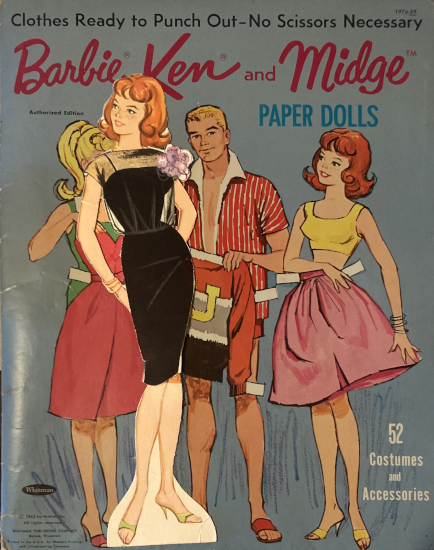
Stealing the spotlight in ’63 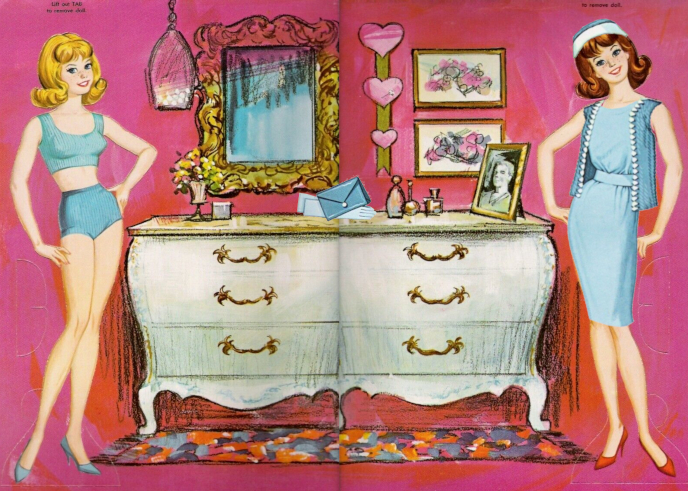
from a solo Whitman paper doll outing, also 1963. 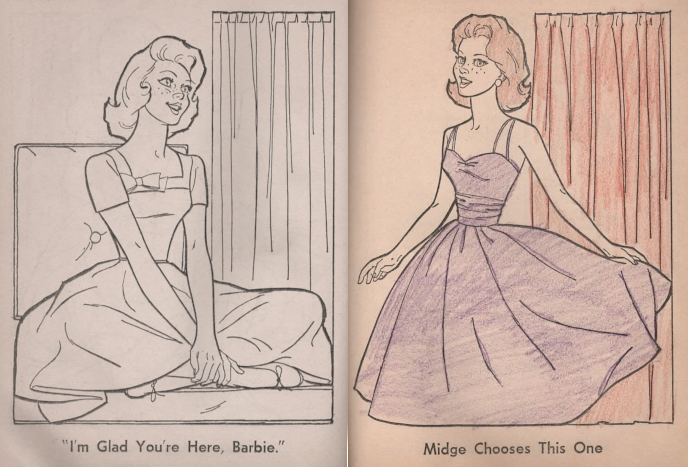
Whitman coloring book of the same year 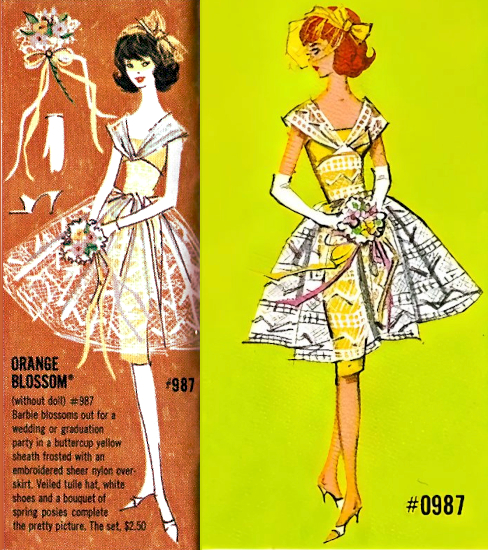
Elegant in Orange Blossom in booklets dated ’62 and ’63 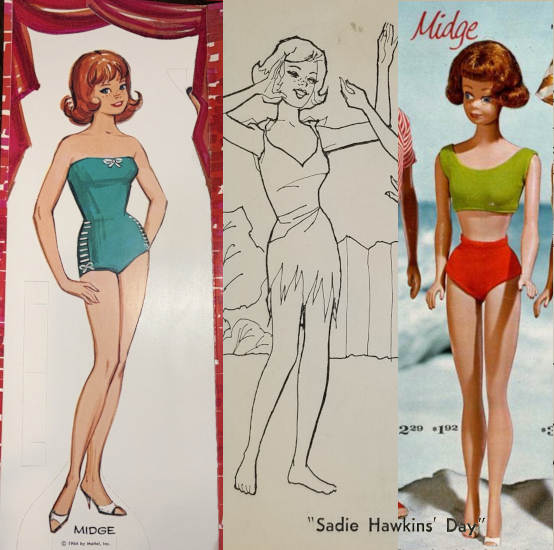
Boudoir to beach, ’64, ’64 and ’63. 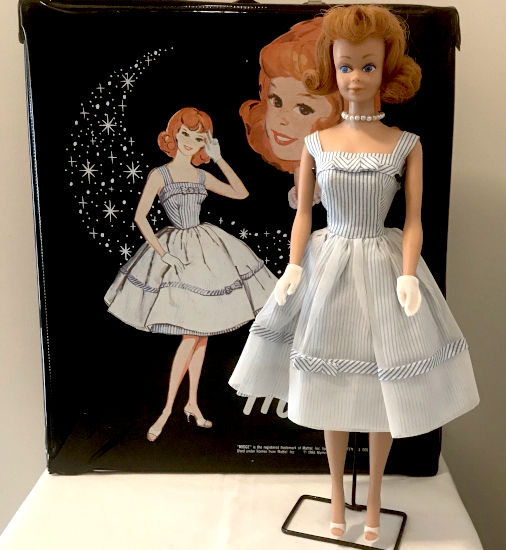
’64 case with doll to match via kase-5974 on ebay. 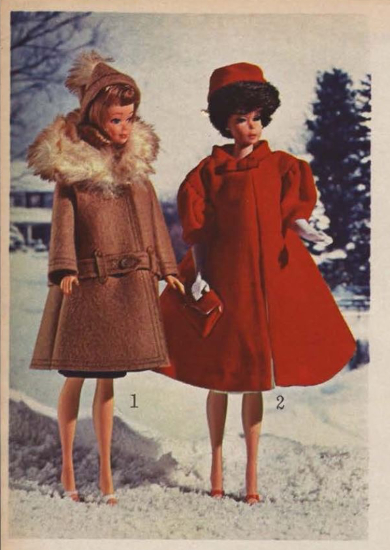
’64 Sears catalog via Wishbook Web. Look at those open-toed shoes in the snow! 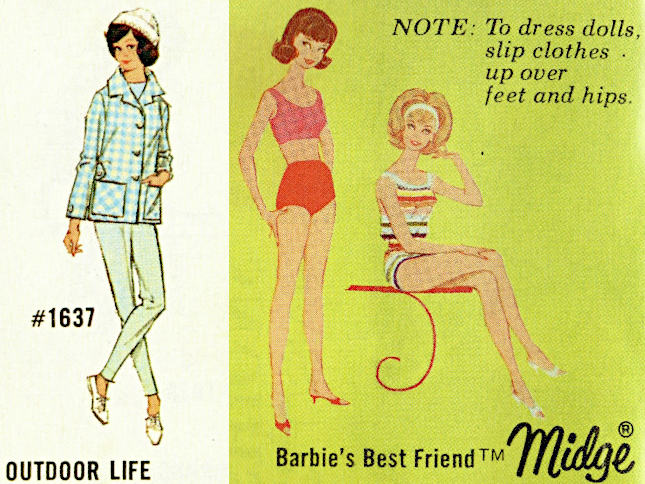
The booklets’ style evolved over time; see more Midge-y examples here. 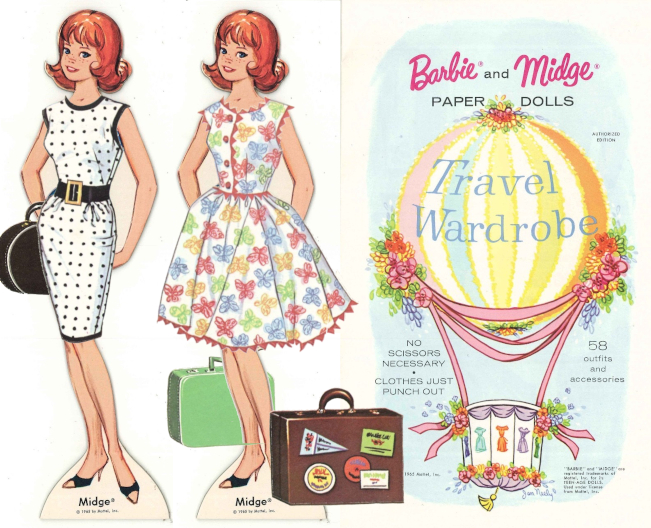
The ’65 paper doll sets maintained Midge’s classic appearance–example via Arlene’s Vintage Paper Dolls 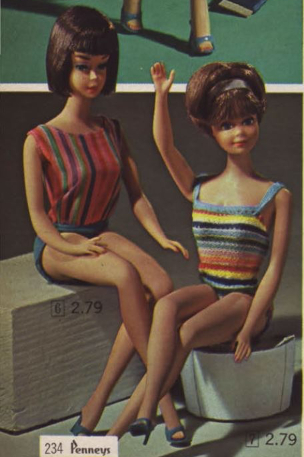
’66 Penney catalog 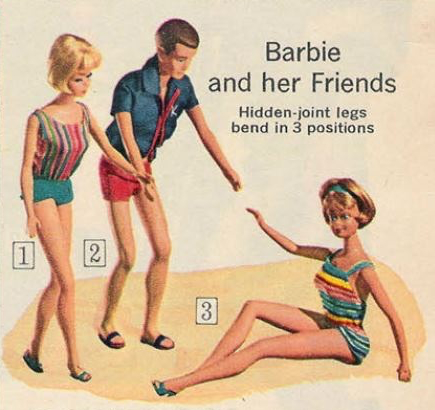
and here’s Sears… did she fall over!? 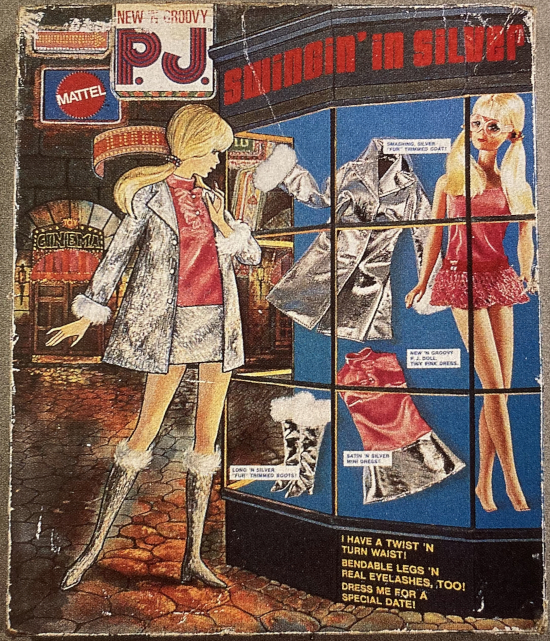
PJ, from 1970, is sort of Midge. She’s like when Maddy moved to Twin Peaks, right down to the big ol glasses. Her face was subsequently swapped, and that new face that we all call Steffie would eventually be used for Midge’s circa-1990 revival, about half the time. 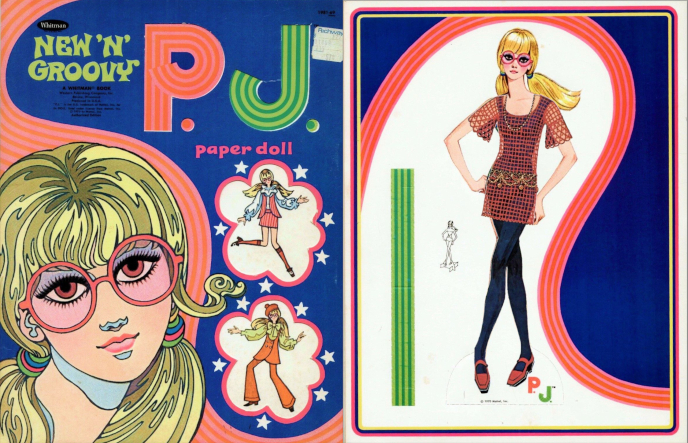
There were at least five solo PJ paper doll sets between 1970 and 1972. That’s not counting World of Barbie and others with multiple characters. 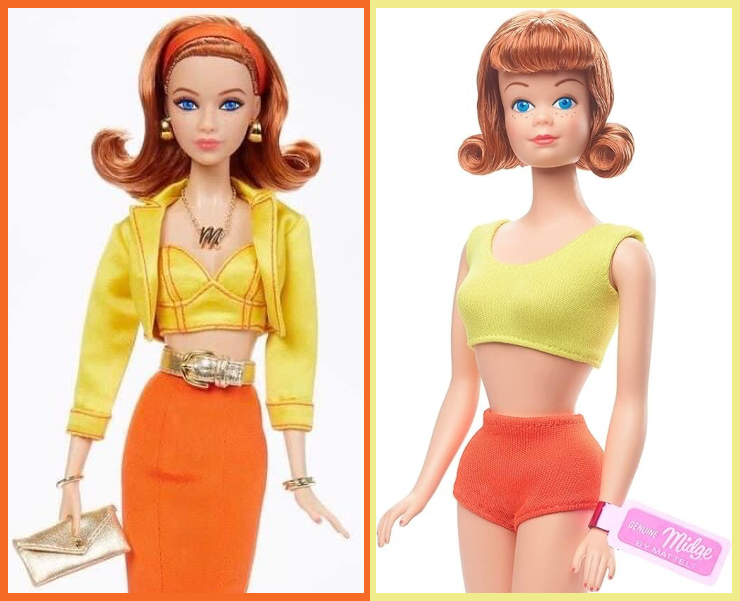
Re: Midge revivals, here are two Mattel promo photos for releases occasioned by her 60th anniversary in 2023: a one-of-a-kind doll designed by Bill Greening for a charity auction; and a nostalgic silkstone release for the rest of us. Signing off,
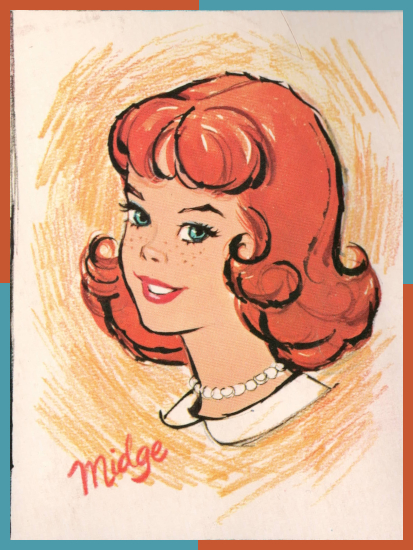
Where to next? This is our only entry focused solely on Midge, but you can spot other Midge renderings in picture books, in comic books, and on the packaging of dolls and fashions. Past Visions were of the ensembles After Five and Solo in the Spotlight. Or head to the Table of Contents for more options.
-
Barbie-sized Mannequins & Dressforms (1963-73)
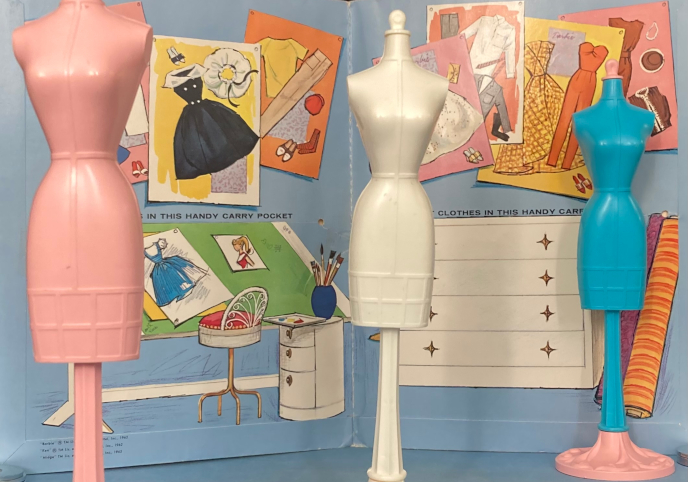
Ever feel like displaying your vintage and nostalgic doll fashions on something besides the dolls themselves? If so, the vintage Barbie era had a range of interesting options to do so. In fact, the boxed doll fashions were lovely displays all by themselves, and many collectors recreate this aesthetic with their own frame boxes; but today we’re thinking of something more figural, freestanding.
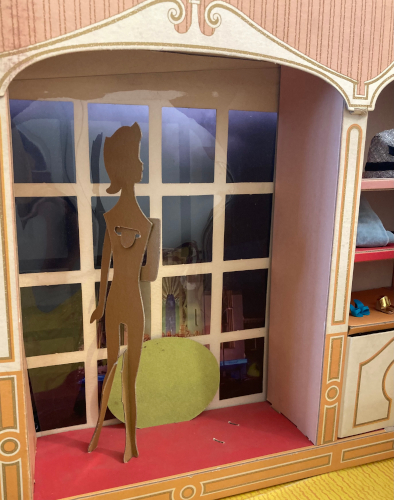
The first Mattel offering in this category must have been the mannequin sold with the Fashion Shop starting in 1963, with its clean, deceptively simple design. The figure is cut from chipboard in two pieces: the main body, plus a removable pair of arms instrumental for maneuvering long-sleeved tops onto this otherwise inflexible figure. As we’ll see, the Fashion Shop mannequin is unique in this category for its ability to wear pants. Tabs on the figure’s feet slot into spaces in the floor of the shop window–two such positions for the single included mannequin, but luckily it’s not too hard to make or purchase extra pieces–and stability is cleverly provided by a crease in the lower leg that lends dimension and sturdiness to the figure base.
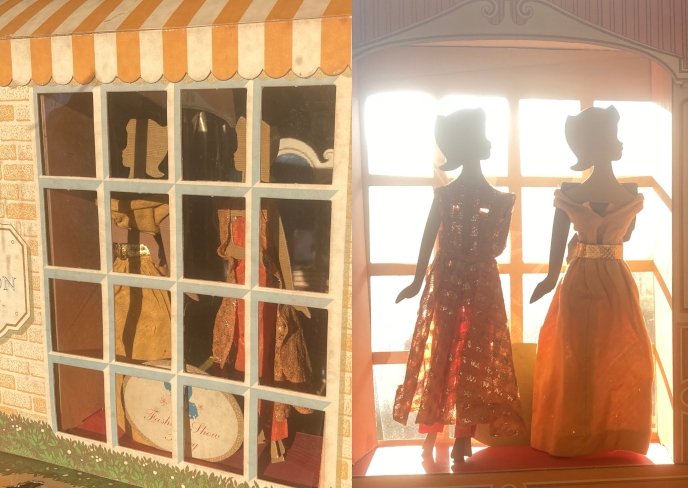
Mattel could have given the mannequin, like other chipboard pieces in the play set, detail through screening; perhaps rendering a face, hair color, skin tone… but bare chipboard is very effective at differentiating this lifeless piece of scenery from the doll characters populating the world around it.
Barbie went shopping next in 1971 at the Unique Boutique, with a fresh riff on the store mannequin: a narrow stand topped by the bust of a cartoonish character, similar in style to a paper doll. This version lacks qualities that so disarmed us in the Fashion Shop: the face and hair are stylized but lively and fairly detailed, unlike the featureless slate of the Fashion Shop mannequins; and while you maybe could swing a pair of pants from this frame, hanger-style, it doesn’t don them. Still, the Barbie-like illustration is charming, very 1970.
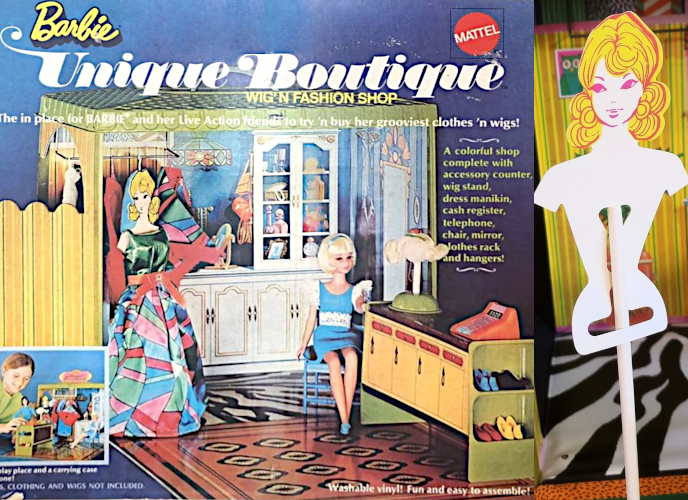
Via Pinterest, the Unique Boutique store mannequin displays Rainbow Wraps on the product packaging at left. At right, via Worthpoint, a closeup of the mannequin declothed. Screened onto the Unique Boutique walls are other, headless interpretations of the store mannequin, bringing us closer to the orbit of the dress form.
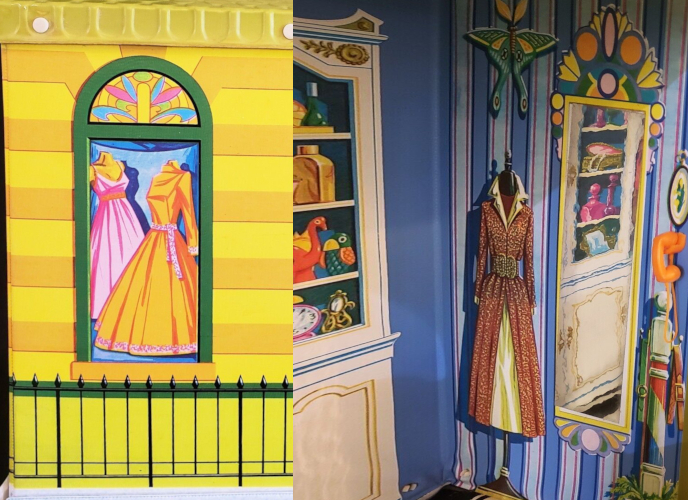
Close kin of the store mannequins, Barbie’s dress forms were sold with crafting kits, used for constructing and/or decorating garments off the doll. The first Mattel dress forms arrived in ’66 with the Color Magic Fashion Designer set. One variant was blue trimmed in pink, the other pink trimmed in blue. Both appear in contemporary advertising materials and can be found in the wild today (find examples at the top of this post).
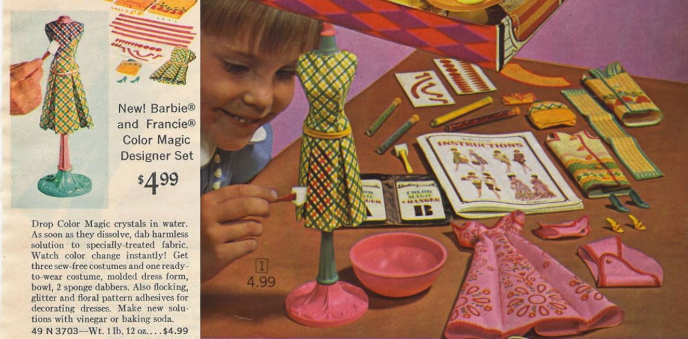
The Color Magic dress form was pink with a blue base in the Sears Wishbook at left and blue with pink base in the JC Penney one, both from 1966. The mold was reused for an all-white form bundled with the Sew Magic kit in the 70s (and also pictured at the top of this page). Of all the dressforms and mannequins discussed herein, these are probably the most common today.
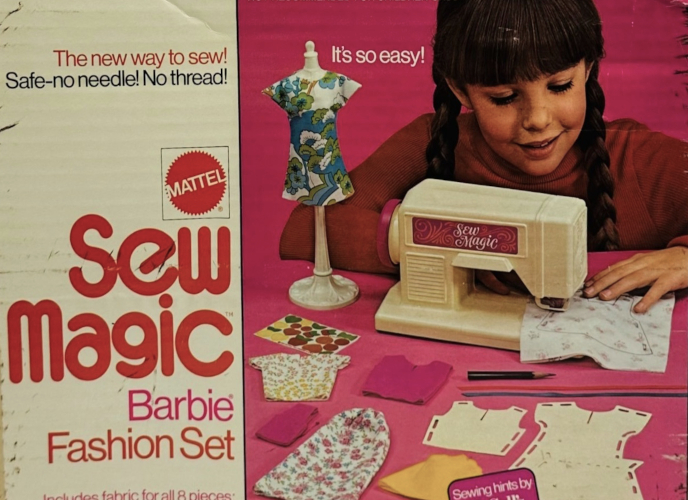
1973 Sew Magic packaging via Pink Paris Flamingo on ebay Offbrand Barbie-sized mannequins and dressforms are fair game for this blog, but I found none in the period 1959-1975. A word of caution to other seekers: don’t fall for the Little Charmer Dress Designing Kit, which advertised a 12″ tall dressform without mentioning what size doll corresponded. This dressform is enormous compared to Barbie, and even compared to her larger rival Tammy.
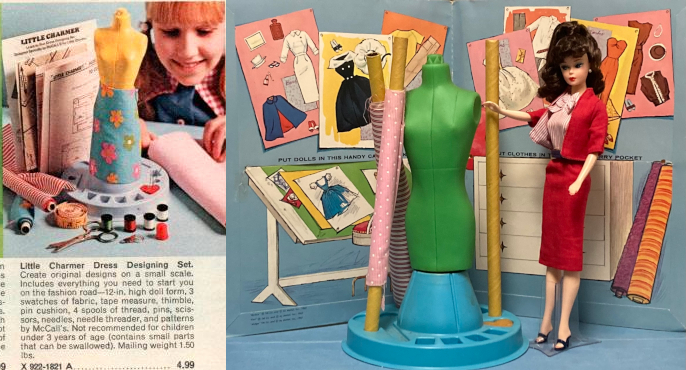
Expectation vs. reality: the Little Charmer doll form in a ’72 JC Penney catalog (L) and looming large beside the Busy Gal Barbie reproduction. The form came in at least three colors. While our focus is vintage collecting, mannequins and dressforms themselves haven’t evolved too much over time, and newer pieces may also suit our vintage displays. Duly noted, we won’t dwell on these.
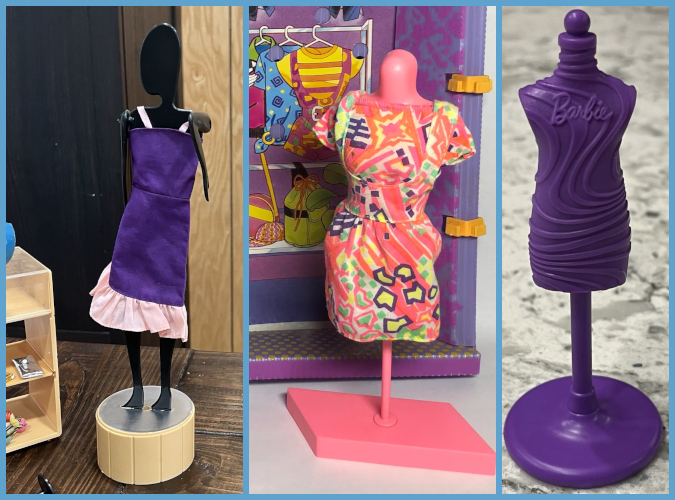
L-R: Mannequins from 1983 Sears Fashion shop and 1991 Barbie Fashion Mall; unidentified Y2K-look Barbie mannequin. From sellers on ebay, Etsy, ebay. Where to next? This post is about Barbie’s early environs, and specifically early furniture. The next-most recent furniture post on this site is about the Japan-exclusive furniture of 1967; the most popular is about Mattel Modern and Susy Goose, while the most popular overall post is about vintage Barbie shoes. Find backdrops for your vintage and nostalgic Barbie dioramas in the Go-Together furniture sets, the built environments of vintage Barbie paper dolls, and the Lively Livin’ House. Or head up the table of contents to see more options.
-
Sew Free? Sew Magic? Sew Simple? Cut and Sew??
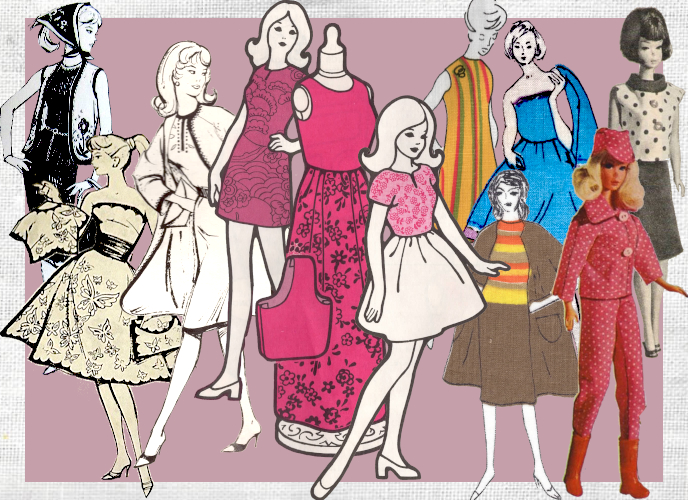
Today we tackle the great mysteries of vintage Barbie collecting, to wit:
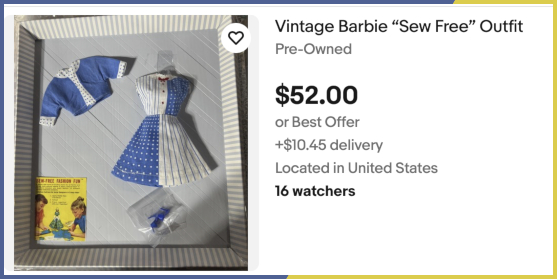
Is the below a Vintage Barbie “Sew Free” Outfit?
What about these, are they Vintage Mattel Sew Free Sew Magic Barbie Doll Clothes 1960s Very Rare?
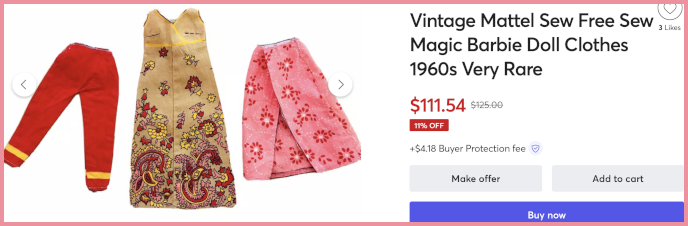
No, and also no. So what are they? How can one tell? And what do all these terms mean? If you’re not sure but curious, read on!
Sew-Free: Sew-Free Fashion Fun Kits were a kids’ craft sold by Mattel around 1965-1966. Garment pieces were printed on a variety of fabrics, to be cut out and assembled by children using included adhesive strips. It’s Sew-Free because no sewing is required. While printing was an important aspect of the Sew-Free style, both to define the garment shapes and for decorative elements (and possibly to prevent fraying, as well), the kits also contained many other details including zippers, buttons, trims, and stickers to enhance the fashions; shoes, belts, and purses–sometimes matching fabric purses to assemble–completed the looks.
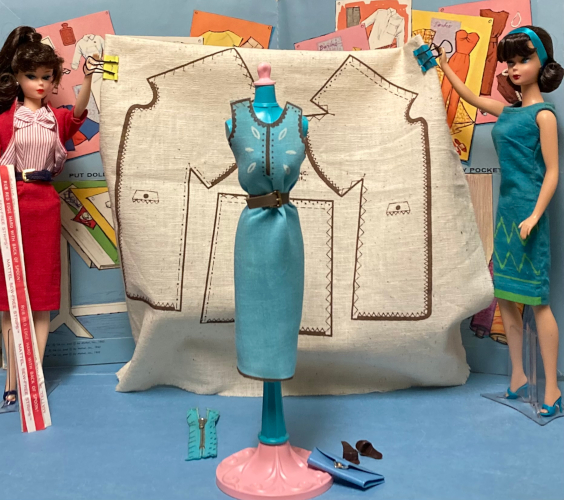
It’s pretty easy to know when you’re looking at a Sew-Free ensemble, even if some of those extra details have been lost over time: only fifteen outfits or sets exist, so if you have one of these, you have a Sew-Free Fashion.
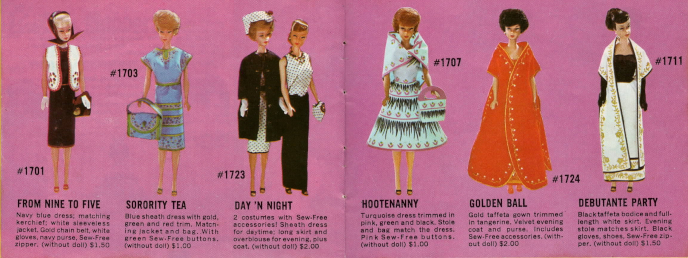
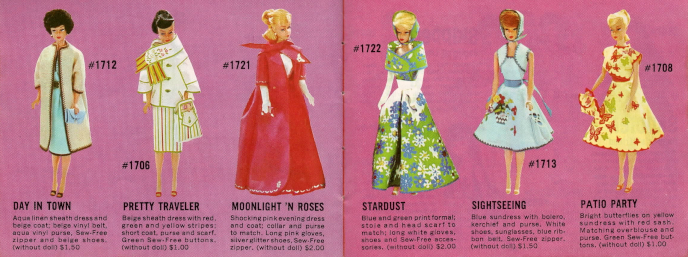
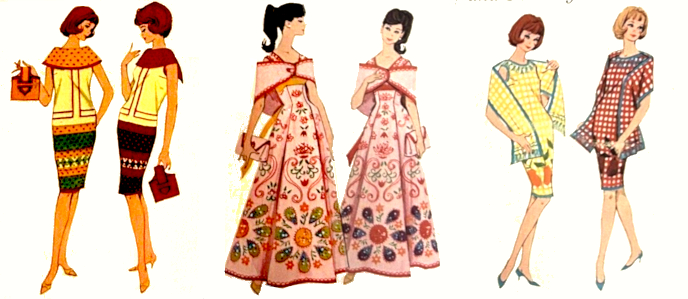
The last row are from the Color Magic Fashion Designer set. “Sew Free Color Magic” sounds almost like the word salad “Sew Free Sew Magic” listing title that kicked off this post, but it’s legit.
Around this time, a few play sets–Skipper’s Go-Together Bedroom and Dream Room; Barbie’s Dream Kitchen–included “Sew-Free” curtains, linens and the like. The Dream Kitchen’s apron, below via Red Stick Retro, counts as one last Sew-Free wearable piece.
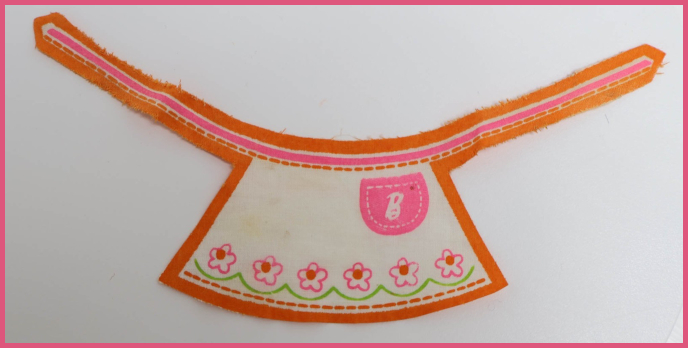
If your fashion is none of the above, it’s not Sew-Free. Simple as that!
Sew Magic: Mattel revisited the Sew-Free concept in 1973 with modifications. This time around, there was no bespoke textile printing; just ordinary fabric swatches and paper pattern pieces. And there were no adhesive strips: instead, the Sew Magic “sewing” machine, a sort of standing glue gun, deposited adhesive onto fabric pieces guided by the user, who then pressed the fabric pieces together along the glue lines.
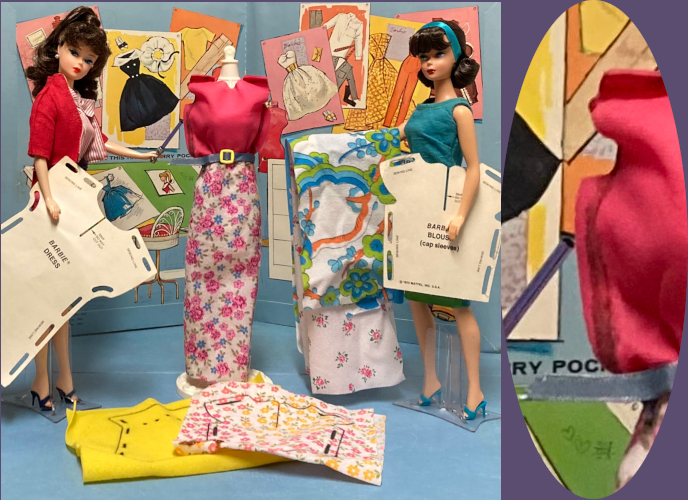
Without the uniquely printed designs of Sew-Free, Sew Magic fashions are less obvious to identify. What’s more, the Sew Magic instructions specifically say to use your own fabric as well as the provided swatches, so the finished product can look any kind of way. The signature feature of the Sew Magic garment, therefore, is that it’s glued together–for an example, see the glued seams on the inside-out shirt that the fashion-designing Barbies have on display above.
On the selling platforms, clothing pieces listed as Sew Magic are very seldom genuine Sew Magic–with the exception of those constructed pieces that come bundled in with the larger Sew Magic machines and kits. If you see clothing lots or individual pieces labeled as Sew Magic being sold without a craft kit, in my experience, they are rarely glued together, are nearly always sewn with thread, and they are nearly always Cut ‘n’ Sew. Which brings us to…
Cut & Sew: Neither licensed nor official Mattel products, Cut and Sew panels were sold at fabric stores, cut from bolts, with Barbie’s usually labeled as being for 11″-12″ fashion dolls. (Skipper-sized and Ken-sized dolls had their own Cut & Sew panels.) They are undated and absent from department store and doll catalogs, but I reckon them to about 1966: their aesthetics resemble the Sew-Free line, and the 11″-12″ range may imply the coexistence of Francie and Tammy.
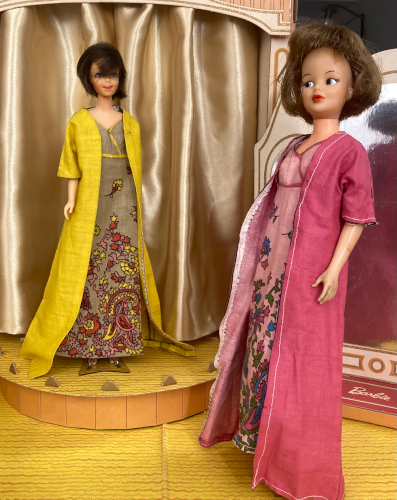
Candidly, Casey is swimming in this; but it cuts an elegant silhouette for the photograph! Cut and sew panels were made of craft cotton with outfit pieces, instructions, and fun little fashion illustrations printed on. They didn’t come with any embellishments or accessories, so elements like closures and thread color (matching, contrasting or somewhere in between) were at the crafter’s discretion. Whereas Sew-Free Fashions incorporated velvety and satiny materials alongside their cottons, Cut and Sew was limited to a single texture. And because garments of multiple hues were printed onto a single panel, the fabric itself had to be white; the outfits’ colors were entirely screened on–in contrast to Sew-Free and Sew Magic made from dyed textiles.
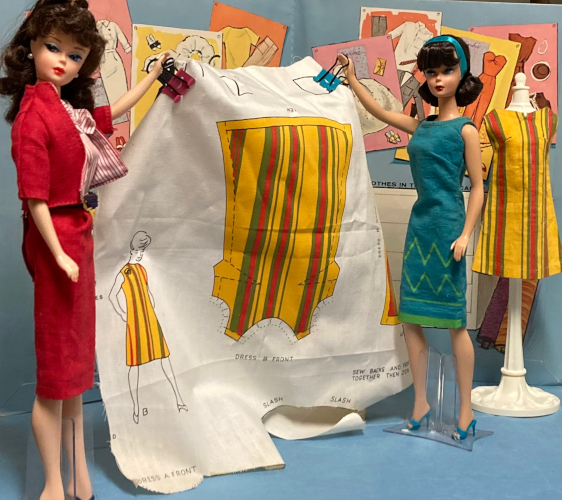
Many of the Cut & Sew designs are quite cute. However, the finished products inhabit a gray area between doll fashion and simple crafting project. They long for buttons and trim, for linings, and to not be made of basic cotton. The evening attire worn by Tammy and Casey above, in particular, could read as casual Seventies maxi dresses and house coats if you didn’t know better. Some others resemble a toile made from bedsheets.
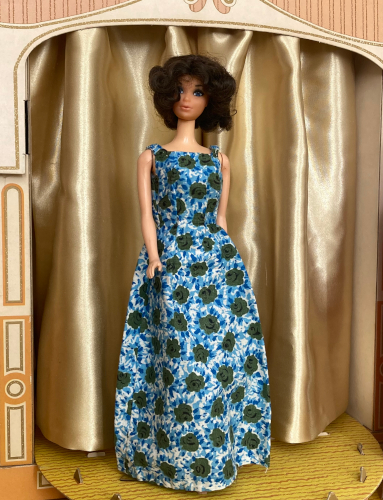
(Kelley’s mussed hair isn’t helping the situation) Panels were offered for many categories of attire: Daywear, Eveningwear, Sportswear, Streetwear, Beachwear, Nightwear, and a couple catch-all “Wardrobe” panels. All designs came in multiple colorways. Let’s meander through outfits and color combos drawn from my collection, as well as some foraged from a recent search of sales.
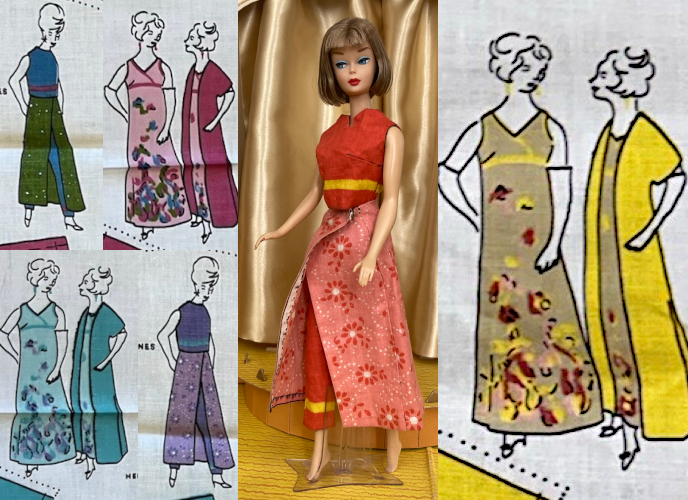
We saw quite a bit of Eveningwear already, modeled by Tammy, Casey, and Kelley above. One Eveningwear panel included two looks in three possible colorways, the first look being the long dress with coat and the second a sort of baffling hostess pyjama or patio ensemble.
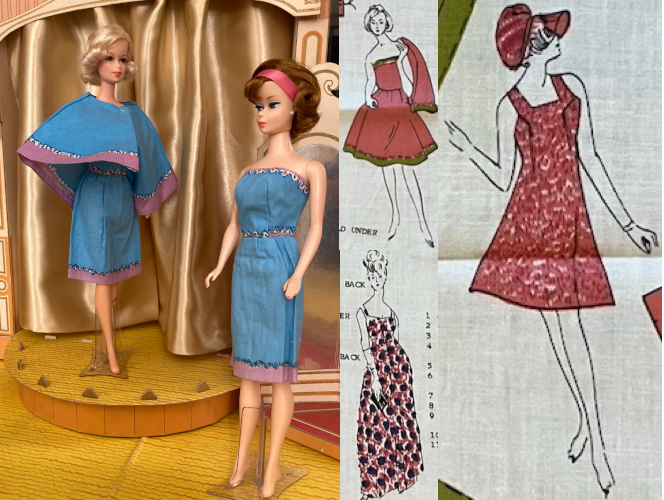
A second eveningwear panel type consisted of three looks in two colorways, including the “toile” we already saw and an interesting cocktail dress with cape. The third look is just mystifying, apparently a sundress and bonnet for evening.
The Daywear collections contain some of the best Cut ‘n’ Sew designs. There was one set of three looks in three colorways, and a second with two looks in (as far as I know) two colorways.
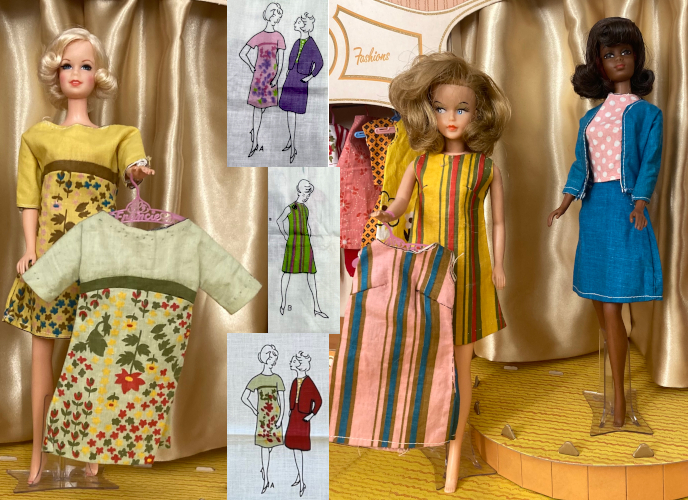
The suit worn by Julia and the shifts worn by Stacey and held by Tressy formed one trio. The shifts worn by Tressy and held by Stacey, along with the illustrated red suit, form another; the third trio is shown above, top center, as illustrations. 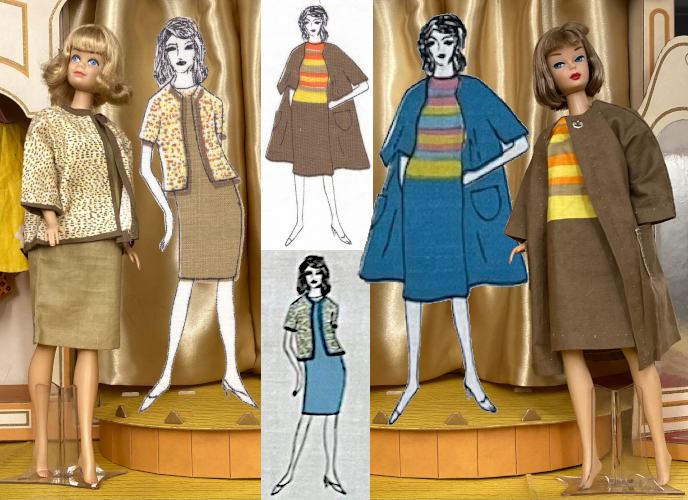
This second offering for day had more consistent colorways: the brown-forward outfits worn by Barbie and Midge are one set, the two teal outfits a second. Sportswear was similarly offered in three colorways for one panel, and (evidently) two colorways for the second.
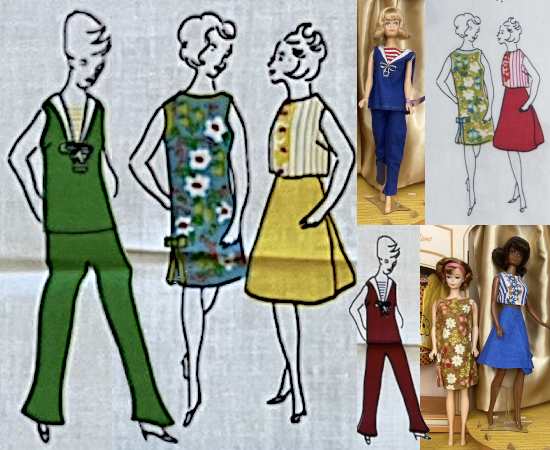
Skirts were a bigger part of sports back then, as were capes, it appears:
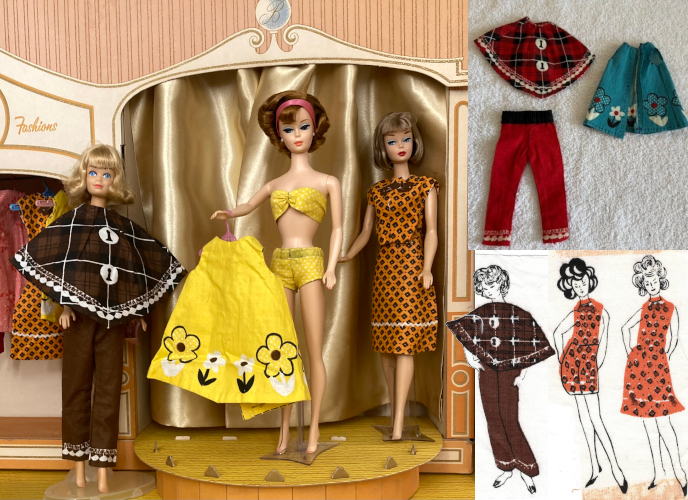
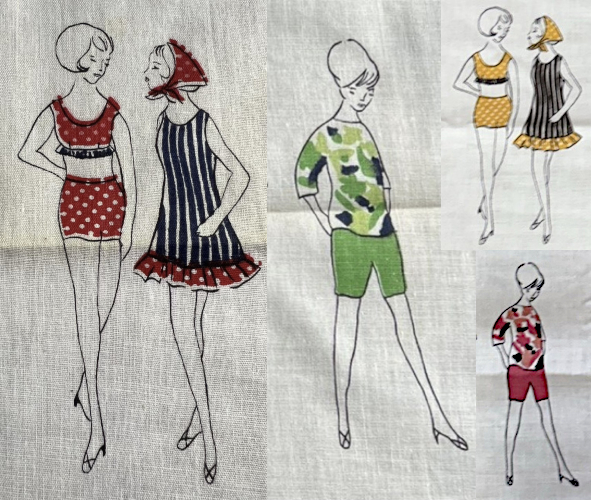
Barbie’s swimsuit top came with straps, but they’re really tiny and proved challenging for the original owner of my set (and others!) to sew. The second figure illustrated in the orange-y set models bloomers. Top right image via eBay. That panel version’s bloomers combo was in green. Up to this point, one panel version in each clothing category has been available in three colorings. If you’ve paid attention to the little illustrations, you’ve probably noticed the same three figures appear on all of these panels: the character with bouffant hair facing the viewer’s right, and the two characters with chin-length hairstyles standing grouped together, each with one arm bent to the outside. To my knowledge, there are just two colorways of the below Nightwear panel design, but based on the trend so far it’s likely there’s a third color combo I just haven’t encountered.
Here’s the Streetwear set sketched in one colorway and constructed in a second. Again, there’s likely to be a third combination out there somewhere, based on these sketched figures being the same ones from all the panels that have had three variations.
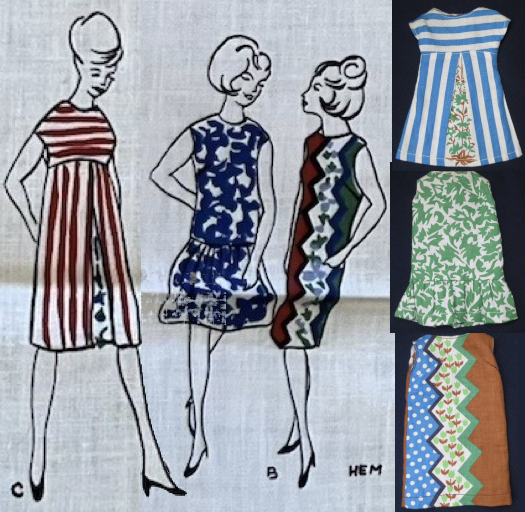
“Streetwear” appears to mean “sleeveless shift” in this context. To my eye, these styles suggest the second half of the ’60s. I’m also aware of one panel design for Beachwear in two colorways, but yet again, a third colorway may exist.
Finally, the Wardrobe panel for 11 1/2″ dolls came in at least two color schemes and consisted of an evening gown, a day dress, a bikini and coverup.
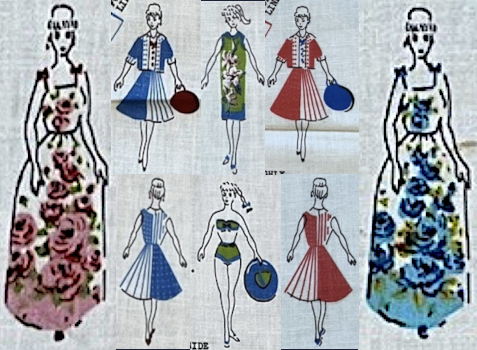
We saw the blue version of the wardrobe’s colorblocked daywear suit mislabeled as “Sew Free” at the very top of the post. Here’s the evening gown on Mercari, attributed to Premier Togs:
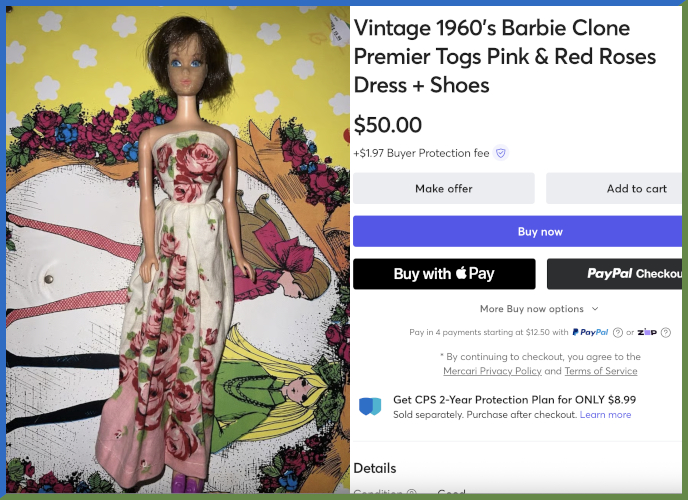
Both this pink gown version and the green beach coverup are common (far rarer is the two-piece swimsuit that the coverup covered), and both can frequently be found mislabeled as one of the Mattel craft kits.
A rarer version of the Wardrobe panel variety has silhouettes suggesting the early ’60s and characters resembling ponytails and bubble cuts. It came in at least two colorways. Here are sketches from an uncut panel and constructed pieces via three ebay users:
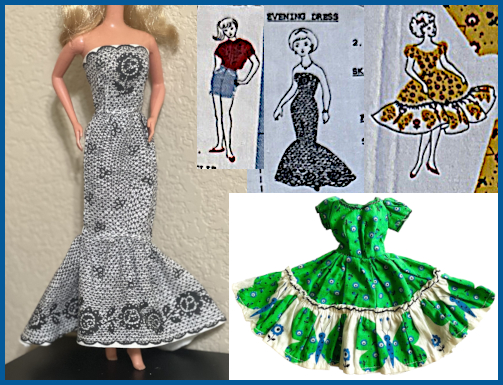
That’s the Cut and Sew line as I know it. As noted, there could be more designs and colorations than I’ve observed; there just can’t be less. For right now, let’s take a gander at one last category of vintage doll fashion/craft.
Sew Simple sets by Coats and Clark were advertised in department store catalogs for at least 10 years, starting in 1964. Whereas Mattel’s crafts freed the user from the burden of sewing but did require some pieces to be cut out, the Sew Simple innovation was pre-cut pieces that required sewing. Unlike Cut & Sew, some finishing touches were included with the sets.
From 1964 through 1967, a single Barbie-sized (and allegedly Francie-sized) set of six fashions was offered:
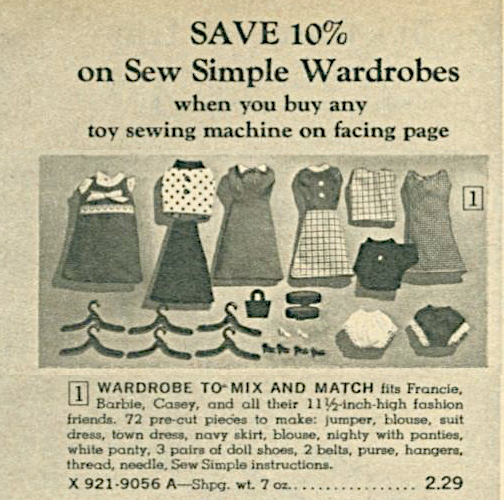
1967 JC Penney listing of the Barbie-sized Sew Simple Wardrobe The set would continue to be sold for a few years with some fabric variations. in 1968 it was joined by the Bride’s Trousseau and London Look sets, and in 1969 the sporty Sun Valley set was introduced.
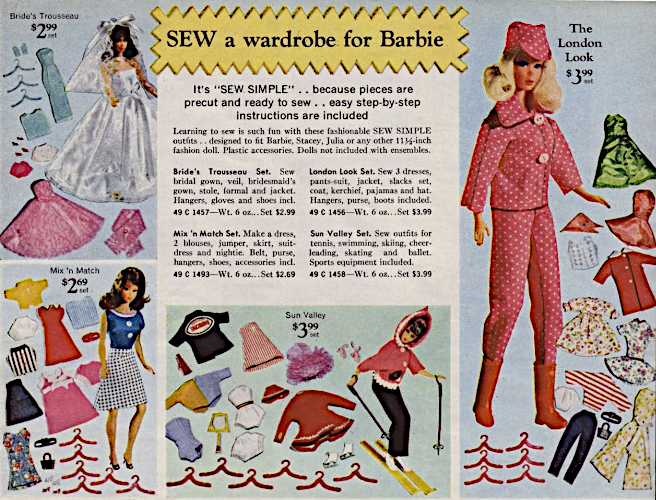
Four sets in the ’69 Sears Wishbook In the 1971 Wishbook, Sears highlighted their exclusive Barbie friend, Walking Jamie. While Barbie still modeled the trousseau (now named Wedding Bells), Jamie modeled new Merrily Mod and Snappy Separates offerings,
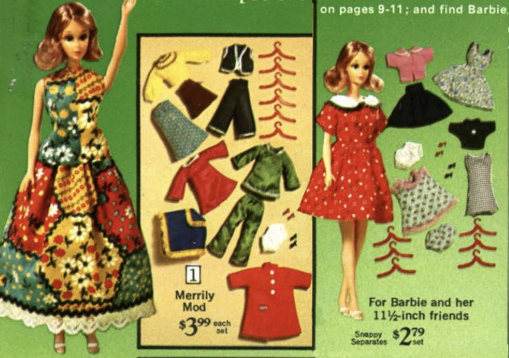
and she also modeled a Skipper-sized set which appeared to include Jamie’s own clothing:
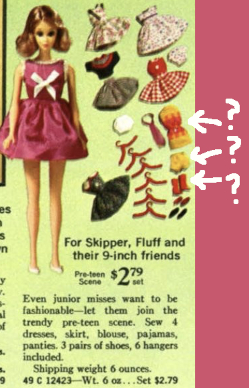
Counting the dress and shoes modeled by Jamie in the image, we can get to the listed number of garments without those that look like Jamie’s own, which seem to have been included in the spread by mistake!
But I digress. The following year, the sets Simply Super and Jet Set Trousseau (with rick-rack aplenty for Barbie’s chic high-flying lifestyle) were new.
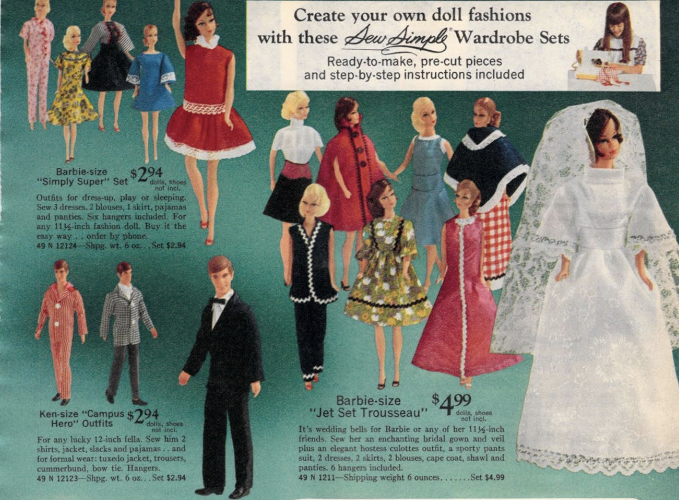
The Trousseau and Ken’s set hung on for at least one more year.
That exhausts my Sew Simple knowledge. A couple unassembled sets are floating around the selling platforms. However, I suspect other, assembled pieces are hiding in plain sight in listings labeled Premier Togs, Shillman, Sew Magic, or even Cut ‘n’ Sew. Let me know if you’ve spotted any of these!
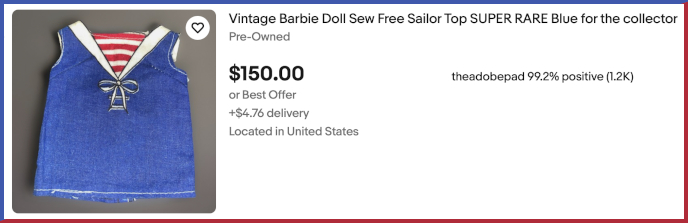
Meanwhile, who can tell me whether this is a Vintage Barbie Doll Sew Free Sailor Top SUPER RARE Blue for the collector?
-
Sidebar: for the Boudoir
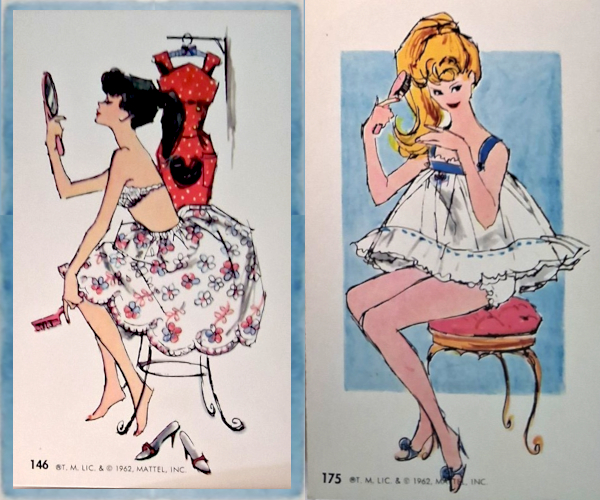
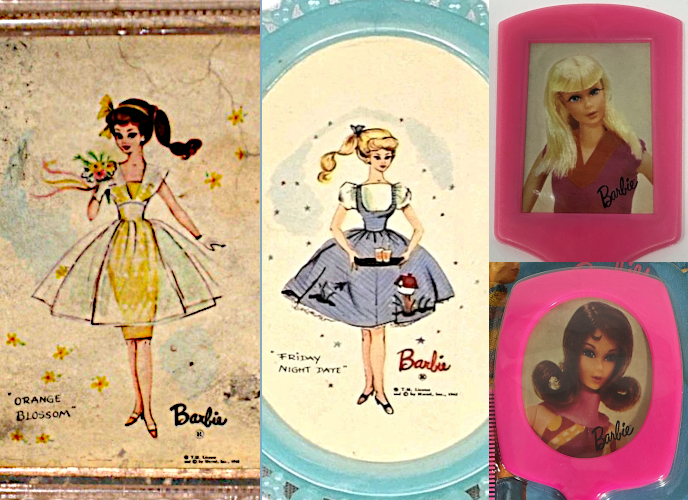
Dynamic Toys Jumbo Trading Cards via quintesscaboo on eBay In the ’60s, Mattel licensed charming illustrations to makers of beauty routine implements for children. Like Barbie, kids could preen in their handmirror, comb their silken locks, apply powders and perfumes–all with Barbie-branded tools.
Here’s the case from a Barbie Beauty Kit, (c) 1961.
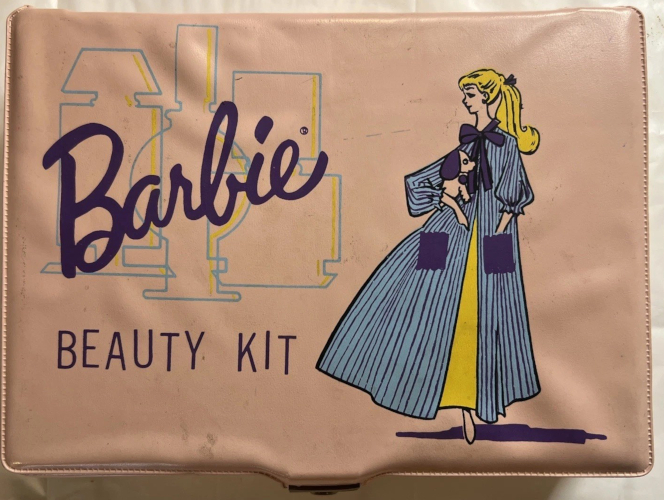
source: vintageodds2ends on eBay What did it contain? Most examples I’ve seen were found empty; this one was full of rollers and hair pins, but those may not have been the original contents–the cosmetics bottles outlined behind the Barbie logo imply they were not.
It’s possible the cases were filled with Roclar bath and beauty products, which also have the 1961 (c) but employ a different art style, comparable to Barbie Sings!— also from ’61.
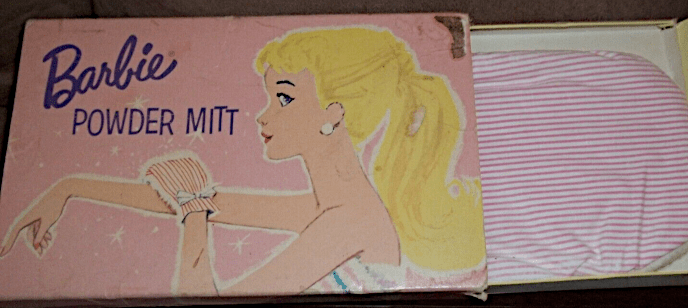
Roclar Barbie Powder Mitt via stinkbomba on eBay (Yes… bath products from stinkbomba.)
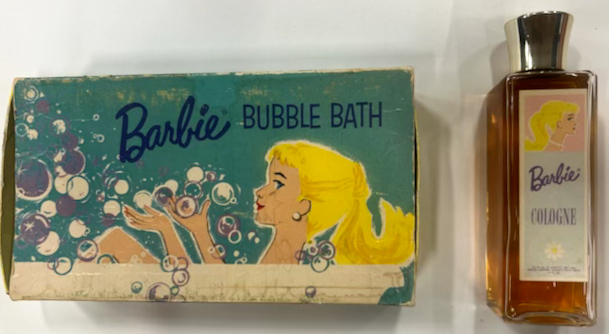
Roclar Barbie bubble bath and cologne via yocumii23 on eBay Products were also offered for haircare. In ’62, the Christmas catalogs advertised 3-piece comb, mirror and hairbrush vanity sets adorned with Barbie illustrations.
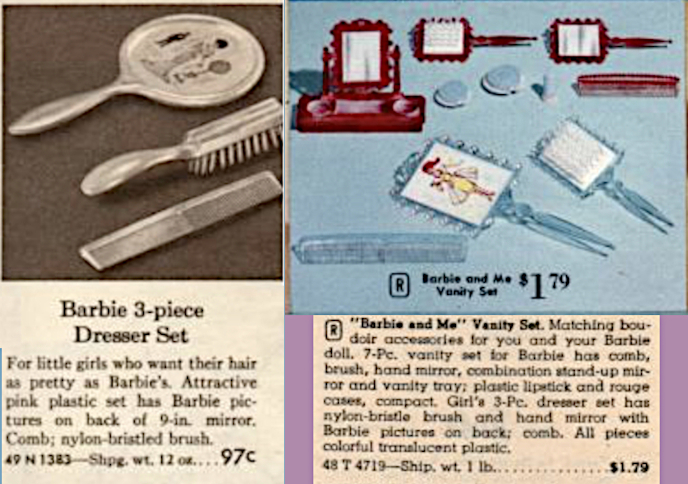
All catalog excerpts herein via christmas.musetechnical.com These appear to be the “Pretty Up TIme” boxed sets manufactured by Pyroxoloid, which bore a couple different copyright dates from at least ’62-’64. The Sears catalog, above left, likely shows an older version: the mirror is round with smooth edges; the brush lacks ornamentation. In addition to the Enchanted Evening (1960-63) version in the catalog, Silken Flame (1960-61) and Golden Girl (1959-62) versions also existed.
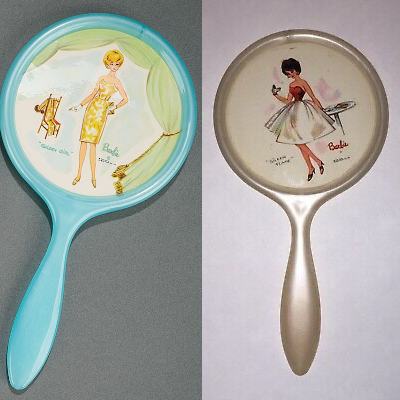
via Facebook and Theriault’s. The updated set with illustrations on both mirror and brush, like Ward’s version above right featuring Barbie in Orange Blossom (which has also been spotted in the wild), appears to be more common. In addition to Orange Blossom (1961-64) we’ve peeped sets for Bride’s Dream (1963-65), Friday Nite Date (1960-64), Ballerina (1961-65), and Let’s Dance (1960-62).
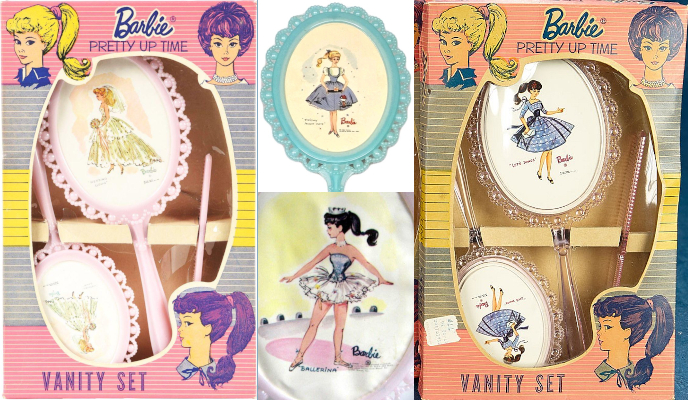
Pretty Up Time vanity sets via invaluable.com, eBay, Worthpoint, and Theriault’s. The following year Ward’s listed a much more involved “Glamour Cosmetics” set consisting of an assortment of makeup and cleansers.
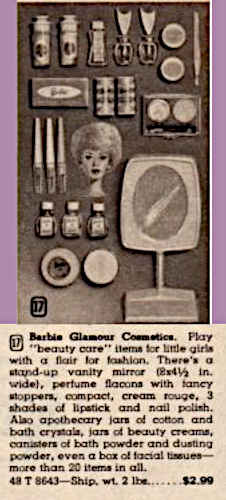
This could be the mysterious Beauty Kit from ’61, or more Roclar products, or perhaps another manufacturer got involved–the pictured packaging isn’t recognizable. If the catalog listing is accurate, these were cute (love the swooshy perfume bottle stoppers!) but not illustrated.
Pyroxoloid had at least one more foray in ’74, now using photography. While youthful grooming and toiletry sets were a Christmas catalog mainstay over the intervening years, our story of Barbie-themed boudoir products ends here.
-
Barbie’s ’70s Travelogue, Part IV: …And I Must Go.
The previous installment being an appendix, you could be forgiven for thinking that the Travelogue had ended–but Barbie’s still got one last frontier to traverse before the decade wraps. (Your appendix is in the middle of your body, too.) Before we tackle the subject at hand, let’s review how Barbie, from her earliest days, attended to her business.
Barbie could always powder her nose. Of ten 1960s domiciles we reviewed in the Many Abodes of Barbie series, eight boasted a vanity with mirror and stool–starting from the very first Dream House in ’62. Standalone vanities were even available, from the Susy Goose furniture set in 1964, proceeding to a Barbie and Skipper vanity/carrying case in ’65.
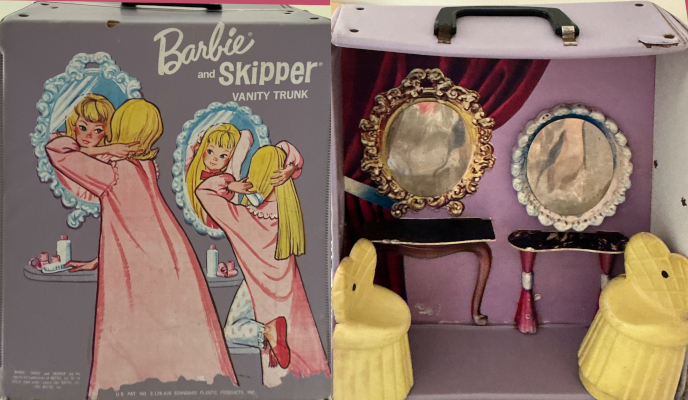
Vanity Trunk exterior and interior via kthlnjane on eBay. Subsequent standalone vanities included a ’68 dressing room case as well as the Action Beauty Scene and Quick Curl Boutique–both detailed in our post on beauty parlors–in ’71 and ’73. Yes, Barbie’s world furnished ample opportunities to powder one’s nose.
Barbie could also wash her hands, if she didn’t mind using the kitchen sink, starting in 1964 with her New Dream House‘s kitchenette, or even earlier, in ’63, in Deluxe Reading’s Dream Kitchen assuming third party offerings qualify (as they will in this post).
But where could Barbie go to freshen up?
From West Germany came an entirely new type of room in 1974. The play set, consisting of a shower/tub combo, washstand, and linens, all on a pedestal affixed to two walls, was produced by Martin Fuchs company; in the US it was a Montgomery Ward exclusive. Such was Barbie’s need for personal hygiene, this set stayed in circulation right up to the decade’s end.
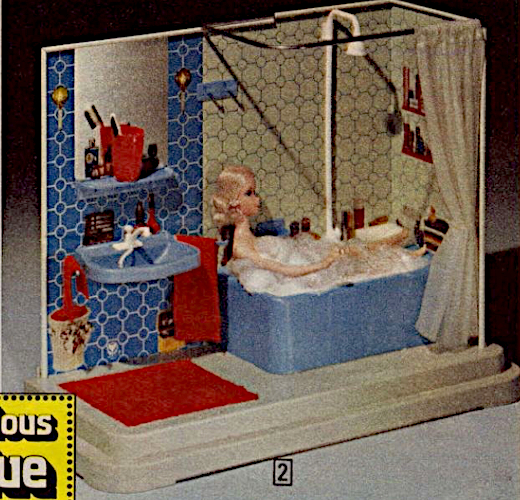
’75 Montgomery Ward Christmas catalog image via Wishbook Web. Where was Mattel during all this? Well, they did include a nod to bathing in the wall details alongside the vanity of their 1974 Town House:
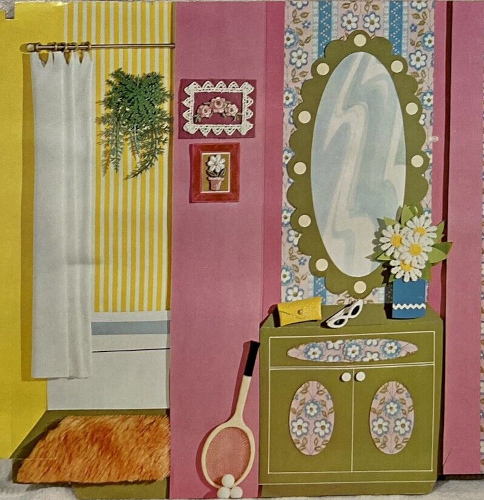
Townhouse wall via jrsgirl on eBay. But the decorater didn’t seem confident of the room’s function, tossing in storage for sporting equipment, plus a houseplant mounted on the shower wall. Lathering and rinsing activities are merely implied by a curtain and hint of tub–really anything could be back there. we don’t count this one.
Mattel then attempted a tangible, palpable shower, one with real spraying water, in the Room-Fulls Vanity and Shower set the following year.
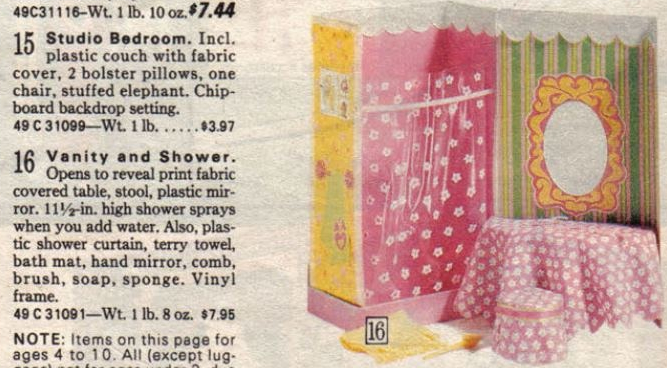
We know this because of the ’75 Sears Wishbook, apart from which there’s no evidence of any such play set, despite the other Room-Fulls being readily available. Though advertised, the Vanity and Shower set appears not to have been manufactured.
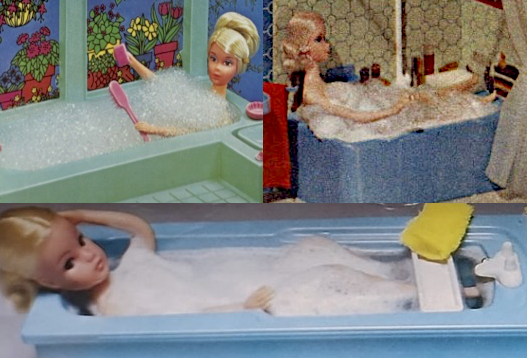
In ’76, at last, the official Barbie Beauty Bath debuted. With frothing tub ringed by windows, plus the requisite vanity with mirror and stool all in a “garden-like setting” (but no washstand), it represented meaningful progress in Barbie’s canonical hygiene journey.
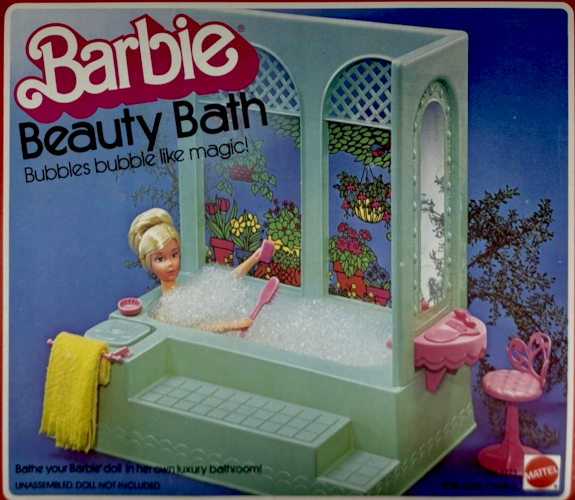
via littlebitt01 on eBay This set returned in the early ’80s as Barbie’s Bubble Bath. By then it was awash in pink.
Mattel followed up in ’77 with the surprising array of mobile plumbing available inside the Star Traveler. In addition to the expected kitchenette sink, the bus housed a shower stall and, in the bedroom, what we believe to be Barbie’s first official hand sink. A compact vanity rounded out the space, creating “a cozy corner for prettying up” (per the box).
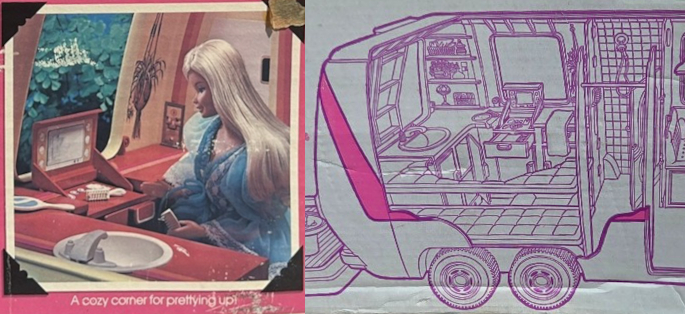
Box graphics show the “cozy corner” plus a cutaway view of the back half of the vehicle, including the shower stall, via wingmyth on eBay. In ’77 Empire brought new depth to these scenes with its Powder Room, a fully realized space with detailed screening containing a vanity with mirror and seat, a washstand, a tub, and a bench, all of chipboard, in an ornate setting beneath a “glass”-paned ceiling. Like other Empire destinations the Lake House and Hawaiian Villa, the set collapsed into its own roof for storage and portability.
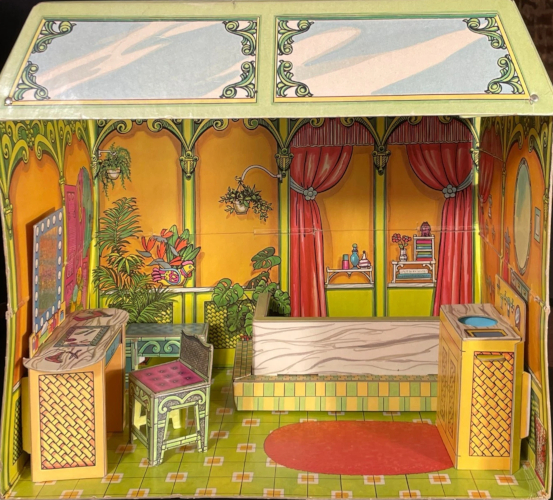
via Past Joys Toys on eBay Truth be told, the existence of an Empire Powder Room in addition to their other sets is how this little excursion became part of the Travelogue.
As the decade drew to a close, in 1978 Marx Toys debuted a Complete Bathroom Scene–Complete!–consisting of bathtub, washstand, and linens. The set was designed for Sindy but still sized appropriately for Barbie to share. In ’79 the tub was supplanted by a shower stall.
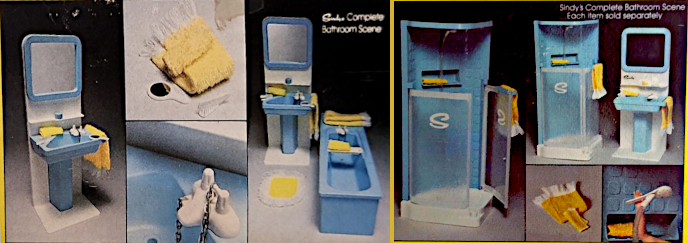
Sindy’s 1978 and 1979 Complete Bathroom Scenes via ATX Drew the Flipper and NOT WALMART on eBay. Across the pond, the original Sindy by Pedigree had been enjoying mustard-hued versions of these amenities–and others–for a handful of years already.
Complete Bathroom Scenes notwithstanding, in 1979 the final piece of the puzzle fell into place at last with Barbie’s Dream Furniture–specifically, her Dream Commode with accompanying Bath Chest.
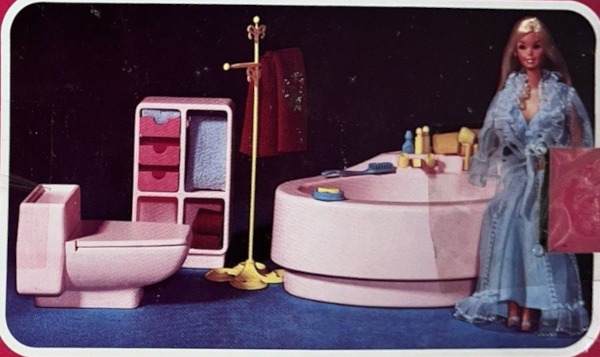
via Mountaineer Pickers on eBay. And there we have it: all that’s needed for Barbie and pals to freshen up, and not a single piece of essential plumbing missing. What a relief!
This concludes our ’70s Travelogue. If you missed them, earlier entries covered Mattel’s travel destinations, off-brand destinations, conveyances, and luggage. Or head up to the table of contents to see other subjects we’ve tackled.
-
Sidebar: Barbie’s Baggage
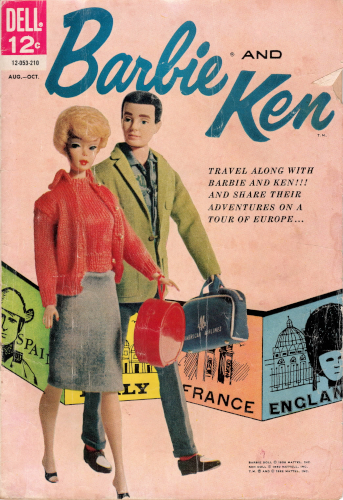
They pack light. As seen in Dell comics. Following are vintage illustrations of Barbie and other characters sporting baggage. For a rundown of vintage and nostalgic luggage suitable for Barbie dolls, check out the previous post.
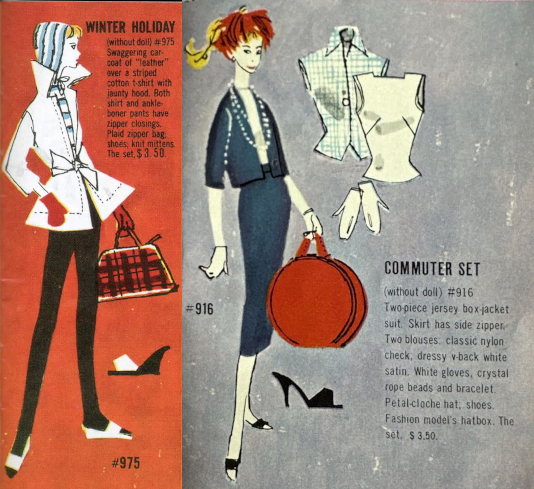
Mattel fashion booklet images, about 1960-1962 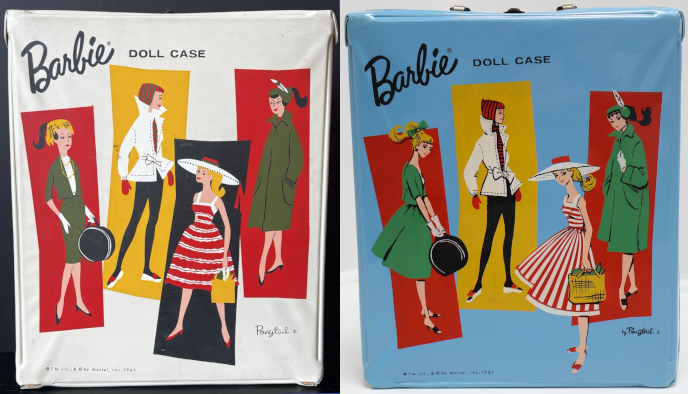
1961 Ponytail carrying cases featuring Barbie in Commuter Set (L) and in the carrying case fashion (R)–as well as in Winter Holiday sans overnight bag. via Red Stick Retro and lhb149 on eBay. 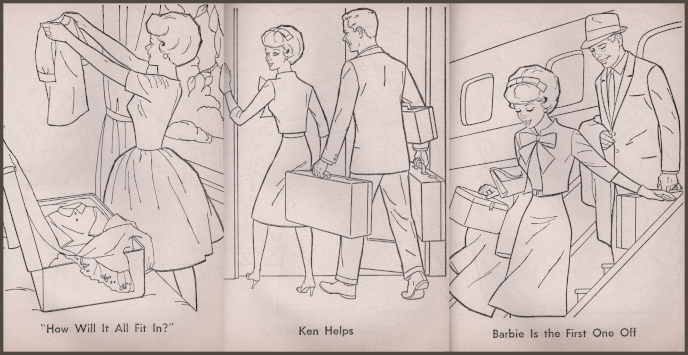
Triptych of 1962 Whitman Barbie coloring book pages 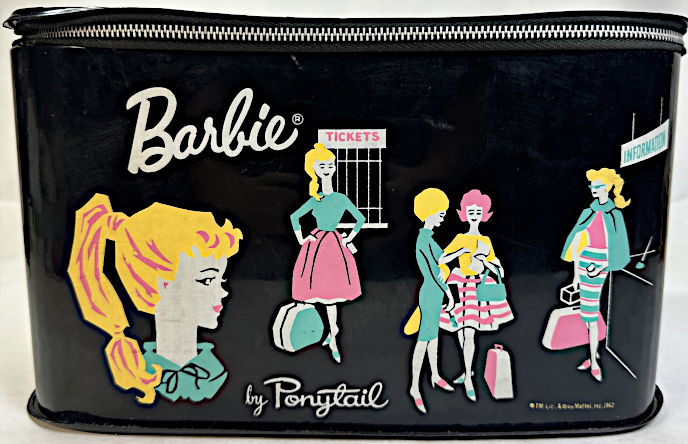
’62 Ponytail train case via lovedagainantiques on eBay 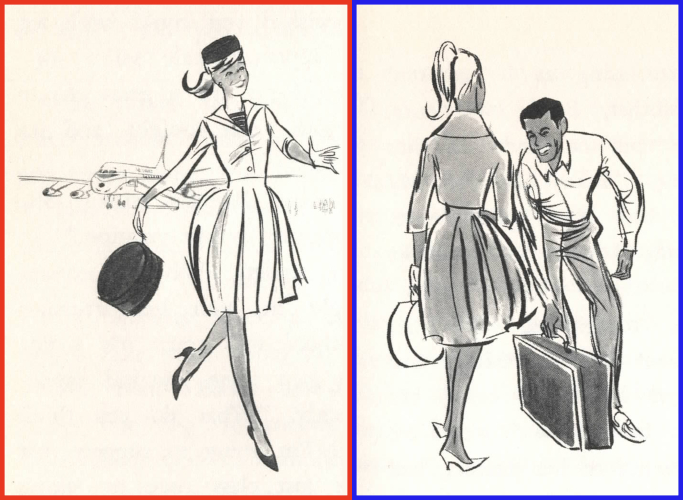
Illustrations from the 1962 Random House chapter books Barbie’s New York Summer and Barbie’s Fashion Success, in which Barbie could be wearing the carrying case fashion again. 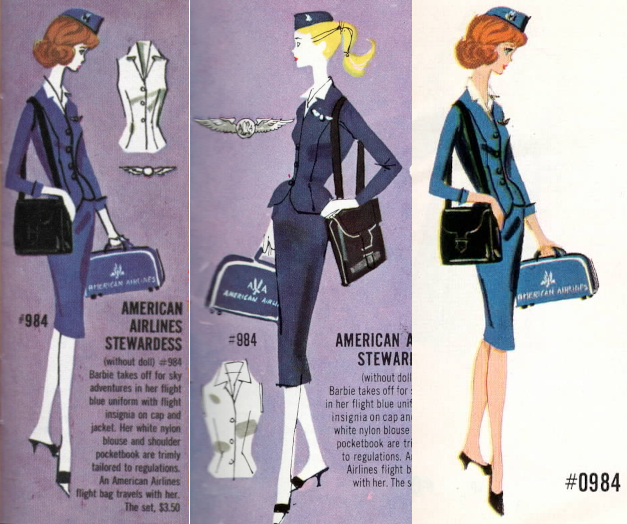
Gaggle of air hostesses from ’62-’63 booklets 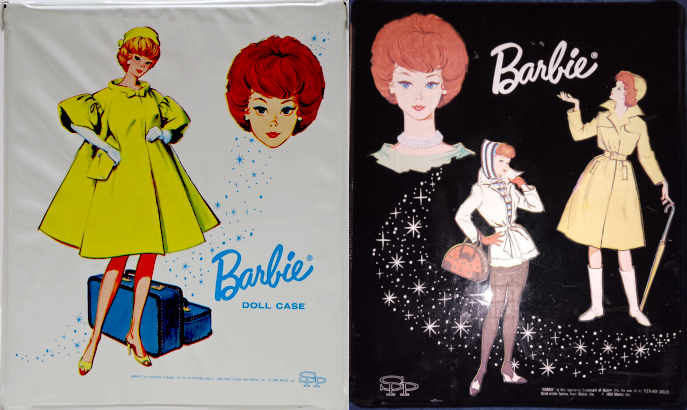
Carrying cases from 1963 and ’64, including Winter Holiday with its overnight bag, via Red Stick Retro and Domerdisc. 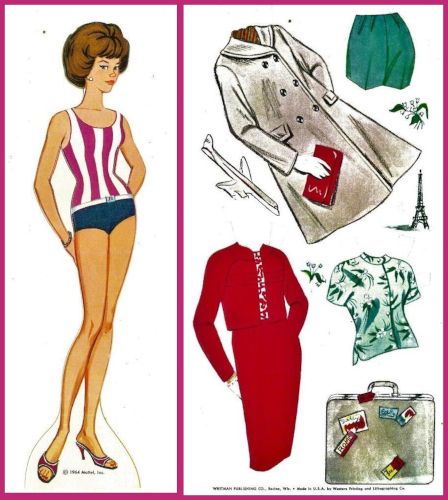
’64 paper doll with part of her Travel Wardrobe 
’67 World of Fashion board game box detail 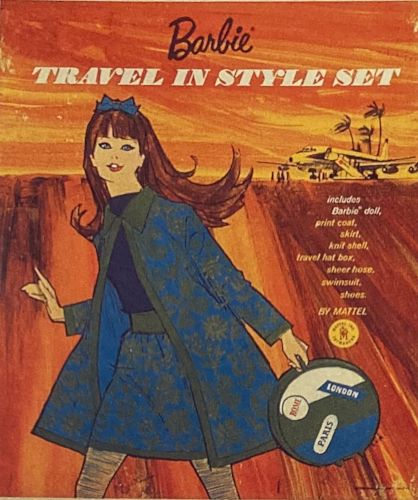
1968 gift set box via Sarah Sink Eames’ book …and some not-Barbies:
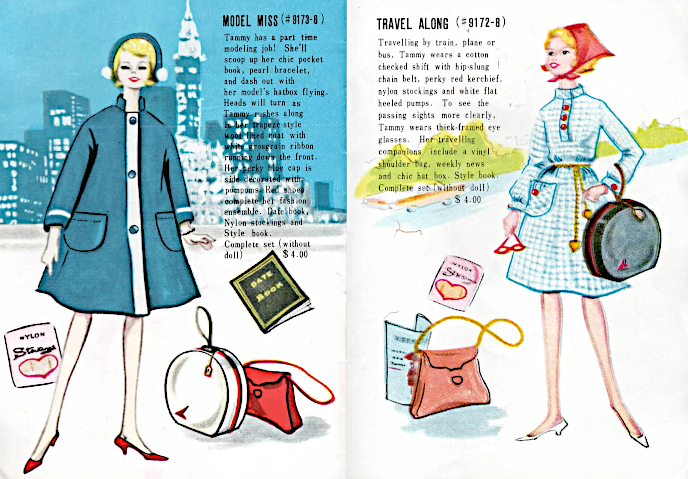
Tammy fashion booklet illustrations 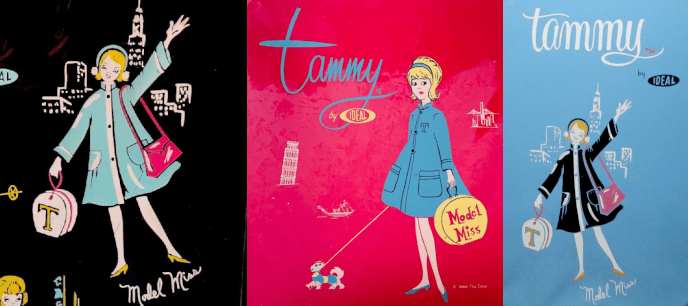
Trio of Tammys on carrying cases and hat boxes, via hotcnetwork, pfmink, and busygaldollhunters on eBay. 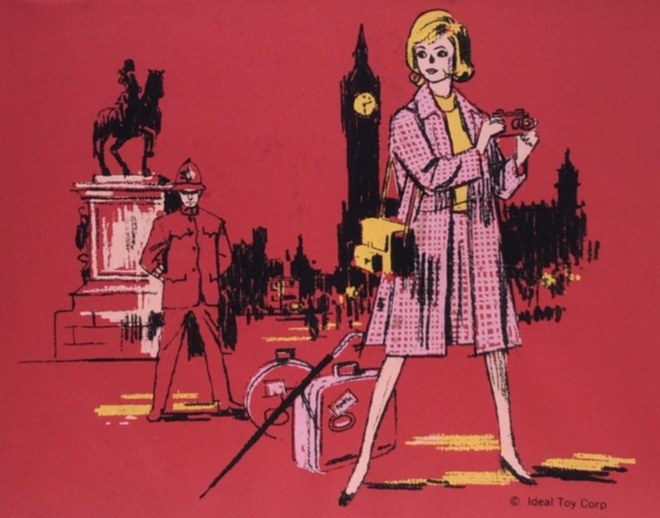
Tammy in London on another carrying case, via Holly’s Dolls and Treasures. 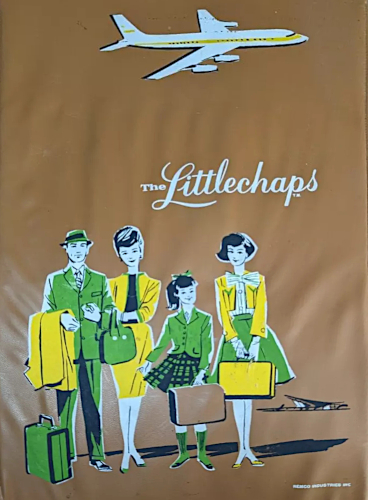
Littlechaps’ case via Thrifty Doodads (eBay) 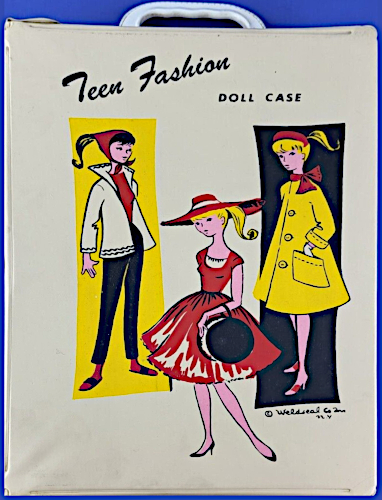
Teen Fashion Doll case from Weldseal Co.
(via homegrowndeals on eBay)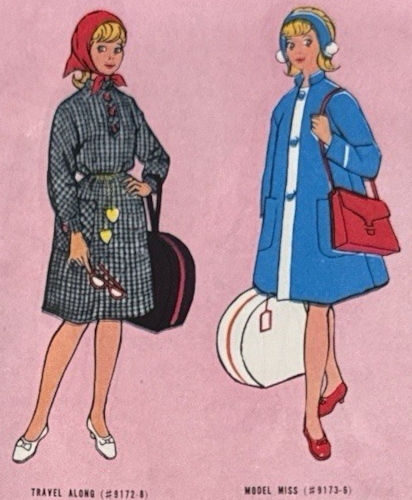
more Tammy fashion booklet illustrations 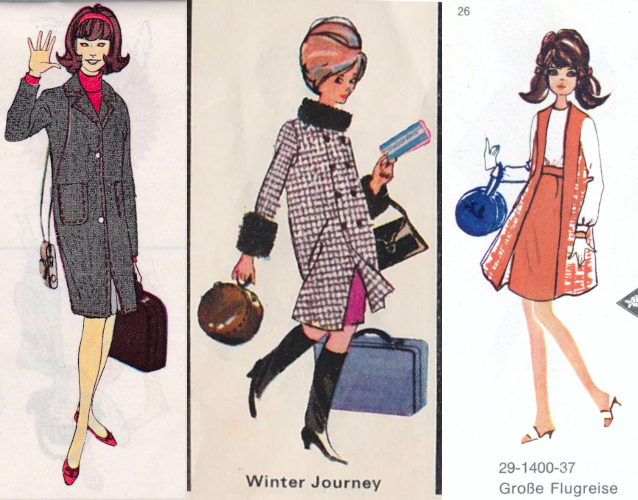
Sindy, Palitoy Tressy, and Gaby fashion booklet art 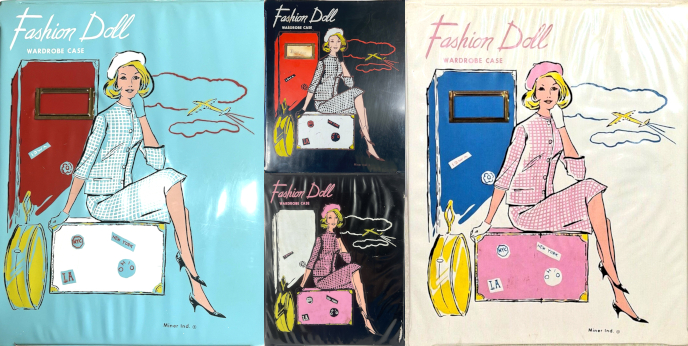
Miner Ltd. fashion doll carrying case in assorted colorways via eBay users This Is Barbie World, TnT ReSellers, Sassy Duck Finds, Catina1845.
According to the labels on the illustrated suitcases, they’ve passed through: New York, New York City, Los Angeles, Iowa and Ohio!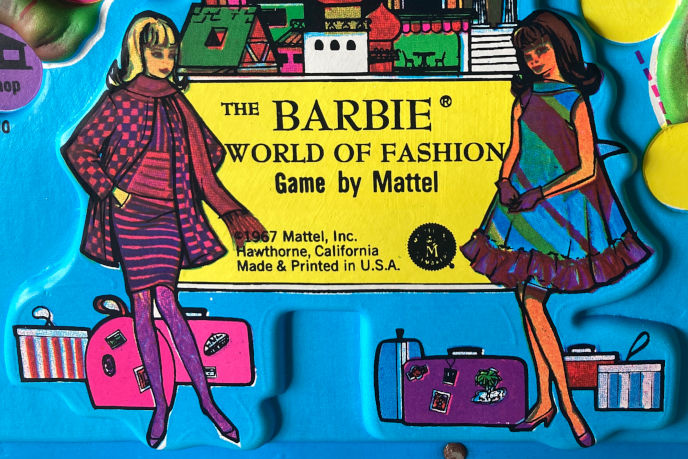
’67 World of Fashion board game board detail 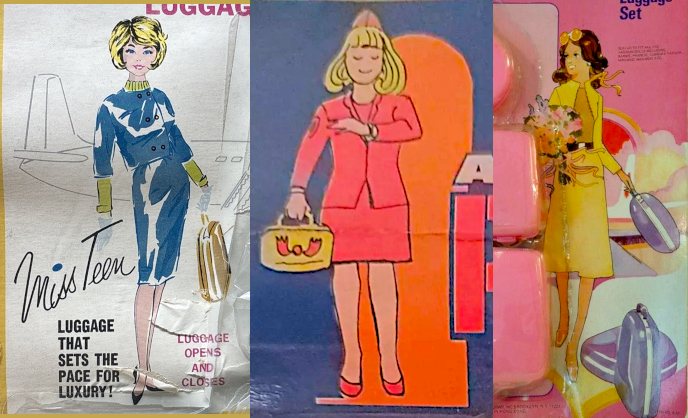
Luggage packaging from: ’63 Payton Samsonite Silhouette (Chloe’s Closet of Collectables on eBay); ’68 Chemtoy Little Stewardess flight bag (Global Pop on eBay); ’78 Shillman Mini-Mod Fashion Doll Luggage Set (Pinterest) -
Barbie’s ’70s Travelogue, the Appendix: What to Pack
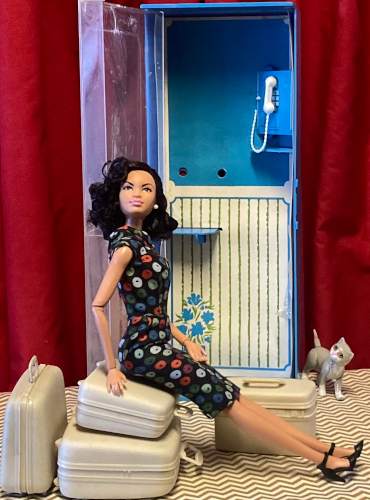
In this series so far we’ve detailed how, during the Seventies, an array of vacation spots popped up for Barbie’s enjoyment. We’ve also seen how she gets from place to place, by land, air, or water. At this point she’s got all she needs, except… Barbie, you’re not packed!
But what to pack?
This latest entry in our Seventies Travelogue is an appendix and not a chapter proper because Barbie could pack her bags right from the beginning, with Winter Holiday’s overnight bag and Commuter Set’s hat box, both 1959, quickly followed by her American Airlines flight bag in 1961.
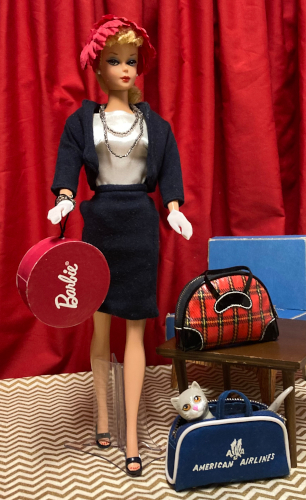
Either bag is serviceable for a quick getaway, but for lengthy journeys she’ll need more capacity than this; and a stylish traveler like Barbie would never be caught toting around a hodgepodge assortment of bags as seen above.
What she really needed was a matching luggage set, such as the one sold for Penny Brite in 1965. The 8″ Penny was supposed to be 6 years old or something, but that didn’t stop her from having a car which came complete with an adorable line of baggage. The much-taller Barbie probably couldn’t operate Penny’s vehicle very easily, but the luggage actually fits pretty well; even the purse strap is close to the right length.
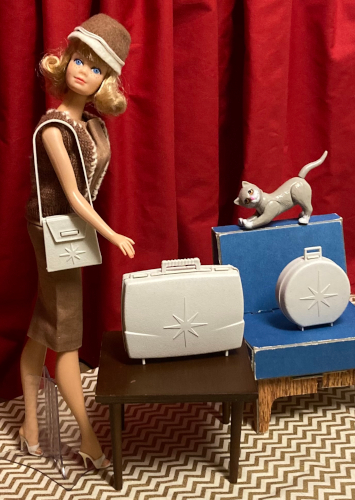
Penny’s play sets had a more Populuxe feel than Barbie’s, all boomerangs, amoeboids, and candy colors. Some of her sets were recolored and put back in production for Dawn in the Seventies, and possibly on another occasion as well, but I believe this is the lone instance of the luggage with its atomic sunbursts.
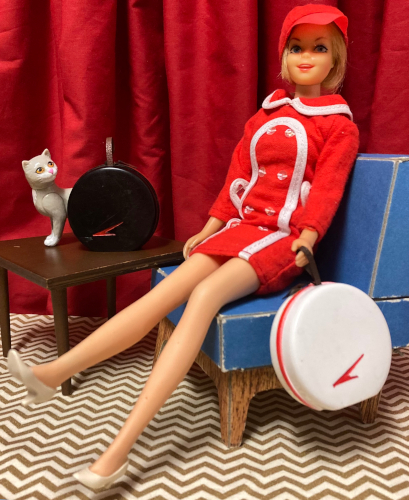
I just adore Penny’s set. It may be my favorite Barbie-compatible luggage set. However, other Barbie rivals also offered worthy baggage alternatives in this timeframe. Another fave is Tammy’s hat box, which came in white or black with different ensembles, always trimmed in red.
What you don’t see illustrated above is the smart little red swoosh on one side of the cases, as aerodynamic as it is midcentury-slick.
Tressy, too, had a hat box. From the outside it’s not much to look at, but the lined interior and mirror help it attain new heights of hat box sophistication.
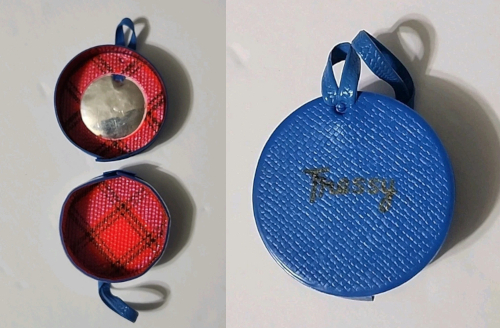
You might argue this piece is not a good fit for Barbie since it’s so prominently labeled “Tressy” on the front, but it’s canon that Tressy’s friends borrow her personalized hat box and even her passport.
The Grand Dame of mid-Sixties off-brand Barbie luggage is the Samsonite Sillhouette line from Payton, marketed for “teenage” dolls in general.
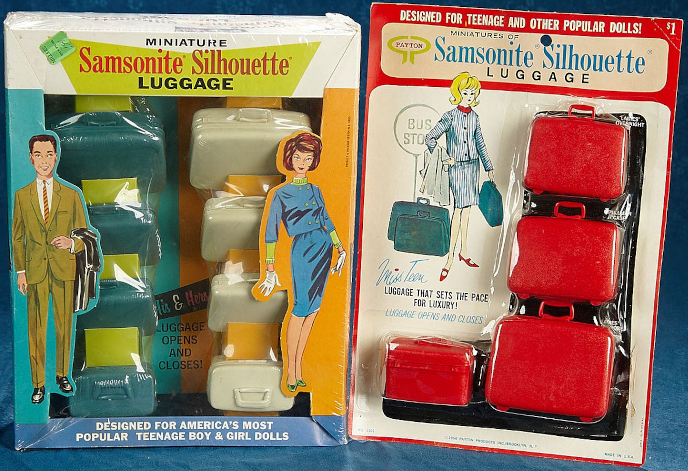
This image is from Theriault’s, who give the date for both as 1963. These four-piece sets were the first to give Barbie ample packing space for weeklong trips or longer. (Even I can admit that the Penny Brite suitcase is a little slim, and that plus a hat box and purse still doesn’t amount to much carrying capacity.) The train case, a classic shape but a fresh innovation in Barbie’s sphere, even has a removable tray like the real ones did.
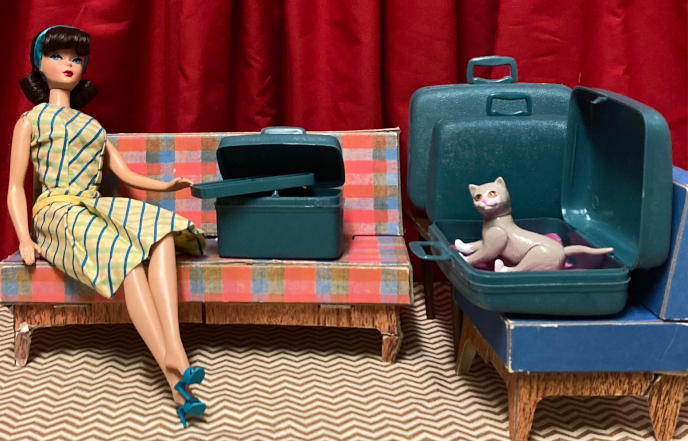
One other, earlier Samsonite offering also deserves notice. This one, found in My Merry sets dated 1958, actually predates Barbie. The My Merry Guest Closet, an accessory set possibly geared for Alexander-style dolls, included a classic tan suitcase stamped Samsonite and adorned with a little travel sticker. The My Merry Overnight Closet had the same case but with two stickers. No shade to the Silhouettes, but this earlier, well-worn case is my favorite for Ken or anyone who’s feeling hard-boiled.
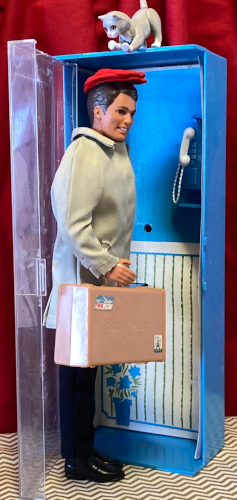
(Apologies for this Nineties fellow–you can see I’m no Ken collector.)
Anyway, back in the mid-Sixties, one other major category of fashion-doll-appropriate baggage appeared by 1965.
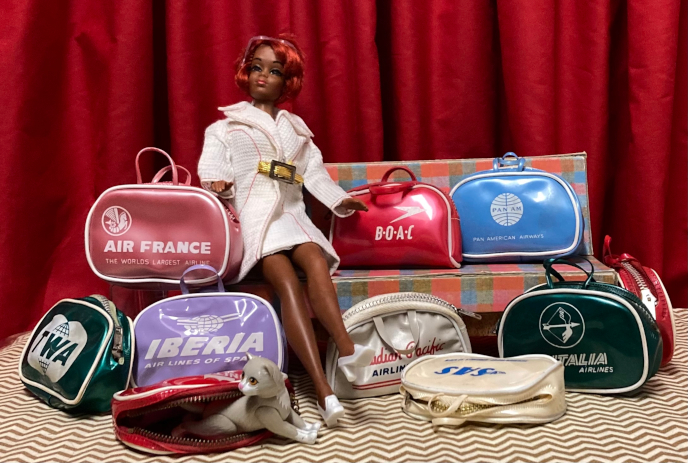
I believe these airline-branded bags are actually a little larger than Barbie-scale; her own American Airlines bag can tuck neatly inside most of them, and they could be a lot for her to lug in one hand. However, Barbie’s posh international lifestyle demands at least one or two. At midcentury, when air travel was still the province of the privileged few, a branded airline bag–especially one from an international carrier–was a status symbol. I made sure my doll had at least BOAC (British Overseas Airways Corporation) and Pan Am bags, those being the first airlines to routinely serve the jet-setting New York-Paris and New York-London routes.
The manufacture dates of these bags can be tricky to pin down–one forum user remembers them as freebies given to child travelers, so some may never have been advertised or labeled to sell. However, many have been found packaged for retail, and those I’ve seen carried (c) dates between 1965 and 1972, with ’65 and ’68 being common. These usually contained sets of jacks–plenty of the vintage ones you find for sale now still have their jacks–and were produced in Hong Kong for the companies Chemtoy of Illinois and Wells Manufacturing of Ohio.
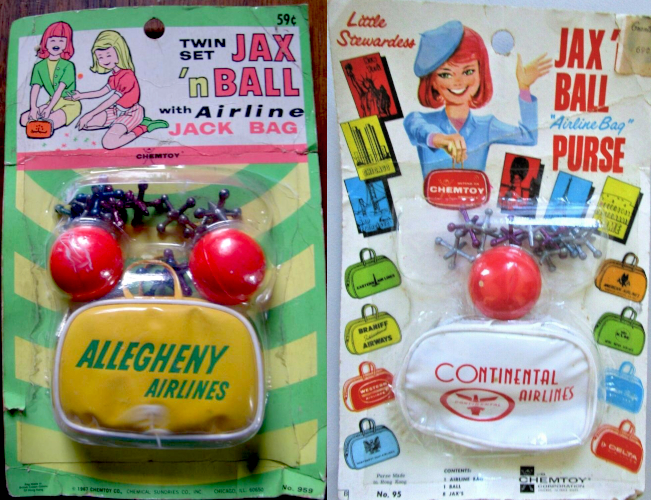
Domestic carriers? Surely, but I’d still add the 1967 Allegheny Airlines and ’68 Continental Airlines miniature bags to my collection. Both via Worthpoint. While we may know only approximate manufacture dates, the stickler for era-appropriateness can check that their doll’s bag has the right look by reading up on the airlines and their logos. For example, BOAC merged into British Airways in 1972; and per Logopedia the Pan Am logo on my Barbie’s flight bag was used from 1958-1971. One can also consult this remarkable early-Sixties Boeing ad:

As shown above, human-sized travelers had access to a much greater diversity of flight bag shapes than did Barbie-sized travelers. However, the doll-sized bag proportions were at least accommodatingly ample. Below, Stacey demonstrates how her United shoulder bag can hold an entire second outfit (the remaining pieces from her United Airlines flight attendant ensemble):
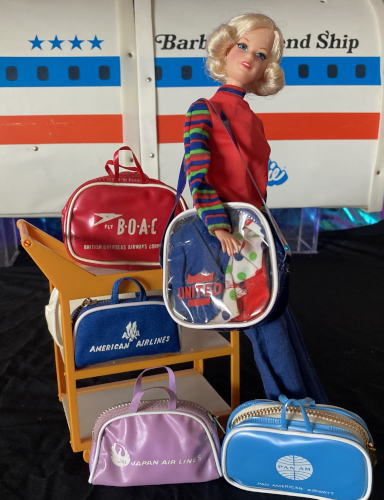
Clear-fronted bags like Stacey’s square shoulder one, along with other clear-fronted ones having the more common oblong shape and handles, originally held Liddle Kiddles knockoffs, roughly dating them to 1967-68, give or take.
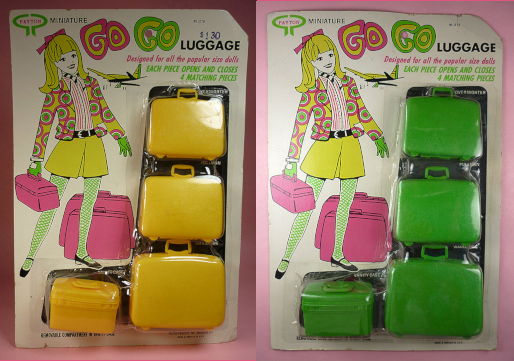
Payton, makers of the Samsonite Silhouettes, also released mod-appropriate “miniature Go Go luggage” in yellow and green. Except for the color refresh they were identical to the Silhouettes but lacked Samsonite branding. The images below, from Joe’s List, are undated; but 1968-ish is a pretty safe bet.
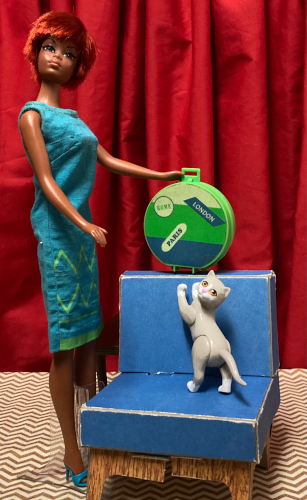
Over in Mattel world, 1968 brought Barbie a brand new hat box with the fabulous, Sears-exclusive Travel In Style gift set, which is rare. Luckily the box was also sold as part of the Tour-Ins accessory pak, which is common.
Francie, too, had hat boxes. The one from the Clear Out ensemble, shown below left via That Toy Girl on eBay, is the most common and is doll-agnostic. The hatboxes for Tweed-Somes (shown below right via bartalk on eBay) and Partners in Print are Francie-branded and are rare, along with their outfits.
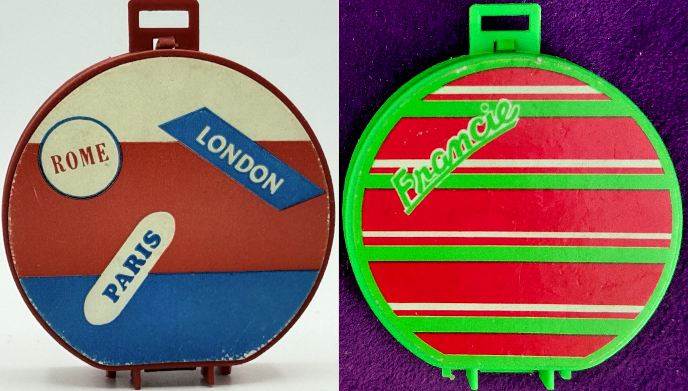
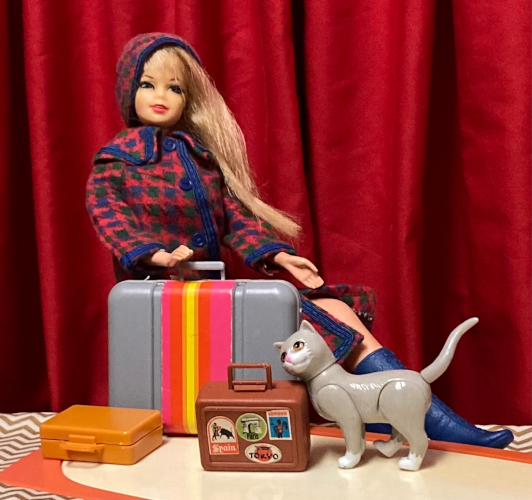
During the Seventies, Mattel again provided Barbie with a mismatched hodgepodge of small luggage pieces. The gold-colored case that came with the Friend Ship, shown below left, may be just about large enough to tote a paperback novel and pack of cigarettes–and what else do Ken and Barbie really need in their carry-on? The brown Busy Barbie case, below right, is covered with stickers suggesting international travel, like the My Merry Samsonite suitcase Ken toted before. However, the Busy case is exactly the same size as an earlier Skipper/Tutti piece regarded by many as a lunchbox. The aluminum-look Star ‘Vette suitcase, below center, appears to have more generous proportions but is practically two-dimensional.
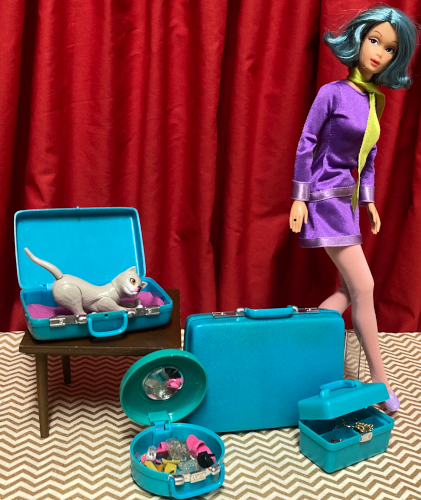
Once again, competitors had enough space for all Barbie’s stuff in matching luggage sets. Miner Industries offered a four-piece Samsonite-style set, similar to the Samsonite Silhouettes but with a hat box, metal-look latches and hardware, and mirrors embedded in the hat box and train case lids.
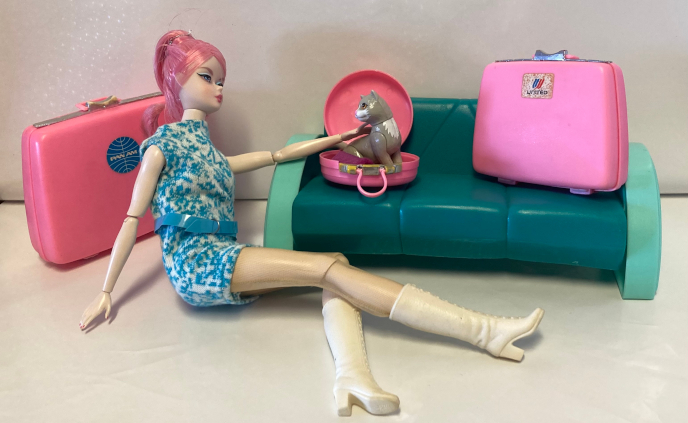
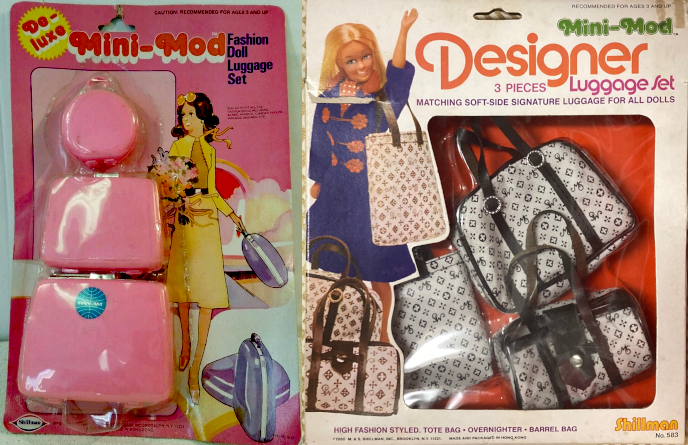
Miner’s set was advertised from 1975-77. In 1978 Shillman’s Mini-Mod line introduced its own Samsonite-inspired set of three pieces, this time in pink, with more metal-look hardware and tiny airline logo stickers. Compared to official Payton Samsonite, both of these sets are rare today.
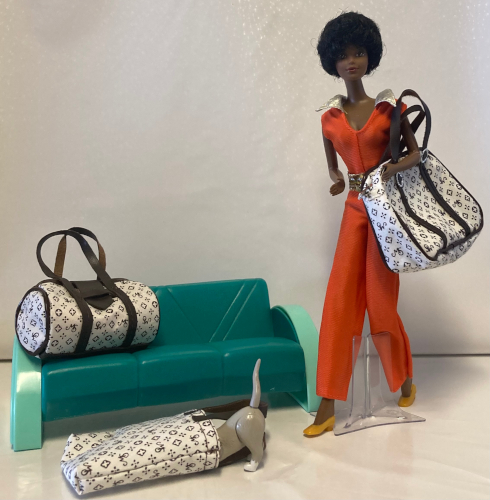
Upon the retirement of their pink suitcases, Shillman/Mini-Mod debuted a long-overdue set of soft-sided luggage in 1980.
Though strictly speaking an Eighties product, this marked and monogrammed Vuitton-style set is ideal for late-Seventies Barbie’s chic Superstar life.
Stretching even further into the post-Seventies future, the ’90s Barbie Millicent Roberts line for adult collectors was chock full of callbacks to memorable early Barbie offerings. The Jet Set baggage particularly evokes the Winter Holiday overnight bag, although its brown leather-look trim is a mismatch for the black-trimmed original, held in Barbie’s right hand below.
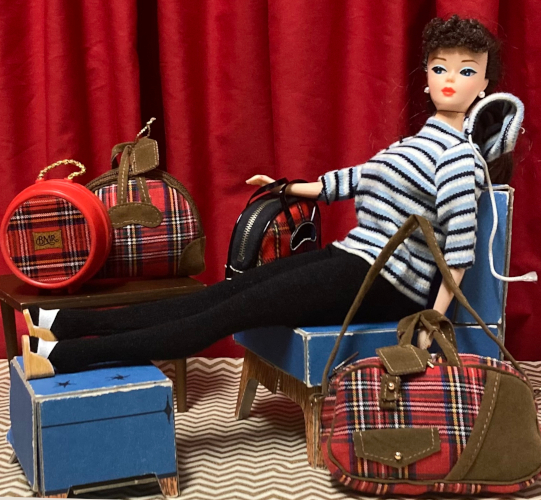
Though it doesn’t complete the Winter Holiday suite, the Jet Set baggage can serve on its own as a stylish and capacious alternative for vintage Barbie’s mountain getaways.
Another nostalgic ’90s release for adult collectors was the Spiegel-exclusive Summer Sophisticate doll. To me she’s less “sophisticated” and more “Doris Day plays a wedding planner,” but she did have a nice retro hat box. Here are some of her sudsy-looking accessories, via A Little of Everything for You on eBay:
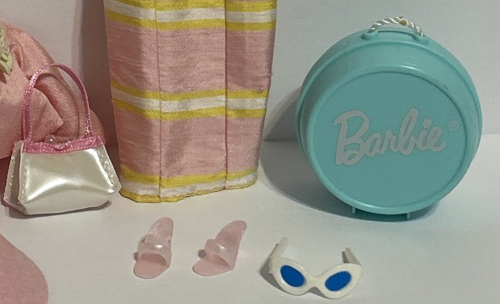
And here’s just the hat box in the Commuter Set context:
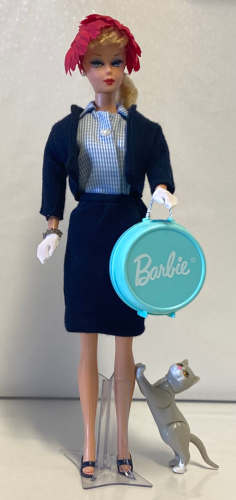
Like so many early Mattel releases for adult collectors, Summer Sophisticate and Jet Set are both easy to find in like-new condition.
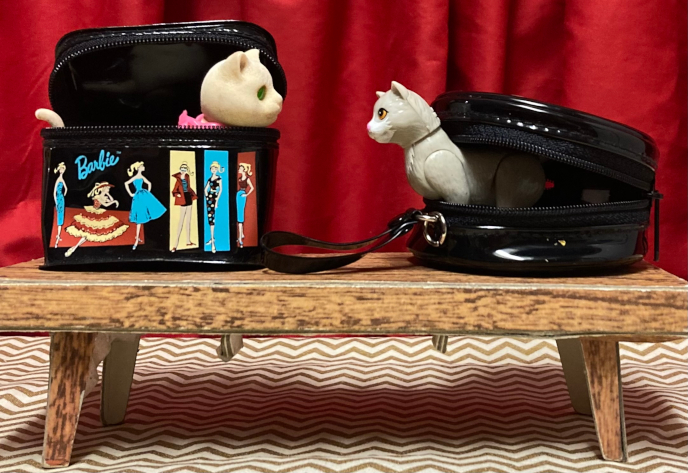
Finally, the Hallmark miniature Barbie train case and hat box ornaments are circa Y2K in manufacture, but they’re also detailed copies of real children’s luggage from the Sixties, perfect for the younger travelers in Barbie’s orbit.
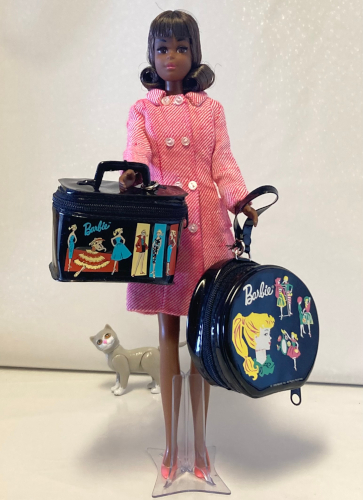
Or do they err in the less-common direction: are they a little large?
At this point, Barbie’s vacation is just about booked. So until we meet again and as Casey’s flight bag says: Bon Voyage!
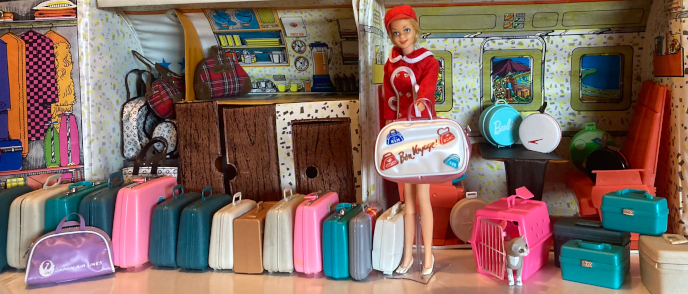
(Find the Seventies Travelogue’s next and final installment here.)
-
Sidebar: Window Shopping
A recurring theme in fashion doll illustration…
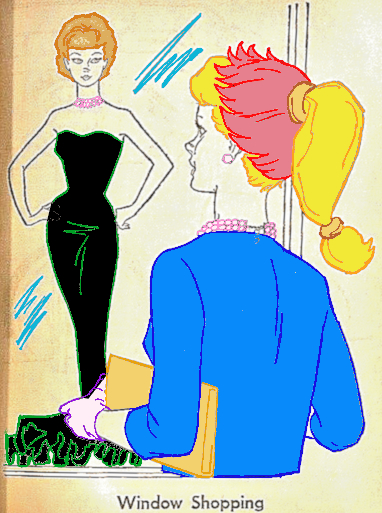
’62 Barbie coloring book page “colored” by me 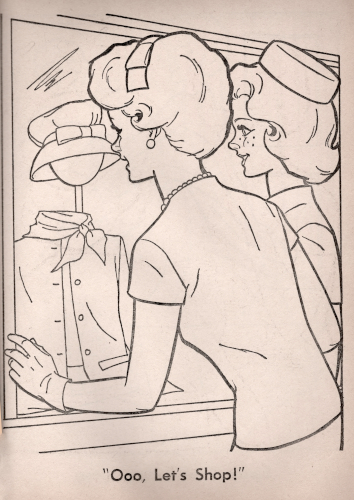
and another for you to color. 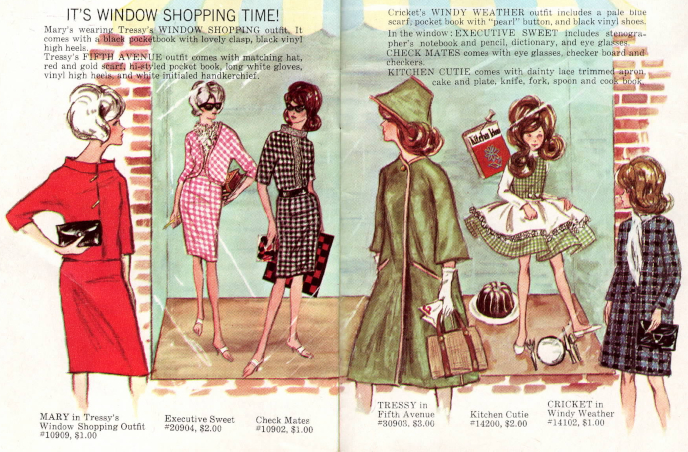
Tressy, Mary and Cricket fashion booklet ca. 1965 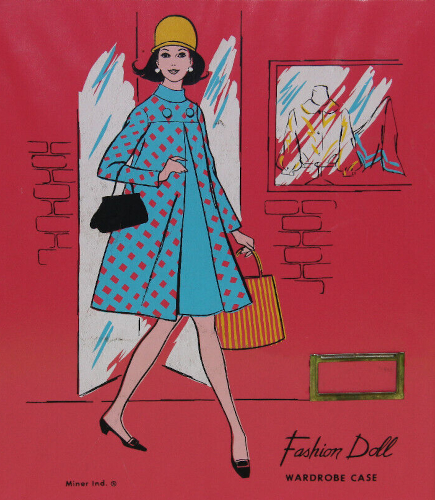
mid-Sixties Miner Industries doll carrying case 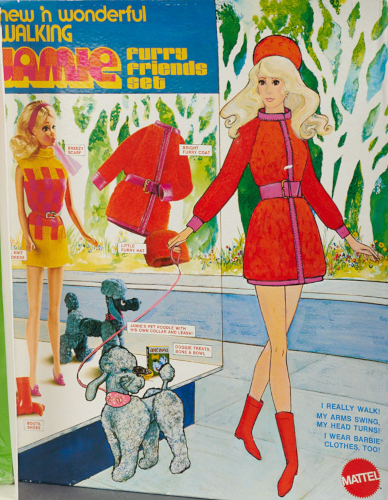
1970 Jamie gift set (via Theriault’s) …plus a bonus: when the shopping gets real.

’62 Barbie and Ken jumbo trading card Happy holidays from Silken Flame!

Silken Flame
Vintage Barbie illustrations, built environment, clones and more

