Seventies furniture and rooms

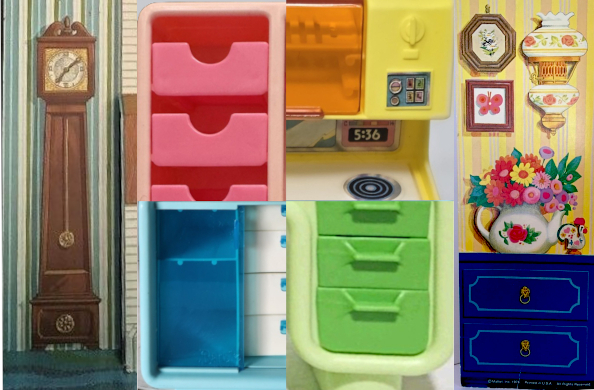
Collage of elements from Mattel 70s rooms and furniture: A grandfather clock illustrated on a wall with blue striped wallpaper behind it; foour drawers or cabinets in plasti furniture in pink, yellow, greena dn blue; and another wall screening of a blue chest of drawers topped by a pitcher of flowers in front of yellow-striped wallpaper also holding a Tiffany lamp, framed butterfly, and hexagonal frame with maybe in illustration of flowers inside.

The “built environment” component of this blog, one of the major drivers of its creation, is drawing to a close: this may be our last survey of Barbie’s environs, ever. At the end of the Many Abodes of Barbie series, in the entry on 1970, we announced that we’d never visit the A-Frame or Townhome; their lore is just too extensive. We did see assorted Seventies Barbie destinations in the Travelogue, including covering Barbie-sized dolls’ plumbing revolution during that decade. But before we close the book on Barbie Homes and Gardens, let’s take a moment to review some of the exciting changes that came to Barbie’s environment, that weren’t quite a house nor quite a destination.

Rooms for Lively Living (1970)

We touched on Barbie’s first Seventies “rooms” in the Many Abodes of Barbie finale. They are breathtakingly rare, so there’s not much more to say about them today. A Lively Livin’Room was sold on eBay a few years ago, as we shared in the earlier post.
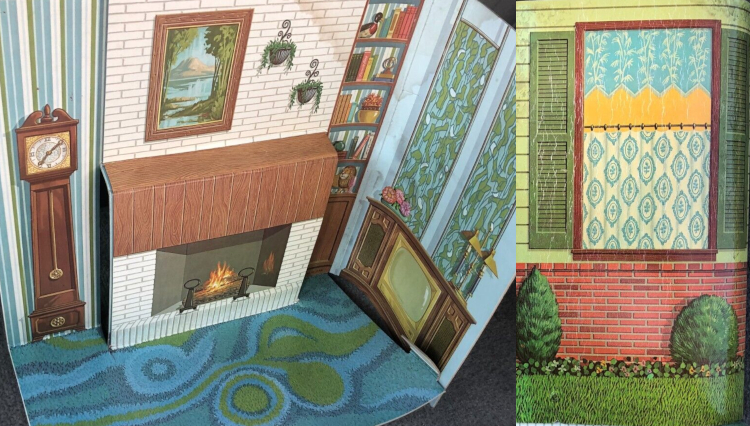
Living room walls and floor: the carpet is pretty psychedelic, with blue and green swirls. Other furnishings are more staid, such as a grandfather clock, a landscape painting, and a television in a heavy wooden cabinet. The space is dominated by a white brick fireplace. Outside, the house is red brick up to a couple feet, then yellow boards; a window has green shutters and blue-and-white curtains within.
1970 Barbie Lively Livin’Room interior walls and floor (L) and exterior (R). Source: wonderwoman13 on eBay.

As we noted at that time, the three rooms were originally offered for sale alongside the Lively Livin’ House, but they have their own design. The structures are simplicity itself: two walls and a floor, with a little variety added by making some elements dimensional: a dresser in the bedroom, the kitchen sink, and the living room fireplace pop out of the wall into the space. The physical furniture is limted: the bedroom included a lightweight plastic bed form with a coverlet, while the kitchen had a table and two chairs that were pretty typical for the era (similar pieces occurred in the Lively Livin’ home). The bedroom also offered a clothing rod and hangers that attached to the screened-on wardrobe. Other elements, like frying pans and flower vases, could be punched out of the cardboard packaging, guaranteeing hours of fun. The walls were printed on two sides, showing the room interior as well as the building exterior.
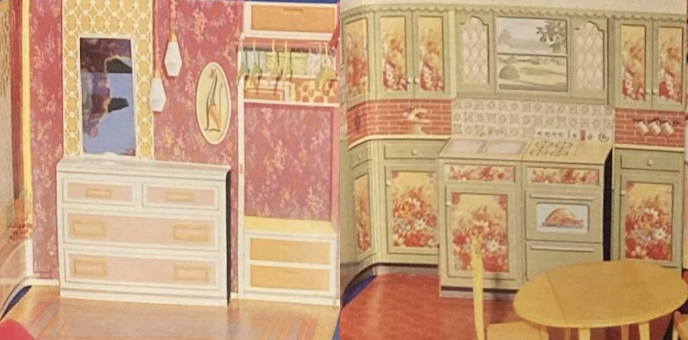
Two paper/chipboard walls with furniture illustrated on. Left, marbled pink wallpaper, a silver reflective mirror, chest of drawers, freestanding wardeobe (but still an illustration), pendant lights and an oval piece of framed art that I think looks like a penguin but probably isn't; right, green kitchen vabinets and appliances, brick wall with tile splashguard, floral print inset on the fronts of all the cabinet doors, and a window over the sink looking out on countryside.

Excerpted from Marl Davidson’s book on Barbie Structures and Furniture, above are the interior walls of the bedroom (L) and kitchen, both quite restrained in style compared to the Lively Livin’ House. What did their exteriors look like? (I suspect that these sets, or pieces from them, do surface from time to time but go unidentified as so little information about them is available. Maybe the above borrowed images will help as people reverse image search their finds.)

Room-fulls (1975)

In contrast to the Rooms for Lively Livin’, the Room-fulls spread far and wide and are not too hard to track down today. Their contents were also a bit more interesting: they had color, and style, and calico and gingham and patchwork quilting, as was the fashion at the time.
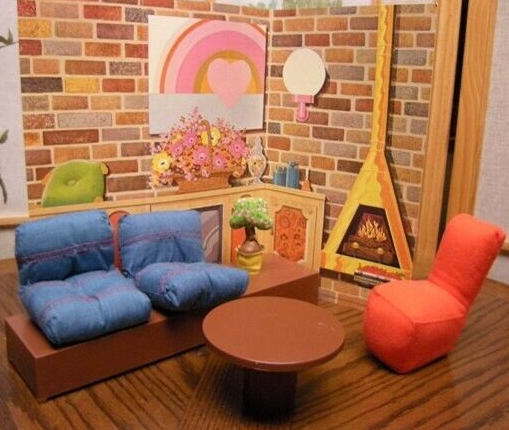
A warm, handsome room consisting of a back wall of vari-colored brick with a graphical heart painting, an orb wall sconce, Malm-type fireplace, screened-on credenza topped by flowers, vases, and green throw pillow. In the foreground is a brickish brown couch topped by denim pillows, a stuffed orange chair with no arms, and a round circular table in the same plastic as the couch. One end of the couch is free of cushions to make a size table on which a little potted tree rests. This scene is set atop a wood-textured surface which isn't part of the Mattel set but adds to the warmth.
So what if those are denim couch cushions? The Firelight Living Room, via motown-girl on eBay, is loaded with appeal.
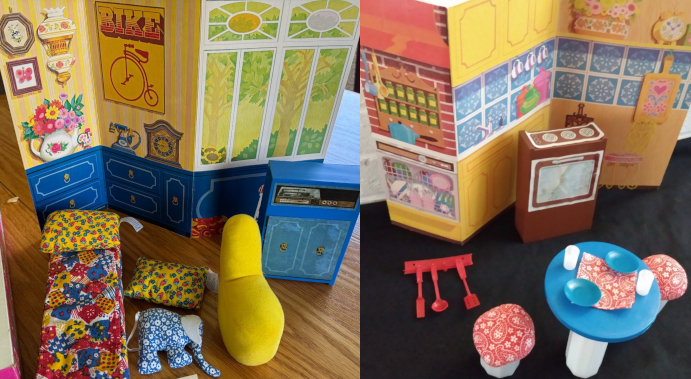
L: Bedroom set: wall with blue drawers, large widnows with stained glass panels decorating the top, wall decorations as descibed in the leading image plus a poster of a pennyfarthing bicycle, clock, and telephone; narrow bed or daybed in colorful patchwork; yellow flowered pillows; yellow stuffed chair with no armrests; freestanding cabinet with record player; calico stuffed elephant. Right: Kitchen wall with yellow cabinets and blue tile splashguard, range hood over the dishwasher backed by bricks; freestanding oven/range, mushroom-shaped stools with paisley seat covers; mushroom-shaped table with white base and blue top; placemat, white cups, blue plates, some red utensils hanging on a mountable rack that lies on the floor.
The Studio Bedroom (via Isetta88) and Country Kitchen, shown here sans paisley table cloth via fue-4145, also have fine qualities–particularly those elaborate details on the bedroom wall.

We talked about a fourth planned Room-full, the shower, in an earlier post. Evidence indicates that this final set was never produced.

Dream Furniture (1979)

Although we cover the A-Frame only in passing, its gorgeous furniture deserves a nod. There has been nothing like it, before or since. The original A-Frame was not the pink structure many know from the 80s; it was before Barbie had fully boarded the pink train, and its furniture, sold separately, reflects the transition of Barbie’s environs from kid-appropriate realism to full toyishness in the surrounding years. For the original Dream Furniture a spectrum of hues were used, all in gorgeous two-tone color schemes.
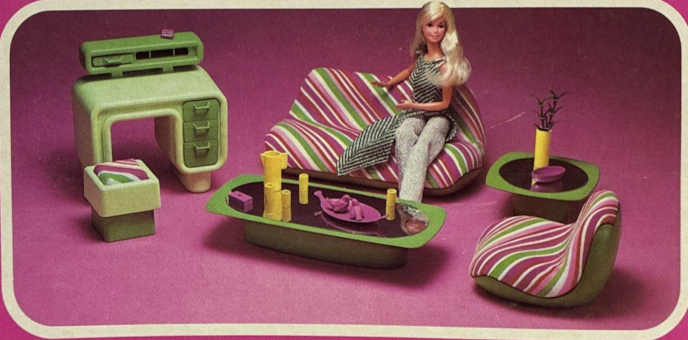
Product image from Dream Furniture packaging. On a pink background, blonde Superstar Barbie sits on a blobular sofa striped in white, green, and pink diagonals. A similar chair sits of one side. An end talbe and coffee table in green plastic have mirrored tops. To one side is a desk in molded light green plastic with dark green accents, along with a molded plastic green stool with the same diagonal stripe for a seat cover. The molded plastic curves instead of having abrupt corners.
via aeb1 on eBay.
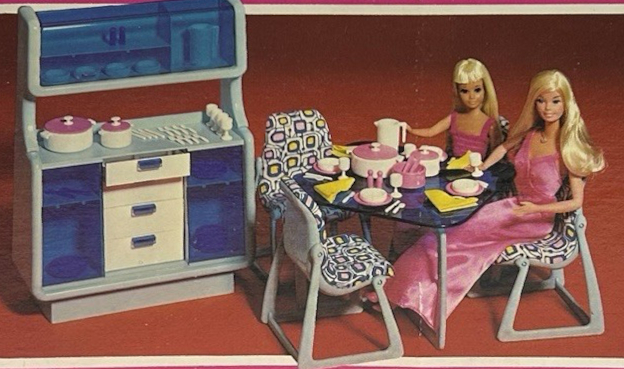
Product image from Dream Furniture packagibg. Blonde Superstar Barbie and matching Skipper sit at a plastic dining table with clear blue surface. The table is laden with pink-and-white dishes and cookware and yellow cloth napkins. The Eames-style chairs have a funky geometric print in blue, white, and yellow covering the molded seats. Nearby sits a dining room hutch in light blue molded plastic with white draws are translucent blue doors.
via grandpasdrawers 😐
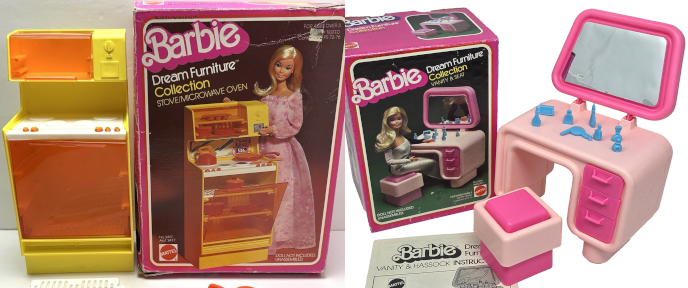
Pieces of Dream Furniture sit next ot their boxes. Left is a stove and microwave combo in yellow plastic with white cooktoop and translucent orange doors; right is a light pink vanity with dark pink drawers and mirror frame, blue cosmetics containers and whatnot (non-functioning), and two-tone pink stool or what the packaging calls a hassock. The packaging features photographs of blonde Superstar Barbie using/showing off the furniture.
Kitchen appliance and bedroom vanity via grandpasdrawers and Vintage_Toys_And_Treasures.

Okay, so there was always a bit of pink in the mix, demonstrated by some pieces above. By ’83 this furniture would ALL be pink.

Puff ‘n’ Play furniture

These inflatable furniture sets were not Mattel but are often identified as such, sometimes even advertised as Dream House furniture–probably because they were so popular and can be found along with the houses in decent condition. (Incredibly, some of these pieces still stay inflated.) If it’s a Seventies aesthetic you seek, you could do worse.
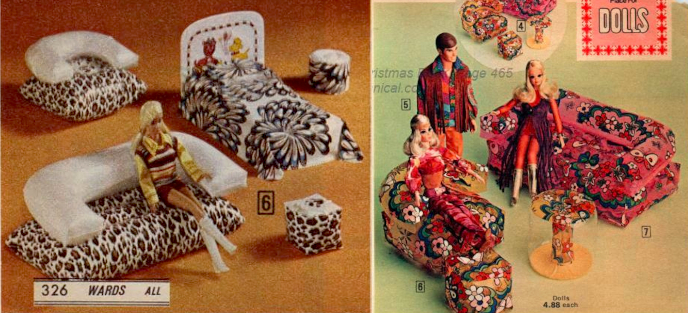
Two color catalog images featuring inflatable furniture. Left, sofa, chair, side tables/stools, and double bed in black-and-white, leopard print in the living room and graphical flowers for the bedroom pieces, all with white trim. Malibu PJ sits on the sofa. At right, colorful sofa, chair, ottoman and side table in psychedelic floral prints on yellow and pink. Live Action Barbie, PJ and Ken occupy the space.
via Christmas.musetechnical.com, Puff ‘N’ Play sets in the ’71 JC Penney Christmas catalog (R) and ’75 Montgomery Ward.

At the height of the festivities in 1977, JC Penney offered three “houses,” each consisting of one room full of inflatable furniture.
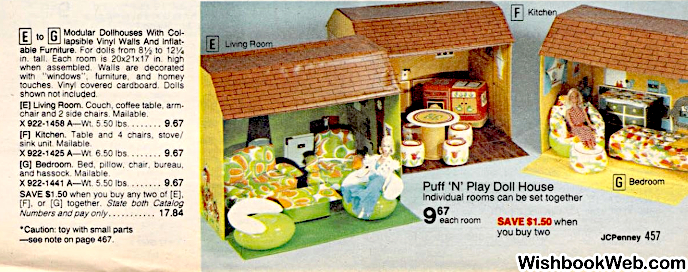
Color catalog listing for three one-room "houses" with yellow walls and brown roofs. One room overflows with green-and-orange floral-y couches, chairs, and coffee table; one has a circular table with stools in white, yellow, and brown with an inflatable oven/sink combo; and one in a floral-patterned bed, chair, and stool with an inflatable chest of drawers (non-functioning). Blonde Barbie sit in chairs in two of the rooms. Some of the text reads:
"Puff 'N' Play Doll House, Individual rooms can be set together, $9.67 each room, SAVE $1.50 when you buy two."
"Modular Dollhouse with Collapsible Vinyl Walls And Inflatable Furniture. For dolls from 8 1/2 to 12 1/4 in. tall. Each room is 20x21x17 in. high when assembled. Walls are decorated with "windows", furniture and homey touches, Vinyl covered cardboard. Dolls shown not included."
’77 JC Penney catalog via WishbookWeb.

These sets were available throughout the decade, at least from ’71-’79 and probably beyond. The patterns were ever-changing, so there’s sure to be a set to suit almost any ’70s interior.
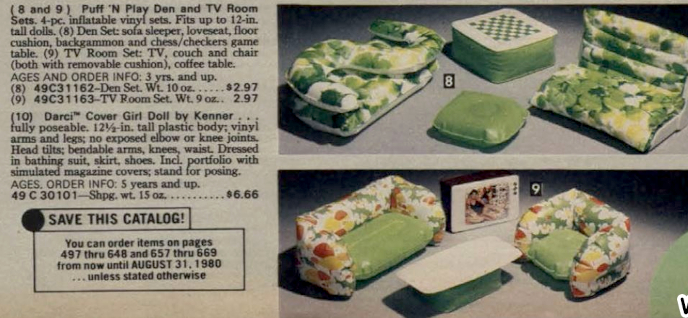
Color catalog entries for two more Puff 'N' Play sets in green and white with flower prints. Top is an armless loveseat, an s-shaped chair pair, an ottoman, and a checkerboard/table; below is a sofa and chair with white-topped coffee table and TV on the floor. Test identifies these as "Puff 'N' Play Den and TV Room Sets." The text IDs the armless loveseat as a "sleeper" so maybe it folds out, the S-shaped chair pair as a loveseat, the ottoman as a "floor cushion." They are each $2.97.
’79 Sears Wishbook, again via WishbookWeb.

Kitchens by Martin Fuchs

Since we covered a different Martin Fuchs room on a previous outing, let’s pause to appreciate the kitchens. Imported from West Germany, in the US they were sold as Montgomery Ward exclusives. A variety of colorways were offered and can be found in the wild today. The following images all come from Christmas.musetechnical,com, our trusted source for Montgomery Ward catalog scans.
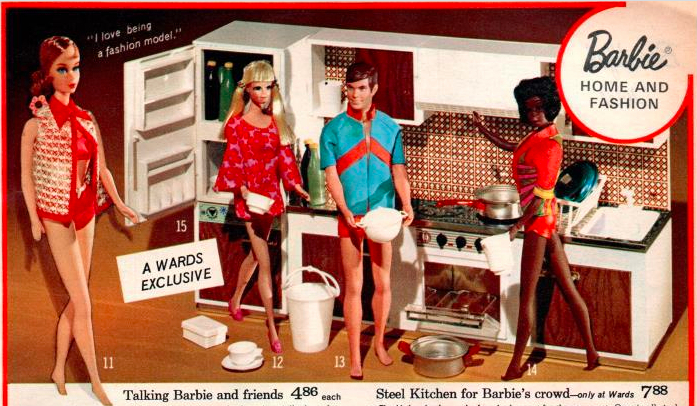
Color catalog entry. Talking Barbie, with Christie, PJ, and Ken stand in front of one wall of a kitchen in white with woodgrain cabinet doors. Dishes are arrayed around them on the floor. A quote, "I love being a fashion model," hovers near Barbie. "Barbie home and fashion" is printed in one corner. The kitchen is $7.88.
From the 1971 Montgomerty Ward Christmas catalog

We hit the ground running with this Steel Kitchen in 1971; by ’72 the kitchen was folding, and “a great place for the young set to congregate.”
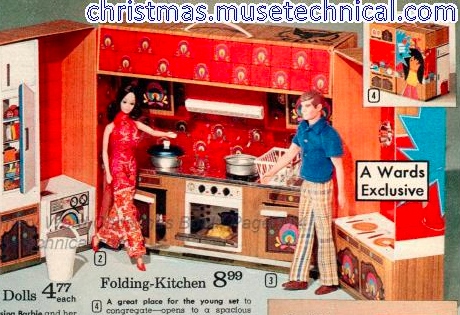
A larger kitchen that folds open from a carrying case, mostly in red; the wings opening out add area for storage and surfaces. The food is no longer on the floor. Folding-Kitchen $8.99.
1972

Throughout the decade, Fuchs offered kitchen makeovers for Barbie almost yearly–the suburban dream in 1960, perhaps just a bit passe by the ’70s.

By ’74 we’re growing facial hair in a “Big new kitchen” with “Florentine design” on its walls. It no longer folds.
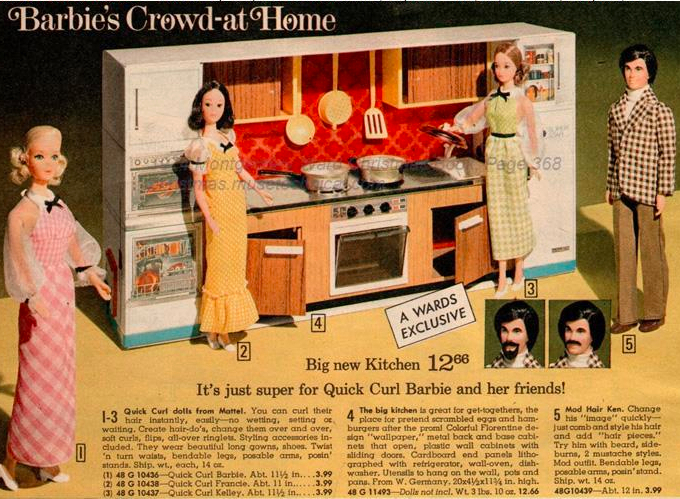
Color catalog, Quick-Curl Barbie, Francie, and Kelley with Mod Hair Ken stand before another one-wall kitchen. This one has no unifying color theme, with a red back wall, light wood look cabinets with darker brown doors, and white appliances rendered on either side. Prices have gone up: "Big new Kitchen $12.66"
1974

In ’75, below left, “the kitchen is where teens gather,” and by ’76 it’s clear Barbie is matching her fashion to her kitchen decor.
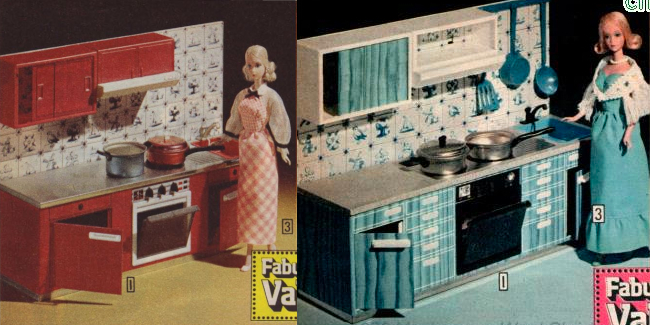
Two more one-wall kitchens, reduced in size from previous offerings. They are the same shape as one another with a floating cabinet and range hood, a printed backdrop, white counter with range and sink over cabines and drawers in the same color as the top cabinet. Left the color is reddish brown, right is teal woodgrain with white trim. Both are modeled by Quick Curl Barbie, at left in her rustic pink dress and at right in a floorlength teal dress with flounce and white crochet shawl.
1975-76

’77’s set, while restrained, could really make the right colorful cookware pop.
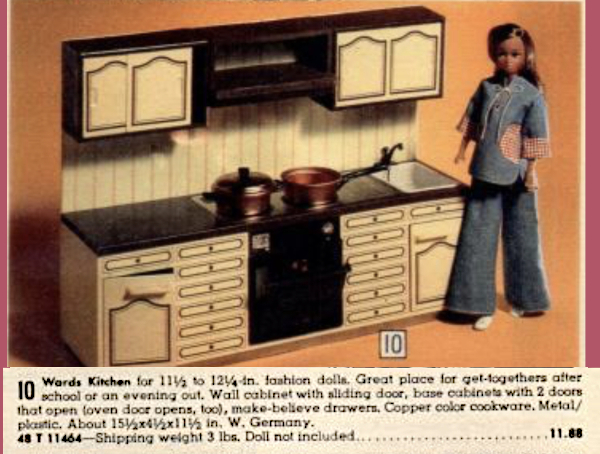
Black-and-white or black-and-cream version of the kitchen for about $12. The counter is black, the backdorp is white wood paneling, and the cabines and drawers are white with black trim. For once, Barbie is not shown; the doll looks like a Maddie Mod or similar, with dark skin, long straight dark hair, and a denim tunic and flared slacks.
1977

Sears Kitchens (1979)

Finally, we’ll toss in this Tabletop Kitchen Center from 1979, advertised in the Sears Wishbook alongside some of the uglier Puff ‘n’ Play furniture.
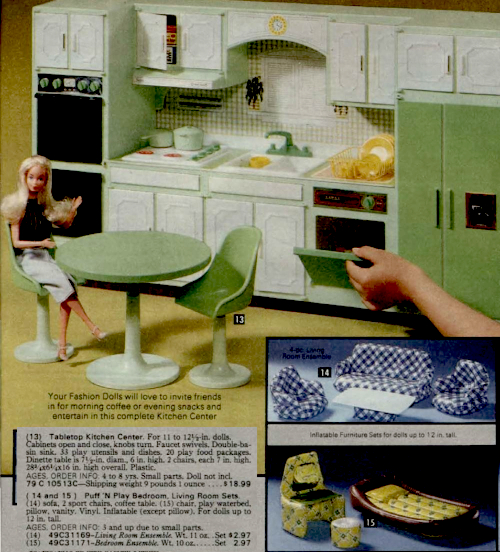
Color catalog image showing most of one page. Blonde Superstar Barbie sits on a tulip chair with white base and avocado green seat, at a circular table with a second chair both in matching style. In the background is one wall of a kitchen, full of white cabinets, two ovens in a dark color, and a dishwasher and two-door refrigerator whose doors match the avocado color. There is a checked splashguard in a neutral tone and yellow dishes stacked next to a double sink. A child's hand reaches into frame to open the dishwasher. In inset panes are one Puff n Play set of vlue-and-white checked couch, chairs, and coffee table, and a yellow-and-borwn inflatable bed (it looks like a pool float) and vanity and stool. There is considerable text:

"Your Fashion Dolls will love to invite friends in for morning coffee or evening snacks and entertain in this complete Kitchen Center."
"(13) Tabletop Kitchen Center. For 11 to 12 1/2-in dolls. Cabinets open and close, knobs turn. Faucet swivels. Double-basin sink. 33 play utensils and dishes. 20 play food packages. Dinette table is 7 1/2-in diam., 6 in. high. 2 chairs, each 7 in. high... $18.99"

"( 14 and 15) Puff 'N Play Bedroom, Living Room sets. (14) sofa, 2 sport chairs, coffee table. (15) char, play waterbed, pillow, vanity. Vinyl. Inflatable (except pillow). For dolls up to 12 in. tall." They are listed at $2.97 apiece.
1979 Sears Wishbook via WishbookWeb

This set may have been manufactured by Wolverine–it’s at least highly similar to one with an orange/brown/cream color scheme sold under Wolverine’s Sunny Suzy label. In the advertised avocado shade shown here, these appliances and the tulip table and chairs make a worthy addition to your midcentury Barbie home.

But be wary of this more-common, less-stylish Sears kitchen which is also dated 1979, with its lawn-appropriate chairs and diminished fridge.
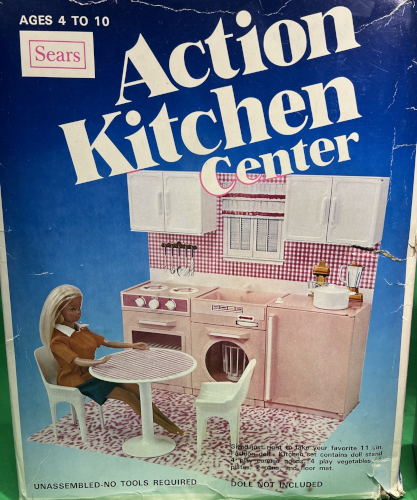
Packaging for Action Kitchen Center as described in the text. The kitchen wall component is smaller, with the dishwasher beneath the sink and a half-sized fridge adjacent; all the appliances and counters are the same sandy pink, while the splash guard and table surface are bolder pink-and-white checks. The chairs are white molded plastic with four legs and armrests like you find outdoors. There is totally unacceptable pink-and-white tiger-striped flooring. Malibu Barbie sits at the table. Text says "Ages 4 to 10, Sears, Action Kitchen Center, Unassembled - No tools required," plus some mostly undiscernable small text including "play vegetables."
Product packaging via crown_point_toys on eBay.

This particular example was marked $7.99 retail, compared to the advertised price of $18.99 for the avocado green set; a satisfactory explanation for the relative commonness of this wallet-friendly offering.

Where to next? This is our most recent post on Barbie’s built environment, possibly forever! Important 70s-room addenda are found in the entries on the Karousel Kitchen, bathrooms, and carrying cases. Way back in the ’60s, rooms and furniture also included the Deluxe Reading Dream Kitchen, Go-Together sets and Susy Goose furniture. Otherwise, the most popular post under the built environment topic concerns penthouse apartments; or head up to the Table of Contents to check out other options.

Leave a comment