
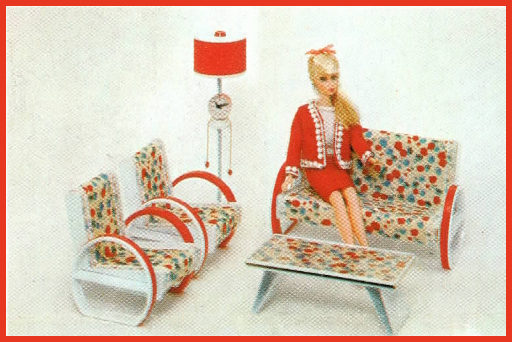
“There’s lots of fun furniture, too!” enthuses a 1967 Barbie booklet produced for the Japanese market. “Desks, chairs, reception sets, and other colorful furniture with a twist. Have even more fun with Barbie! Yellow dress with red chair… your dreams will fill your heart.” (Translation is very approximate.)
And there are pictures, too. Two versions of the booklet, shown above and below, advertise two versions of the “reception set,” both with brightly-printed upholstery and coffee table to match; curious circular armrests; and a funky clock embedded in a floor lamp.
As for the rest of the furniture, we don’t get to see the desks, nor do we see the “other colorful furniture.” What we do see is a startling assortment of chairs, again with variations between the booklets.
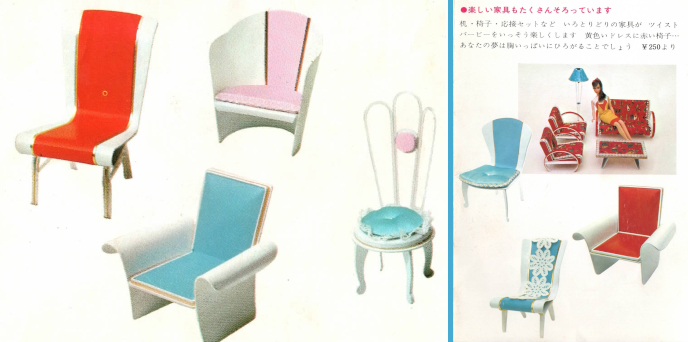
Did all of these variations exist? Did any of them? What about the desks? Keiko Kimura Shibano, in her very thorough book on Barbie in Japan, reproduces the booklets and mentions that the furniture is “very scarce.” The many, varied, and detailed scenes used for the book’s excellent photography do not appear to feature any of this exclusive furniture. Is it out there somewhere?
The book does include one photograph of another Japanese market exclusive: “Twist ‘N Turn Barbie’s Golden Chair Set,” another rough translation, or what Kimura Shibano refers to as the “Twist ‘N Turn Barbie house.” The “house” in question is little more than packaging to hold a doll, chair, and mini TV (the last was also sold in the US in some accessory paks). An advertisement for the set, unearthed on Pinterest and attributed to one ggsdolls, is undated. The doll and fashions shown both in the advertisement and in Kimura Shibano’s photograph of a real set all appear in the ’67 pamphlets, so we can approximately date this set to 1967–but this whole post is approximate.
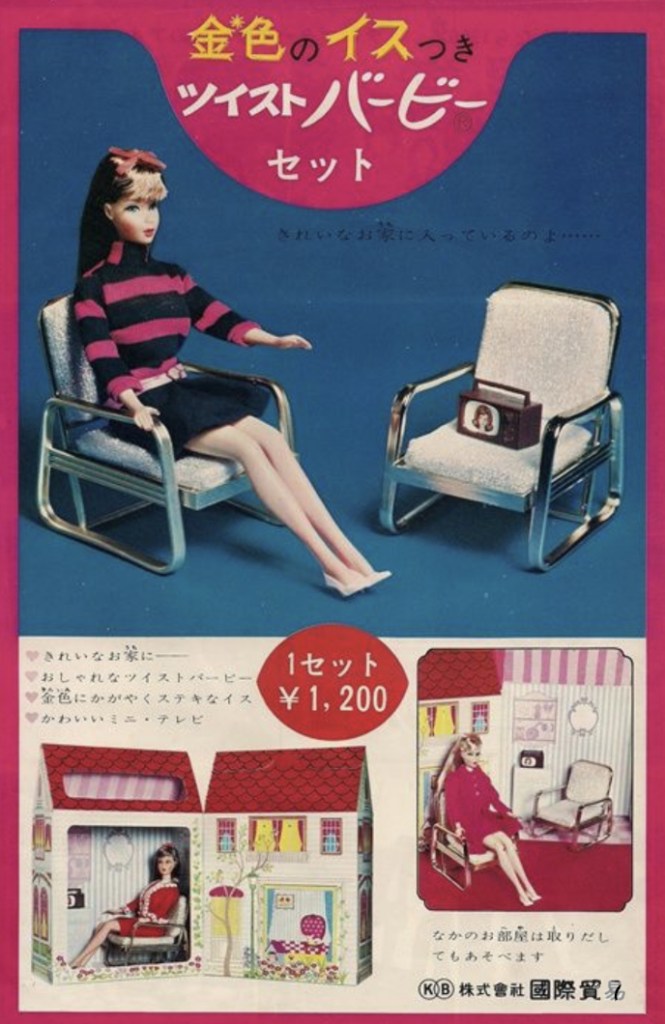
As the advertisement’s images show, in quality the chair was beyond anything available stateside, with convincing chrome look (actually painted plastic) and real upholstery. The silhouette is contemporary, the color palette restrained. Rarely has Barbie reposed in such refinement.
There’s one last Japanese-exclusive furniture item that definitely did exist, though it too is rare. This one could seat two!
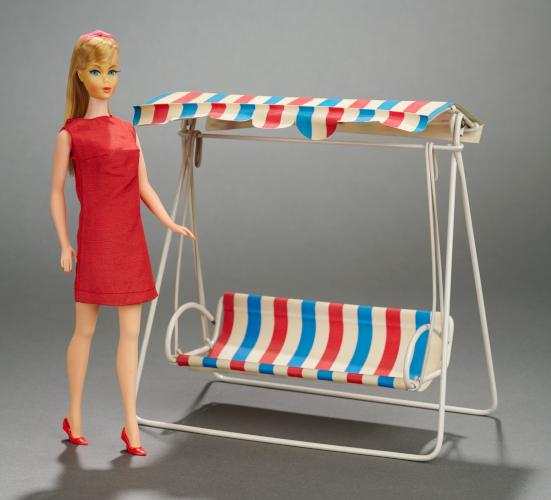
It looks similar to the earlier Go-Together/Miss Barbie lawn swing that was available in the U.S., but while those were plastic with cloth awning and seat, Theriault’s describes this one as a metal frame with vinyl elements. They indicate its year as 1967.
An aside: This piece, once part of Barbie designer and utter legend Bill Greening’s collection, was auctioned off along with many of his treasures. It’s beyond sad that Mattel booted Bill, and I don’t wish to make light of it here. To browse the many rarities included in his Theriault’s auction is simultaneously fascinating and heartbreaking.
But back to the topic at hand. In 1967, Barbie had many places to sit in Japan. We don’t know for sure if she had a desk, as the booklets claimed, but if she did it’s likely she could sit there as well. I’d also like to mention in closing that the T’n’T Barbie who modeled fashions for those ’67 pamphlets was frequently shown sitting on her x-stand. By no means a Japan-exclusive piece, this may have been an exclusive utilization thereof.

Where to next? This post is about Barbie’s early built environment. The most recent post in this category concludes the Barbie’s Seventies Travelogue series, and the most popular are those on Mattel Modern and Susy Goose furniture and on penthouse apartments. Otherwise, the overall most popular posts on this site are about Barbie shoes, 1959-67, and about Mattel fashion booklets. Or just head up to the Table of Contents to see more options.
 Silken Flame
Leave a comment