
Barbie’s early clothing designs, with their period detail and high-fashion perspective, never fail to fascinate. Buried within the illustrations and other ephemera that we browse here are a smattering of alternate-reality Barbie fashions that never quite made it to production or perhaps were never slated for production at all. Almost all that we’ll review here have been featured previously in other posts on this blog; today just felt like time for a roundup.
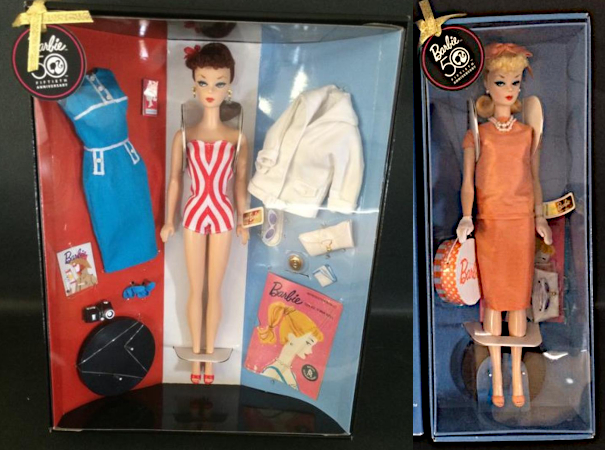
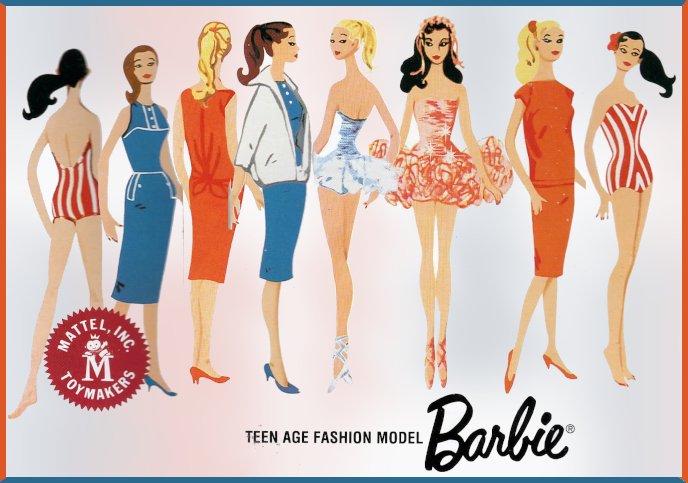
We led off with a collage of sketches from the box in which some of the first Barbies were retailed. While the box art included many of the iconic, original 1959 ensembles, like Gay Parisienne, Evening Splendour, and Easter Parade, about four of the depicted sets weren’t offered. We include the Ballerina fashion in this list because that ensemble didn’t hit the streets ’til 1961, and the box art seems uncertain of the outfits’ eventual color palette and styling. Three others went unproduced until becoming convention exclusives in 2009, shown above. One, a red-striped, strapless bathing suit, I conjecture morphed into Barbie’s well-known black-and-white striped suit. The alignment of the fabric to form a chevron pattern is reminiscent, and a second such swimsuit in the earliest slate of fashions would have been beyond repetitive. Regarding the teal sheath with baggy jacket, if I’m right in thinking it’s got some nautical flavor, it may have been supplanted by Cruise Stripes/Roman Holiday, which are absent from the box art. (An aside: I think Mattel designer Robert Best tried to recreate this bizarre parka-and-pencil-skirt combo during his Project Runway season. The judges weren’t having any of it.)
The disappearance of the peachy-colored, drop-waisted chemise, on the other hand, may have quite a different explanation: when the ’20s-style silhouette was revived and updated by the French couture in 1957 it was widely lauded, but its subsequent decline and fall was so sharp that fashion designer and fit-and-flare aficionado Anne Fogarty delivered a postmortem just two years later in Wife Dressing (1959), claiming the easy-wearing garment’s popularity was quashed by dismayed husbands who required their wives’ curves to be always on display. The following year Eve Merriam devoted a full chapter of Fig Leaf (1960) to the sack dress phenomenon, attributing its fall from favor to overhype and oversaturation. Whatever the reason, by Barbie’s 1959 debut the chemise had met its demise. (It was really just ahead of its time, as the shift dress was integral to Swinging London and the Youthquake felt ’round the world.)
Before moving on, it would be irresponsible of me not to point out that the box illustrations show closed-toed shoes almost exclusively. (The image atop this post teases but a sampling.)
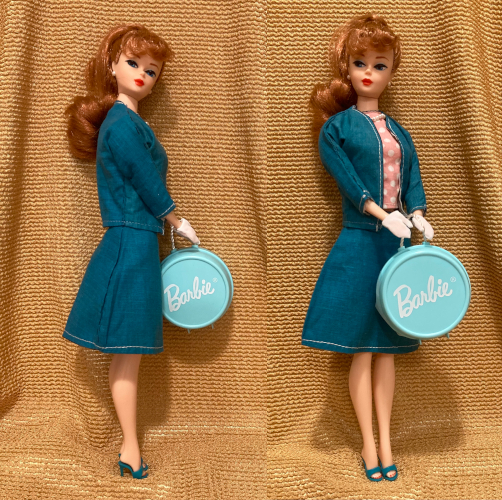
1959’s Commuter Set is also not included on the retail box art, but it was depicted on some of the Ponytail carrying cases with (c) date of 1961, after Commuter Set had already been retired. Below left, we see the fashion booklet rendering of Commuter Set alongside a matching image from a carrying case.
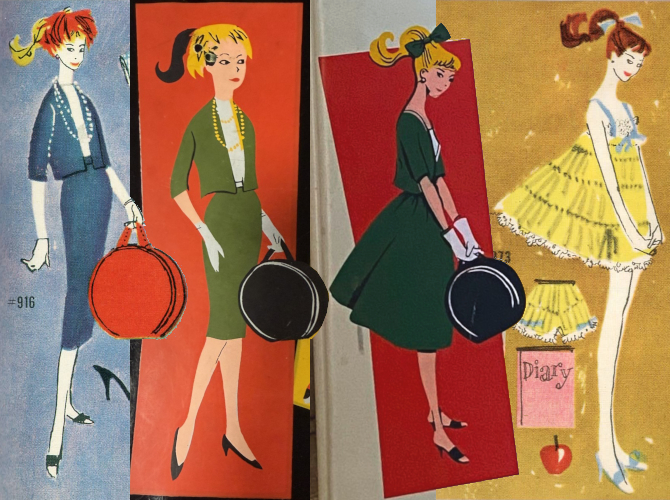
Other carrying cases, as above-near-right, instead show a similar fashion but with full skirt and a pose that seems based on that used for Sweet Dreams in the booklet (above right). I imaginatively dubbed this the Carrying Case Fashion in an earlier post. Was it a planned Barbie ensemble? Unless Commuter Set infringed on someone’s copyright or something, which seems impossible, I see no other reason to have swapped its illustration out. The fact that the new fashion evidently doesn’t have its own pose, though, might argue that this offering was never planned. We may never know for certain.
Barbie’s paper doll sets were full of fashions both real and imagined. In my review of the pre-1966 paper dolls, I pointed out an interesting After Five variant, below left, in a set that otherwise showed real, produced Barbie fashions. Could this adjusted style have been conceived and considered for the real fashion? It’s worth pointing out that BillyBoy* noted the compelling similarity between the official After Five and a Dior design that has no sheer overskirt and which may have inspired After Five exactly as manufactured.
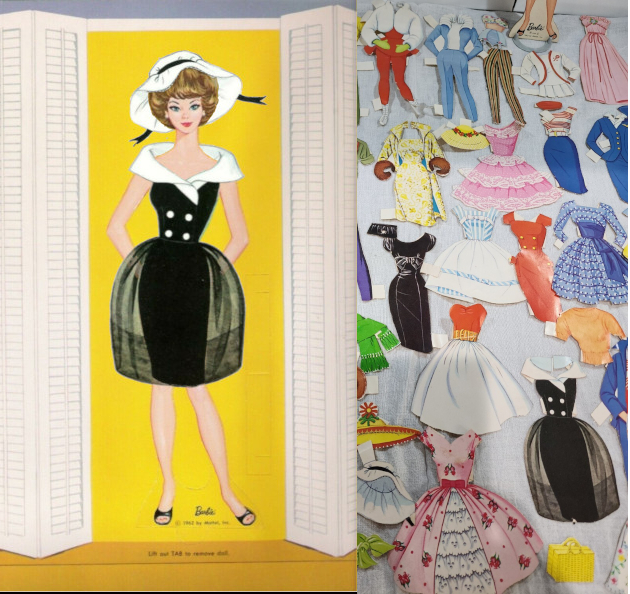
Another paper-doll-based possible variant arose for Midge, among mostly real and accurate ensembles, when Sorority Meeting was rendered in baby blue. However, there are so many, many paper doll sets that include no actual Barbie ensembles, or a clear mixture of the real and fantastic. It’s possible that no paper doll set ever teased an unproduced Mattel design, either considered and changed or considered and discarded; these may simply be flights of fancy.
The first advertisements for Barbie’s celebrity friend Julia, appearing in fashion booklets dated 1968, didn’t show her in her nurse’s uniform, nor in the later Mattel fashions for Julia, but instead in this unknown, sparkly pink dress.
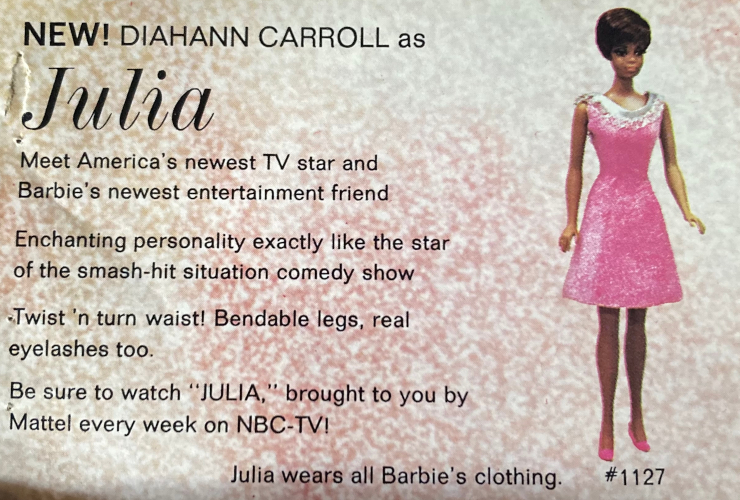
Unlike carrying case and paper doll fashions, this design certainly did exist as a prototype doll outfit since we have its photograph. It may share some DNA with the dress from Velvet Venture, always stunning on Julia and Christie. However, that dress is more salmon and gold than bubblegum and silver, and its high neckline has but the narrowest metallic trim.
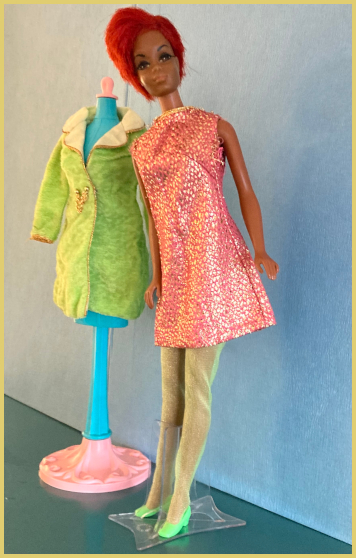
Next up is a cool new-to-the-blog fashion that wasn’t, from a mod-era carrying case dated 1968. The photo below shows Barbie doll in a fan-made version of the dress drawn for the accompanying case. Theriault’s recently auctioned off the doll and its casespiration as a lot.
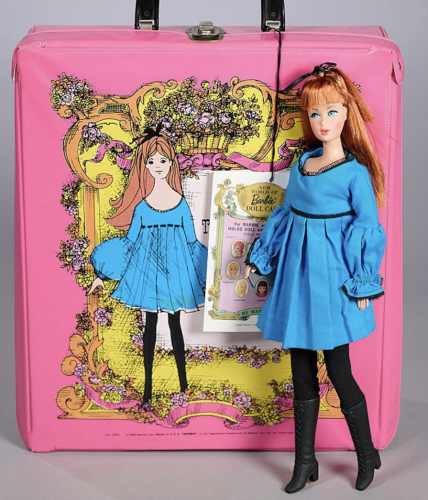
Of all the fashions herein, this is the one I’ve suspected most strongly was never planned for production. The below collage shows other carrying cases and case rooms, all from 1968, all in the same art style, all with fabricated fashions…
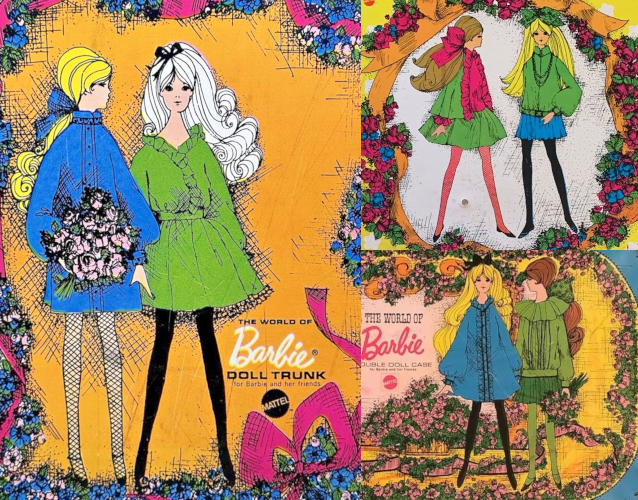
…with the glaring exception of Fancy Dancy, worn by Stacey in the top right image. That ensemble’s presence raises a big cloud of uncertainty around all the rest. The date of these cases coincides with a time when Barbie was getting a major fashion overhaul, so it may be that the illustrations do represent early design concepts.
What about this Jamie case room from 1970, illustrated in a totally different style? Jamie’s clearly wearing her genuine attire, while Barbie is wearing… nothing I recognize. A planned fashion or the illustrator’s creative license?
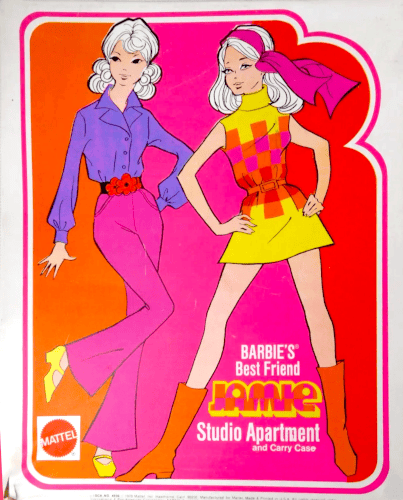
About half the time when I think I’ve spotted a fashion-that-wasn’t on a carrying case, in a catalog, etc., it turns out to be a real Mattel fashion shown without a coat or other outer layer, or else just something I couldn’t place; this design in particular seems like one I could have overlooked. Any leads?
Before we finish up, here’s one semi-fashion-that-wasn’t for Francie, from the 1966 Montgomery Ward Christmas catalog:
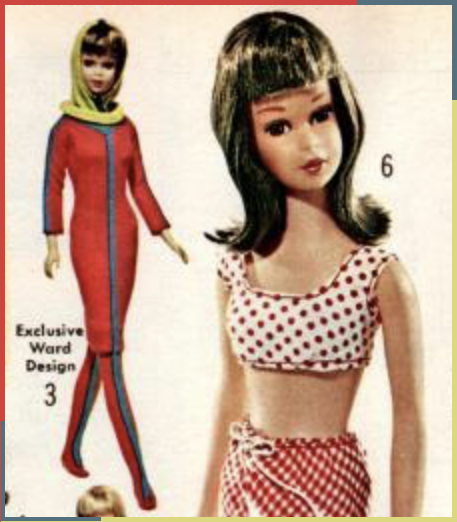
Yes, Swingin’ Skimmy did and does exist, but for some reason the one photographed for this catalog–perhaps the only place to see it advertised for the US market, since it was a store exclusive–shows added trim, like that running down the front of the shift, also adorning the stockings and sleeves.
Is this a prototype, or could someone have restyled the doll for catalog photography? (If so, why!?) In Japan Swingin’ Skimmy was not a store exclusive and is accurately represented in the ’67 Japanese fashion booklets. Furthermore, Joe Blitman, via Miller’s Magazine, has shown a production sample with differently-colored trim, but without any extra trimming. On that topic…
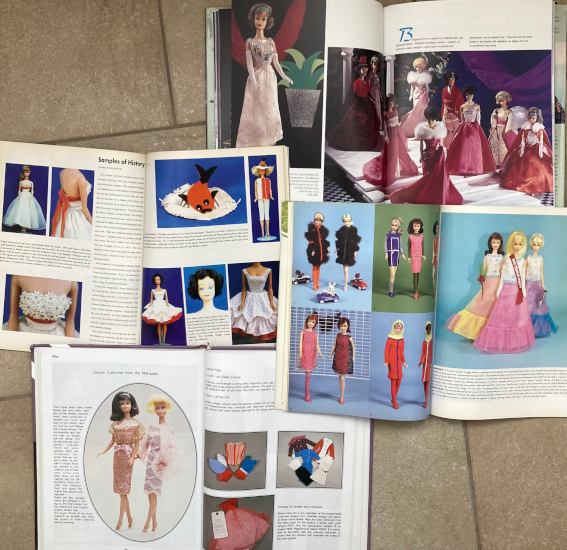
Today we’ve focused on designs that were customer-facing, on packaging, advertising, and licensed products, but didn’t see the light of day as realized Barbie clothing for whatever reason. The overall subject of unproduced designs is much richer than just these few examples: collectors have unearthed many over the years. The book Barbie in Japan by Keiko Kimura Shibano includes factory samples that were retailed in that market, while Sarah Sink Eames’ guides show heaps of samples made by Mattel’s designers that subsequently underwent changes or were scrapped completely. More have popped up in magazines like Miller’s, at auction, and in various other places. Carol Spencer’s book even shows the sample costumes she made for her Mattel job interview, which apparently were never considered for production (such a shame!).
Where to next? This post is the most recent of our miscellaneous musings. The top post in this category is the one about shoes, also linked above. Other top posts are one on fashion booklets and some from the Many Abodes of Barbie series. Or swing by the table of contents to choose from other options.


Leave a Reply