Barbie-sized Mannequins & Dressforms (1963-73)

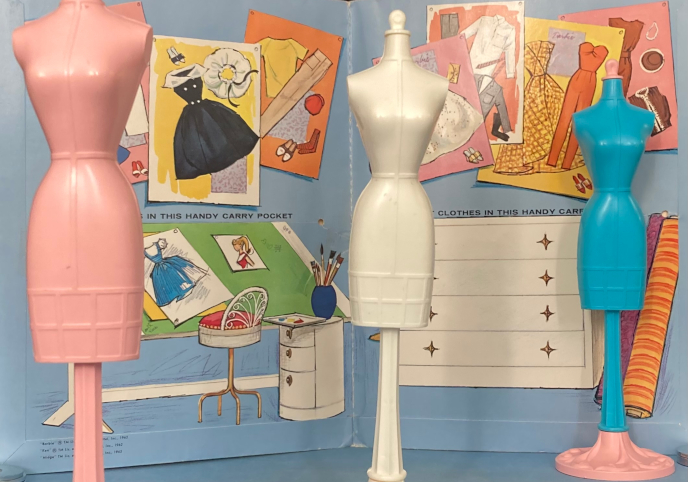
Three Barbie-sized plastic dress forms stand in a row, one pink, one white, and one blue, in front of a paper doll folder that stands propped up, illustrated with scenery from a fashion designer's studio.

Ever feel like displaying your vintage and nostalgic doll fashions on something besides the dolls themselves? If so, the vintage Barbie era had a range of interesting options to do so. In fact, the boxed doll fashions were lovely displays all by themselves, and many collectors recreate this aesthetic with their own frame boxes; but today we’re thinking of something more figural, freestanding.
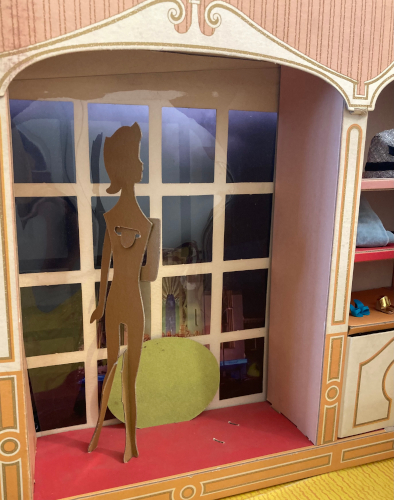
A cardboard silhouette of a ponytailed female figure standes before a darkened window of cellophane crisscrossed by off-white chipboard to form panes.

The first Mattel offering in this category must have been the mannequin sold with the Fashion Shop starting in 1963, with its elegant, deceptively simple design. The figure is cut from chipboard in two pieces: the main body, plus a removable pair of arms instrumental for maneuvering long-sleeved tops onto this otherwise inflexible figure. As we’ll see, the Fashion Shop mannequin is unique in this category for its ability to wear pants. Tabs on the figure’s feet slot into spaces in the floor of the shop window–two such positions for the single included mannequin, but luckily it’s not too hard to make or purchase extra pieces–and stability is cleverly provided by a crease in the lower leg that lends dimension and sturdiness to the figure base.
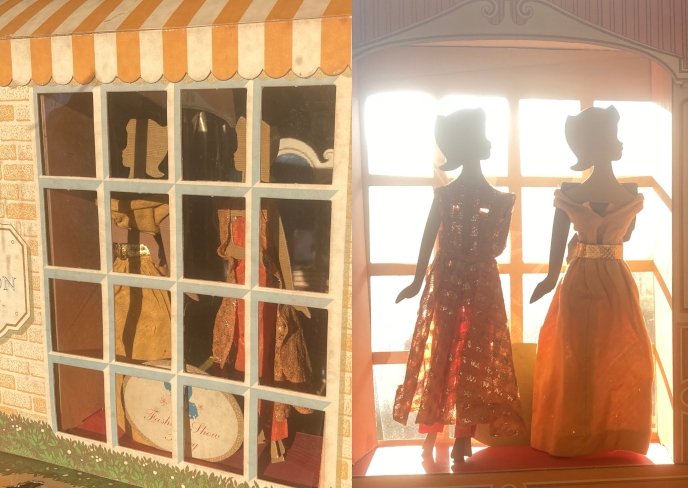
Two of the ponytailed cardboard sillhouettes stand before the window, now drenched with sunlight. They are dressed in Barbie's Dinner at Eight and Golden Evening fashions. One view shows the shop from outside, and the fashions from the front; a second shows them from the back, from within the shop, from which angle the sunlight washes out the fashions' colors.

Mattel could have given the mannequin, like other chipboard pieces in the play set, detail through screening; perhaps rendering a face, hair color, skin tone… but bare chipboard is very effective at differentiating this lifeless piece of scenery from the doll characters populating the world around it.

Barbie went shopping next in 1971 at the Unique Boutique, with a fresh riff on the store mannequin: a narrow stand topped by the bust of a cartoonish character, similar in style to a paper doll. This version lacks qualities that so disarmed us in the Fashion Shop: the face and hair are stylized but lively and fairly detailed, unlike the featureless slate of the Fashion Shop mannequins; and while you maybe could swing a pair of pants from this frame, hanger-style, it doesn’t don them. Still, the Barbie-like illustration is charming, very 1970.
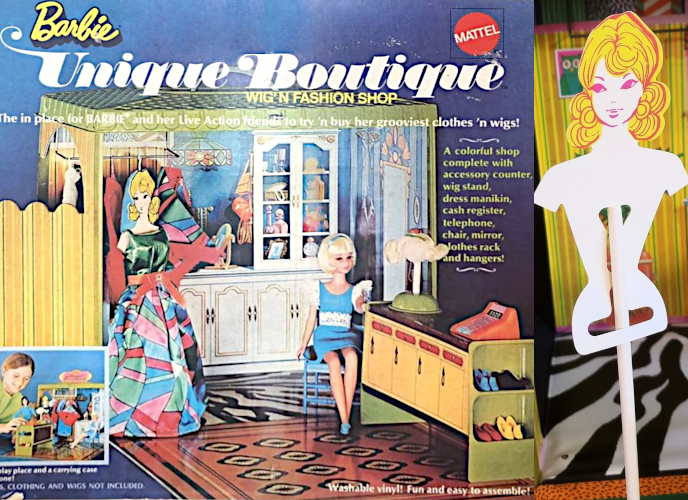
Two panels. Left is the Unique Boutique box which shows the shop opened out, with Francie seated next to a counter with a hatstand and register, and across from ther the mannequin, a flat carboard piece illustrated with the face and head of a woman with curly yellow hair attached to a coatrack-like base, swearing a long dress with a metallic green bodie and a multicolor skirt with stained glass mosaic print. At right is a closeup on the mannequin sans clothing, showing Venus de Milo arm stumps and the coatrack base. The dolls face is detailed in pink ink in this shot.
Via Pinterest, the Unique Boutique store mannequin displays Rainbow Wraps on the product packaging at left. At right, via Worthpoint, a closeup of the mannequin declothed.

Screened onto the Unique Boutique walls are other, headless interpretations of the store mannequin, bringing us closer to the orbit of the dress form.
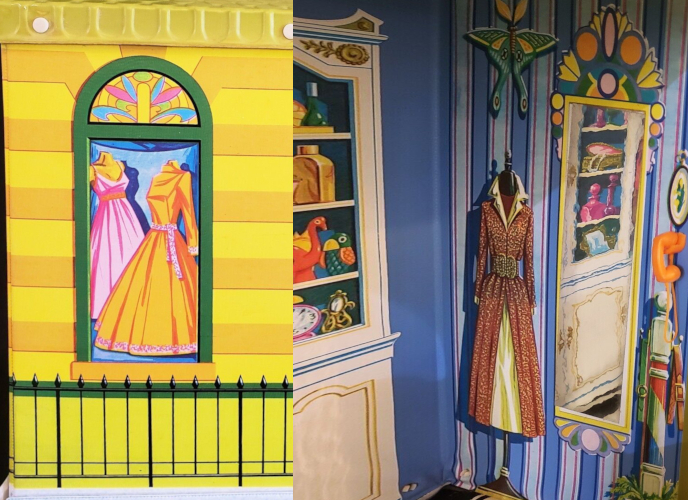
Details of the Unique Boutique playset's vinyl walls. First panel, an exterior of yellow wall with a window in which two dresses: one sleevelss and pink, one long-sleeved, orange with pink trim, are on headless yellow mannequins; the second, an interior shot of striped blue walls, a long mirror that actually reflects the adjacent shelving illustration, and (still illustrated) a black dress stand with a know atop the next instead of a head, and displaying a belted animal-print coat over a white or off-white skirt.

Close kin of the store mannequins, Barbie’s dress forms were sold with crafting kits, used for constructing and/or decorating garments off the doll. The first Mattel dress forms arrived in ’66 with the Color Magic Fashion Designer set. One variant was blue trimmed in pink, the other pink trimmed in blue. Both appear in contemporary advertising materials and can be found in the wild today (find examples at the top of this post).
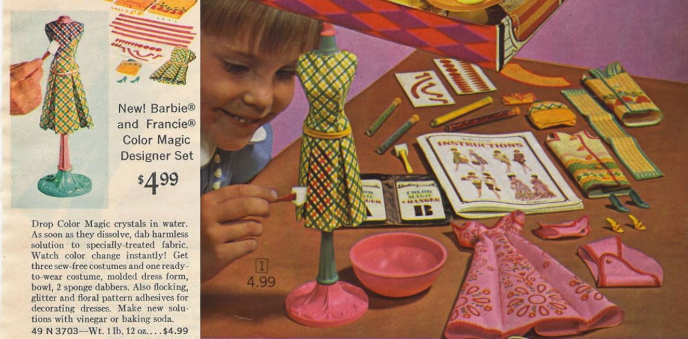
Two color images from catalogs. Both show a Color Magic Fashion Designer Dress--yellow sundress with blue and green checks--being swaabbed with chemicals to change its colors to red and blue. In the righthand images, the Sew Free Color Magic garments are assembled and lying around: a hot pink ballgown with stole and two yellow shift dresses with orange and green trim. There are also closed-toed heels in yellow and green and various stickers and things for decorating the garments. The lefthand image includes text: New! Barbie and Francie Color Magic Designer Set $4.99; Drop Color Magic crystals in water. As soon as they dissolve, dab harmless solution to specially-treated farbir. Watch color change instantly! Get three sew-free costumes and one ready-to-wear costume, molded dress form, bowl, 2 sponge dabbers. Also flocking, glitter and floral pattern silhouettes for decorating dresses. Make new solution with vinegar or baking soda.
The Color Magic dress form was pink with a blue base in the Sears Wishbook at left and blue with pink base in the JC Penney one, both from 1966.

The mold was reused for an all-white form bundled with the Sew Magic kit in the 70s (and also pictured at the top of this page). Of all the dressforms and mannequins discussed herein, these are probably the most common today.
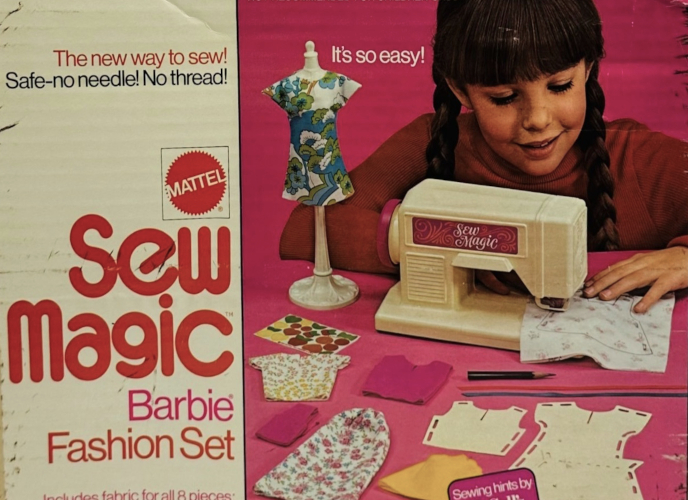
1973 Sew Magic packaging via Pink Paris Flamingo on ebay

Offbrand Barbie-sized mannequins and dressforms are fair game for this blog, but I found none in the period 1959-1975. A word of caution to other seekers: don’t fall for the Little Charmer Dress Designing Kit, which advertised a 12″ tall dressform without mentioning what size doll corresponded. This dressform is enormous compared to Barbie, and even compared to her larger rival Tammy.
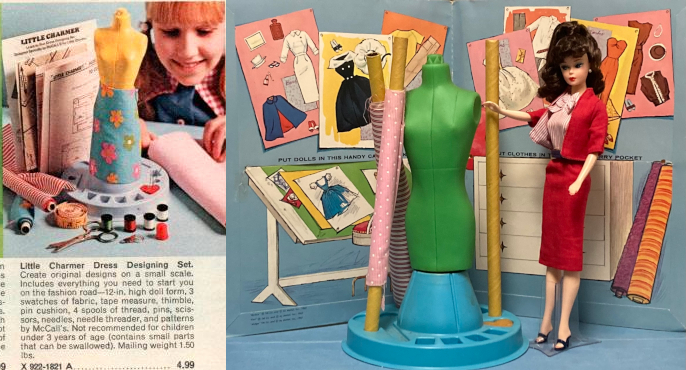
Left is a color catalog image showing a doll-sized, yellow dress form wrapped with a blue floral fabric at skirt height. Around it are small rolls of fabric (pink, blue, and red-and-white striped), thread, scissors, paper patterns, and a needle threader. A smiling child fingers one of the fabric rolls at the back. Text says: "Little Charmer Dress Designing Set. Create original designs on a small scale. Includes everything you need to start you on the fashion road--12 in. high doll form, 3 swatches of fabric, tape measure, thimble, pin cushion, 4 spools of thread, pins, scissors, needles, needle threader, and patterns by McCall's. Not recommended for children under 3 years of age (contains small parts that can be swallowed). Mailing weight 1.50 lbs.... 4.99"
Right is a photograph in front of the same paper doll folder as the top image in the post, this time showing a nostalgic fair-skinned, brunette ponytail Barbie doll in a red skirt-suit with red-and-white striped blouse standing next to a green dressform that is about her height but only modeling a figure from about knee to neck--in other words, the full scale figure the form represents would be about half again as tall as Barbie. Its bust, hips, and waist all seem about twice as wide as hers. The form is encircled by little fabric rolls on cardboard tubes: one red-and-white striped, one pink with white polka dots, and one bare cardboard tube.
Expectation vs. reality: the Little Charmer doll form in a ’72 JC Penney catalog (L) and looming large beside the Busy Gal Barbie reproduction. The form came in at least three colors.

While our focus is vintage collecting, mannequins and dressforms themselves haven’t evolved too much over time, and newer pieces may also suit our vintage displays. Duly noted, we won’t dwell on these.
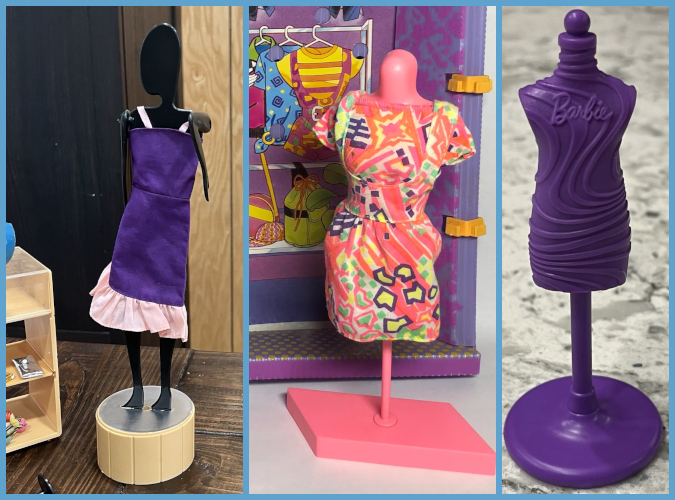
3 panels showing later mannequins. Left is a black plastic molded form that is flat, 2D like a gingerbread person, but with its head and arm angled out for a 2.5-D effect. It has two legs inserted into a round base. It wears a purple sundress with wide ruffle bottom and stands next to a store counter that is mostly out of the frame. Center is a bright pink dressform with trapezoidal base, wearing a splashy, bright abstract-patterned dress in neons and standing before an illustrated clothing rack on a purple background. Right is a purple dressform with a psychedelic swirl pattern texture and the Barbie signature across the chest.
L-R: Mannequins from 1983 Sears Fashion shop and 1991 Barbie Fashion Mall; unidentified Y2K-look Barbie mannequin. From sellers on ebay, Etsy, ebay.

Where to next? This post is about Barbie’s early environs, and specifically early furniture. The next-most recent furniture post on this site is about the Japan-exclusive furniture of 1967; the most popular is about Mattel Modern and Susy Goose, while the most popular overall post is about vintage Barbie shoes. Find backdrops for your vintage and nostalgic Barbie dioramas in the Go-Together furniture sets, the built environments of vintage Barbie paper dolls, and the Lively Livin’ House. Or head up the table of contents to see more options.

Leave a comment