-
Welcome!
Thanks for swinging by my vintage Barbie fan site, where you’ll find articles on Barbie’s built environment, Barbie illustrations, vintage rival and clone dolls and playsets, and miscellaneous musings/deep dives. What are you looking for?
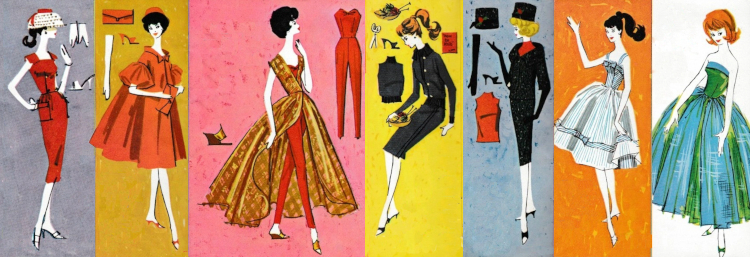
Vintage Barbie Illustrations
- Mattel fashion booklets, 1960-67 (approximately)
- Basic and Dressed Doll Boxes, 1959-64
- Doll Carrying Cases, 1961-72
- Jumbo Trading Cards, 1962
- Gift set art, 1960-70
- Illustrated fashion packaging, also about 1960-70
- Random House books (plus some from other publishers), 1962-65
- Dell Comics, 1962-63
- Whitman Paper Dolls, 1962-65 and 1967-73
- Whitman Coloring Books, 1962-65 (A mod sequel post is possible but not planned at this time.)
- More crafts and hobbies, 1963-1971
- Queen of the Prom board game, 1961-63
- Keys to Fame board game, 1963
- Sew-Free Fashion Fun Kits, 1965
- Sewing Patterns, 1962-?
- The Barbie World of Fashion board game, 1967
Plus the illustration “sidebars,” short entries on niche topics:
- Busy Gal fashion sketches, 1960
- Barbie Sings!, 1961
- Go-Together furniture sets, illustrated
- Color Magic, 1965-66
- Mattel fashions for Julia, 1968-69
- All the Barbie and friends illustrations on mod house exteriors like the one below
- Miss Lively Livin’ board game, 1970
- Window shopping, illustrated
- Barbie’s Baggage, illustrated (not super short, but surveys many illustration categories examined in other posts)
- Vintage dress-up and other child-size items for the boudoir
- The illustration component of the 1964 Little Theatre and travel costumes entry is sidebar-sized.
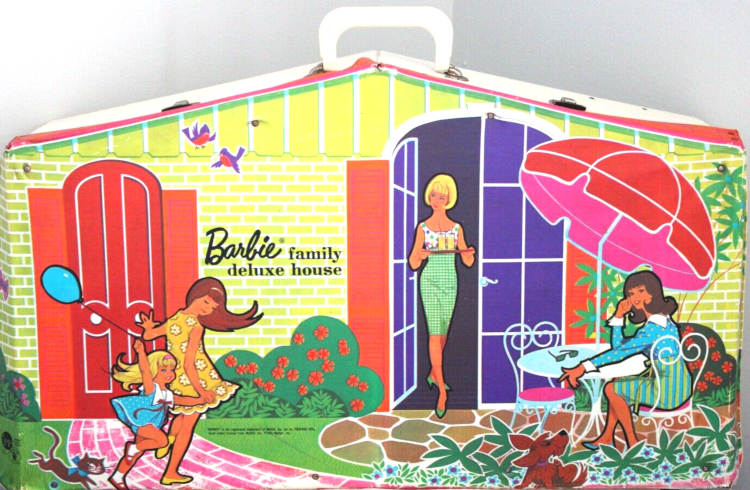
Barbie’s Built Environment
- Entries by year for many of Barbie’s early abodes: 1962, 1964, 1965, 1966, 1967-68, 1969, 1970.
- Barbie’s ’70s Travelogue: Part I, Part II, Part III, Part IV.
- Mattel Modern and Susy Goose furniture, 1958-1966
- Barbie on TV, a roundup of some of Barbie’s early toy TV sets (this post also has a strong “illustration” component)
- Barbie’s Fashion Shop, 1963
- and a detour into Mannequins and Dress Forms, ’63-’73
- The Deluxe Reading Dream Kitchen, 1963 (note, this is not a Mattel product)
- The Little Theater, 1964
- Skipper’s Schoolroom, 1965
- Penthouse apartments, 1964-76
- Beauty parlors, 1964-77
- Japan-exclusive furniture, 1967
- Unique Boutique and Cafe Today, both 1971
- The Sears Karosel Kitchen, 1971-1976 (note, this is not a Mattel product)
- A roundup of fireplaces in Barbie and Barbie-sized houses, 1963-79
- The “built” environments of Whitman Barbie paper dolls, which real Barbie dolls can also use; 1963-1973.
- The built environments of mini vintage Barbies
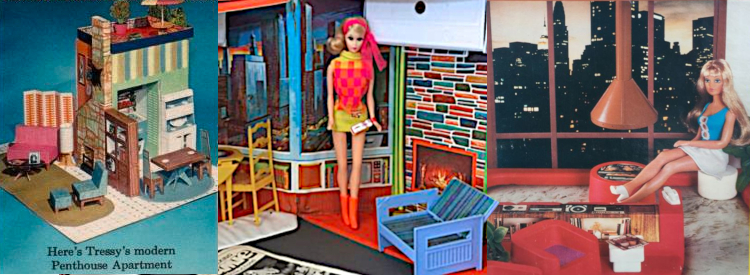
Articles relating to clones, rivals, and off-brand Barbie-style products
- Rival fashion booklets
- The Two Abodes of Tammy covers the living spaces of one of Barbie’s most notable rivals
- Barbie’s ’70s Travelogue, Part II: Unofficial Adventures is about non-Mattel playsets suitable to Barbie and Barbie-sized dolls
- Clones are recommended in the “existing alternatives” section of the musing, Three Nostalgic Black Barbies We Need (and a few existing alternatives).
- Clone kitchens: The Deluxe Reading Dream Kitchen, The Sears Karosel Kitchen
- Clone washrooms are prominent in Barbie’s ’70s Travelogue: Part IV.
- The pieces on penthouses, beauty parlors and fireplaces include non-Mattel offerings.
- Not Barbie on TV: Barbie and friends’ early TV sets that were tuned to other programs
- The entry on Mattel Modern and Susy Goose furniture includes some offbrand furniture items of the 70s and 80s.
- We wrote about clone carrying cases, including some created for competitor dolls.
- Certain of the sewing patterns are for generic fashion dolls, as are the Sew Simple and Cut ‘n’ Sew craft kits.

Miscellaneous Musings and Deep Dives
- A Chronicle of Barbie shoes, 1959-67
- Barbie’s Seventies Travelogue: the Appendix reviews vintage and nostalgic Barbie and Barbie-sized luggage options
- When Barbie Turned 21 in Manhattan, 1980
- Three Nostalgic Black Barbies We Need (and a few existing alternatives)
- Great Books for Vintage Barbie Fans
- The piece on Skipper’s Schoolroom includes “play sets that never were”: Barbie’s Sixties careers for which environments were not produced.
- Visions of After Five (1962) and Solo in the Spotlight (1960)
- Who wore it best? pairs vintage and mod Barbie and Francie fashions with their likely or confirmed inspirations. The Airborne edition does the same for vintage flight attendant uniforms, while the Mary Quant one highlights Francie fashions that appear influenced by Swinging London designer Mary Quant.
- Millennium Mod catalogs Barbie’s returns to the late Sixties youth-driven zeitgeist between 1980 and 2020.
- We tackle an age-old mystery with our investigation into Sew Free? Sew Magic? Sew Simple? Cut ‘n’ Sew??
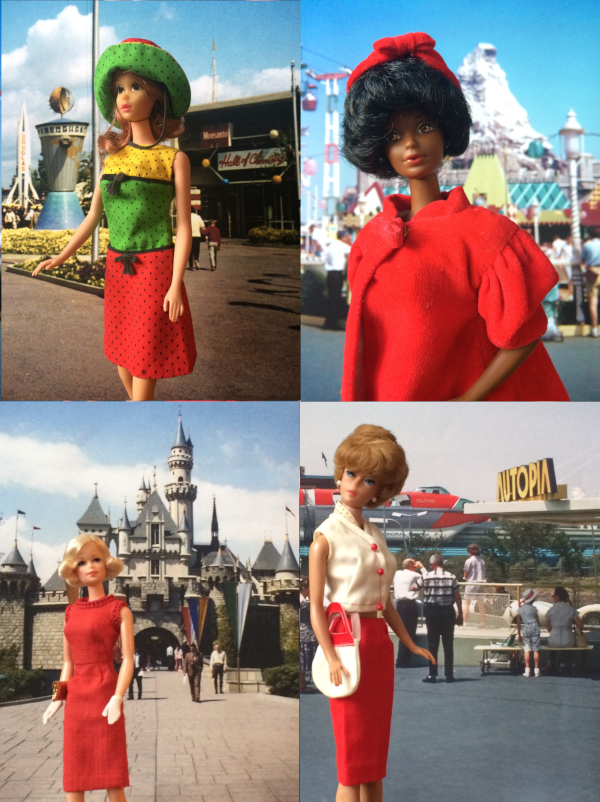
There’s still more to come, but before you scroll off into the distance, here’s the first image ever posted to this blog back in 2022: some of my dolls, dressed in vintage or vintage reproduction, in front of vintage Disneyland backgrounds belonging to Bill Cotter:
-
Gift sets Galore (1960-1970)
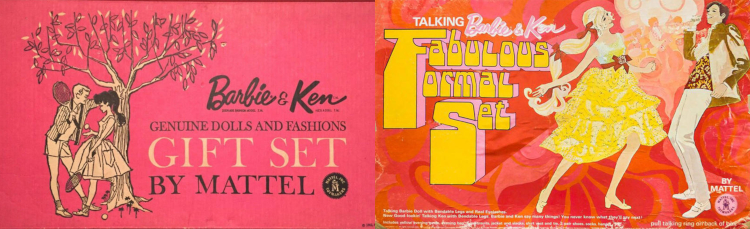
Barbie and Ken star in a 1962 Tennis Gift Set (left) and a 1969 Fabulous Formal Gift Set. See these images and others at full resolution over at Pink Fashion Doll. Could there be any controversy? Gift set packaging is the vintage Barbie art category most likely to make a good calendar.
Consider:- Many lush, color images
- Already an appropriate scale (12″ or so tall; many are roughly square)
- It would be fun to map gift set illustrations to seasons and holidays
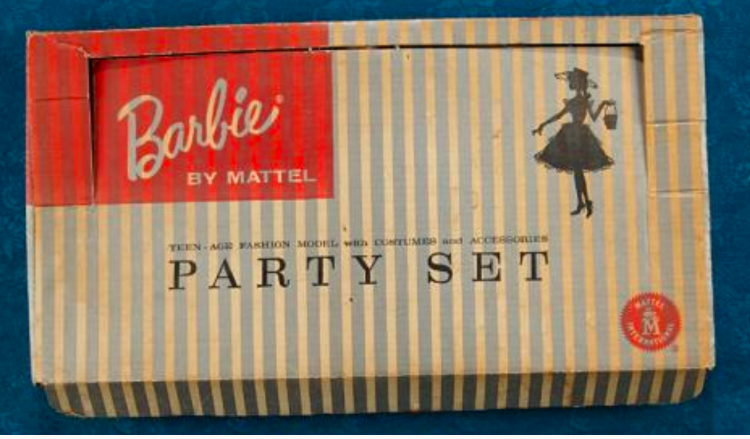
1960 Party Gift Set packaging. Source: Theriault’s. The earliest sets had “discreet” packaging, for sure; apart from a single silhouette they weren’t really even illustrated. Still, the early “Party Set” box above is our pick to kick things off in January.
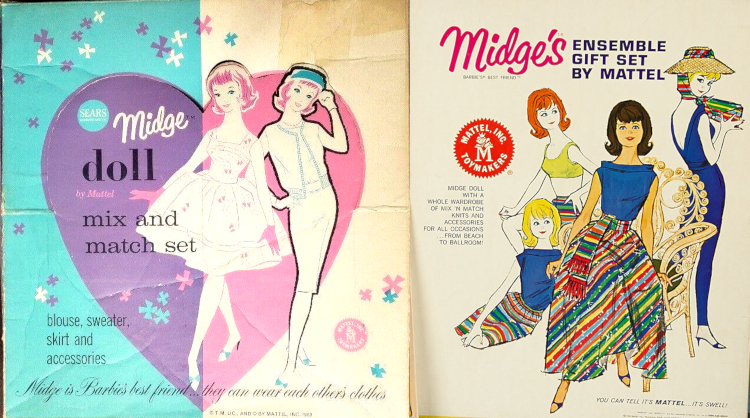
Two Midge gift sets from 1963. Sources: brendassouthpacificplace on eBay, Theriault’s. Next up is a Midge double-header. For February, the Midge Mix and Match Set demonstrates what we call the “sketch-collage” style; another example is the Tennis Set at the top of the post. The illustrations have a technique and sophistication similar to the early carrying cases, supplemented by some simple decorative flourishes.
Following on the heels of the “sketch-collage” style in the package design timeline is the “superior fashion booklet” style, as we see on Midge’s Ensemble Gift Set, above right. These illustrations are close relatives of the contemporaneous fashion booklet ones, but with a little more scenery and more complex layouts; the Little Theatre Gift Set provides another example.
April brings our personal favorite instance of “superior fashion booklet” style on a vintage Barbie gift set, this brightly-hued ‘Round the Clock set:
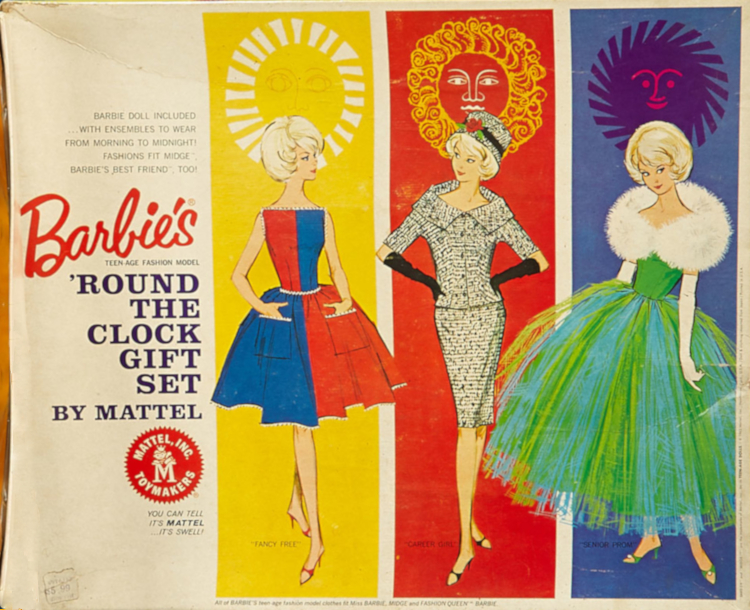
1964 Barbie’s ‘Round the Clock Gift Set. Source: Theriault’s. We’ve heard time and time again that canonically, Barbie and Ken never married. However, Mattel’s products didn’t match that messaging in the early ’60s, when they repeatedly released trousseau sets and eventually this 1964 Wedding Party set for the lovebirds:
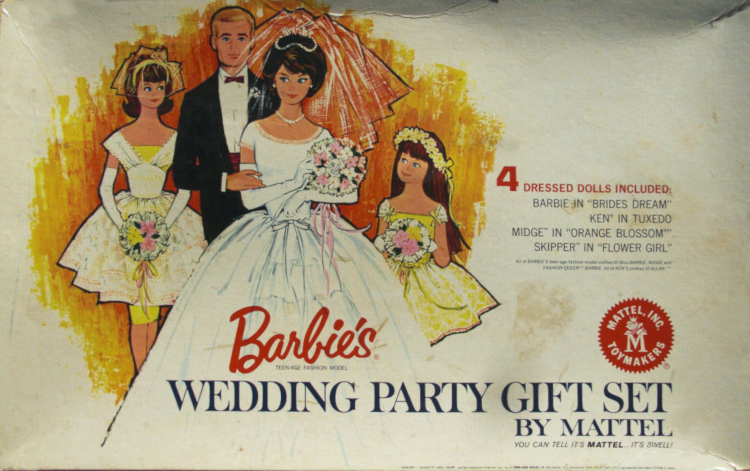
Definitely not married. Source: Pink Fashion Doll. Trousseaux and wedding gowns were common among the creepy, baby-proportioned fashion dolls that preceded Barbie, which may explain this trend–Barbie’s very first trousseau may even predate Ken. Anyway, this packaging, our pick for a May non-wedding, is still in the “superior fashion booklet” style, but also alludes to a loose, marker-y style similar to the Sew-Free Fashion Fun Kits; that look, which we’re calling “courtroom portrait” today, is fully embodied in one of the trousseau sets.
Through 1965, the gift sets consisted of garments and accessories also available in other sets, either paks or ensembles, perhaps with a few add-ons (some dishware in the Hostess Set; a tiny ring on a pillow in Wedding Party). In the second half of the decade that all changed, along with the advent of a package illustration style we simply call “sumptuous.”
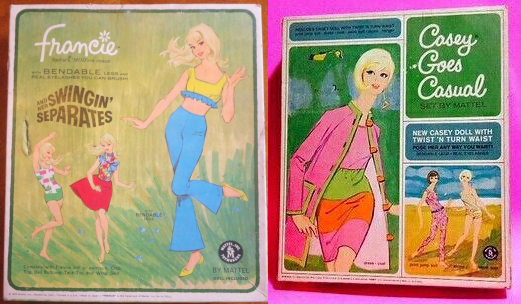
1966 Francie and her Swingin’ Separates; 1967 Casey Goes Casual. Sources: Pinterest, Worthpoint. The grassy imagery in Francie’s 1966 Swingin’ Separates set is perfect for June, and 1967’s Casey Goes Casual, with its scene of Francie’s jelly-torsoed friend dancing at the beach, is a worthy follow-up for July. These are early-sumptuous illustrations, filling the space with scenery and detail but not quite as ambitious as the high-sumptuous illustrations still to come:
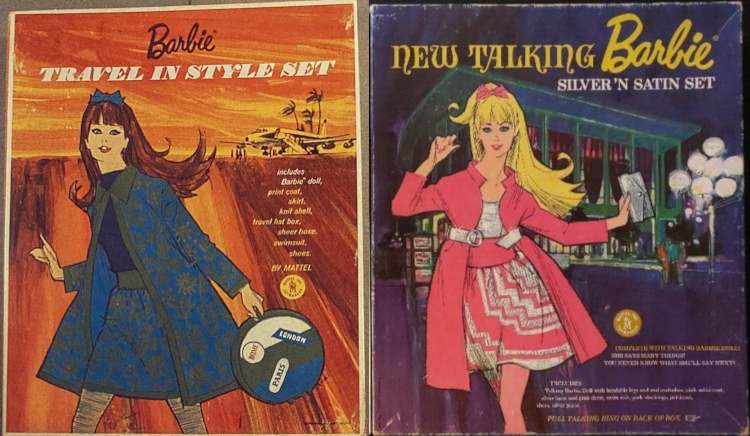
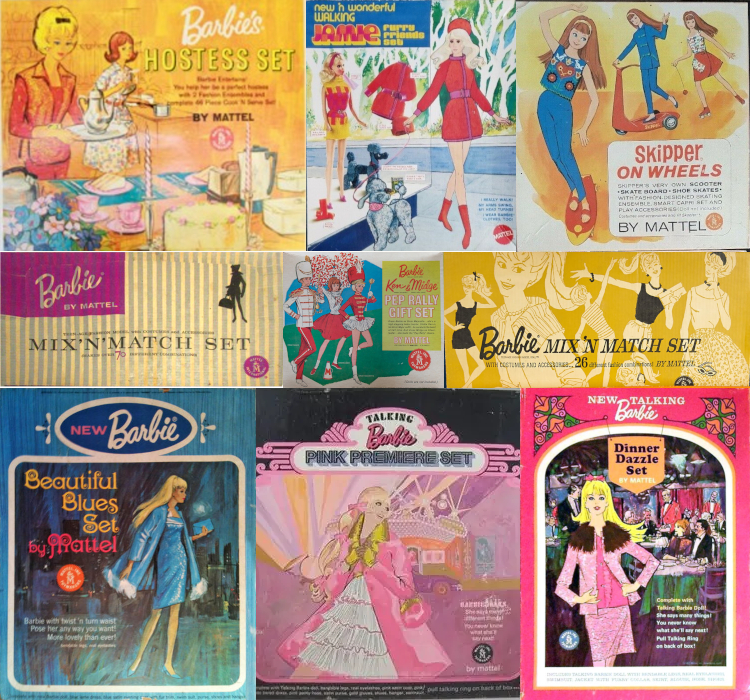
1968 Travel in Style and Silver ‘n Satin gift sets. Sources: Barbie Doll Fashion, Vol. II by Sarah Sink Eames; brendassouthpacificplace on eBay. We had to opt for the 1968 Travel in Style set, with its sweltering airport runway, for August, while September goes to the Talking Barbie Silver ‘n Satin Set of the same year. We’ve entered the Hellenistic era of the “sumptuous” style, and Silver ‘n Satin is its Winged Victory of Samothrace: The movement! The drama! (What is she running from?) So many stunning gift sets were released over a period of about two years, we can’t showcase them all; other notable works include Beautiful Blues, Pink Premiere and Dinner Dazzle.
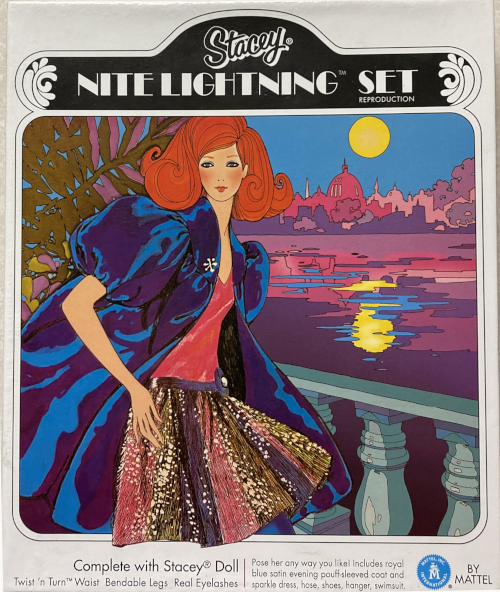
Mattel’s 2006 reproduction of the 1969 Stacey Nite Lightning gift set. The illustration is faithful to the original. From the author’s collection. For October’s featured image we have the 1969 Stacey Nite Lightning Set. This illustration is still vivid, and yet more stylized, a nod to the late 1960s Art Nouveau revival. The Fabulous Formal set shown at the top of the post, from the same year, also fits this scheme.
November is another ’69 pick–Talking Julia’s Simply Wow Set–at which point we see the “sumptuous” period is subsiding. The Julia fashions are nicely illustrated, but they are not placed within a scene; instead, a kaleidoscope of photo images of the head of actress Diahann Carroll, who played Julia, fill the remaining space.
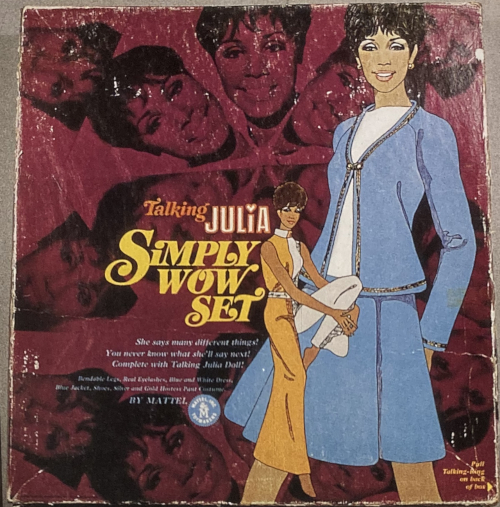
1969 Talking Julia Simply Wow Set. Source: Barbie Doll Fashion, Vol. II by Sarah Sink Eames. The high period of gift set art declined and fell: starting in the 70s, packaging consisted of photographs of the sets’ contents, useful to the shopper but not particularly expressive.
Before the inevitable end, in 1970 a series of charming graphics combining product photos and illustrations graced the exteriors of sets for Barbie, Jamie, Skipper, P.J. and Ken. Each illustration featured the character in question, in some detailed setting, gazing into a shop window within which the photographic element accurately depicted the sets’ contents. The compositions are all clever and appealing, and although Living Barbie’s Action Accents, with its ski chalet scenery, is more than worthy of a winter holiday, our ultimate choice for December had to be the festive P.J. Swingin’ in Silver set:
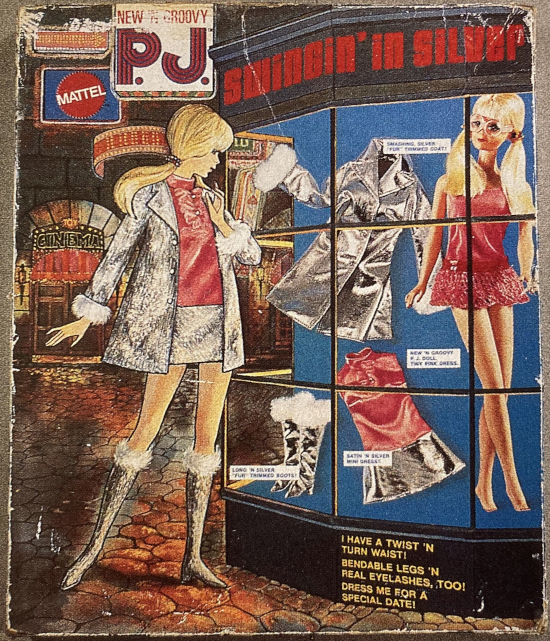
1970 P.J. Swingin’ in Silver gift set. Source: Barbie Doll Fashion, Vol. II by Sarah Sink Eames.Because a period of high artistic output was in its dying throes, we call the series of graphics from 1969-70 combining drawings and photos the “decadent” style.
Now you’ve seen all the significant epochs in Barbie gift set illustration styles from 1960-1970: discreet, sketch-collage, superior fashion booklet, courtroom portrait, early-sumptuous, high-sumptuous or Hellenistic-sumptuous, and decadent. Which one is your favorite? What swaps and substitutions would you make, to craft the ultimate 12-month calendar? There were so many lovely gift set illustrations we didn’t have space for, including a couple Skipper sets–maybe next time we’ll aim for 18 months!
Where to next? This post is about vintage Barbieillustrations. Our most popular post in the category is on Mattel fashion booklets. The most recent post in the category is on the World of Fashion board game. Other popular posts on this site include the Many Abodes of Barbie series (currently covering 1962-1970) and our Chronicle of Barbie shoes, 1959-67. Or just head up to the Table of Contents to see more options.
-
Vintage Sewing Patterns
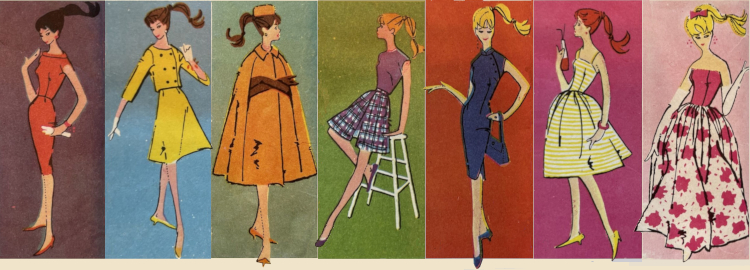
Collage of illustrations from Advance Barbie sewing patterns In 1961 Barbie’s fashion horizons expanded in the form of Advance sewing patterns, whose illustrations fit the style of the era’s fashion booklets. Unlike the carrying case illustrations, they don’t seem to be traced; but the art styles are, to say the least, in harmony. Here are examples of early fashion booklet sketches that resonate with the pattern illustrations at the top:
Vintage Barbie fashion sketches that appeared in 1962 Mattel booklets. Composed of scans by TheVintageToyAdvertiser. But fashion booklets are a story for another day. Here’s how those pattern illustrations looked on the products:
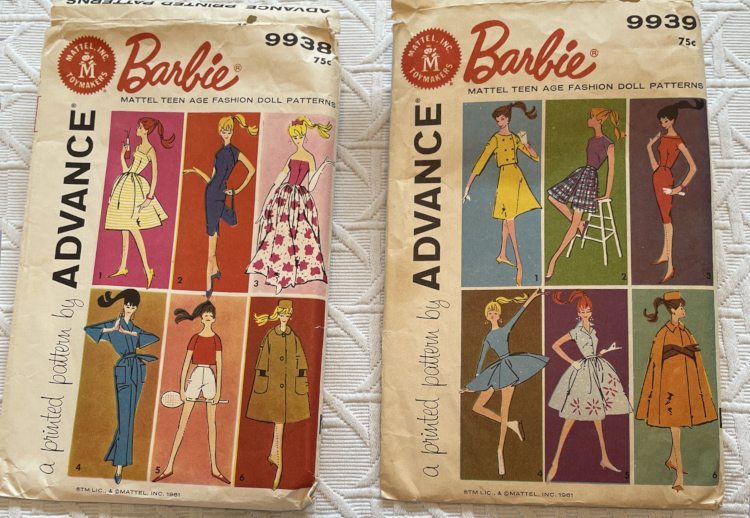
Two envelopes from Barbie Advance sewing patterns. Source: star7272 on eBay. For the curious, you can find samples of some of these patterns online, for example, at sewingandpattern.com. Scroll down on that page and you’ll also see examples of the 1962 Advance Barbie patterns, which had photographed images of dressed dolls instead of fashion sketches. We won’t engage with those here, but in 1963 McCall’s picked up the pattern-sketching slack with a tighter illustration style:
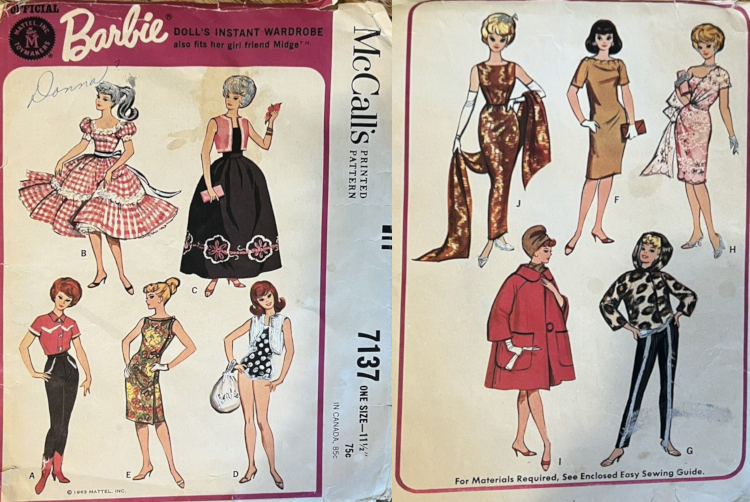
Front and back of a 1963 McCall’s official Barbie Doll’s Instant Wardrobe pattern envelope. Source: thriftydollhunter on eBay. I’m not sure if it’s the illustrations, the colorless backdrop or the fashions themselves, but somehow the McCall’s pattern sleeves just had a little less pizzazz.
Alongside the sewing patterns, the fashion booklets were evolving a more realistic style in this year, as well.
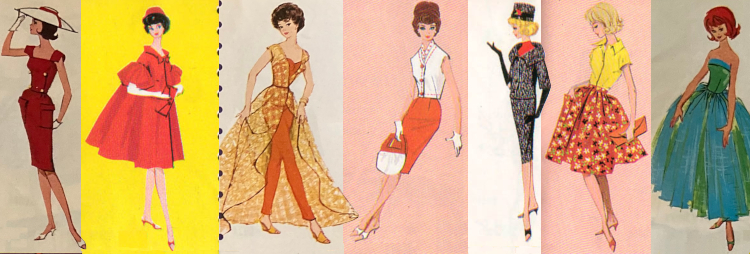
Fashion sketches in 1963 Mattel fashion booklets. Composited from scans by TheVintageToyAdvertiser and from the author’s collection. But we’re not here to talk about that! Ken, Skipper and Francie all had their own illustrated patterns in the 1960s.
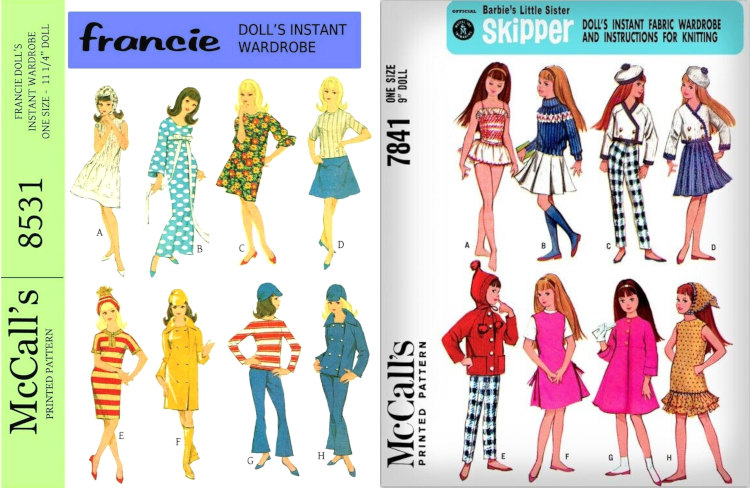
McCall’s pattern envelopes for Francie (left) and Skipper. These examples have both been digitally cleaned up by their owners, who sell reproductions. Sources: old-school-house on eBay, once-upon-a-time-patterns on eBay. Like Barbie’s, the McCall’s Skipper and Francie pattern illustrations were also similar in style to the characters as they appeared in contemporaneous fashion booklets, on carrying cases, and as paper dolls.
There were more generic fashion doll patterns than licensed ones in the ’60s; many of these had their own charming illustrations.
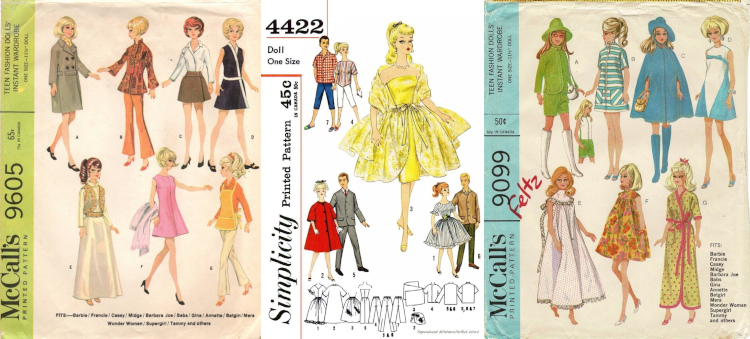
Generic doll patterns of the 1960s. Source: patternperfect on eBay, gremmy1234 on eBay. Where to next? This post is about vintage Barbieillustrations. Our most popular post in the category is on Mattel fashion booklets. The most recent post in the category is on the World of Fashion board game. Other popular posts on this site include the Many Abodes of Barbie series (currently covering 1962-1970) and our Chronicle of Barbie shoes, 1959-67. Or just head up to the Table of Contents to see more options.
-
Early furniture: Mattel Modern and Susy Goose
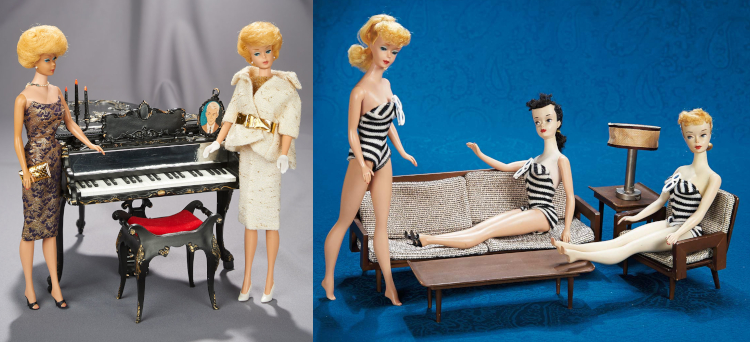
Bubble cut Barbies with 1964 Susy Goose music box piano (left); ponytail Barbies with 1958 Mattel Modern living room set. Source: Theriault’s. Mattel Modern (1958)
In 1958, Mattel debuted its Mattel Modern line of stylish, wooden doll furniture, and a year later Barbie was introduced to make use of it.
Wait, what? Okay, that’s not quite how it happened. Mattel Modern, a line of sleek, midcentury-styled, real wood furniture, was released before Barbie, but it was meant for (approximately) 9″, non-Mattel dolls–like those produced by the Alexander company. The images below, from Theriault’s auctions, show Barbie exploring the bedroom set–doesn’t she look just a little tall for that bed?–and the 10″ Cisette doll, made by Alexander, standing between a Mattel Modern queen bed and fold-out sofa bed. Per the official Mattel Modern literature, even Cisette is too tall for some of these furnishings.

Note that the cushions on these pieces weren’t always flat as in the above images, but deflated over the years. Otherwise, this line of solid-wood furniture seems to have held up very well.
The 1958 Mattel Modern furniture line included:
- a sofa, an easy chair, a coffee table and an end table with working (battery-powered) lamp, all as in the image at top right of this post, and also sold together as a living room set;
- a queen bed, open wardrobe (holds dresses for 8″ and 10 1/2″ dolls, per the brochure), and dresser with real glass mirror, all shown above left and sold, along with the lamp and end table, together as a bedroom set;
- a dining table with two chairs (below, with its original packaging) and a buffet (shown beside the bedroom set above left), also sold together as a dining room set, and
- a “studio set” consisting of two convertible sofa beds–one can be seen behind Cisette, above right–plus the end table and lamp.
The last set is intended for 8″ dolls only, the brochure cautions. Scroll to the bottom of the post for a shot of Ken and Ricky standing amidst Mattel Modern furniture, including the studio set; the sofa beds might fit Ricky lying down, but not Ken.
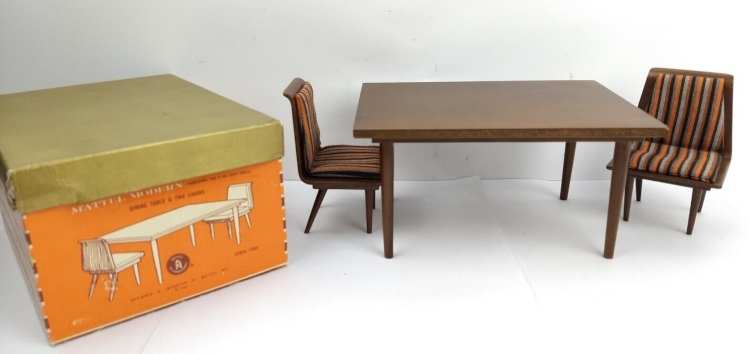
Mattel Modern dining table and chairs. Source: calelles on eBay. Most of these pieces are stamped Mattel Japan, 1958. However, there is at least one example of the dining set marked instead with a sticker reading “Tahei Mokko Ltd. Co.” It’s likely that Mattel outsourced production to the Japanese company, and they may have also sold these and similar items under their own branding, possibly to foreign markets. This could explain the similarity between the real-deal Mattel Modern pieces and the TV and stereo also displayed with Cisette, above, as well as the two luggage stands mixed into the bedroom set pictured with Barbie to Cisette’s left. Of course, other stylish furniture sets for 8″-10″ dolls were also available in the years leading up to Barbie’s debut.
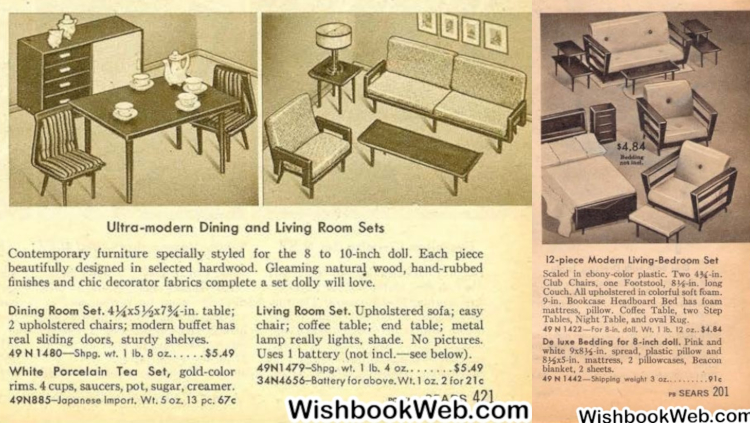
Left: Mattel Modern furniture in the 1958 Sears Christmas catalog. Note, we do not know the maker of the porcelain tea set advertised. Right: modern-styled plastic furniture for 8″ dolls from the 1957 Sears Christmas catalog. Source: wishbookweb.com So the year before Barbie is introduced, we find Mattel with the means to produce gorgeous, solid-wood furniture for similarly-sized dolls. Why didn’t they scale up a little for Barbie’s height, and carry on? Maybe the price point was wrong for Barbie’s customers, or maybe the manufacturing couldn’t have kept pace with Barbie’s audience. Whatever the case, when Barbie did get her own furniture it bore little resemblance to Mattel Modern.
Susy Goose (1962-1966)
When Barbie debuted and for her first couple of years, she had no furniture of her own. Once the time came to fill out Barbie’s little world, Mattel could have revived the Mattel Modern concept. Instead, they went a different route: licensing the Barbie trademark to Susy Goose, a division of Kiddie Brush & Toy Co of Jonesville, Michigan, along with starting production of their own play sets of the chipboard variety, both in 1962.
The Susy Goose line first appeared in the 1962 Sears Christmas catalog as a wardrobe and four-poster canopy bed with an under-bed storage drawer. By 1964, below, a set of bed linens, music box piano (in white or black–see top of post), queen-sized bed, queen-sized chifferobe, and vanity with stool (same as the piano’s stool) had been added. Ken had a wardrobe of his own in a taupe plastic, not pictured.
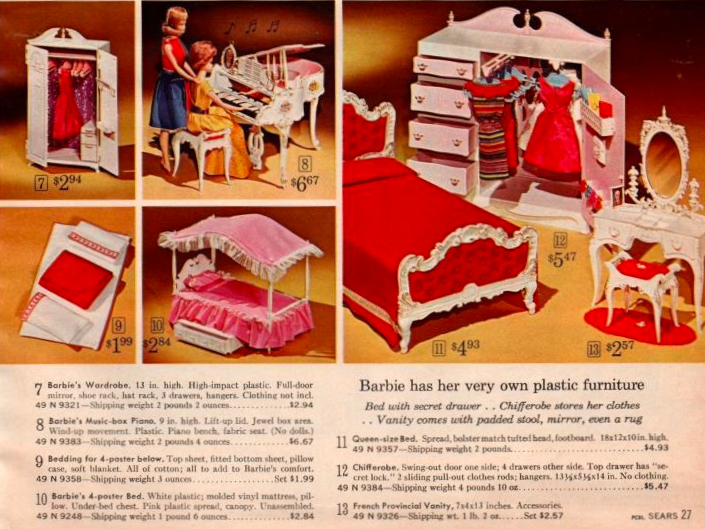
Susy Goose furnishings in the 1964 Sears Christmas catalog. Source: christmas.musetechnical.com Plastic furniture development moved in-house at Mattel around this time with the Go-Together rooms and subsequent plastic-y play sets. In 1965, the Susy Goose Skipper’s “jewel”-trimmed bed, vanity and wardrobe competed with the Go-Together Skipper’s Bunk Bed set–see the collage of catalog listings below. The Go-Together Bunk Beds (left) appeared alongside the jeweled bedroom set (middle and top right) in the 1965 Sears Christmas catalog, while a different bedroom set “for Skipper, Skooter, other 9-in dolls,” lower right, shared the Bunk Beds’ page in the Montgomery Ward ’65 catalog.

1965 Sears and Montgomery Ward (lower right) listings of furniture for Skipper. Source: christmas.musetechnical.com. Skipper’s “jewel-studded” bed was an uncharacteristically gauche design from Susy Goose, with the “photo insets” of smiling children, haphazardly arranged on a plain background, badly undercutting the elegance. Barbie also had a jeweled bedroom set (below left), sans photographs, around this time, and the final Susy Goose design under Mattel’s trademarks may have been Francie’s 1966 Mod-a-Go-Go bedroom (below right), where the decoupage-style embellishments are a much better fit.
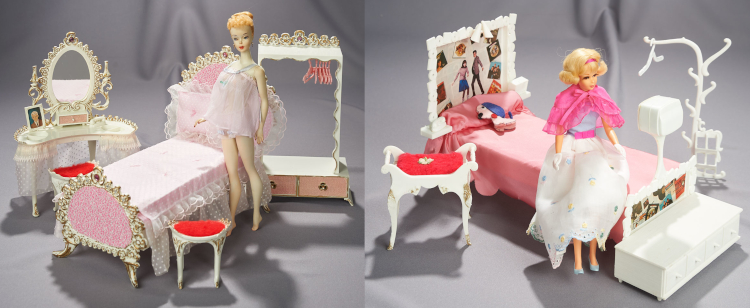
Left: Barbie in her Susy Goose jeweled bedroom set, with an extra bench. Right: Francie with her Mod-a-Go-Go bed and costumer; the bench and under-bed storage unit pictured are from older Susy Goose sets. Source: Theriault’s. Want to know what’s playing on the far-out, amoeboid television attached to the base of Francie’s bed? Images we browsed on eBay suggest it’s a smaller version of those “pin ups” scattered across the headboard.
There, we suppose, the licensing agreement with Mattel comes to an end. An off-brand, Susy-Goose-lookalike bedroom set was advertised in JC Penney and Montgomery Ward Christmas catalogs from about 1970-75.

Left: 1970 JC Penney catalog listing for an off-brand bedroom set. Right: 1975 Montgomery Ward catalog listing for a similar set. Source: wishbookweb.com For the first three years the set was advertised, the JC Penney catalog description claimed that the suite “opens up into [luxurious/glamorous/pretty] bedroom,” with the flattering adjective varying from year to year. This seems like a copy-paste error coming from a case room or other play set description; the reference to “opening out” was removed in 1973 and in subsequent years. As pictured above, the JC Penney version of the set was of white plastic, like many Susy Goose pieces, while the Montgomery Ward version was dark brown or possibly black. The copy in the 1974 Montgomery Ward catalog (not shown) asserts that their set is “pretty and feminine” and that its dark plastic is “wood grain.”
Maybe these were Susy Goose or Kiddie Brush & Toy Co. products, but maybe not: after all, most of the Susy Goose designs were pretty timeless, and many would be rehashed by other manufacturers, including Mattel, over the years. Just look at how 11.5″ fashion dolls were living in 1982:

Left: Mattel electronic piano as shown in the 1982 Sears Christmas catalog; 1982 Mattel Dream Bed as pictured in the 1985 Sears Christmas catalog; part of an off-brand bedroom set shown in the 1982 Sears catalog (clone doll “Lindsey” is modeling). Source: wishbookweb.com The pink canopy bed in particular seems to echo across time: following the ’60s version at the top of this section and the ’82 Dream Bed above center, Barbie also slept in a Dream Glow bed (1985), a Starlight bed (1991), and a Glitter ‘n’ Glow bed (1996), ranging from romantically lit to radioactive, during the late 20th century,:
Dream Glow bed commercial. Source: Retro Toys and Cartoons on YouTube. Starlight bed commercial. Source: Retro Toys and Cartoons on YouTube. Glitter n Glow bed commercial. Source: iRemember That on YouTube. The Mattel Modern furnishings celebrate their 65th anniversary this year. Although we’ve seen a smattering of other modern-styled Barbie furniture over the years, as far as we know Mattel never produced, nor licensed their trademarks for the production of, real wooden Barbie furniture.

Ken and some Rickys amidst the Mattel Modern studio set and dining room set, with some additional dining chairs and living room tables. Source: Theriaults. Where to next? This post is about Barbie’s early built environment. The most recent post in this category is Barbie’s Seventies Travelogue, Part 2, and the most popular are this one and one on penthouse apartments. The overall most popular post on this site is about Mattel fashion booklets. Or just head up to the Table of Contents to see more options.
-
Great books for vintage Barbie fans
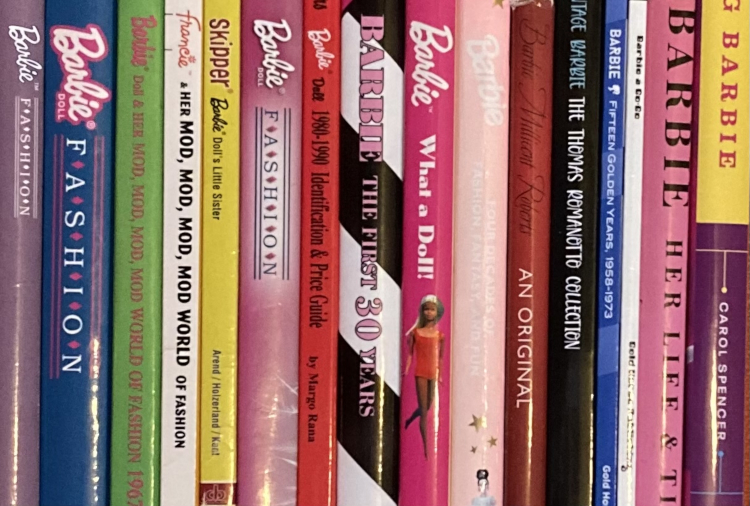
Recently, in a series of hilariously escalating blunders, someone at Mattel slipped on a banana peel, stepped on a rake, ran headlong through a sheet of plate glass being carried across the street by men in coveralls, and then accidentally ordered only two hundred copies printed of a new book on Barbie Dream Houses–all in a single day! Dream Houses are kind of our beat–although the elusive Mattel volume features only a handful spanning vintage to present, while we’re more of the strictly-vintage, thorough persuasion–but we’ll never see the Mattel book, so let’s say no more about it.
Fortunately, competent publishers have released so many wonderful books in sufficient quantities over the years. I have none to recommend specifically on houses or other play sets (hence, one of the main motivations for this blog), but hopefully anyone can find something to their tastes in this (partial) list of great works of Barbie scholarship.
Identification Guides

Barbie Fashion Vols. I-II by Sarah Sink Eames
A comprehensive listing of fashions not just for Barbie, but also for Francie, Ken, Skipper and Ricky, through the vintage and mod years. Long out of print, the first volume, at least, is not too hard to track down. Each year is covered by a chapter, with sections for the differently-sized dolls’ fashions. Ensemble entries are accompanied by color photos of the garments and accessories, either loose, on a doll, or mint in package, along with a description and some light narrative: “Election time! Barbie doll was nominated for president of her sorority! She could hardly uncross her fingers long enough to get dressed for the big decision!” begins the description of 1962’s Sorority Meeting, before launching into a detailing of the outfit elements. When I felt anxious after seeing a couple wedding dresses in Francie’s chapters, Sink Eames reassured me that the teenaged Francie had merely modeled them. There are also segments on prototype outfits and overseas exclusives. In the second volume, gift sets each get a page to themselves, to display the cover illustration as well as the boxed contents.

Top left: A typical spread from Barbie Fashion, Vol. I; Top right: Japanese exclusive dolls and fashions; Bottom left: Simply Wow gift set in Barbie Fashion, Vol. II; Bottom right: a German Francie doll plus a selection of 1972 Francie fashions A third volume also exists, covering 1975-1979. It is the rarest of the three, covering the shortest time span, and, to me, the least interesting fashion. In the third volume almost everything is photographed in its original packaging, which is an accomplishment from the collectors’ point of view but perhaps the worst way to display the contents. To me, the third book is not must-have but still nice-to-have.
Francie & Her Mod, Mod, Mod, Mod World of Fashion; Barbie Doll & Her Mod, Mod, Mod, Mod World of Fashion, 1967-1972 by Joe Blitman
Beyond the fact that they are limited to mod fashions, Blitman’s books are distinct from Sink Eames’ in a few ways. First, almost every fashion gets its own page, with a cleverly-posed doll (or dolls) modeling the ensemble (Blitman has also reproduced these images on playing cards), in addition to a photograph of the loose outfit pieces. Second, the entries are peppered with entertaining commentary like “Take a sedative before you try getting the jumpsuit on a bend-legged doll,” describing Twiggy Gear (I think the strategy is to turn the garment inside out and roll it onto her legs); “The robe proves that there is an afterlife for old bathroom carpeting,” describing Barbie’s 1969 Dream-Ins; “You really have to work at it to make this jumpsuit look good on a doll,” referring to Firelights; and commenting on 1972’s Pants-Perfect Purple, a single, very punctuated word: “PURPLE!!!!!!!!???????”
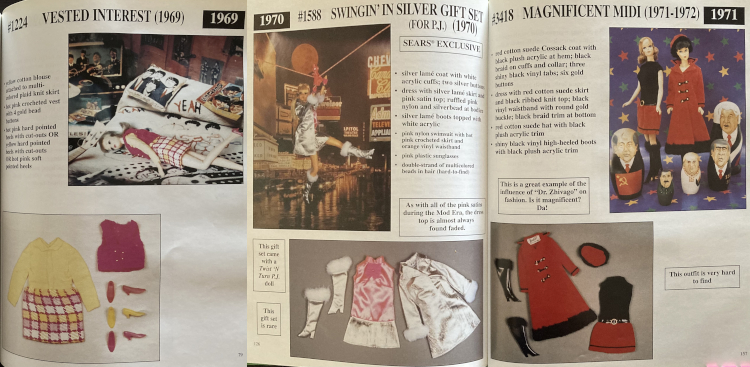
L-R: Francie in Vested Interest swoons over the Beatles; PJ in Swingin’ in Silver ziplines through Times Square; Barbie and Stacey in Magnificent Midi are influenced by Dr. Zhivago. From Joe Blitman’s books. Blitman is thorough in detailing variants (though Sink Eames is no slouch in that department, either), and sections at the backs of the books grouping together all the dolls’ original ensembles can do double duty, in a pinch, to help track down a doll ID. Alphabetized indices of the fashions are also extremely helpful. Overall, when I need a mod Barbie or Francie outfit ID I reach for Blitman’s books first.
The Collectible Barbie Doll and Identifying Barbie by Janine Fennick
Janine Fennick’s book, The Collectible Barbie Doll, and its “study guide” follow-up, are both great resources. Identifying Barbie is a small-sized volume with an exclusive focus on doll IDs, including some super-rarities. For the many gorgeous photos, she took the opportunity to showcase some rare fashions, as well.

Spreads from the Janine Fennick’s little study guide, Identifying Barbie, including rarities as well as common finds. Skipper: Barbie Doll’s Little Sister by Arend, Holzerland and Kent
I have to admit I’m no Skipper expert, but this book is notable for its thoroughness. In addition to covering Skipper and her same size friends’ dolls and fashions with a wealth of excellent color photos and descriptions, the book also has sections on Tutti and Todd, Skipper-sized clones, vinyl cases, play sets and furniture, paper dolls, and even more. If you’re not a Skipper collector yet, this well-wrought volume might make you one.
Barbie: The First 30 Years by Stefanie Deutsch
Another volume with a focus on doll identification, this work is a good resource for learning the distinctions between, say, #3 and #5 ponytail dolls, or learning how Ken, Francie and the rest of Barbie’s circle evolved across the decades. The author hails from Germany and the extensive sections on Bild Lilli and on Barbie variations for foreign markets (and foreign play sets and carrying cases!) are particularly worthwhile. One drawback to this book is that its photographs are not at the level of quality of those in the rest of this post; frankly, many look like they were taken with flash on. However, this book is still an excellent reference containing a trove of unique material.
Barbie Doll Structures & Furniture by Marl Davidson
A niche topic but one of our favorites, Davidson’s rare book covers Mattel’s Barbie structures through 1972 and furniture sets through 1975, with detailed component lists and color photographs of carefully costumed and posed dolls inhabiting the structures (The photography is amateur but fun). This book is likely to cost more than many on this list, but much of its information can be found nowhere else.

Spread from Barbie Doll Structures & Furniture by Marl Davidson showcasing rare Seventies furniture sets. Histories

Barbie: Her Life & Times by BillyBoy*
THE history of Barbie, in my view. Published in 1987 to coincide with The New Theatre of Fashion–a traveling show for which seemingly every couturier in the industry designed a one-of-a-kind Barbie fashion–this book covers Barbie’s life by mining novels, comic books, marketing materials and more for the details of Barbie’s personal affairs, and covers her times through author BillyBoy*’s encyclopedic style knowledge. If you need to know that Barbie’s 1960s charm bracelets are “a la Calder” or that Alexandre invented the bubble cut hairstyle in Paris, this book is for you.

Top row: early Barbie and her contemporary influences; Barbie in the Seventies. Bottom row: Japanese Barbies in the Eighties; some designs for the New Theatre of Fashion. From the book by BillyBoy*. If you just want to browse sumptuous color images spanning 1959-1987, some of which are as tall as Barbie herself (the pages measure about 12″ on their longer edge), including a lengthy section on the designs for the New Theatre show… still your book.
Dressing Barbie by Carol Spencer
A personal history of Spencer’s career designing Barbie fashions, spanning decades from the early ’60s into the ’90s. Among her many adventures, read how Spencer designed Barbie-sized swimwear prototypes for her job interview; developed novelty lines like the Color Magic ensembles and Sew-Free fashions; created Country Club Dance and Holiday Dance to use up surplus Fashion Queen fabric; designed Black Magic based on Ruth Handler’s own wardrobe; pieced together the Rainbow Wraps mosaic pattern by hand; weathered changes in fashion trends and at Mattel; ghost-designed for Oscar de la Renta; and much more.

Left to right: Swimsuit prototypes from Spencer’s job interview; Fashion Photo Barbie; Totally Hair was “the best-selling Barbie of all time.” Centered on Spencer’s own work, Skipper, Francie and Ken don’t factor into the tale, nor do the couture looks Charlotte Johnson created in the early years. But the inside perspective Spencer shares, coupled with her long career, makes for a singular narrative.
Doll Fashion Anthology by A. Glenn Mandeville
Not a lush photo book like the first two in this category, but a thorough history of Barbie, including influences, chapters on contemporary clones, extras like store displays, board games, packaging, and much more, lined with images, many in color. I felt there should be a “citation needed” next to some of the author’s claims about the minds of the buying public and the minds of the designers at various intervals, but on the whole this little book is a treasure trove of Barbie information, including many details that slide past the more fashion-focused volumes. My copy of this book ends in the Nineties, with the author expressing some enthusiasm for then-recent collector dolls. He predicts the holiday dolls will be popular with collectors, while stopping short of suggesting that they will be valuable. Well played, Mr. Mandeville.
Barbie in Japan by Keiko Kimura Shibano
The topic of 1960s Japanese-exclusive Barbie fashions and dolls is a bit niche, but for the curious, this well-written volume, festooned with gorgeous photographs, is a joy to read. Furthermore, the introductory chapter on initial Barbie development as a collaboration between Mattel and Japanese manufacturers will be of interest to any fan of Barbie’s early history.
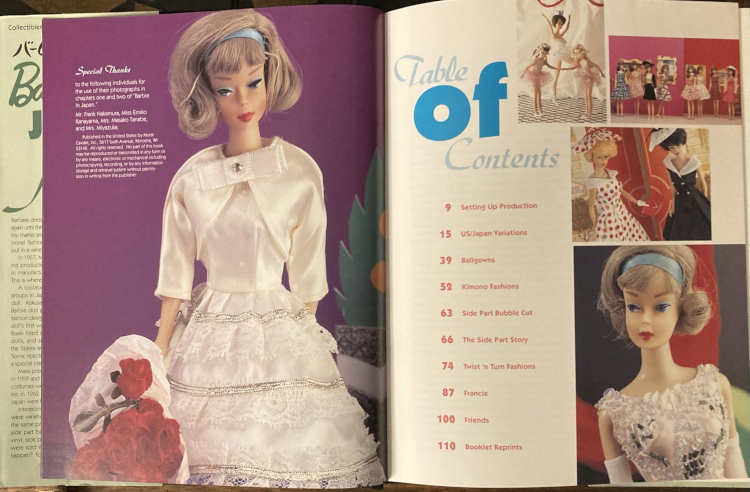
Opening spread and table of contents from Barbie in Japan. Coffee Table Books

Barbie: Four Decades of Fashion, Fantasy, and Fun by Marco Tosa
Two of the histories in the preceding section are also coffee table books, and this coffee table book is also a history. The book kicks off with a critical analysis of Barbie’s place in our culture, including some modern fine art ruminations on the doll in question, before delving into a history that starts with some of Barbie’s earliest antecedents, from about 150 AD, and continuing through Victorian fashion dolls and Bild Lilli, to Barbie’s inception and up through most of the ’90s. The focus is almost entirely on fashion, with some play sets mentioned as they relate to fashion lines and almost no other Barbie ephemera discussed. Barbie’s ’60s style is placed in the context of Balenciaga, Dior, Grace Kelly, Doris Day, Jackie Kennedy, and more, continuing through Oscar de la Renta and Bob Mackie to the (then-)current period. Separate sections on more recent movie-based dolls (including the Marilyn Monroe doll on the book’s cover) and Dolls of the World round out her evolution up to the date of publication.
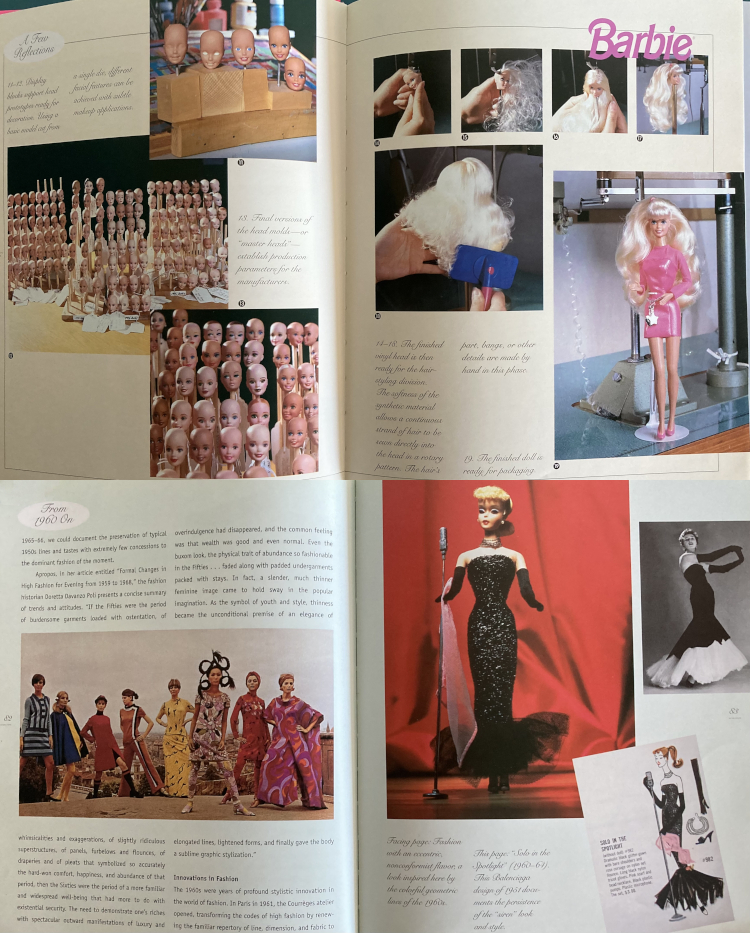
Top: How Barbies are made; Bottom: a spread on ’60s style influences. From the book by Marco Tosa. A more serious work than the others we categorize as coffee table books, it boasts a bibliography (including some of the books already listed here as well as many others) and an index of the dolls and fashions appearing in its many high-quality photographs.
Barbie: What a Doll! by Laura Jacobs
A 1994 book of Barbie fashions on posed dolls with neutral backgrounds, stretching from Barbie’s earliest years through the Eighties. Fashions are grouped thematically (“Trouser Styles,” “Outer Wear,” “Party Girl”) and within those chapters by color palette, so that 1960s tailored suits sit comfortably alongside similar designs from the Eighties, while late Sixties switched-on mod minis mingle with late Eighties neon and glitter (the Seventies are mostly flyover territory). If you’ve collected or at least browsed the trading cards released a couple years before this work, you’ll see images you recognize. One thing that might drive the aspiring collector crazy about this book: each picture is captioned with a year and a description of the garments, but not the ensemble names!
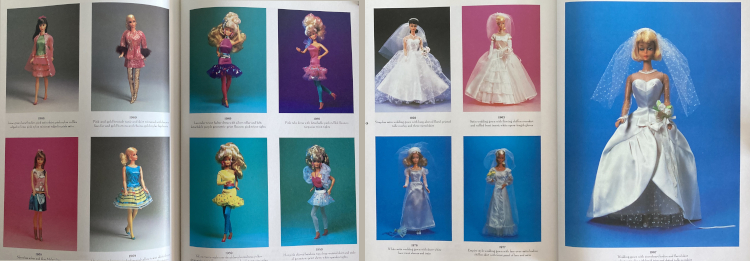
Left: the Sixties and Eighties coexist harmoniously in these party clothes. Right: Five of the happiest days of Barbie’s life, featuring a rare 1970s double feature. The introduction was written from Barbie’s perspective, and some just-for-fun appendices include a family tree, a list of Barbie’s careers, and a list of nationalities Barbie has assumed–the last of which draws attention to the fact that almost every ’70s and ’80s doll appearing in the book is blonde. Maybe this choice was intended to emphasize the individual Barbie narrator, but it wasn’t really working for me. Regardless, I enjoyed the pairings of ’60s and ’80s fashions, which you don’t often see.
Barbie Millicent Roberts: an Original by David Levinthal
This nearly text-free book explores the concept of Barbie fine art photography, posing, lighting and framing her as she would have appeared in 1960s advertisements for gowns, jewels, furs and perfumes. The fashions are drawn from the glamorous vintage years beginning in 1959, stretching to some of the more fabulous styles of the mod years up to about 1972, with occasional offroading into, for example, a Tuesday Taylor bathing suit (below). A prefacing essay by Valerie Steele, longtime curator of the incredible Museum at the Fashion Institute of Technology, explores 1950s and ’60s fashions as they’re reflected in Barbie’s wardrobe and in photographs.
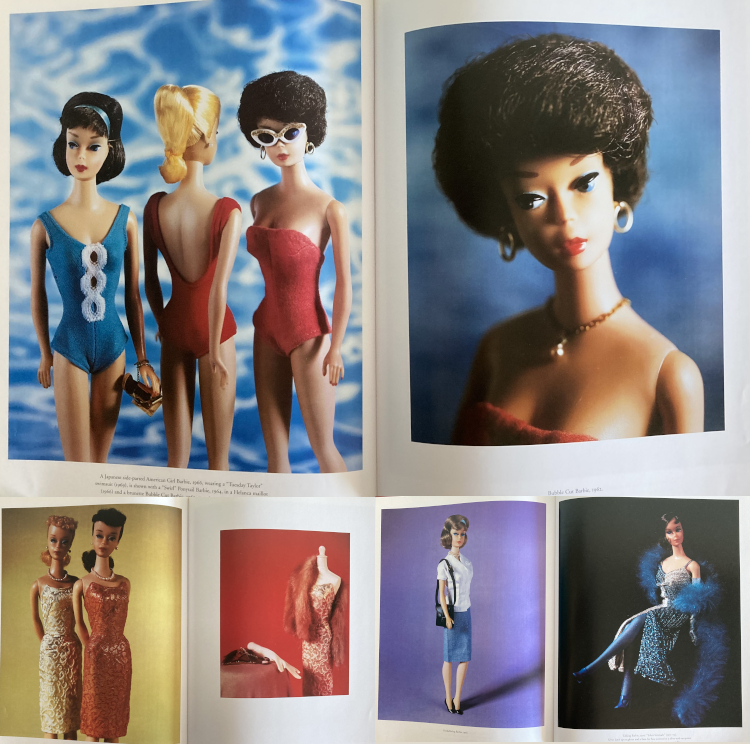
Three spreads from Barbie Millicent Roberts featuring photography by David Levinthal. Catalogues
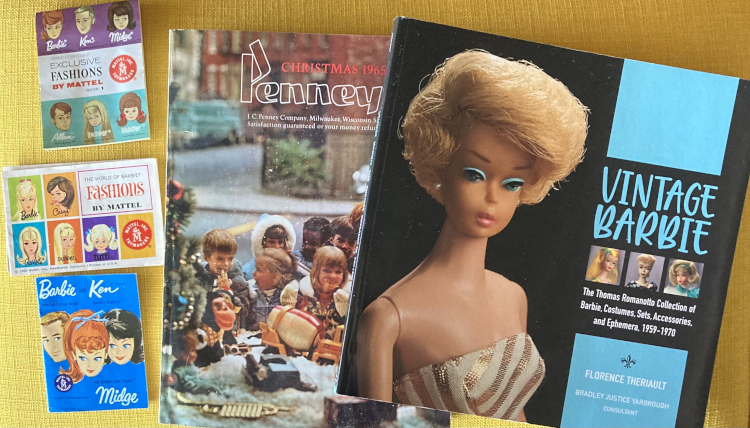
Okay, it’s a bit of a stretch to call most of the entries in this section “works of scholarship,” but read other entries in this blog to see how we depend on them for “research”–and all are enjoyable to browse for eye candy and inspiration.
Auction catalogs
You can browse recent Barbie auction catalogs from Theriault’s for free online, or you can invest in physical versions–or do both, as I do. The search feature online is invaluable, but the page layouts and high-resolution photos are so enjoyable in their physical form. These catalogs do contain a number of errata–misnamed ensembles, some Mattel outfits left unidentified, 1950’s Mattel furniture for 9″ dolls labeled as Barbie furniture, a Deluxe Reading Dream Kitchen incorrectly attributed to Mattel–as well as a general lack of specificity about complete sets or matching exactly the right accessories to garments. Identification guides, they aren’t. However, both the online catalogs and those you purchase from Theriault’s after the auction include both estimated and realized prices, so if you do want value estimates they provide an up-to-date source alongside the stunning visuals: gorgeous full-color, professional-quality photographs of dressed dolls, furniture, Bild Lillis and other clones, Japanese and European exclusives, carrying cases, and countless other treasures.

Top row: A two page spread on Tressy’s Penthouse; a rare European fashion variant. Bottom row: page layouts in aqua and gold. Mattel booklets
They’re our primary source for the most fundamental Barbie fashion illustrations and contemporary documentation, straight from the source, of what products were offered in a given year. And plenty were printed–we’re looking at 50-year-old examples that are still in circulation and affordable.

Are they an awkward fit for your bookshelf? Yes. Is that because they’re in fact not books? Also yes.
Vintage mail order store catalogues
Both rarer and brittler than the Mattel booklets, and mostly concerned with non-Barbie topics, these will give you the least bang for your buck of all the options presented here and also are not genuine books. What’s more, sources exist online for decent quality scans of many of them.
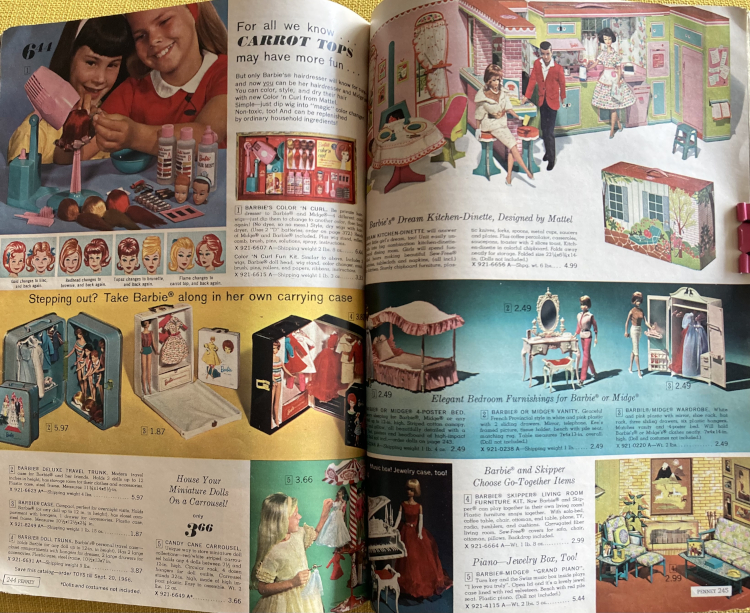
1965 JC Penney Christmas catalog. Rats nibbled the last pages of this copy but left the fashion doll pages intact, so I got a good deal. Still, if you happen upon a bargain, or you find one that’s missing from the online repositories, a vintage catalogue can be very rewarding to thumb through.
And that’s a wrap
Thanks for rifling through my bookcase with me! Do you have a favorite Barbie volume that wasn’t mentioned here? We’d love to hear about it.
Where to next? In our Deep Dives and Musings category, the most popular post is our Chronicle of Barbie Shoes, 1959-1967. The most recent musing is about Barbie-sized luggage, and a severely underappreciated musing is When Barbie Turned 21. We’ve recently been enjoying writing Barbie’s Seventies Travelogue in the “built environment” category; or just head up to the Table of Contents for more options.
-
Doll Carrying Cases (1961-1972)
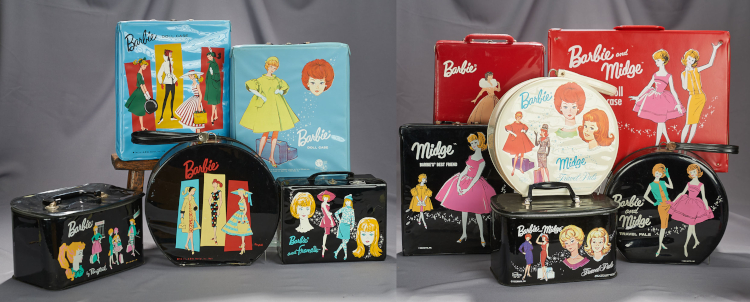
1961-63 Barbie travel cases and children’s luggage. Source: Theriault’s. The Barbie carrying cases of the mod and vintage years certainly packed a lot of style. From the earliest examples, with limited palettes used to depict Barbie posed before jazzy, off-kilter colored quadrilaterals, her poses mirroring those found in the early fashion booklets, into the full-color phase, with floating heads and sparkle trails, during which Midge and Skipper come on scene, and into the kaleidoscopic mod years, when the art styles were as changeable as Barbie’s circle of friends, we’ll sample at least a flavor of the endless possibilities of carrying case illustrations during their first ten or so years. Fashion Doll Guide also has a nice summary of case collecting.
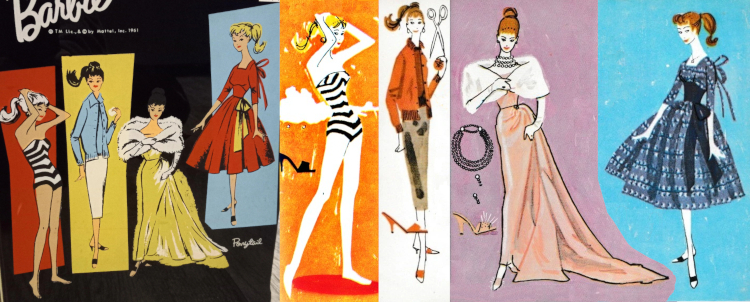
Left: detail from the front of a 1961 Barbie carrying case, showing Barbie dressed in her original swimsuit, Sweater Girl, Enchanted Evening, and Let’s Dance. Source: iwish-iwish on Reddit. Right: composited images from the 1961 fashion booklet, showing the same fashions. Source: Constance Ruppender on Flickr. The very first cases, released in 1961, tend to show Barbie modeling her various fashions before colorful quadrilaterals. The silkscreened graphics use only a handful of hues per case, although the palette is switched out from case to case–meaning we get to experience familiar fashions in a variety of surprising shades. As mentioned in the introduction, the poses here are the same as the ones in the fashion booklets–redrawn, but possibly traced–though the color schemes may be unfamiliar (as in the image above, where Sweater Girl, Enchanted Evening, and Let’s Dance all get fresh paint jobs). The one “original” fashion that I have seen shows Barbie in profile, in a full skirt, holding a roundish case of her own. This pose may have been traced from Sweet Dreams in the 1961 fashion booklet–a highly similar stance for a totally unrelated fashion.

Two 1961 Barbie carrying cases by Ponytail. On the case at left, the leftmost figure models the “original” carrying case fashion, and the 1961 Sweet Dreams fashion booklet depiction is included at the top left corner for reference. At right, on a highly similar case, the “original” fashion is exchanged for Commuter Set, which was out of production by 1961. Commuter Set from a 1960 fashion booklet (via aA Walk Thru Time on eBay) is included to the righthand side for pose comparison. Lastly, the pose used for the red-and-white striped dress varies between the cases; on the left it matches 1960-61 illustrations of Suburban Shopper, as shown to the left; the pose used on the righthand case version may be a variation on the Suburban Shopper stance, but is certainly not the later Busy Morning pose, top right corner, despite the dresses’ similarity. Sometimes, the similarities between the 1961 illustrations in booklets and on carrying cases can help us identify an ensemble whose details were changed or simplified for the case illustration, as in the example below, where we can establish that the top Barbie fashion on the Ken case is Cotton Casual, rather than the somewhat similar Suburban Shopper and Movie Date fashions, based on the model’s pose: arms akimbo, face shown in profile.
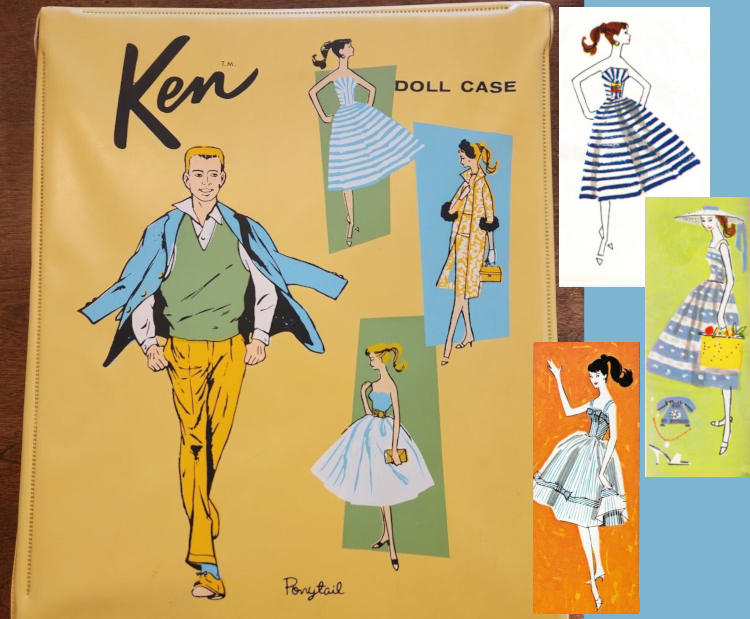
Left: cover of a 1961 carrying case featuring Ken. Source: heidihofromidaho on eBay. Right: Fashion booklet images of Cotton Casual, Suburban Shopper, and Movie Date. Sources: Constance Ruppender on Flickr, thevintagetoyadvertiser blog. Now that we’ve seen it once, it’s easy to recognize Cotton Casual when it appears on the ’61 record totes shown below. But what about the polka dotted dress below that? It reminds me of Party Date, which didn’t exist yet. Pose analysis indicates that I was close: the figure is copied from Silken Flame as it appears in the booklets (and you can see another color-altered Silken Flame on the Ken case above).
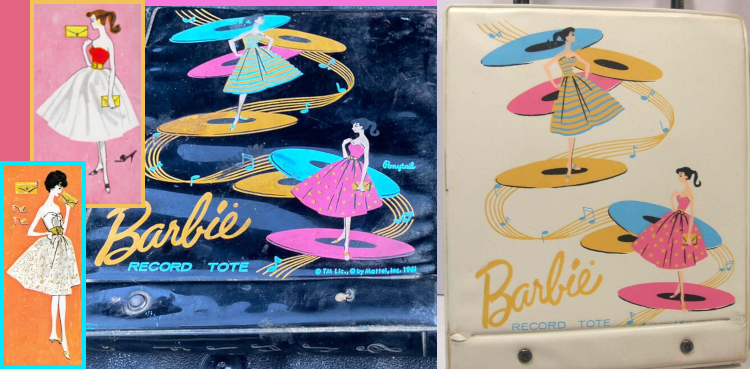
Two 1961 record totes, a 1961 fashion booklet illustration of Silken Flame, and a 1962 illustration of Party Date. The Silken Flame and Cotton Casual (above) sketches match the figures on the record cases. Sources: jasperman111 on eBay, Constance Ruppender on Flickr, thevintagetoyadvertiser blog In addition to doll carrying cases and record totes, the same imagery appeared on lunchboxes, pencil cases, scrapbooks, children’s luggage, and more.
In the 1963 iteration of the cases, Midge joined the scenes and both she and Barbie adopted all-new poses. Sometimes the color palette was expanded to allow richer illustration, but not always. Sparkle trails and floating heads replaced the off-kilter rectangles.
The set of three pieces of children’s luggage below, still utilizing the limited color scheme, feature Sorority Meeting in three different color combos made from mostly the same colors (teal with white trim and reddish hat and shoes, orange dress with teal sweater, shoes and gloves, orange dress with teal sweater but no gloves), while Movie Date, on Midge, is consistently pink.
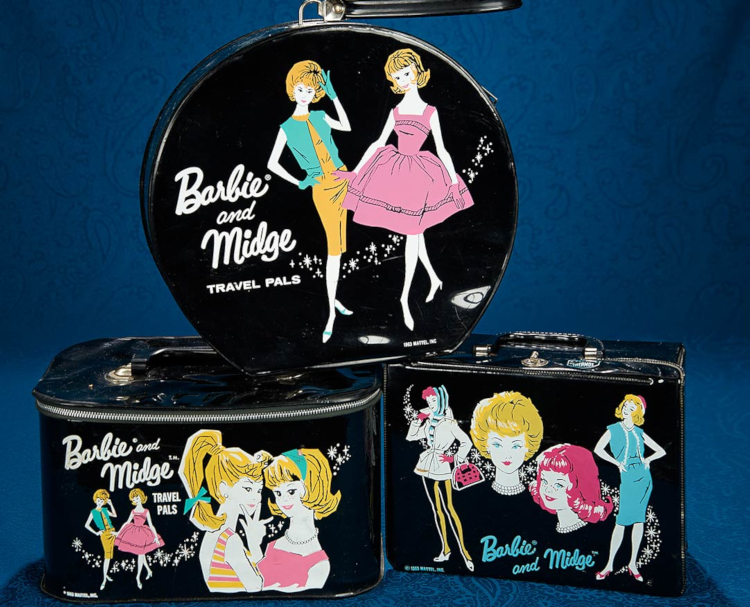
1963 Barbie and Midge children’s luggage with limited color palette. Source: Theriault’s. The case at lower left raises a question: was “Travel Pals” a sort of euphemism?
Even with unlimited colors available, sometimes the outfits were recolored to add visual interest, as happened to Sophisticated Lady, below right, and “Red” Flare in the image that opened this post.
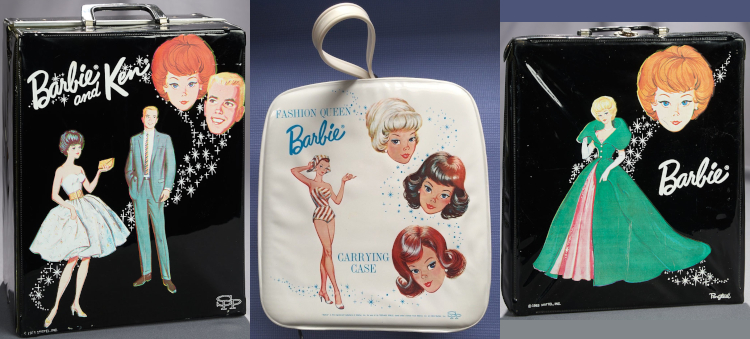
1963 Barbie doll cases with full-color palettes. Source: Theriault’s. Starting in 1965, the mod years came in with an explosion of color and form, as the sparkle trails and floating heads were supplanted by colorful art-nouveau-by-way-of-Swinging-London flourishes:
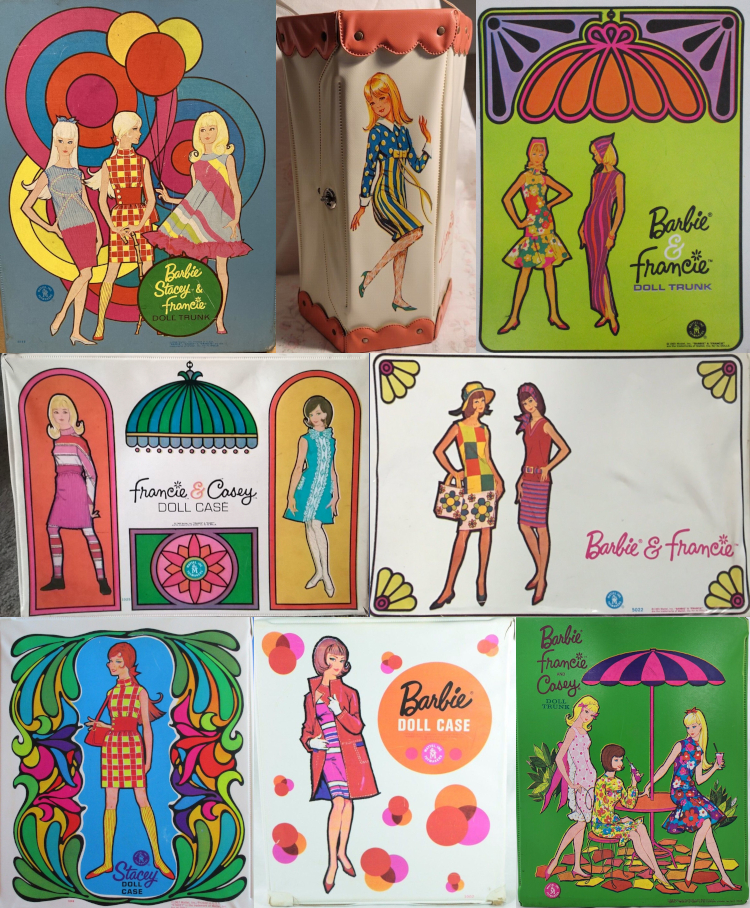
Eight later-60s carrying cases from eBay users including shisha dolls, babyandbro, and szepie77. In the above collage we see, amid a wealth of details, cases that perpetuate the lie that Color Magic ensembles will fit Francie, as well as one or two spots where Francie bears a strong resemblance to Marlo Thomas as Ann Marie on “That Girl.” Where have we seen these themes in the past? Ah yes–a 1967 Francie Casey paper doll set.
Out of step with the Barbie carrying case aesthetic of these years, one 1967 lunch box was decidedly non-mod:

1967 King Seeley Campus Queen Lunch Box. Source: Smithsonian Institute That’s because the Campus Queen lunch box, above, is not licensed by Mattel. Though the resemblance to American Girl Barbie, Ken, and Queen of the Prom was undeniable (the back of the box features a little “board game” played with magnetic pieces, and the sides show scenes of characters engaging in dress shopping and other activities), this item has no Barbie affiliation whatsoever.
Back in Barbie’s milieu, it was during the mod era that Sleep-n-Keep cases were introduced. One half of the case resembled a standard carrying case, with compartments for dolls and hanging clothes and drawers for accessories, while the other half was painted up to look like a bedroom, with vinyl bed(s) and tables that folded down from the wall like elements in a pop-up book.
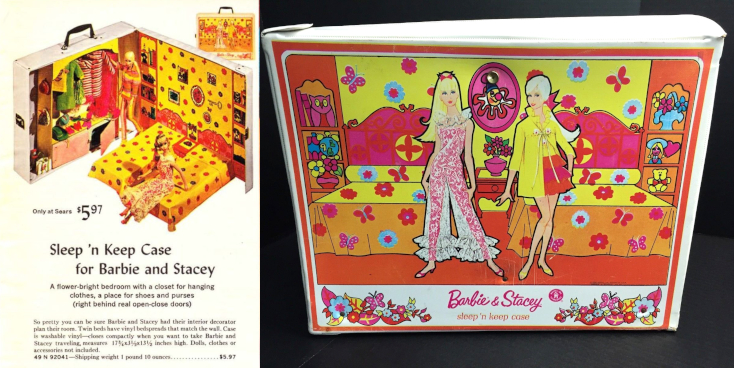
Left: 1968 Sears catalog listing for the Sleep-n-Keep Barbie and Stacey case; Right, the exterior of the case. Sources: Wishbook Web, eBay The first Sleep-n-Keep case we’ve observed is the ’68 Barbie and Stacey case shown above. The catalog text at left asserts that the room is “So pretty you can be sure Barbie and Stacey had their interior decorator plan their room.” It wasn’t so pretty that the girls wanted to keep living there, though, because by the following year they had a new “Romantic Victorian bedroom,” per the ’69 Sears catalog (not shown).
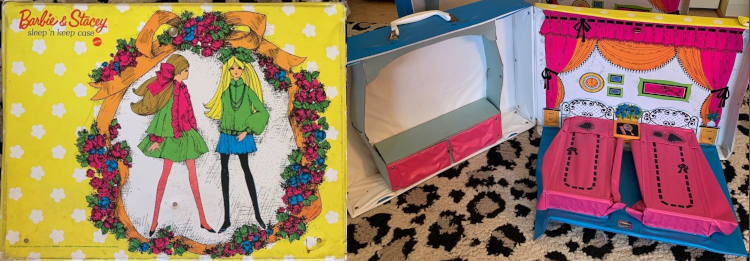
Exterior and interior of the 1969 Barbie and Stacey Sleep-n-Keep case room. Source: rhondazimmerman on eBay. Barbie and Stacey’s interior decorator was not consulted about the animal print carpet seen in the eBay listing above.
In 1970 Barbie was rooming with PJ in the neon-bright bedroom below, and Jamie had a case room all her own–a single. Then in ’72 Barbie and Steffie were back living in the Victorian bedroom Barbie had shared with Stacey previously. You can see the Jamie and Steffie cases, with other examples, over at barbieworld.it.

Exterior and interior of Barbie and P.J.’s Sleep-n-Keep case room. Source: pure-9 on eBay. Why did Barbie have so many different roommates? Was she difficult to live with? I choose to believe that these rooms represent some of her many pieds-a-terre, as her swinging modeling career and jet-setting lifestyle took her from London to New York to Paris to LA, where she had dedicated space to crash with pals, all while maintaining her idyllic suburban lifestyle in some less fashionable burg. But who knows?
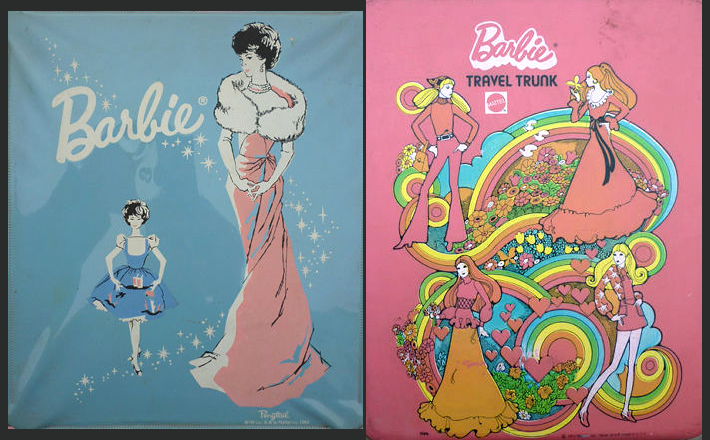
I like to go out on notes of sparkles and rainbows, when possible:
Where to next? Check out our post on off-brand carrying cases; see more portable homes in the Many Abodes of Barbie; get into Basic and Dressed Doll Boxes; or make your way to the table of contents to view more options.
-
Deluxe Reading Dream Kitchen (1963)
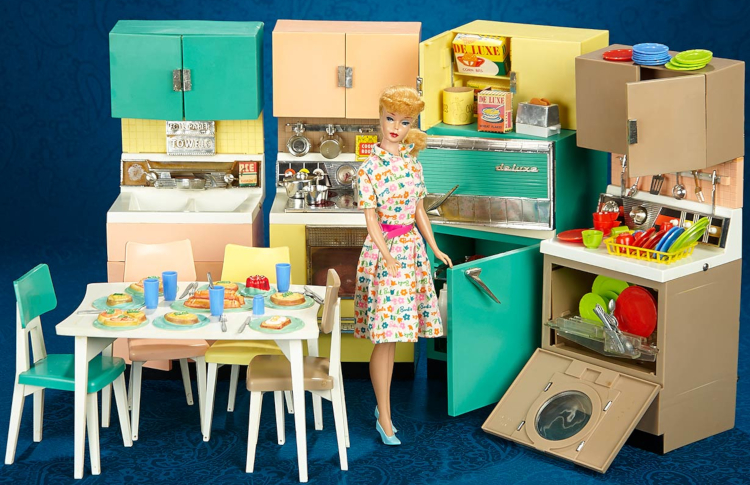
Source: Theriaults Barbie’s earliest abodes may suggest that she was not much of a cook: neither the ’62 Dream House nor her ’64 Campus dorm room provided kitchen facilities (predictably, in the latter case); the Go-Together rooms offered a dining room, but no kitchen; and the ’64 New Dream House had a very minimal kitchen in the bedroom. Perhaps Mattel reasoned that a teen-age fashion model/full-time college student had little time to cook, but someone else was looking out for Barbie’s culinary concerns: the Deluxe Reading Corp., who produced a kitchen that was not affiliated with any doll, but was advertised for “popular teen-age dolls” in general. The set appears to have been a Montgomery Ward catalog exclusive.

“De Luxe Dream Kitchen” packaging. Source: grubermoe3nnt on eBay. Digitally altered by the author. Today this set is highly-sought, even by collectors who are otherwise Mattel purists, and it’s no wonder: the Dream Kitchen is technologically sophisticated, realistically detailed, and candy-colored mid-century fabulous. I’d argue that Mattel has never made a play set that combined so much style and functionality. Running water, a motor-operated rotisserie and light-up burners were just a few of its cutting-edge features, and with all the dishware, cookware, and tiny food, 176 pieces were included. The lines of the table and chairs were positively atomic, with A-shaped silhouettes forming the chair backs and back legs, and a jaunty, bowtie-shaped top for the table.
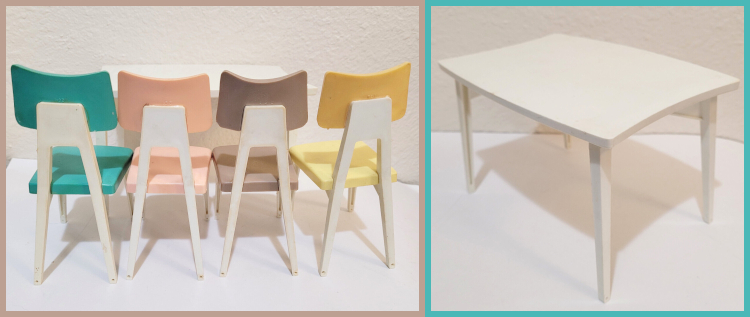
Deluxe Reading Dream Kitchen chairs (left) and table. Source: anns_hobby_shop on eBay But many who dreamed of the Dream Kitchen probably had to settle for less–its price was prohibitive. At $11.88 in 1963 and $10.88 in ’64 (about $105-$115 in 2022 dollars), the Kitchen cost around twice was much as the most expensive Mattel play sets did during the years the Kitchen was available. A “Copper Kitchen” available during the same years also included food and dishes–no table, chairs, or functioning appliances–and came in at less than half the price. When another technologically-dazzling off-brand kitchen, the Karosel Kitchen, came on the scene in 1971, even it was cheaper at $9.99 (about $75 in 2022 dollars). I surveyed the catalog prices of a couple dozen Mattel and non-Mattel play sets available in the early-mid Sixties and summarized them in the plot below (the Karosel Kitchen falls outside this time frame).

Average price in Christmas catalogs of a sampling of play sets for Barbie and similarly-sized dolls, over the years 1962-1967. Mattel sets are noted with solid lines while all others have dotted lines, where more than one year of data is available. The subject of this post, the Dream Kitchen, straddles 1963-64 in red near the top of the plot. This survey is not exhaustive but includes twelve Mattel sets (rightmost column of the figure legend), six Ideal or American Character sets (for Tammy, Tressy, Misty and Pepper), the Dream and Copper Kitchens (top left column), and five other Brand-X “clone” houses (grey entries at the bottom of the left column); in all, about 60 unique data points contribute to the averages shown. I did omit the (fifteen-inch-tall) Littlechaps’ furniture in 1963. The Littlechap family had three standalone rooms available at $3.33 apiece, or the posh consumer could get all 3 for $8.99. This uber-set approaches the Kitchen in price but still falls short. Mattel’s Deluxe House, a couple years after the Dream Kitchen, came closest in price of all sets surveyed but also did not arrive, and when the Karosel Kitchen finally increased in price to $13.99 in 1974, it was still cheaper than the Deluxe Reading Dream Kitchen in inflation-adjusted dollars.

Left: Copper Kitchen from the 1965 Montgomery Ward catalog. Right: Dream Kitchen from the 1963 Montgomery Ward catalog. Tressy models the Copper Kitchen while Barbie models the Dream Kitchen, but neither was officially associated with a doll. Source: christmas.musetechnical.com All of which is to say, the Dream Kitchen was expensive. However, its matchless style, abundant detail and many technical flourishes certainly justified its intimidating price tag.
Where to next? This post is about Barbie’s early built environment. The most recent post in this category concludes the Barbie’s Seventies Travelogue series, and the most popular are those on Mattel Modern and Susy Goose furniture and on penthouse apartments. Otherwise, the overall most popular posts on this site are about Barbie shoes, 1959-67, and about Mattel fashion booklets. Or just head up to the Table of Contents to see more options.
-
Barbie’s Fashion Shop (1963)
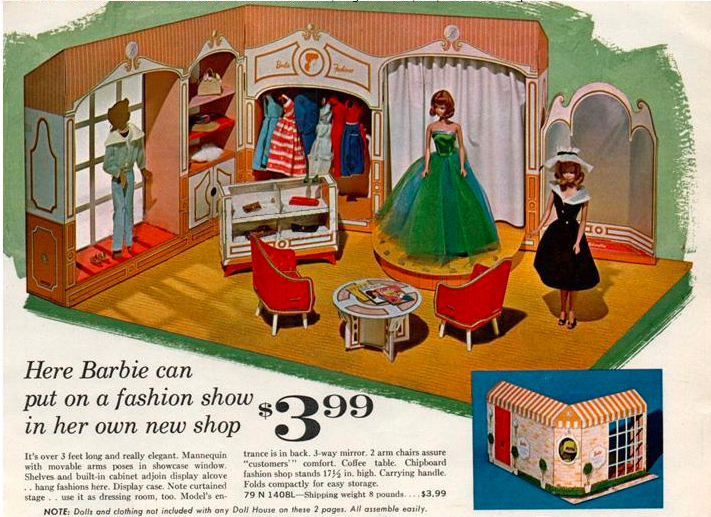
1963 Sears Christmas catalog image. Source: christmas.musetechnical.com; digitally restored by the author What is it that makes a doll boutique so desirable? I always wanted one as a child. Did my young mind subconsciously believe that the shop would refill with new designs as Barbie “purchased” them? Is it an aspiration to consumption, and a desire to incorporate the act into make-believe? Or would it simply render the experience of dressing and re-dressing a fashion doll more immersive? Perhaps it’s a little of each.

1964 JC Penney Christmas catalog image. Source: christmas.musetechnical.com Speaking of dressing and re-dressing one’s dolls in a fashion shop setting, the 1963 Barbie’s Fashion Shop play set illuminates one difference between children sending their dolls shopping today and back in the mid-Sixties: in the catalog image directly above, the customer, Miss Barbie, is seated watching a shop model show Senior Prom, while Midge in After Five works the sales floor. In other catalog images we may see another shop model, or the shopper may be dressed for a fitting; it’s unclear. At any rate, women didn’t go in the dressing room and try on potential purchases at a shop like this one in 1963. More people–or dolls–had to be involved.
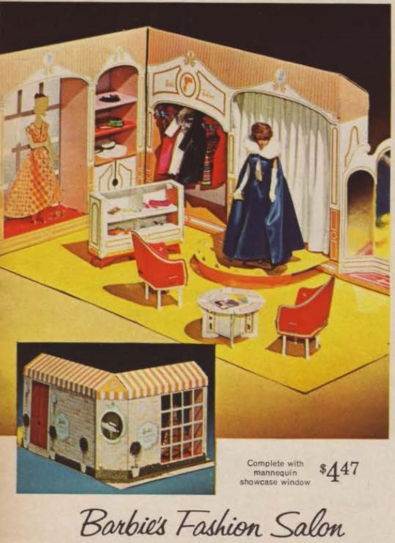
1964 Sears Christmas catalog image. Source: wishbookweb.com The catalog’s descriptions fill in details of the Fashion Shop setting. According to the JC Penney catalog copy, “Here’s where high fashion rules–where Barbie’s friends meet to discuss new trends. Includes modeling stage with curtains, display corner, furniture for customers, display cases and hat rack, model’s entrance to dressing room, even a mannequin with movable arms–so handy for showing new styles to Barbie and her friends.” Over at Sears, the “Fashion Salon” was “tastefully designed with curtained stage, alcove for hanging clothes, built-in cabinets, dressing room entrance, even a mannequin with movable arms. Salon furnished with 3-way mirror, arm chairs, coffee table, display case, hat rack.”

Mannequin in shop window and shelving units. Source: ringsforkim on eBay. In the Christmas catalogs, this elegant set was advertised for just two years.
Where to next? Visit a beauty parlor; pick out shoes; read up on Barbie’s modeling career in the Random House books; or go to the table of contents to see more options.
-
The Many Abodes of Barbie, Part II: 1964
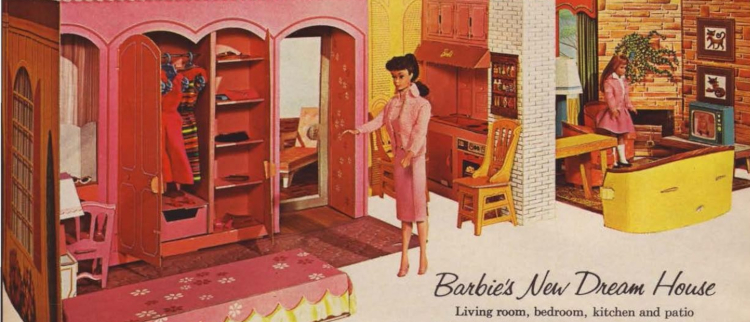
The 1964 New Dream House as seen in that year’s Sears Christmas catalog. Source: wishbookweb.com The New Dream House
In 1964 Barbie’s style of living got a major upgrade in the form of a new house, rich with detail, packed with almost too much furniture, and separated into four living spaces: living room, bedroom, kitchen and patio. The new home was furnished with a sofa, two armchairs, an end table, a coffee table, a television, two lamps, a vanity chair, a bed, two kitchen chairs, a kitchen table, and a chaise longue for the patio, in addition to smaller details like books for the bookshelves, flooring, and extra screens for the TV, so Barbie could watch different programs. The walls, too, were rich with textures and details, like the white-painted brick in the kitchen, the fieldstone fireplace, and those two gorgeous, midcentury-style framed cats hanging in the living room.

Pamphlet included with the New Dream House. Source: 610621 on eBay; digitally altered by the author The bedroom had built-in storage with working doors and drawers, and almost everything in the kitchen opened and closed, including cabinets, the oven, and the shutters of the pass-through window (just like the Petries had on Dick Van Dyke). Given the fragility of chipboard, it’s breathtaking to behold some of the pieces still in circulation today.
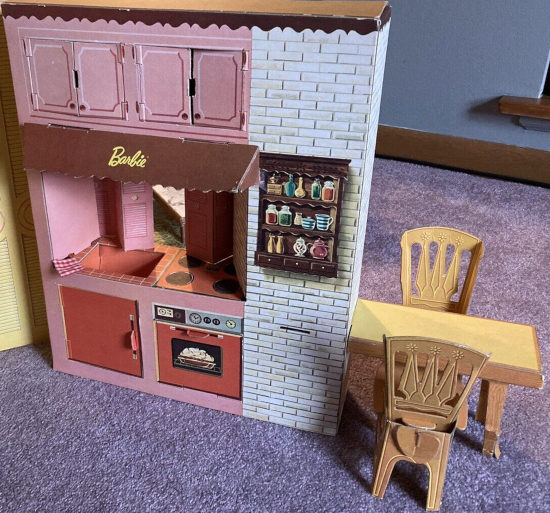
Little chipboard doors, 58 years later. Source: jbak4493 on eBay. A “screen” door adjacent to the kitchen and bedroom could open onto the patio. The two-legged kitchen table was made to affix to a wall and could be placed in at least five locations: three sides of the half-wall between the kitchen and living room (preceding images), into the louvered doors next to the kitchen to create a breakfast nook, and out on the patio (following image).

Breakfast nook (left) and patio. Also note the see-through door communicating between these parts of the house. Sources: snapclamp on eBay; mnovak1 on eBay After evaluating the outdoor spaces, I have ruled this home a second suburban sanctuary. However, the kitchen’s being in the bedroom (top image) was Very New York. Of course, the structure could be transformed to give more or less space to certain areas as they were needed, so the bedroom/kitchen area could be made less cramped, as in the second image.
Go Together Furniture Sets

Go Together Rooms box art. Sources: barbieworld.it, Theriault’s, nostalgic_toys_dolls on eBay. See more in our sidebar on Go-Together packaging illustrations. Populuxe author Thomas Hine, who was right about so many things, alleged in his landmark work that Barbie owned a split-level home (all the rage at mid-century). I haven’t seen the proof. However, if youngsters in the Sixties wanted to construct a split-level or multi-level home for Barbie, the Go Together sets made it easier. Each set consisted of one printed wall and several pieces of plastic furniture–including foam cushions and textured inserts–to make up a room. With these sets, one could add to an existing Barbie home or just enjoy a single space.
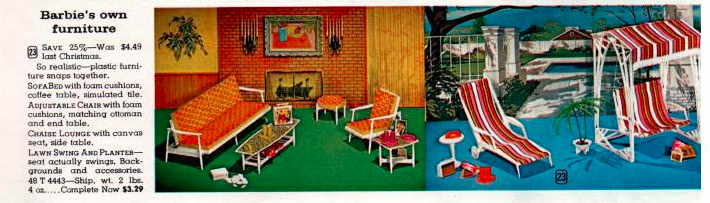
Go Together Furniture Sets advertised in the 1965 Montgomery Ward Christmas catalog. Source: christmas.musetechnical.com The Go Together sets were marketed alongside Miss Barbie in 1964 and included decor for the living room and patio; the dining room and Skipper’s bedroom were added a short time later, and all with backdrops to match. The advent of plastic introduced innovations like drop-leaf tables, convertible sofa-beds, a standing swing, and Skipper’s bunk beds that converted to single beds. Little extras like dishes, telephones, radios, and magazines were also included. Nowadays, partial sets are much easier to track down than complete ones–some of those foam cushions must have deteriorated, while the hard plastic furniture has endured.
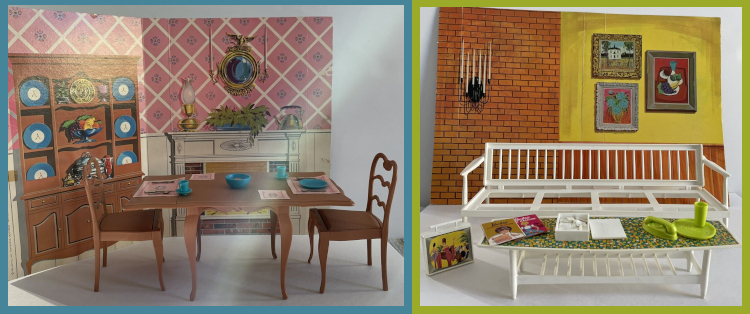
Partially-complete dining (left) and living room sets. Source: 56chzwgn on eBay. We adore illustrations here at Silken Flame, and the Go Together walls were bursting with illustrated detail. Skipper’s bedroom featured several of what I would call Easter Eggs: sitting on her vanity is a framed photograph of, I think, Midge wearing Fancy Free; on the wall are a framed photograph of Skipper herself in Silk ‘n’ Fancy, and photographs of Ken and Allan baring their chests (?); on the shelves are, I believe, a bend-leg Midge doll, an Allan doll, a Barbie guitar, the megaphone from Barbie’s Cheerleader ensemble, plus Skipper’s own hat from Red Sensation; and peering through the bed frame in the below photo like Bob from Twin Peaks, is what appears to be Bugs Bunny–if we moved the bed we’d find he even has a carrot.
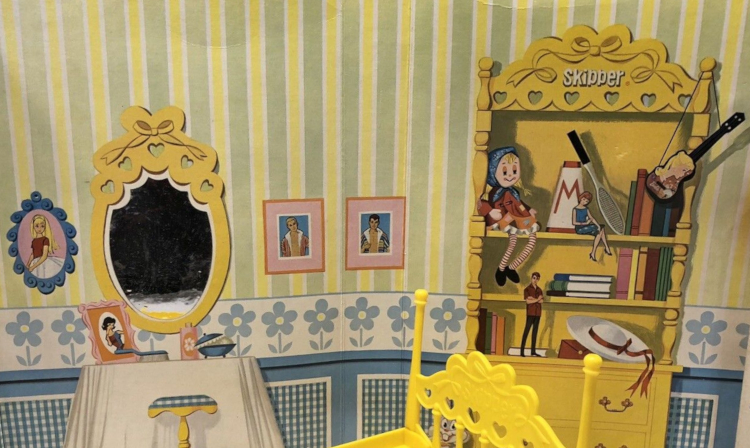
Part of Skipper’s wall. Source: nostalgic_toys_dolls on eBay. The walls that came with the outdoor furniture also confirm that Barbie is still trying to have it all in the suburbs. But she still has one more housing adventure to embark on this year…
Barbie goes to College
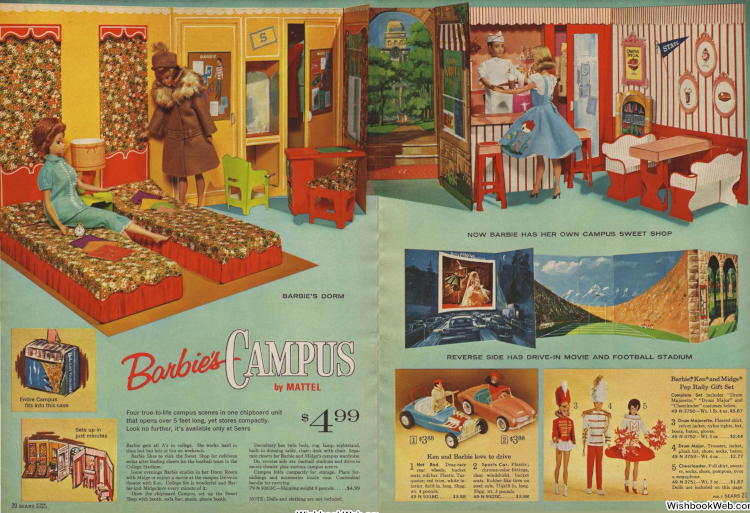
Barbie’s Campus play set as seen in the 1964 Sears Christmas Catalog. Source: wishbookweb.com. In 1964 the Teen-Age Fashion Model was ready to attend college. That year’s Cheerleader and Drum Majorette fashions hint at her involvement in campus life, and the campus play set provides the setting. Barbieworld.it has many excellent photographs of this set, which included a dorm room, a campus sweet shop, an exterior wall depicting the football field, and other scenes that suggest college but not really hitting the books. This set was a Sears exclusive.
Like many of us, Barbie went to college for a few years. In ’64, Midge is ubiquitous on campus, appearing both in the dorm room she and Barbie share, and in the campus sweet shop, in the catalog images above. By ’66 it is known that Midge and Barbie had grown apart. That year, although Midge was still seen patronizing the Sweet Shop, Barbie’s roommate was alleged to be… Francie? Francie was advanced for her age.

Campus Play Set in the 1966 Sears Catalog. In all, 1964 was a watershed year for Barbie’s housing options. Will she be satisfied dividing her time between her newer, larger dream house, her individual go-together rooms, and her shared campus accommodations? Or will she, like a true member of the American middle class in the 1960s, aspire ever onward and upward? Find out in the next installment.
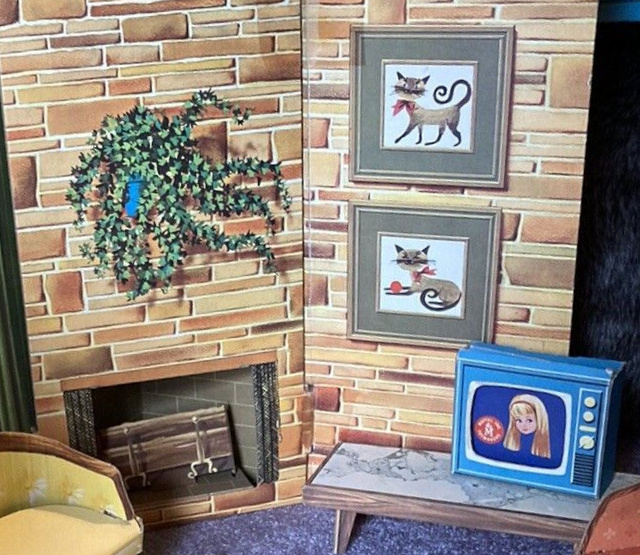
1964 New Dream House details. Source: jbak4493 on eBay. -
Sew-Free Fashion-Fun Kits (1965-1966)
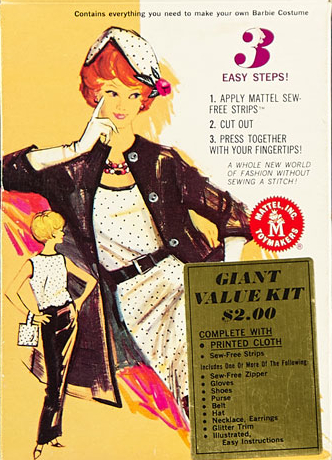
Packaging for Day ‘n’ Night, a Sew Free Fashion for Barbie. Source: Theriault’s In the realm of vintage Barbie illustrations, the Sew-Free Fashion-Fun kits are a category all their own. The loose, markered style, supplemented with certain precise details like fabric patterns and fingered gloves, as above, lends the drawings drama, romance, and, of course, glamour. Were the fashions themselves elegant and appealing? We shall see. The illustrations certainly were.

Digitally-altered 1965 Sears Christmas Catalog listing for Sew-Free Fashions A 1965 Sears catalog listing lays out the premise: children can make their own Barbie fashions from the kits by cutting out pieces, attaching adhesive strips, and pressing tightly with their fingers. No sewing necessary! Interestingly, during these years the Christmas catalogs also advertised off-brand home sewing kits for 11.5″ dolls with no cutting necessary–just sew the pre-cut pieces!
Despite what Sears claims above, there were no such fashions sold for Skipper.
Sears had different names for the sets than did Mattel, and in some cases combined two sets into one. The Day ‘n’ Night fashion, illustration at the top of the post, really did contain two looks for Barbie. Sears renames this pair Coordinates, and advertises another set as Day-Night, combining Mattel’s Debutante Party and From Nine to Five sets.
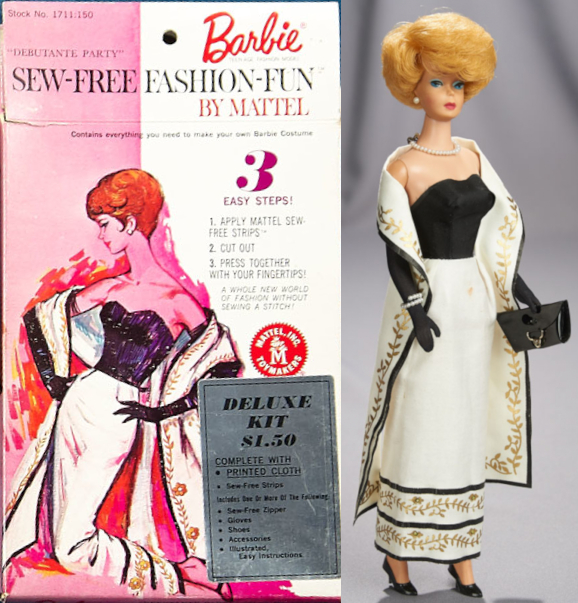
Debutante Party Sew-Free Fashion-Fun packaging (left) and dressed doll. Source: Theriault’s Like Mattel’s fashion booklets of the time, the Sears catalog includes example photographs of the fashions under the best case scenario, assembled and styled by professionals. But the images are so small! Theriault’s, the doll auctioneers, have also professionally styled a few of the fashions assembled by hands unknown in the past.
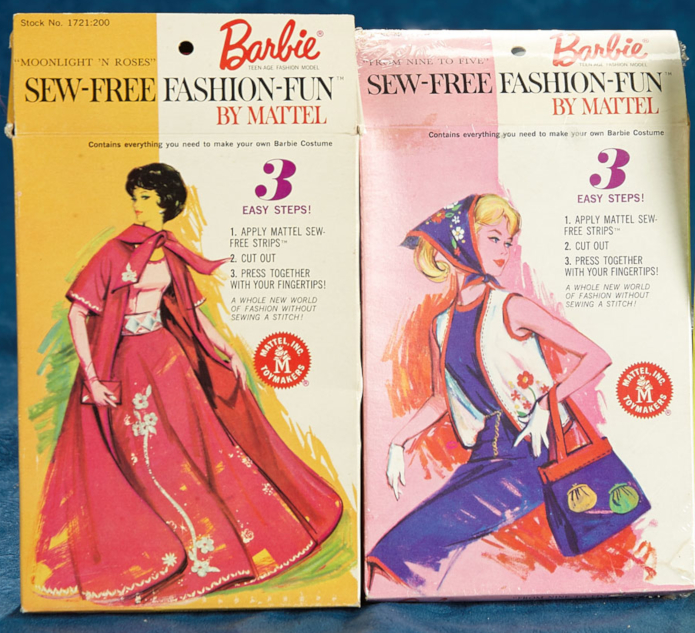
Moonlight ‘n’ Roses (left) and From Nine To Five Sew-Free Fashion Fun packaging. Source: Theriault’s Back in the world of Sears, the Moonlight ‘n’ Roses kit has been renamed Gala Ball. The Moonlight ‘n’ Roses packaging displayed above doesn’t include the helpful “Giant Value Kit” sticker that Day ‘n’ Night had at the top of the post, but its stock number ending in “-200” indicates that’s what it was. Sears listed both Giant Values at $1.77 apiece, 23¢ off the sticker price; while the Day-Night combo pack of two Deluxe Kits, listed at $2.66, represents 34¢ savings. Sears’ Travel Fun combines Mattel’s Sorority Tea and Pretty Traveler, two $1 Basic Kits, for $1.87–13¢ back in your pocket.
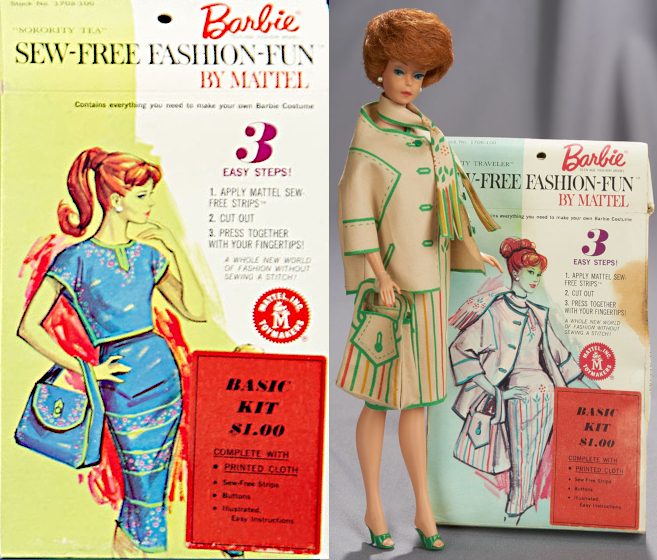
Sorority Tea Sew-Free Fashion-Fun packaging (left) and Pretty Traveler packaging and dressed doll. Sears dubbed this pair “Travel Fun.” Source: Theriault’s While nowadays it goes without saying that Barbie’s playline fashions have details printed on, this was a Sew-Free innovation in 1965–Barbie’s usual finery had high quality, sewn-on embellishments. Both of the Sears Travel Fun fashions had printed designs, and the photographed example above right looks, in the context of Barbie’s typical 1965 attire, less than glamorous. The contrast top stitching must have been pretty and playful in the designer’s mind, but printed on that beige fabric it looks like nothing more than a sewing pattern waiting to be cut. And the way the sleeve hole seems to jut out straight into the doll’s bosom? Maybe the original owner had trouble constructing this one. Otherwise, the fetching article in the illustration just is not borne out in the finished piece. Too bad.

Left: Day In Town Sew-Free Fashion-Fun packaging. Source: Theriault’s. Right: Doll dressed in Day In Town from a 1966 Montgomery Ward catalog. Source: musetechnical.com The 1966 Montgomery Ward catalog shows another dressed doll (above right) looking quite chic in her Sew-Free Fashion. This listing actually included the American Girl doll, with her original swimsuit and shoes, along with three Sew-Free fashions: Day In Town, plus the Basic Kits Hootenanny and Patio Party (below), all for $2.99.
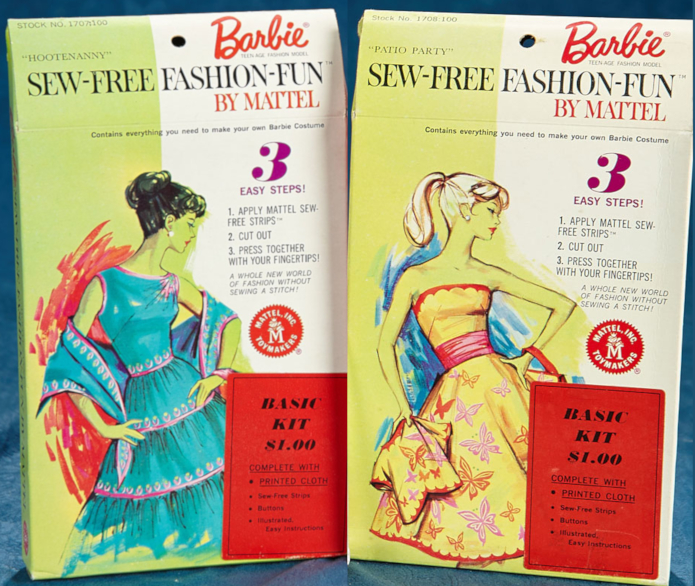
Hootenanny (left) and Patio Party Sew-Free Fashion Fun packages. Source: Theriault’s These two kits each included a dress, a shawl or jacket, and a purse. All had printed details. The catalog included photographs of constructed examples, but not displayed on dolls. Many other examples of the assembled fashions, the packaging, and even the (illustrated) instructions exist here and there on the Web for the curious.

As the fashions themselves go, I believe these sets were more activity than style, but the packages sure are gorgeous.
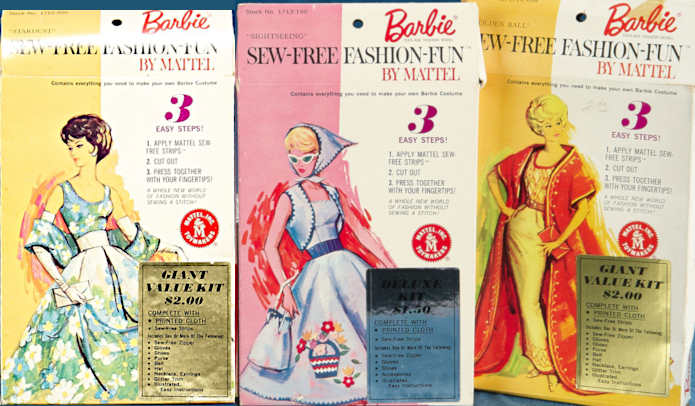
L-R: Stardust, Sightseeing, and Golden Ball Sew-Free Fashion-Fun packaging. Source: Theriault’s Where to next? If you like these illustrations, you’ll probably also like gift set art; if crafting is more your bag, check out the sewing pattern illustrations; for a dusting of glamour, swing by Barbie’s Fashion Shop, then head over to the beauty parlors; or visit the table of contents to see more options.
-
A chronicle of Barbie shoes, 1959-1967
Recently, while sourcing various, specific vintage shoes for a custom project, I began to realize there were basic facts about Barbie’s early shoes that were not known to me. What year was Barbie’s first pair of closed-toe shoes produced? (The answer surprised me, but maybe you already know.) What were the most common “gold” open-toed heels? So I sat down with Sarah Sink Eames’ books on Barbie fashions and did a little elementary data science.
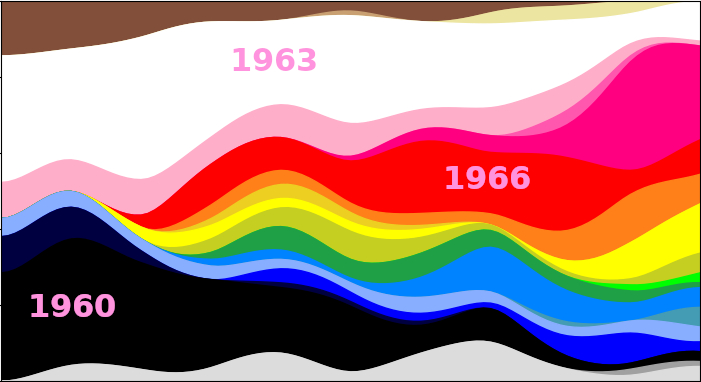
Stacked proportion of available shoe colors per year, 1959-1969 The chart above shows the proportion of occurrences of shoes in each color, per year, over the period 1959-1969 (although I’ll mostly conclude my analysis at 1967–you’ll know why later). The horizontal direction represents a timeline; the depth of any given color in the vertical direction represents the ratio of outfits available with shoes in that color at a given time, relative to the total number of outfits available at that time. The white ripple running along toward the top isn’t empty space, but rather white-colored shoes, and the light gray at the very bottom actually represents clear shoes.
The figure below shows stacked total numbers instead of proportions, counting only the outfits or sets introduced each year instead of counting over all the outfits that were available that year (the differences between introduced shoes and available shoes are generally small, since most fashions lasted 1-2 years during this time period). I didn’t number my axes, but the red vertical bar inside the white filled contour at 1964 represents the maximum number of white shoe occurrences in ensembles or paks introduced in a given year (13 paks or ensembles with white shoes were introduced in ’64), and the white vertical bar in the red filled contour shows the location of the maximum number of occurrences of red shoes in sets introduced in a year: 11 in 1965. Overall I prefer the stacked proportions because we could go back and forth about how to count sets that came in variations or with multiple pairs of shoes, but by looking strictly at proportions or ratios (top plot), most of that stuff should wash out.
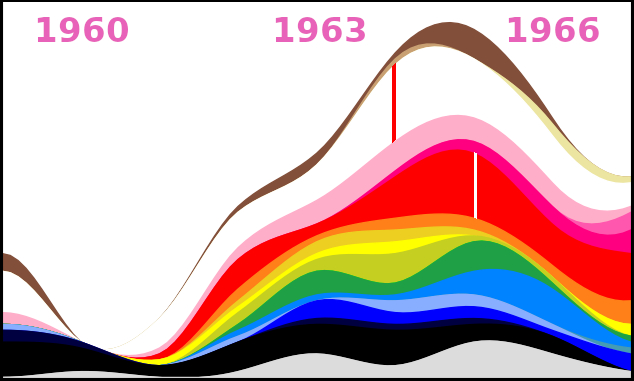
Stacked total shoes per color in sets introduced each year, 1959-1967 What can we learn from the ratios? I notice that black, navy, and brown, three colors that were around in 1959, are extinct or threatened with extinction by 1969. Other 1959 hues have also lost market share, but that’s to be expected as the variety of available colors increases. In fact, white and pale pink both gained in real numbers in the mid-Sixties (second plot), although they truly do seem to be waning by ’69. Red, nonexistent in 1959, experiences a heyday around 1966 but also seems to be losing ground at the end of the timeline. Meanwhile hot pink and yellow are posed to explode–but we’ll get to that. Here’s what happened in the mean time:
1959
Before 1959 Barbie had no shoes, because there was no Barbie. During the first year of Barbie’s existence she had a decent footwear assortment–though it’s notable that she had no closed-toed pumps, which were certainly in fashion at the time. I’ll hazard a guess that there were manufacturing challenges. Anyway, in the first year of her life Barbie wore open-toed pumps and cork wedge sandals. Some of the open-toed pumps had pompons on top, to be worn with nightgowns and negligees; these came from a slightly different mold than the regular open-toed heels, having a hole at top center in which to affix the pompon. Her shoes came in black, brown, navy, white, pale pink and pale blue.
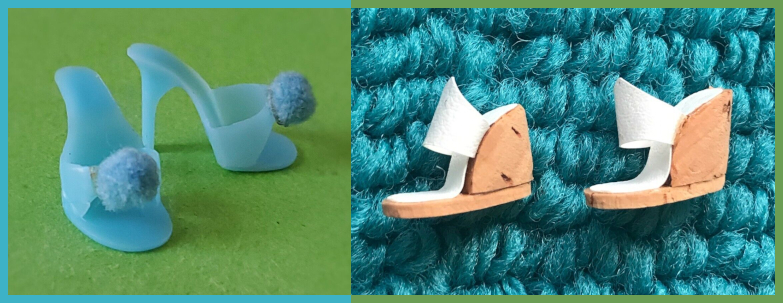
Open-toed mules with pompons for wearing in the boudoir, and cork wedges for wearing on vacation, were footwear options for Barbie from year one. Sources: anotherbarbie on eBay; jemmy2 on eBay In fact, the very first, first Barbie shoes had holes in the soles to poke her stand through. This arrangement lasted less than a year.
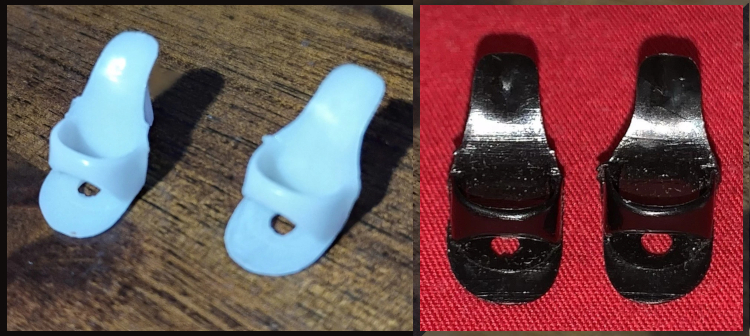
Two sets offered in the first year, Undergarments and Floral Petticoat, were sold with no shoes, while 21 ensembles were complete with footwear.
1960
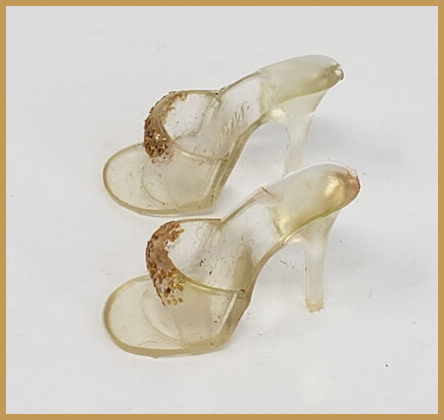
Clear heels with gold glitter like those sold with the Enchanted Evening fashion. Source: vintage_toys_and_treasures on eBay Barbie got no new shoe styles in 1960, but she did get a new color, one of my favorites: the clear open-toed pump. These shoes all came with either gold or silver glitter painted on, and in 1960 the glitter was gold. The shoes were exclusive to the Enchanted Evening ensemble in their first year, but they’d find their way into many fashions over time and were still well-represented by 1967-1969, when many of Barbie’s other classic styles were falling out of favor. They also represent the first option for a “gold” open-toe heel for my purposes. Mattel has a spotty record for including accurate versions of these in repros: the 1996 Enchanted Evening reproduction came with gold glitter open-toed shoes, but the glitter was embedded in the plastic instead of painted over the top, while the 2007 Evening Gala reproduction included accurately-reproduced gold glitter heels; the 2013 Invitation to Tea reproduction included accurate silver glitter heels, while the 2004 Sparkling Pink gift set reproduction included pale pink open-toed heels (the original set included both clear with silver glitter heels, and pale pink heels).
As seen below, only the silver glitter versions–not the gold–tended to have glitter on the heel, too.
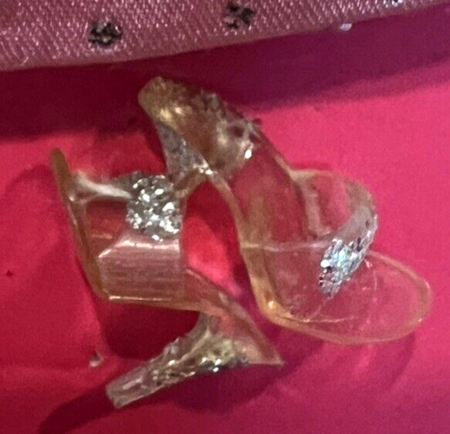
Clear heels with silver glitter in the 1963 Sparkling Pink gift set. Source: rivalc38 on eBay. Ambiguity: According to multiple Mattel fashion booklets we checked throughout the time Enchanted Evening was advertised, the ensemble should have included pale pink open-toed heels with silver glitter.
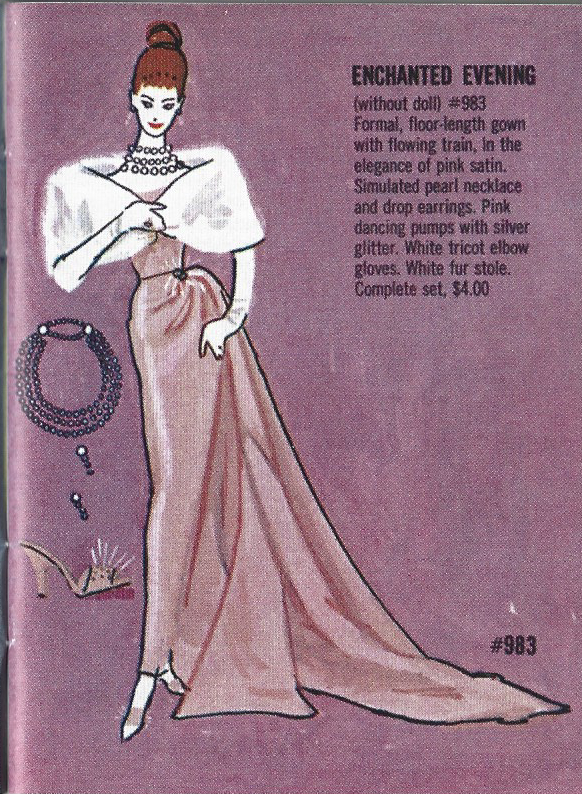
From a booklet copyrighted 1962, showing fashions for 1963, the last year Enchanted Evening was available. The same illustration was used in previous years. If the set was ever sold this way it changed at some point, since NRFB examples exist with clear shoes. Opaque glitter shoes did exist in the 60s, however: in addition to the (purported) Enchanted Evening pale pink glitter heel, 1964’s Satin ‘n’ Rose gift set had darker pink heels with silver glitter (like their clear counterparts, they were glittered on both the upper and the heel).

L: unopened Enchanted Evening with clear, gold-glittered heels; R: unopened Satin ‘n’ Rose with silver-glittered, rose-pink heels. Sources: dubarbie on eBay, liloxbow on eBay. If the pale pink glitter shoe ever existed, its ultra-rarity today suggests that the clear shoe was more common for Enchanted Evening despite the booklet description, though it is interesting that no other pak or ensemble appears to have included clear shoes until ’62. At any rate, this means Barbie’s new shoe in ’60 may not have been the clear heel, but rather the elusive opaque glitter heel.
1961
Barbie got two new styles in 1961: terry scuffs for wearing with a bathrobe, and ballet slippers to accompany the long-lived Ballerina fashion. Not much was new for evening, however.
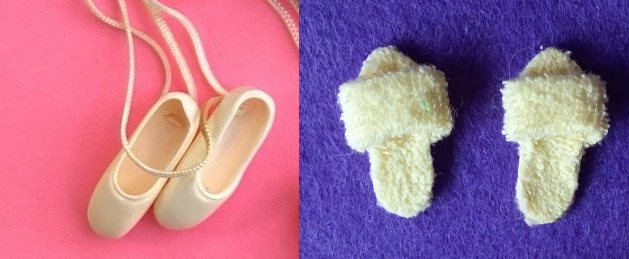
via lulubelle and quinniessentials on eBay. The first set containing multiple pairs of shoes was introduced: Barbie Doll Accessories. The set included open-toed heels in black, white and pale pink, as well as a swimsuit, tote bag, gloves, jewelry and glasses. Pak fashions had not been offered yet in ’61, so this set of odds and ends is a sort of proto-pak.
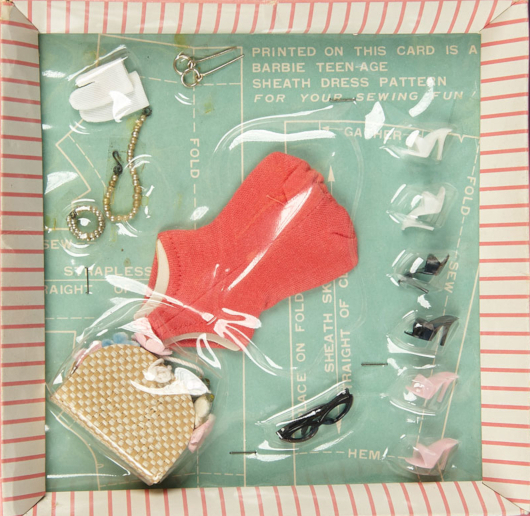
The 1961 Barbie Doll Accessories “proto-pak” included three pairs of open-toed heels. Source: Theriault’s 1962
In 1962 paks were introduced, bringing with them for the first time a wide variety of Barbie fashions (including dresses and shirt/shorts sets) sold without shoes. Many pak fashions did include shoes, and one 1962 ensemble–Movie Date–appears to be the first non-underclothes Barbie ensemble offered sans footwear. Paks ushered in variations, in which a single set, like Gathered Skirt or Lingerie Pak, would be offered in different colors, including with differently-hued shoes. This explains the 1962 blowup in total number of shoe selections offered that we saw in the second plot.
The cork wedge, around since 1959, now came with a metallic gold upper in the ensemble Mood for Music and with the Helenca swimsuit pak. This could serve as a gold open-toed heel for my quest, although I was after something more evening-appropriate.
New colors of shoe plastic were also added to the roster. Despite the red-forwardness of Barbie’s early wardrobe, the only “red” shoes I counted pre-’62 were cork wedges with a red upper in a leather-like material, like the ones worn with Open Road. In 1962 red open-toed heels became the default shoe for dolls sold wearing the new red jersey swimsuit; they also accompanied Red Flare and some of that year’s pak fashions. Other new hues were orange and one of my favorites: mustard, the other candidate for a “gold” open-toed heel for my project.
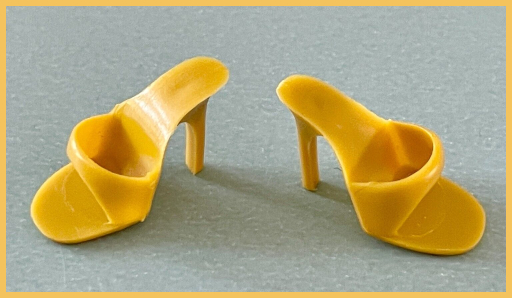
There was no metallic gold shoe plastic, but these mustard-colored heels may have suggested shiny gold shoes. Source: punky-shoester on eBay I believe the mustard shoe color is somewhat unique in that it was offered almost exclusively with paks, the one exception being 1964’s Golden Evening ensemble, which was composed entirely of various pak outfit elements. The orange open-toed heel was a true pak exclusive, but orange closed-toed pumps and other shapes would eventually come into wide use.
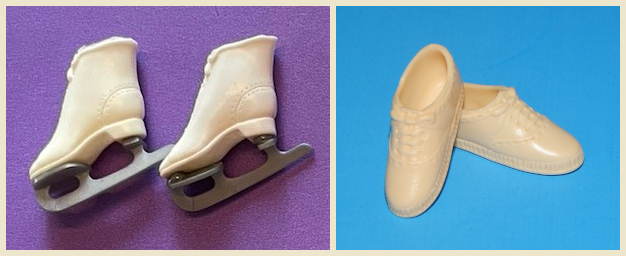
Sources, on eBay: andywc3, braniffmod Finally, in 1962 Barbie added ice skates and sneakers to her recreational wardrobe. Her footwear for evening was still limited to open-toed heels.
1963
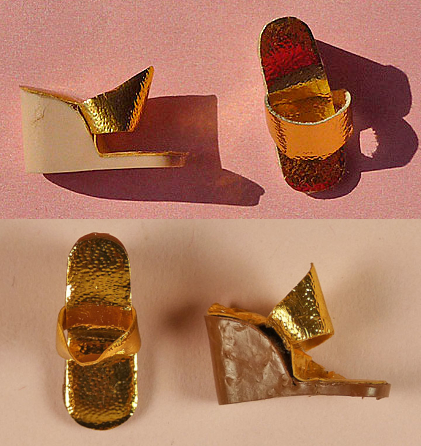
Tan and brown plastic wedges were new for 1963. Shown with the metallic gold upper discussed above. Source: Joe’s List A couple small changes to Barbie’s shoe collection occurred in 1963: cork wedges started to be phased out in favor of plastic wedges, which came in either tan plastic or dark brown; and a unique variation on the open-toed heel made its lone appearance.
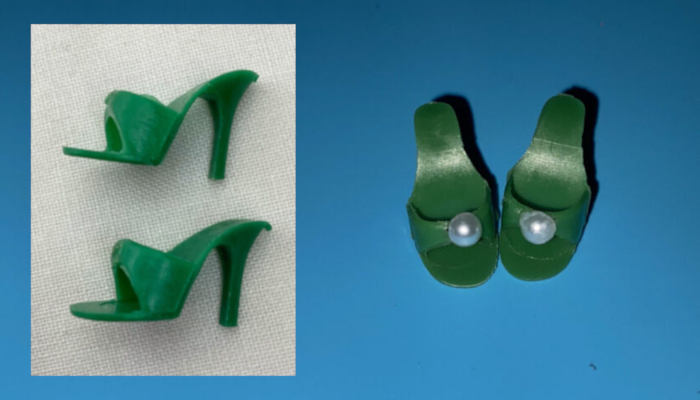
Two examples of Senior Prom pearl-accented heels that have lost their pearls. The pair at right was refurbished with replacement pearls. Sources: de*be on eBay, niccipl4 on eBay. The Senior Prom formalwear ensemble came with pearl-accented shoes, as seen above. The shoe mold was again modified, this time to include a setting for the pearls. Unfortunately, so many pearls have been lost or damaged over the years that it’s hard to find a pristine pair outside of unopened ensembles; many of the nicer-looking pairs available are refurbished, as in the righthand image above. I wonder if the pearls were already causing trouble in the 60s; that could explain why this appealing design was never repeated for other fashions. Evidence suggests that this has also been an issue for the reproduction versions that were offered with the 35th anniversary Midge gift set (when those two eBay links break, note that they pointed to one opened repro set, and one NRFB, both with one shoe’s pearl detached or missing).
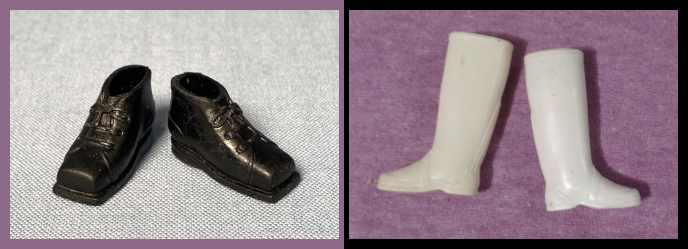
Black Ski Queen boots and white Stormy Weather boots both via eBay ’63 also saw ski boots and rain boots added to the roster, but still no closed-toed shoes for evening. Mysteriously, a Whitman Barbie paper doll set this year included an illustration of Barbie standing by her closet, wearing and surrounded by closed-toed heels. A shoe pak advertised in the booklets around this time also showed a similar, unexplained abundance.
1964
What a year was ’64, for wacky one-off Barbie shoes.
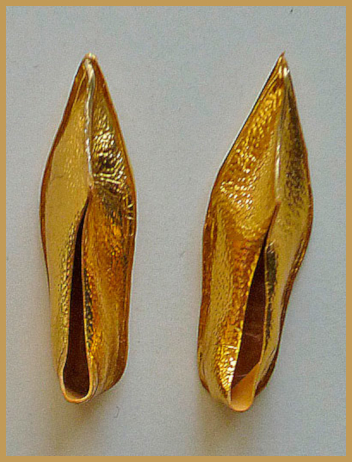
Little Theatre Arabian Nights shoes from 1964-65. Source: Joe’s List Between the Little Theatre costumes and the travel costumes, Barbie had thong sandals (Japan), clogs (Holland), brocade slippers (as Guinevere), the Arabian Nights shoes above, and the Little Red Riding Hood shoes below that, to me, are the most unexplained aspect of Barbie footwear and the pair of shoes that look most like a manufacturing error.
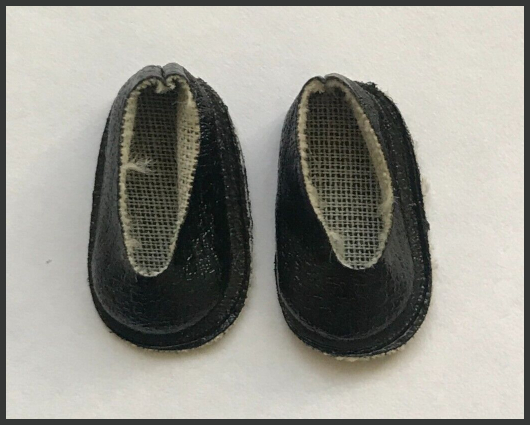
Little Red Riding Hood’s shoes. But why? Source: jemmy2 on eBay Yes, Barbie could acquire leather-look flats shaped like the disposable shoe covers you might wear to process a crime scene, before she could have a decent pair of closed-toed shoes for evening.
She also got a pair of roller skates in the For Rink and Court set, and two sets this year also came with majorette boots, a new style that would be repeated in at least two future years.

The black majorette boots of the Fashion Feet pak (left, source) and the white roller skates of For Rink and Court (right, source) were new styles in ’64. The boots also came in white with the Drum Majorette ensemble that year. Besides the majorette boots, none of 1964’s new designs would recur with any other fashions during the years covered herein. The travel costumes were available for just one year, while For Rink and Court and all of the Little Theatre costumes besides Red Riding Hood survived for one additional year.
1965
In 1965, Barbie got closed-toed heels.
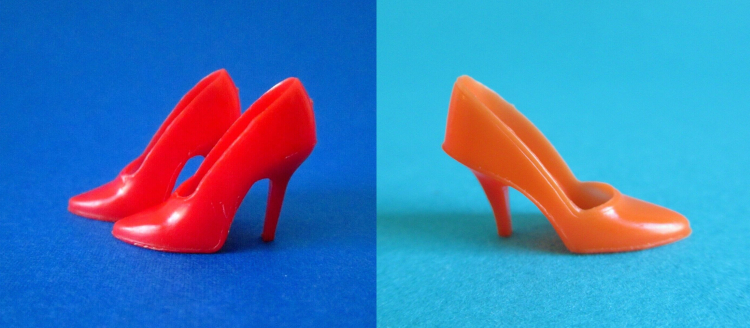
Spikes and a non-spike from 1965. Source: anotherbarbie on eBay Overnight, Barbie went from no such shoes to at least sixteen occurrences in the first year, all with ensembles that debuted that year (closed-toed pumps also became available in paks the following year). The birth of the closed-toed shoe for evening is actually pretty famous, because for a very short time “spike” heels (above left) were produced, to be replaced by the less-ambitious pump at right before the first year ended.
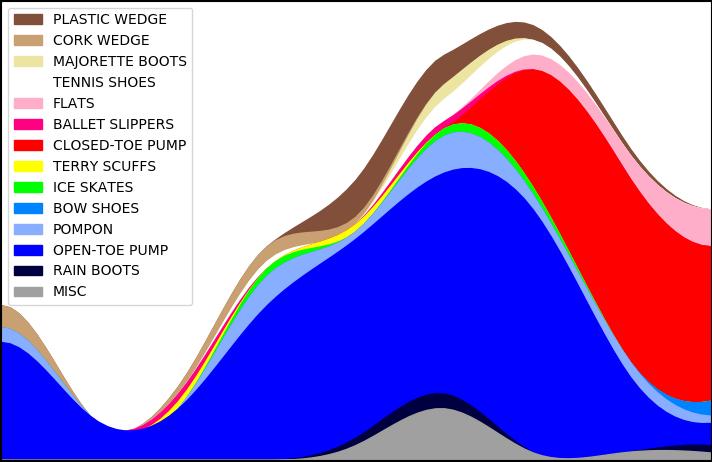
Stacked total shoes per style in sets introduced each year, 1959-1967 Here, at last, are timelines of styles per year–above shows the total number in sets introduced by year, and below is the proportion of different styles in sets available by year. While I think the proportions give more intuition, the figure below is not entirely pleasing to the eye with that great blue whale (open-toed pumps) filling most of the space. It almost suggests using a log scale for this dataset. Anyway, the open-toed pumps dominate most of the timeline–with some of that mid-Sixties bulge, above, due to pak variants–and then are suddenly swept aside in 66-67 by everyone’s new favorite, the closed-toed pump (indicated in red). Interesting that the pompon open-toed shoe, light blue in the figures, seems resilient to changes in fashion; I guess Barbie’s fraction of nightgowns and negligees is fairly stable over time.
In these figures the “MISC” category (miscellaneous, grey filled contour at the very bottom) covers everything that only appeared in one set during ’59-’67: all the inventive articles from 1964 (that’s the big grey bump at the bottom, just past the halfway point in time), the pearl-accented heels, et cetera. At the tops of the plots, in two shades of brown, we can see the cork wedges supplanted by the plastic wedges which then diminish by the end.
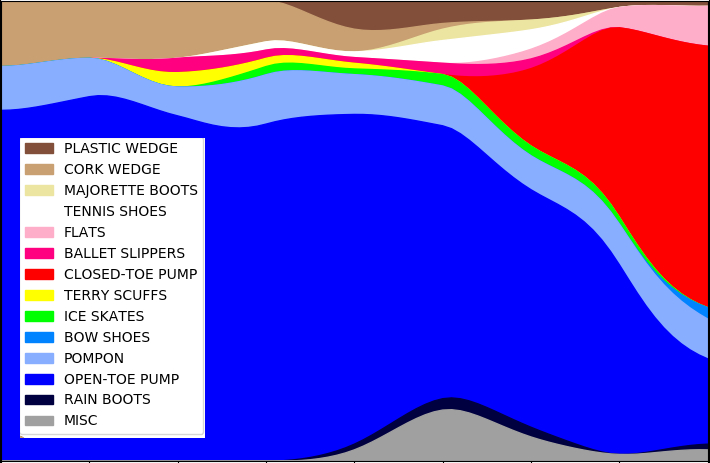
Stacked proportion of available shoes per style, 1959-1967 Mattel’s cobblers had a couple more surprises for us in ’65: in addition to the closed-toe heel and its spiky variant, the Miss Astronaut set came with unique zippered boots, and plastic slip-on flats made their first appearances, in a handful of more casual ensembles like “Vacation Time.”
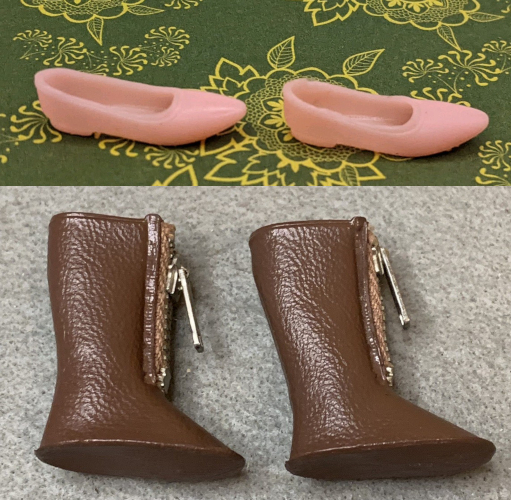
Flats and boots for vacation and space travel, via wildamaryllis and vtg.barbie.girl on eBay Now that we’ve properly introduced closed-toed heels, it’s time to circle back to one more Little Theater oddity from 1964: the single “glass slipper” for Barbie, that came with Ken’s Prince costume. While Barbie as Cinderella wore a pair of silver-glittered, clear, open-toed heels, Ken’s costume came with a single, unglittered, closed-toed heel for Barbie as Cinderella to try on. Doesn’t that make too many glass slippers? Oh well. This also means a closed-toed shoe for evening was technically available to Barbie already in ’64, but you had to buy two copies of the Ken ensemble to make a pair.

Ken as the Prince, brandishing a slipper. Souce: mynorthwestnovelties on eBay. Is someone defiling these rarities with silver glitter? There are a couple such pairs on eBay right now, listed as 1966 Shimmering Magic shoes. NRFB Shimmering Magic examples we found had red closed-toed shoes, which is also what Sink Eames lists. Mattel’s ’66 toy catalog for retailers doesn’t describe the shoes in text but shows red closed-toe pumps (the fashion booklet for that year lacks text descriptions); but it’s possible the silver glitter closed-toed variant also existed, maybe to use up extra glass slippers. In any case, the variant is at least rare, and we’d advise caution around those eBay listings.
1966-67
After the many innovations of the previous year, 1966 was a quiet year for Barbie’s shoe styles (not counting the Shimmering Magic controversy described in the previous section). She did get a new pair of riding boots. Francie debuted with closed-toed shoes, boots and skates of her own.
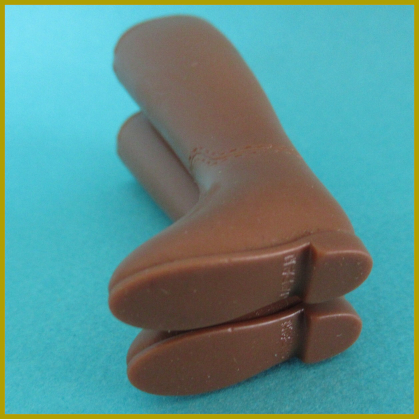
Riding in the Park (#1668) boots via VintageBarbieCollectibles on eBay. We end our story at 1967 because it’s where Sink Eames’ first book ends, and also where Joe Blitman’s mod Barbie book begins, and when Barbie shoe life was just getting too complicated. Case in point: the 1967 fashion “Weekenders,” which Sink Eames lists as including green ankle boots–if so, the only ankle boots in the period 1959-1967. However, Blitman lists pink flats, and a photographed NRFB set spotted online sides with Blitman.
Before the tale ends, the first bow shoes entered the fray in ’67, heralding the new mod era that impacted shoes in addition to garments, hair and just about everything else. Bow shoes were made of a squishy material, and these shoes’ colors may not line up exactly with those of hard plastic shoes–yet another late-Sixties complication for cataloging and indexing.
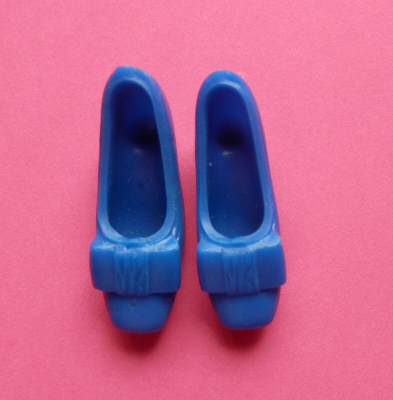
Squishy bow shoes. Source: wags94 on eBay One more bold footwear trend manifested in ’67: the swimsuit doll came barefoot for the first time, and she’d continue to be barefoot for years, essentially until the “swimsuit doll” concept diminished and dressed dolls became the main mode of Barbie-buying.
Included in Sink Eames’ book but omitted from the present study are the Braniff air hostess costumes of 1967, which included shoes of almost indescribable, painted-on color and unique design, being manufactured in Hong Kong by Marx Toys, not Mattel. Though collectors do seem to regard these as legitimate Barbie fashions, the shoes exist outside Mattel footwear trends.
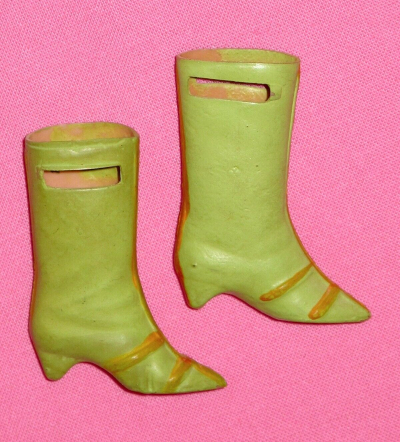
The Braniff hostess outfits came with unusual shoes. Source: brodjam on eBay …and beyond
I kept toiling away doing data entry until 1970 but found more and more discrepancies between Sink Eames and Blitman with each passing year, and Blitman also indicated that many outfits came with variant shoe styles, especially beginning in 1969. By ’70 it seemed like practically every outfit could include bow shoes OR T-strap heels OR pilgrim shoes, and viewing the commonness of the different styles in terms of appearances in different sets was losing meaning. Then I saw the JC Penney exclusive 64-piece Shoe Bag of 1970 and knew I was beat. That’s why I ended up considering color trends out to 1969 and style trends only to ’67.
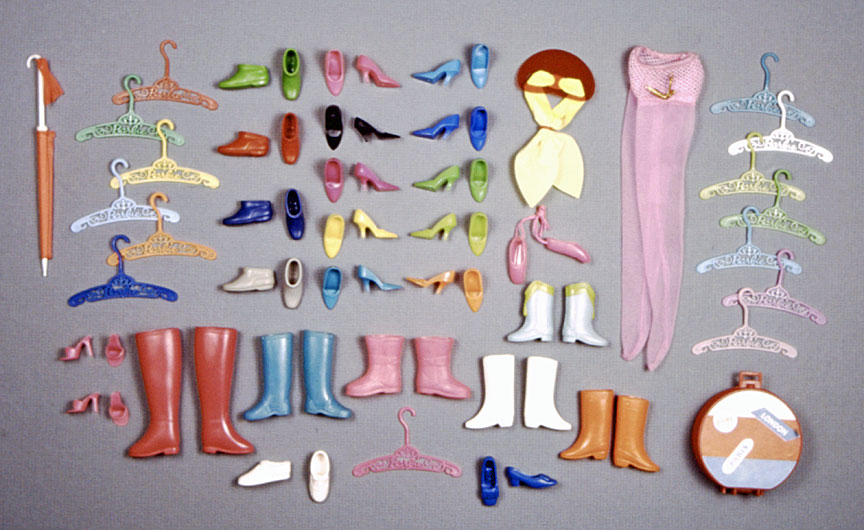
Contents of a 1970 JC Penney exclusive “Shoe Bag.” Source: Joe’s List (also Joe Blitman’s book, Barbie & her Mod, Mod, Mod, Mod World of Fashion, 1967-1972) Blitman has said that four of the closed-toed pump colors were exclusive to the set above. Can you spot them?
Before throwing in the towel, I observed that almost every outfit in ’70 has either hot pink or yellow shoes, and that the closed-toed pumps, so dominant in 1967, were fast being replaced by bow shoes, t-strap heels and pilgrim shoes (some of which are, admittedly, closed-toed heels themselves). The same winds of change pushing the basic closed-toed pumps out of favor were also eroding away past favored shoe colors like red, as noted at the top of the post.
Applying what we learned
Based on the shoe trends covered here, which shoes in the 2004 “reproduction” shoe pak shown below are NOT based on a 1960s offering?
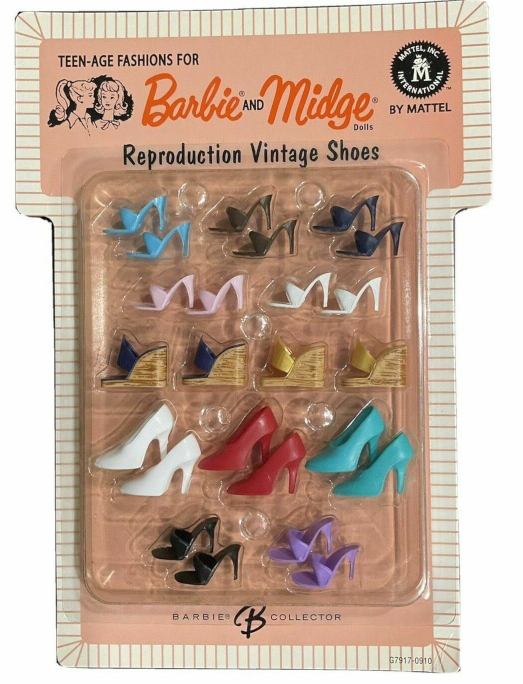
2004 Reproduction Vintage Shoes. Source: kopykatcom on eBay. Where to next? Learn about our favorite reference books, like those by Sink Eames and Blitman; view one more graph in the piece on Deluxe Reading Dream Kitchen; read our thoughts on nostalgic Black Barbies; study up on Mattel Modern and Susy Goose furniture; or see more options in the table of contents.

Silken Flame
Vintage Barbie illustrations, built environment, clones and more
 Silken Flame