-
Welcome!
Thanks for swinging by my vintage Barbie fan site, where you’ll find articles on Barbie’s built environment, Barbie illustrations, vintage rival and clone dolls and playsets, and miscellaneous musings/deep dives. What are you looking for?
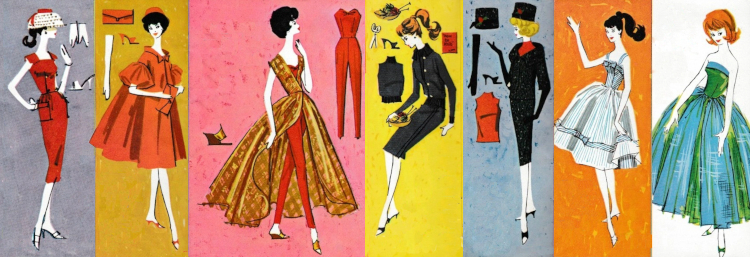
Vintage Barbie Illustrations
- Mattel fashion booklets, 1960-67 (approximately)
- Basic and Dressed Doll Boxes, 1959-64
- Doll Carrying Cases, 1961-72
- Jumbo Trading Cards, 1962
- Gift set art, 1960-70
- Illustrated fashion packaging, also about 1960-70
- Random House books (plus some from other publishers), 1962-65
- Dell Comics, 1962-63
- Whitman Paper Dolls, 1962-65 and 1967-73
- Whitman Coloring Books, 1962-65 (A mod sequel post is possible but not planned at this time.)
- More crafts and hobbies, 1963-1971
- Queen of the Prom board game, 1961-63
- Keys to Fame board game, 1963
- Sew-Free Fashion Fun Kits, 1965
- Sewing Patterns, 1962-?
- The Barbie World of Fashion board game, 1967
Plus the illustration “sidebars,” short entries on niche topics:
- Busy Gal fashion sketches, 1960
- Barbie Sings!, 1961
- Go-Together furniture sets, illustrated
- Color Magic, 1965-66
- Mattel fashions for Julia, 1968-69
- All the Barbie and friends illustrations on mod house exteriors like the one below
- Miss Lively Livin’ board game, 1970
- Window shopping, illustrated
- Barbie’s Baggage, illustrated (not super short, but surveys many illustration categories examined in other posts)
- Vintage dress-up and other child-size items for the boudoir
- The illustration component of the 1964 Little Theatre and travel costumes entry is sidebar-sized.
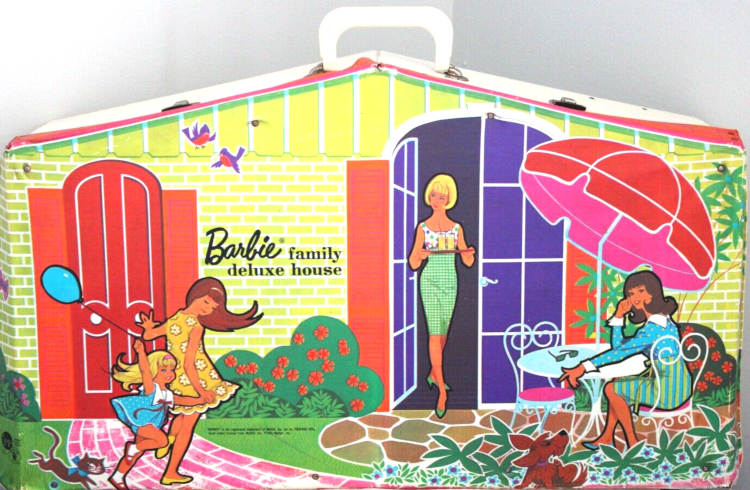
Barbie’s Built Environment
- Entries by year for many of Barbie’s early abodes: 1962, 1964, 1965, 1966, 1967-68, 1969, 1970.
- Barbie’s ’70s Travelogue:
- Mattel Modern and Susy Goose furniture, 1958-1966
- Barbie on TV, a roundup of some of Barbie’s early toy TV sets (this post also has a strong “illustration” component)
- Barbie’s Fashion Shop, 1963
- and a detour into Mannequins and Dress Forms, ’63-’73
- The Deluxe Reading Dream Kitchen, 1963 (note, this is not a Mattel product)
- The Little Theater, 1964
- Skipper’s Schoolroom, 1965
- Penthouse apartments, 1964-76
- Beauty parlors, 1964-77
- Japan-exclusive furniture, 1967
- Unique Boutique and Cafe Today, both 1971
- The Sears Karosel Kitchen, 1971-1976 (note, this is not a Mattel product)
- A roundup of fireplaces in Barbie and Barbie-sized houses, 1963-79
- The “built” environments of Whitman Barbie paper dolls, which real Barbie dolls can also use; 1963-1973.
- The built environments of mini vintage Barbies
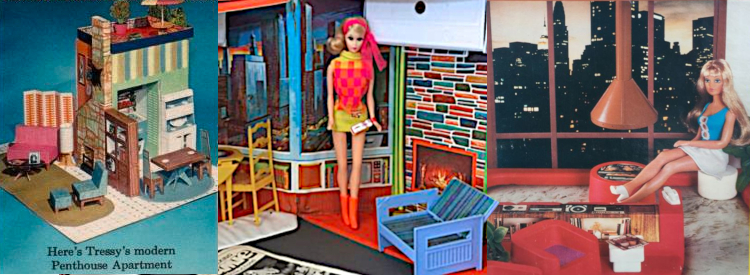
Articles relating to clones, rivals, and off-brand Barbie-style products
- Rival fashion booklets
- The Two Abodes of Tammy covers the living spaces of one of Barbie’s most notable rivals
- Barbie’s ’70s Travelogue, Part II: Unofficial Adventures is about non-Mattel playsets suitable to Barbie and Barbie-sized dolls
- Clones are recommended in the “existing alternatives” section of the musing, Three Nostalgic Black Barbies We Need (and a few existing alternatives).
- Clone kitchens: The Deluxe Reading Dream Kitchen, The Sears Karosel Kitchen
- Clone washrooms are prominent in Barbie’s ’70s Travelogue: Part IV.
- The pieces on penthouses, beauty parlors and fireplaces include non-Mattel offerings.
- Not Barbie on TV: Barbie and friends’ early TV sets that were tuned to other programs
- The entry on Mattel Modern and Susy Goose furniture includes some offbrand furniture items of the 70s and 80s.
- We wrote about clone carrying cases, including some created for competitor dolls.
- Certain of the sewing patterns are for generic fashion dolls, as are the Sew Simple and Cut ‘n’ Sew craft kits.

Miscellaneous Musings and Deep Dives
- A Chronicle of Barbie shoes, 1959-67
- Barbie’s Seventies Travelogue: the Appendix reviews vintage and nostalgic Barbie and Barbie-sized luggage options
- When Barbie Turned 21 in Manhattan, 1980
- Three Nostalgic Black Barbies We Need (and a few existing alternatives)
- Great Books for Vintage Barbie Fans
- The piece on Skipper’s Schoolroom includes “play sets that never were”: Barbie’s Sixties careers for which environments were not produced.
- Visions of After Five (1962) and Solo in the Spotlight (1960)
- Who wore it best? pairs vintage and mod Barbie and Francie fashions with their likely or confirmed inspirations. The Airborne edition does the same for vintage flight attendant uniforms, while the Mary Quant one highlights Francie fashions that appear influenced by Swinging London designer Mary Quant.
- Millennium Mod catalogs Barbie’s returns to the late Sixties youth-driven zeitgeist between 1980 and 2020.
- We tackle an age-old mystery with our investigation into Sew Free? Sew Magic? Sew Simple? Cut ‘n’ Sew??
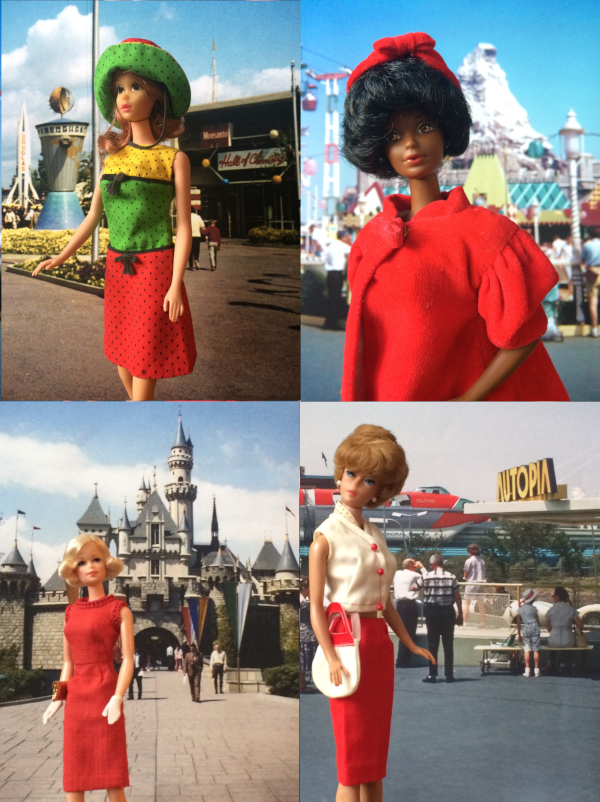
There’s still more to come, but before you scroll off into the distance, here’s the first image ever posted to this blog back in 2022: some of my dolls, dressed in vintage or vintage reproduction, in front of vintage Disneyland backgrounds belonging to Bill Cotter:
-
Fashion Booklets
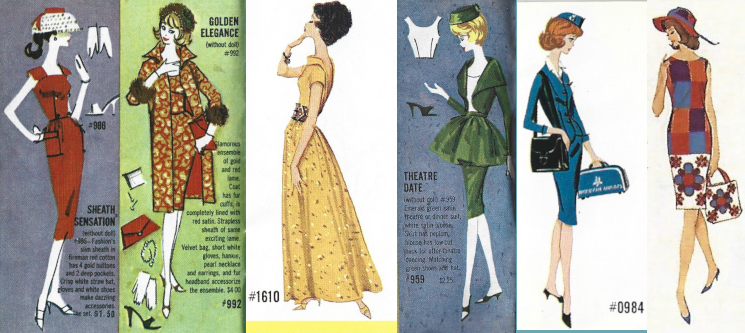
The first, foremost, and most famous source of vintage Barbie illustrations is, of course, the fashion booklet. When we assess the drawings on items like carrying cases, doll packaging, and sewing patterns, our evaluations often center on similarities to and differences from the booklet versions. Within the booklets, there are hundreds of hand-drawn illustrations to admire in incrementally evolving styles, up until photography takes over at the end of the Sixties. In this post we’ll pick through some interesting themes and patterns we observed; you can browse unedited booklets on Toy Addict, Constance Ruppender’s Flickr feed, Vintage Toy Advertiser, “and everything else… …too” blog, House of Retro, and elsewhere.
Fashion illustration by 1959
The 1920s and ’30s are regarded as the Golden Age in fashion illustration, according to Cally Blackman in 100 Years of Fashion Illustration. Photography, while technically available, could not yet approach the mood, the mystique, the glamour of the fashion sketch.
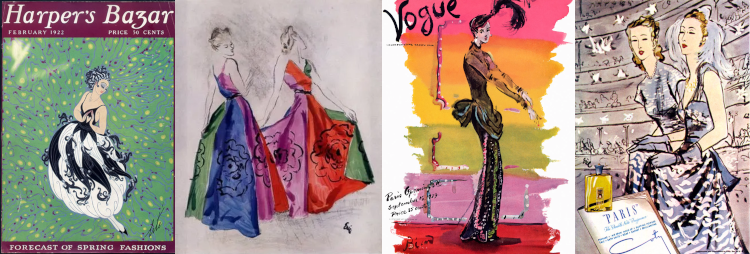
Erte cover for Harper’s Bazaar, 1922; Eric drawing of Lucien Lelong’s opening for Vogue, 1937; Bebe cover for Vogue, 1939; and Coty perfume ad by Eric, 1944. Sources are linked in artist names. By the Fifties, however, customers wanted the accuracy and detail photography offered, and magazine publishers, even the more artistically-inclined, obliged. The celebrity photographer and his model muse were born–think Bailey and the Shrimp, or Avedon and Dovima–while illustration faded to obscurity, at best used for longstanding campaigns in lingerie or scent, like Eric’s work for Coty perfume, sampled above.
During this time Rene Gruau was fairly ascendant, due in part to his friendship and working relationship with Dior, whose scent campaigns he illustrated for some forty years. Gruau’s bold outlines, flat planes of color, sparse backgrounds, elongated forms, pointed toes, and colorless flesh are among the hallmarks he shares with Barbie’s early illustrators.
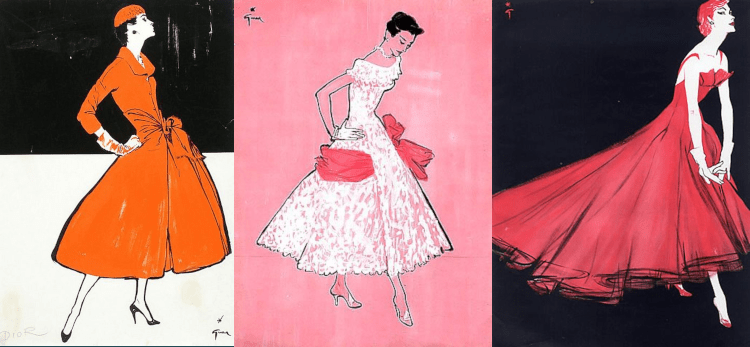
Rene Gruau illustrations for Dior, Jacques Fath, and Lanvin, all circa 1955. Red, a favorite color of Gruau’s (per Rene Gruau: Master of Fashion Illustration by Chariau and Brubach), was also prominent in Barbie’s early wardrobe.
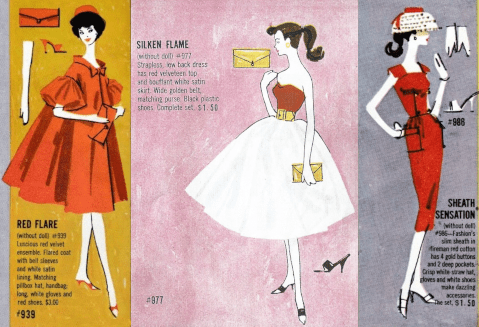
In Barbie: Her Life and Times, author BillyBoy* points out the similarity between this Gruau-drawn Dior lingerie advertisement, circa 1950, and one of the earliest Barbie fashion sketches:
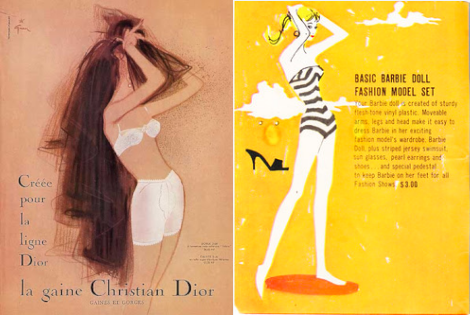
Now we know where things stand in the wider fashion illustration world. Let’s dig into the Mattel booklets.
Evolutions in time
Some categories of Barbie fashions persisted through the years and can be used to summarize the booklet sketching styles all at once. Most prominent are the bathing suits, the most common way that Barbie dolls were sold throughout the Sixties and thus receiving coverage in every fashion booklet.
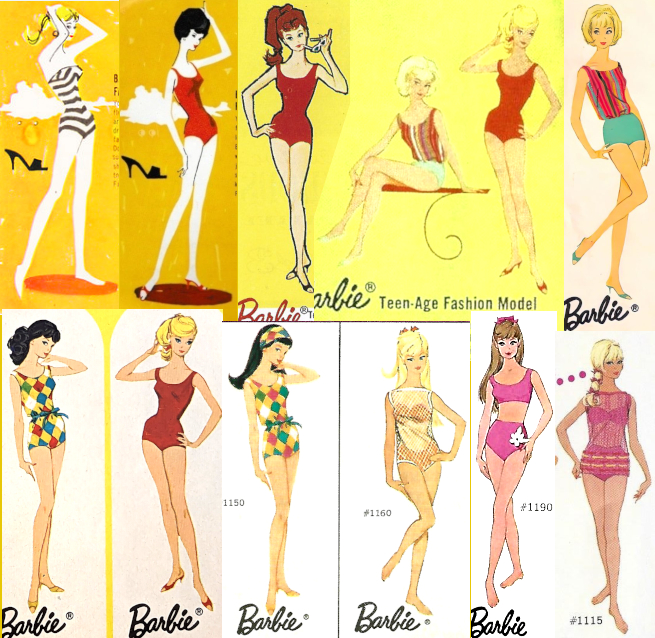
Twelve damsels in their bathing costumes, from about 1960-1968. Underthings were another common offering, though they were demoted to the “pak” category for a while, and not shown on a dressed character (more on that below).
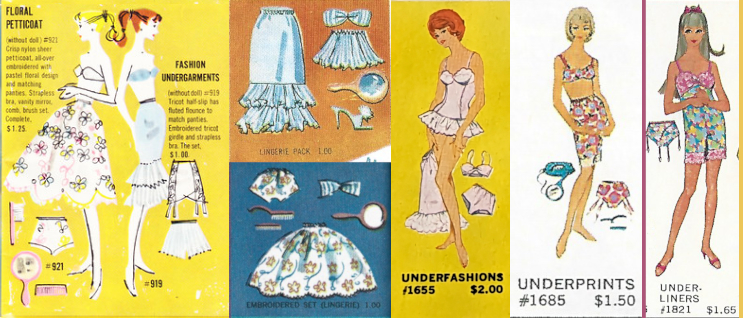
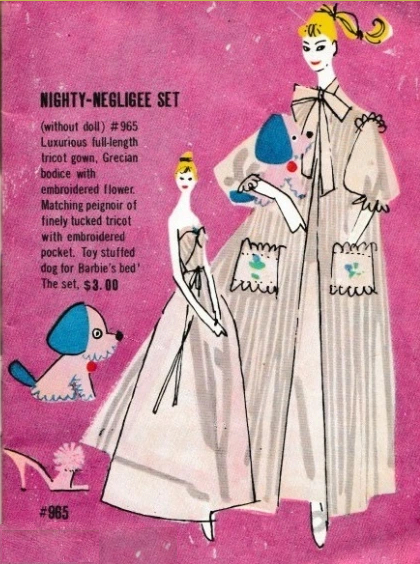
In a 1961 Barbie booklet, two early sets of undergarments were staged in a group pose; the same sketch of Barbie in Floral Petticoat was used without Fashion Undergarments subsequently. Later, the same or similar sets appeared in the pak category where they were displayed flat–in one white Barbie, Ken, and Midge booklet, the apparently identical Floral Petticoat and Embroidered Set (Lingerie) were both advertised, for $1.25 and $1 respectively. Over the next few years, Underfashions arose in the ensembles, followed by Underprints and Underliners. The earliest booklets sometimes used group poses to display multiple ensembles, as shown above left, or even to show the same ensemble in two configurations (jacket on or off, for example); one illustrating a nightgown with and without coordinating peignoir appears at the bottom of the post.
Finally, though she never married, Barbie was frequently seen modeling a bridal ensemble.
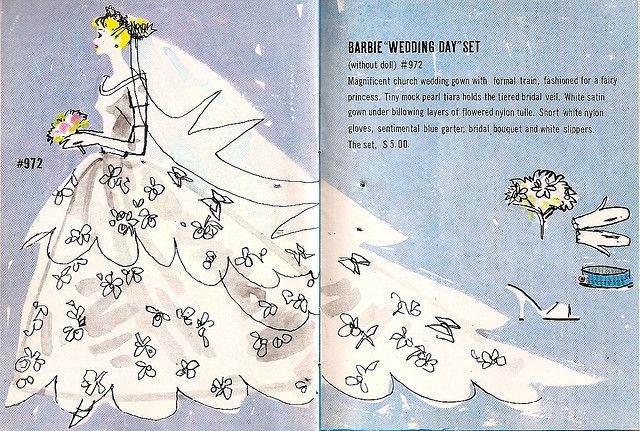
The first Bridal ensemble shows the hasty, angular style of the early illustrations in a two-page spread. 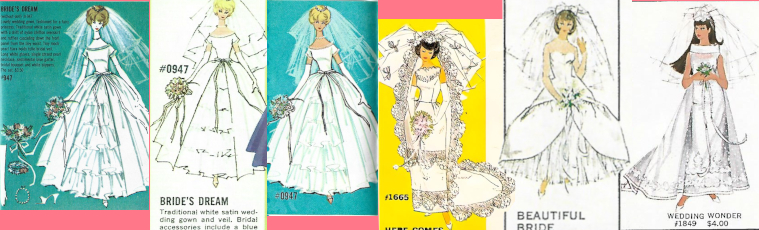
Bride’s Dream is thrice redrawn, softening each time; Here Comes The Bride, Beautiful Bride, and Wedding Wonder bring us closer to photorealism. Some stars of the Ponytail era
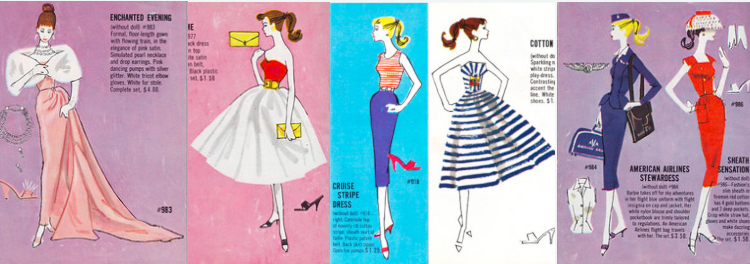
The early books have a minimal art style: Barbie’s skin lacks color, her face has little detail, the pen strokes appear bold and angular. Some of Barbie’s most-loved vintage fashions were produced in her first few years and are depicted in this style.
Bubbles rising
When bubble cut Barbie arrived on the scene, she started to model some of the fashions. Our review indicates that bubbles were used to model some of the new ensembles, rather than redrawn existing ones.
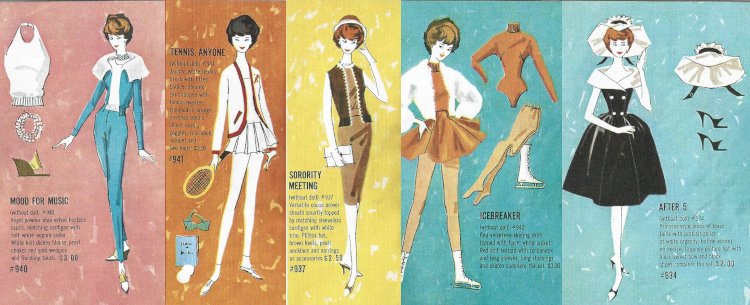
Bubbles in a 1961 Barbie and Ken booklet However, redrawing toward more detailed and doll-like depictions did occur subsequently.
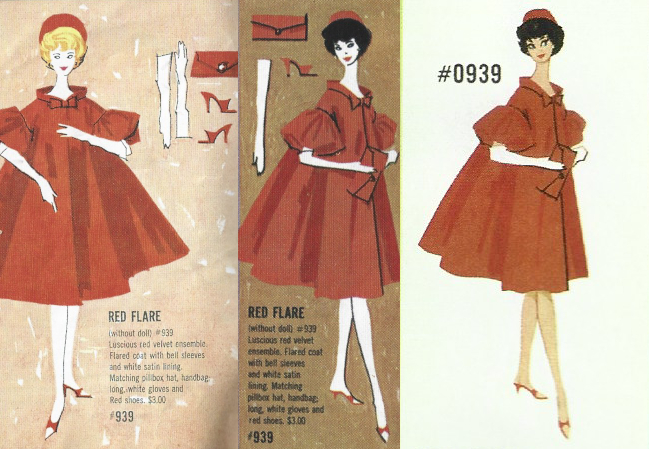
Red Flare and Bubble Cut make their debuts together in a 1961 “Barbie and Ken” booklet; redrawn for a 1962 “Barbie, Ken, and Midge” booklet; colors updated and face details enhanced for a 1963 “Exclusive Fashions” volume. Midge models, too
While not herself a Teen-Age Fashion Model, when Midge hit the scene she took on some of the booklet modeling duties. Midge’s illustration style evolved considerably over those few short years, following the broader trends.
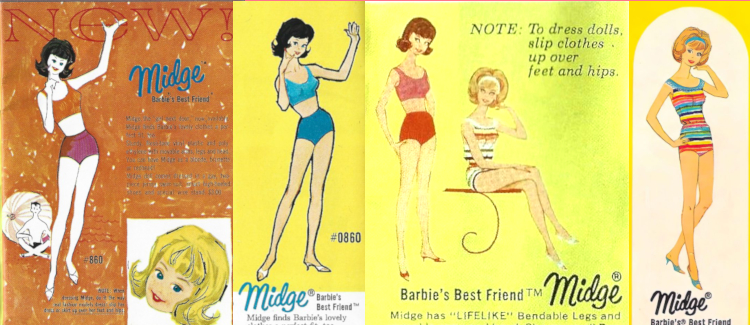
Of course, Midge modeled her own swimsuits. The straight-leg two piece swimsuits’ colors should have varied with Midge’s hair; some of the illustrations contradict that. 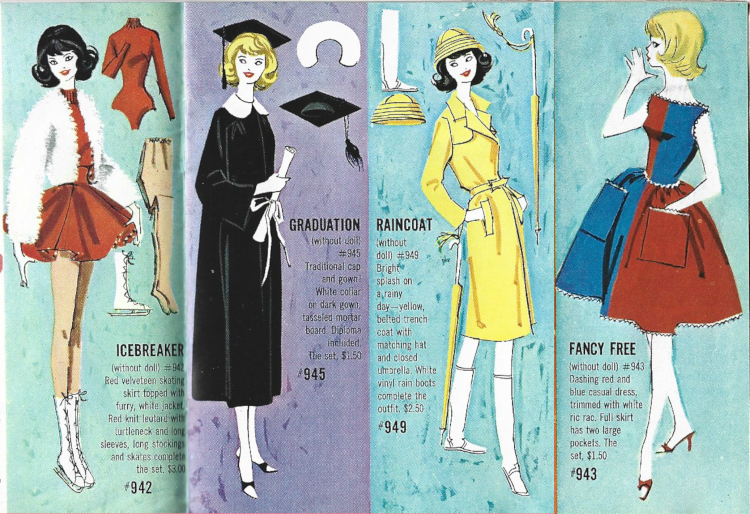
Midge’s debut in a blue 1962 “Barbie, Ken, and Midge” booklet focused on sporty and casual attire. Note she’s claimed Icebreaker from last year’s Bubble. 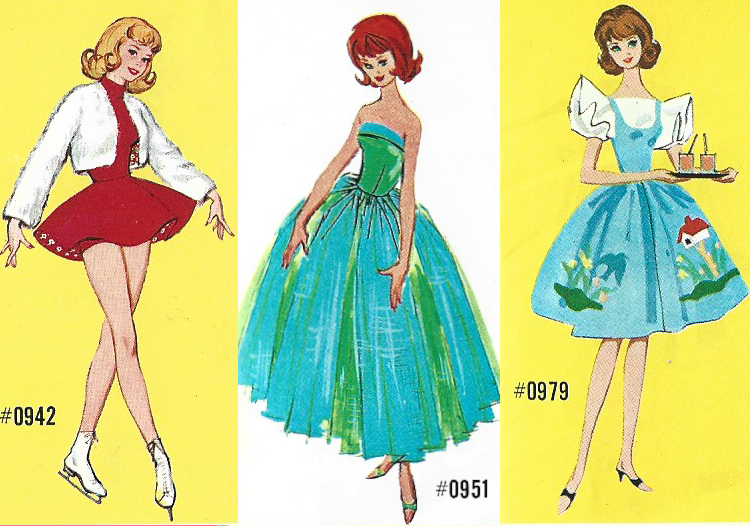
Some transitional Midges in different styles from a single “Exclusive Fashions” booklet. The Icebreaker rendering is all-new; Senior Prom is recolored from the white “Barbie, Ken and Midge” booklet; Friday Nite Date is redrawn in the same pose from the white “Barbie, Ken and Midge” booklet. 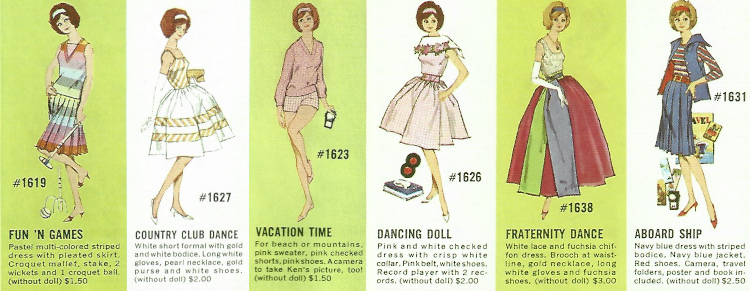
In the bend-leg era, Midge apparently had a headband to go with everything. A special Skipper booklet
Skipper’s fashion coordination with Barbie-sized outfits was depicted in a special standalone Skipper booklet, with Barbie, in her matching looks, appearing in uniquely detailed booklet backgrounds.
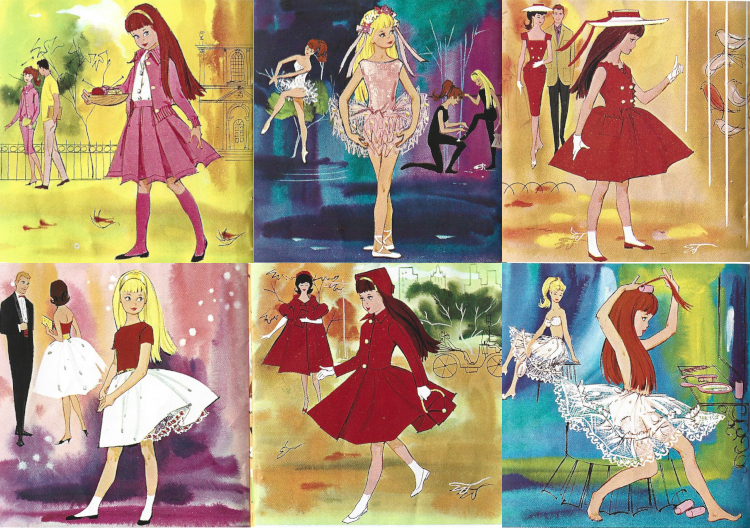
A smattering of illustrations from the 1963 Skipper booklet. What did they get on their Silken Flame/Silk ‘n’ Fancy skirts? Pak fashions
As a rule, Pak fashions were sketched hanging or lying loose, not on a figure.
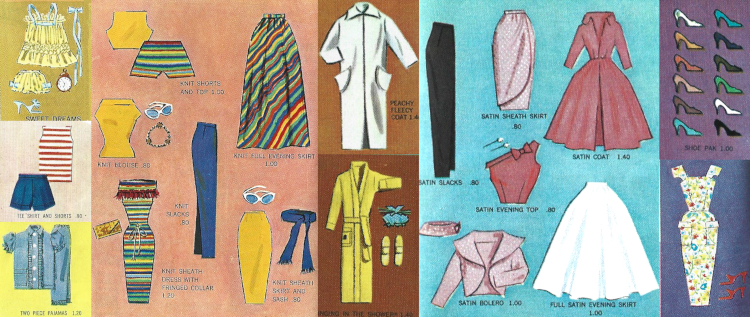
Due to some fashions drifting in and out of the pak classification and other factors, certain pak-associated styles were also modeled by characters.
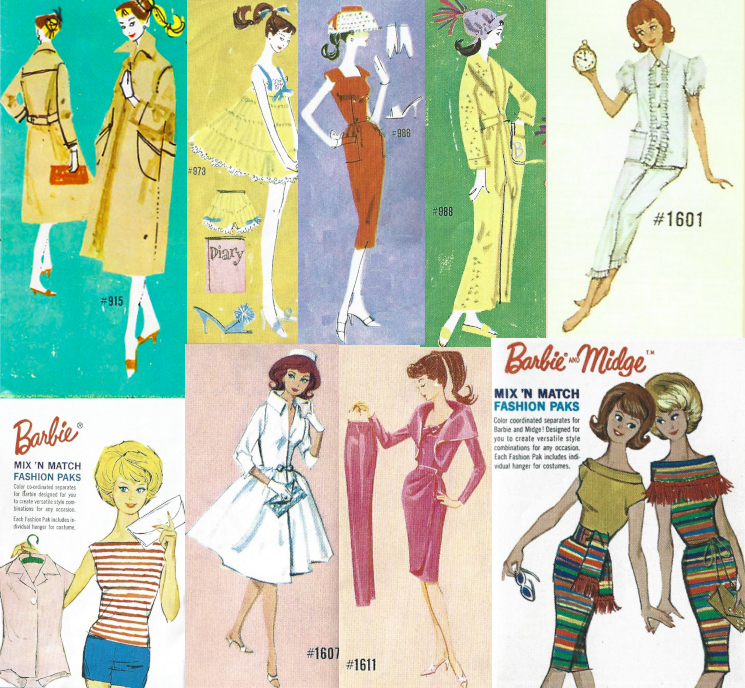
This category also includes the fabulous Golden Evening, shown at the very top of the post.
American Girls
In the bend leg era, some of the poses went next-level (I’m looking at you, Drum Majorette). A newer, more-detailed artistic approach helped to emphasize the high glamour of these years’ couture looks.
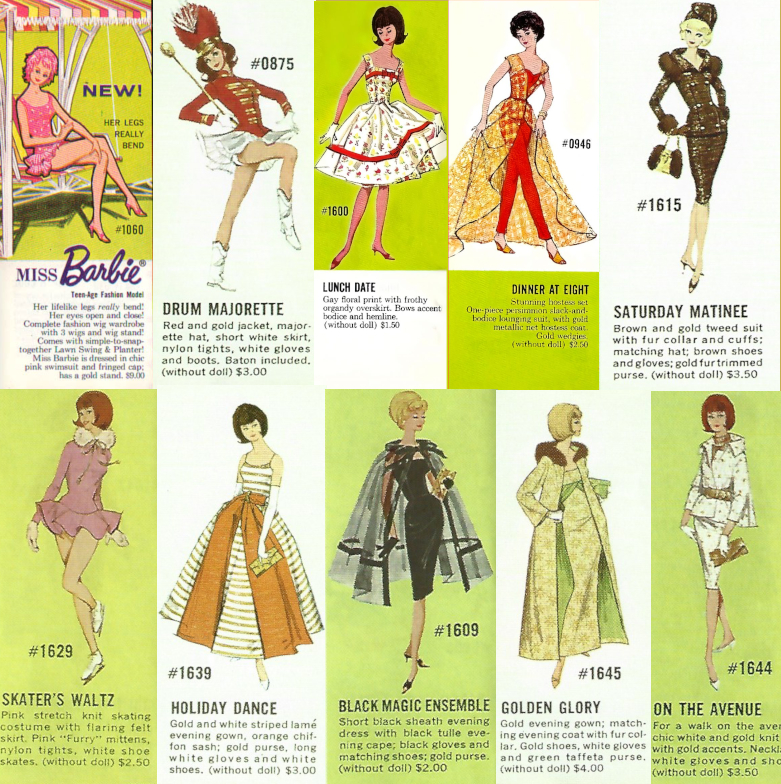
Increased realism for both leisure and elegance, approx. 1963-65. The Move to Mod
Barbie went mod in her final days as an American Girl with a massive wardrobe refresh, and then she did the same thing again the following year with her new T’n’T body. Two “World of Barbie” booklets in our possession show no overlap between the fashions of these years and any previous, so while the style continued to evolve, side-by-side comparisons aren’t as useful; nothing was redrawn for the T’n’T doll, that we could find.
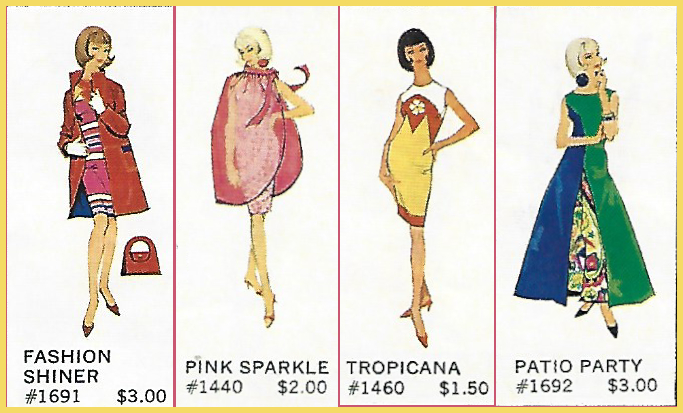
Late American Girls in early Mod ensembles One of our 1966 “World of Barbie” volumes, above, advertises the T’n’T doll but uses American Girl as a model for all the fashions; the second shows the T’n’T model in entirely different ensembles.
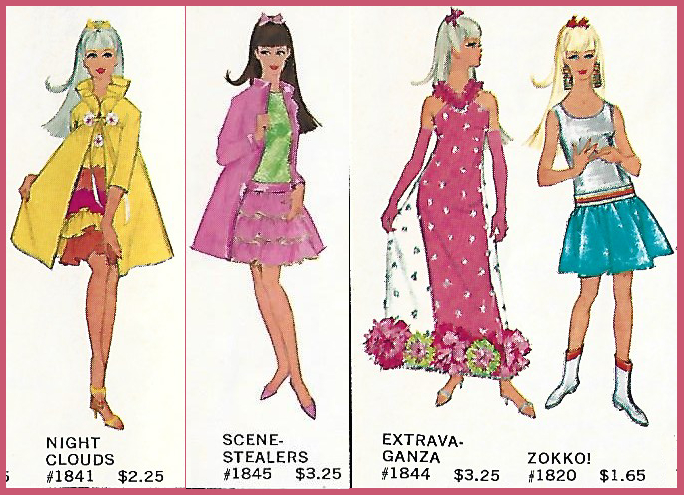
Early T’n’T Barbies in the next wave of Mod fashions Some photographs had been used in the booklets to advertise gift sets, cases, play sets and other miscellany, dating back at least to Fashion Queen. At the end of the Sixties, the booklets pivoted to 100% photography of dressed dolls to advertise the ensembles (and doll-less photographed garments to advertise paks). Doll photography, of course, is an art form all its own, but the booklets’ photographed fashions seem workmanlike to us. We’ll leave that for others to examine.
Until next time, don’t talk to me or my daughter ever again.
Where to next? This is the most popular post in our category on vintage Barbie illustrations; another popular entry concerns vintage Barbie carrying cases, while the most recent post in the category is on ’60s fashion packaging. Other top posts on this site include the Many Abodes of Barbie series (currently covering 1962-1970) and our chronicle of early Barbie shoes. Or just head up to the Table of Contents to see more options.
-
Clone Carrying Cases

Credit: witalis120, jennile3, levysmercantile We previously discussed some of the gorgeous fashion illustrations that graced the lids of Barbie’s early carrying cases and other various totables; concurrently with these, an assortment of off-brand and competitor cases boasted similar stylish graphics. Like Barbie’s official carrying cases, they also offered alternate color palettes in otherwise identical cases, as you may find by comparing the image at top with some scattered through the post. Now, let’s browse a sampling of these cases (all images via eBay unless otherwise specified).
Ideal Cases for Tammy and Misty
Tammy and Misty were competitor dolls launched by Ideal in the early 1960s; some of their carrying cases exemplified a level of chic that the dolls themselves never managed to attain.

Credit: mwdolls, thelittleblackcloset, dollsamore, pied_pipers_vintage To be fair, Tammy was marketed as the girl-next-door answer to Barbie’s worldliness: more likely to spend leisure time at home, on the phone, as on the above left case, than to enjoy an “Evening in Paris,” at right. Glamour Misty, as the name implies, was Tammy’s style-conscious counterpart.

Credit: nikisworldofstuff, kscloset2, hazelbuzz11 Wendy Ward and Tressy
Wendy Ward, the Mongomery Ward exclusive doll by Uneeda, and Tressy, by American Character, were close to Barbie in size and could also be toted.
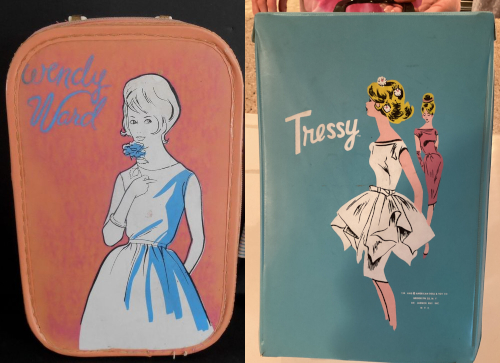
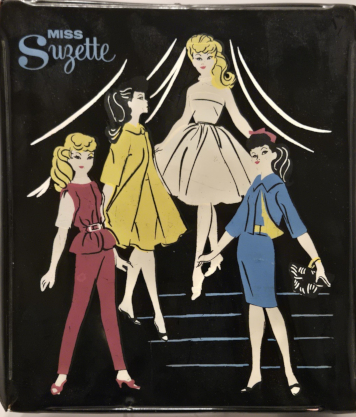
Sources: unknown via Pinterest; toyroombill on eBay. Beloved by collectors of non-Mattel fashion dolls, Miss Suzette was another Uneeda offering.
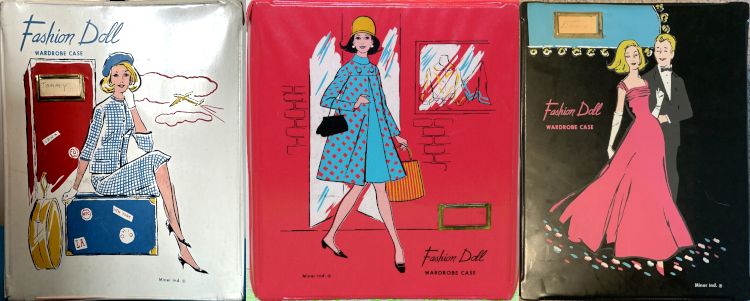
via Miner Industries
Miner were heavy-hitters in 60s generic fashion doll cases; if you’re beguiled by the glamour of a vintage doll case associated with no particular doll, odds are good it bears the Miner trademark.
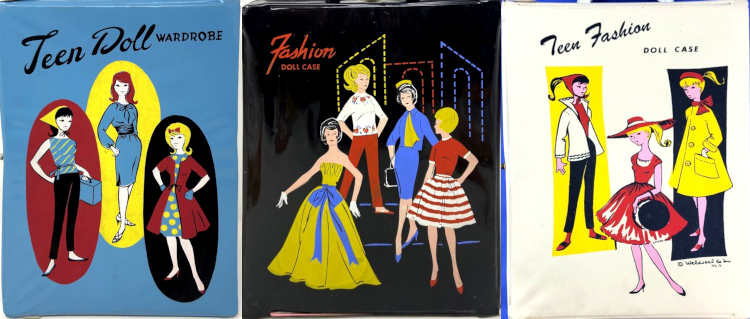
Credit: pattys1606, jennile3, nailgirl2 Unbranded Sixties Cases
Some cases with a distinctive Barbie-like style bore no brand. The one at right below is actually not unbranded but labeled “Weldseal Co Inc, NY”; it’s included here because its graphic approach is highly similar to the other, unbranded items we show in the category.
Credit: candiesandcuriosities (left and center); home_grown_deals Around the World
We’ve focused on US-based makers so far. Some of the most memorable off-brand cases were international, like the two Canadian cases, below left and center, and one German one (by Theia Spielwahren) below right.

Credits: bob_drake16, luckyant0417, lilironlady1000. Miscellaneous Totables
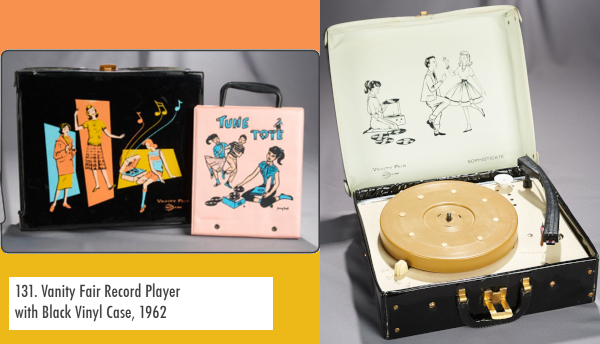
In the entry on Barbie carrying cases we covered other portable items, including record totes and even a clone lunchbox. Barbie-style graphics also graced other, similar non-Barbie products: Theriault’s auctioned off a Barbie-esque 1962 Vanity Fair record player and a Ponytail brand “Tune Tote” in one of their Barbie auctions (Ponytail also produced the early Barbie cases):
Case Rooms
In the 1970s, when Barbie was jet-setting among her various case rooms, such accommodations existed for generic dolls, too.
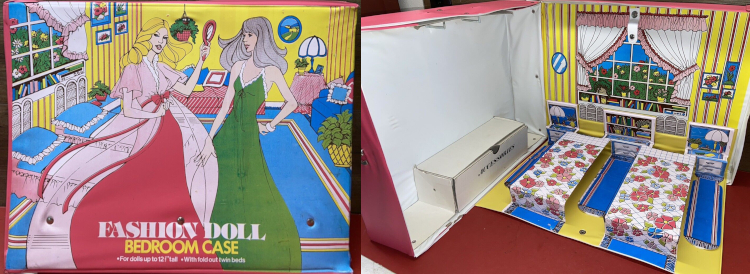
Credit: 1969340dart This 70s dressing room case for Crissy, another Ideal doll, “and friend,” is strikingly similar to Barbie’s 1968 dressing room case (though Crissy was a larger doll whose case wouldn’t have suited Barbie):

Credit: jennile3 The Seventies and Beyond
Naturally, generic and competitor cases persisted into the following decades. Cases by the Tara Toy Corp were ascendant in the Seventies; we won’t explore that epoch but will leave you with a glimpse, courtesy of Tara, of the dystopian future (1984).
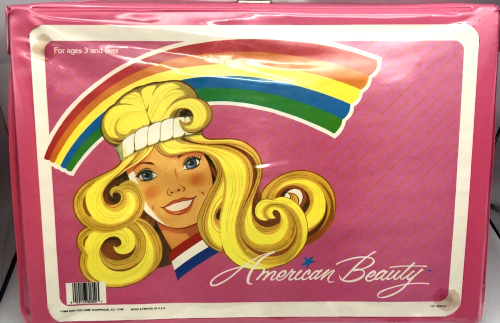
Credit: timefortoys2014 -
Beauty Parlors (1964-1977)

Tressy’s was first, in 1964. Introduced by American Character the year prior, she had the most sophisticated hair play for the time among Barbie and her rivals, with a lock of hair that lengthened and shortened by two separate mechanisms (a button to press and key to turn). Tressy’s Beauty Salon wasn’t functional–it didn’t add any new customization to styling Tressy–but, like Barbie’s Fashion Shop and New Dream House that were advertised the same year, it was a nicely detailed chipboard scene with almost too much furniture.

Tressy’s Beauty Salon in the 1964 Sears catalog. Source: Wishbook Web. The two dryer-chairs and three other chairs suggest the salon was designed to serve many Tressys simultaneously. Speaking of design, Tressy’s Beauty Salon, like her Penthouse, is packed with modern touches including a room divider, potted plant, and tiered side table holding a lamp with tall cylindrical shade, all in what the catalog rightly calls “high-style colors.”
Misty’s Glamour Beauty Shop followed in 1965-66. Made by Ideal, Misty’s hair play innovation was a set of washable markers that could be used to tint her platinum-blonde hair a variety of shades. The Sears-exclusive Beauty Shop set came complete with doll and markers, but otherwise, like Tressy’s Salon, added no functionality.
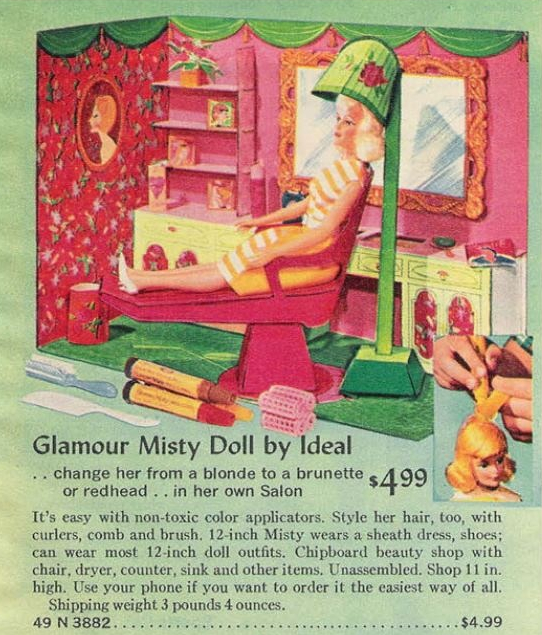
Sears Glamour Beauty Shop for Misty in the 1966 Sears catalog. Source: Wishbook Web. Compared to Tressy’s salon, Misty’s, with its single dryer chair and counter, looks pretty spare. However, some nice details are scattered over those shelves. While this set is rare, Flickr user Susan Hall archived eBay images from an unused set back in 2013, and Worthpoint has good images from a less-mint auction.
It would be years before Barbie got a hair salon of her own. Before we reach our destination, let’s pause to review a few Mattel releases that were not salons.

L-R: Barbie’s Wig Wardrobe (source: Theriault’s); Color ‘n Curl play set in the 1966 Sears catalog; Action Beauty Scene in the 1971 Sears catalog (both Wishbook Web).
Fashion Queen was Barbie’s first foray into hair customization, although the wigs were not meant for styling. They came on little wig stands like the one pictured, above (and Midge also had a set). The opportunity for a salon was there, but Mattel didn’t take that step. A couple years later, starting in 1965, they were again releasing doll heads and wigs as part of the Color ‘n’ Curl Color Magic play set. Now the styling aspect was very real, as the wigs were meant to be both colored and cut, and the set included extensive styling instructions; it even came with a little battery-operated dryer–innovative functionality preceded only by Tressy’s 1964 cool-air-blowing dryer–but still, no salon-like environs for Barbie to enjoy. In 1971 another set with battery-operated dryer, the Action Beauty Scene, DID feature basic environs (wall with wall outlets, counter, chair, wall mirror and separate lighted mirror), but the pieces suggest a domestic setting rather than a visit to the beauty parlor. As with other sets discussed here, the Action Beauty Scene was connected to hair play, being advertised alongside the Growin’ Pretty line of dolls whose hair lengthened and shortened in a manner similar to Tressy’s–although Growin’ Pretty Barbie and pals are not actually shown in promotional images like the one above.
In 1973 Barbie finally had her hair professionally styled at the Quick-Curl Boutique. This latest advancement in hair play added thin wires to Barbie’s and friends’ hair, enabling, as the name implies, rapid coiffurization. Along with the dolls a simple case room containing a vanity, chair and mirror was sold. These furnishings are not terribly different from what Barbie had enjoyed at home in ’71; however, the name Boutique indicates this set as a commercial shop.
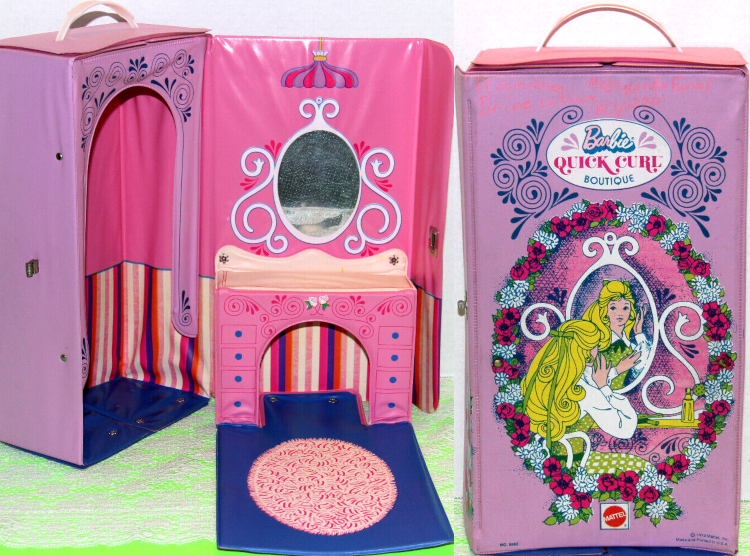
Barbie Quick Curl Boutique via eBay user jennile3. The original chair can be seen in the small catalog image at the top of this post. The case also had space for clothes storage, which further blurs the line between salon and home, but we’ll take what we can get.
Sears had another salon offering starting in 1973: the famous Sears Beauty Salon. Its dryer chair and other features distinguish it as a professional operation. Both the dryer and mirror lights were battery-operated. The set was advertised at least until 1977.
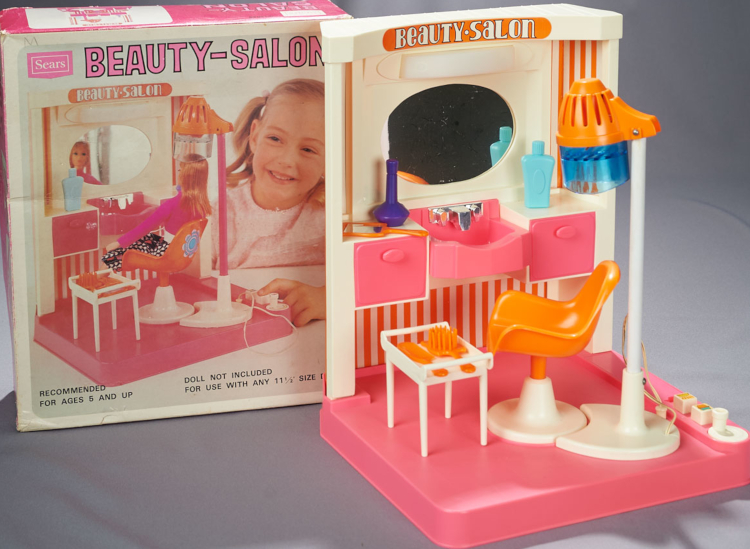
Sears Beauty-Salon and its original packaging. Source: Theriault’s.
In the years that followed, Barbie kept getting better at going to the salon. The 1976 Barbie Fashion Plaza included a small salon, and during the Superstar years various beauty parlors competed for her custom.
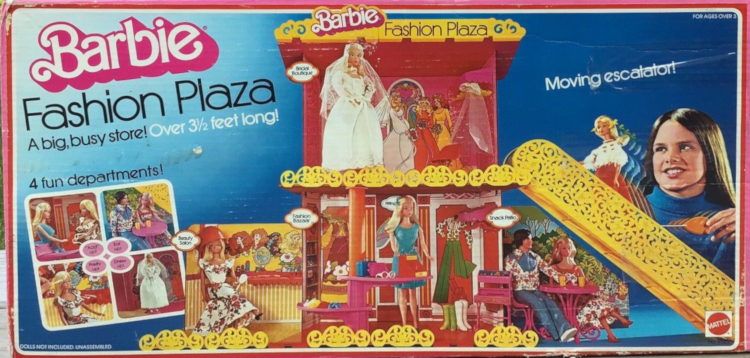
Barbie Fashion Plaza packaging; the modest salon is shown at lower left. Source: lammer007 on eBay. 
1977 Superstar Barbie Boutique packaging. Source: aboundingvintage on eBay. Isn’t it strange that it took so long for Barbie to get to the hairdresser, considering what a difference that can make for a teenage fashion model’s career? Just look what it did for Twiggy! We’ll navigate other gaps in Barbie’s early built environment in future entries.
Where to next? This post is about Barbie’s early built environment. The most recent post in this category concludes the Barbie’s Seventies Travelogue series, and the most popular are those on Mattel Modern and Susy Goose furniture and on penthouse apartments. Otherwise, the overall most popular posts on this site are about Barbie shoes, 1959-67, and about Mattel fashion booklets. Or just head up to the Table of Contents to see more options.
-
Random House Books (1962-1965)
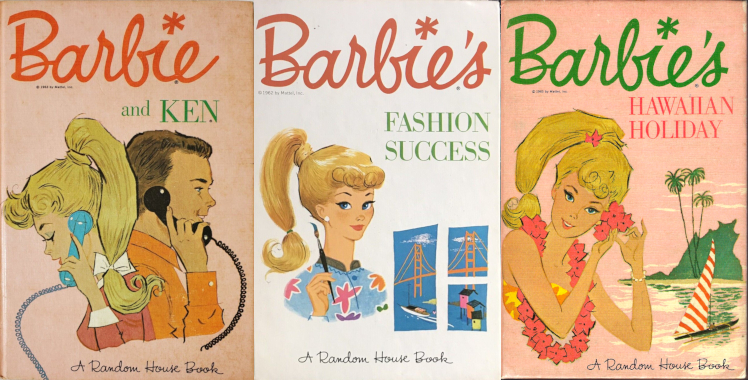
Random House Barbie book covers from 1962. Sources (L-R): jilevr0 on eBay, brickabrackandknicknknack on eBay, kellerbooks on eBay. Starting in 1962, Random House released a series of books set in the Barbieverse, and naturally, those books were illustrated. By themselves, the books’ covers, like those above, form a nice collection of illustrations; however, the interiors have even more to offer, and we’ll detail a few favorites here. Almost unique within the annals of Barbie illustration, the illustrator of each work is identified by name–it would have been even more unusual for Random House to omit the name of a book illustrator.
1962 Chapter Books
In the first year six books were released, along with a compendium merging the first three. These were chapter books and short story collections, not heavily illustrated but with a simple sketch at the top of each chapter or story.
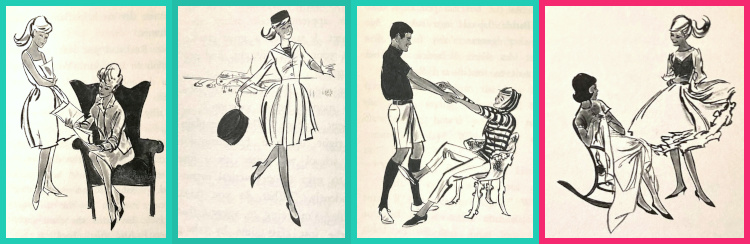
Three illustrations from Barbie’s Fashion Success and one from Here’s Barbie. From the author’s collection. The illustrations from the first set of books are all by Clyde Smith, who would also illustrate Barbie’s Easy-As-Pie Cookbook in 1964 (its illustrations being mainly of food, we won’t showcase this volume). He depicts Barbie in some more-or-less recognizable fashions; while the plots of these stories are not our focus, since this blog is Silken Flame let’s take a peek at the description of Barbie’s prom dress, illustrated above right: “Barbie’s dress was all red and white and shimmery, like a silken flame. The strapless top was of rich red velvet. Below it, a full white satin skirt billowed out, shining where it caught the light. Her belt was a streak of softly glittering gold. White satin pumps and a matching satin envelope purse added their touches of elegance.”
That’s accurate in most of the particulars, although elsewhere the text by Betty Lou Maybee does describe the dress as “waltz length,” which may be excessive. Anyway, in case you’ve wondered, Barbie is crowned Queen of the Prom–the junior prom, that is–in something resembling Silken Flame.
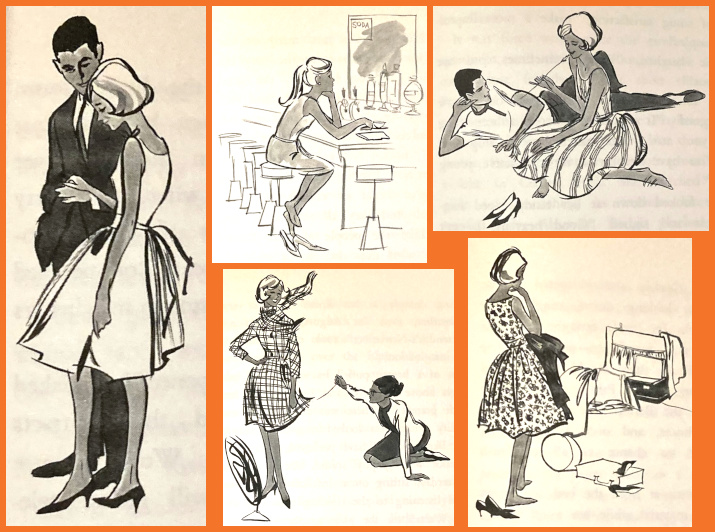
Five illustrations from Barbie’s New York Summer. She keeps taking off her shoes in this one. From the author’s collection. You might think the height of glamour would be achieved in a book called Barbie’s Fashion Success, but overall the most glamorous images of the ’62 books are probably the ones in Barbie’s New York Summer. In this story, Barbie wins a prestigious summer internship at a fashion magazine. We’ve actually discussed a similar, real-life program here before–one whose alumnae included Betsey Johnson, Joan Didion, and Sylvia Plath, as well as one of Barbie’s early fashion designers. While that internship housed its college-aged participants at the Barbizon hotel for women, Barbie, still in high school and evidently the lone intern, is asked to bring her mother to chaperone her. At the end of her real-life internship, Betsey Johnson was offered a permanent position with the magazine; so is Barbie, which is weird: she still has a year of high school to go.
More chapter books, 1964-65
It wasn’t long before Barbie embarked on further Random House adventures, now with richer illustrations scattered through the text. The ’64 and ’65 releases include Barbie’s Secret, Barbie’s Candy-Striped Summer, Barbie and the Ghost Town Mystery (Nancy Drew much? Barbie was often solving mysteries in these stories), and our favorite: Barbie in Television. We’ve seen Barbie on TV a few times before, but this time she was in it. The new chapter books were illustrated by Robert Patterson.
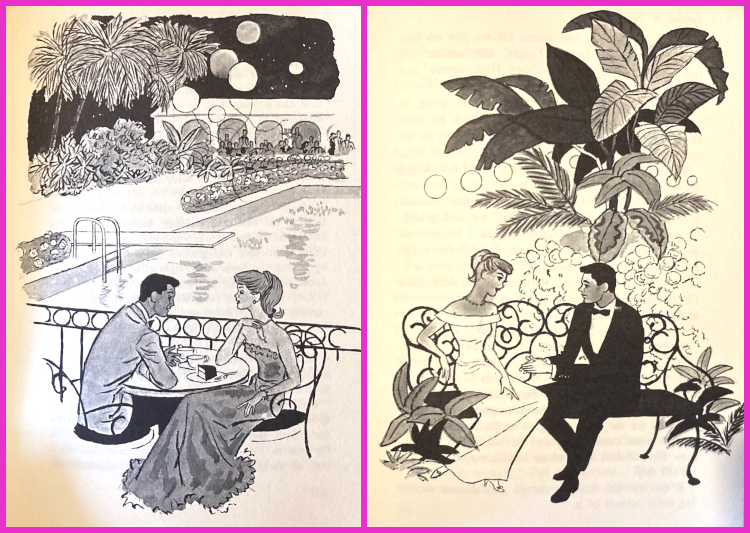
Two Illustrations from 1964’s Barbie in Television. From the author’s collection. Maybe it’s worth pointing out that Barbie often travels in these books, and she finds suitors wherever she goes. When she’s around home her suitor is Ken, of course; but when Ken’s not available to escort her there’s always a handsome fellow ready to fill the role. As the stories progress her beaux often begin to hint at marriage, even after knowing her for only a few weeks.
Picture books, 1964 and 2012 (!)
In ’64 Random House also released at least one picture book with full-color illustrations: Barbie’s Adventures at Camp, illustrated by Burmah Burris. Barbie’s camp attire isn’t too glam, but the Fashion Queen bathing suit and some outdoorsy pak fashions can be spotted in its pages.
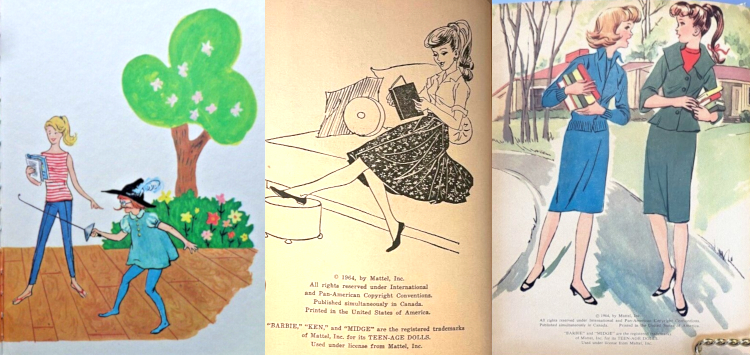
L-R: illustrations from Barbie’s Adventures at Camp, Barbie’s Adventures to Read Aloud, and Barbie the Baby Sitter. Sources (all on eBay): rudyandcathi, ronnie-bird-fan, kreativestiles. Most illustrations in Adventures to Read Aloud have a single color in addition to black and white. Another publisher, Wonder Books, released additional “Easy Reader” picture books with either full-color or partially-colored illustrations. These images, by illustrator Claudine Nankivel, are a veritable vault of recognizable Barbie fashions. We’ll let the reader guess what Barbie wears for most of Barbie the Babysitter; in the short story book, Barbie’s Adventures to Read Aloud, she cycles through several of her beloved casual looks; but it’s in Barbie Goes to a Party that we see the most, and most fabulous, of Barbie’s early-Sixties attire.
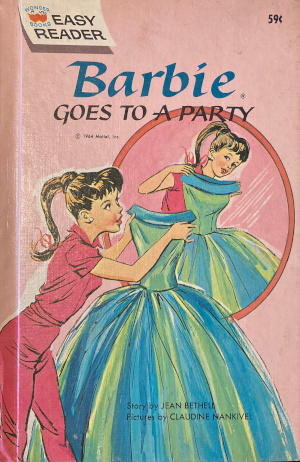
The plot of this work concerns Barbie and her entire social circle having no idea what to wear to a party.
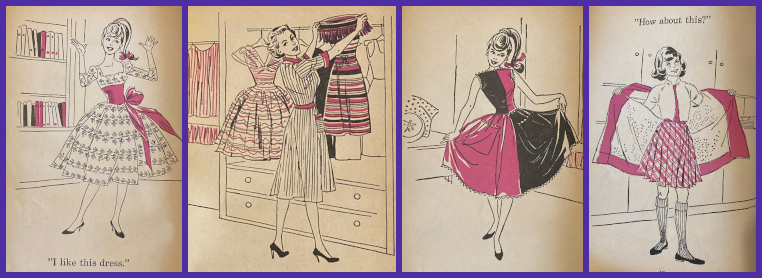
At right above, Midge is in fact not in a recognizable fashion, but Barbie’s mother quickly intercedes to let her know it’s not an appropriate look for the party, anyway. Mrs. Roberts is not one to mince words:
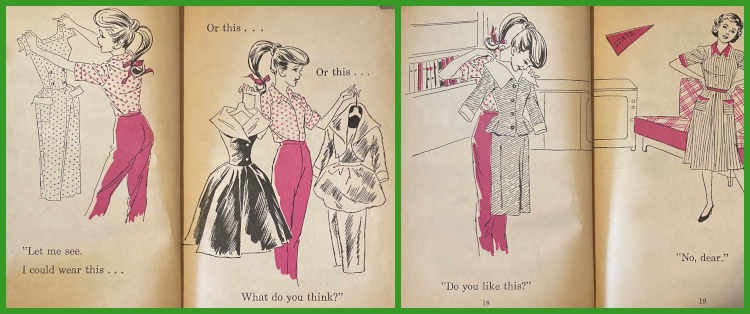
This and above two images: Barbie Goes to a Party, from the author’s collection. An added delight: elements of the first Dream House are recognizable in the backgrounds of some drawings.
In 2012, a Little Golden Book titled World of Barbie reused some of the vintage illustrations, newly colorized.
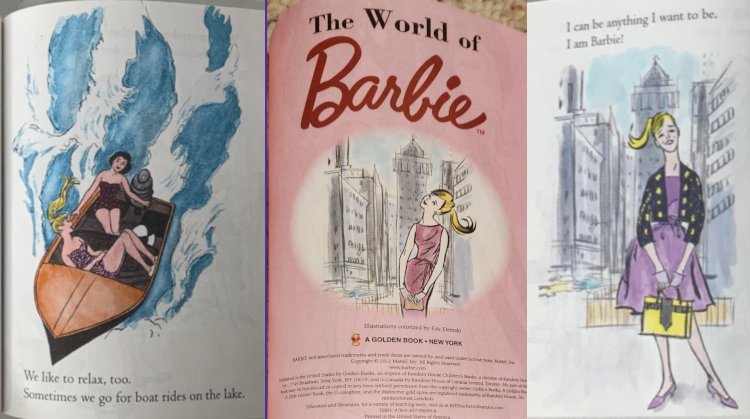
Newly colorized illustrations originally by Robert Patterson and Clyde Smith. Sources: mickeejo and furchesl201y on eBay. -
The Many Abodes of Barbie, Part IV: 1966
During the Sixties, Americans imported Mini cars and miniskirts from Swinging London, while Barbie innovated a “mini” all her own: the cramped accommodations she and her social circle favored in the second half of the decade. We got our first taste in the 1965 episode with the Sears exclusive “Deluxe” house; in the following year that house came back in a bold new visual scheme, its interior completely redesigned.
Barbie Family Deluxe House
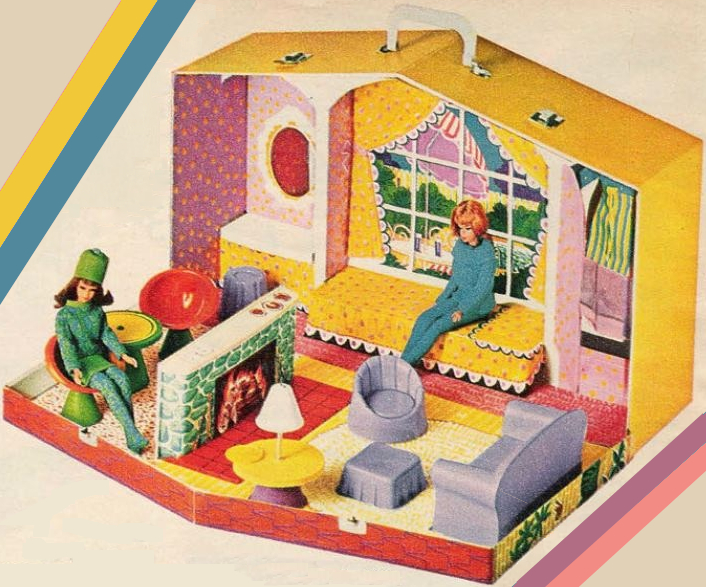
The redesigned Deluxe Family House in the 1966 Sears Christmas Catalog. Source: Wishbook Web. The new layout was less constricting, reducing the kitchen, pushing the bedroom to the back wall and separating the remaining space into sitting area and breakfast nook with a divider that doubled as a fireplace, on the living room side, with galley kitchen depicted on the breakfast nook side.
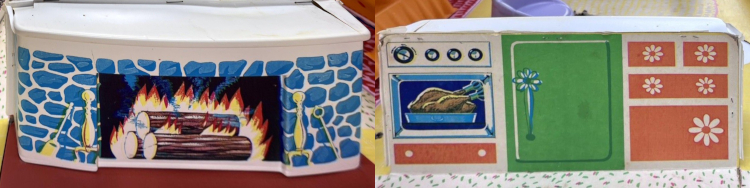
The fireplace has a “kitchen” on the opposite face. Source: mill8834 on eBay. A double-sided fireplace could have been cuter, but Barbie’s got to eat.
Inside the house, mod aesthetics are apparent in the space-age breakfast nook chairs and living room side table; at least one other innovation distinguishes this play set as the start of Barbie’s mod housing arc:
Tutti, Skipper, Barbie and Francie cavort on the exterior of the Family Deluxe House. Source: jll1966 on eBay. While last year we could see Barbie and Skipper through the “window” on the case exterior, this year the characters are portrayed outside the house, enjoying its outdoor spaces. Thus began a mod-era standard of depicting Barbie and friends recreating on the outsides of their houses, marking yet another intersection of Barbie’s built environment with her illustrations.
It was this mod-flavored ’66 Deluxe House, and not the original ’65 version, that inspired a 2007 Hallmark ornament.
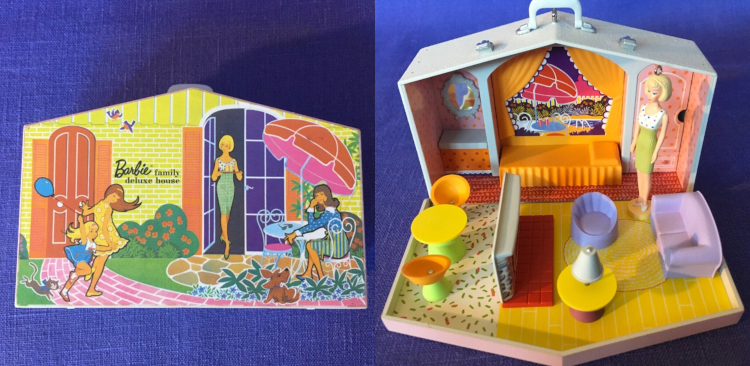
A 2007 Hallmark ornament commemorates the later version of the play set. Source: purplesnoopy on eBay. Francie House
Only Sears had the Family Deluxe House, but any retailer could carry Francie’s House–or “Contemporary Room, completely furnished to meet the needs of these swingin’ dolls,” as the catalog shown below described it–in 1966.
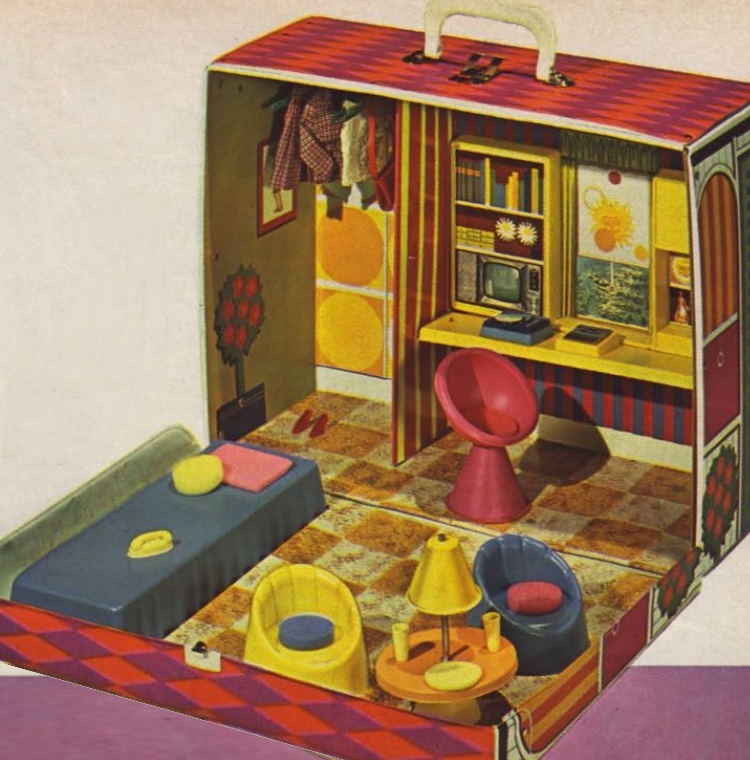
Francie’s House in the 1966 JC Penney Christmas Catalog. Source: Wishbook Web. Francie’s furniture was molded in place, including a “typewriter,” centered on the desk, and a kind of uninspiring television represented on the shelves. Fully mobile/removable parts of the set included the desk chair, pillows, telephone, and phonograph (looks like the one that came with the Dance Party ensemble–Francie had so many record players!). The mod trend is evident in the allover bright color scheme and the psychedelic sun decorations around the desk. The floor looks absolutely filthy, but it’s actually meant to suggest funky, tile-patterned shag carpet. In the product image above, there appears to be a little Francie illustration partially hidden in the closet. On closer examination, she may be doing a bit of flat-footed shimmying:
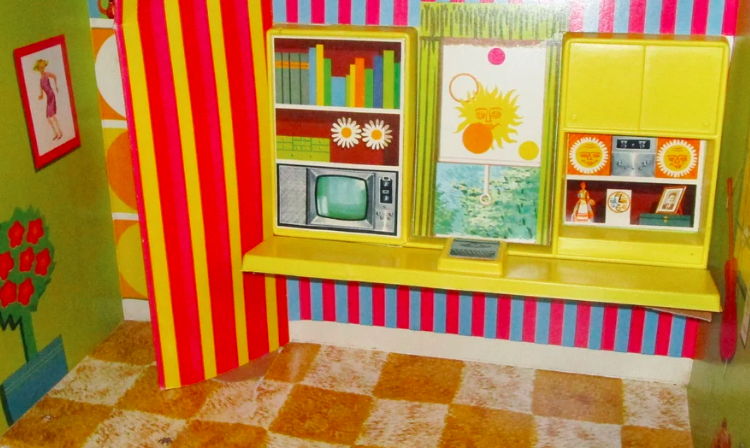
Details of Francie’s house. Source: Fallsavevintage on Etsy.
The exterior puts this case right on the threshold in terms of rendering characters outdoors, as Francie is shown standing just inside the doorway, and yet disconcertingly large in proportion to the doorway, almost as if she were closer to the viewer.
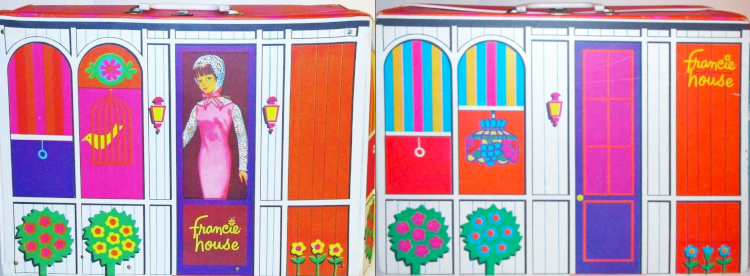
Front and back views of the “francie house.” Source: Fallsavevintage on Etsy.
The same visual trick was used to chilling effect in Alejandro Amenabar’s 2001 gothic horror masterpiece, The Others–but I digress. Details to appreciate on the package exterior include the Tiffany pendant lamp–auguring things to come–and surfeit of mod daisies, psychedelic striped blinds, and stylized caged bird.
If you read the previous entry and have been waiting with bated breath to find out whose boots we sensed approaching: they were Courreges boots! The mod era is now in full swing; we’ll see further evidence next time.
-
Sidebar: Color Magic Illustrations
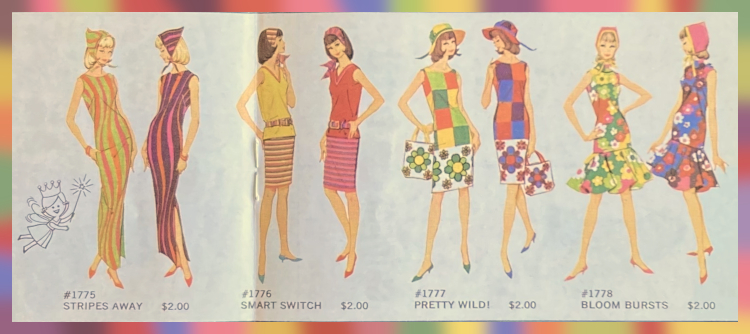
Color Magic ensembles illustrated in a Mattel Barbie booklet. from the author’s collection. The Color Magic line was a juggernaut for Barbie circa 1966, and with it came a raft of illustrations used for advertising and instructions. The image above is a run-of-the-mill fashion booklet spread like all ensembles merited in those days, but do a little more digging–from the dolls themselves, to the fashions, to the Sew-Free Fashion Designer set, to the Color ‘n’ Curl wig-styling set–and a treasure trove of Barbie fashion and hair illustration emerges. See what we unearthed below:
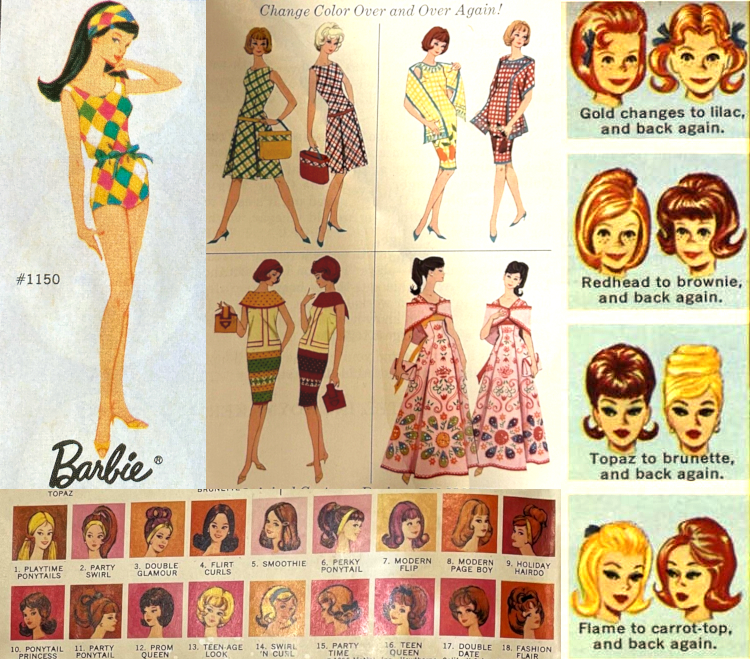
Sources (clockwise from top left): The author’s collection; vintagedollstoys on eBay; WishBookWeb; SwellMerchandise on eBay. 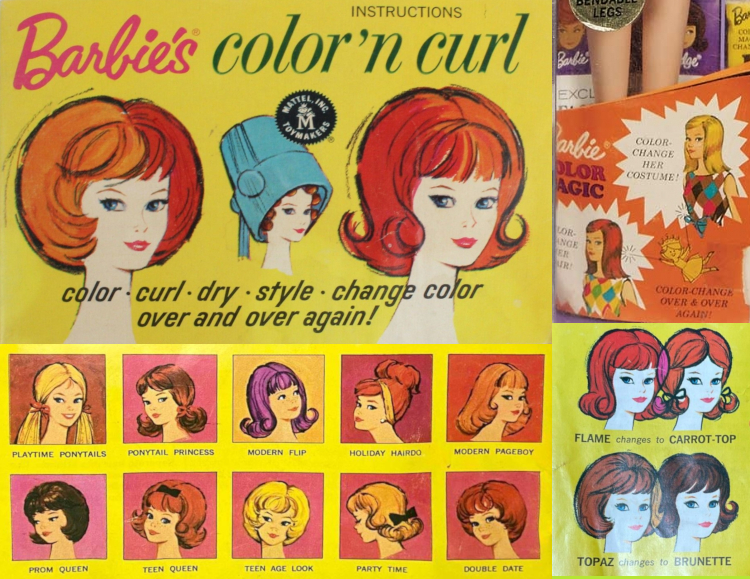
Sources (clockwise from top left): itsgreat on eBay; Theriault’s; C&B EMPORIUM on eBay; cdflp on eBay. 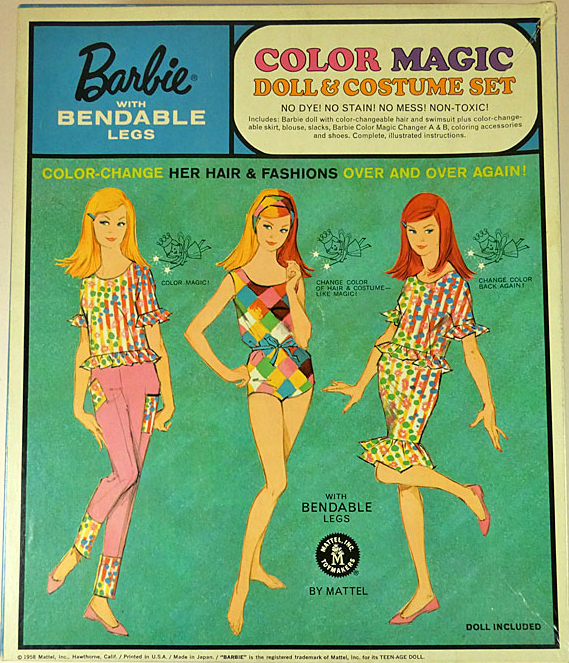
Source: Joe’s List. 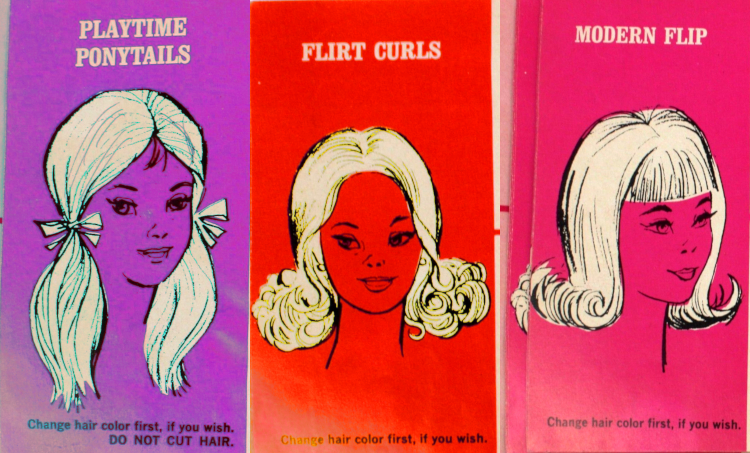
Source: itsgreat on eBay (recolored by the author). 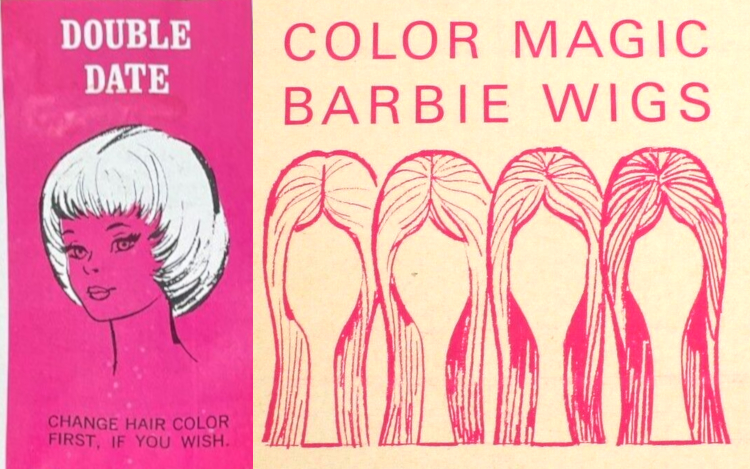
Sources (eBay): C&B EMPORIUM, itsgreat 
Source: Theriault’s. Further reading: the website My Vintage Barbies has a fashion booklet sketch showing an unproduced floral swimsuit, as well as more details about the dolls and other products.
Where to next? This post is an illustration “sidebar,” meaning short and sweet. Our most popular sidebar is on Barbie and friends illustrations on mod house exteriors, while the most recent investigates Window Shopping. The top post on the entire site concerns shoes; or just head up to the Table of Contents to see more options.
-
Whitman Coloring Books (1962-1965)

Whitman coloring book covers from 1962 to 1965. Sources (all eBay): peppermint-bargains; PicknThrift; jjwlet211; space_eighteen. Whitman’s coloring books are the Midge to their own paper dolls’ Barbie: a little less popular, a little less pretty, but still they hold a special place in our hearts. You can recognize the cover art, above, from paper dolls, fashion booklets and other media; the interior pages, however, are almost totally unique.
One thing we love about the vintage books is how they’ve been customized by their owners; for example, the three bubble cut beauties below, from 1962-1964 (L-R), say they were colored by Cynthia, Heidi B., and Lilliauna, respectively:
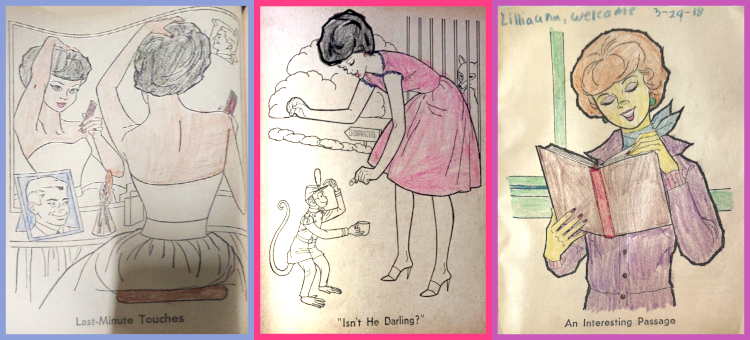
Coloring book pages with some color. Sources (all eBay): alhamiltonsfamousfactorythrowouts, pudgeman, McIntoshMishMash. We’ll note that while the illustrations are all vintage, the colorizations may or may not be: Lilliauna’s work, at right, appears to be dated 2018.
As can be seen in the depiction of Barbie befriending a monkey above, some of the coloring book pages contain interesting context about Barbie’s life and times; I’m too polite to show you how badly Midge struggled with feelings of inadequacy in the same story.
Like Barbie illustrators in general, many (most?) of the amateur colorists transforming these mass-produced pages into one-of-a-kind treasures have remained nameless; our favorite piece from a casual eBay browse is unattributed:
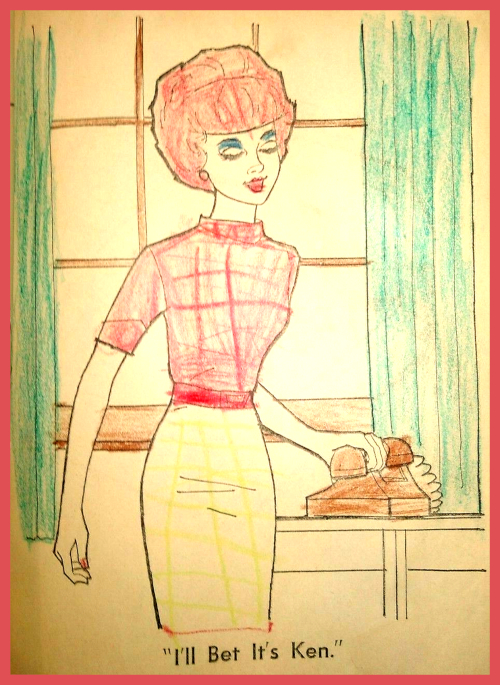
Coloring page with color by an anonymous artist. Source: flatwatertrader on eBay. Of course, the young folks of yore did spare a few choice pages for us to color in ourselves:

1962 Whitman Barbie coloring book pages waiting to be completed. Source: peppermint-bargains on eBay. Are we having a “That Girl” moment on the righthand side of this spread?
Some of the books, including the 1965 Barbie and Skipper one shown at the top of the post, even provide fashions you can color yourself to dress included paper dolls; these are VERY familiar from the proper paper doll sets.
We spent most of our time today on books from 1965 and earlier, but coloring books returned in the mod era and have continued up to the present. Here’s just a couple shots from a 1967 Francie book, with colors attributed to Julie T. and Sara Marie L., to awaken your thirst:
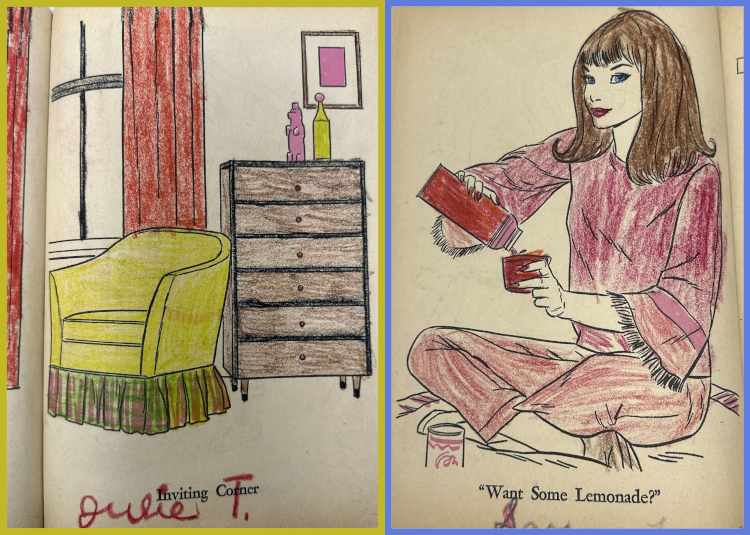
Pages from a Whitman Francie coloring book with colors by Julie and Sara. Source: Momma’s Hobby Vintage on eBay. Love to see that little splash of home decor, too.
Gentle reader, the choice is yours: are you keen to color, or do you prefer your Barbie illustrations pre-inked? Want Some Lemonade?
Before we say “bye,” here’s one more tasteful shading attributed to Heidi B. Note Barbie’s ensemble, familiar except for that little box purse and, given the year, her closed-toe shoes.
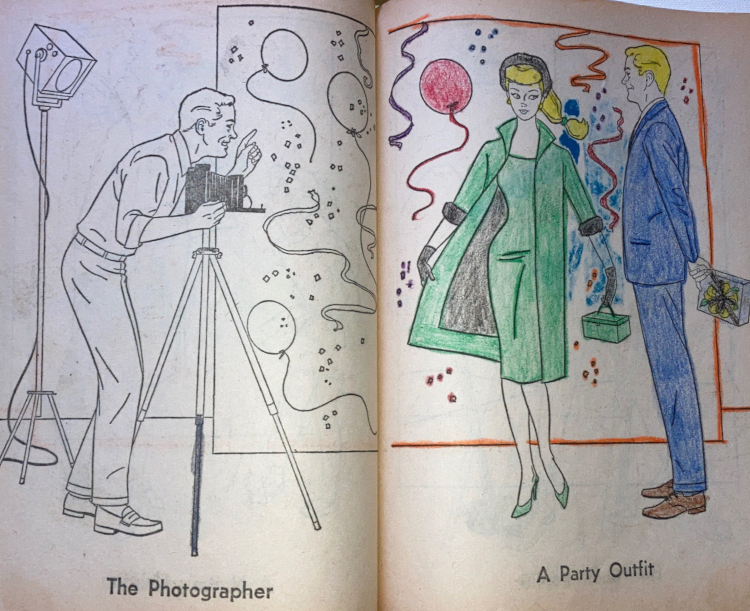
1963 Whitman Barbie coloring book personalized by Heidi B. Source: pudgeman on eBay. Where to next? This post is about vintage Barbie illustrations. Our most popular post in the category is on Mattel fashion booklets. The most recent post in the category is on the World of Fashion board game. Other popular posts on this site include the Many Abodes of Barbie series (currently covering 1962-1970) and our Chronicle of Barbie shoes, 1959-67. Or just head up to the Table of Contents to see more options.
-
The Many Abodes of Barbie, Part III: 1965
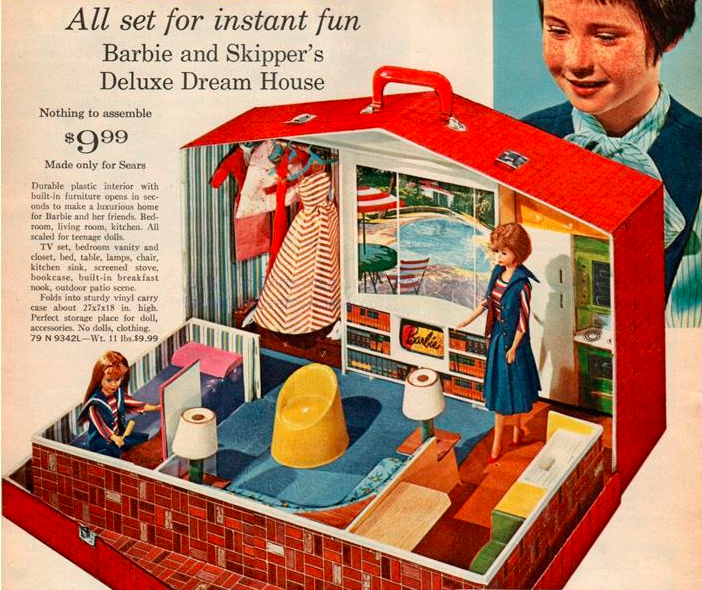
Barbie & Skipper Deluxe House in the 1965 Sears Christmas Catalog. source: christmas.musetechnical.com Barbie & Skipper Deluxe House
Another year, another dream house… and this one’s deluxe! But was it? Unlike earlier houses, Sears’ exclusive 1965 Deluxe House for Barbie and Skipper was mostly plastic, which probably was deluxe in 1965, its furniture molded in place. However, compared to last year’s New Dream House, Barbie’s square footage had gone way down–plus, now she’s sharing with Skipper! Looking at the kitchenette with its two burners, the sink in the next room, and the dining area with very tight seating for two, we could almost convince ourselves Barbie had finally made the move to the big city–but there’s really no arguing with that plate glass window looking out on the backyard and swimming pool.
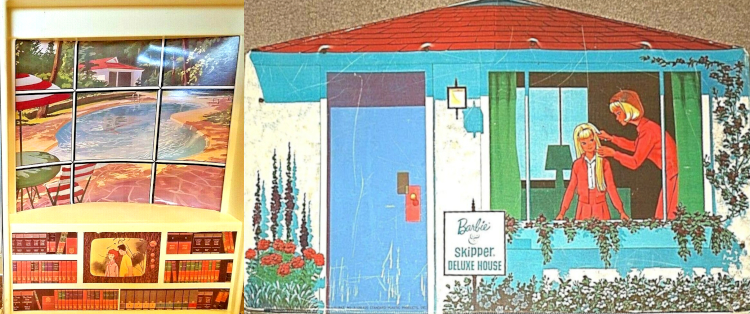
Interior and exterior views through Barbie and Skipper’s windows. Sources: A Vintage Closet on eBay, VANESSA’S BARBIES, TOYS & MORE on eBay Note the change in television show between the product image at top and the vintage piece directly above, which appears to show a red-ponytailed Barbie in Sweater Girl, walking with Ken (this illustration also appears in, and likely originated for, a Skipper fashion booklet). Peering in from outside at this set’s second Barbie illustration, she’s changed her hair but is wearing Sweater Girl again!
Anyway, Barbie and Skipper weren’t suffering too badly in these cramped quarters, thanks to a pair of chipboard rooms also released this year–some of the last chipboard accommodations Barbie and family would ever know.
Skipper Dream Room
It may not have been deluxe, but Skipper’s 1965 room was a dilly!

Packaging from Skipper’s Dream Room, illustrating the same. Source: Atomic Age Vintage Doll World on eBay. As depicted above, Skipper’s room had an open floor plan along the lines of the earlier New Dream House, with tastefully applied “Sew-Free” ruffles and curtain, a day bed, a precious window nook with table and heart-shaped chairs, chipboard birdcage, both chipboard and sew-free throw pillows, among other luxuries.

Not shown here, the room’s exterior had illustrated patio furniture, bird bath, and table tennis table, plus a physical two-seater bench in a cozy nook. Back inside, on a shelf printed onto the wall we see some of the same possessions from Skipper’s Go-Together room which premiered a year ago, including the Red Sensation hat, a Barbie guitar, and Bugs Bunny, and on other walls we see some Barbie and family illustrations, representing merely a handful of the rich ephemera included with this set:

Some of Skipper’s stuff. This image and the one previous, source: Shermer Vintage on eBay. At left, above, we find a couple Barbie illustrations in a familiar style among the decor that’s permanently inscribed Skipper’s wall; at right we see “Barbie Magazines” with travel poster illustrations for covers; a little black-and-white version of the real Barbie Easy-as-Pie cookbook; an unidentified blonde dancing and/or singing on TV; Skipper, Skooter, and Ricky’s portraits in a novel style; and more. But the very best treasure in Skipper’s trove was none of these; instead, it was…
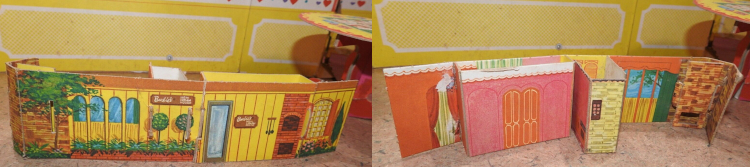
A tiny New Dream House was included with the Skipper Dream room. Source: bigrackdaddy on eBay. Astonishing! To accompany the mini-Barbies included with Skipper outfits such as “Me and My Doll” and “Day at the Fair,” the Skipper Dream Room boasted an itsy bitsy New Dream House–sans furniture, but featuring the midcentury cat wall art we admired in our post on this Dream House.
If you think about it, this year’s plastic Deluxe House falls somewhere between the real New Dream House and this miniature version in size. But Skipper wasn’t the only member of the house with a capacious getaway: Barbie had a sanctum of her own, of sorts.
Barbie’s Dream Kitchen/Dinette
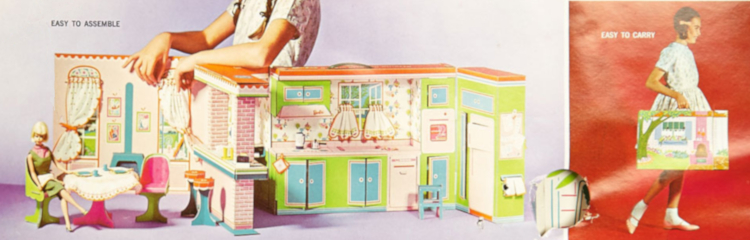
Barbie’s Dream Kitchen/Dinette product packaging. Source: Theriault’s. Lucky lady! While Skipper retires to her chambers, Barbie can go enjoy her… kitchen? To its credit, it’s at least bigger than the “deluxe” house, and with sufficient seating. Like Skipper’s room, the Dream Kitchen/Dinette has Sew-Free embellishments, as well as, in the style of last year’s house, lots of opening cabinets and other storage, plus a stylish mid-century pass-through window of tile mosaic and exposed brick. There’s also some abstracted food art, a little dimension to the wood-burning fireplace, and a set of plastic dishes and cookware.

Left and top right: mid-century fireplace, food art, and pass-through; source: Vintage Up North Pickers on eBay; coffee pot and casserole dishes; source: Barbie’s In The Wild on eBay. From Dream House to Deluxe House, where will Barbie land next? How many roommates will she have? You’ve heard her chipboard era is winding down; is plastic the way of the future? Style-wise, whose boots do I hear crunching up the gravel drive? Stay tuned to find out!
Note: some of the sets featured in this entry bear a copyright of 1964. As always in this series, we go by the year things first appeared in the Christmas catalog. If it wasn’t available in time for Christmas in 1964, was it really released in 1964?

Chipboard playsets in the 1965 Sears Christmas Catalog. source: christmas.musetechnical.com -
Three Nostalgic Black Barbies We Need (and a few existing alternatives)

We’ve got a lot to cover today, but first let’s clarify what’s meant here by a nostalgic doll. Since you’re on this page, chances are you’re already aware of Mattel’s reproductions, re-releases of Barbie and family doll+outfit designs that were originally produced decades ago. These are examples of nostalgic dolls, but they are not the only nostalgic dolls. Nostalgic dolls, for this discussion, are those which are styled to evoke a past era, but also styled to evoke the way that Barbie was designed and produced during that same era. For example, the dolls in the Mod Friends gift set are circa-1968 reproductions; they are nostalgic dolls for the mod era. On the other hand, this year’s 55th anniversary Christie references the mod era in a very 2023 way and thus is not a (Barbie-)nostalgic doll. Looking strictly at the vintage Barbie era preceding the mod era, one example of a nostalgic doll that is not a reproduction is the 2008 convention-exclusive Joie de Vivre: though the gown, chignon hairstyle and makeup are all new-to-Barbie designs (also referencing the “Take the picture!” scene from the 1957 film Funny Face, starring Audrey Hepburn), it has the vintage head+body and a face paint style that riffs on the vintage era .

Nostalgic or no? L-R: Joie de Vivre, Katherine Johnson, Toujours Couture. Sources: morgaswindel0, windycitydolls, crazy4barbie, all on eBay. The 2023 12 Days of Christmas doll is another example along these lines.
We’ll stay in the pre-mod, vintage era for the remainder of this post. The Inspiring Women series entry for Katherine Johnson is another 1960s-inspired doll, but its head mold, body, and facial screening are all modern. The body is too slender and long-limbed to model most vintage ensembles flatteringly, and the face detailing stands out amidst a gaggle of vintage dolls, so for today’s discussion this doll is historical, but in terms of Barbie, is not nostalgic. Finally, the Barbie Fashion Model Collection (BFMC) or Silkstone dolls walk the perimeter of nostalgia: their faces are similar to vintage dolls’, but their shapes, too, tend to be unsuited to vintage attire. Toujours Couture (2008), shown above right, somewhat resembles a Swirl Ponytail doll from the 1960s, while her garments come from no era at all but straight out of the BFMC alternate universe where no quantity of bows and trim is too much. Ultimately, because of the bad fit of vintage clothes and because some vintage collectors dislike the Silkstone material (we don’t notice it that much), we’ve ruled BFMC/ Silkstone dolls as not Barbie-nostalgic. Now, let’s dive in to our “needs”:
Dolls we need: 1. Ponytail Barbie
The original conception of Barbie is THE icon. Barbie in her black-and-white striped swimsuit, cat eye sunglasses, ponytail swinging, is the image we associate most with vintage Barbie. Based on what I’ve seen on fan forums, this is also the doll others most want to see revisited with darker complexion.
As you see below, this doll already exists in “swirl ponytail” form and is called 60th Sparkles (2019), a platinum label, convention-exclusive doll released in an edition of no more than 1,500. That’s right: Mattel has produced this doll once and sold her through exclusive channels, treating their own imposed scarcity as a selling point. That’s not serving the majority of fans and collectors, and honestly, as their lone* offering of a non-White, early-1960s nostalgic fashion doll sized to the vintage fashions, treating this release not as an acknowledgment of Barbie’s broad fan base or as a long overdue correction, but rather as an insiders-only variant that a precious few collectors deserve to own… it’s a little embarrassing for Mattel. So we’ll specify that the doll we need is a widely available ponytail/zebra swimsuit nostalgic Black Barbie doll.
60th Sparkles as a “swirl ponytail” nostalgic doll, wearing (L-R): her own glittered-up interpretation of the zebra swimsuit (though the pattern is more similar to Fashion Queen’s); reproduction red swimsuit and accessories authentic to the swirl ponytail; vintage pak playsuit and accessories; and another nostalgic, glittery reinterpretation: the reimagined Belle dress from 2022’s 12 Days of Christmas set. *In fact, 60th Sparkles has not been the lone offering of a doll meeting the criteria listed above: another convention-exclusive Black ponytail doll was released for the 75th anniversary, this one with a Silkstone body in vintage proportions, and with curly bangs like the first Barbie dolls. It is unspeakably rare today.
Dolls we need: 2. Bubble Cut Barbie
As noted above, everyone’s clamoring for ponytail dolls. But Barbie had other early-’60s iconic looks that, in my opinion, were better suited to her glamorous fashions, and also open up new possibilities in diverse hair representation.
Except for their curly bangs, the ponytail dolls’ hair was smooth, flat, and fine. Certainly, the same can be said of individuals’ hair from any race or ethnicity, and in the ’60s it was the fashion in the Black community to chemically straighten one’s hair: Ta-Nehisi Coates tells how his mother, at age 12 in 1962, started going to the salon to achieve “the locks of Lena Horne.” Earlier, Malcolm X and others in his social circle were doing the same chemical-straightening thing at home, and in the early 1960s he observed that the practice was still in vogue within the Black community, including among celebrities and members of the fashionable classes. (He further noted contemporary women “wearing these green and pink and purple and red and platinum-blonde wigs.”) So yes, it is accurate for an early-’60s Black fashion doll to have smooth hair, as 60th Sparkles does and as other nostalgic Black ponytail dolls likely would.
On the other hand, Coates’ mother realized in college, and Malcom X realized in jail, that frying your hair and scalp to meet a standard of beauty that was not designed for you–that just maybe was designed to exclude you–is a form of self-loathing. Though historically accurate, should these trends be celebrated uncritically today? Yes, some Black women’s hair is naturally smooth, and others may choose to straighten their hair with no dearth of self-esteem, and collectors love and desire the ponytail dolls. But let’s not overlook the bubble cut style and the opportunity it provides to depict fashionable, early-’60s Black women with texture and volume in their hair. I am aware of no Mattel offerings along these lines to date.
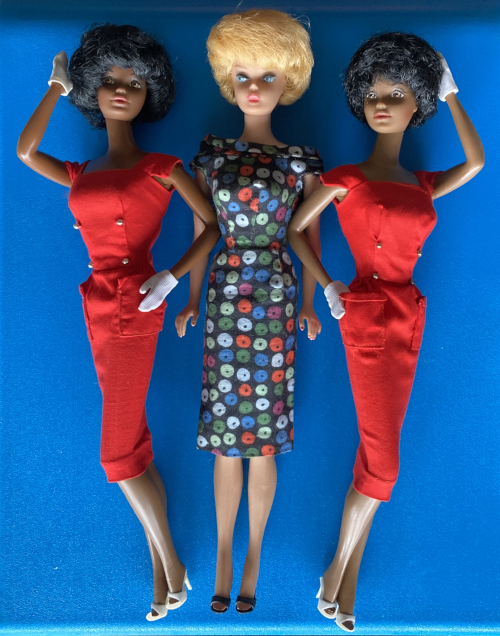
Best we could do: vintage bubble cut Barbie in Apple Print Sheath is surrounded by (R): 1980’s first Black Barbie and (L) the 2009 repro, both wearing Sheath Sensation sans chapeaux. Dolls we need: 3. Midge
How have we still never been introduced to Barbie’s best friend from the early 1960s, Midge, who is Black? To me this seems like a slam dunk. The original Midge mold can be used, or maybe the variant that was created for Julia and Christie–but Midge’s wide-eyed gaze, girlish pink lip shade, carefully coiffured curls and smattering of freckles are musts.
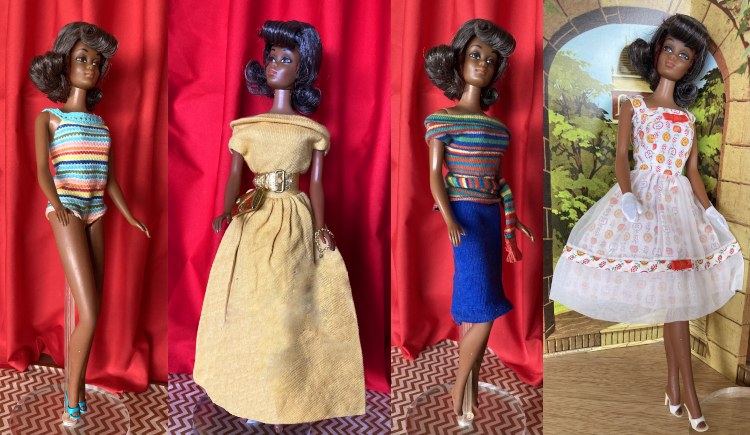
Julia goes Midge-mode in a wig from the Hair Fair reproduction and: Midge’s original bend-leg swimsuit; various knit pak items; and Lunch Date. A few existing alternatives
- Restyle a Julia or Christie: As you saw above, Julia or Christie may stand in for Midge. A face-up and rerooting would help a lot, especially for the vintage dolls whose hair has oxidized to bright red over time. However, both the dolls and their reproductions are rare; it absolutely requires resources to acquire one of these dolls and then pay a pro to restyle it. Price: $50-$100 for vintage Julia in fair condition before any OOAK; more for Christie.
- The first Black Barbie, or the reproduction, as a bubble cut: The hair is not quite right, the face is not ’60s vintage (though along the lines of the discussion on hair texture above, there are some upsides to using the Steffie face in place of Barbie’s original mold), and the body is just a bit curvier, making some of the clothes a squeeze–the Sheath Sensations pictured above are literally bursting at the seams! For purists, the bent arms are bound to be another sticking point. Otherwise, these dolls are available to serve as bubbles in a pinch. Price: $70 (deboxed repro)-$140
- Along the same lines as the first Black Barbie, Deluxe Quick Curl Cara (1976) has a great no-bangs Midge hair style and the Steffie face. She’s rare, especially with her hair in good condition. I don’t know how high on Mattel’s to-do list we’d find reproduction Quick Curl dolls, but I’m keeping my fingers crossed for 2026–they’re probably higher on the list than a true nostalgic Black Midge, anyway. Price: $275-$500 in display-ready condition.
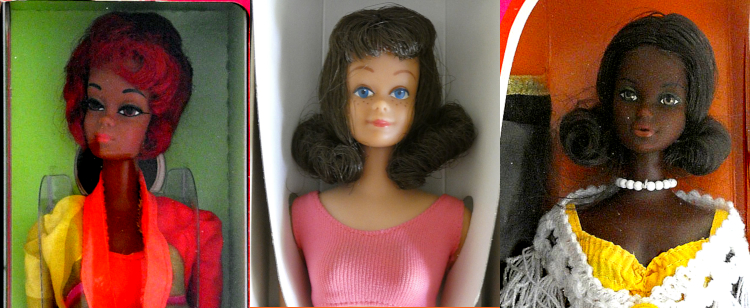
L-R: Christie’s sultry looks; Midge’s wide-eyed sweetness; Quick Curl Cara captures some of Midge’s wholesomeness. Source: Joe’s List. - Barbie Fashion Model Collection “Silkstone” dolls: Besides those already discussed, various other Black Silkstone dolls exist. Debut is a no-bangs riff on the original chevron-suited Barbie and another rare, expensive con exclusive. The nostalgic face mold has also been used for several Black dolls in the BFMC line that don’t reference specific vintage Barbie styles, including Toujours Couture, the more moderately priced #5 Lingerie doll with chin-length hair, and more. Besides the price, drawbacks include that their rail-thin figures often don’t fill out the vintage clothes, their face details are more stylized, their limbs are sometimes posed peculiarly, and, as noted above, the Silkstone material.
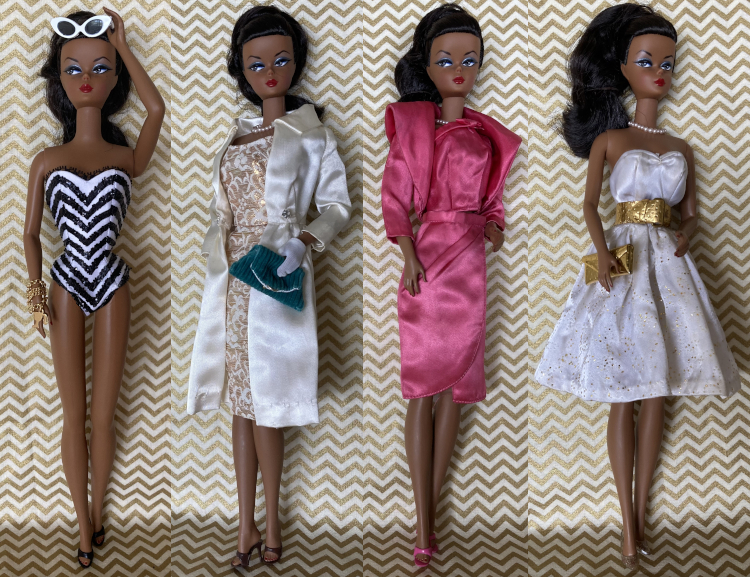
BFMC Debut models a Silkstone swimsuit and some 1960s fashions. L-R: Debut’s own papery, glittered-up version of the zebra-stripe swimsuit; Golden Girl’s stiff brocade maintains its shape on her slender physique, while loose-fitting garments like the pak satin coat are always safe choices (note, her inflexible, splayed right hand wouldn’t fit into the second glove); other pak satin items sit loosely on her frame; the strapless Party Date dress stays up long enough to take the photo with the help of a stiff belt and a slight lean. Substitute shoes used in all vintage ensembles because stiff Silkstone feet will cause splits in vintage shoes.
- Sixties clones, including the Uneeda/Hong Kong Lilli varieties and the Twistee/Totsy dolls, introduced glamorous Black Barbie counterparts before Mattel did. These are again rare, not cheap, and quite uncommon to find “minty.” Furthermore, there will be fit issues, especially with shoes, when using them to model vintage Mattel fashions. In addition to the sampling of dolls below, take a gander at the examples included in The Bold Doll’s article on clones, particularly the gorgeous Peggy Ann about halfway down (note: the “Evening Splendour copy” she wears is by Premier Doll Togs!). Price: $250-$500 in fair condition.
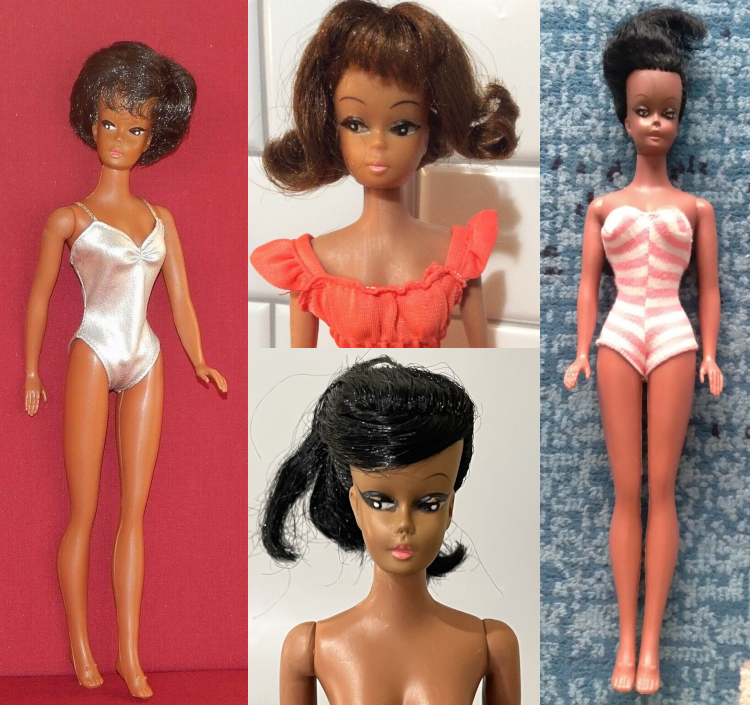
1960s Twistee doll (top center) surrounded by Uneeda/Hong Kong Lilli dolls. Sources (clockwise from top center): dblobby on eBay; bookofsmiles on eBay; random_depot on eBay; area.59 on eBay. - If you’re crafty, you can dye common dolls. The blogger at this link got nice results from the more-affordable 35th ponytail repro… just make sure the dye doesn’t bleed onto your vintage fashions! This is also a buyer-beware moment for those shopping for ’60s clones and other rarities: dyed dolls are out there, some masquerading as originals. If you get a doll whose look you love, there should be no issue; just don’t wildly overpay, and beware of bleeding dye, if you’re not sure of a doll’s provenance.
Why so few recent dolls? Starting when Barbie went disco in the Superstar era, face detailing became a little more cartoonish. Although it has evolved many times since, it has not returned to the classic style except for deliberate purposes like the repros. (2026 update: we can no longer trust Mattel’s “repros” to sport “classic” face styling.) Dolls like Pop Life Christie and Nichelle Nichols as Uhura, while referencing the (mod) Sixties, are omitted from these considerations because they don’t sit comfortably alongside vintage and faithfully-rendered, Barbie-nostalgic dolls.
What about some WHITE nostalgic dolls? They are plentiful… multitudinous.
Beyond Black and White
In the early Sixties, about 1 in 10 Americans was Black, while no more than about 1 in 100 was from any other given non-White ethnicity. For this reason, and because of the apparent popularity of the idea in the Barbie fan community, we’ve prioritized Black representation for Barbie as a vintage-era American young lady. Expansion of the nostalgic line to other ethnicities should happen, too.
Besides overlooking the demand for non-White nostalgic Barbie dolls, another and related glaring error that Mattel continues to make is dressing every Asian collector fashion doll in embroidered silk, as if she’s stepping not from the 1960s or later, but from an earlier century; as if she is not American. A customer worded the issue rather well, way back in 2003 when the Chinoiserie Silkstone was released. Mattel’s response on that page was dismissive, and we can see from their output over the next two decades that they did not learn from this very valid criticism: outside the playline, Asian Barbie dolls rarely reflect modern fashions as their White and Black counterparts are free to do. The customer’s mention of Anna May Wong is particularly rich, since this year an Anna May Wong Inspiring Women doll was released. Wong was California-born and -raised, and in her personal life was entirely modern and fashionable; but she was typecast by Hollywood, only allowed to play “dragon lady” characters, foreigners. Was Mattel sensitive to Wong’s struggles in designing the new doll? Yes but no. They put her in a red satin dress with a great big metallic dragon plastered across the front as an acknowledgment of the stereotypes that stifled her a century ago.

Nostalgic Midge reproduction and vintage Julia in vintage Fun n Games; vintage bubble cut and vintage first Black Barbie in vintage silk sheaths; nostalgic 60th Sparkles and nostalgic Busy Gal repro in vintage Sheath Sensation sheaths; 2023 Guo Pei Lunar New Year in 12 Days of Christmas Belle and nostalgic Cool Collecting in vintage Belle. As we wrap up I’ll note that not every Asian American woman looks Chinese or is of Chinese extraction, and today the most populous ethnic minority group in America is neither Black nor Asian; in other words, there’s plenty of identity to explore in collector and nostalgic dolls representing fashionable, American women.
-
Sidebar: Busy Gal Fashion Sketches (1960)
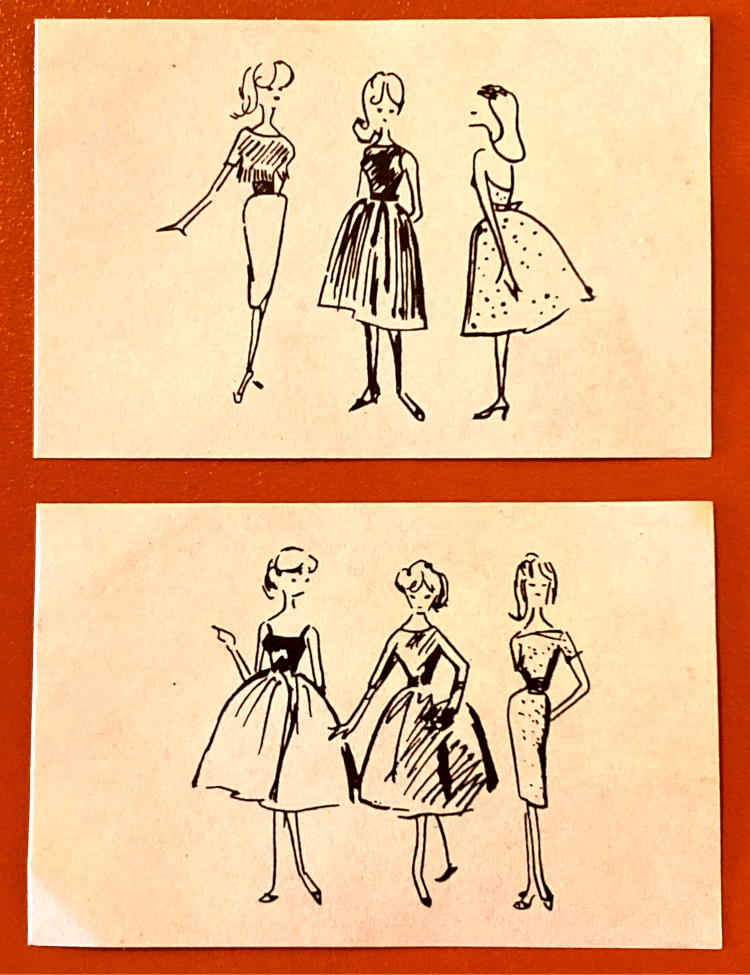
One of Barbie’s earliest careers–besides being a Teen-Age Fashion Model–was as a fashion designer, as reflected in the 1960-61 Busy Gal ensemble and its portfolio. (A few years later she was a JUNIOR fashion designer.) Shown above are the miniature fashion sketches (measuring about 3.5″ on the diagonal) found inside the portfolio. The designs don’t reference specific Barbie fashions, though one can find similarities between these looks and Let’s Dance, Silk Sheath, Party Date… Regardless, they clearly evoke the postwar French fashions that inspired Barbie’s early styles. The sketches above are from the 1995 reproduction, but Joe’s List shows the genuine articles along with most of the rest of the vintage set; the repros appear faithful:


Silken Flame
Vintage Barbie illustrations, built environment, clones and more
 Silken Flame