-
Welcome!
Thanks for swinging by my vintage Barbie fan site, where you’ll find articles on Barbie’s built environment, Barbie illustrations, vintage rival and clone dolls and playsets, and miscellaneous musings/deep dives. What are you looking for?
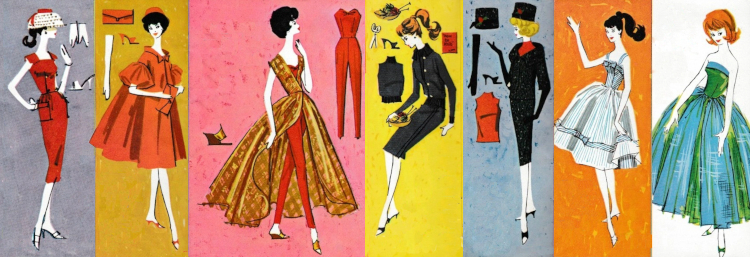
Vintage Barbie Illustrations
- Mattel fashion booklets, 1960-67 (approximately)
- Basic and Dressed Doll Boxes, 1959-64
- Doll Carrying Cases, 1961-72
- Jumbo Trading Cards, 1962
- Gift set art, 1960-70
- Illustrated fashion packaging, also about 1960-70
- Random House books (plus some from other publishers), 1962-65
- Dell Comics, 1962-63
- Whitman Paper Dolls, 1962-65 and 1967-73
- Whitman Coloring Books, 1962-65 (A mod sequel post is possible but not planned at this time.)
- More crafts and hobbies, 1963-1971
- Queen of the Prom board game, 1961-63
- Keys to Fame board game, 1963
- Sew-Free Fashion Fun Kits, 1965
- Sewing Patterns, 1962-?
- The Barbie World of Fashion board game, 1967
Plus the illustration “sidebars,” short entries on niche topics:
- Busy Gal fashion sketches, 1960
- Barbie Sings!, 1961
- Go-Together furniture sets, illustrated
- Color Magic, 1965-66
- Mattel fashions for Julia, 1968-69
- All the Barbie and friends illustrations on mod house exteriors like the one below
- Miss Lively Livin’ board game, 1970
- Window shopping, illustrated
- Barbie’s Baggage, illustrated (not super short, but surveys many illustration categories examined in other posts)
- Vintage dress-up and other child-size items for the boudoir
- The illustration component of the 1964 Little Theatre and travel costumes entry is sidebar-sized.
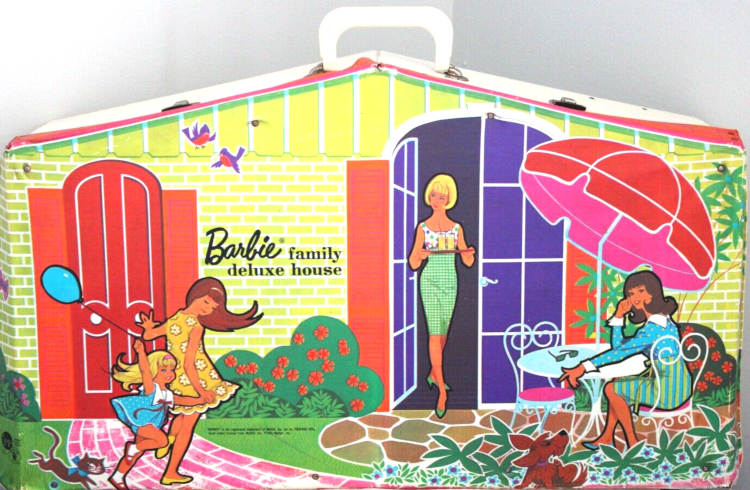
Barbie’s Built Environment
- Entries by year for many of Barbie’s early abodes: 1962, 1964, 1965, 1966, 1967-68, 1969, 1970.
- Barbie’s ’70s Travelogue: Part I, Part II, Part III, Part IV.
- Mattel Modern and Susy Goose furniture, 1958-1966
- Barbie on TV, a roundup of some of Barbie’s early toy TV sets (this post also has a strong “illustration” component)
- Barbie’s Fashion Shop, 1963
- and a detour into Mannequins and Dress Forms, ’63-’73
- The Deluxe Reading Dream Kitchen, 1963 (note, this is not a Mattel product)
- The Little Theater, 1964
- Skipper’s Schoolroom, 1965
- Penthouse apartments, 1964-76
- Beauty parlors, 1964-77
- Japan-exclusive furniture, 1967
- Unique Boutique and Cafe Today, both 1971
- The Sears Karosel Kitchen, 1971-1976 (note, this is not a Mattel product)
- A roundup of fireplaces in Barbie and Barbie-sized houses, 1963-79
- The “built” environments of Whitman Barbie paper dolls, which real Barbie dolls can also use; 1963-1973.
- The built environments of mini vintage Barbies
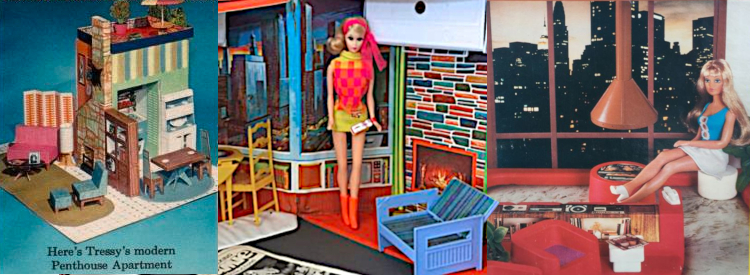
Articles relating to clones, rivals, and off-brand Barbie-style products
- Rival fashion booklets
- The Two Abodes of Tammy covers the living spaces of one of Barbie’s most notable rivals
- Barbie’s ’70s Travelogue, Part II: Unofficial Adventures is about non-Mattel playsets suitable to Barbie and Barbie-sized dolls
- Clones are recommended in the “existing alternatives” section of the musing, Three Nostalgic Black Barbies We Need (and a few existing alternatives).
- Clone kitchens: The Deluxe Reading Dream Kitchen, The Sears Karosel Kitchen
- Clone washrooms are prominent in Barbie’s ’70s Travelogue: Part IV.
- The pieces on penthouses, beauty parlors and fireplaces include non-Mattel offerings.
- Not Barbie on TV: Barbie and friends’ early TV sets that were tuned to other programs
- The entry on Mattel Modern and Susy Goose furniture includes some offbrand furniture items of the 70s and 80s.
- We wrote about clone carrying cases, including some created for competitor dolls.
- Certain of the sewing patterns are for generic fashion dolls, as are the Sew Simple and Cut ‘n’ Sew craft kits.

Miscellaneous Musings and Deep Dives
- A Chronicle of Barbie shoes, 1959-67
- Barbie’s Seventies Travelogue: the Appendix reviews vintage and nostalgic Barbie and Barbie-sized luggage options
- When Barbie Turned 21 in Manhattan, 1980
- Three Nostalgic Black Barbies We Need (and a few existing alternatives)
- Great Books for Vintage Barbie Fans
- The piece on Skipper’s Schoolroom includes “play sets that never were”: Barbie’s Sixties careers for which environments were not produced.
- Visions of After Five (1962) and Solo in the Spotlight (1960)
- Who wore it best? pairs vintage and mod Barbie and Francie fashions with their likely or confirmed inspirations. The Airborne edition does the same for vintage flight attendant uniforms, while the Mary Quant one highlights Francie fashions that appear influenced by Swinging London designer Mary Quant.
- Millennium Mod catalogs Barbie’s returns to the late Sixties youth-driven zeitgeist between 1980 and 2020.
- We tackle an age-old mystery with our investigation into Sew Free? Sew Magic? Sew Simple? Cut ‘n’ Sew??
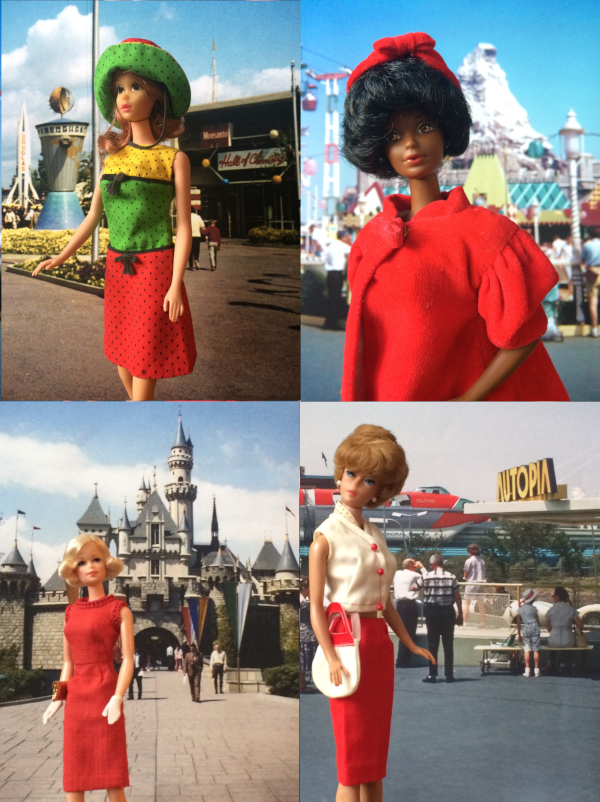
There’s still more to come, but before you scroll off into the distance, here’s the first image ever posted to this blog back in 2022: some of my dolls, dressed in vintage or vintage reproduction, in front of vintage Disneyland backgrounds belonging to Bill Cotter:
-
When Barbie turned 21
![Small newspaper blurb in black and white. At left, a model wearing a life-size copy of Silken Flame (holding her gold clutch and opera-length gloves in her hands) looks at a human-sized copy of Fashion Editor displayed on a mannequin. At right, text reads:
"21 Dress Salute
"Barbie has finally achieved cult status. Along with a revival in sixties music and fashion has come renewed interest in Mattel's 1959 doll. Leading this revival is Timothy Dunleavy, a children's-clothing designer, who has done his first couture collection inspired by Barbie's own wardrobe. 'Barbie embodies the spirit of sixties American Elegance,' says Dunleavy, 'whether it is Roman Holiday, or Fashion Editor and Silk & Flame [sic] [both pictured[. Barbie's wardrobe contains a microcosm of an entire era of American style, sensibility, and tradition." To celebrate Barbie's twenty-first birthday, Hurrah is throwing a party that will be highlighted by a fashion show of 21 outfits from Dunleavy's collection--modeled on great big beautiful dolls. -Richard Buckley
The Barbie Fashion Show/Hurrah April 21 at 9 p.m. and midnight
36 West 62nd Street/541-4909
Admission, $6"](https://silkenflame.net/wp-content/uploads/2022/09/nymagazine-1.png?w=416)
Announcement of Barbie’s 21st birthday festivities appearing in New York Magazine, April 1980 It’s a paradox: she was a teen-age fashion model in 1959, and she turned 21 in 1980. For Barbie, both are true. And in 1980 Barbie held her 21st birthday bash, where else? in a nightclub: “Hurrah” in Manhattan, a “new wave disco,” per the Charlotte Observer. Befittingly, the party was punctuated by a fashion show that ran twice, once at 9 p.m. and again at midnight. The life-size fashions were created by designer Timothy Dunleavy, who hoped to bring Barbie’s vintage styles back as couture. And it worked, sort of: in addition to the birthday to-do, a couple of fashionable women wore his interpretations to society events. According to a contemporary account in the New York Daily News, Solo in the Spotlight was worn to a wedding by one Enid Geller, while Gay Parisienne was worn by Nathalie Perr, herself a designer, to a “black tie dinner” at the Met.
Unfortunately, hardly a trace of material seems to remain from Barbie’s 1980 fêting. I’ve assembled here the accounts I could find, from New York Magazine, New York Daily News, The New Yorker, and the Charlotte Observer (Dunleavy hailed from North Carolina, perhaps explaining the last publication’s interest).
The venue was a mirrored room bisected by a red-carpeted runway; to one side were folding chairs for the press and fashion industry types, while to the other side the audience who’d paid $6 admission could mingle. Barbie’s Dream House was on display. A total of 21 dresses were shown to mark Barbie’s 21 years, though the time period covered was said to be just 1959-64 and the designer expressed partiality for fashions from the years 1959-61.
The show opened, appropriately, with Barbie’s original attire: the zebra-striped swimsuit. Although The New Yorker claimed that the proceedings were videotaped, there seems to be no evidence remaining of most of the looks. However, nearly forty years later Unique Vintage would also remake some of Barbie’s iconic fashions in life size. The Unique Vintage versions are not especially well made–no one’s wearing these to a black-tie affair at the Met–but we can still substitute a couple of their images to help set the mood.
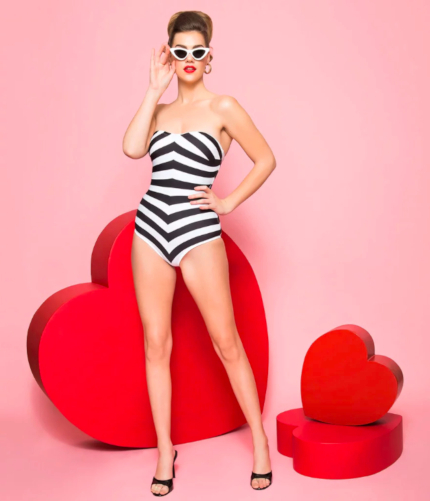
Barbie x Unique Vintage zebra swimsuit. Source: uniquevintage.com The ensuing show was, shall we say, tongue-in-cheek: the model showing Sweater Girl (1959) did a mock striptease while balancing her basket of colorful balls of yarn; the Winter Holiday (1959) model came out to the James Bond theme brandishing a pistol; and the model clad in a bejeweled take on Ballerina (1961) danced to a disco version of Swan Lake. Some of the doll-like elements were exaggerated, such as the gold beads representing buttons on Sweater Girl, which became “big gold ball buttons” in Dunleavy’s interpretation. Attention was paid to details: the designer resorted to painting pin-dots on Gay Parisienne (1959) himself when the right fabric wasn’t available, and in addition to the yarn balls mentioned above, history tells us that Fashion Editor (1965!) included its vintage camera, although Solo in the Spotlight (1960) lacked accessories.

A model sports a life-sized copy of Solo in the Spotlight from the collection by Timothy Dunleavy for Barbie’s 21st. Source: New York Daily News So far we’ve encountered the Zebra swimsuit, Gay Parisienne, Winter Holida,y and Sweater Girl (all 1959), Silken Flame and Solo in the Spotlight (both ’60), Ballerina (’61), and Fashion Editor (’65). Other fashions on display that night include Roman Holiday and Barbie-Q (both ’59), Friday Night Date (’60), American Airlines hostess (’61), and one of the brocade sheaths–let’s say Golden Girl (’59). Mood for Music and Sorority Meeting (both ’62) were probably also shown, as both are mentioned by the Charlotte Observer.

American Airlines Stewardess #984 (left) and “Gay Parisienne” Costume #964 as they appeared in contemporary Mattel Barbie fashion booklets That leaves five additional, unknown ensembles before the finale. An attendee pointed out to The New Yorker‘s reporter that Registered Nurse (1961) was not among the fashions shown, but beyond that it’s anyone’s guess what other ensembles were paraded. Surely one of the journalists present would have told us if the striking Red Flare (’62) swing coat had sashayed by. The Charlotte Observer mentioned skirts so tight the models “had to mince down the runway.” That describes Solo in the Spotlight but may also allude to Enchanted Evening (’60). I’d like to think all my favorite sheaths (Sheath Sensation, Silk Sheath, Apple Print Sheath…) appeared, as well as the legendary Black Magic (’64).
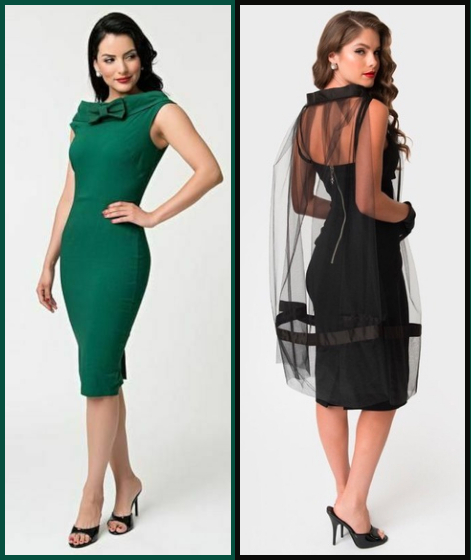
Left: life-size reproduction “silk” sheath (really a stretchy, coarse-textured plastic material) by Barbie x Unique Vintage; Right: “Black Magic” By Barbie x Unique Vintage, whose wide ribbon trim and prominent back zipper might have appealed to Dunleavy’s sensibilities. Source: uniquevintage.com In Barbie’s early years it was typical for fashion shows to end with a wedding gown, and this show closed with “Barbie” in Wedding Day (1959), festooned with rhinestones and escorted by a tuxedo-clad “Ken.” But what happened after the lights dimmed on Barbie’s soirée? Dunleavy would take another stab at retro Barbie camp in 1982, designing the costumes for a short-lived off-Broadway show called “Livin’ Dolls,” a send-up of the ’60s Beach Party genre. The show’s visual design received praise, both its sets by John Lee Beatty–“a huge vinyl Barbie Doll carrying case that opened up to become the set all done in 1960s colors: aqua, orange, pink and hot pink” (American Set Design by Arnold Aronson)–and Dunleavy’s “wild array of loud-to-louder beach costumes” (The New York Times). Their efforts weren’t enough, though, and the show lasted only 25 performances. I found no images of the costumes, and only one image of the set, online.
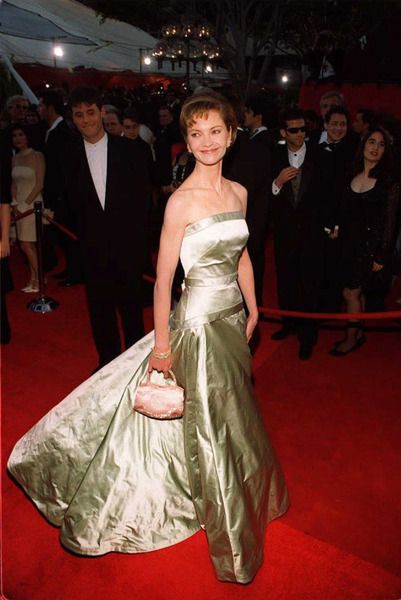
Joan Allen arrives at the 68th Academy Awards in a gown by Timothy Dunleavy. Source: Pinterest Dunleavy also designed red carpet fashions, including a piece worn by Joan Allen to the 1996 Academy Awards that I think looks just a bit like Enchanted Evening.
UPDATE: In Summer 2023, vintage-Barbie-based couture has entered the mainstream. People says the Margot Robbie looks below were created by the fashion houses of Vivienne Westwood and and Elsa Schiaparelli, while the 1980s Day-to-Night interpretation Margot also wore recently (not shown) was created by Versace.

Margot Robbie in life-sized Enchanted Evening, left, and Solo in the Spotlight, right. Sources: andrewmukamal on Instagram, justjared on Instagram. In 1994 Mattel revisited the concept of a birthday party/fashion show for Barbie at Disney’s EPCOT theme park. If the birthday party described above sounds like your scene, this one may not be:
Not the Barbie birthday party video we need, but evidently the one we deserve. As different in tone as the Orlando version of Barbie’s birthday fashion show seems to be from the Manhattan original, it does still end with a wedding ensemble. We should do the same.
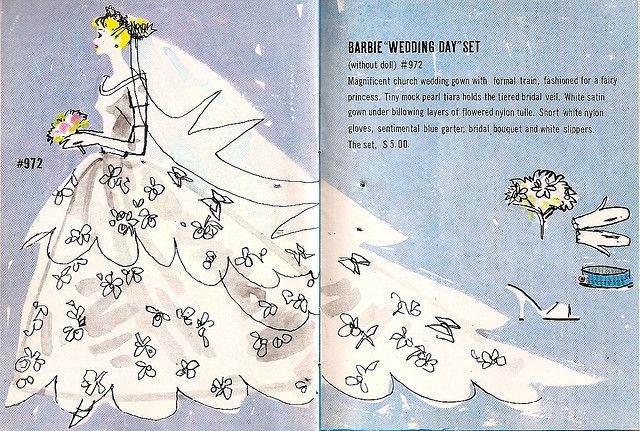
Barbie “Wedding Day” Set #972 as it appeared in contemporary Mattel Barbie fashion booklets Where to next? Peruse a Chronicle of Barbie shoes, 1959-67; visit Barbie’s Fashion Shop; browse the early fashion booklets; have Visions of Solo in the Spotlight; or pop up to the Table of Contents to see more options.
-
Barbie and Ken Little Theatre (1964)
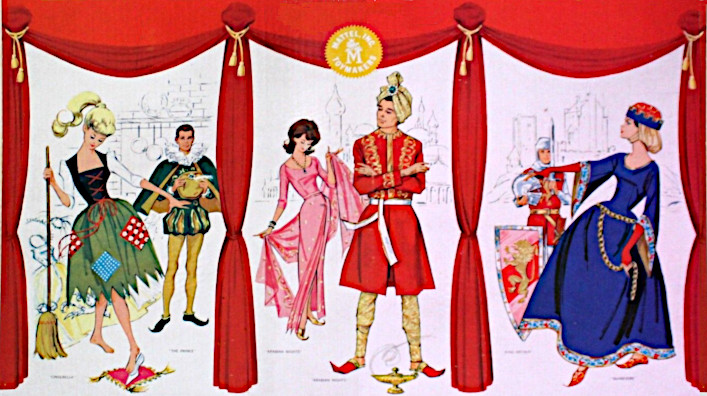
Digitally-enhanced detail from the Little Theatre Gift Set packaging. Source: dreamhousedolls on eBay The built environment of Barbie got a unique entry in 1964: a repertory theatre where Ken and Barbie starred in all the plays. In addition to the play set, seven costume ensembles were sold separately in 1964, with all but one carried over into ’65; the image above shows part of the packaging for a gift set that united all the costume sets that survived into the second year.
Like other Barbie play sets of the time, the theatre came as a chipboard carrying case that folded out to form the environment, and the closed carrying case represented the outside of the building. The exterior below, with its carved stone facade, hints at the sort of timeless grandeur of this set’s aesthetic.
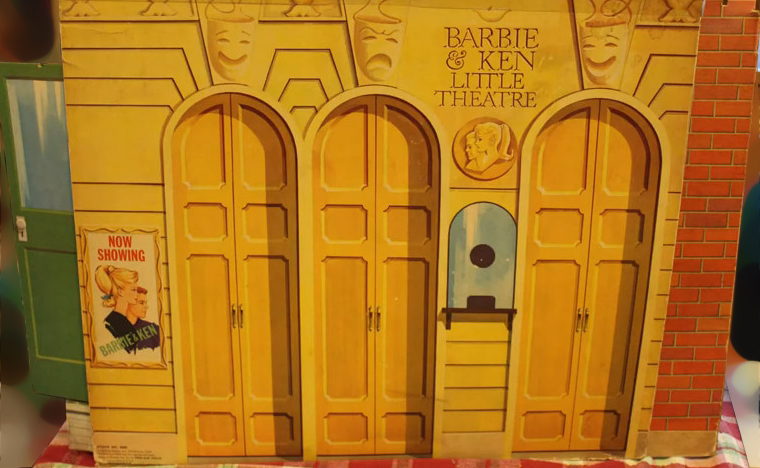
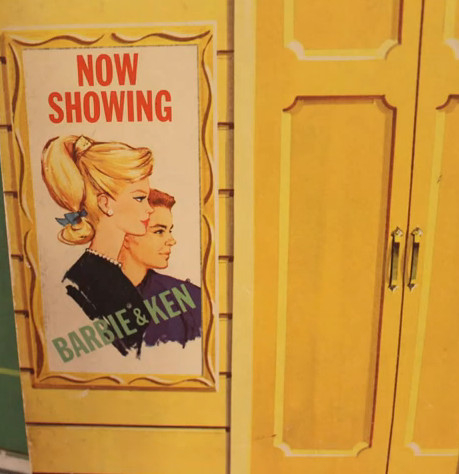
The Little Theatre exterior. Source: barbee0913 on youtube Note the attractive illustration of Barbie and Ken in the “Now Showing” poster at left. Although the set came with tons of accessories and paper bits, it did not include separate posters for all the shows; instead, Barbie and Ken themselves were advertised.
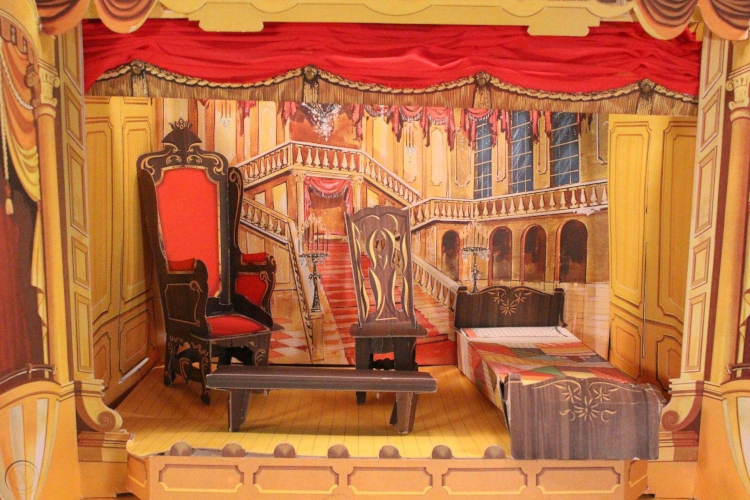
Little Theatre interior and some furniture pieces. Source: worthpoint.com The theatre’s interior is dominated by its stage. The set came with backdrops, furniture and other pieces of scenery, and a real fabric curtain could be raised and lowered like a roman shade. The backdrops are particularly nice pieces. The one shown above was probably conceived for the ball scene in Cinderella, and may have served for other plays, as well. With its resemblance to the Grand Staircase in the Palais Garnier (Paris Opera House), it also suggests a theatre within a theatre!
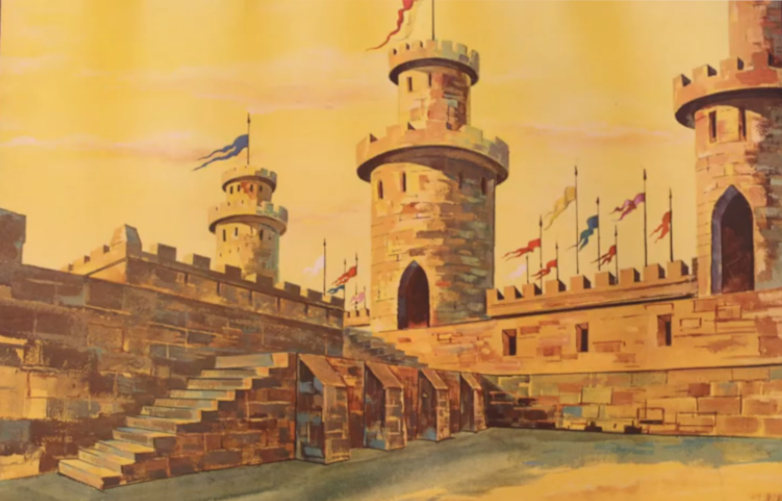
A moody scene at Camelot. Source: barbee0913 on youtube The castle courtyard backdrop shown above was probably created with Camelot in mind. Other scenes show a castle’s interior that evokes Camelot but may have also served for scenes in Cinderella (below); a bazaar or Middle Eastern city scene; a cottage interior that suits either Red Riding Hood or Cinderella; and a forest scene that suits several of the stories.
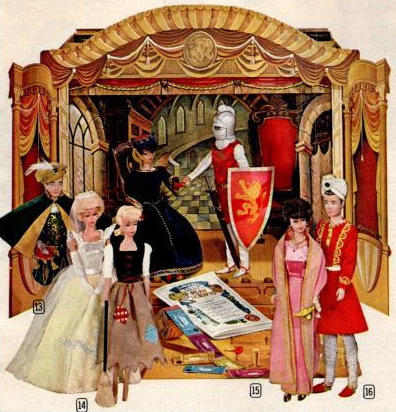
The Little Theatre and costumed dolls as they appeared in the 1964 Montgomery Ward Christmas catalog. Source: christmas.musetechnical.com The 1964 Christmas catalogs showed the play set in action alongside the corresponding costumes, which were sold separately. While Lerner and Loewe’s Camelot musical toured the States in 1964 following its massively successful Broadway run, Barbie as Guinevere and Ken as King Arthur held court in the catalog image above. I wonder who played Lancelot? Or else, what was the plot of Barbie’s Arthurian drama? The book of short plays sitting near the center in the image above would tell us, but I haven’t seen one up close.
The outfit sets came with theatre programs or playbills showing Barbie and Ken in costume, charmingly illustrated. We saw three of the illustrations in a composition at the very top of this post, and here are three more.
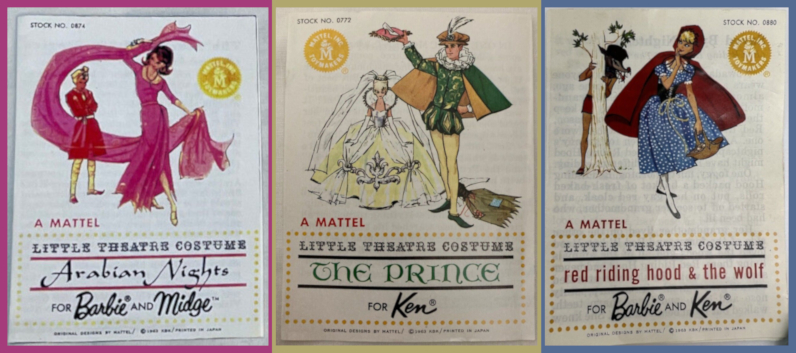
Three playbills included with Little Theatre costumes. Sources (L-R): barbimom5 on eBay; de*be on eBay; ala0339 on eBay When the Red Riding Hood costume says it’s “for Barbie and Ken,” it means something different than the Arabian Nights costume saying it’s “for Barbie and Midge.” In one case, a single set contained the pieces to dress two dolls, while in the other either Barbie or Midge could perform the role. We have to assume Midge understudied Barbie since it’s Barbie’s name “in lights” outside.
1964 was also the year of the travel costumes, five for Barbie and four for Ken, which came with illustrated travel brochures depicting the costumes in a style mirroring that of the playbills. I’m sure some of these costumes made their way onstage, as well.
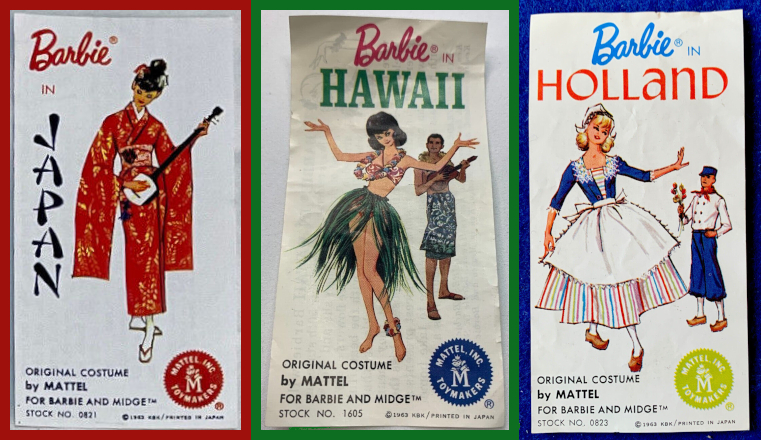
Three brochures included with 1964 Barbie travel costumes. Sources (L-R): barbimom5 on eBay; *jenmar* on eBay; pascovintage on eBay Although Skipper debuted in 1964, she was not invited on vacation nor did she appear in any plays. Her Ballet Class ensemble did come with a program for the Nutcracker Suite, with Skipper herself heading the very short list of performers (okay, the only listed performer is Skipper), and the Little Theatre was the ideal venue for her dance recital. Barbie, whose Ballerina ensemble was sold through 1965, likely also twirled these boards a time or two.
But now it’s time to find our seats–the curtain’s going up!
Detail from the Little Theatre exterior. Source: barbee0913 on youtube. Where to next? This post is about Barbie’s early built environment. The most recent post in this category concludes the Barbie’s Seventies Travelogue series, and the most popular are those on Mattel Modern and Susy Goose furniture and on penthouse apartments. Otherwise, the overall most popular posts on this site are about Barbie shoes, 1959-67, and about Mattel fashion booklets. Or just head up to the Table of Contents to see more options.
-
Sidebar: Barbie Sings! (1961)
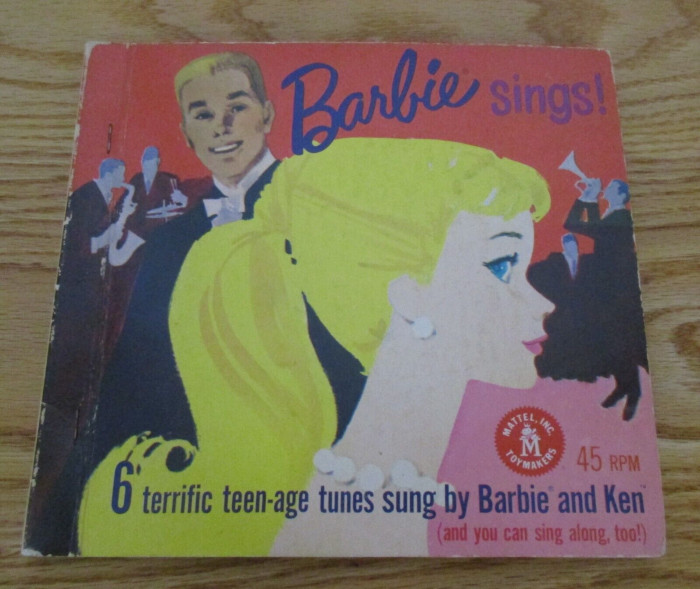
Cover of the Barbie Sings! record set from 1961. Source: mgrant4743 on eBay I stumbled across an interesting eBay listing over the weekend: a set of 45 rpm records from 1961, “sung” by Barbie and Ken (the back cover identifies the real singers as “lovely Charlotte Austin” and “handsome young Bill Cunningham”). The record jacket and lyrics pages are illustrated and make for a nice mini-update.
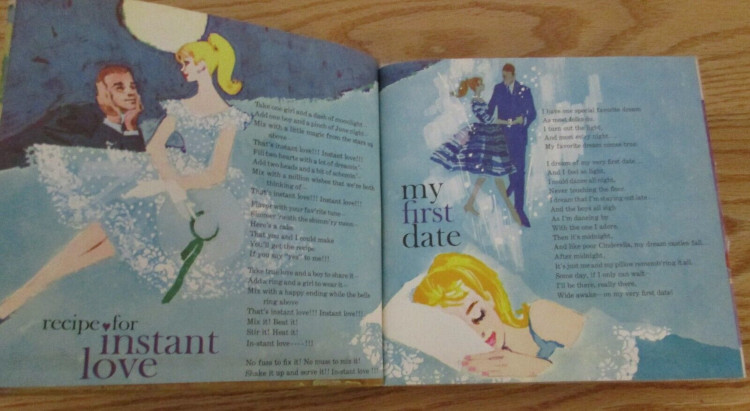
Illustrated lyrics included in the the Barbie Sings! record set from 1961. Source: mgrant4743 on eBay Jodi Benson, best known as the voice of Ariel, The Little Mermaid, has recalled in interviews that as she was preparing to voice Barbie for the Toy Story series, someone from Mattel told her that she would be the very first actress to give voice to this iconic character. Benson found that amusing because she’d heard exactly the same spiel when she voiced Barbie for a 1991 aerobics video (“Dance! Workout with Barbie“). I was aware of a few earlier examples of Barbie’s voice–the doll herself was speaking way back in 1968!–but this set of records may actually be the very first time that Barbie had a voice.
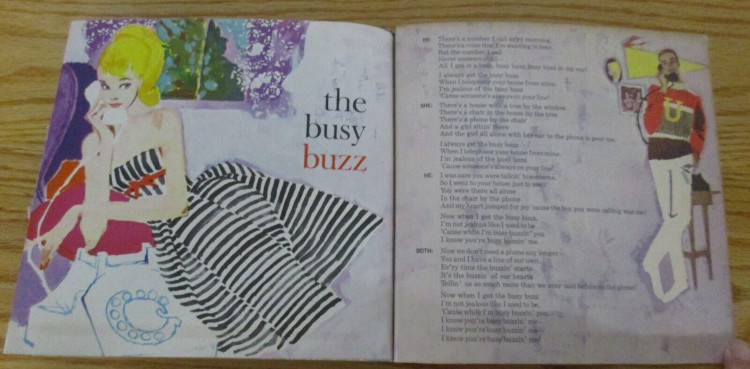
Illustrated lyrics included in the the Barbie Sings! record set from 1961. Source: mgrant4743 on eBay The six songs in the set were written especially for Barbie and Ken. Luckily for those of us without record players, today we can hear Barbie sing! on YouTube, and the songs are better than I expected. Austin’s singing style is more Doris Day than Annette Funicello. You can hear a sample, plus view some additional illustrations and very limited animations, in this lovely TV commercial:
Barbie Sings! commercial uploaded by Harold on YouTube See more images from this curiosity on the eBay listing.
Where to next? This post is an illustration “sidebar,” meaning short and sweet. Our most popular sidebar is on Barbie and friends illustrations on mod house exteriors, while the most recent investigates Window Shopping. The top post on the entire site concerns shoes; or just head up to the Table of Contents to see more options.
-
Whitman paper dolls (1967-1973)

Barbie paper dolls from Whitman sets released during the years 1967-1973. Source: onceagain34 on eBay. During Barbie’s mod years, the Whitman illustrators experimented with a diversity of art styles, demonstrated in the collage of Barbie paper dolls above. (If a couple of them look like Stacey to you, let me reassure you that Whitman identified all as Barbie herself–we’ll see Stacey in a moment.)
Starting with the “Barbie has a New Look” set in 1967, fresh illustration styles were demonstrated on the folder art as well as on the dolls and fashions.
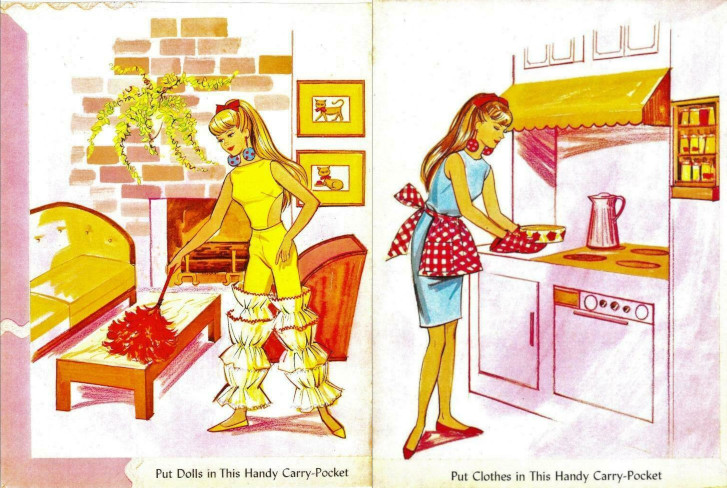
Inside the “Barbie has a New Look” folder from 1967. Source: onceagain34 on eBay. At the far end of the timeline, departing the mod era, a 1973 set called Barbie’s Friend Ship depicted the same-named play set from that year and can be used for dioramas recreating everyone’s favorite setting, the golden age of air travel.
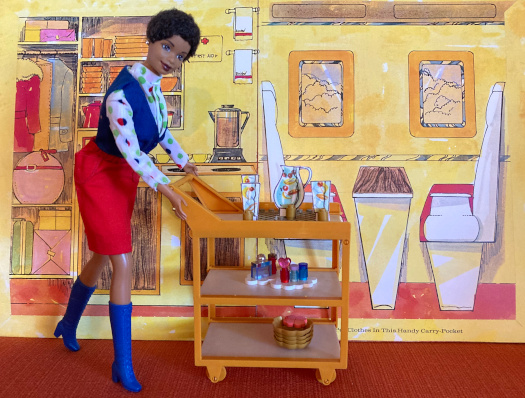
The folder for Barbie’s Friend Ship from 1973. In front, the Avon Sales Rep doll wears parts of the 1973 United Airlines ensemble, along with the boots from a 1972 shoe pak. The cart, from the Barbie’s Friend Ship play set, bears additional pieces of the paper doll set as well as some LEGO bits and bobs. From the author’s collection. In addition to its range of artistic sensibilities, the mod years also introduced an unprecedented number of friends for Barbie. In the paper doll world, she explored fashion alongside Christie, Stacey, P.J., Francie, Casey and Ken (Skipper made her return with the Malibu look in ’73). A Francie and Casey set from 1967 reproduced many of the same outfits as the “Barbie has a New Look” set–but now they were Francie-sized.
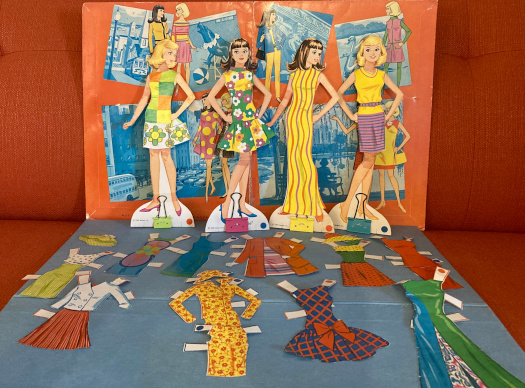
Francie and Casey paper dolls from the 1967 Whitman set, dressed in Color Magic fashions that came with their set. Other normally-Barbie-sized fashions from the set are spread at their feet. From the author’s collection. Of course, Francie and Casey still dressed like themselves, sometimes, too.
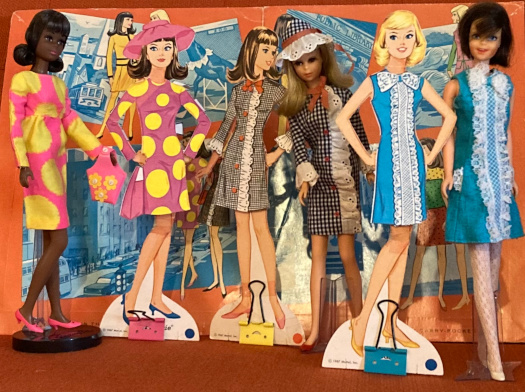
Francie and Casey dolls from the 1967 Whitman set, along with their respective inspirations in matching fashions. From the author’s collection. A 1968 “Barbie Christie Stacey” set claimed that “All fashions fit each doll.” However, a couple of the fashions revealed distinctly lighter skin. I overlaid Fancy Dancy and Extravaganza on Stacey and Christie, below, and digitally corrected the skin tone on Extravaganza to suit Christie.
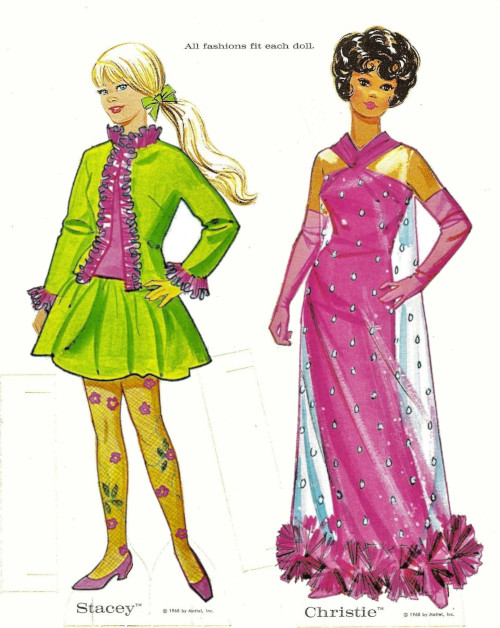
Stacey and Christie from the 1968 Whitman “Barbie Christie Stacey” paper doll set, overlaid with digitally-altered fashions from the same. Source: onceagain34 on eBay. Both Fancy Dancy and Extravaganza appeared in multiple paper doll sets during the mod years.
Barbie’s friend P.J. had multiple Whitman sets all to herself for some reason.

P.J. anticipating “Hipster Ariel” in a 1970 Whitman set. Source: wehavestufftoo on eBay. While the fashion booklets switched to using photographs in the late Sixties, the paper doll sets remained a resource for illustrated fashions. The sets I surveyed from 1967-1971 depicted a higher proportion of genuine Mattel Barbie fashions than did the sets I previously surveyed from 1965 and earlier; we can revisit some of our favorite mod looks as we explore the variety of art styles.
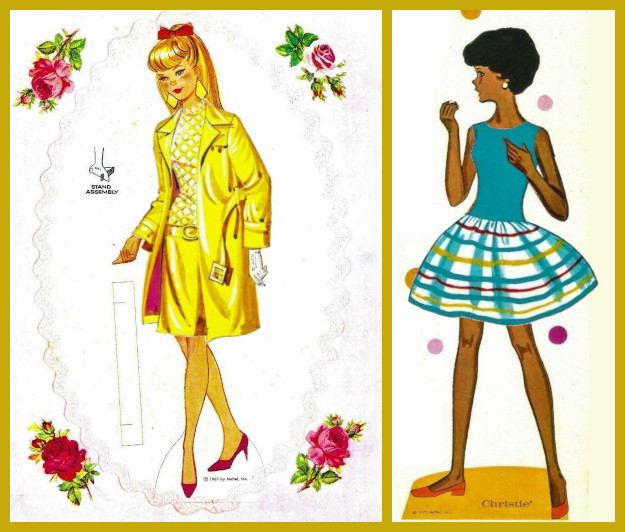
Two paper dolls from Whitman Barbie sets produced in 1967 and 1971, overlaid with fashions that came with them. Source: onceagain34 on eBay. Above, the lushness of the 1967 “Barbie has a New Look” set is contrasted with the flat graphic style of the 1971 “World of Barbie” set, with the 1967 doll modeling the “Intrigue” fashion and 1971’s Christie modeling the 1968 fashion “Twinkle Togs.” Both of these fashions were available in other late Sixties Whitman sets, as well.
1969 brought us at least two renderings of the Sears exclusive Twinkle Town, these two demonstrating the loosest and tightest art styles I found in the mod years:

Two paper dolls from Whitman Barbie sets produced in 1969, overlaid with fashions that came with them. Source: onceagain34 on eBay. In 1971 Barbie got very nautical, wearing her own See Worthy fashion and Francie’s Land Ho!, both from 1969, in a single Whitman set. See Worthy occurred several times in these sets.
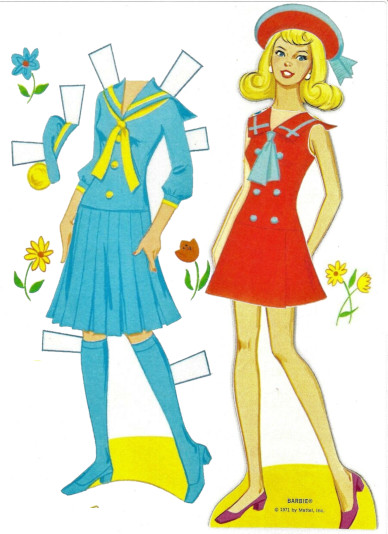
A Whitman Barbie paper doll from 1971 accompanied by two of her fashions. Source: onceagain34 on eBay. Barbie’s licensed acquaintances had non-Mattel Whitman sets of their own: Julia (Diahann Carroll’s television character) and Twiggy each had at least two sets in 1968 and 1967, respectively, and Truly Scrumptious appeared in a Chitty Chitty Bang Bang set in 1968.
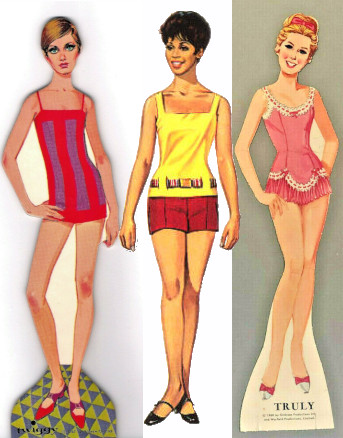
Whitman also interpreted Twiggy, Julia and Truly Scrumptious. Sources: onceagain34 on eBay, onceagain34 on eBay, albertacus on eBay. You can also find Marlo Thomas as “That Girl,” regarded by many as an inspiration for Barbie’s late-Sixties look, in a 1967 set, along with countless other fashion icons of the era. I won’t belabor the point since it’s veering off topic, but one of Twiggy’s sets in particular is a mod dream. The Chitty Chitty Bang Bang Set, as you may imagine, is not especially modern.
Play us out, 1967 Barbie has a New Look!
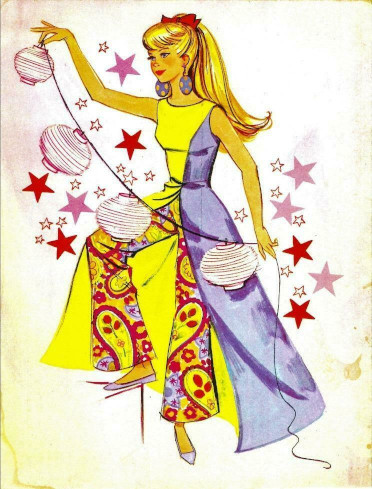
Illustration from the “Barbie has a New Look” Whitman paper doll folder from 1967. Source: onceagain34 on eBay. Where to next?
- Read the post on earlier Barbie Whitman paper dolls or Barbie Whitman coloring books
- dig into mod houses, starting with the 1966 entry in our Many Abodes of Barbie series
- survey some mod-era carrying cases, including case rooms
- or go up to the table of contents.
-
The Many Abodes of Barbie, Part I: 1962
It’s 1962 and the Teen-Age Fashion Model is moving into her Dream House. One might be surprised to learn that the home of Barbie’s dreams consists of just one room, equipped with a twin bed, an entertainment system and a variety of seating. It’s breathtakingly modest–but then, for a single young woman of the time period, it’s quite luxurious in another sense.
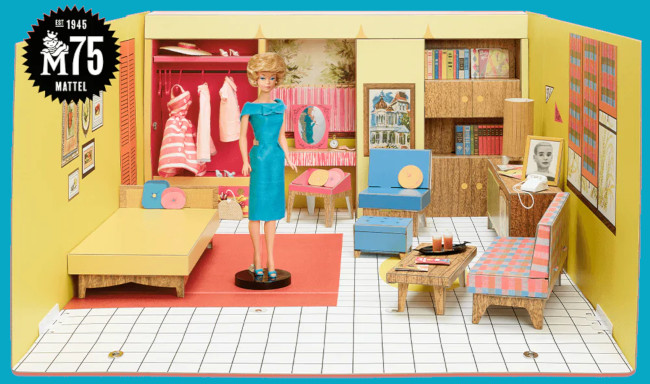
Interior shot of the 2020 reproduction of Barbie’s 1962 Dream House. Source: Mattel. Respectable young women of the early ’60s did not simply move into their own homes to live alone. When young Betsey Johnson completed a Mademoiselle internship in the summer of 1964 and accepted a full-time role at the magazine, her parents insisted that she continue living in a “hotel for women” like the Barbizon, where Mademoiselle had housed her cohort. In her memoir, Johnson remembers the hotel (which was really short-term housing) this way:
The Barbizon was like a fortress. There were signs all over the place: No Men Allowed! It was all very uptown and white gloves, a very ladylike, straight-arrow type of place.
-Betsey Johnson, Betsey: A MemoirJohnson doesn’t devote too much space to the Barbizon or her subsequent lodging (which was similarly strait-laced; she struggled with the curfew and was eventually evicted for smoking), but Sylvia Plath went through the Mademoiselle internship a decade earlier and described life at the Barbizon in The Bell Jar. In Plath’s time the rooms were singles–Johnson had a roommate–and the bathroom was down the hall; meals were held in a communal space.
(Another Mademoiselle internship alumna from the Fifties who’s written about her experiences is iconic Barbie designer Carol Spencer.)
A couple of years after Johnson was hired at Mademoiselle, in 1966, protagonist Ann Marie’s solo move to the city to pursue an acting career drives much of the tension on the sitcom “That Girl.” Marie’s disapproving parents make frequent visits and phone calls to assure themselves she hasn’t fallen into prostitution (Plath remembered the Barbizon’s clientele as “girls my age with wealthy parents who wanted to be sure their daughters would be living where men couldn’t get at them and deceive them” while they attended secretarial school or worked in office jobs, waiting for marriage proposals). Played by Marlo Thomas, Marie has a fully-equipped, multi-room apartment all to herself, but clearly the idea seemed quite daring to the show’s creators. Incidentally, the Barbizon was used for exterior shots of Marie’s building, although she did not reside in a hotel for women: her neighbors included men and families.
Back in 1962, Barbie enjoyed an unusual level of freedom.
So, was Barbie’s very first Dream House located in a hotel for women? On reflection, the answer is probably not–those accommodations were hardly “houses,” and the exterior of Barbie’s house suggests a suburban home with a grassy lawn. Barbie’s original Dream House would be better described as a cottage.

The original 1962 Dream House exterior. Source: castasidebeauty on eBay. During the first US Census taken after the opening of the Barbizon, in 1930, one of the hotel’s residents was a fashion model (along with a singer, a statistician and others; per “A Room of her Own” by Qianye Yu). It’s notable that Barbie was able to keep her career going from this suburban sanctuary… but maybe that was the dream.
Next time: Barbie gets a roommate (or two).
-
Visions of After Five
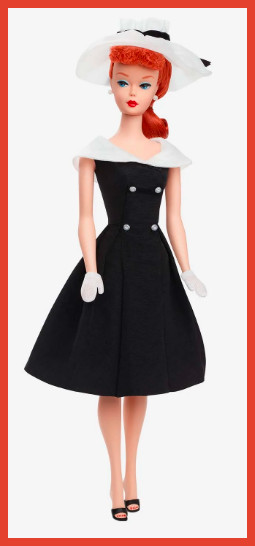
The new Silkstone doll. Source: Mattel. 
Sketch from a 1962 booklet. Author’s collection. 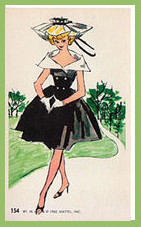
Barbie jumbo trading card #154. Source: joeslist.com. 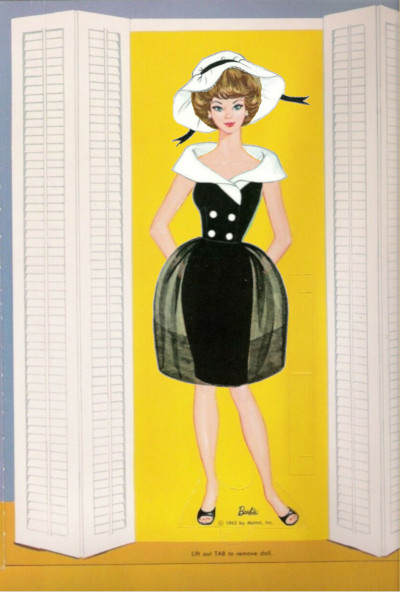
A fashion from a 1962 Whitman Barbie paper doll set superimposed on a 1963 Whitman Barbie paper doll, both as reproduced by eBay user onceagain34 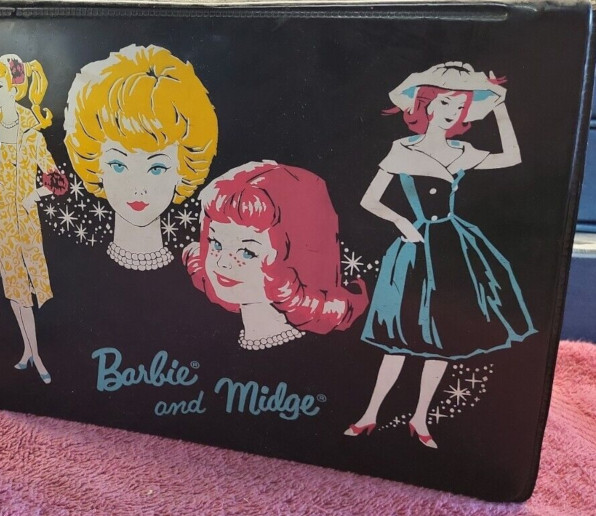
1963 Barbie and Midge lunch box. Source: member_12364 on eBay. 
Illustration included in a 1963 Whitman Barbie, Midge and Ken paper doll set as reproduced by eBay user onceagain34 
Excerpt from the 1964 JCPenney Christmas catalog. Source: christmas.musetechnical.com. 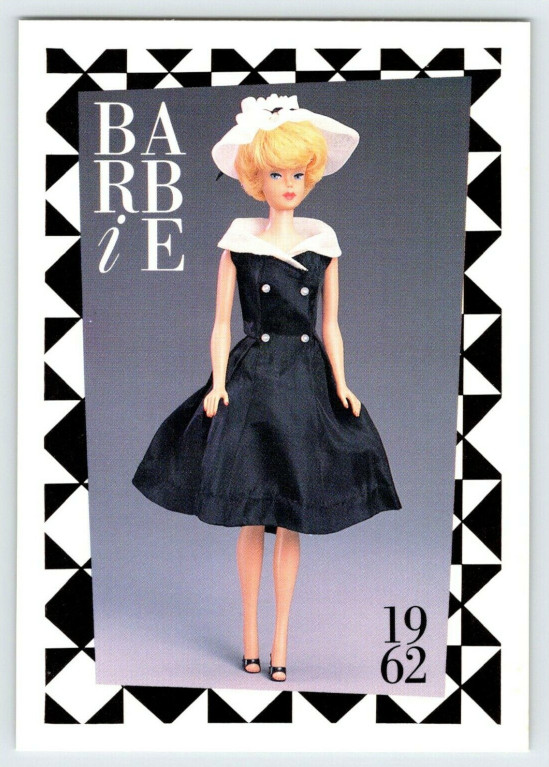
1990 Barbie trading card. Source: eBay user river_creek_designs. 
The author’s “bubble cut” dolls, one dressed in After Five, in front of a background belonging to Bill Cotter 
Human-sized reproduction by Unique Vintage. Where to next? Have visions of Solo in the Spotlight; envision After Five one more time in the Keys to Fame board game; or go up to the Table of Contents.
-
Whitman paper dolls (1962-1965)
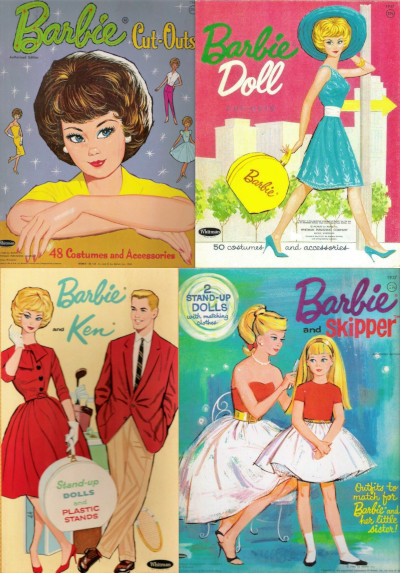
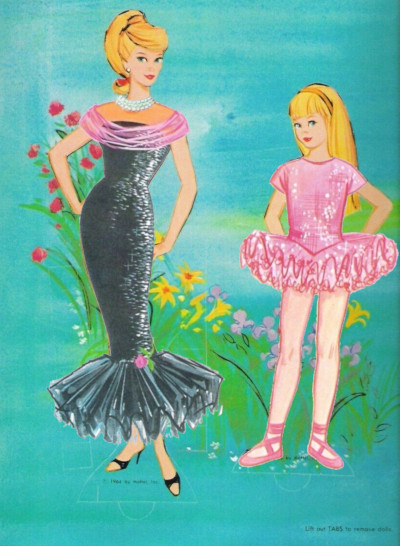
Four Whitman Barbie paper doll book covers as reproduced by eBay user onceagain34 One of the deepest wells of vintage Barbie fashion sketches must be Whitman paper dolls–if you agree that they have a place alongside all the art that came straight from Mattel. Whitman had paper dolls on many subjects, from Kim Novak to Marlo Thomas to Twiggy and far beyond, and it’s perfectly possible that the Barbie sets share more DNA with those non-Mattel Whitman items than they do with non-Whitman, Mattel Barbie sketches. Whatever the case may be, I like the sets and think their aesthetic fits nicely alongside other Barbie illustrations.
Fortunately for us, a wealth of the vintage paper dolls are still floating around sites like eBay, and a few enterprising individuals are even selling homemade reproductions of the 1960s originals. For this exploration I am focusing on the product of a single reproduction seller. I don’t know her and am not affiliated with her, but her extensive collection and high-quality images form a very convenient resource.

Pages from a 1962 Whitman Barbie paper doll set reproduced by eBay user onceagain34 You could probably write a whole chapter on the art in the Whitman paper doll sets without even mentioning the dolls or the fashions they wore: alongside the dolls and fashions are a wealth of other interesting illustrations of the life, times and surroundings of Barbie and her friends, as you see illustrated above and below.
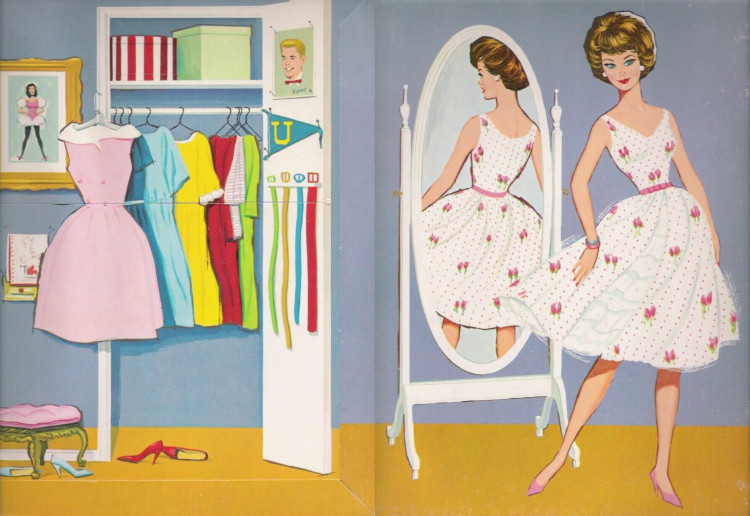
Pages from a 1962 Whitman Barbie paper doll set reproduced by eBay user onceagain34 But maybe we’re here to talk fashions. Above, an illustration accompanying a paper doll set shows Barbie trying on Garden Party. Around her room we also see a dress that may be Dancing Doll, some possible pak belts, and a number of closed-toe shoes–improbable for Barbie in 1962, but that’s a topic for another post.
In the paper doll sets I browsed I found dozens of recognizable Barbie fashions. Here’s a sampling:

Collage of fashions from 1962-1965 Whitman Barbie paper doll sets reproduced by eBay user onceagain34 A funny thing happened to the After Five fashion in 1962, when it was reimagined to have a trim, sheath skirt with full sheer overskirt–reminiscent of the Orange Blossom silhouette.
A fashion from a 1962 Whitman Barbie paper doll set superimposed on a 1963 Whitman Barbie paper doll, both as reproduced by eBay user onceagain34 I think it’s an improvement!
A Barbie and Skipper set from 1964 was full of their real-life matched ensembles. Do you know what Skipper look corresponds to Barbie’s Solo in the Spotlight? I didn’t.
Fashions from a 1964 Whitman Barbie and Skipper paper doll set overlaid on dolls from the same set, all as reproduced by eBay user onceagain34 (The answer, above, is Ballet Class.)
Just as often, the paper doll fashions appear to be originals–maybe designed by someone at Whitman? We know so little about the sources of these illustrations. But often, the new fashions are great–some worthy of OOAK projects, in my opinion. One 1963 set is packed with stylish, elsewhere-nonexistent fashions for Barbie and Midge. I didn’t recognize a single one of the styles in this set as one that was sold for the real Barbie and Midge:
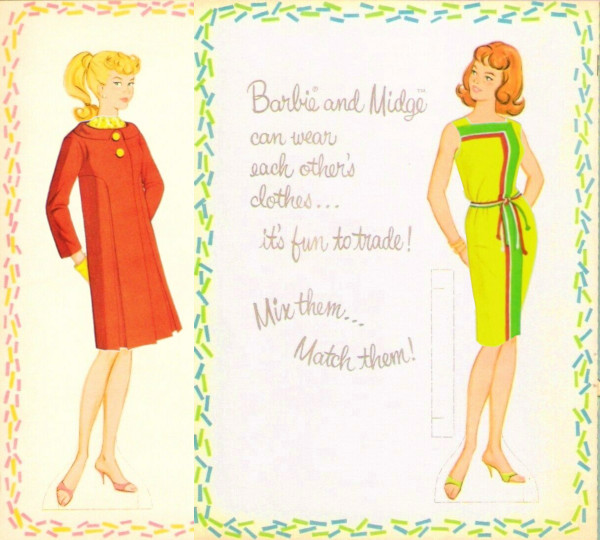
Fashions from a 1963 Whitman Barbie, Midge and Ken paper doll set overlaid on dolls from that set, all as reproduced by eBay user onceagain34 …and yet, oddly enough, the very same set includes an illustration of a drafting table surrounded by fashion sketches, all depicting legitimate, Mattel Barbie fashions.

Illustration included in a 1963 Whitman Barbie, Midge and Ken paper doll set as reproduced by eBay user onceagain34 I’m no Ken aficionado, but I did see one Mattel Ken fashion I recognized replicated in this set–although I sort of wish I hadn’t seen it.
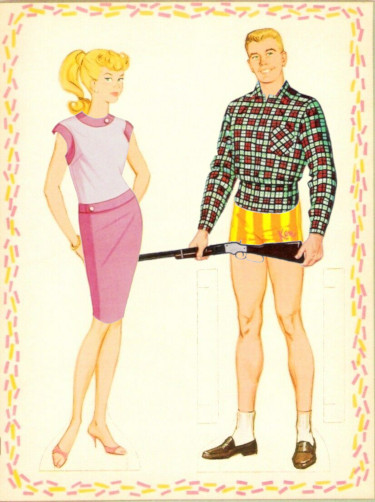
Fashions from a 1963 Whitman Barbie, Midge and Ken paper doll set overlaid on dolls from that set, all as reproduced by eBay user onceagain34 Why is he brandishing that around Barbie and Midge?? Different times. Wash your eyes with some svelte styles from Barbie’s 1964 travel wardrobe:

Fashions from a 1964 Barbie paper doll set as reproduced by eBay user onceagain34 A “Wedding Dress ‘n’ Fashion Clothes” set from the same year featured mostly new creations for Barbie with a similar aesthetic. These samples also offer a glimpse of the many small touches adorning some of the Whitman pages, that I didn’t have space to detail here.
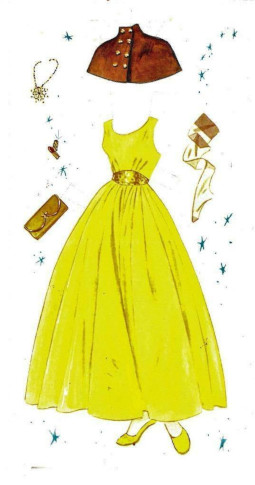
Page from a 1964 Whitman Barbie paper doll set as reproduced by eBay user onceagain34 The fun didn’t stop in 1965; the next sets take Barbie and friends into their mod years and beyond.
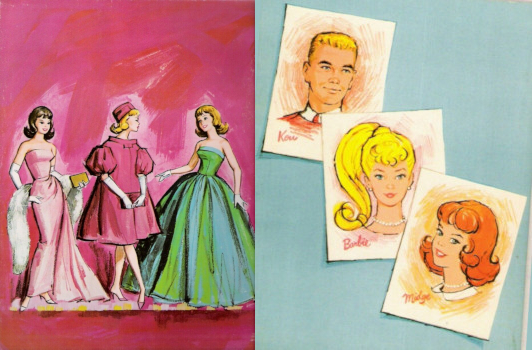
Back covers from (left) a 1963 Whitman Barbie, Ken and Midge paper doll set and (right) a 1963 Whitman Midge paper doll set, both as reproduced by eBay user onceagain34 -
Barbie on TV
When Barbie turns on her TV, it’s usually to watch Barbie. The televisions of the early years are examples of Barbie’s built environment that double as Barbie illustrations.
The earliest television we feature comes from the original 1962 Dream House. It is actually a TV-stereo combination, as a panel on the top opens to reveal a turntable.

Possibly Barbie’s earliest TV appearance, as part of the 1962 Dream House. Excuse the busted legs on the set–those delicate, midcentury-fabulous legs of cardboard were not built to last. So what was Barbie watching on her dream TV? It looks like Bubble Cut Barbie in the Solo in the Spotlight fashion, beside the microphone from that set.
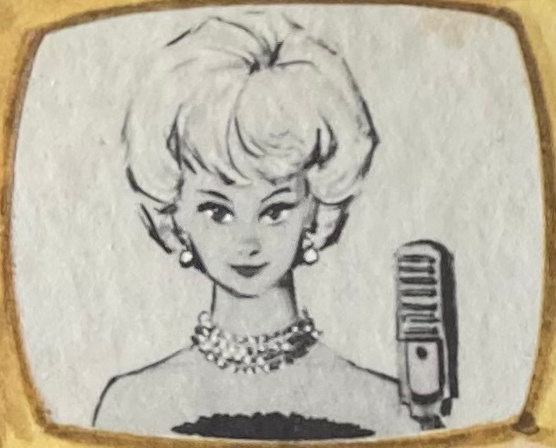
Barbie’s TV debut? Barbie’s various domiciles boasted many other TV sets and programs over the years; up next, we’ll check out one from the 1964 “Leisure Hours” accessory set. A darker brown version for Ken was also sold in his “Party Fun” pak, beginning the same year. When Ken turned on the TV, it was also to watch Barbie.
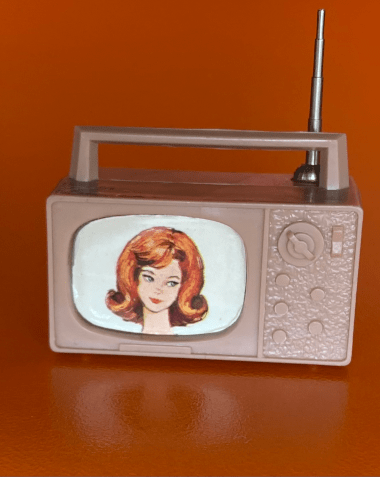
The Fashion Queen hits the airwaves. Note the metal antenna looks collapsible, but isn’t. There’s no context to suggest what sort of television program Barbie is appearing on here; the floating-head style of this illustration is reminiscent of the fashion booklets that came with dolls of the era.
In 1964, Barbie also got an assortment of “Go-Together” furniture sets with partial walls (no floors). The year’s Christmas catalogs (this one is from wishbookweb.com) advertised a few sets:

1964 Sears catalog excerpt. Source: wishbookweb.com In the top left panel, Barbie’s newest living room can be seen, with a small television set sitting on the floor (!) at lower right. But what’s on TV?
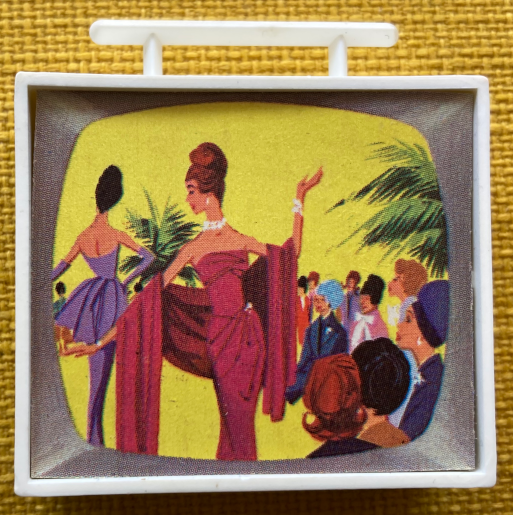
The small, portable TV set Barbie kept on the floor during her Go-Together phase. This time, Barbie is watching a fashion show. One might argue that she’s not watching herself–it’s not clear the illustrated models are meant to suggest her, and the fashions don’t seem to refer to anything specific in her wardrobe. However, she WAS the Teen-Age Fashion Model, so we deem it likely that she appeared on screen at some point during this program.
Barbie also watched herself on TV in the modestly-proportioned Barbie Family Deluxe House she shared with Skipper in 1965. At that link you can also see what Skipper was watching in her separately sold, considerably larger bedroom; we think that blonde singer isn’t Barbie (though we can’t be certain).
Before we leave Barbie to watch her shows in peace, let’s fast forward to 1972 and Busy Barbie, who stayed busy in part by gripping the handles of included accessories such as her portable television set.

A television for the fashionable young woman of 1972 to wield. On screen, Barbie is back at the microphone again, this time wearing Silver Serenade (1971-1972).
Where to next? If you enjoyed this post, you may also enjoy Not Barbie on TV; a roundup of fireplaces in Barbie and Barbie-sized houses, 1963-79; Go-Together furniture sets, illustrated; or check the Table of Contents for more fun.
-
Jumbo trading cards (1962)

Barbie jumbo trading cards #167 and #141. Source: joeslist.com. A treasure trove of rare vintage Barbie illustrations lies hidden deep within Joe Blitman’s website, Joe’s List: 67 jumbo trading cards produced by the Dynamic Toy company in 1962. These cards are scarce, but Joe and co. have kindly scanned and uploaded examples of almost all that were manufactured. (I believe–the numbering starts at 141, so it’s not crystal clear.)
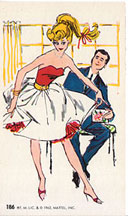
Barbie and Ken jumbo trading card #186. Source: joeslist.com. The cards were issued as two sets: Barbie cards, numbered 141-175, and Barbie+Ken cards, numbered 176-210. The backs of the cards contain advice or little vignettes, sometimes related to the illustration, sometimes not. Depicted on card 186, above, is Barbie showing Ken how she’s paired the Silken Flame cocktail dress with a daring red slip; on the flipside, the reader is advised to “be yourself.” Card 194 describes how Ken’s artistic passion is ignited when he sees a painting of a clown, and card 206 weaves another fascinating tale:
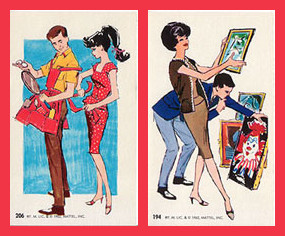
Barbie+Ken jumbo trading cards #206 and #194. Source: joeslist.com. …He insists that men make the best cooks, anyhow. “Do you know of any restaurant or hotel with a lady chef?”
It’s fun because Ken refutes a sexist stereotype with other sexism.
Joe Blitman’s scans include all the vignettes and advice blurbs, in addition to the illustrations.
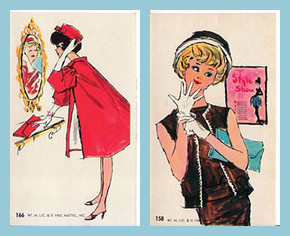
Barbie jumbo trading cards #166 and #158. Source: joeslist.com The cards offer a unique glimpse into Barbie’s day-to-day existence, whether she’s primping at the hall mirror before stepping out in Red Flare, as in card #166, or noting a flyer for a fashion show while wearing Sorority Meeting, as in card #158. Sometimes the cards also raise questions. Did Barbie really don After Five for a daytime stroll in the park, as seen on card #154? Or get decked out in Sheath Sensation to sit around playing solitaire as in #143? In the latter case I speculate that that good-for-nothing Ken fellow stood her up–but the blurb on the back of that particular card gives no insight.
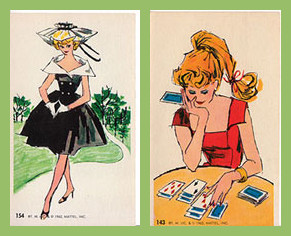
Barbie jumbo trading cards #154 and #143. Source: joeslist.com. It’s not too surprising that Joe shares an incomplete set of cards–if recent eBay sales are any indication, you could spend literal hundreds of dollars getting your last three of these rarities. However, examples of the cards missing from Joe’s set can be found elsewhere with just a bit of searching. I love this one of Barbie in Evening Splendor:
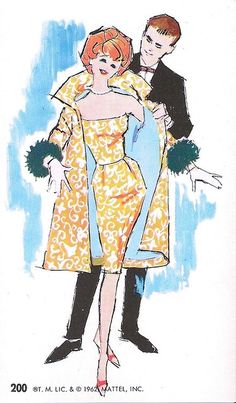
Barbie+Ken jumbo trading card #200. Source: pinterest. Mattel has also reproduced these cards… sort of. The illustrations have been used for convention-exclusive charm sets and charm bracelets a couple of times. These occasionally show up on eBay, far more accessibly priced than the originals.
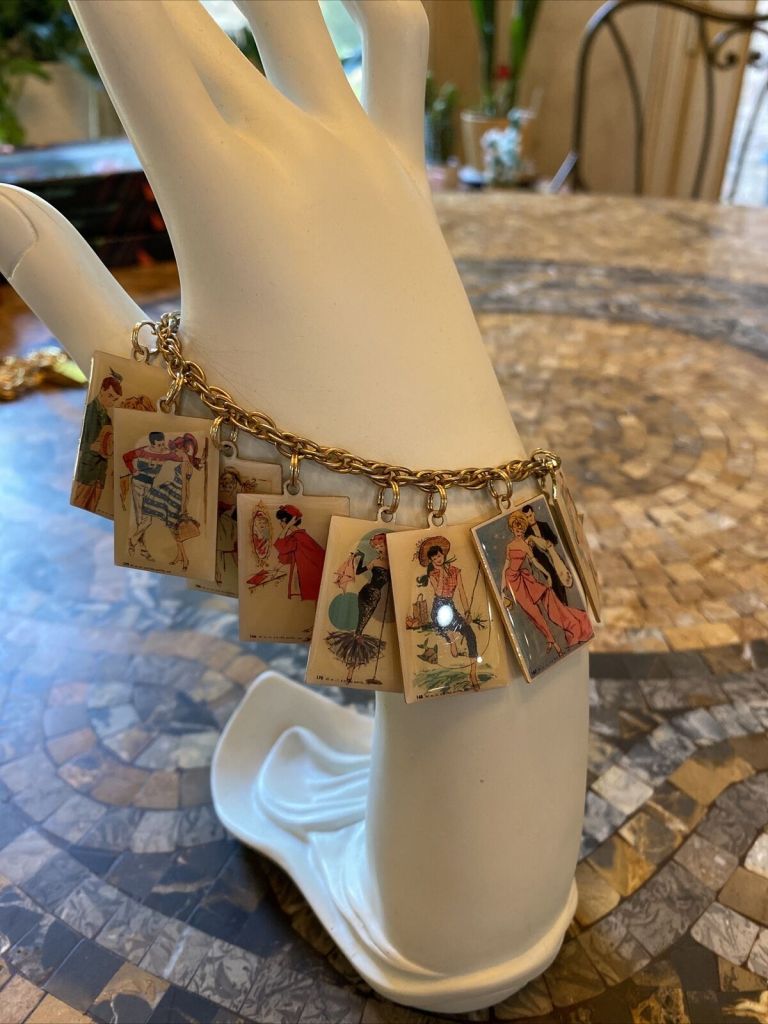
Convention-exclusive charm bracelet featuring jumbo trading card art. From a recent (sold) listing by eBay user morgaswindel0. That’s enough rambling from me. You can browse Joe’s entire collection of Barbie jumbo trading cards here, and his collection of Barbie+Ken cards here.
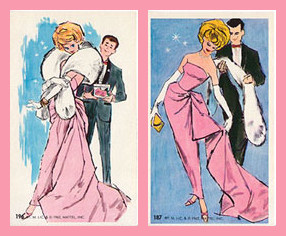
Barbie+Ken jumbo trading cards #196 and #187. Source: joeslist.com. Where to next? Read about gift set art, 1960-70; browse our books for vintage Barbie fans; journey through the Many Abodes of Barbie; or head on up to the Table of Contents to see other possibilities.
-
Sears Karosel Kitchen, 1971-1976
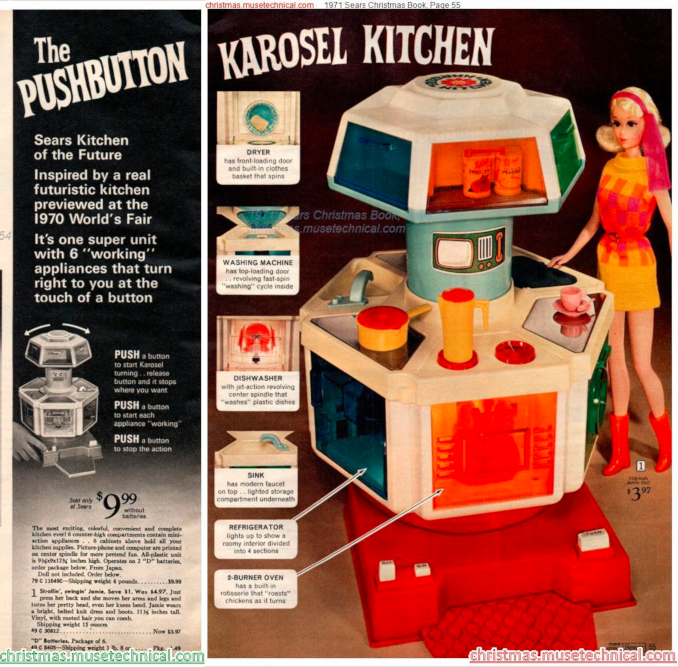
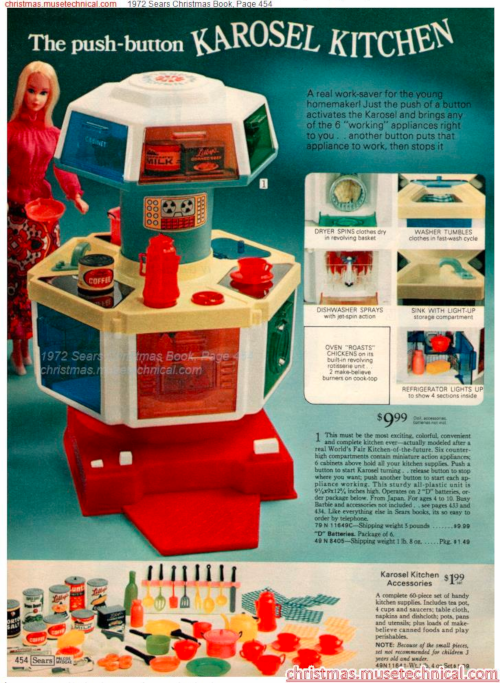
Spread advertising the Karosel Kitchen in the 1971 Sears Wishbook. Source: christmas.musetechnical.com I’ve seen this funny little kitchen listed as a Barbie playset a couple times and was curious about it. I began my investigation with the handy catalog search feature of christmas.musetechnical.com. Although Sears was not shy about letting you know what doll might use the set, it turns out it was actually not Mattel- or Barbie-branded.
According to the copy in 1971 (above), this kitchen set was based on one demonstrated at the 1970 World’s Fair. I didn’t find many resources about the World’s Fair kitchen prototype, but my searches did lead me to this amazingly detailed Google video about the toy:
Lucky Penny Shop on Youtube explores the Sears Karosel Kitchen of the Future In the video the presenter guesses that he has an early version of the toy because it has a hand-turned crank to rotate the kitchen, instead of the futuristic push-button convenience of other models. However, the 1971 version already has the push-button; we’ll actually encounter the crank later. The presenter also speculates that a device on the middle column (visible on the catalog page at top) might be a microwave, but we know from the catalog copy that it is in fact a video phone. The opposite side of the column features a “computer,” visible in the 1972 wishbook:
Excerpt from 1972 Sears Wishbook. Source: christmas.musetechnical.com This year the accessory set mentioned in the video was also introduced.
While Walking Jamie advertised the kitchen in year one, this year we see Busy Barbie standing well back from the contraption–almost as if she knows which way that hot food on the range will go flying, should anyone press the “rotate” button.
Busy Barbie is put through her paces in the 1973 catalog, operating the washer and dryer and manipulating various dishes.
In 1974 the hand crank appears. This year the set is also produced in Singapore, rather than in Japan as in years previous.

Excerpt from 1974 Sears Wishbook. Source: christmas.musetechnical.com The futuristic kitchen returned in 1975 and made its final appearance in 1976, demonstrated by Malibu Barbie. By 1970, adults were probably already aware that a spinning kitchen was not the way of the future; maybe by ’77 the kids were catching on, too.
Where to next? Explore refined living in Penthouse apartments, 1964-76; check out another off-brand kitchen: The Deluxe Reading Dream Kitchen; on the illustration front, browse Mod-Era Whitman Paper Dolls; or just go up to the Table of Contents.

Silken Flame
Vintage Barbie illustrations, built environment, clones and more
 Silken Flame