-
Welcome!
Thanks for swinging by my vintage Barbie fan site, where you’ll find articles on Barbie’s built environment, Barbie illustrations, vintage rival and clone dolls and playsets, and miscellaneous musings/deep dives. What are you looking for?
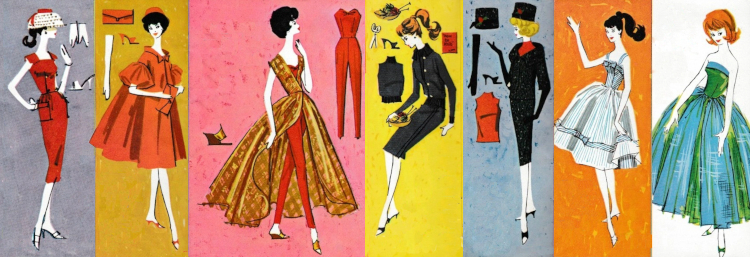
Vintage Barbie Illustrations
- Mattel fashion booklets, 1960-67 (approximately)
- Basic and Dressed Doll Boxes, 1959-64
- Doll Carrying Cases, 1961-72
- Jumbo Trading Cards, 1962
- Gift set art, 1960-70
- Illustrated fashion packaging, also about 1960-70
- Random House books (plus some from other publishers), 1962-65
- Dell Comics, 1962-63
- Whitman Paper Dolls, 1962-65 and 1967-73
- Whitman Coloring Books, 1962-65 (A mod sequel post is possible but not planned at this time.)
- More crafts and hobbies, 1963-1971
- Queen of the Prom board game, 1961-63
- Keys to Fame board game, 1963
- Sew-Free Fashion Fun Kits, 1965
- Sewing Patterns, 1962-?
- The Barbie World of Fashion board game, 1967
Plus the illustration “sidebars,” short entries on niche topics:
- Busy Gal fashion sketches, 1960
- Barbie Sings!, 1961
- Go-Together furniture sets, illustrated
- Color Magic, 1965-66
- Mattel fashions for Julia, 1968-69
- All the Barbie and friends illustrations on mod house exteriors like the one below
- Miss Lively Livin’ board game, 1970
- Window shopping, illustrated
- Barbie’s Baggage, illustrated (not super short, but surveys many illustration categories examined in other posts)
- Vintage dress-up and other child-size items for the boudoir
- The illustration component of the 1964 Little Theatre and travel costumes entry is sidebar-sized.
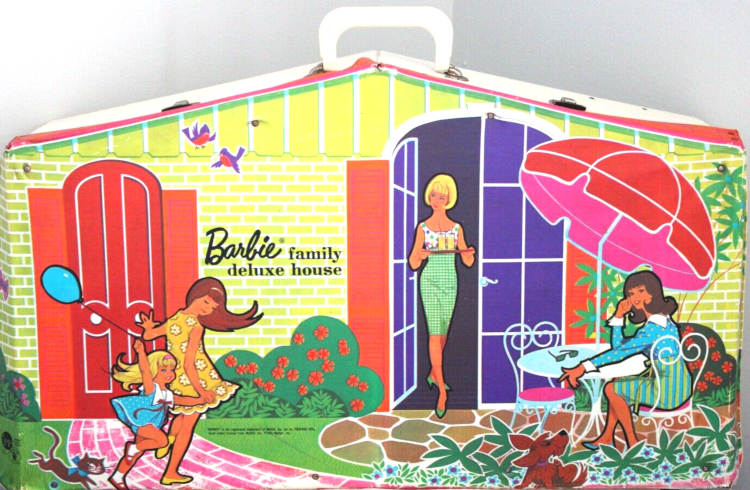
Barbie’s Built Environment
- Entries by year for many of Barbie’s early abodes: 1962, 1964, 1965, 1966, 1967-68, 1969, 1970.
- Barbie’s ’70s Travelogue:
- Mattel Modern and Susy Goose furniture, 1958-1966
- Barbie on TV, a roundup of some of Barbie’s early toy TV sets (this post also has a strong “illustration” component)
- Barbie’s Fashion Shop, 1963
- and a detour into Mannequins and Dress Forms, ’63-’73
- The Deluxe Reading Dream Kitchen, 1963 (note, this is not a Mattel product)
- The Little Theater, 1964
- Skipper’s Schoolroom, 1965
- Penthouse apartments, 1964-76
- Beauty parlors, 1964-77
- Japan-exclusive furniture, 1967
- Unique Boutique and Cafe Today, both 1971
- The Sears Karosel Kitchen, 1971-1976 (note, this is not a Mattel product)
- A roundup of fireplaces in Barbie and Barbie-sized houses, 1963-79
- The “built” environments of Whitman Barbie paper dolls, which real Barbie dolls can also use; 1963-1973.
- The built environments of mini vintage Barbies
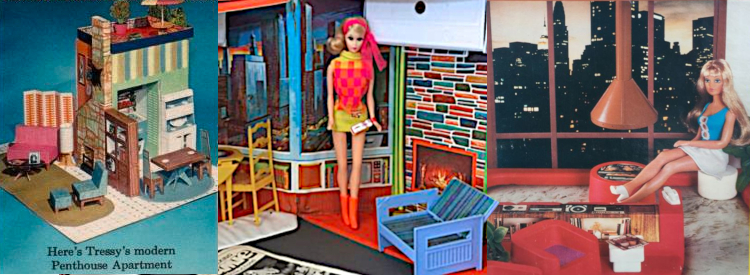
Articles relating to clones, rivals, and off-brand Barbie-style products
- Rival fashion booklets
- The Two Abodes of Tammy covers the living spaces of one of Barbie’s most notable rivals
- Barbie’s ’70s Travelogue, Part II: Unofficial Adventures is about non-Mattel playsets suitable to Barbie and Barbie-sized dolls
- Clones are recommended in the “existing alternatives” section of the musing, Three Nostalgic Black Barbies We Need (and a few existing alternatives).
- Clone kitchens: The Deluxe Reading Dream Kitchen, The Sears Karosel Kitchen
- Clone washrooms are prominent in Barbie’s ’70s Travelogue: Part IV.
- The pieces on penthouses, beauty parlors and fireplaces include non-Mattel offerings.
- Not Barbie on TV: Barbie and friends’ early TV sets that were tuned to other programs
- The entry on Mattel Modern and Susy Goose furniture includes some offbrand furniture items of the 70s and 80s.
- We wrote about clone carrying cases, including some created for competitor dolls.
- Certain of the sewing patterns are for generic fashion dolls, as are the Sew Simple and Cut ‘n’ Sew craft kits.

Miscellaneous Musings and Deep Dives
- A Chronicle of Barbie shoes, 1959-67
- Barbie’s Seventies Travelogue: the Appendix reviews vintage and nostalgic Barbie and Barbie-sized luggage options
- When Barbie Turned 21 in Manhattan, 1980
- Three Nostalgic Black Barbies We Need (and a few existing alternatives)
- Great Books for Vintage Barbie Fans
- The piece on Skipper’s Schoolroom includes “play sets that never were”: Barbie’s Sixties careers for which environments were not produced.
- Visions of After Five (1962) and Solo in the Spotlight (1960)
- Who wore it best? pairs vintage and mod Barbie and Francie fashions with their likely or confirmed inspirations. The Airborne edition does the same for vintage flight attendant uniforms, while the Mary Quant one highlights Francie fashions that appear influenced by Swinging London designer Mary Quant.
- Millennium Mod catalogs Barbie’s returns to the late Sixties youth-driven zeitgeist between 1980 and 2020.
- We tackle an age-old mystery with our investigation into Sew Free? Sew Magic? Sew Simple? Cut ‘n’ Sew??
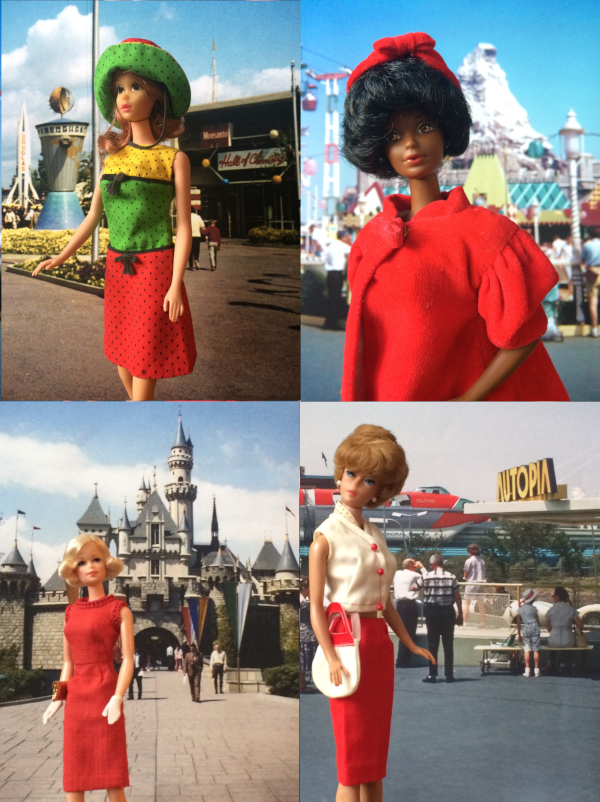
There’s still more to come, but before you scroll off into the distance, here’s the first image ever posted to this blog back in 2022: some of my dolls, dressed in vintage or vintage reproduction, in front of vintage Disneyland backgrounds belonging to Bill Cotter:
-
Sidebar: All the Barbie and friends illustrations on mod house exteriors
Tutti, Skipper, Barbie and Francie cavort on the exterior of the Barbie Family Deluxe House, available in 1966. Source: jll1966 on eBay. 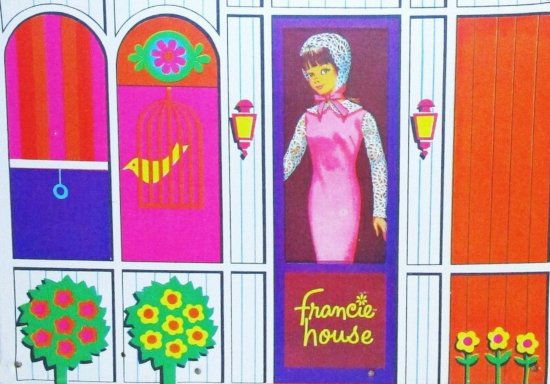
1966 “francie house.” Source: Fallsavevintage on Etsy. 
Barbie and Francie+Casey 1967 House-Mates exteriors, front (top) and back. Source: misscarol on eBay. 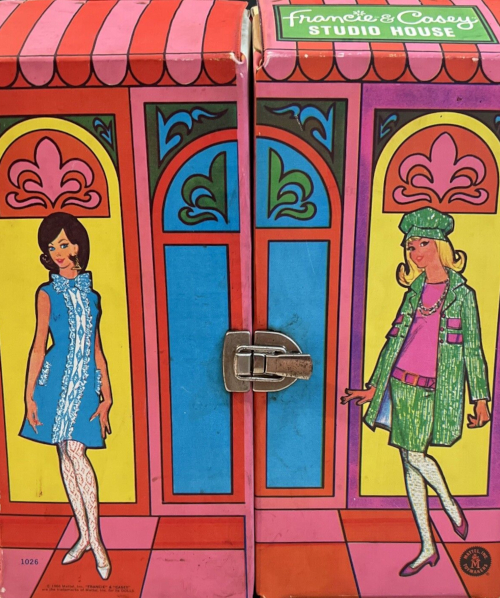
Francie & Casey on their circa-1967 Studio House. Source: purplejojo on eBay. 

Front (L) and back of the World of Barbie Family House, 1967 (above) showing Barbie, Francie, Casey, Skipper, Tutti, and Chris, and 1968, showing Barbie, Stacey, Francie, Tutti, and Chris. Sources: debonbay on eBay, moxie213 on eBay. Note: the character illustrations on the ’67 World of Barbie house above also appear in “World of Barbie Fashions” booklets from 1966-67, and the same illustrations and positioning are used on the exterior of the (otherwise differently designed) elusive German case home, Villa Barbie.
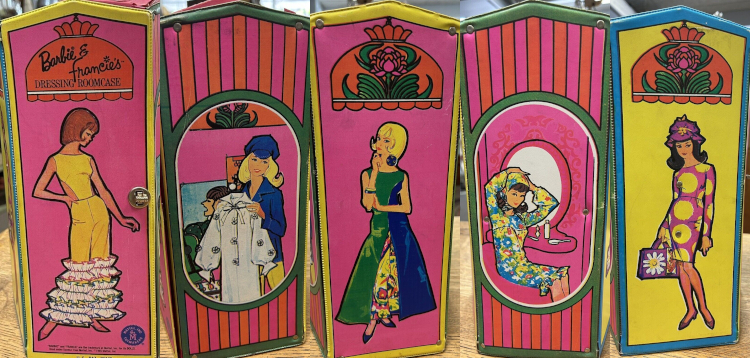
Exterior of the five-sided 1968 Dressing Room case. Source: the_old_vineyard on eBay. For more habitable case illustrations, see the Sleep-n-Keep section in our entry on carrying cases. Elsewhere in the mod section of that article you’ll also find examples of repeated character imagery from the ’68 World of Barbie house and the Francie & Casey Studio House,


Four views of the 1969 Barbie Family House, showing Barbie, Ken, Stacey and Skipper, and in which Barbie and Ken are implied to be cohabitating. Source: pickerscornerllc on eBay. -
The Many Abodes of Barbie, Part VI: 1969

1969 Barbie New Family House exterior. Source: pickerscornerllc on eBay. When we last checked in on Barbie, she was living in a two-room “World of Barbie Family House,” her most sprawling home since her chipboard days. In 1969 life got better again for Barbie with the New Family House. At a glance the folded-up house, above, looks pretty similar to the old family house; but while that one compressed to a thin slab, the new house could only fold to an almost-cube; the extra space needed was due to its new third room.
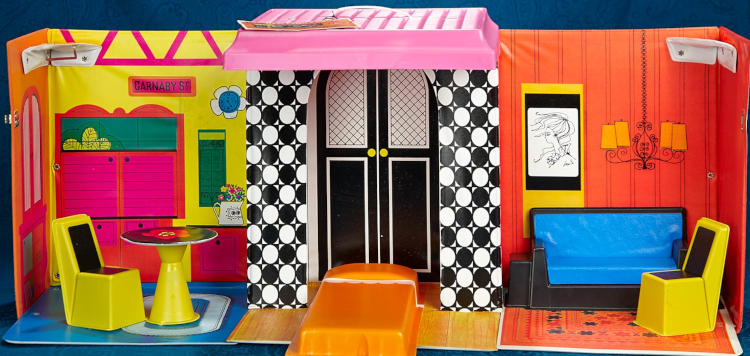
1969 Barbie New Family House interior with furniture. Source: Theriault’s. Another luxurious touch: unlike previous years, the 1969 house’s furniture (bed, sofa, table and two chairs) could be freely rearranged. Above, we see but one of many possible layouts, this one with the bed pushed up close to those double doors. A strange choice, but also the arrangement shown in some of Mattel’s promotional images, including the one printed on the tag tied to the handle on the roof above. At least some of Mattel’s images, including some from fashion booklets, show the bed in the leftmost room, and the table and both chairs in the middle space.
Other changes spoke less to luxury. Compared to earlier houses in the mod aesthetic, the New Family House’s walls are practically unadorned: a black-and-white sketch of Barbie with the wind in her hair, a wrought-iron-look chandelier, a flower-shaped clock and a street sign reading “Carnaby St.” are among the few eye-catching pieces lithographed to its vinyl walls (the area rugs and “hardwood” in the front room are nice touches, though). Maybe Barbie had started to grow tired of moving and decorating just to pack up and move again… or maybe her new “roommates” didn’t share her style sensibilities?
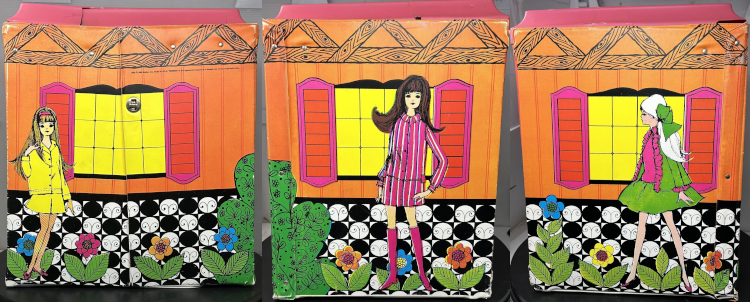
1969 Barbie New Family House exterior. Source: pickerscornerllc on eBay. Perhaps the biggest change of all for Barbie is the suggestion that she and Ken had taken their relationship to the next level: shown at top, the pair pose like newlyweds in front of this new family house (though we know, of course, that they never officially married). On the other faces of the exterior, Barbie, Francie and Stacey creep through the flower beds and peer in at the windows. Like the interior, the exterior is otherwise lean on detail.
The New Family House stayed around until 1972. The following year, the Barbie Country Living Home was architecturally similar enough that we include it here.
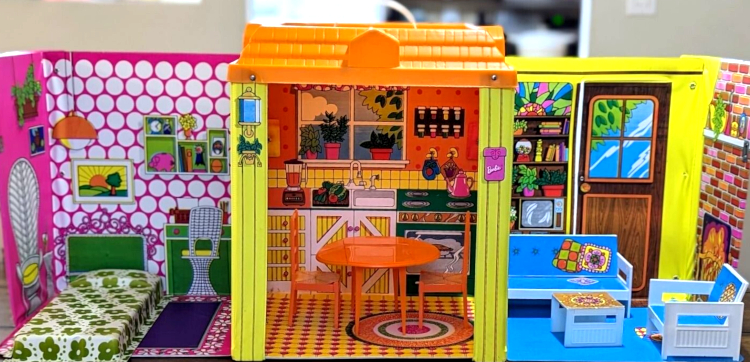
1973 Barbie Country Living Home interior. Source: janzy67 on eBay. The structure was largely unchanged from the New Family House. The method for folding and carrying was identical; outside, the roof was slightly altered, and a functioning door opened out from the rear of the living room, above right. On the interior, the big architectural change was that full walls had been erected between the three rooms, with functional saloon doors connecting living room to kitchen and dutch doors between kitchen and bedroom.
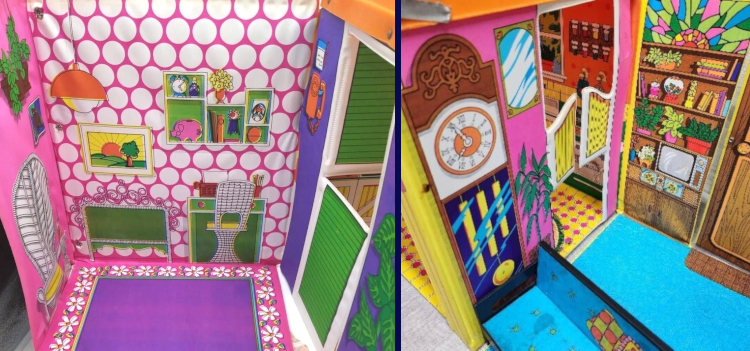
1973 Barbie Country Living Home details, including interior doors. Sources: itznthemail and embat_7, both on eBay. The furniture was all-new, too, other than the bed, which was only recolored. The kitchen table and two chairs, sofa, easy chair and tile-topped coffee table are all variations on the furnishings common to ’70s sets including Jamie’s Party Penthouse and the Lively Living/Surprise House.
Unlike its predecessor, the Country Living Home’s rooms were indicated by the detailed illustrations on the walls: bookshelves, television and grandfather clock in the living room, cabinets and appliances in the kitchen, wicker chairs, headboard and wall phone (!) in the bedroom. The exterior was also rich with inviting and homey details in wood, brick, and greenery, but no characters–the characters’ appearances on the sides of structures ended with the mod period.

1973 Barbie Country Living Home exterior. Source: kelfis11 on eBay. The New Family Home was the last of the mod abodes, but the Country Living Home wasn’t quite the first post-mod one. Next time, we’ll see what came between them.
-
Who wore it best?
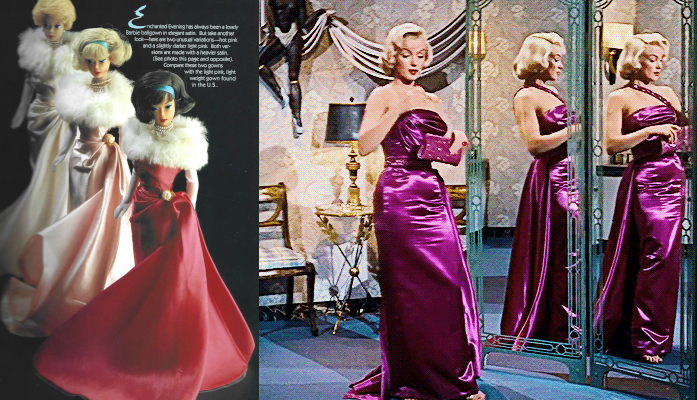
L: Side-part American Girl and Bubble Cut Barbies in Enchanted Evening (1960) variants, from Barbie in Japan by Keiko Kimura Shibano (the text describes the frontmost dress color as “hot pink”); R: Marilyn Monroe in “How to Marry a Millionaire,” 1953; costumes by William Travilla. Fox Studios. 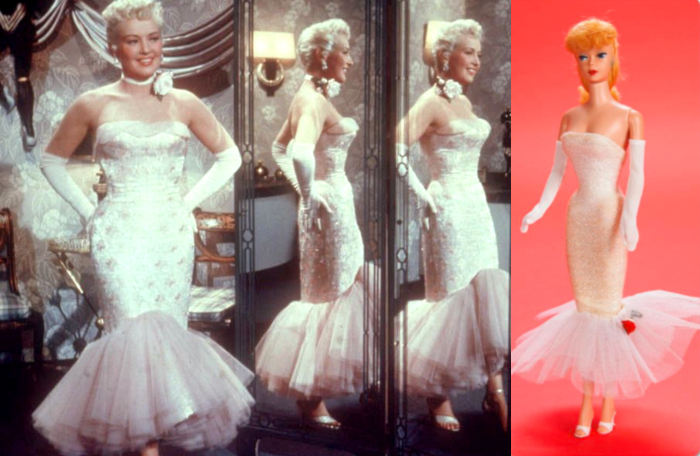
L: Betty Grable in “How to Marry a Millionaire,” 1953; costumes by William Travilla. Fox Studios. R: Barbie in Solo in the Spotlight (1960) prototype. Credit: Theriault’s. 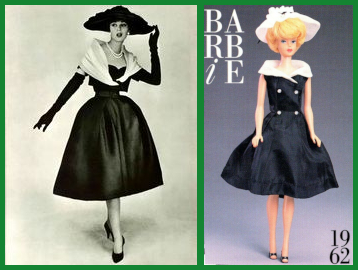
L: Christian Dior’s New Look, 1950s; R: Bubble cut Barbie in After Five (1962) from a ’90s Mattel trading card. Hat tip to BillyBoy*, who highlighted the above similarity in his 1987 book, Barbie: Her Life and Times.
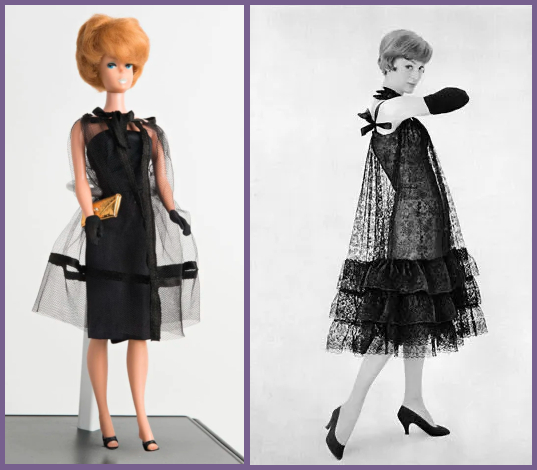
L: Bubble cut Barbie in Black Magic (1964); R: unknown model in Balenciaga “Baby Doll” dress (1957); via Unique Vintage and Oh So Delightful. 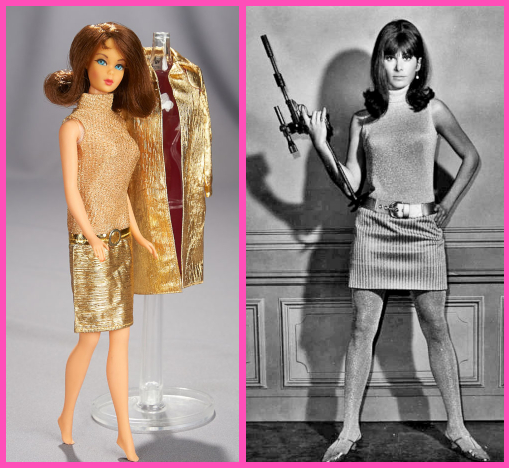
L: “Marlo Flip” Barbie in Intrigue (1967); R: Stefanie Powers as April Dancer in a promotional photo for ’60s spy TV show “The Girl from U.N.C.L.E.” Credit: Theriault’s, NBC. 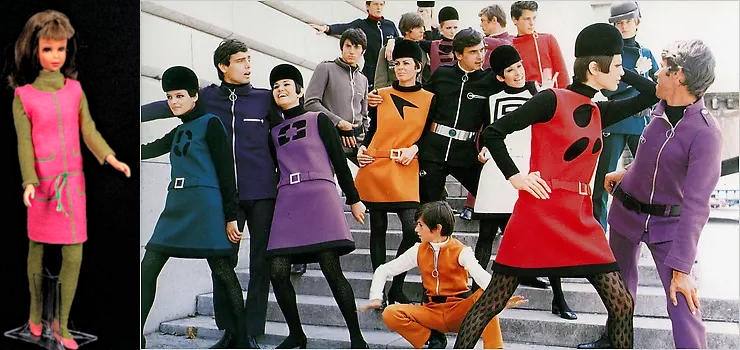
L: Francie in Quick Shift (1966); credit: Apple Tree Auctions. R: Pierre Cardin Cosmos collection; the line was introduced in 1964 but this photograph is from ’67. (via New York Times). 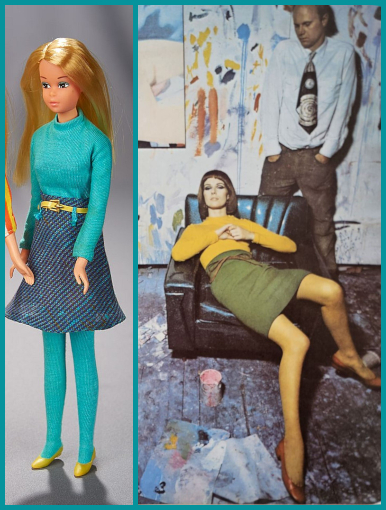
L: Baggy Casey in Hip Knits (1966); credit: Theriault’s. R: Unknown model wearing ensemble by Christiane Bailly, photographed for Vogue Paris, 1966, with artist (possibly Claes Oldenburg) in his studio. Source: atoumagg60 on eBay. 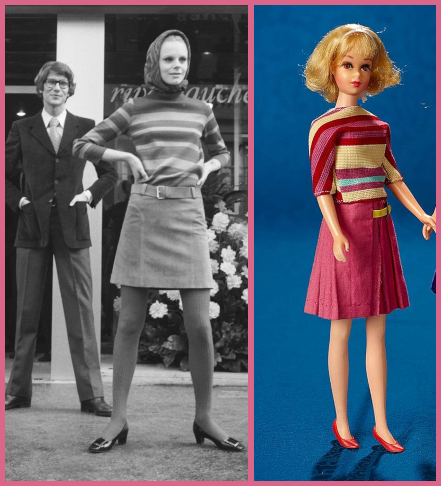
L: Unknown model in Yves Saint Laurent before his rive gauche boutique, with Yves in the background (1966). Source: Musee YSL Paris. R: Short flip Francie in Hi-Teen (1967). Credit: Theriault’s. Hat tip to Paris Refashioned: 1957-1968 by Colleen Hill for featuring the Yves Saint Laurent and Christiane Bailly designs above.
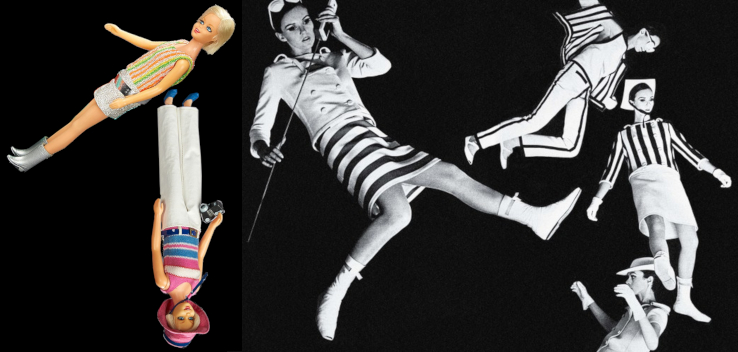
L: Mattel’s Twiggy doll in Twiggy Turn-outs and Twiggy Gear (both 1968); credit: Theriault’s, composited by the author; R: Andre Courreges space age collection photographed by Peter Knapp for Elle, 1964. The magazine’s captions stated that the garments’ color schemes included pink, yellow, orange, and navy in addition to white (per Paris Refashioned: 1957-1968 by Colleen Hill). Where to next? Two further entries ask, “Who wore it best?”: one on designer Mary Quant, featuring Francie, and one on flight attendant uniforms; if you like comparative fashion analysis you might also enjoy our recent piece on Millennium Mod, comparing Barbie’s newer swingin’ fashions to classic ones; or see more options in the table of contents.
1960, 1964, 1966, 1967, 1968, after five, balenciaga, betty grable, black magic, cardin, christiane bailly, courreges, dior, enchanted evening, francie, how to marry a millionaire, intrigue, marilyn monroe, solo in the spotlight, stefanie powers, the girl from U.N.C.L.E., twiggy, vintage barbie, vintage francie, yves saint laurent -
Fireplaces, 1963-79
Winter weather moved in last week and put me in the mood to huddle near pictures of mid-century toy fireplaces. Join me!
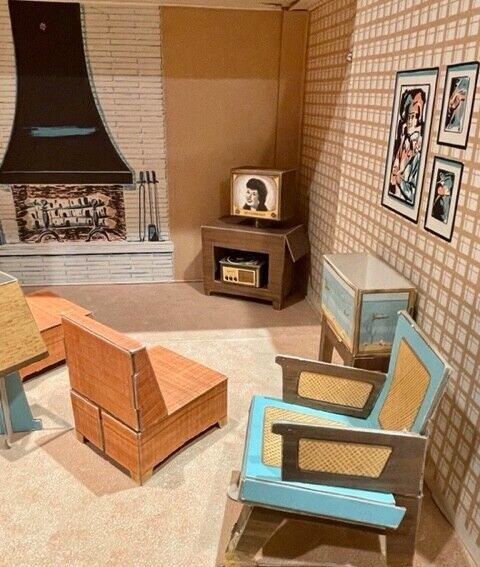
1963 Ideal House for Tammy or Barbie. Source: sunset4813 on eBay. 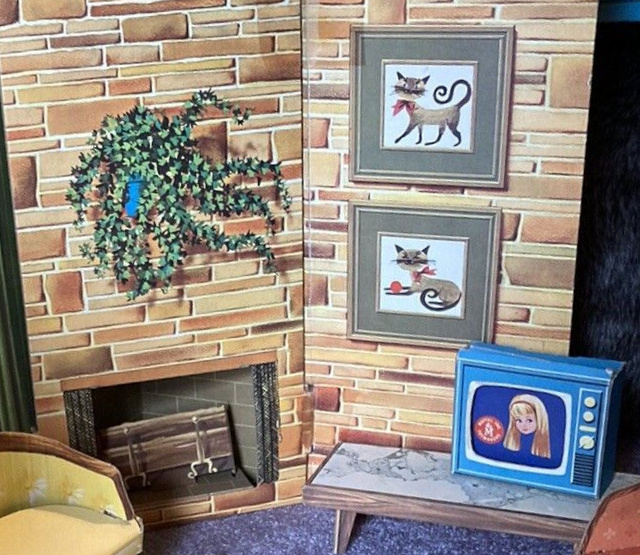
1964 Barbie’s New Dream House. Source: jbak4493 on eBay. 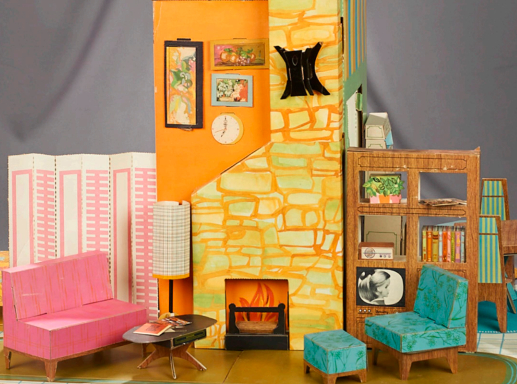
1964 Tressy’s Penthouse. Source: Theriault’s. 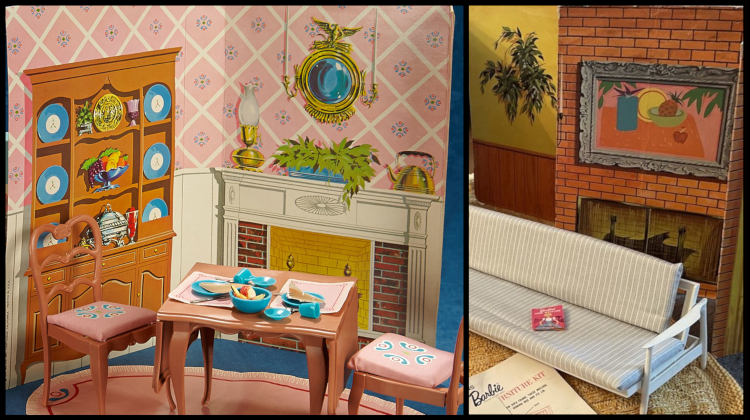
1964 Mattel Go Together Rooms. Source: Theriault’s (L), messejoshu on eBay (R). 
1965 Barbie Dream Kitchen and Dinette. Source: hues999 on eBay. 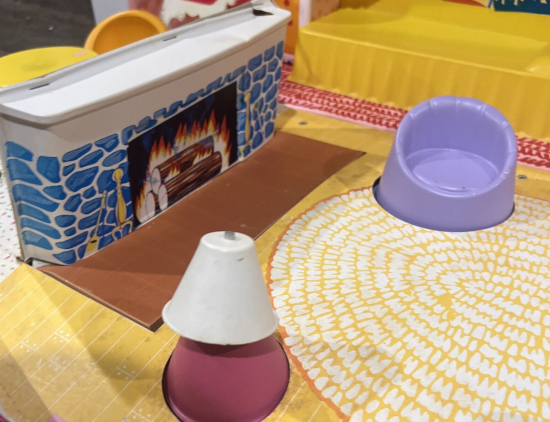
1966 Barbie Family Deluxe House. Source: retrowasteland81 on eBay. 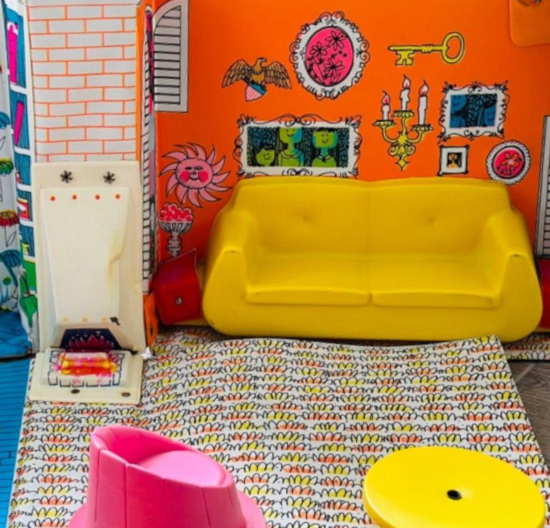
1967 World of Barbie house. Source: debonbay on eBay. 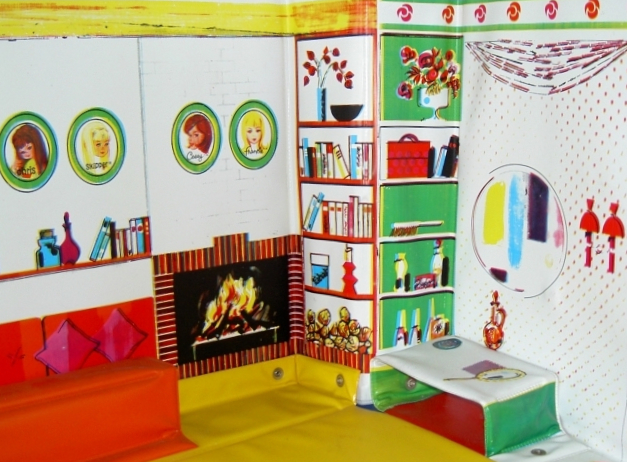
circa 1967 German Villa Barbie. Source: barbielistholland. 
1970 Barbie Lively Livin’Room, product photo with furnishings (L) and backdrop (R). Source: wonderwoman13 on eBay. 
1970 Jamie’s Party Penthouse (Mattel). Source: beanieblazer on eBay. 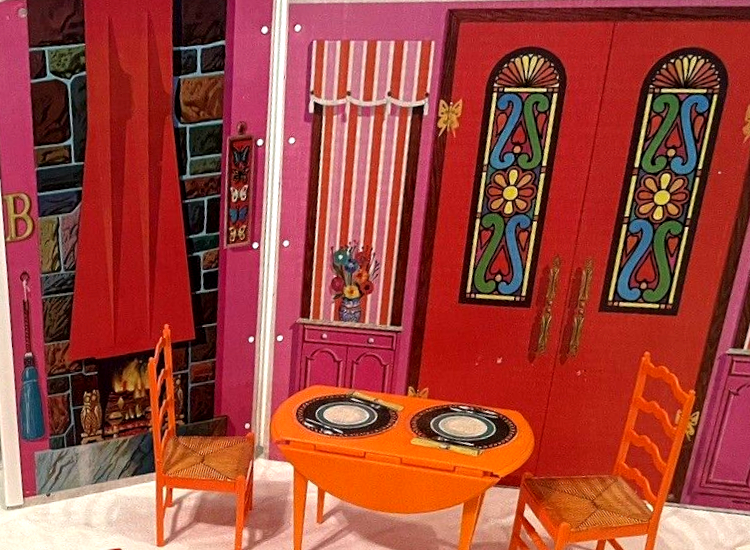
1970 Barbie Lively Livin’ House/1972 Surprise House. Source: aur_2547 on eBay. 
1972 Barbie Mountain Ski Cabin. Source: cegossett on eBay. 
1973 Barbie’s Country Living Home. Source: janzy67 on eBay. 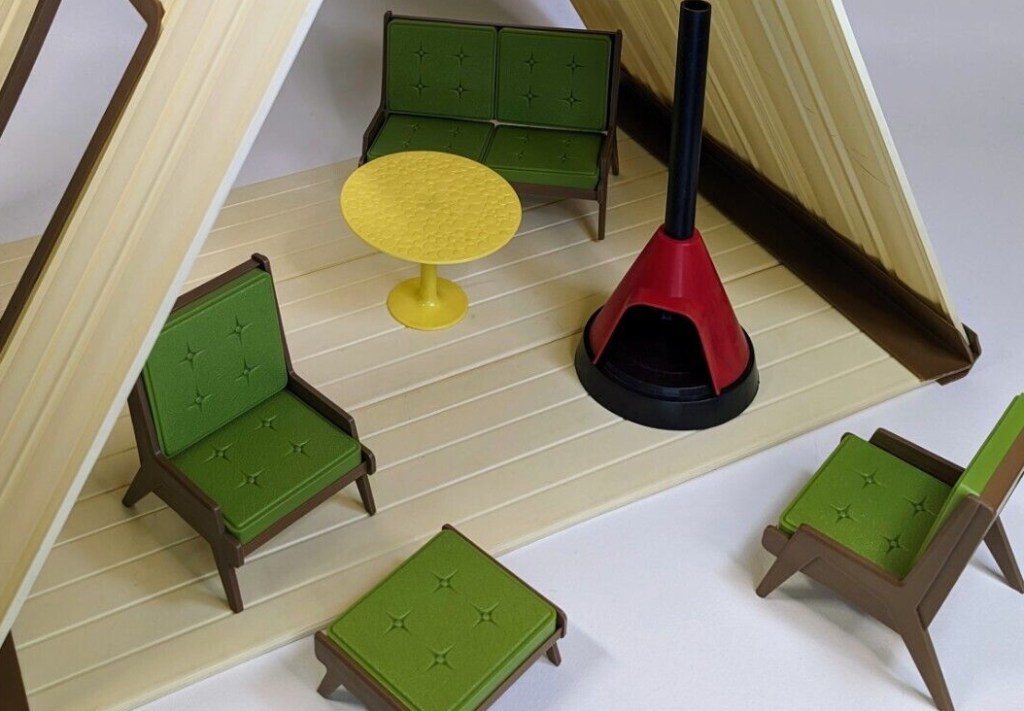
1973 Omlie Industries A-Frame Ski Cabin. Source: saltyladybird on eBay. 
1975 Barbie Room-Fulls Firelight Living Room. Source: motown-girl on eBay. 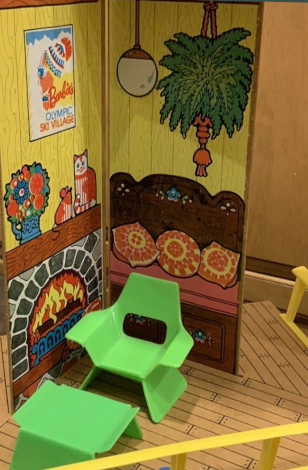
1975 Barbie’s Olympic Ski Village. Source: metaltree on eBay. 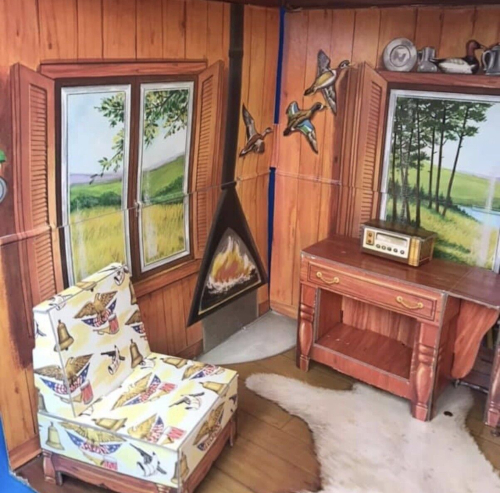
1976 Empire Rustic Lakehouse. Source: fabcitytoys on eBay. 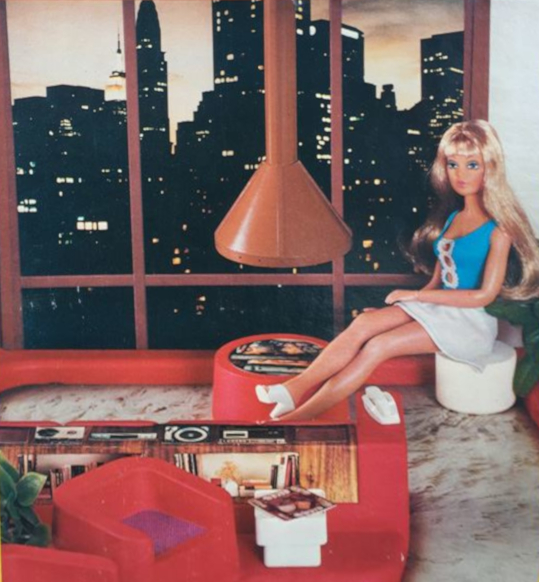
1976 Ideal Tuesday Taylor penthouse. Source: Savacool and Sons. 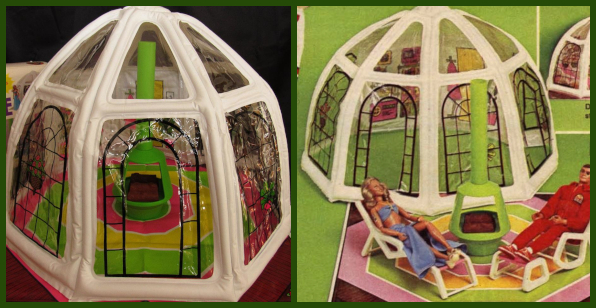
1976 Kenner Bionic Woman Dome House. Source: Worthpoint (L); ’76 Sears Christmas Catalog via Wishbook Web (R). 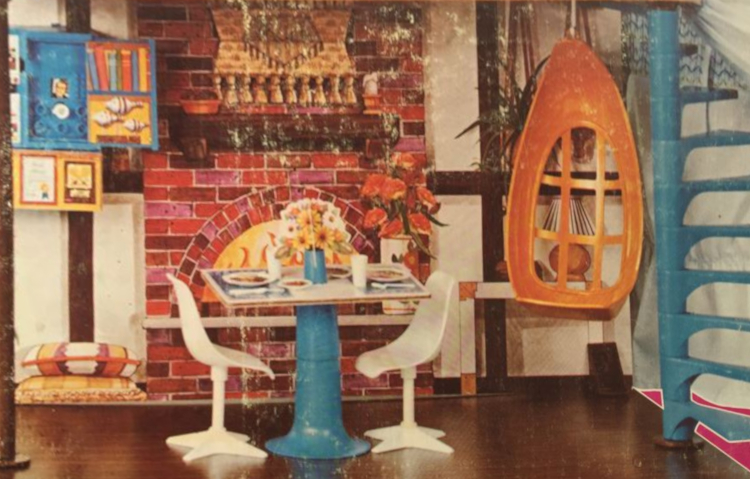
1977 Kenner Bionic Woman’s Carriage House. Source: Savacool and Sons. 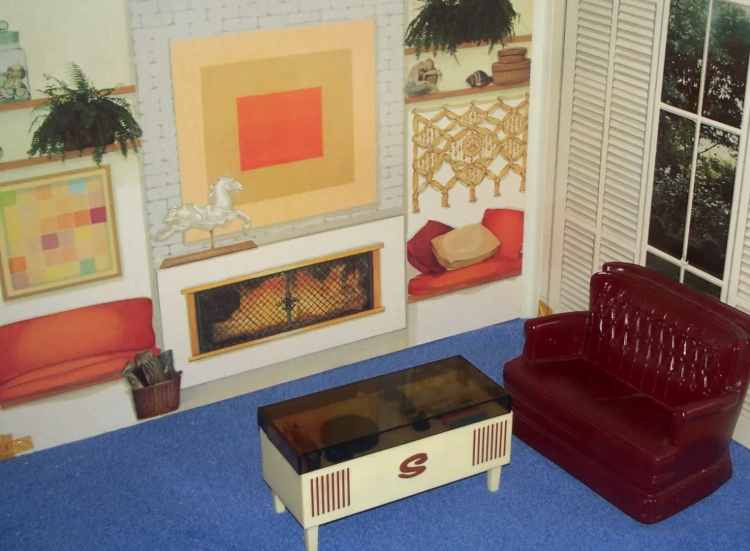
1979 Marx Sindy’s Scenesetter. Source: Awesome Treasures 4 U on eBay. Where to next? This post is about Barbie’s early built environment. The most recent post in this category concludes the Barbie’s Seventies Travelogue series, and the most popular are those on Mattel Modern and Susy Goose furniture and on penthouse apartments. Otherwise, the overall most popular posts on this site are about Barbie shoes, 1959-67, and about Mattel fashion booklets. Or just head up to the Table of Contents to see more options.
-
Queen of the Prom, AKA the Barbie game
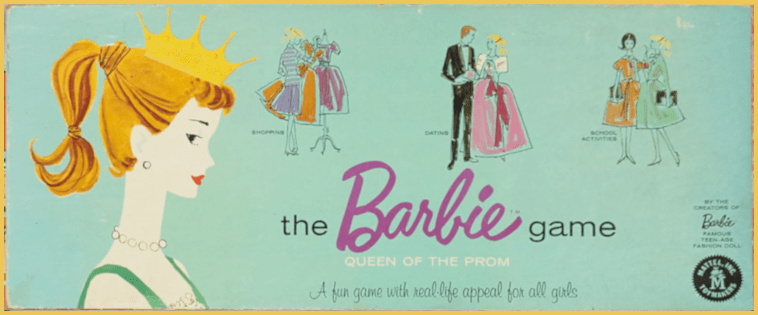
1961 Queen of the Prom board game box lid. Source: Theriault’s. In 1960 Mattel developed a gorgeous board game for its brand new character, Barbie, and her boyfriend Ken. Titled “the Barbie game” upon its 1961 release, it’s better known by its subtitle, “Queen of the Prom.”

Source: hello-good-buys on eBay. Never mind that the Barbie close-up on the box lid and the fashion illustrations–of Enchanted Evening, Silken Flame, Let’s Dance and Solo in the Spotlight–both on the board and on the cards, above, were reused from the fashion booklets. The game was a candy-colored masterpiece whose design is still celebrated today.
Beyond the reused booklet art, there were some fresh little sketches of Barbie and friends, such as the illustrations of shopping, dating and school activities on the box lid:
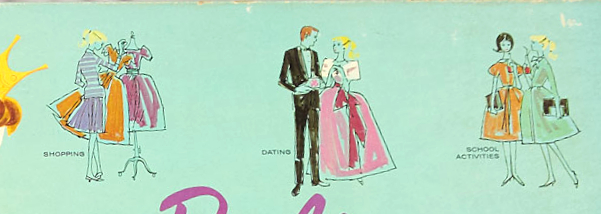
Detail from the 1961 Queen of the Prom board game box lid. Source: Theriault’s. as well as illustrations of Barbie cavorting, dancing, and approaching a sweeping suburban home on the corners of the game board:
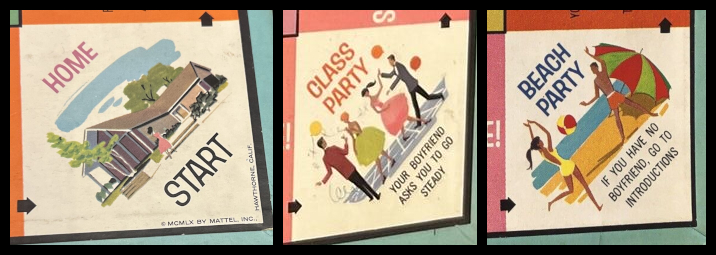
Details of 1961 Queen of the Prom game board. Sources: dcamma on eBay; csg675 on eBay. and little renderings of not Barbie, we assume, but all of her friends, lining the approach to the winning square, where Barbie is crowned Queen of the Prom:
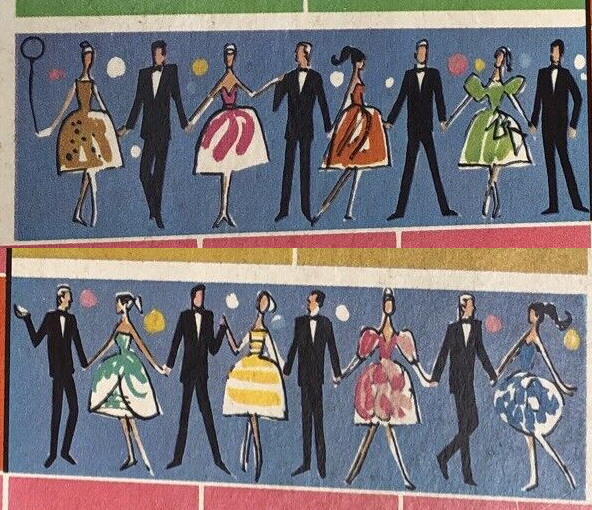
Detail of 1960 Queen of the Prom game board. Sources as above. These last remind us of the Busy Gal fashion sketches.
But Queen of the Prom was so much more than the sum of its sketches. The appeal of its broader aesthetic has led the game to be revived and honored in many ways over the years, including in high quality reproductions, starting with the 35th anniversary re-release:
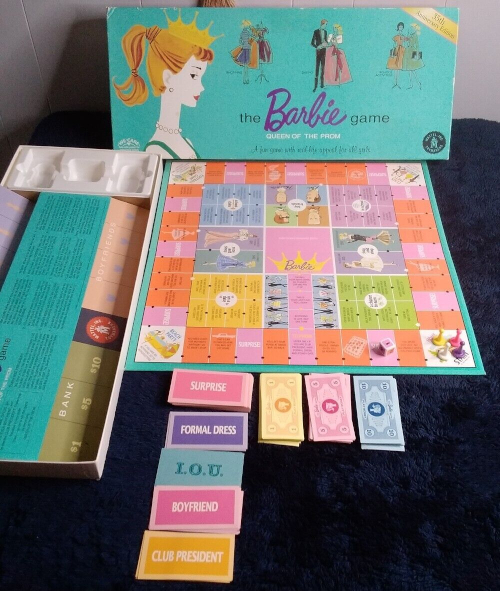
35th anniversary release. Source: buzz-dealzz on eBay. in miniature as a Barbie-scaled box sold with the nostalgic Cool Collecting Barbie, and a playable keychain game, both 1999:
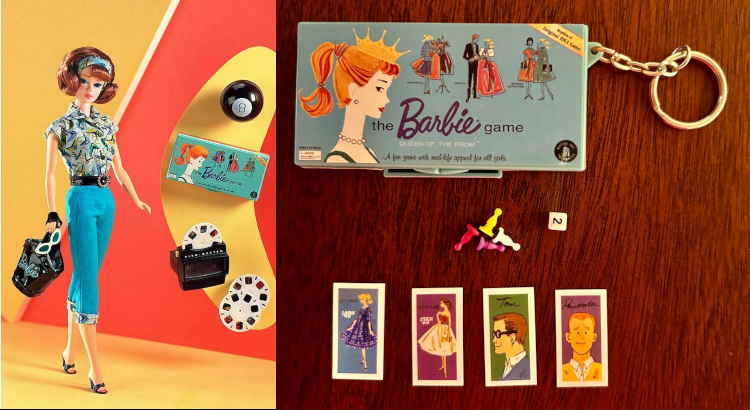
L: Mattel product image of Cool Collecting Barbie and accessories. R: Queen of the Prom keychain, source: jenniferc1961 on eBay. and in a convention-exclusive set of notecards for the 2001 Barbie convention, which was itself Queen-of-the-Prom-themed:
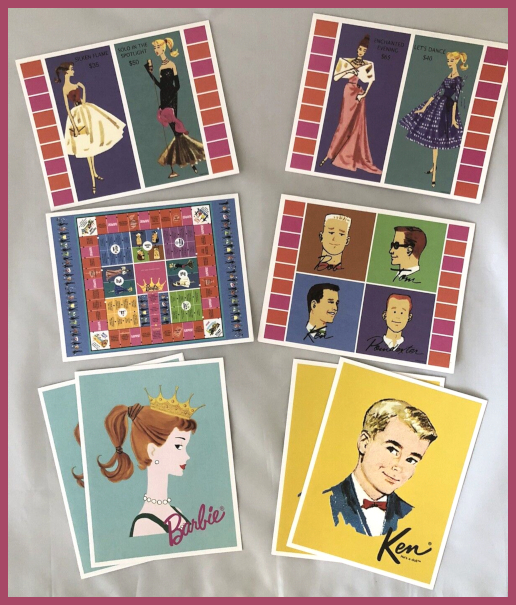
Source: shoppingwithmarnie on eBay. In 1963 the board game was revamped with all-new art that has not been reused or reproduced, and was formally renamed, eliminating “the Barbie game” from its title (by now it coexisted with Barbie’s Keys to Fame, a second board game).

1963 Barbie Queen of the Prom board game box lid. Source: rmac2 on eBay. On the cover stands Barbie, radiant in white, surrounded by maid of honor Midge, flower girl Skipper, and groom–wait, this isn’t a wedding, it’s prom! Then what’s Skipper doing there? The ’63 Queen of the Prom box lid could easily stand in for the wedding gift set packaging of the same period. However, game play still revolved around getting a date–and dress–for the dance.
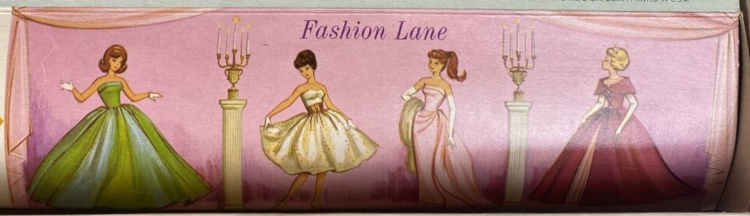
This iteration’s ensemble options were Enchanted Evening (again), Sophisticated Lady, Senior Prom, and Party Date–which was still labeled “Silken Flame.”
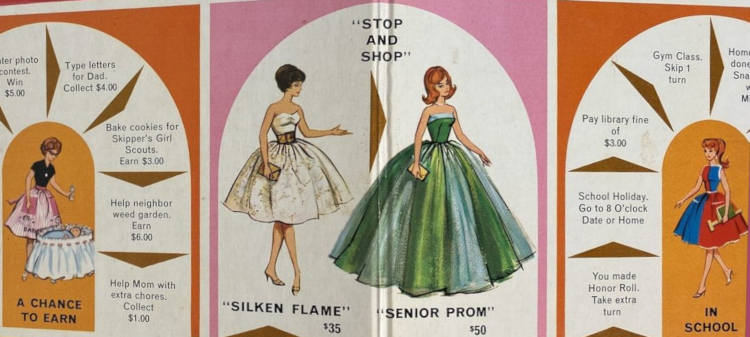
It looks like Midge pitched in to model Senior Prom, a favorite look for her.
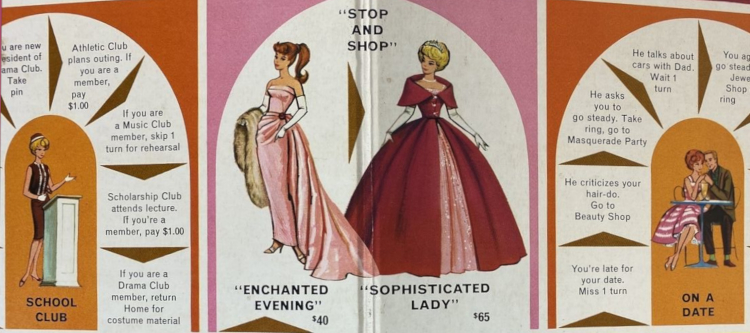
Alongside the four formal ensembles, Barbie is shown wearing a number of familiar outfits for school and extracurricular activities (including playing “mother” to Midge and Skipper, seemingly, in the “Home” tile shown below right).
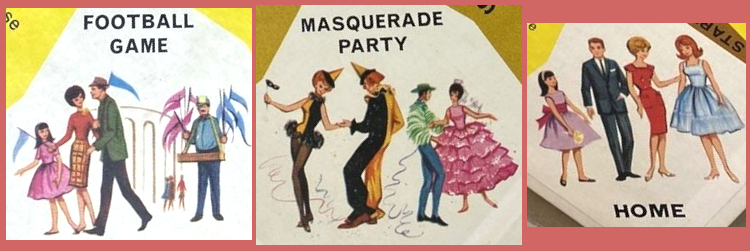
Details from the 1963 game board corners. This and above three images: woodycrew on eBay. 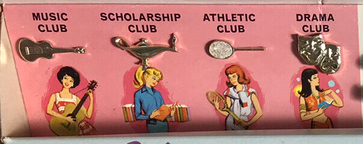
Detail from the 1963 game box interior. Source: rmac2 on eBay. The updated version of the game came with more gadgets, like the club pins above, as well as rings for going steady and custom-molded game pieces, unlike the mostly generic components used for the original version. The added expense of all these custom pieces may be part of the reason we haven’t seen this version, with its unique and beautiful art, reproduced.
Queen of the Prom was refreshed one more time, in 1991, with contemporary art and costumes, and the Sixties originals almost certainly also provided inspiration for the off-brand Campus Queen lunchbox a couple years after their original run. But neither of these compares to the original game, with its rich mid-century color palette, or the first revamp with its glamorous illustrations.
Most of Mattel’s nostalgic looks back at the board game came within a few years of each other in the Nineties to the early Aughts. Will there be further tributes, or is that ground now well-trodden? We’d love to see a 1963 reboot, or even a Queen-of-the-Prom-themed doll gift set, though most of the ensembles have been reproduced separately already.
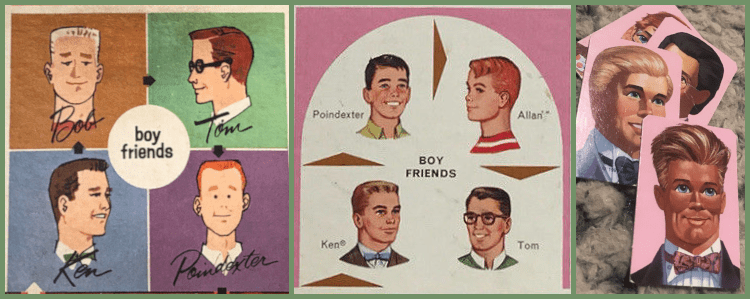
Bye for now, from us and all of Barbie’s beaux:
Where to next? This post is about vintage Barbie illustrations. Our most popular post in the category is on Mattel fashion booklets. The most recent post in the category is on the World of Fashion board game. Other popular posts on this site include the Many Abodes of Barbie series (currently covering 1962-1970) and our Chronicle of Barbie shoes, 1959-67. Or just head up to the Table of Contents to see more options.
-
Basic and dressed doll boxes
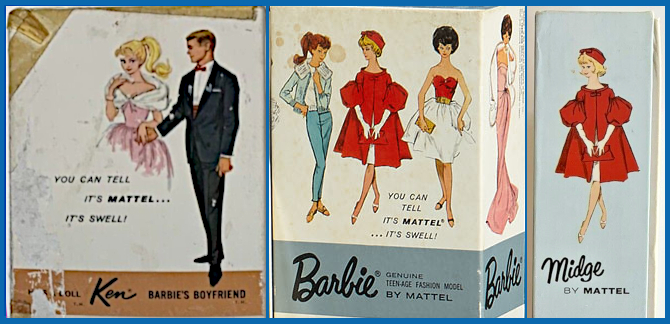
Basic Barbie boxes
The first boxes in which Barbies were sold came decorated with illustrations that were simultaneously more detailed and softer in style than the fashion booklets of the time; where the booklet sketches employed heavy lines, the illustrations on the first dolls’ packaging were mostly without lines, except where needed, as in their stylized facial features.
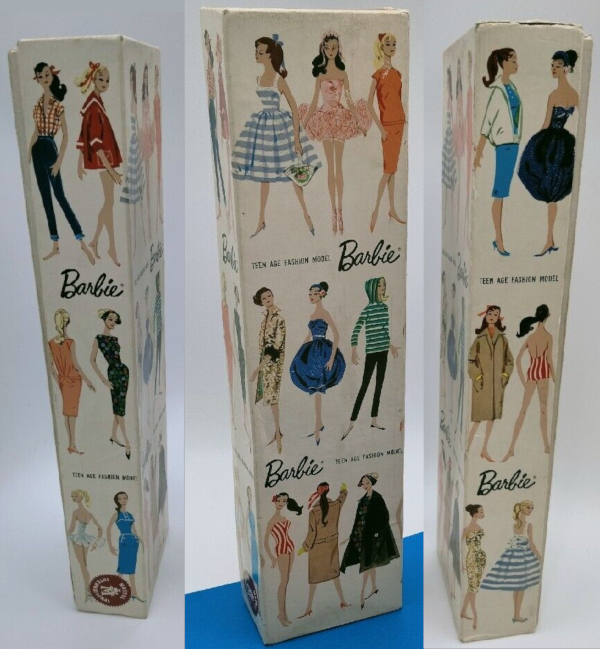
Basic Barbie doll box used from about 1959-1961. Source: handmadeandvintage1 on eBay. This first box is festooned with images of some of Barbie’s earliest fashions, like Easter Parade, Evening Splendour and Gay Parisienne (Ballerina, 1961, is one of the later arrivals shown). Three of the depicted fashions, however, were not released at all around that time: a peach-colored, drop-waisted chemise; a bright blue sheath with white trim, once shown with a loose-fitting jacket; and a strapless swimsuit with vertical red and white stripes. These outfits were finally produced, for Barbie’s 50th anniversary, as convention exclusives: Voyage in Vintage and Red, White and Beautiful.
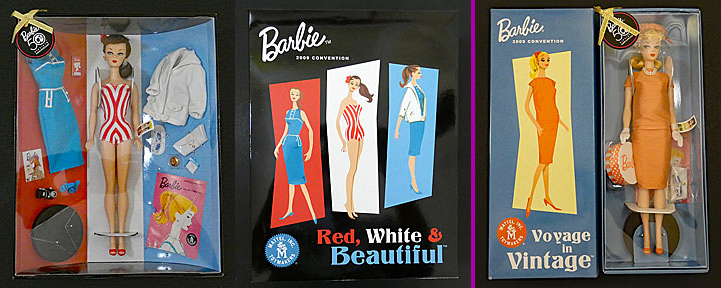
Nostalgic dolls based on the Ponytail doll box; their packaging reproduced the original box art, enlarged. Source: joeslist.com. The box itself has been reproduced a few times, including as part of the 35th anniversary reproduction doll offerings, in miniature in a 50th anniversary 2009 Hallmark ornament, and even more in miniature to contain a Barbie-scaled Barbie included with the 40th anniversary doll.
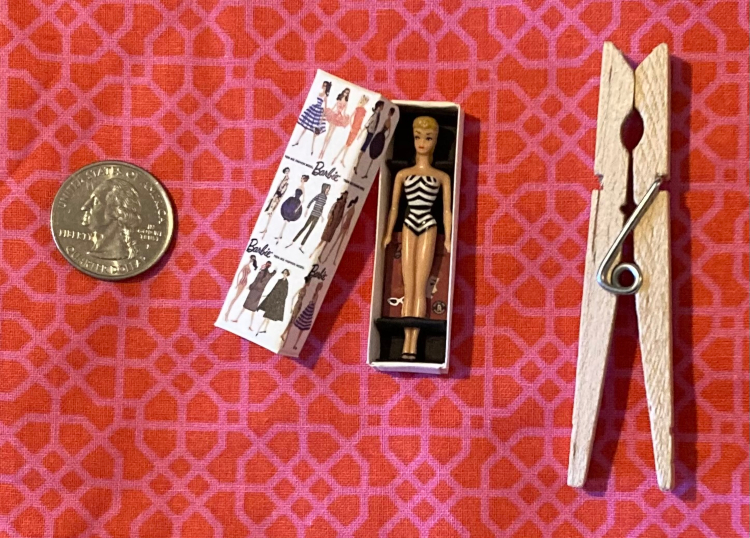
40th anniversary mini Barbie and box; quarter and clothespin for scale. 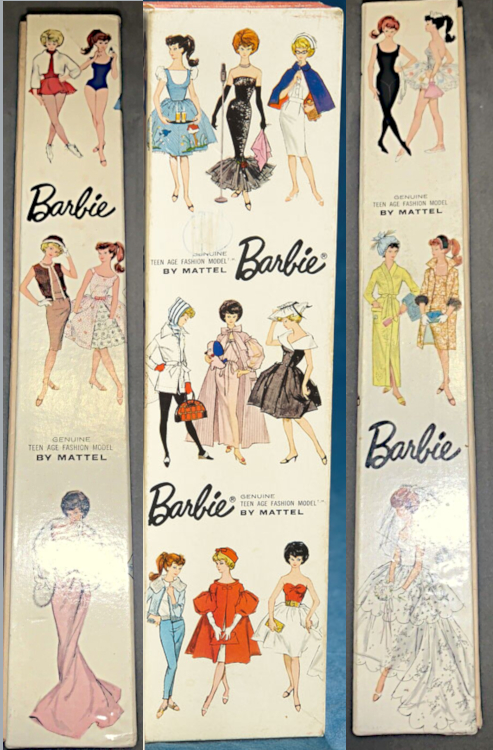
Source: booksandschmitt on eBay; Theriaults The next iteration, above, included sketches of the bubble cut and updated the selection of fashions from Barbie’s wardrobe. The artistic style had grown closer to that used in the fashion booklets starting in about 1963.
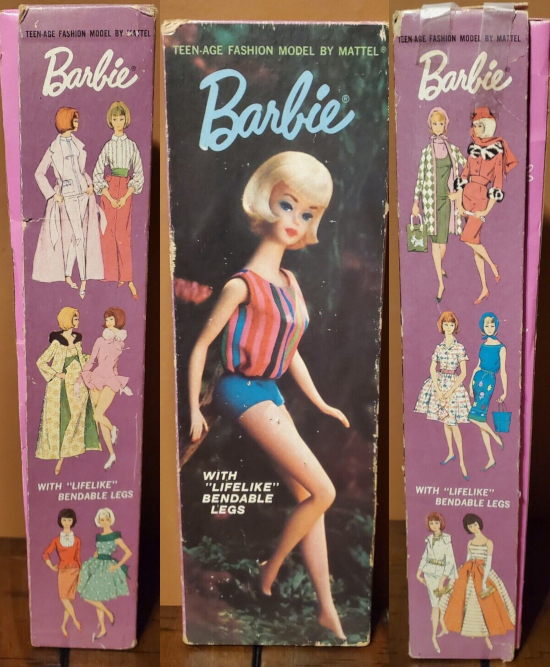
American Girl Barbie packaging. Source: laj821 on eBay. The third basic box, starting in 1964, was for the bendable-leg American Girl doll. Its front was a full-size photograph of the doll, but the box sides still featured small illustrations. These came straight from the fashion booklets. The next iteration, for Twist ‘n’ Turn Barbie, featured only photographs: a full-sized photograph on front, and small ones illustrating the doll’s poseability on the sides.
Dressed Barbie boxes
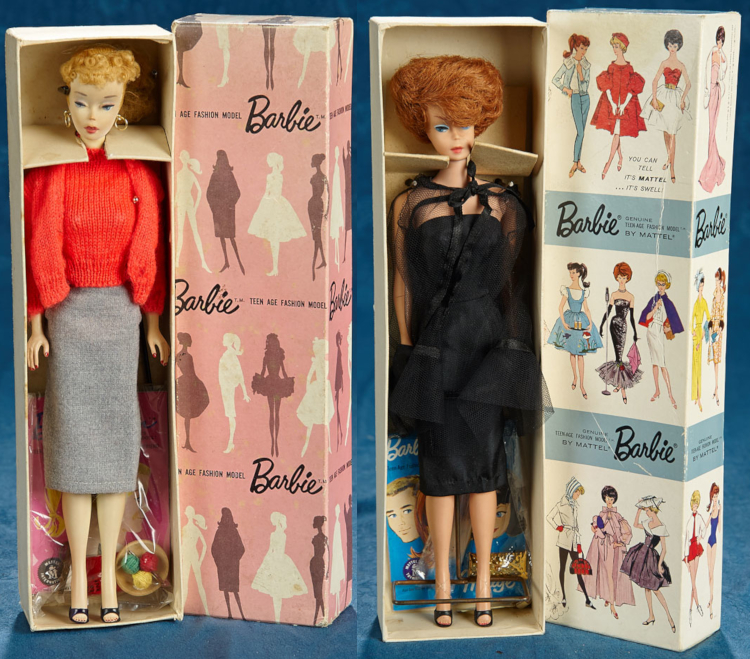
1960 and 1962 dressed doll boxes. Source: Theriaults. The early dressed doll boxes were lined with silhouettes, in which the sketches from the basic boxes can be recognized. The second version used the sketches from the bubble cut-era basic doll box, but rearranged.
Midge and Ken boxes
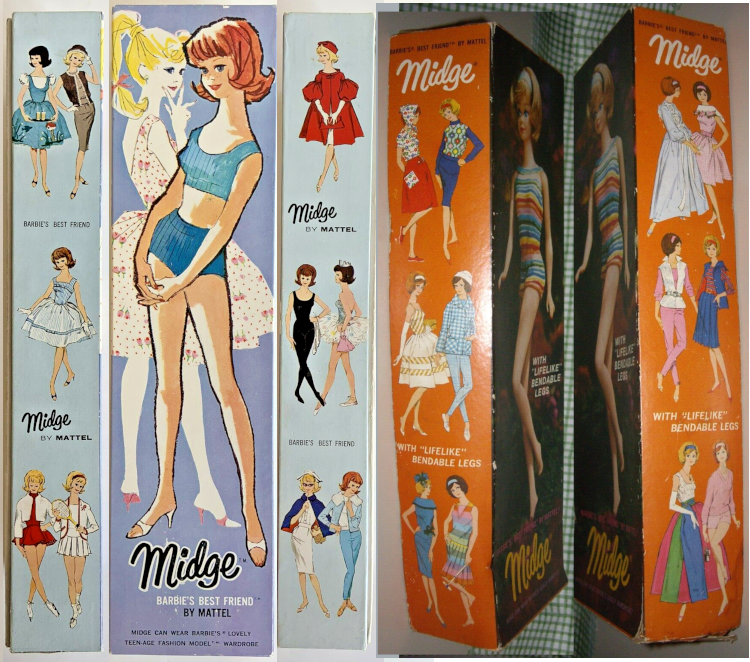
1963-64 Midge boxes. Sources: kst7714, lynette195209 on eBay Midge’s first box featured a large illustration of herself and Barbie in the “Travel Pals” pose on the front. The sides reuse many of the same drawings as Barbie’s second box, just with new (Midge) heads. Her second box had bend-leg Midge illustrations from the fashion booklets running down the sides and a full-size photograph on the front, just like Barbie’s box from that time.
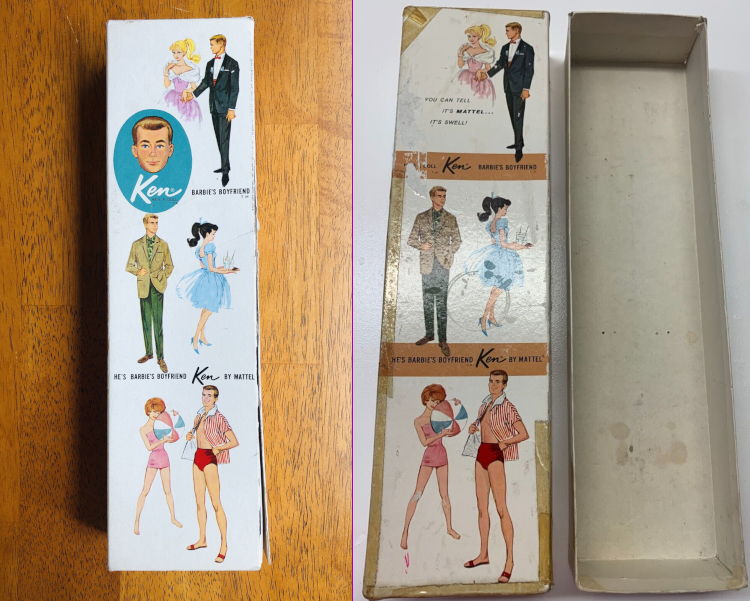
Basic Ken doll box (L) and dressed. Sources: stargazer9254 on eBay, jenmar on eBay. Ken’s boxes–either basic or dressed–had their own Barbie renderings, wearing what may be Enchanted Evening, a de-embellished Friday Nite Date, and some manner of playsuit. The sides of the boxes showed just the gents.
Hand-drawn boxes yielded to photography in the latter part of the Sixties, but they never went away entirely, as Barbie would be illustrated on her packaging countless times through the decades and until today. Many Barbie fans favor the lush Superstar-era illustrations, while some Barbie Fashion Model Collection offerings clearly reference the vintage illustration style we cover here.
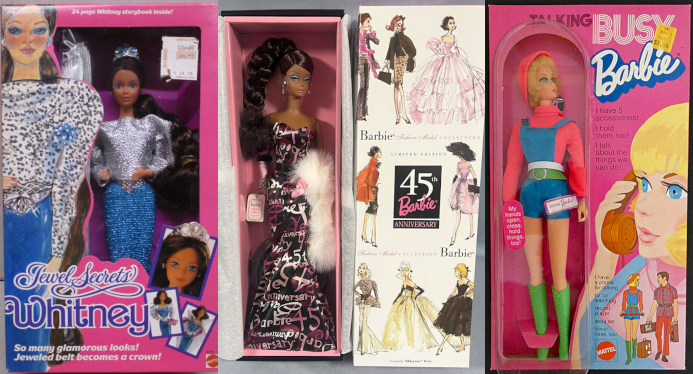
L-R: 1980s Jewel Secrets Whitney doll in package, 45th anniversary BFMC “Silkstone” doll with nostalgic-style box illustrations, and 1970s Talking Busy Barbie doll in illustrated packaging. Via eBay and Theriault’s. Where to next? This post is about vintage Barbie illustrations. Our most popular post in the category is on Mattel fashion booklets. The most recent post in the category is on the World of Fashion board game. Other popular posts on this site include the Many Abodes of Barbie series (currently covering 1962-1970) and our Chronicle of Barbie shoes, 1959-67. Or just head up to the Table of Contents to see more options.
-
The Many Abodes of Barbie, Part V: 1967-68

1967 Barbie House-Mate; 1968 Dressing Room case; 1968 World of Barbie House. Sources (all eBay): cantrellclutter, the_old_vineyard, topg. In Barbie’s mod housing saga, the parade of small houses continued in 1967 with additional Sears exclusives, the “House-Mates” for Barbie, Francie, and Tutti:

1968 Sears catalog listing for the House-Mates. Source: WishbookWeb.com These cozy quarters, with their few furniture pieces mostly nailed to the floor, inhabited a grey zone between house and case room, with a couple aspects differentiating House-Mates from Sleep-‘n-Keep cases: first, they weren’t advertised to carry dolls, just to be portable themselves; second, their exteriors illustrate the house exteriors, while the case rooms’ exteriors simply illustrate the characters.

Barbie and Francie House-Mates exteriors, front (left) and back. Source: misscarol on eBay. Convergent evolution at work: by adding fold-down vinyl beds and some lithographed features, the Sleep-n-Keep cases developed room-like complexity beyond the basic carrying case (which had had a closet-like component already), while the House-Mates continued the streamlining and simplification of the “deluxe” plastic houses of the previous two years.
(Note: A similar circa-67 offering, the Francie and Casey Studio House, we’ve ruled as more of a case-room and less of an abode–and no abode of Barbie’s, in any event. Its furniture folded down from the wall, Sleep-n-Keep style but with no floor; and on the outside its characters were posed before something like a cross between a building exterior and abstract Tiffany stained glass.)
But the main event in 1967 Barbie dwellings was the World of Barbie Family House. Finally, Barbie had a little space again–although this set still sported nailed-down furniture and folded up compactly, its two rooms were decently-sized for living and entertaining.
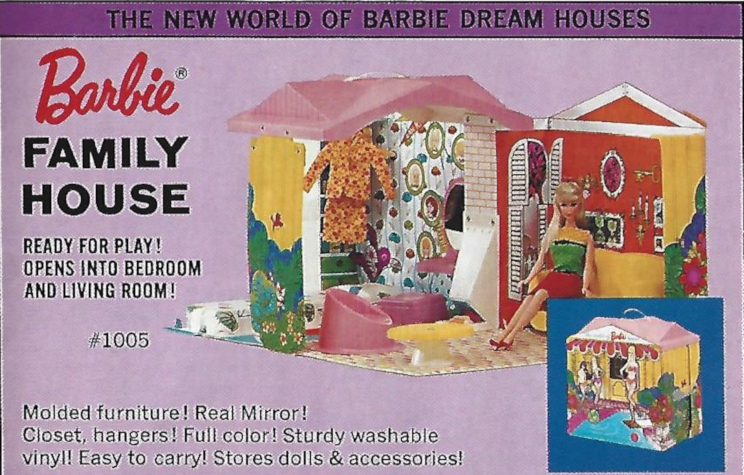
The first World of Barbie Family House, advertised in a 1966 Mattel booklet. Barbie had a sofa, table, chair, vanity, ottoman (or “hassock seat,” as in the House-Mates description), bed, fireplace, and a place to hang her clothes: out in the open between the rooms, as seen above. A distinctive feature of this set is its pitched, pink roof.
In 1968 the set got a face lift with all new wall decor, inside and out, plus a redder roof.
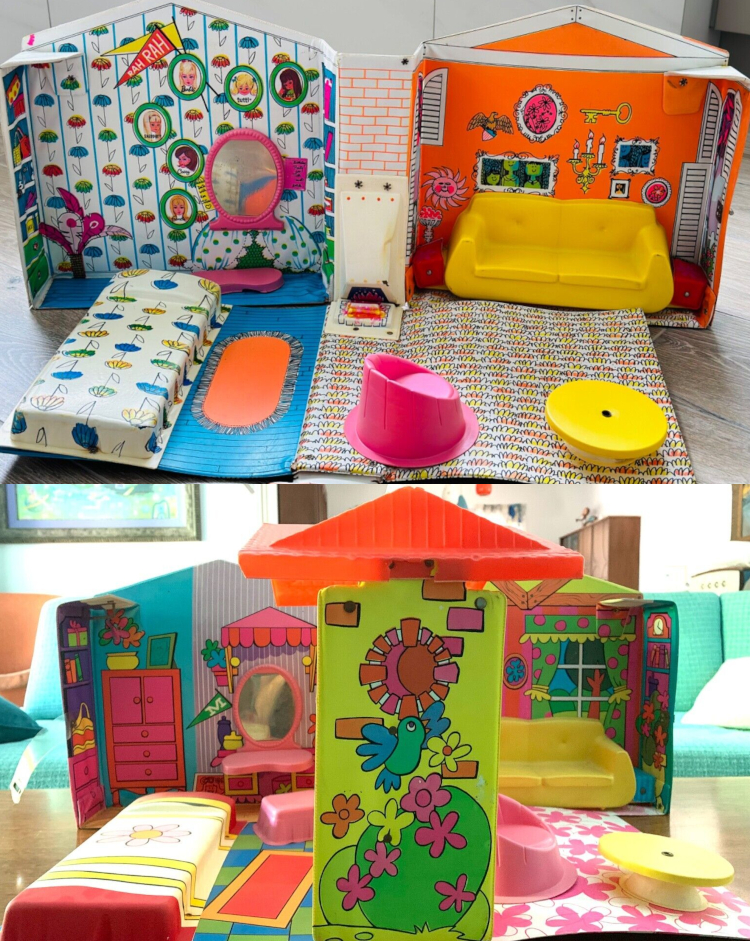
World of Barbie Family House interior in 1967 (above) and 1968. Sources: debonbay on eBay, moxie213 on eBay. The new version of the house replaced the fireplace and iffy clothes storage with a wide arched doorway:
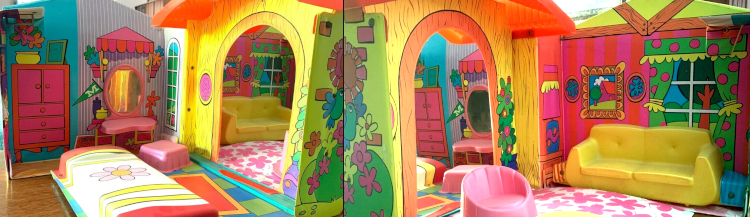
1968 World of Barbie Family House interior. Source: moxie213 on eBay Also in 1968, a Dressing Room Case with a matching pitched pink roof was sold. Although not resembling a building on its exterior, and implausible as a standalone structure in any case, it made a nice addition to the World of Barbie houses and gave Barbie somewhere more appropriate to store her clothes.
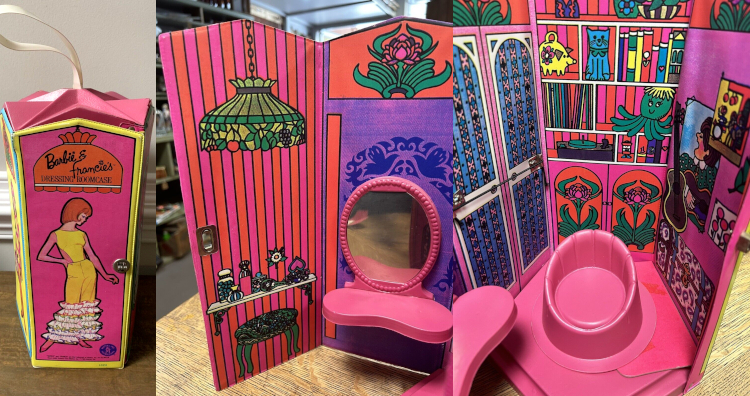
1968 Dressing Room case exterior (left) and interior. Sources: jungleberry on eBay, the_old_vineyard on eBay. The dressing room’s richly psychedelic lithographed interior details include some of the nicer touches of late-60s Barbie habitations.
This entry covered two years in one go, and up to three separate Barbie abodes, depending on how you count them. Are we gaining speed as we spiral toward the conclusion of the “Abodes” series? Probably! Stick around to find out.
-
Skipper’s Schoolroom (1965) and the play sets that never were

Skipper’s Schoolroom in the 1966 Sears Christmas catalog. Source: Wishbook Web. A Sears exclusive in 1965 and 1966, Skipper’s Schoolroom was notable as the first Mattel play set where Barbie went only to work (she may have worked or shopped at the Fashion Shop, and the Little Theatre similarly had multiple uses), as well as the last public space introduced to the Barbiesphere for a handful of years and maybe the last chipboard structure ever added. The play set contained all the school essentials: desks, chairs, books, globe, a chalkboard you could write on, and a playground for recess on the flipside. In the catalog graphics (1965’s image is identical to the ’66 one above), Barbie is seen wearing Student Teacher, as one might expect. Like the other late chipboard sets, details abound; many images of the interior, grounds and accessories can be found on a 2019 listing from Ripley Auctions (love the functionality in that trash receptacle!). This play set, marking the end of an era, got us thinking about where else Barbie went to work during the Sixties.

Barbie’s Fashion Shop, from the 1964 JC Penney Christmas catalog. Source: christmas.musetechnical.com It makes sense that the Teen-Age Fashion Model’s first realized place of employment was the Fashion Shop: according to the Random House chapter books, most of her teen-aged modeling career was spent doing trunk shows or similar; furthermore, fashion was central to the Barbie enterprise. It also makes some sense that another was the schoolroom, since it also accommodated Skipper and her crew. However, Barbie had many careers in the Sixties, most of which never got an official setting.
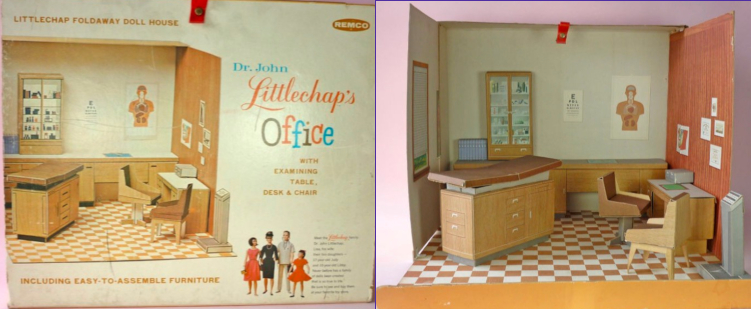
Dr. Littlechap’s chipboard office, sold in 1963, may have been suitable for Barbie as Nurse; according to flickr user Foxy Belle, it was sized for Barbie rather than the larger Littlechaps. The Keys to Fame game supplies a good roundup of Barbie’s confirmed early occupations, from more-traditional female roles like Teacher, Nurse, and Mother, to more audacious ones like Fashion Designer, indicated by the Busy Gal ensemble: while female precedents existed, in the ’60s it was a very male-dominated profession. (Barbie was actually demoted to Junior Designer around the time the Schoolroom was produced, but that’s a scandal for another day.)
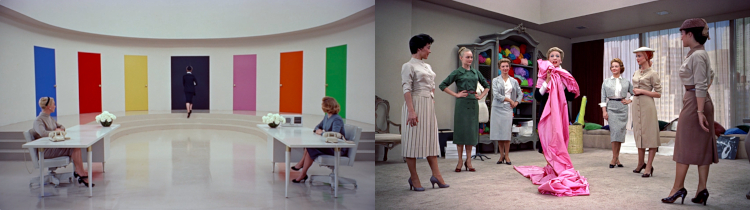
Not a fashion designer’s office, but a fashion magazine office–with bolts of fabric and a dressmaker’s dummy–in the 1957 film Funny Face. Source: Paramount Pictures. A fashion designer’s studio play set could have made a great accompaniment to offerings like Sew-Free fashions, Color Magic, and even the Busy Gal and Junior Designer ensembles.
Barbie’s most trailblazing early career was Astronaut: although commentators today are just as likely to fixate on the goofy hot pink, puff-sleeved ’80s space suit, Barbie’s original astronaut garb was wholly appropriate to the task, and she wore it into space before the real NASA employed a single female astronaut.
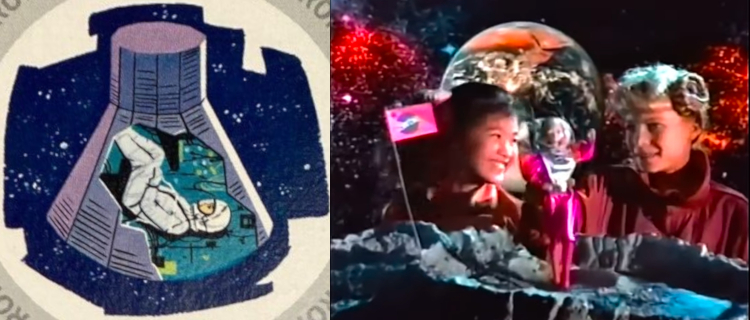
What would an astronaut play set for Barbie look like? Visions from the Sixties (Barbie’s Keys to Fame, via statestpac2011 on eBay) and Eighties (Barbie commercial via Jemz.Archive. on YouTube). Based on certain of her less-job-specific ensembles, we can conjecture that 1960s Barbie had other business-y careers, as well: while Commuter Set may have been a mere secretary or receptionist, Career Girl looks more executive, and no one’s telling the woman wearing On the Avenue to take a memo. Since our knowledge of Sixties career women is based, for better or worse, on Doris Day and Rock Hudson comedies, we conjecture Career Girl and On the Avenue as interior designer and advertising executive, respectively. But Mattel wouldn’t provide Barbie with a business setting for professions like these until–we believe–the Day to Night office in 1984. And yes, it was kinda pink-forward.
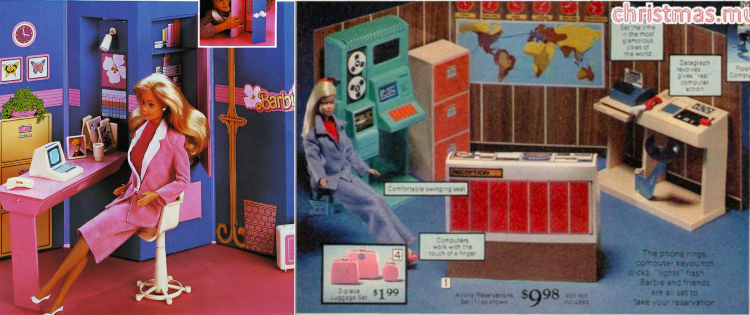
Left: The Technicolor-appropriate Day-to-Night home/office play set from 1984 was the first Mattel Barbie office. Source: Pinterest. Right: The offbrand Airline Reservations Set, seen in the 1978 Sears Christmas catalog, was a forerunner in office-type settings suited to Barbie. Source: christmas.musetechnical.com. Further careers are posited in the Random House books. While Barbie’s Fashion Success finds our heroine merging fashion design and modeling in one temporary position, another early offering, Barbie’s New York Summer, places her in an internship at a fashion magazine where she performs a mixture of modeling and journalistic tasks, while contemplating making a career of it (the mid-Sixties Fashion Editor ensemble suggests how deliberations went). Back home, Ken urges her to consider whether a career is really what she wants, or whether she might rather remain in their small town as a lawyer’s wife; his wife. In Ken’s mind the two possibilities are that Barbie stay by his side while he pursues the path he’s chosen without her input, or that they part ways; Barbie seems to find nothing exceptional in his attitude. Though Barbie and Ken don’t break things off, two years later, in 1964, she seems committed to pursuing a career of some sort. She’s decided that modeling entails too much standing around and decides to try out broadcasting in Barbie in Television.
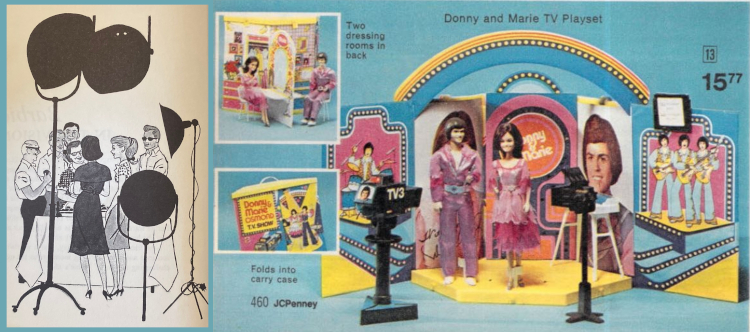
Left: in an illustration by Robert Patterson, Barbie visits the set of a cooking show during the events of 1964’s Barbie in Television. Right: Mattel later produced a television studio for Barbie-sized Donny and Marie Osmond dolls, as seen in a 1977 JC Penney Christmas catalog. Source: WishbookWeb.com. Barbie herself got a somewhat similar photo studio the same year. Based on all these possibilities, any number of Barbie-as-working-professional play sets could have been devised. Astronaut may have been out of scope for mid-Sixties Mattel, while Barbie as Stewardess would get her aircraft in the Seventies, and a brightly-hued, though not particularly executive, office awaited various other of her careers in the Eighties. Did any career-focused chipboard play sets make it to prototype, or at least the planning stages, besides the couple that were produced? We’d love to know.
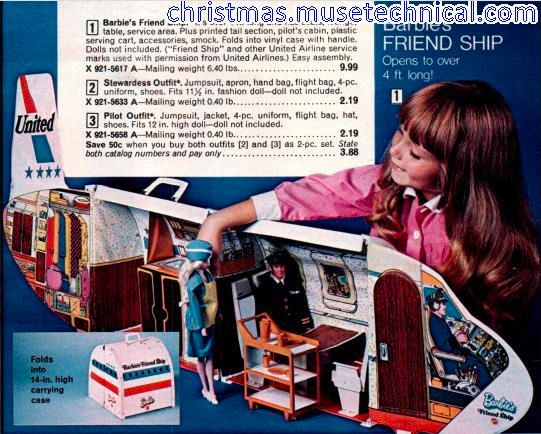
Stewardess Barbie finally got an airplane in the 1970s. JC Penney catalog images like the one above from ’73 showcase Barbie in an offbrand stewardess outfit that looks more Sixties, compared to the colorful United Airlines uniforms that coincided with the Friend Ship offering. Where to next? This post is about Barbie’s early built environment. The most recent post in this category concludes the Barbie’s Seventies Travelogue series, and the most popular are those on Mattel Modern and Susy Goose furniture and on penthouse apartments. Otherwise, the overall most popular posts on this site are about Barbie shoes, 1959-67, and about Mattel fashion booklets. Or just head up to the Table of Contents to see more options.
-
Barbie’s Keys to Fame

Illustrations from the Keys to Fame game. Source for all images in this post: statestpac2011 on eBay.
A funny little mid-Sixties board game, Barbie’s Keys to Fame illustrates a number of possible futures for the one-time Teen-Aged Fashion Model, each emblematic of a “key” to fame: the stamina of the Ballerina, the style of the Fashion Designer… Note: fashion model is not one of the possible callings.
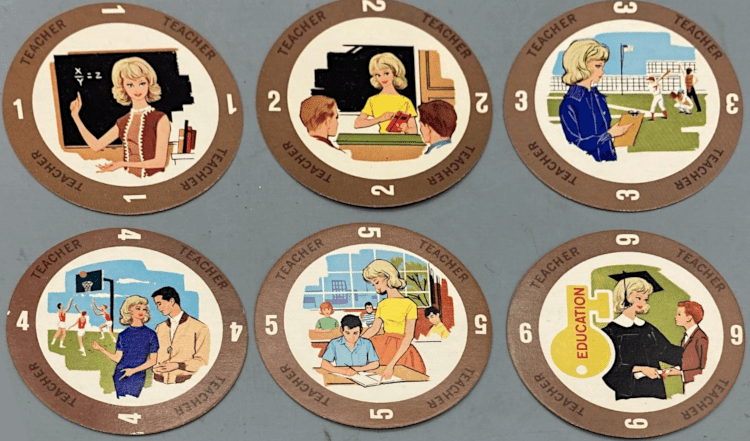
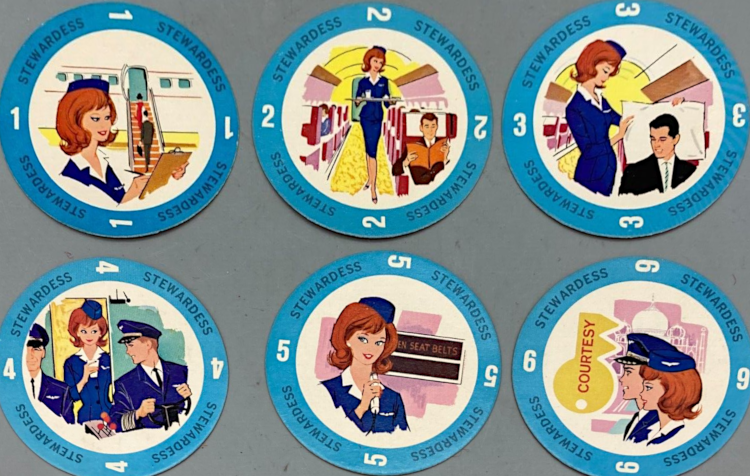
Each of the eight vocations is depicted in six illustrations that we believe are entirely unique to this game–a total of 48 exclusive illustrations. Unlike a certain, more famous Barbie board game, Keys to Fame has never been reproduced, so these illustrations are rare.
The different versions of Barbie’s future are distinguished by unique combinations of hair style and color, with only the ballerina repping her original ponytail.

Most of the others have either a “flip” wig or an American Girl ‘do–the two can be difficult to distinguish in an illustration, but we’re tentatively classing Teacher and Mother as flip wigs, and three others (Nurse, Stewardess, and Astronaut) as American Girls.

As Barbie attains success along each of these life paths, she seizes the opportunity to model a number of recognizable fashions from the first half of the Sixties. The Nurse, Ballerina and Stewardess paths show her wearing exactly what you’d expect–Registered Nurse, Ballerina, and American Airlines Stewardess, respectively; all 1961–whereas on the Astronaut path she wears the 1965 Miss Astronaut ensemble right up to the end, then attires herself in 1962’s After Five for a ticker tape parade.

Sometimes Barbie deviates from the expected in her dress. As a teacher, Barbie wears Sorority Meeting (’62), Knitting Pretty (’63 version), Graduation (’63), and Country Fair (’64)–but never 1965’s Student Teacher. As a fashion designer she wears the pak Silk Sheath to design the Belle dress ( both ’62) and wears Career Girl (’63) to visit Paris, but eschews the fashion-designer-themed 1960 ensemble Busy Gal.

The movie star, who, along with the fashion designer, sports a bubble-on-bubble hairdo, has some of the more elegant costume changes: reading a script in Golden Girl (’59), walking a red carpet in Enchanted Evening (’60), signing autographs in a four-button sheath (’62), and receiving an award in Senior Prom (’63). Her garments aren’t visible in the remaining two images, but it’s fun to see her on the big screen after her many television appearances.

The award for most costume changes goes to Mother, who goes through Fancy Free (’63), Busy Morning (’63), pak cotton separates (’62), Knitting Pretty (’63), Friday Night Date (’60), and Nighty Negligee (’59) for her scenes.

Some of these occupations seem to lend themselves more readily to fame than others, but with a little mulling, we were able to think of women who’ve attained fame from all of these pursuits, except one: the stewardess. Do any famous flight attendants spring to mind?
Want to see more board games? Stick around. We’ll tackle that famous one–plus a mod game or two–in upcoming posts.
Where to next? This post is about vintage Barbie illustrations. Our most popular post in the category is on Mattel fashion booklets. The most recent post in the category is on the World of Fashion board game. Other popular posts on this site include the Many Abodes of Barbie series (currently covering 1962-1970) and our Chronicle of Barbie shoes, 1959-67. Or just head up to the Table of Contents to see more options.
-
Visions of Solo in the Spotlight
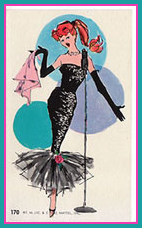
Barbie Jumbo trading card #170 by Dynamic Toy, Inc. Source: joeslist.com. 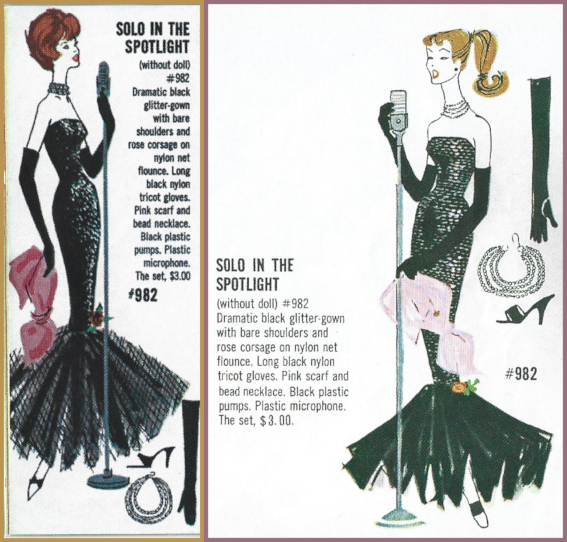
1962 Mattel fashion booklet illustrations. 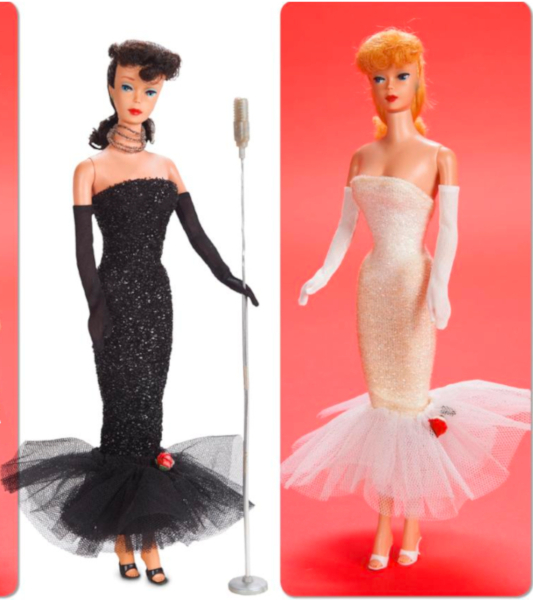
1960 Solo in the Spotlight fashion and variant prototype. Source: Theriault’s. 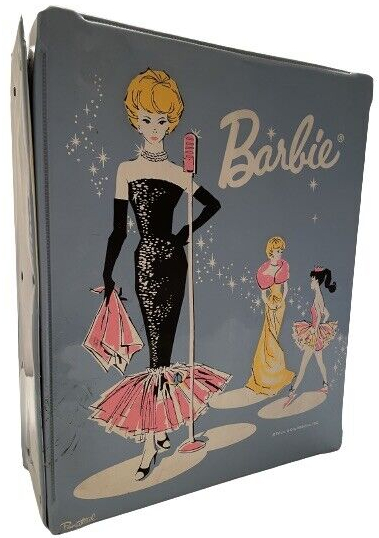
1962 Barbie doll carrying case by Ponytail. Source: pfmink on eBay. 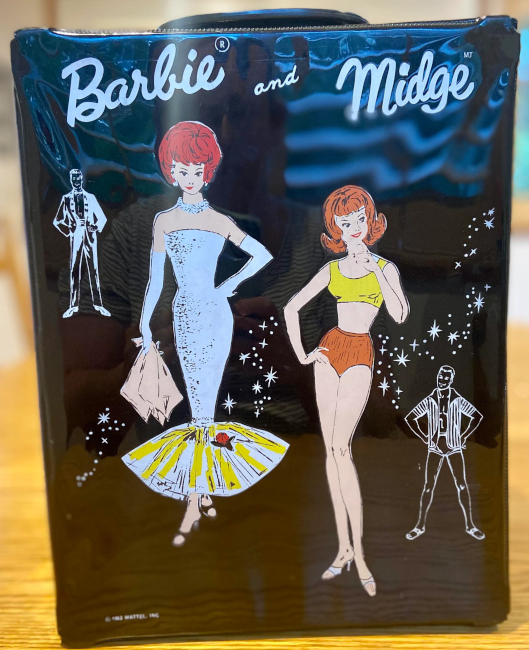
1963 Barbie doll carrying case by Mattel. Source: fuzzypeacheese on reddit. 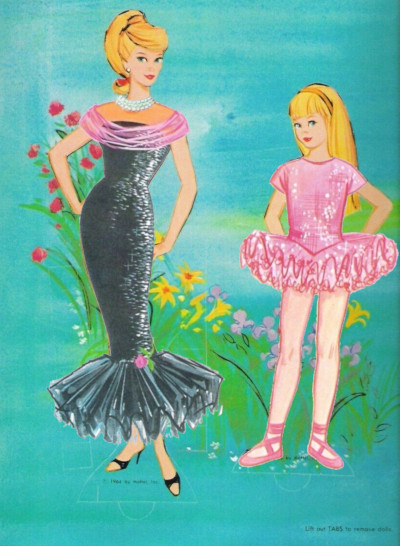
1964 Whitman paper doll fashions overlaid on dolls from the same set. Source: onceagain34 on eBay. 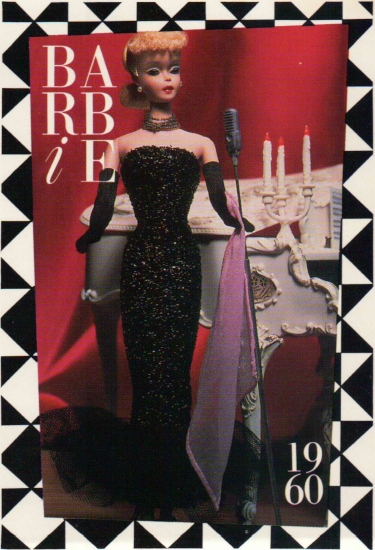
1990 Barbie trading card. Source: PostcardsAndMore on eBay. 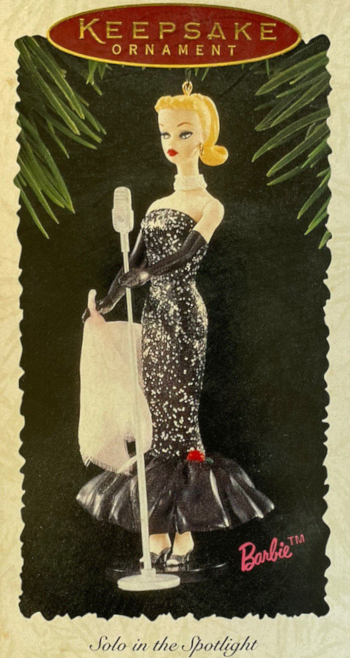
1995 Hallmark ornament. Source: Chris15collectionCorner on eBay. 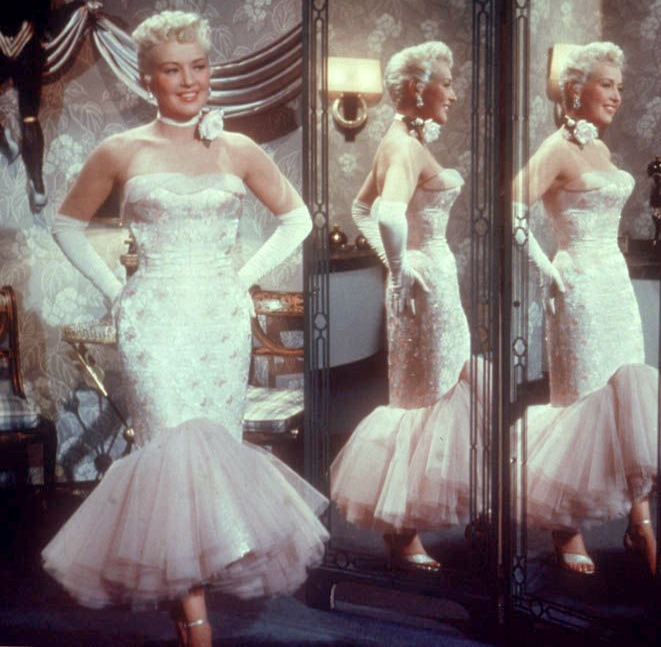
Costume by William Travilla, worn by Betty Grable in How to Marry a Millionaire, 1953. Source: Fox Studios. 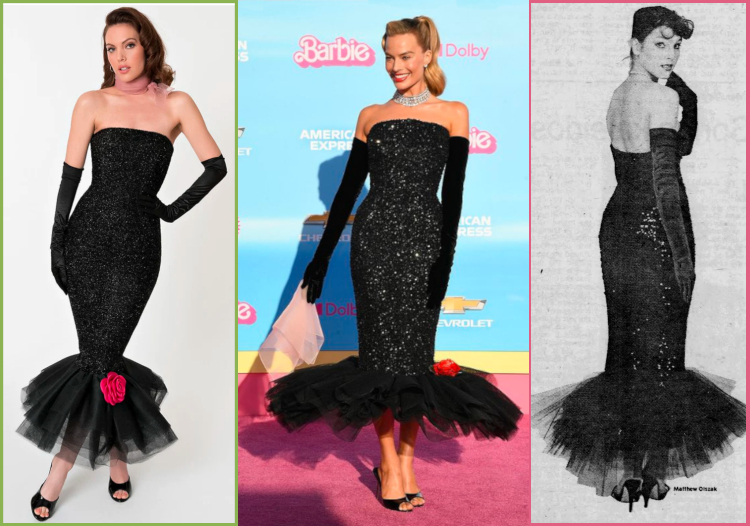
Interpretations by (L-R): Barbie x Unique Vintage; House of Elsa Schiaparelli custom for Margot Robbie, 2023 (via justjared on Instagram); Timothy Dunleavy for Barbie’s 21st birthday, 1980 (via New York Daily News).

Silken Flame
Vintage Barbie illustrations, built environment, clones and more
 Silken Flame