-
Welcome!
Thanks for swinging by my vintage Barbie fan site, where you’ll find articles on Barbie’s built environment, Barbie illustrations, vintage rival and clone dolls and playsets, and miscellaneous musings/deep dives. What are you looking for?
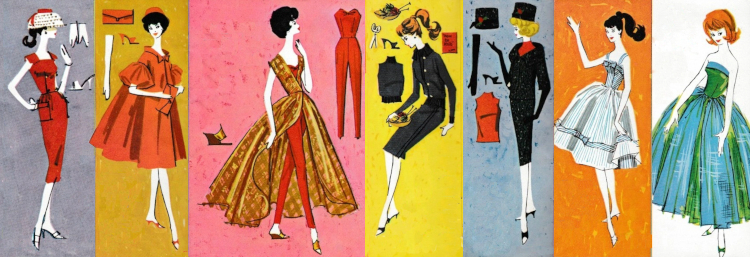
Vintage Barbie Illustrations
- Mattel fashion booklets, 1960-67 (approximately)
- Basic and Dressed Doll Boxes, 1959-64
- Doll Carrying Cases, 1961-72
- Jumbo Trading Cards, 1962
- Gift set art, 1960-70
- Illustrated fashion packaging, also about 1960-70
- Random House books (plus some from other publishers), 1962-65
- Dell Comics, 1962-63
- Whitman Paper Dolls, 1962-65 and 1967-73
- Whitman Coloring Books, 1962-65 (A mod sequel post is possible but not planned at this time.)
- More crafts and hobbies, 1963-1971
- Queen of the Prom board game, 1961-63
- Keys to Fame board game, 1963
- Sew-Free Fashion Fun Kits, 1965
- Sewing Patterns, 1962-?
- The Barbie World of Fashion board game, 1967
Plus the illustration “sidebars,” short entries on niche topics:
- Busy Gal fashion sketches, 1960
- Barbie Sings!, 1961
- Go-Together furniture sets, illustrated
- Color Magic, 1965-66
- Mattel fashions for Julia, 1968-69
- All the Barbie and friends illustrations on mod house exteriors like the one below
- Miss Lively Livin’ board game, 1970
- Window shopping, illustrated
- Barbie’s Baggage, illustrated (not super short, but surveys many illustration categories examined in other posts)
- Vintage dress-up and other child-size items for the boudoir
- The illustration component of the 1964 Little Theatre and travel costumes entry is sidebar-sized.
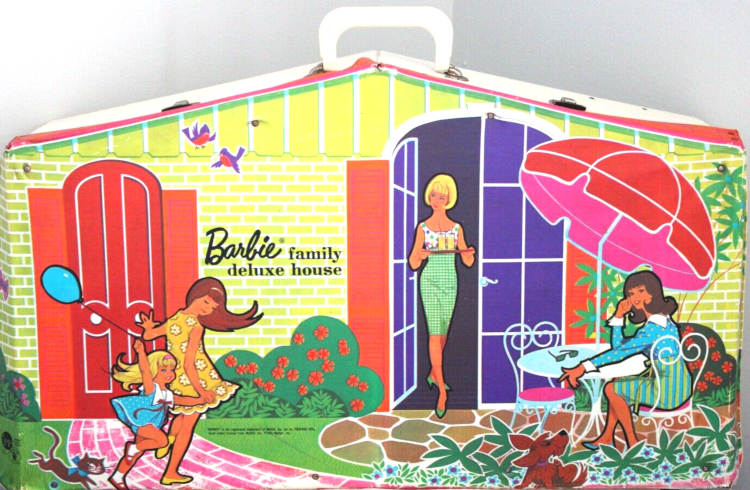
Barbie’s Built Environment
- Entries by year for many of Barbie’s early abodes: 1962, 1964, 1965, 1966, 1967-68, 1969, 1970.
- Barbie’s ’70s Travelogue:
- Mattel Modern and Susy Goose furniture, 1958-1966
- Barbie on TV, a roundup of some of Barbie’s early toy TV sets (this post also has a strong “illustration” component)
- Barbie’s Fashion Shop, 1963
- and a detour into Mannequins and Dress Forms, ’63-’73
- The Deluxe Reading Dream Kitchen, 1963 (note, this is not a Mattel product)
- The Little Theater, 1964
- Skipper’s Schoolroom, 1965
- Penthouse apartments, 1964-76
- Beauty parlors, 1964-77
- Japan-exclusive furniture, 1967
- Unique Boutique and Cafe Today, both 1971
- The Sears Karosel Kitchen, 1971-1976 (note, this is not a Mattel product)
- A roundup of fireplaces in Barbie and Barbie-sized houses, 1963-79
- The “built” environments of Whitman Barbie paper dolls, which real Barbie dolls can also use; 1963-1973.
- The built environments of mini vintage Barbies
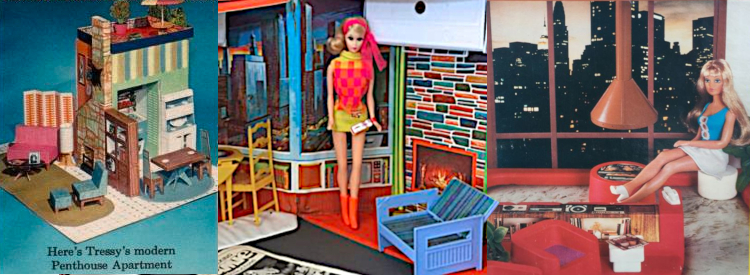
Articles relating to clones, rivals, and off-brand Barbie-style products
- Rival fashion booklets
- The Two Abodes of Tammy covers the living spaces of one of Barbie’s most notable rivals
- Barbie’s ’70s Travelogue, Part II: Unofficial Adventures is about non-Mattel playsets suitable to Barbie and Barbie-sized dolls
- Clones are recommended in the “existing alternatives” section of the musing, Three Nostalgic Black Barbies We Need (and a few existing alternatives).
- Clone kitchens: The Deluxe Reading Dream Kitchen, The Sears Karosel Kitchen
- Clone washrooms are prominent in Barbie’s ’70s Travelogue: Part IV.
- The pieces on penthouses, beauty parlors and fireplaces include non-Mattel offerings.
- Not Barbie on TV: Barbie and friends’ early TV sets that were tuned to other programs
- The entry on Mattel Modern and Susy Goose furniture includes some offbrand furniture items of the 70s and 80s.
- We wrote about clone carrying cases, including some created for competitor dolls.
- Certain of the sewing patterns are for generic fashion dolls, as are the Sew Simple and Cut ‘n’ Sew craft kits.

Miscellaneous Musings and Deep Dives
- A Chronicle of Barbie shoes, 1959-67
- Barbie’s Seventies Travelogue: the Appendix reviews vintage and nostalgic Barbie and Barbie-sized luggage options
- When Barbie Turned 21 in Manhattan, 1980
- Three Nostalgic Black Barbies We Need (and a few existing alternatives)
- Great Books for Vintage Barbie Fans
- The piece on Skipper’s Schoolroom includes “play sets that never were”: Barbie’s Sixties careers for which environments were not produced.
- Visions of After Five (1962) and Solo in the Spotlight (1960)
- Who wore it best? pairs vintage and mod Barbie and Francie fashions with their likely or confirmed inspirations. The Airborne edition does the same for vintage flight attendant uniforms, while the Mary Quant one highlights Francie fashions that appear influenced by Swinging London designer Mary Quant.
- Millennium Mod catalogs Barbie’s returns to the late Sixties youth-driven zeitgeist between 1980 and 2020.
- We tackle an age-old mystery with our investigation into Sew Free? Sew Magic? Sew Simple? Cut ‘n’ Sew??
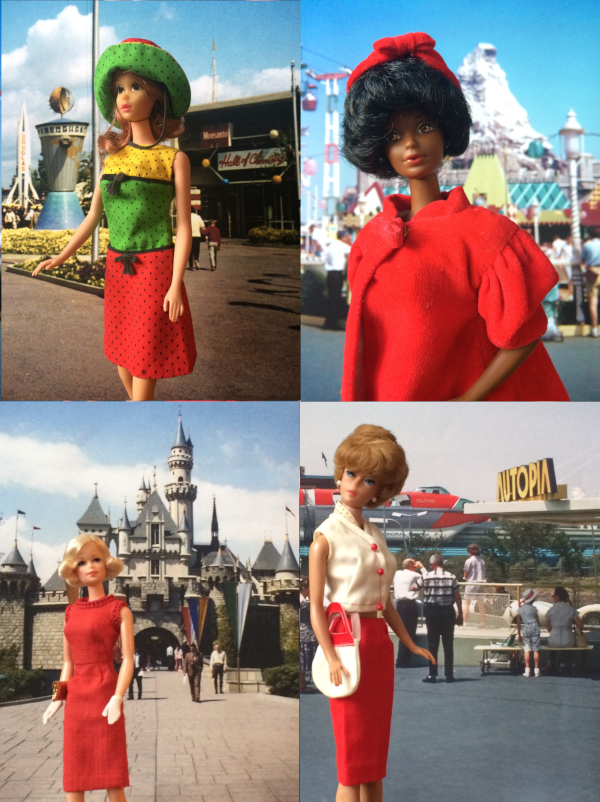
There’s still more to come, but before you scroll off into the distance, here’s the first image ever posted to this blog back in 2022: some of my dolls, dressed in vintage or vintage reproduction, in front of vintage Disneyland backgrounds belonging to Bill Cotter:
-
The built environments of mini vintage Barbies

Casey gestures toward the mini New Dream House that came with Skipper’s bedroom. Bandai mini Busy Gal stands outside. One of the last key topics we have yet to cover in Barbie’s 1960s built environment is this one: miniature environs suited for Barbie-scaled vintage Barbie dolls. Since Barbie is 1:6 scale and 11.5″ tall, we’re talking about dolls that are 1:36 scale relative to a human, standing just a hair under 2″ high. Note that we draw a distinction between mini vintage Barbies and vintage mini Barbies: under the heading of mini vintage Barbies we include mini dolls that were made as recently as this century, but styled like Barbie of 50+ years ago. The Bandai mini Busy Gal, shown above, is but one example.
In the category of vintage mini Barbies, mini dolls manufactured 50+ years ago, there is only one example: the red-swimsuited, swirl ponytail doll Francie holds at right, below. The doll was sold in several sets for Skipper and Tutti; when purchased as part of the “Me and My Doll” Skipper ensemble she included a tiny, elastic gingham skirt in red or pink, as shown below.
And in the category of vintage mini Barbie houses there is only the miniature New Dream House, front and back views of which are displayed above and below. This is one of many delightful little chipboard accessories that came with Skipper’s 1965 Dream Room. Although lacking furniture and with simplified structure and screening, this mini house is on the whole a pleasing adaptation.
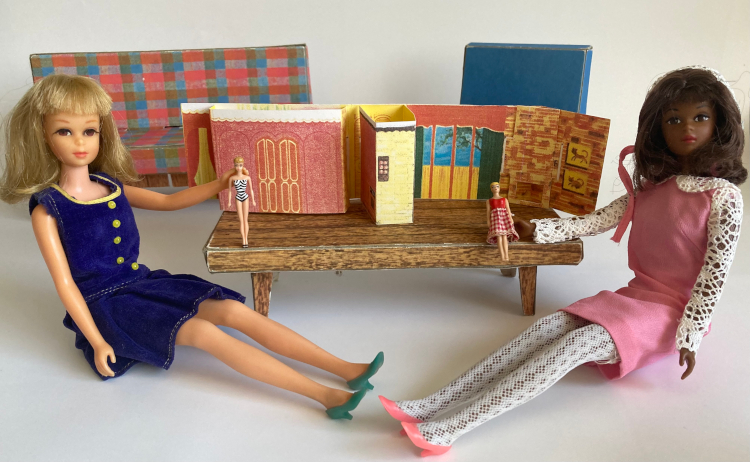
Francie and Francie brandish the vintage mini Barbie and the 40th anniversary mini Barbie in front of the mini New Dream House. Decades would pass before another mini Barbie environment was produced.
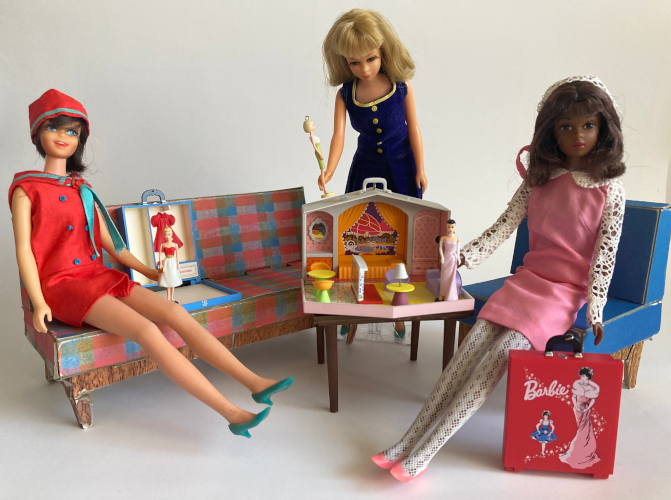
Above, we see the 2007 miniature Barbie Family Deluxe House from Hallmark. This is purportedy an ornament–like, for a Christmas tree–hence the little metal loop poking out of the miniature American Girl doll included in this set, wielded by Francie above center. It’s also an accurately-scaled, strikingly faithful downscaling of the ’66 original case house that only makes us wish Hallmark would venture into the vintage abode game more often. They did produce a pink Dream House in 1999 that reflected Barbie’s lifestyle at that time, but its ceilings are less than 2″ high, slightly cramping mini Barbie’s style. There’s also a series of cases with dolls, molded wardrobes and working accessories drawers, examples of which are seen above and below.
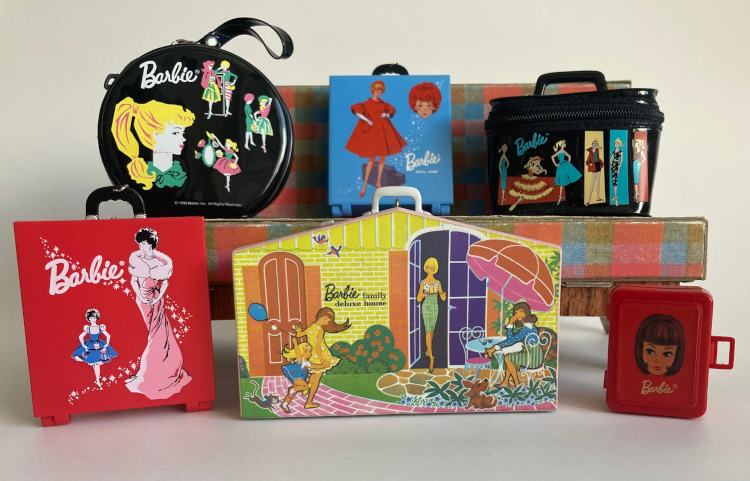
The Hallmark Barbie Family Deluxe House ornament, bottom center, within the case ornament milieu, alongside a couple Barbie-scaled Hallmark luggage ornaments and, at lower right, a vintage mini Barbie case for Tutti (sometimes identified as a lunch box, it’s just a bit too small to hold vintage mini Barbie). Next, let’s turn our attention to the World’s Smallest Dreamhouse, which is based on the verging-on-vintage A-frame Dream House.

Casey and Casey demonstrate the World’s Smallest Dreamhouse, along with a World’s Smallest Superstar case and the dolls–ponytail Barbie and Malibu Christie–that came with them. Inside, the Superstar case is divided into 3×3 compartments to hold the little dolls. Maybe it comes with the territory of being World’s Smallest, but this house is too small for Barbie-scaled Barbie dolls. Keeping with the Seventies context, the accompanying dolls are more Dawn-scale than Barbie-scale.
To achieve 1:6 scale, this house needs to roughly double in size:

Francie with a back view of the World’s Smallest Dreamhouse, left, and with a digitally resized version, right. If it existed, the version at right would be the correct 1:6 scale. It’s also not as faithful a representation as Hallmark’s work: as shown above, the mini version has screened walls on the back and is completely open in front, while the real version’s front and back are fairly similar, with various door and window openings, movable wings, and no screening. The World’s Smallest version does include some furniture in sticker form (not shown).
The last option for mini vintage Barbie environs that we’ll cover is DIY. The blog Dutch Fashion Doll World is the undisputed ruler of mini chipboard play set DIY; I linked an overview but you can poke around the site to see other articles detailing their approach. Does their mini Skipper’s Dream Room include a mini mini New Dream House? It totally does.
I’m not so skilled or dedicated, so for my DIY project I decided to make some paper dolls. This method is super easy because you can find PDFs of the vintage paper doll sets (I picked mine up on Etsy for a couple bucks), print them small, and you’re pretty much done! Our piece on paper doll environments contains many tempting candidates for a Barbie-scaled paper doll scene, but I opted for an old favorite: the Friend Ship. Here are Francie and Casey riding on the Friend Ship, playing with 1:6 scale paper dolls from the Whitman paper doll sets Barbie’s FriendShip (’73) and New ‘n’ Groovy P.J. (’70):

In this instance, the built environment is the Barbie’s FriendShip paper doll folder propped up at the back of the table.
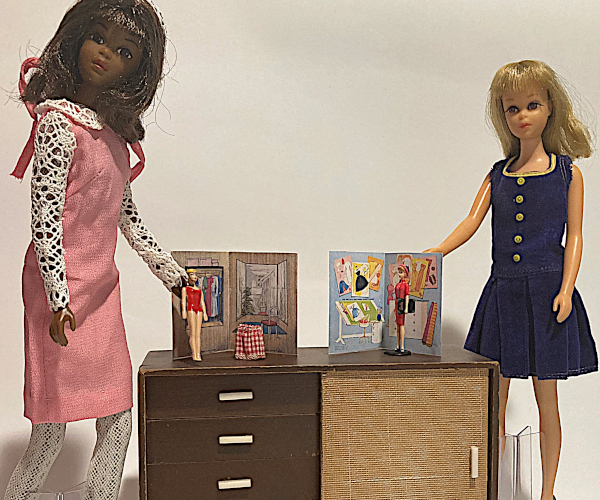
We’ve previously demonstrated the paper doll sets’ potential as environments for fully dimensional Barbie in addition to her paper doll form, and that applies in miniature, as well: your dolls can use mini paper doll folders as environs for their other dolls, too. Below, Francie helps vintage mini swirl ponytail enter a 1966 Barbie, Skipper and Skooter dressing room folder to try on her lone garment, while Bandai Busy Gal is posed before the fashion designer’s studio from a 1963 Barbie, Ken and Midge set.
Setting aside our paper doll sets for the moment, Barbie-scaled vintage Barbies are scattered throughout this post. Before we wrap up, let’s quickly review our dolls’ doll options.

Mini Barbies occupying the World’s Smallest Dreamhouse and checking out the vintage case/lunchbox. In the house, top row: Silken Flame from the Hallmark Red Flare case and vintage swirl ponytail mini Barbie. Bottom row: Lunch on the Terrace from the Hallmark Barbie Family Deluxe House; 40th anniversary mini Barbie in her reproduction box; Bandai mini Busy Gal; a Fairytopia Little Lands doll and Mini Barbie Land (Barbie Movie) mini doll that are smaller than Barbie-scaled Barbie but larger than World’s Smallest Barbies; and World’s Smallest Malibu Christie, the smallest of them all. Next to the vintage case are World’s Smallest Barbie and Ken, who can easily occupy the box as a carrying case, and a second Mini Barbie Land Barbie, who can fit in the case if she bends. While there are about a million different Barbie Land mini Barbies, if any sport a vintage look we haven’t spotted them (though actually, there’s an astronaut with rocket ship that might be passable as 1965’s Miss Astronaut). Another non-vintagey line of mini Barbies, that are the correct Barbie-for-Barbie scale, are the Y2K-era Tomy capsule toys. While not mini vintage Barbies by our definition of “vintage,” a couple could be used to fill out crowd scenes for your dolls.
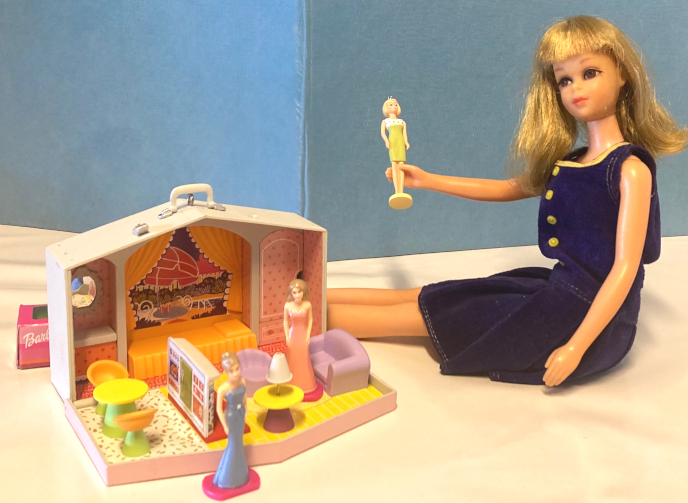
The American Girl Hallmark doll (in Francie’s hand) invites a couple Y2K Tomy mini Barbies to her case house. One of the Tomy doll boxes, which clearly indicates the dolls’ era, is just visible at back left. Though we show just one or two examples, Hallmark and Bandai have produced five or six vintage-style mini dolls apiece, while the two Mattel 1:6 scale Barbies we show are the only two they’ve made at that scale, to our knowledge. Both Hallmark and World’s Smallest also produce larger Barbie figurines, around 3″-5″ tall; we love the nostalgic Hallmark ones but don’t quite see a role for them in full-sized Barbie’s world.
A slight tangent: while most of the vintage-style mini dolls stand straight, the Bandai minis have more expressive poses that wouldn’t have been possible for the stiff-limbed originals. Inaccurate for actual vintage dolls, these poses are based on the fashion booklet illustrations corresponding to each ensemble!
Since some non-vintage dolls have entered the conversation, let’s address the elephant in the room: yes, your doll’s dolls can occupy the mini Barbie Land Movie houses, but no, they have no vintage atmosphere. Like the movie, they are pink, opulent, and oversized, and they have slides. Here’s the most restrained one in the series:
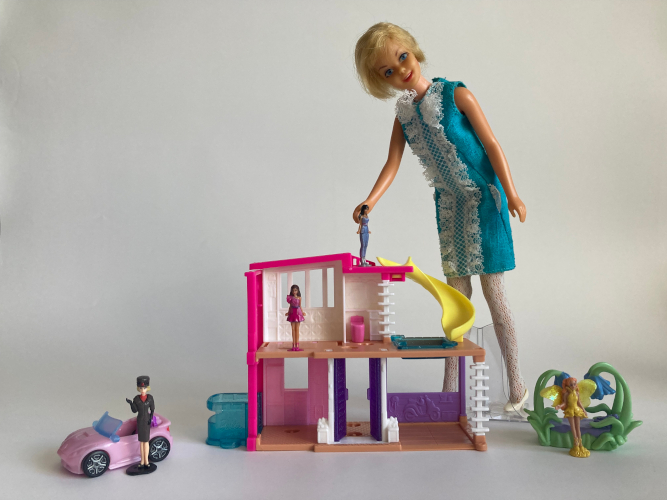
Scaled a little small for 1:6 scale Barbie, but with high ceilings and plenty of square footage, we grudgingly note them as a multistory alternative to the too-small World’s Smallest Dreamhouse.
At left in the above image, Bandai mini Career Girl demonstrates how the Barbie Movie mini convertible might pass for a vintage Austin Healey if you squint.
Above right, the Fairytopia mini doll dragged her preposterous bed into the shot to try to suggest that Fairytopia Little Lands could serve as a built environment option for your mini vintage dolls. They cannot. Even though the little Fairytopia figures are smaller than Barbie-scaled Barbie, their play sets are absolutely enormous, in addition to falling squarely outside the vintage theme. Unless your dolls are Richie Rich types, they’re not playing with these “little” environments:
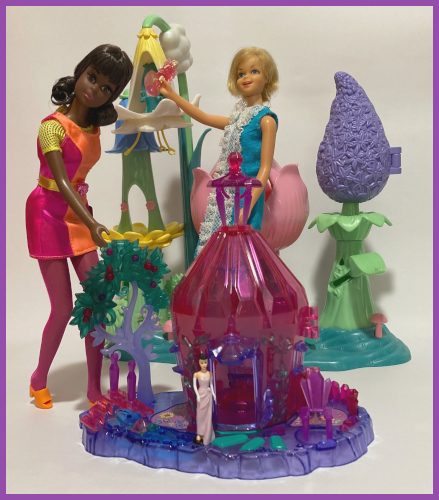
Francie reaches for the Hallmark mini Enchanted Evening doll in front of Jewelia’s house, while Casey brandishes Jewelia near Peony’s house at back. That’s really not the vibe we’re going for here… Let’s dial it back a notch.

Serious and silly mini houses with vintage-styled occupants Where to next? This post is about Barbie’s early built environment. The most recent post in this category concludes the Barbie’s Seventies Travelogue series, and the most popular are those on Mattel Modern and Susy Goose furniture and on penthouse apartments. Otherwise, the overall most popular posts on this site are about Barbie shoes, 1959-67, and about Mattel fashion booklets. Or just head up to the Table of Contents to see more options.
-
Millennium Mod
Barbie’s Swinging Fashions, 1980-2020
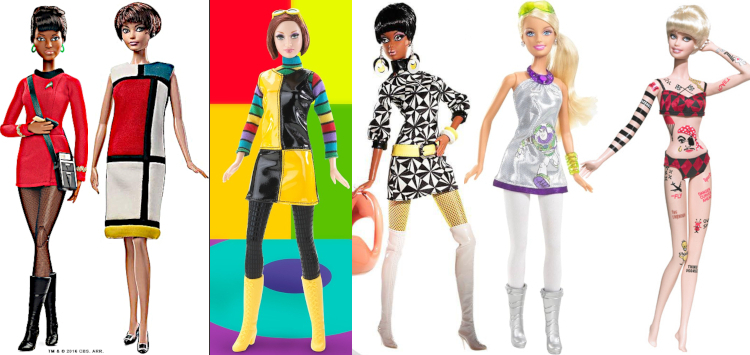
The mod era–the Swinging Sixties, the Youthquake, fashion’s Space Age–was a time of major style upheaval. Short skirts with high boots, vibrant patterns and colors, and rejection of tradition reigned. Street fashion led the new trends while couturiers rushed to keep up. For Barbie, the period spanned approximately 1967 to 1973 (or earlier), following her couture-focused early years that some refer to as the vintage period (for this piece we take “vintage” to mean anything made for Barbie through 1973).
Since those heady days, various aspects of the mod look have come in and out of fashion, and Barbie’s wardrobe has reflected that. In this post we highlight those times since 1980 (and ending in 2020, for symmetry about the millennium) when Barbie’s designers have deliberately referenced Sixties mod fashion. We’ll place the newer looks in the context of their classic counterparts and explore similarities and differences in the design approaches.
1985 Galaxy a Go Go
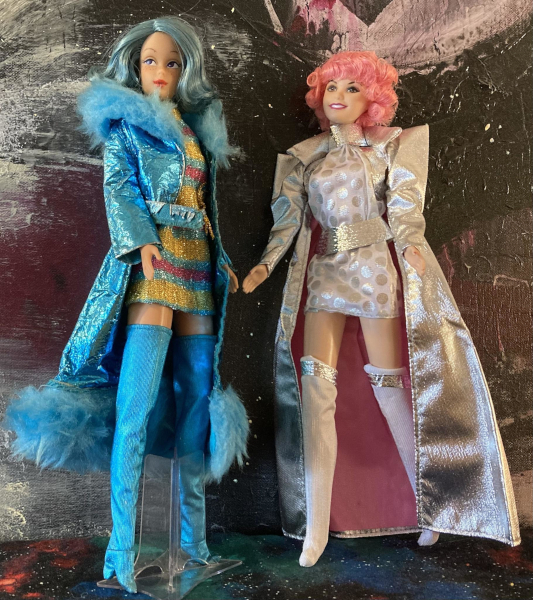
Barbie’s mod years were still receding in the rearview mirror when the futuristic Astro Fashions were released alongside the controversial Astronaut Barbie. Galaxy a Go Go, in particular, references the Swinging Sixties in both name and design. The short dress paired with long coat and high boots in metallic fabrics, shown at right above, may be an explicit nod to 1970’s Maxi ‘n Mini, left. Just as easily, the two could drink independently from the same space age fountain. Without prior knowledge, is it easy to pick out which of the above is a mod design, and which is Eighties? We think not. The pointed shoulders on Galaxy a Go Go, which occur on both dress and jacket, are one hint, though that oversized fur collar on Maxi ‘n Mini is nothing to sniff at in terms of shoulder fullness. (Note, Carol Spencer credits designer Thierry Mugler as the inspiration for the Astro Fashions line, including its sharp shoulders.)
It would take a few more years for mod style to become appealingly nostalgic, so this early example, using mod-era futuristic notions for an updated spacey look, is our lone Eighties mod entry. Popular retro looks of this period tended toward the early Sixties (Barbie and the Sensations) and prior.
1992 Hollywood Premiere
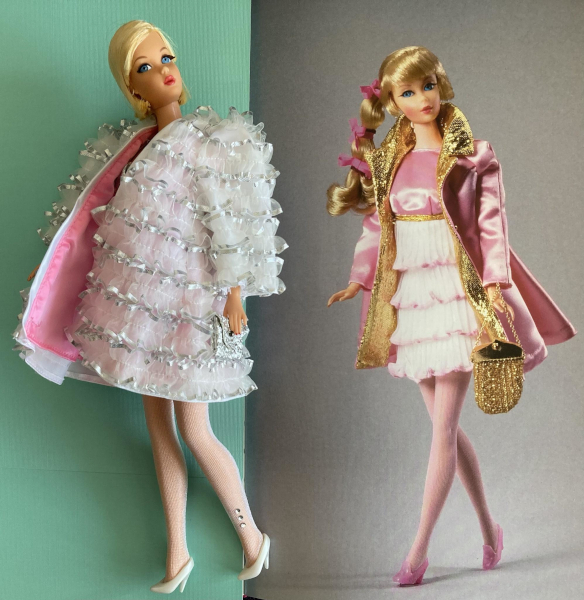
1992 was still a little early to revisit mod ideals, but we think this Carol Spencer design contains not-so-subtle references to 1969’s Pink Premiere. Hollywood Premiere was part of the collector-targeting Classique series, which was meant to highlight Mattel’s designers for the first time. In her book Dressing Barbie, Carol Spencer states that her concept for the Benefit Ball Classique doll was inspired by the 1966 Benefit Performance fashion, one of her personal favorites–though the designs themselves are dissimilar. She further indicates that the other designs were also informed by past episodes in Barbie’s life: the Classique Uptown Chic fashion referenced Barbie’s earlier experiences shopping on Fifth Avenue–think On the Avenue (1965), and other fashions from that glamour year–and it stands to reason that Hollywood Premiere refers to 1969’s Pink Premiere, a Spencer design highlighted in her book, shown above right. While Hollywood Premiere’s bodycon silver minidress is more Jean Paul Gaultier, the ruffled, trapeze-shaped, mini-length coat alludes both to Pink Premiere and to the ’60s more generally.
The similarity in color schemes between Hollywood Premiere and Galaxy a Go Go–white, silver, and pink, with the pink jacket linings apparently identical–is an interesting coincidence. Like Galaxy a Go Go, Hollywood Premiere also sported formidable shoulders.
1996 Star Trek 30th Anniversary
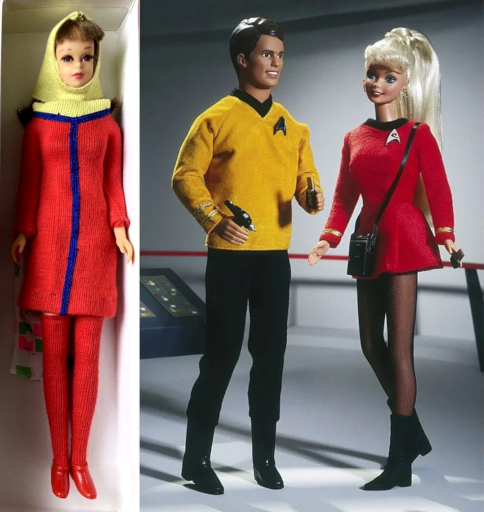
Not a fresh perspective on swinging style, but a fairly accurate interpretation of a 1966 TV costume for 1996 Barbie. Those of us familiar with the original television series may experience burning of the eyes when we see blonde Barbie modeling the Star Trek female crew member’s uniform. Ken resembles Captain Kirk, more or less. Why doesn’t Barbie look like Uhura? Perhaps because this model or a similar one was used time and time again for mid-’90s gift sets and special editions. For what it’s worth, with her tricorder and plaited hair she’s deliberately styled like Yeoman Janice Rand, originally a core, blonde character and Kirk’s love interest, whose role was reduced due to budget constraints and to free up the Captain for romantic (mis)adventures on alien planets. Still, these explanations fall short of satisfying.
Whatever the case may be, we’re comparing the Star Trek uniform to Francie’s Swingin’ Skimmy (via raisingfour on eBay), another ’66 design that’s clearly influenced by the Cosmocorps and Moon Girl uniforms proposed by Sixties visionaries Cardin and Courreges–notably in the hood/helmet department.
1996, the 30th anniversary for both Star Trek and Francie, is also the year Mattel started releasing mod Francie reproductions, though Swingin’ Skimmy hasn’t had its moment yet.
1997 Teen Skipper Fashion Avenue (and Sticker Fun Barbie)
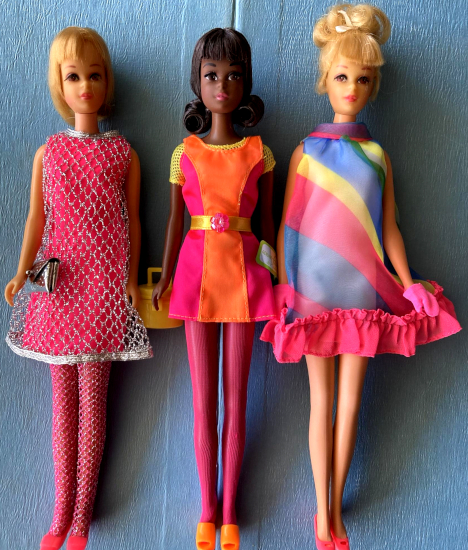
Mod made the mainstream again in 1997 with a couple flower-forward Mattel creations: a Teen Skipper design for Fashion Avenue, modeled by repro Francie, above center, and a highly similar design for Barbie under the name Sticker Fun (not shown). Teen Skipper’s ensemble above is surrounded by vintage Francies in 1968’s Silver Cage and Floating In (repro shown). With platform shoes, day-glow colors and a daisy-shaped belt accent, the only really ’90s thing about the Teen Skipper outfit, to me, is the mesh shirt; but even that has precedent in Silver Cage.
Fashion Avenue also offered a pink-and-orange baby doll dress for Barbie with very Sixties daisies along the waistline. Its silhouette and accessories are overall regrettable, but for the completionist the ensemble still merits a gander (not shown here).
1997 Sixties Fun and 1998 Far Out
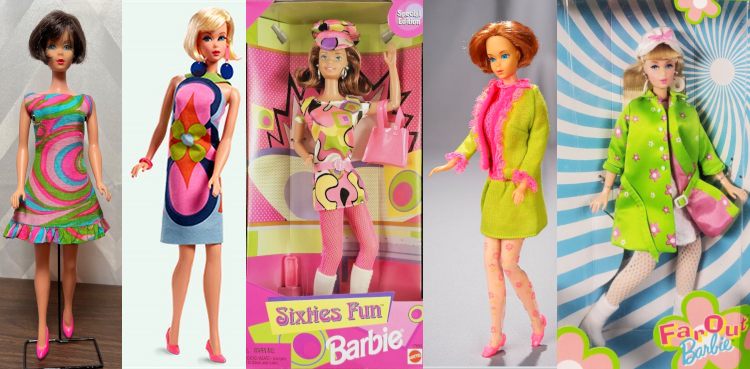
The mod parade continues! Above, two more ’90s mod interpretations (via Super Thrift and claudia_attic_17 on eBay) are lined up with vintage designs Swirly Cue (1968, via Mimi Collects It on eBay), Sunflower (1967; 2016 repro product photo shown), and Fancy Dancy (1968, via Theriault’s).
Somehow, Sixties Fun Barbie’s patterned fabric looks more postmodern: it exists in a world where Jean-Michel Basquiat and Keith Haring are known. Otherwise, the white boots the two ’90s dolls wear come straight from Courreges–strange that Barbie seldom wore white ones in her original mod phase–and the big chunky earrings are on point. Far Out Barbie’s big plastic discs a la Paco Rabanne are reminiscent of those included with the Sunflower ensemble, seen above, and Swirly Cue also came with chunky plastic ear hardware.
1998 Pretty in Plaid and 2000 Hip 2 Be Square
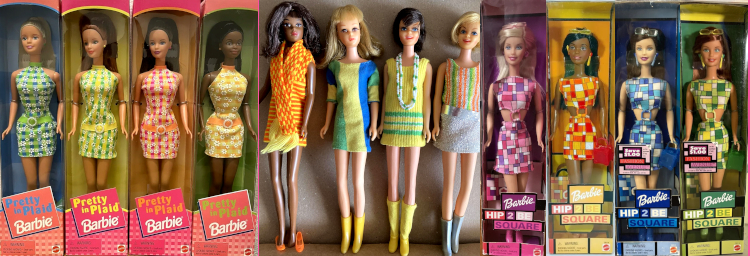
Pretty in Plaid, Twiggy, and Hip 2 Be Square fashions. “Millennial” images via eBay sellers: Squid Willy, johannesattic, oosushi, Beetlejuice’s Treasure, JJ Resale and Collectibles. Here, at the turn of the millennium, mod has infested the playline. As shown above, both of these outfits came in four color palettes on four dolls, and all featured the micro-minidress. The hemline is true to the Sixties–we compare to the four minidresses Mattel designed for their Twiggy doll in 1968, modeled by Francie and Casey above–as are the bright, bold patterns–but the skintight, bodycon aspect is more Nineties. The double waistline of curve-clinging silhouette and drop-waisted belt on Pretty in Plaid isn’t working for us, but the cutouts on Hip 2 Be Square’s dress are authentic to the original mod time period.
1999 Fun to Dress Fashions
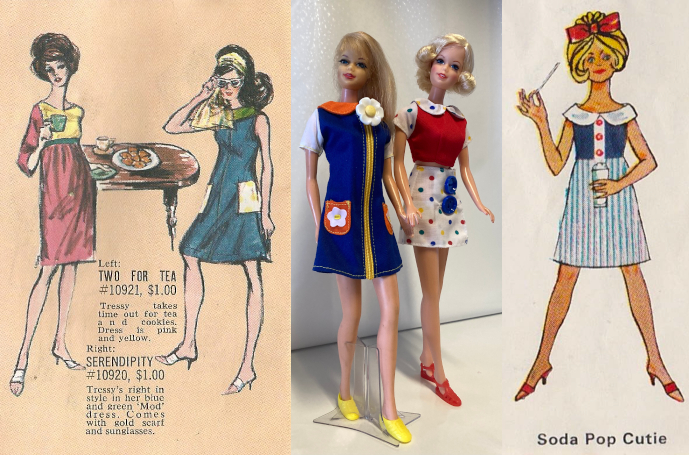
A quartet of fashion packs taught youngsters how to zip, button, buckle, and tie in colorful, playful mod style. Two, for zipping and buttoning, are displayed on a pair of Staceys above. The outfits that aren’t shown, both flower-powered minidresses, were groovy in their own right, particularly the buckling ensemble with its wide, white belt at hip height. For a change of pace we offroad a little, comparing the ’99 fashions to illustrated looks from circa-1966 Tressy fashion booklets with similar color blocking and even flowered patch pockets.
2000 Groovy 60’s Barbie
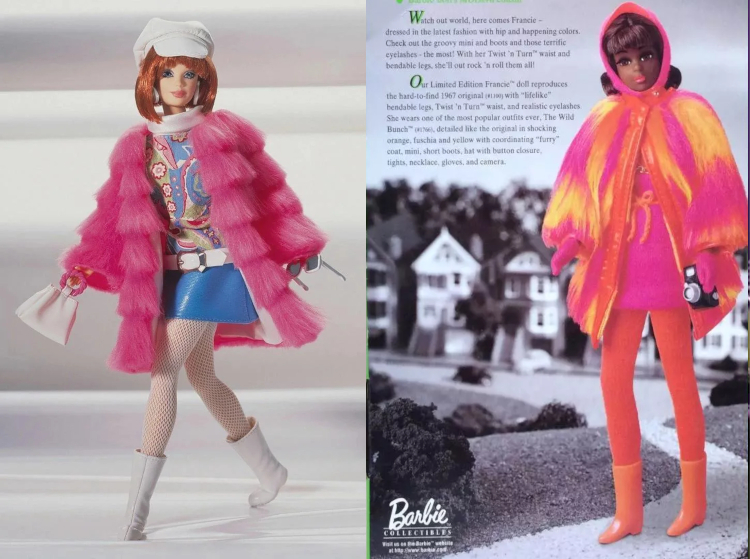
Part of a Great Fashions of the 20th Century line, Groovy 60’s Barbie, at left, fits right in with the earlier Far Out and Sixties Fun dolls–right down to her chunky earrings and white boots. Her novelty-colored faux fur reminded us of Francie’s the Wild Bunch (1970; 1997 repro shown above), and really, the whole look is in harmony. A faithful, detailed Sixties evocation.
2001 Sunshine Day Barbie
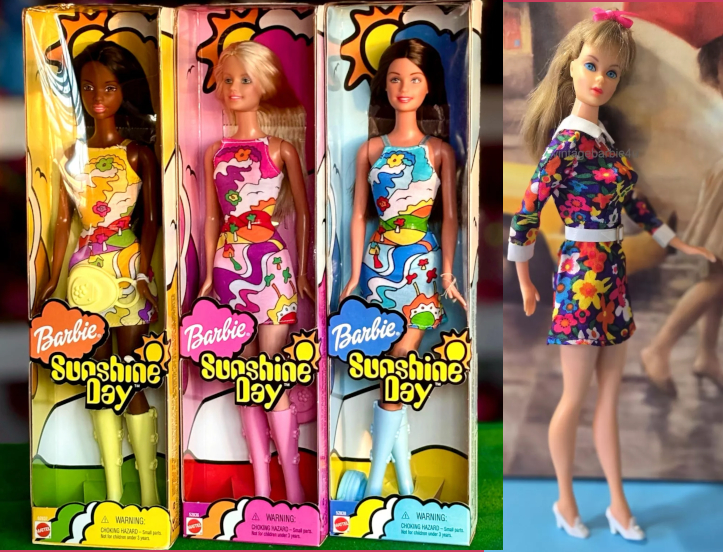
Hat tip to Scarlett-Crypt on Reddit! Here’s another turn-of-the-century swinging playline series with different color schemes for each doll. “It’s a Sunshine Day” was, of course, a hit for the Brady Bunch in 1972. In ’73 Mattel released the unnamed Barbie fashion #3347, shown at right (via eBay seller vintagebarbie4u), colloquially known as the Marsha Brady dress. The dress came with white knee socks, in the patterned version above and in solid red.
2002 Scooby Doo Daphne
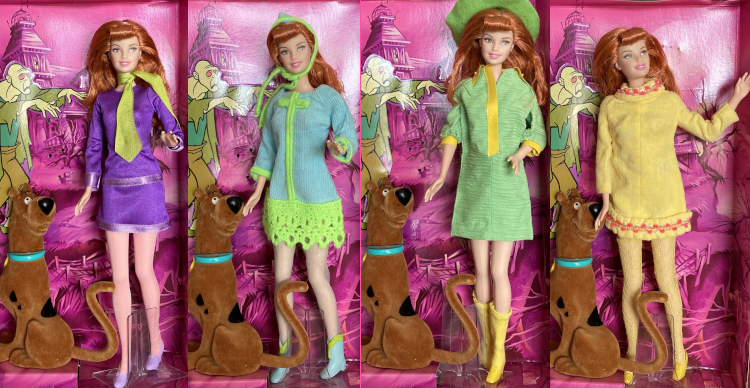
Two Daphnes were released around this time, one based on Sarah Michelle Gellar’s character in the then-new live action film, and one based on the cartoon from 1970. Either could suit this list, although we opted for the more-authentic cartoon version. Daphne in her original outfit, above left, has total mod Barbie style as evidenced by the doll redressed in, from left to right, Now Wow, Snap Dash, and Mellow Yellow (all 1968-69). Except for one small detail: maybe because the hue was granny-coded circa 1960, Barbie wore almost no violet from her creation at least through the end of the original mod era in 1972. Thus Daphne’s outfit makes a great supplement to our vintage collections.
2002 Rocky Mountain Mod Convention Doll
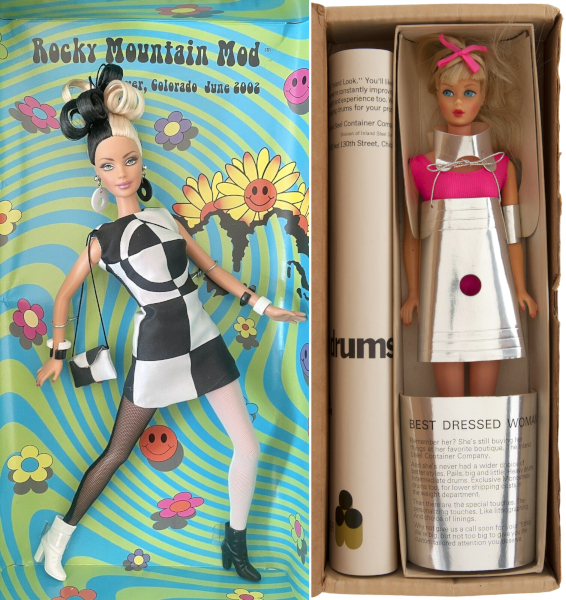
Rocky Mountain Mod doll via ForeverPink on eBay; Barbie Loves the Improvers via Hake’s Auctions. This one’s kind of a cheat, because Mattel didn’t release the Rocky Mountain Mod doll; it was produced for the convention without Mattel/Barbie branding. However, its mod-ness is undeniable: the boots, chunky jewelry, and op-art design are all on point. It could be a John Bates design for Emma Peel (Diana Rigg) on the original BBC TV show, The Avengers.
Due to its unofficial nature, we compare Rocky Mountain Mod to Barbie Loves the Improvers: a Sixties concoction by Inland Steel, circulated among their salesmen and/or customers, featuring a mod Standard Barbie wearing an outlandish, space-age metal tube. The “Improvers” garment is based on an avant garde design by Paco Rabanne and includes a belly-button-revealing circular cutout at the navel (the doll pictured above wears her metal tube too low), while the “Rocky Mountain” dress features a circle design at chest level. Captioning an assortment of solar-plexus-adorning or navel-indicating circle patterns on vintage dresses in Vintage Fashion: A Complete Sourcebook, Nicky Albrechtsen wrote that “the circle is the identifying shape of the sixties. Metallic, plastic, PVC and easy-care synthetic fabrics were the basis of Space Age modernist designs of mid-sixties boutique culture.” These dolls concur.
2003 A Nod for Mod and 2004 Mod Redux
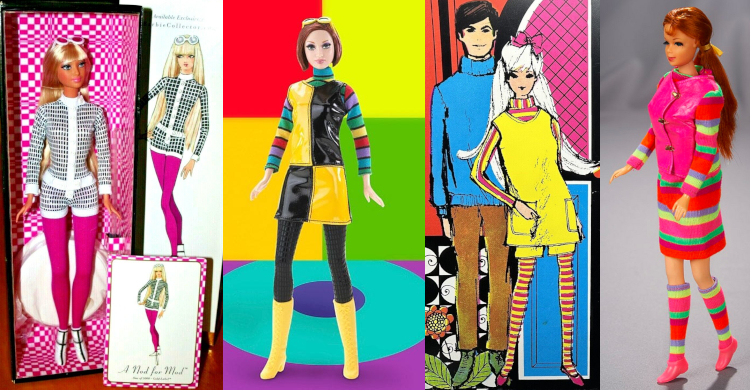
The two collector’s editions shown above left, released as a series, must rank among Mattel’s best original mod designs in the millennial timeframe. They are of a piece with the vintage fashions, represented above by the 1968 ensembles Tunic ‘n’ Tights (as illustrated on the Barbie Family House) and Stripes Are Happening (via Theriaults). Red White and Warm (1969) and Color Kick (1971), not shown, are also compatible, especially with the Gernreich-flavored Mod Redux. The major difference is that Barbie’s classic mod wardrobe tended to avoid black.
2008 Goldie Hawn Blonde Ambition
The only design on this list that’s an absolute miss for us, Goldie Hawn’s doll was based on an outfit she wore once on Laugh-In, the variety show that debuted in 1968 and launched her to stardom. A promotional photograph of this pirate-inspired, body-painted bikini look from the show is widely available, but Laugh-In had so many great, colorful costumes, it seems criminal to make a single Laugh-In fashion doll and let this be the “fashion.” Add some sequins and spangles to Swirly Cue, Sunflower, Flower Wower, or Two Way Tiger, vintage fashions shown elsewhere in this post, and you get much closer to the psychedelic look of Laugh-In. An opportunity squandered. Mattel’s 2008 choices appear in the header image for this post.
2009 Barbie Loves Buzz
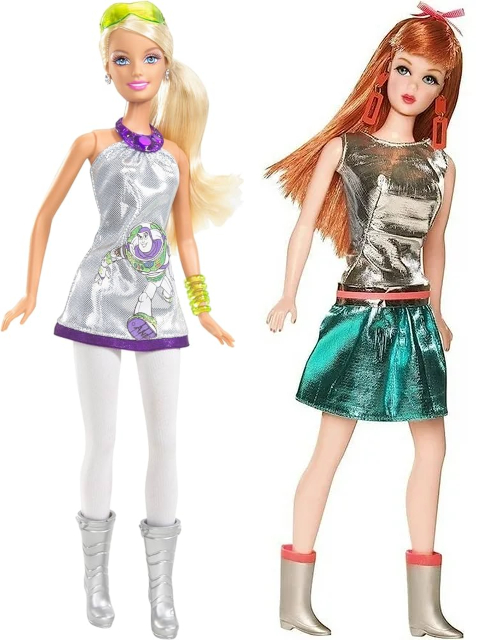
One of a series of dolls wearing Toy-Story-inspired fashions, Barbie Loves Buzz has great futuristic go-go style with metallic fabric, silver boots, chunky plastic accessories, and the most micro of micro-minis (with white leggings to complement). We compare her to 1968’s Zokko!, Barbie’s spaciest classic mod look. A recent book claimed Zokko! must be a BBC tie-in, because BBC aired a children’s show with a similar name. If Zokko! refers to anything, it seems most likely that this outfit was inspired by Johnny Sokko and his Flying Robot, the Japanese children’s show that was syndicated in the US, and maybe in Britain, too. In the Sixties the BBC would have partnered with Pedigree’s Sindy, not Barbie–but that’s a tale for another time. Anyway, Barbie Loves Buzz is a great nod to the futuristic visions of an earlier era.
2009 Pop Life
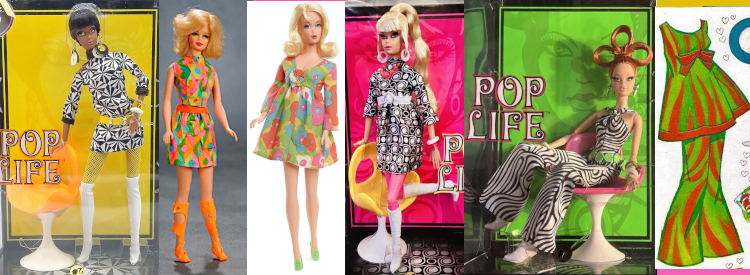
We have entered the nigh-priceless stage of our review: this series and the collector dolls coming up in the next ten years are some of the most hard-to-find, most expensive millennial-mod looks, despite being the most recent. The Pop Life dolls were meticulously period-authentic, with boots, chunky jewelry, op-art prints and modern tulip chairs. Some even used retro face molds. For all these reasons, along with limited production and circulation, they are highly sought. We compare them with the vintage fashions Wild ‘n Wonderful (1968, image from Theriault’s), Flower Wower (1970; 2018 repro shown), and Two Way Tiger (1971; paper doll version shown) to show how similar the silhouettes and patterns of the newer fashions really were to the late Sixties/early Seventies creations. Barbie’s earliest mod adventures, the Color Magic ensembles, would also suit. However, the vintage examples also highlight a difference we’ve noted at least once before: vintage mod Barbie did not wear black and white. Carol Spencer has spoken about adapting then-current trends to children’s tastes, and that’s probably part of the story. Without question, vibrant color palettes were also in fashion and Barbie’s designers focused their energy there. The recent dolls, made for adult collectors, face no such constraints.
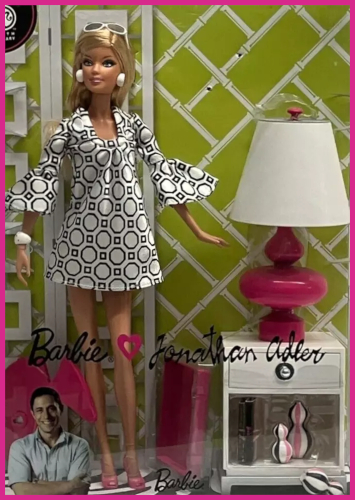
Update: We just learned about this Jonathan Adler Barbie, also from 2009. Style-wise, she’s a bit of a fourth Pop Life; and her furniture is a suitable accompaniment to the Pop Life chairs.
via baseballcards-and-bobbleheads. 2016 Star Trek Lieutenant Uhura
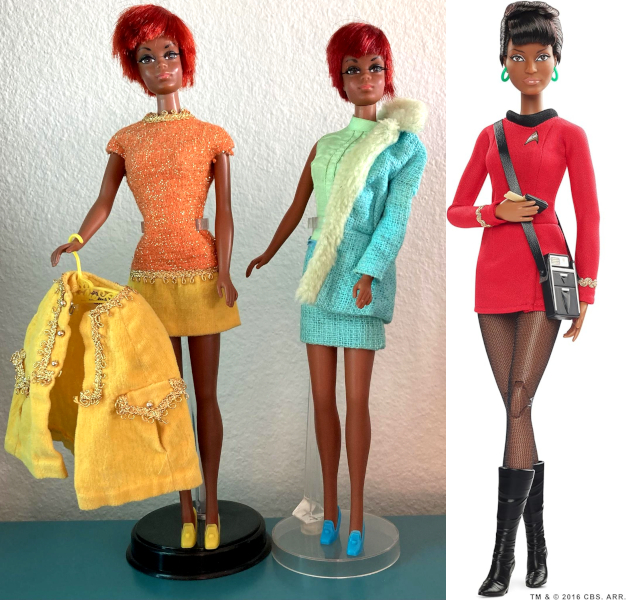
Twenty years on, Mattel corrected course and released the Star Trek doll they should have made in 1996. The fashion is little changed from the ’96 release, but is now worn by the most memorable female crew member from the original series. This time around we compare her to Mattel’s 1968 Julia doll, based on Diahann Carroll’s TV character, wearing two fashions marketed for that doll. Note that Diahann Carroll did not have red hair; the vintage dolls’ hair has oxidized (they look sharp redressed as Star Trek officers, by the way). Julia and Uhura were both pioneering characters: Julia as series lead and title character who was not a broad stereotype (unlike the earlier Beulah); Uhura as a high-ranking officer in a professional, technical role–firsts for Black women, and in Uhura’s case, possibly for any woman.
And, as depicted above, both characters were associated with miniskirts. The Star Trek pilot episodes show female crew in trousers, but the tunic-like minidresses arrived when the show went to series. Grace Lee Whitney (Yeoman Janice Rand, mentioned above) recalled appealing to the costume department to let her wear skirts, and producers concurred. In 1966 hemlines had been rising for a few years, so a costume designer envisioning the future had nowhere to go but up. The skirts of Star Trek are about as short as they get. Two years later, when Julia debuted, hems had indeed risen as far as they could; at the close of the decade they plunged, the mini supplanted by the midi. This caused turmoil over at Julia, where the miniskirt was regarded as her “signature look.” Should she stay on-trend or maintain her image?
It’s easy for commentators today to overlook the fact that, like trousers, miniskirts in the ’60s were associated with women’s liberation. Before the swinging revolution, women’s options were movement-constricting pencil skirts or weighty yards of fabric with oppressive undergarments, a la Dior; thus the mini represented freedom, both literal freedom of movement and figurative choice and autonomy. Nichelle Nichols (Lt. Uhura) later said, “I was wearing them on the street. What’s wrong with wearing them in the air? I wore ’em on airplanes. It was the era of the miniskirt. Everybody wore miniskirts. It amazes me that people still make some remark about ‘the revealing’. They revealed nothing. I had long black stockings on and boots up to my knees and the skirts and panties on and a skirt that gave you freedom to move in.”
2018 Yves Saint Laurent “Mondrian”
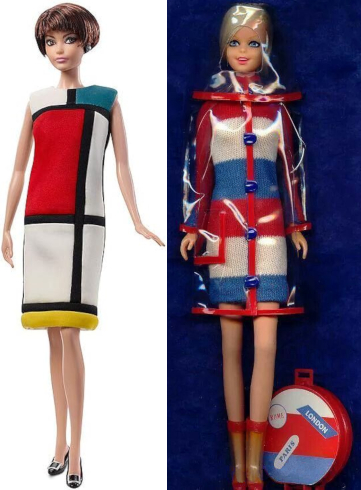
Yves Saint Laurent’s 1965 “Mondrian” series saluted the mod aesthetic with simple lines, bold colors and strong geometry. Mattel reproduced it faithfully, even going so far as to design a doll with the mod-essential “five point bob” haircut by Vidal Sassoon; everyone from Mary Quant to Nancy Kwan had a Vidal Sassoon cut. The doll’s features are further reminiscent of fashion model Peggy Moffitt, best known for her work with Rudi Gernreich, another proponent of sharp color palettes. See a few models sporting Mondrian dresses with Sassoon-style bobs in promotional images on display at the PatternVault blog.
At right above we find Mattel’s Twiggy rocking the color block in Clear Out (1967), the dress from which resembled, in different colors, Twiggy doll’s original ensemble (shown in a collage with ’90s playline fashions a few sections up). Coincidentally, Twiggy had one of the most famous Sixties hair cuts that wasn’t by Sassoon.
Miscellaneous Millennial Repros: peppered through this article have been mod reproductions created starting in 1996, including Zokko!, Sunflower, Flower Wower, and Wild Bunch. Older designs, they are still Millennium Mod in their production, as are further repros summarized in the image below.
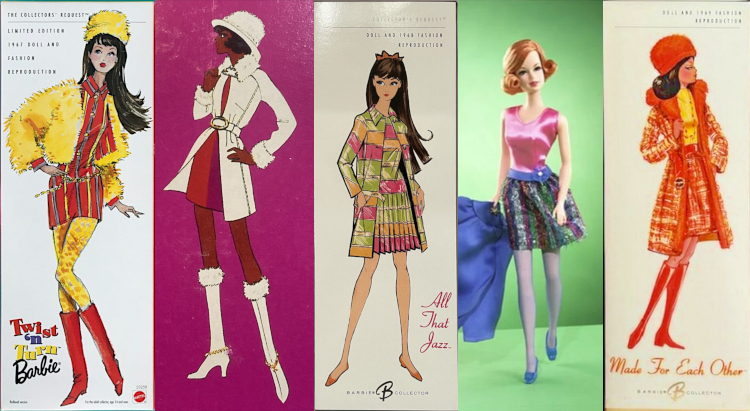
Mattel product images and box art for the Smasheroo, Red White & Warm, All That Jazz, Nite Lightning, and Made For Each Other reproductions. Did we miss any critical Millennial Mod designs? Having spent a good bit of effort assembling these examples, we still find more from time to time and would love to know of other gems we’ve so far overlooked!
-
Cafe Today (1971)

Source: kvitochki on eBay. Sixties Barbie was all dressed up with few places to go. There was the Little Theatre, but what’s “dinner and a show” without dinner? A show? Barbie’s only known 1960s eatery was not much of a restaurant, certainly not a nightclub: the Campus Sweet Shop was where Ken took Barbie for malteds, but she had absolutely nowhere to do this, or this,
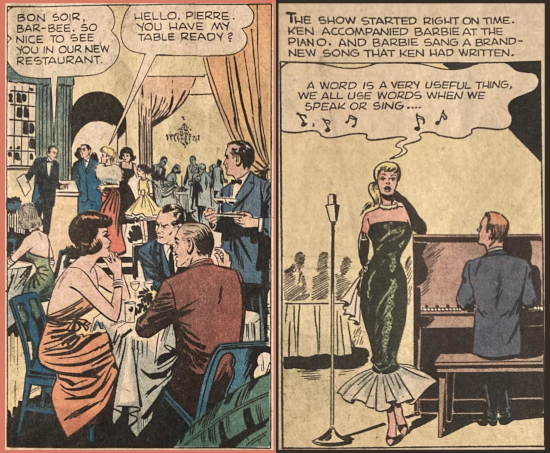
Source: Dell Comics or any of this,

just this:
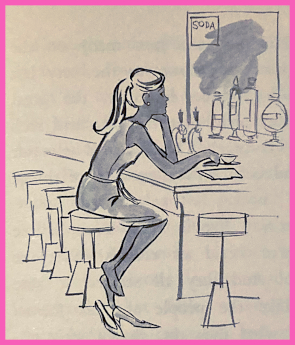
Source: Random House books. The 1971 Cafe Today play set didn’t help the situation. With burgers on the grill, soft drinks in paper cups, hot dogs on the table, and the counter window with awning outside, Cafe Today appears to be a hamburger stand.
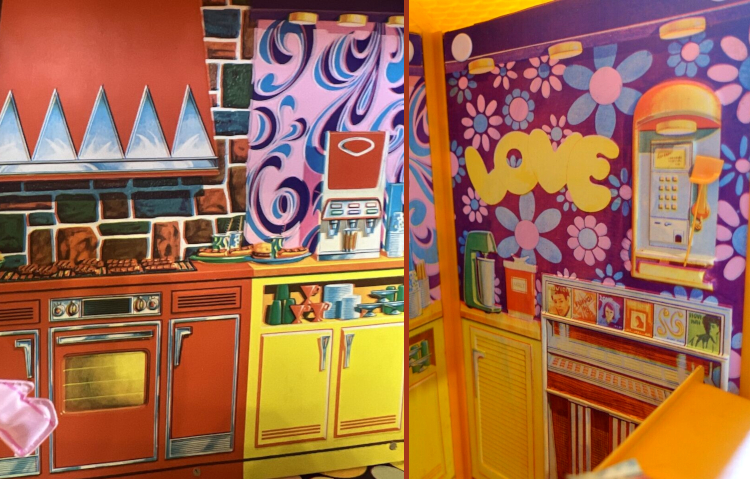
Printed interior details showing grill, soft drink dispenser, pay phone and ’70s-style jukebox. Ebay sources: supersebbe and kvitochki. We commend the interesting barrel chair design, at least:
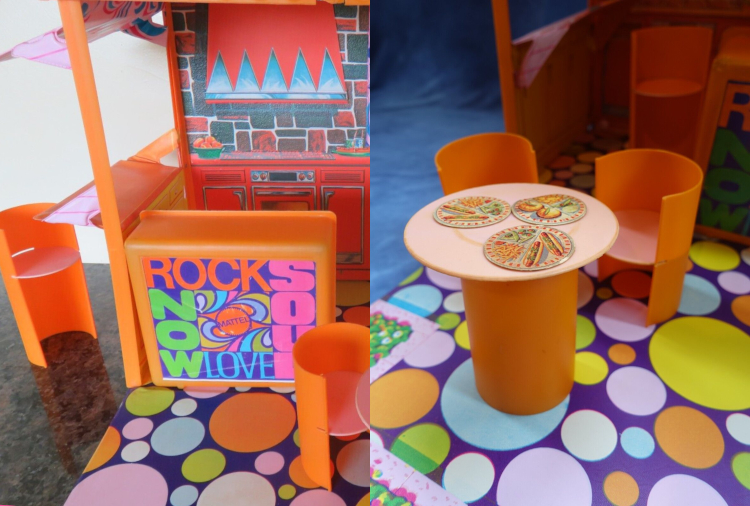
Counter, chairs, and hot dogs. Ebay sources: sjsutherland-2, supersebbe. In her Barbie structures book Marl Davidson describes Cafe Today as a discotheque, but I think that’s being generous.

Now this is a discotheque (off-brand play set/working radio from Sears Christmas catalog, 1976). Would Barbie ever get to dine in style? This might be moving the goal posts, but I’ll venture the 1986 Barbie and the Rockers Dance Cafe, unquestionably a discotheque, as a fashionable place to see and be seen, drink and dance, possibly even get a bite to eat:

Stylish Mattel discotheque, via retrorodeo82 on eBay. Will Pierre, the maitre d’, greet Barbie by name at the Dance Cafe? Perhaps not. But at least she can be hounded by paparazzi on the way in.
Back at the Cafe Today things are comparatively laid back: jukebox blasting, sun shining and grill sizzling. It’s an informal hangout space to complement the Unique Boutique of the same year.

Cafe Today exterior front and back. Source: kvitochki on eBay. Glamour will have to wait.
Where to next? This post is about Barbie’s early built environment. The most recent post in this category concludes the Barbie’s Seventies Travelogue series, and the most popular are those on Mattel Modern and Susy Goose furniture and on penthouse apartments. Otherwise, the overall most popular posts on this site are about Barbie shoes, 1959-67, and about Mattel fashion booklets. Or just head up to the Table of Contents to see more options.
-
The “built” environments of Whitman Barbie paper dolls
We talk a lot about Barbie illustrations here, and we talk a lot about Barbie’s play sets and furniture, but what about the built environments within Barbie illustrations? In our posts on Whitman paper dolls we featured some paper doll folder interiors that show Barbie’s home or place of work; in fact, there are many such folders worthy of consideration. These illustrations provided a backdrop against which to dress and re-dress paper dolls, adding a little immersion to the 2D doll experience. The set below is a perfect example.
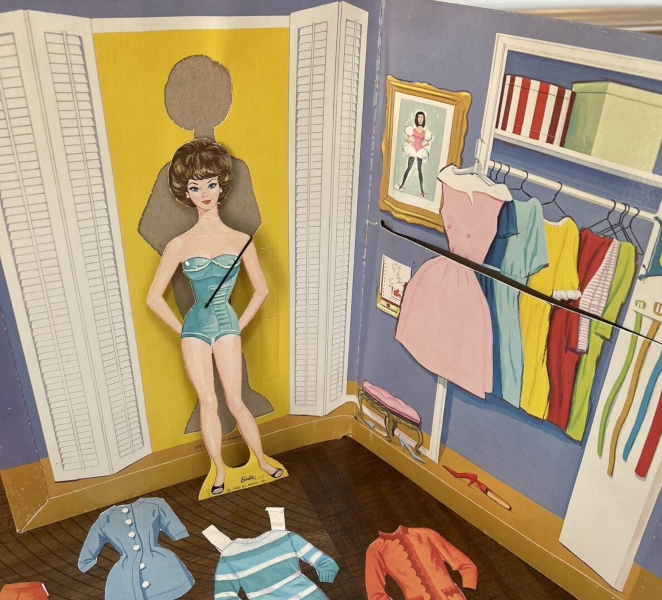
1963 Whitman Barbie paper doll set interior with doll. Source: PORCH SAFE on eBay. The illustrated interiors often show places where Barbie might dress, like this one depicting a changing room and closet. On the back of this folder is an illustration of Barbie posing before a full-length mirror, which we highlighted in our first post on the Whitman paper dolls.
A thematically similar design from 1966 shows either a boudoir scene or a store dressing room (since there are tags on all the dresses). We used this backdrop for a Francie/Casey photo shoot in a recent post.

1966 Whitman Barbie Skipper Skooter paper doll folder interior, with dolls and fashions poking out of the lefthand pocket. Source: dianeb6182 on eBay. Midge’s changing area was decorated in a romantic style. As a backdrop for diorama or for imaginative play, this piece loses some immersivity due to its paper-doll-shaped holes (the missing Midges of this set are very cute, by the way).
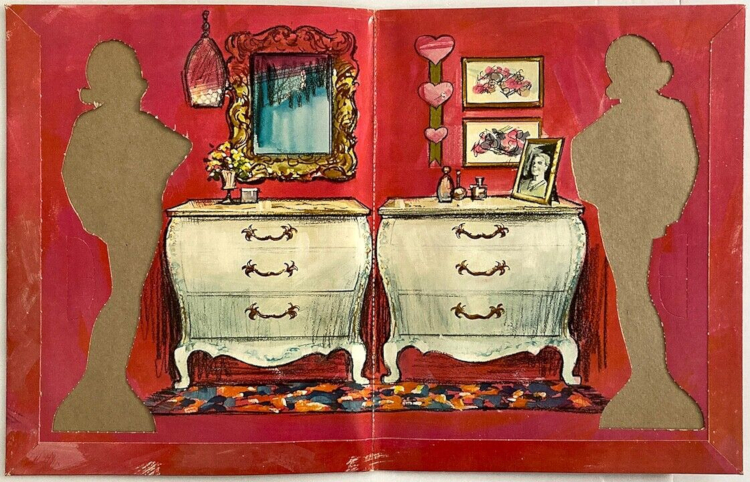
1963 Whitman Midge paper doll set interior. Source: harpagon-half on eBay. A different type of dressing room appeared inside the Little-Theatre-themed “Costume Dolls” set, which also included small versions of the Little Theatre’s stage backdrops. Since the Little Theatre itself has no backstage area, this folder makes a valuable addition.

1964 Whitman Barbie Costume Dolls folder reproduction. Source: Arlene’s Vintage Paper Dolls on eBay. Barbie’s early-Sixties career as a fashion designer provided another setting in which dolls might get changed, below. We’re especially fond of all the sketches of authentic Mattel Barbie fashions shown, when the paper doll set itself contained few or no recognizable Barbie ensembles.
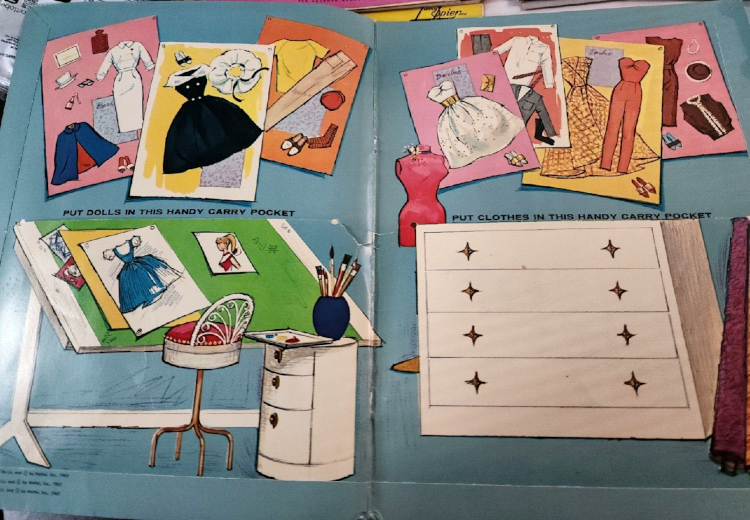
1963 Whitman Barbie, Ken and Midge folder interior. Source: Bees Knees Shoppe on eBay. At least once, a Barbie career was featured that did not immediately suggest dressing:
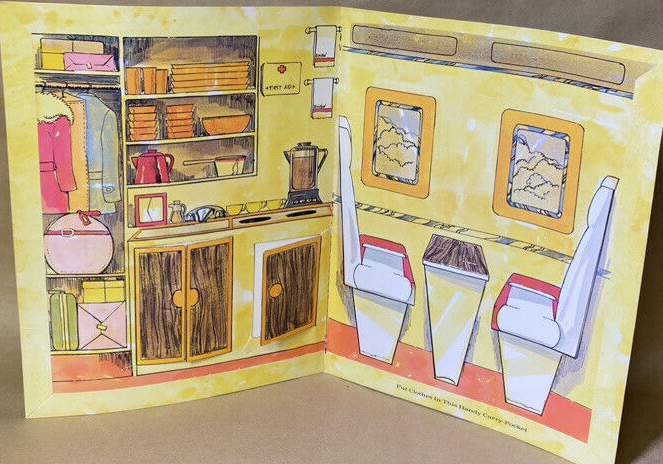
1973 Whitman Barbie’s Friend Ship paper doll folder interior. Source: Variety Company on eBay. although the Braniff air hostesses from a couple years earlier did have three costume changes per flight! We’ve demonstrated the use of this folder as a diorama backdrop in a couple of posts.
And other times, the illustrated setting was neither work nor home, as in the case of this drive-in burger joint:
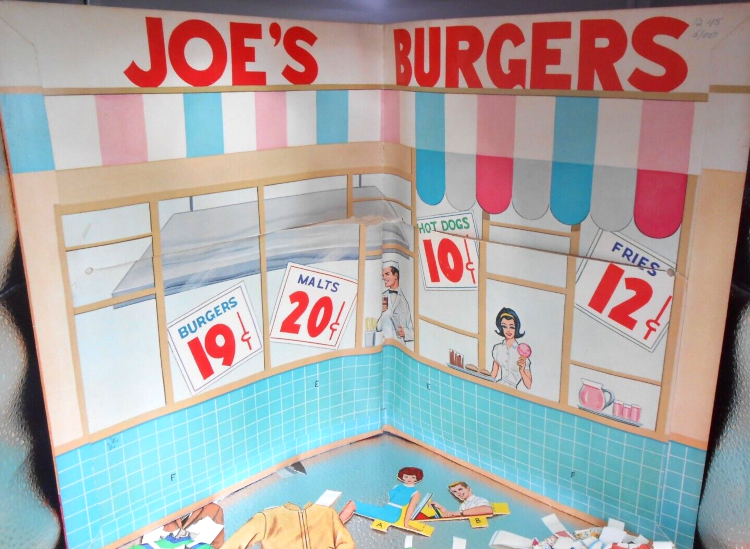
1963 Whitman Barbie and Ken paper doll folder. Source: Momma’s Hobby Vintage on eBay. To use it with dolls, paper or otherwise, the user must supply the car. The set did come with a small-scale paper car and small-scaled Barbie and Ken (lying in front of the folder shown above) to sit in it.
Lastly, at least one folder featured Barbie’s house with Barbie squarely in the scene. These illustrations, on a 1967 folder, show that year’s new T’n’T Barbie inhabiting the New Dream House, first available in 1964:
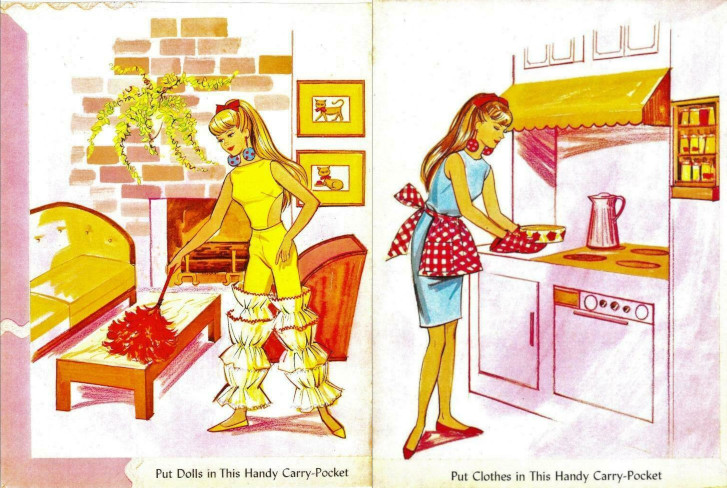
Inside the “Barbie has a New Look” folder from 1967. Source: onceagain34 on eBay. This is surely not an exhaustive list of built environments in the Whitman paper doll folders, although many folders featured illustrations less suited as a setting for imaginative play; in the Seventies the folders were phased out in favor of books with fewer ancillary illustrations.
Where to next? This post is about Barbie’s early built environment. The most recent post in this category concludes the Barbie’s Seventies Travelogue series, and the most popular are those on Mattel Modern and Susy Goose furniture and on penthouse apartments. Otherwise, the overall most popular posts on this site are about Barbie shoes, 1959-67, and about Mattel fashion booklets. Or just head up to the Table of Contents to see more options.
-
Unique Boutique (1971)

Barbie Unique Boutique package exterior During the second half of the Sixties, Barbie was a total homebody: following the release of Skipper’s Schoolroom in 1965, Barbie went through about a dozen homes, but no more public spaces. When she was finally ready to reemerge in 1971, it was into a different world.
Between the years 1963, when Barbie’s Fashion Shop debuted, and 1971’s Unique Boutique, clothes shopping underwent a revolution. In Vintage Fashion: a Complete Sourcebook, Nicky Albrechtsen explains: “Music, art and fashion interlinked to create a new culture, epitomized by the renowned informal boutique shopping experience… Boutiques stayed open ad hoc, a party atmosphere prevailing until the early hours, as consumers shopped listening to the newest music and the celebrities of art, pop and rock mingled with young shoppers all seeking forward-looking fashion that broke with convention.”
An early and impactful boutique reimagining was Mary Quant’s Bazaar store in Chelsea, which faced legal trouble in the 1950s for staying open too late, placing an unfair burden on the competition to do likewise. The boutique of Marion Foale and Sally Tuffin was another Swinging London staple, where the clothes were hung on overhead rails that stretched from wall to wall, surrounded by bare lightbulbs in red and blue. In his book on the pair, Iain R. Webb quotes a contemporary journalist describing Carnaby Street boutiques such as theirs as “like a club–the assistants just smoke and lean against the wall and put records on.”
Reminiscing for The New Yorker on his time living upstairs from trendsetting London boutique Granny Takes a Trip, Salman Rushdie wrote, “Inside Granny’s, it was pitch dark. You went in through a heavy bead curtain and were instantly blinded. The air was heavy with incense and patchouli oil and also with the aromas of what the police called Certain Substances. Psychedelic music, big on feedback, terrorized your eardrums. After a time, you became aware of a low purple glow, in which you could make out a few motionless shapes. These were probably clothes, probably for sale. You didn’t like to ask. Granny’s was a pretty scary place.”
Meanwhile in New York, Paraphernalia, serving the Warhol set with designs by Quant, Tuffin and Foale in addition to American designers like Betsey Johnson and Diana Dew, leaned more Exploding Plastic Inevitable: a vast, chrome-and-white interior with slides of the fashions projected on the walls. Johnson described it as “like stepping into a spaceship or into the future.” In all cases, music was blaring.
Mirroring progress in the real world, Barbie’s Unique Boutique, unlike the earlier Fashion Shop, has no stage for the store’s models to occupy, no armchairs and magazines for its customers. The space is narrow, an explosion of color and texture; you can easily imagine the records spinning… and you can practically detect the heady scents, as well.
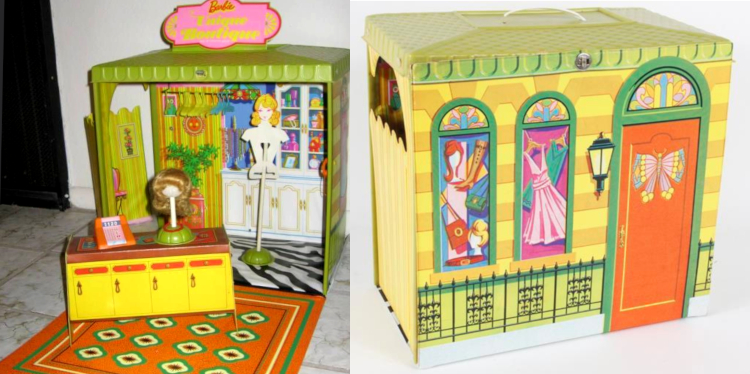
Left: vintage Unique Boutique interior including “manikin,” wig stand with wig, and cash register sitting on the counter/shoe rack. All that’s missing is that straight-backed plastic chair. Right: Unique Boutique exterior. Source: Ripley Auctions. Of the real-life Sixties boutiques we surveyed, we think the Unique Boutique shares the most DNA with Granny Takes a Trip–or maybe Biba. But Barbie’s London boutique phase was fleeting; her next forays into consumerism, in the Superstar era, would take place at indoor malls and department stores of a decidedly more American persuasion.

Barbie’s shopping evolutions in Christmas catalogs, 1964-1976. via WishbookWeb.com. Where to next? This post is about Barbie’s early built environment. The most recent post in this category concludes the Barbie’s Seventies Travelogue series, and the most popular are those on Mattel Modern and Susy Goose furniture and on penthouse apartments. Otherwise, the overall most popular posts on this site are about Barbie shoes, 1959-67, and about Mattel fashion booklets. Or just head up to the Table of Contents to see more options.
-
The Many Abodes of Barbie, Part VII: 1970

Source: slicksilver66 on eBay. In 1970 the best Barbie house arrived. A controversial statement, to say the least: among vintage Barbie Dream House enthusiasts, the chipboard diehards clearly feel differently, and for many plastic aficionados the great, timeless houses came later in the decade. However, we’ll present compelling evidence that the Lively Livin’ House (and the Surprise House, which is the same) represented the acme of Barbie’s domestic adventures.
In terms of furniture this house had the usual for 1970, glimpsed above: the couch and chair with game board, the circular dining table with two high-backed chairs, the solid molded shell of a bed; one novelty was a swing chair hanging from the second-story balcony, occupied by Christie in the image above. The ’72 version, the Surprise House, also added a planter with seeds for growing real plants and some gardening implements in keeping with the country emphasis of the time. The furniture was just fine.
But the Surprise House distinguishes itself in two key areas: the walls and floors.
Walls
Let’s take a closer look at that front room/living room, lower left in the box art that introduced this post:
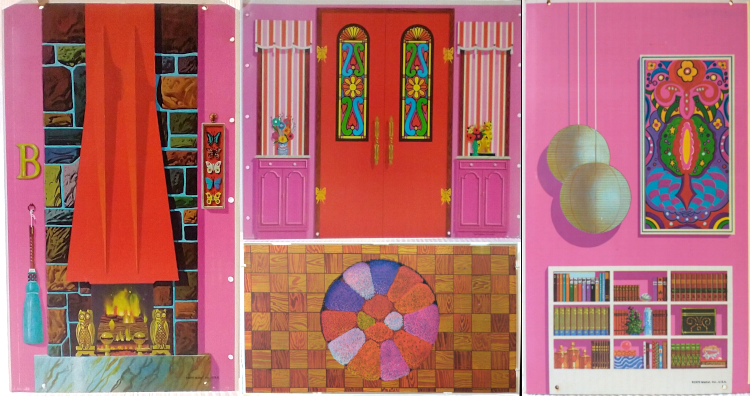
Walls and floor of one room of the Lively Livin’ House, via grozalis on eBay. Rich, colorful, detailed, midcentury-psychedelic. And here’s the kitchen next door:
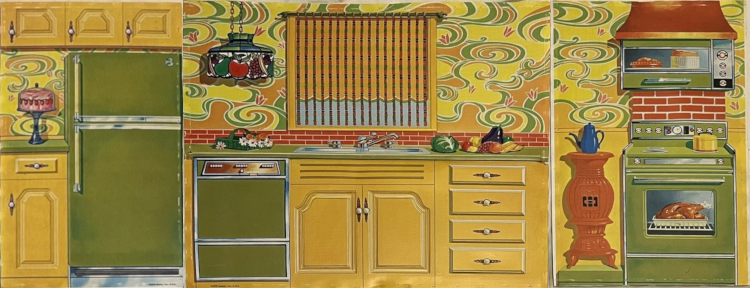
Walls of the Lively Livin’ House kitchen, via raregold on eBay. That mad wallpaper! The avocado appliances! There is no more beautifully-styled interior in Barbie’s plastic dream home era.
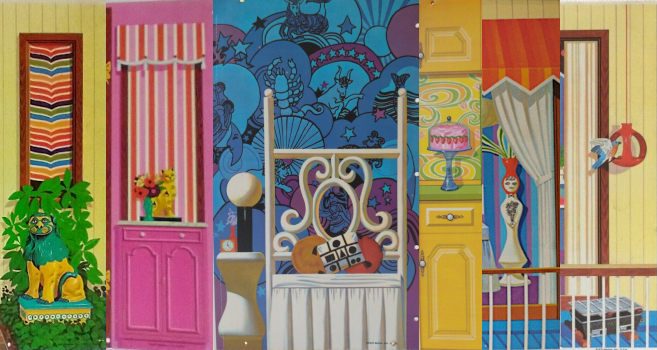
And outside? We’ve noted that Barbie and her friends were illustrated on the exteriors of the Sixties mod houses. 1970 marked the end of that trend. Instead, the Lively Livin’ House walls are jam-packed with gorgeous furniture, plants, planters, etc. These panels enclose the living room and kitchen we surveyed above:
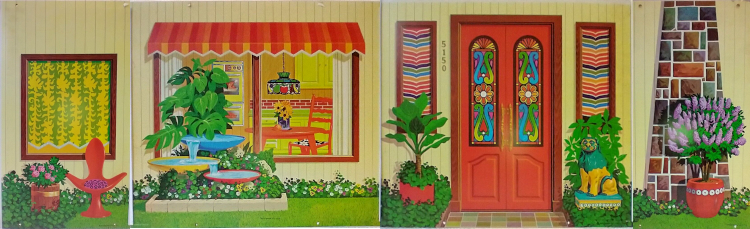
First floor exterior of the Lively Livin’ House, via grozalis on eBay. The chair and fountain would not be out of place in the original Star Trek series, while the stained glass and fieldstone chimney are all peak 1970 aesthetics.
In addition to the surfaces we’ve highlighted here, there was a bedroom in rich blues and purples, and three panels of garden walkways including a shuffleboard court. In a sharp pivot, this house didn’t fold up for carrying, but the three outdoor walkway panels did fold up to complete the house exterior with additional windows and decor and make it a bit more compact to store. The panels easily remove from the structures to serve as stylish backdrops for dioramas, and they are indestructible-ish vinyl, so they’re fairly common today.
Floors
When I named floors as a distinguishing trait of the Lively Livin’ House, I wasn’t talking about the appealing tiled floors that complement the walls described above. They’re great, but the real innovation of this house, floorwise, is this: as a two-story structure, it is the first Barbie home to have a second floor. Its multistory structure and lack of fold-and-carry capability set the precedent for more famous Seventies houses: the Townhouse and the A-Frame.

Famous houses. Sources: some_gave_all on eBay; Wishbook Web. The Townhouse had stylized interior walls featuring a heavy helping of gingham, but no printed exteriors. By the time the A-Frame arrived, screened-on wall decor was passé. We intend to end our Many Abodes series here, without digging into these dwellings; but it’s worth noting that the Townhouse is, with the possible exception of the Sleep-n-Keep case rooms, the most urban accommodation the Teen-Age Fashion Model ever inhabited. It took multistory housing to convince her to make the move which we’ve argued was necessary for her career since the start.
Back to our thesis: the combination of richly illustrated interiors (and exteriors!) as Barbie enjoyed in the Sixties, with the structural sophistication she’d come to know in the Seventies and beyond, is what makes the Lively Livin’/Surprise House the best Barbie Dream House, ever.
Rooms for Lively Livin’
A column runs down the right-hand side of the box art that led this post, apparently describing the house’s three rooms: Lively Livin’ Room, Cookin’ Fun Kitchen, and Teen Dream Bedroom. There’s nothing unusual about describing the play set’s contents on the package, and it’s not too extraordinary to give them these cute little names. But as it happens, there is more to this tale.

1970 Sears catalog entry for the Lively Livin’ House. Source: Wishbook Web. The 1970 catalog excerpt above lists not just the house itself, but also three individual rooms, sold separately: Bedroom Set, Den Set, and Dining Set. From the terse description, it seems as if these are just subsets of the full play set’s components (although this listing claims there is no bed or bedspread included with the Lively Livin’ House, other sources–including the box shown at top–disagree). But the Christmas catalog entries were often based on prototypes and concepts, as is the case here: besides the bedding confusion, note the red brick chimney on the lower left side of the house, and the densely-slatted fencing that differs from the final product. The real Lively furniture sets, rare-to-vanishing today, put their own spin on these rooms.
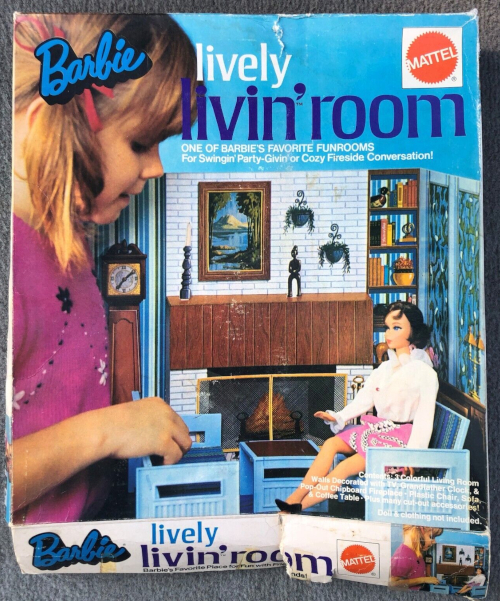
1970 Lively Livin’Room box art In fact, the “livin’room” set (probably the Den Set from the Sears catalog) does include the sofa, chair and table from the Lively Livin’ House, but in a different color palette (shuffleboard is not in evidence). The same was true of the Teen Dream Bedroom and Cookin’ Fun Kitchen furniture pieces. But it’s in the walls and floors (again with the walls and floors!) where the furniture sets really went in their own direction.
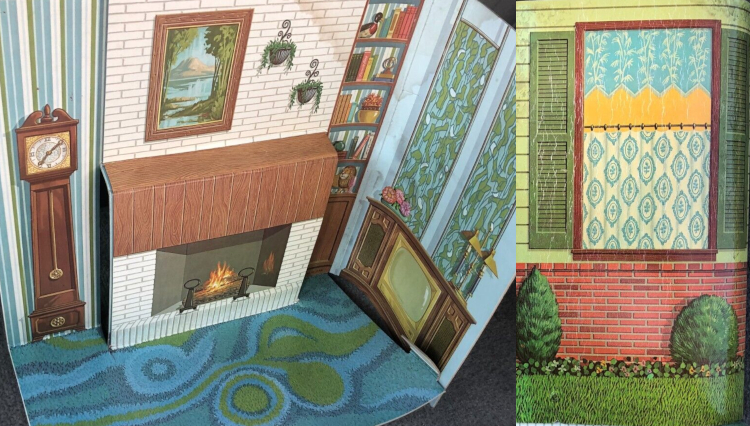
1970 Barbie Lively Livin’Room interior walls and floor (L) and exterior (R). Source for this and previous image: wonderwoman13 on eBay. They’re not as groovy as the Lively Livin’ House–then again, what is?–but still deeply 1970. This living room is a little more family-oriented than the one in the Lively house, displaying grown-up touches along with that trippy carpet.
The wall had a simple dimensional feature that pushed the fireplace into the room, as shown above. The other two sets augmented their basic furnishings in the same way, with a dimensional bedroom dresser and kitchen sink. Like the livin’room, these rooms’ walls were new conceptions. Due to the rarity of the sets I have no images to share; however, Marl Davidson photographed them for her book on Barbie structures, and we included a snapshot of those pages when we recommended her book.
Well there you have it! It’s the end, for now at least, of the Many Abodes of Barbie series. Our final house isn’t technically the Lively Livin’ House of 1970, or even the same-y Surprise House of ’72, but rather the ’73 Country Living Home we visited last time. There are still some Seventies furniture sets we wish to discuss with you, but on the whole, Barbie’s focus during this decade was outside the home. Where might we find her as the next decade progresses?
Where to next? This post is about Barbie’s early built environment. The most recent post in this category concludes the Barbie’s Seventies Travelogue series, and the most popular are those on Mattel Modern and Susy Goose furniture and on penthouse apartments. Otherwise, the overall most popular posts on this site are about Barbie shoes, 1959-67, and about Mattel fashion booklets. Or just head up to the Table of Contents to see more options.
-
Who wore it best? Mary Quant edition
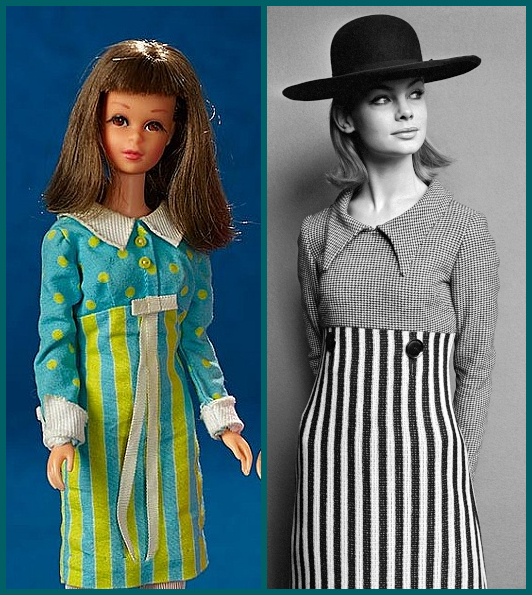
L: Francie wears It’s a Date (1966). Source: Theriault’s. R: Jean Shrimpton in Mary Quant, 1963. In her 1965 memoir Quant wrote, “When you break a rule, you automatically arrive at something different and this is fun. Take stripes, checks and polka dots. For years these were worn on their own or teamed with a plain colour. Nobody asked why. I believe in mixing patterns and colours wildly. So far as I’m concerned, spots go with stripes and checks.”
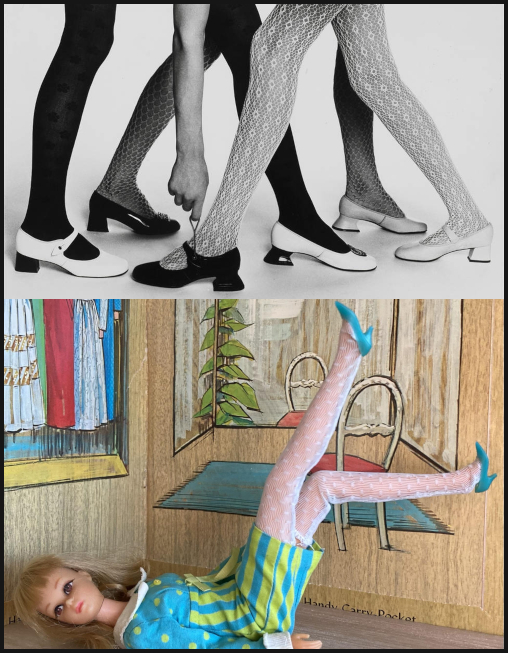
Top: From a 1965 advertisement for Mary Quant patterned tights. Bottom: Francie in It’s a Date. 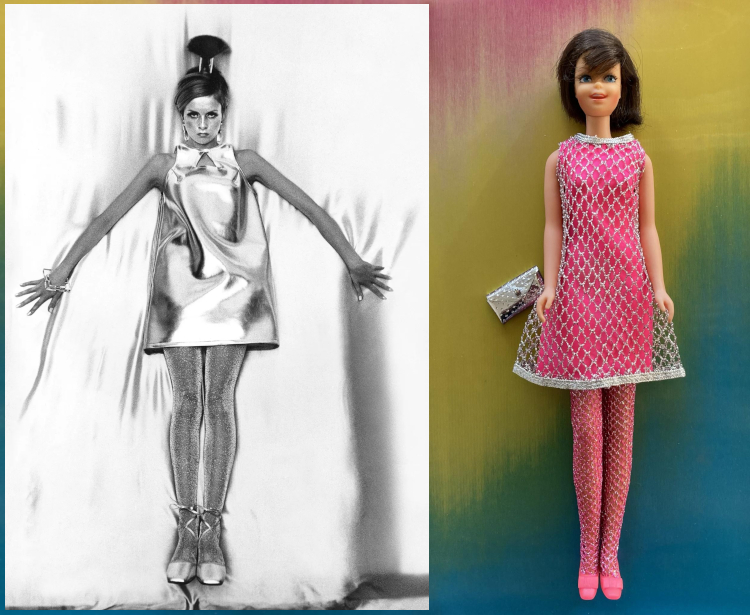
L: Twiggy in 1966, wearing glitter tights by Mary Quant. R: Casey in The Silver Cage (1968) (The above is not meant to claim that Silver Cage is a Mary Quant design–neither is the frock Twiggy wears here–but in the mid-60s Quant made great innovations in womens’ tights; the glitter ones of ’66 were a particular success.)
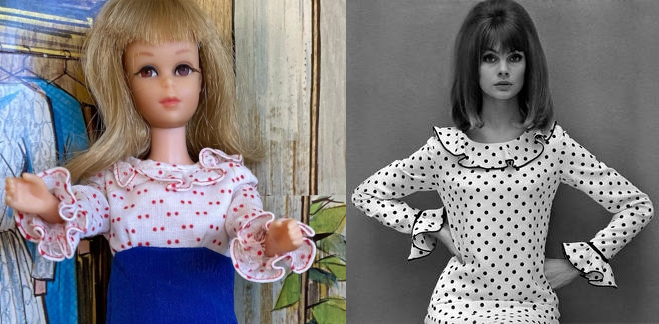
L: Francie in the Concert in the Park (1966) dress. R: Jean Shrimpton in Daddy’s Girl by Mary Quant for Ginger Group, 1964. 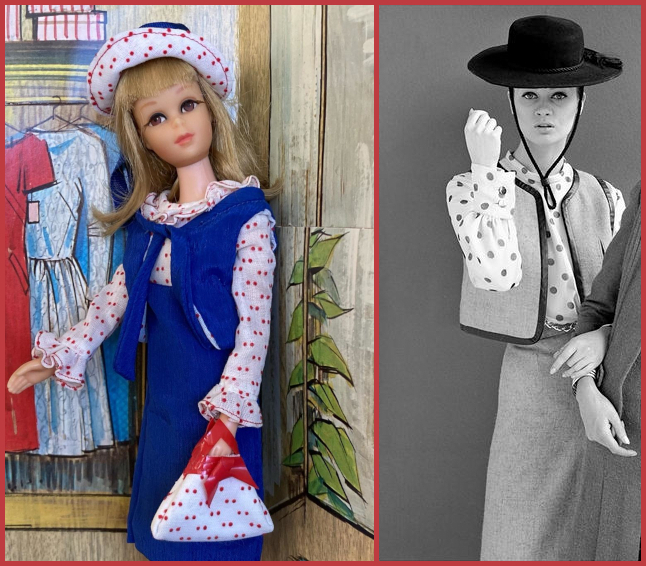
L: Francie in Concert in the Park. R: Celia Hammond in Coal Heaver by Mary Quant, 1962. A 1965 New Yorker piece covering a Mary Quant “Youthquake” fashion promotion for the States quotes from a brochure titled, “Youthquake Lingo (For Salespeople Only)”: “‘Super’ is the British way of saying O.K. All these Youthquake fashions are very much super, meaning O.K. ‘Smashing’ is the English word for ‘great,’ meaning the most exciting. And it’s a great word to use for the entire Youthquake collection. A ‘flakeout’ is so bad it’s really awful…”
When Francie hit the scene the following year, an article in Barbie Magazine titled “Say It In Mod” explained, “Mod is short for modern and it means new… Cool means anything that’s great… and so does fabby, and marvey and neat! In means anything that’s in style, out means anything that isn’t! Groovy and gear are the same as cool…” and so forth (as transcribed by BillyBoy* in Barbie: Her Life and Times).
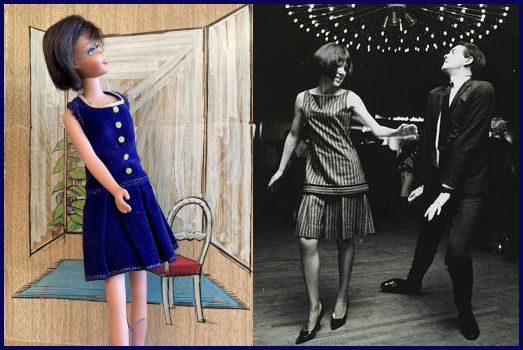
L: Casey in Pleat Neat (1967). R: Quant and husband/business partner Alexander Plunket Greene dance in New York City. Photographed for Life Magazine’s 1960 feature, “A British Couple’s Kooky Styles.” The preceding images of Quant, Shrimpton, Hammond, and unknown models in tights come from the Victoria and Albert Museum and its 2019 exhibition catalog, Mary Quant.
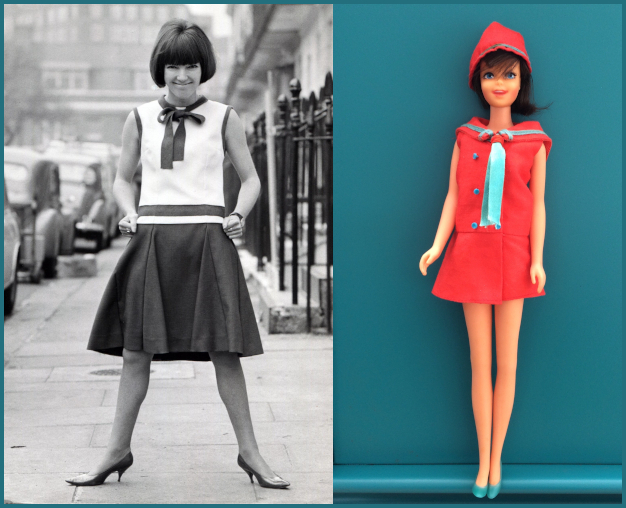
L: Mary Quant in London, 1961. R: Casey in Land Ho! (1969). Quant also wrote in ’65 that “there was a time when every girl under twenty yearned to look an experienced, sophisticated thirty… when every girl dreamed of a slinky black dress worn with very high heels. All this is in reverse with a vengeance now… their ambition is to look like Patty Boyd rather than Marlene Dietrich.” (Twiggy would be discovered the following year.)
I swear, that Pattie Boyd–herself a Teen-Age Fashion Model when she met future husband George Harrison in 1964, catapulting her to celebrity status–reminds me of someone I’ve seen…
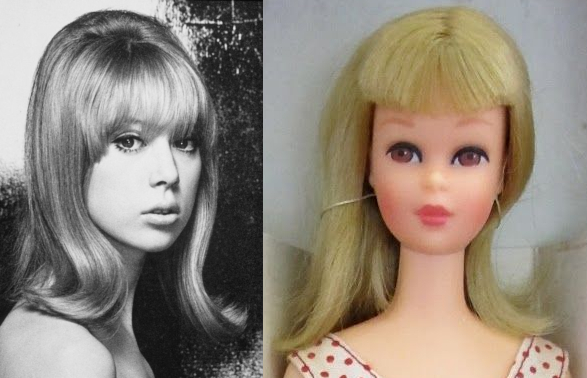
Mid-Sixties Pattie, meet mid-Sixties Francie. -
Dell Comics (1962-1963)
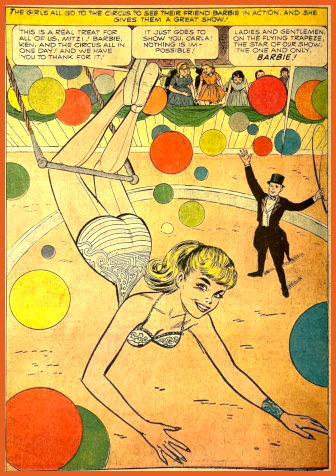
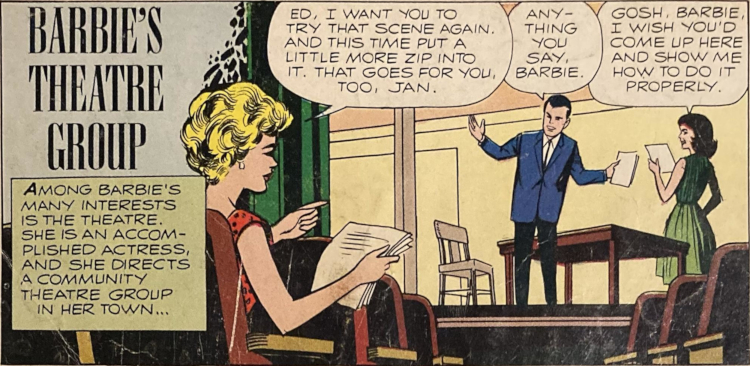
Barbie and Ken #3, May-July 1963. via Three Palms Vintage on eBay. From May of 1962 to August of ’63, Dell Comics released a 5-issue run of “Barbie and Ken” comic books. Contemporaneous with the Random House chapter books, the comics introduce a different vision of Barbie. Whereas the chapter books’ protagonist was a high school student, the comics’ Barbie is an adult with numerous careers: flight attendant, newspaper reporter, nurse, dental assistant, nightclub singer, circus performer, ballerina, meteorologist, and more. (Ken, meanwhile, is television producer, nightclub-owning songwriter/pianist, dentist, surgeon…)

Where the chapter books show her learning from her mistakes, sometimes prone to doubt and insecurity, in the comics she is assured, unerring and impossibly talented–though she accepts compliments very graciously.

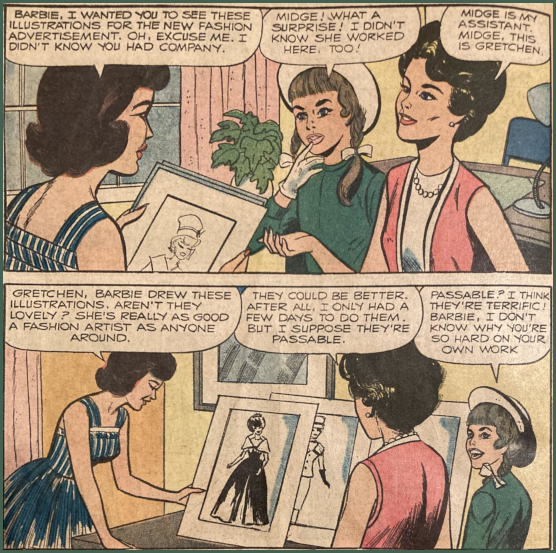
Everywhere she goes she is praised, and nothing can function without her. When she covers the fashion beat for a local newspaper, assistant Midge comes by to have her check some illustrations–but Barbie also drew the illustrations. And aren’t they lovely?
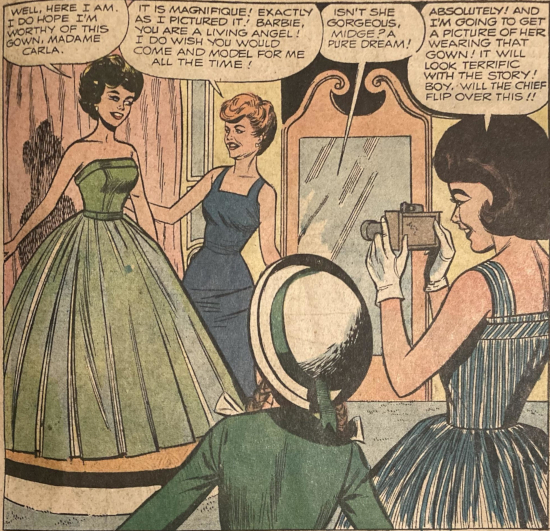
Later, when she goes to report on a fashion show, the designer asks Barbie to model for her.
Despite all her poise and accomplishments, she relies on strange children to choose her furniture.
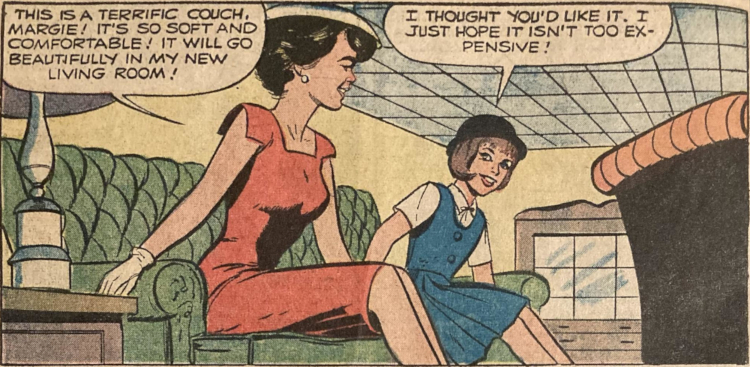

The children are all members of the Barbie Fan Club; each episode is set within a framing device of club members describing the time that they met Barbie. The best explanation for her reliance on the tastes of children, as well as her abundance of careers, is that the stories are all made up. In the first issue one of the children even admits her story was a dream; but does that admission strengthen or undermine the conclusion that the rest are fabrications, too?
Anyway, let’s talk illustrations, which are in a standard midcentury comic style. Outside of the fashion booklets, the comics are probably unmatched in density of character renderings–even the coloring books did not need multiple Barbies per page. Perhaps it’s a consequence of the need for mass illustrations that their quality varies so much. At times Barbie looks lovely, as the text insists.
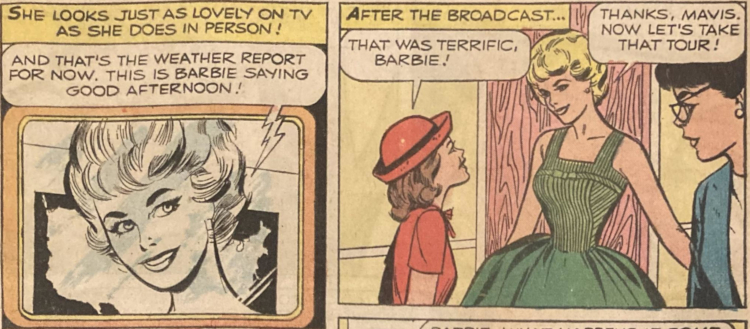
At other times her features are mismatched.

(A note on the story and Barbie’s virtue: as Ken is quick to clarify, the unwedded couple don’t just go gallivanting about Europe together; Barbie’s aunt, though absent from the action, chaperones them. In the episode where Barbie buys furniture for her new home it’s revealed that Barbie’s mother lives there with her. Dell’s Barbie is unquestionably a “nice” girl.)
Sometimes the illustration quality even varies from frame to frame, as in these excerpts from “The Barbie Fashion Show,” a local TV broadcast:

Making that face, before that curtain, while referencing Mr. Bob… it’s all a little too Twin Peaks!
You may have noticed by now that the panels are also chock full of legit Mattel-designed Barbie fashions. We’ve glimpsed Senior Prom, Solo in the Spotlight, Sheath Sensation, After Five, Movie Date, and more. Since the whole series rolled out over approximately one year, there are a lot of fashion repeats: we were happy to see our namesake fashion, Silken Flame, worn by Barbie, Midge, and an unknown model at Madame Carla’s salon.
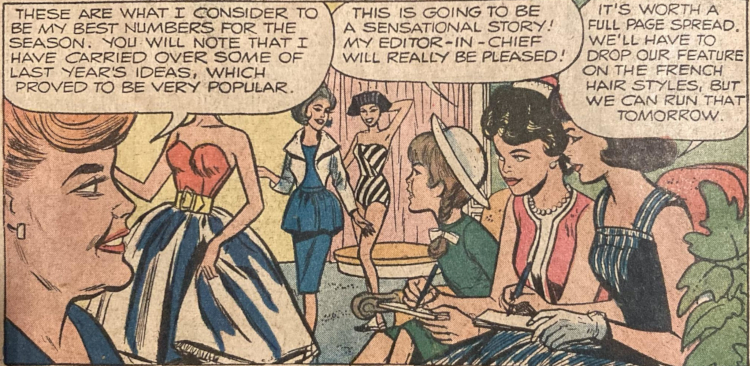
Midge dons Silken Flame to praise Barbie’s largely-unsung glory.
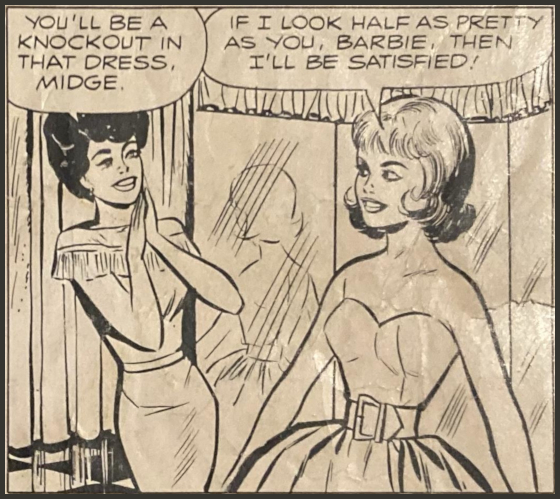
Barbie is at her most human getting weak-kneed over piles of money in a Monte Carlo casino, wearing Silken Flame in a de Stijl-influenced color scheme.

Ken’s satisfied. Is Barbie?
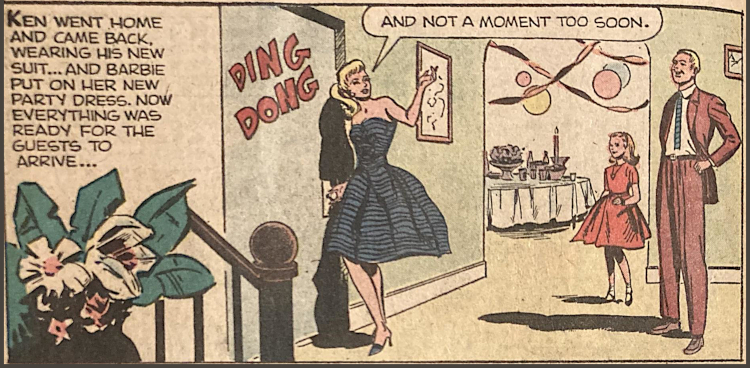
In issue #2 Barbie spends much of the first episode wearing a red-colored Cotton Casual version; then in the second episode she puts on her “new party dress,” which is Cotton Casual in blue!

Despite our focus on hand-drawn illustration in this blog, our favorite images from this series are actually the doll photography used for the covers:

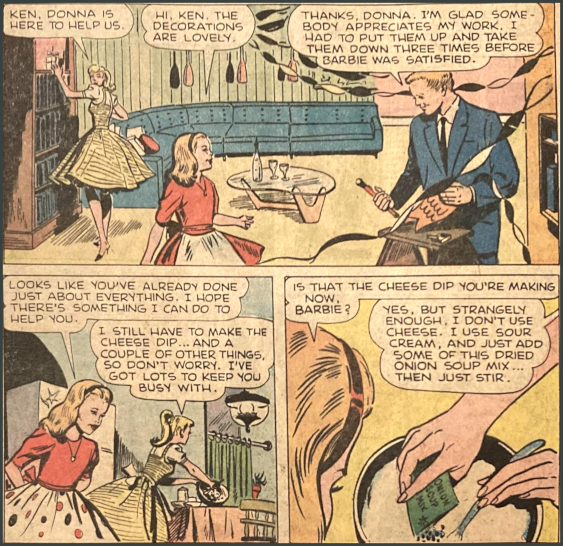
Dell Barbie and Ken issues 2, 4 and 5 covers via eBay. Worth framing. But that’s probably enough on the vintage comics, given that there were only five issues and the art style was pretty consistent throughout. Before we go, I hope you’ll appreciate Barbie’s midcentury couch, coffee table and “cheese” dip:
Where to next? This post is about vintage Barbie illustrations. Our most popular post in the category is on Mattel fashion booklets. The most recent post in the category is on the World of Fashion board game. Other popular posts on this site include the Many Abodes of Barbie series (currently covering 1962-1970) and our Chronicle of Barbie shoes, 1959-67. Or just head up to the Table of Contents to see more options.
-
Not Barbie on TV
In an earlier post, we reviewed a handful of Barbie’s television appearances on early Barbie sets. But Barbie, her friends, and rivals watched other programs, too. Let’s view a few.

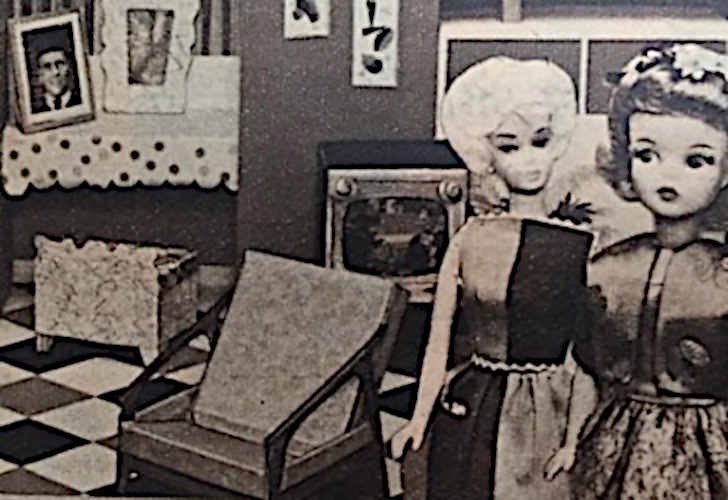
1963 Ideal Doll House television set. Source: 608samolly on eBay. First up is the 1963 Ideal house that was marketed for use by either Tammy or Barbie. This was a big house for its era, with kitchen, living room and bedroom in modern furnishings. On the black-and-white TV is a woman with Loretta Young looks and either a high fur collar or the most carefully-coiffured mullet on Earth.

1963 Ideal Doll House prototype in the ’63 Sears Christmas catalog. Source: christmas.musetechnical.com. Midge reclines in a prototype of the same house in the 1963 Sears catalog, with a similar show airing on the small TV in the built-in shelving unit at back. What looks like a second set, facing Midge but lacking a screen, is in reality a bulky side table or storage unit.
Actually, the prototype TV show looks like a cross between the production version above and Tammy’s second television set, below.
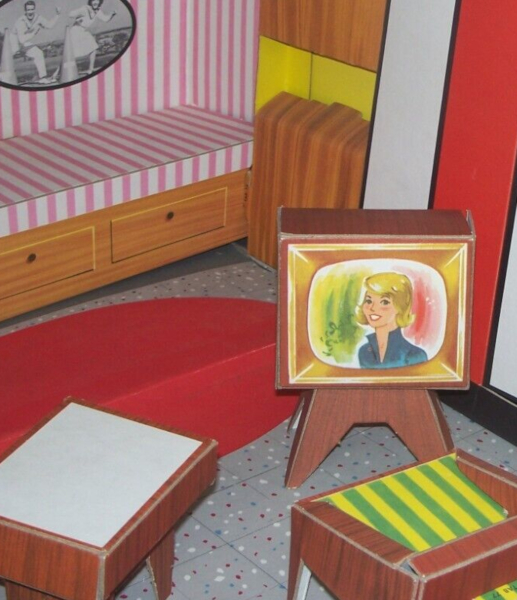
Tammy’s Ideal House / Tammy’s Playhouse television. Source: janetnmark2010 on eBay. Ideal also made a house especially for their own doll, Tammy, in ’63. Tammy’s Ideal House, sometimes Tammy’s Playhouse, has color TV, and she’s watching an unknown blonde performer.
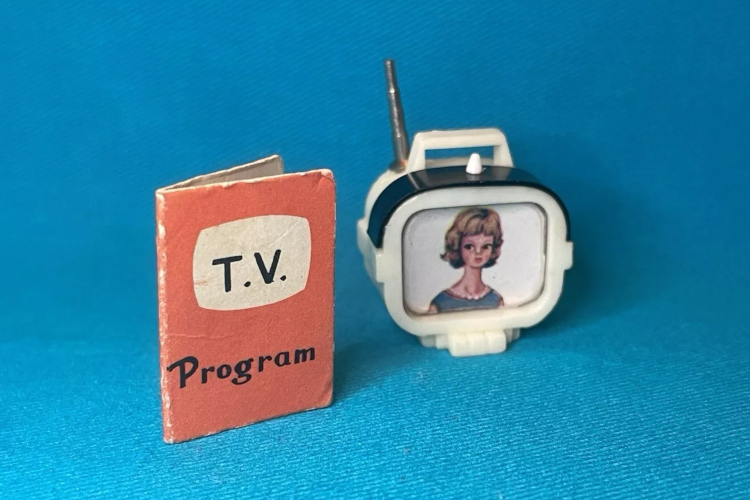
Tammy’s pak TV. Source: pfmink on eBay. Tammy, the girl next door, was less likely than Barbie to see herself on air; but a portable plastic television that came with some of her accessory paks did show a figure with Tammy’s trademark pout on screen.
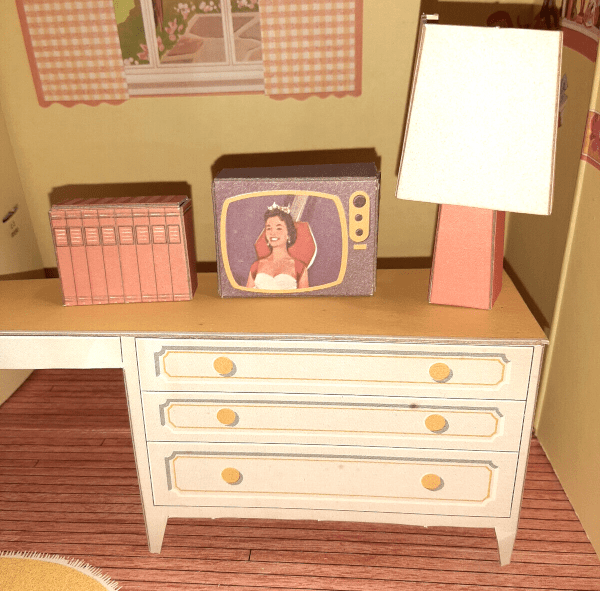
Littlechaps’ Living Room TV set. Source: 2bdebtfree on eBay. Over at the Littlechaps’ residence, still in ’63, the color TV shows a smiling brunette. This could be one of the Littlechap ladies, but we doubt it; like Tammy, they led private lives. This one looks a bit like a young Queen Elizabeth II, but for the lack of necklaces–maybe this is more of a homecoming queen, beauty queen or similar. The Bold Doll has an amazing article all about the Littlechaps, including images of the booklet advertising all their ephemera. Visible in the booklet (at the bottom of the article, but peruse the whole thing–it’s great) is a different (prototype) television, showing, in black and white, a possible newscaster or crooner before a microphone. The same version appeared on the Family Room’s packaging.

1963 and ’64 Montgomery Ward catalog listings for a “Portable Doll House” or bungalow for Barbie and/or Tammy and/or Wendy and/or Tressy. Source: christmas.musetechnical.com There was a glut of chipboard houses in 1963, imitators of Barbie’s original. Here’s a “Portable Doll House” we’ve only seen in Montgomery Ward’s catalogs, above. It looks like there’s a TV, but what’s on? Enhance!
We’ll venture that that’s a landscape at night–it could be anything, though.

The telly in Tressy’s penthouse. Source: LaneyCummings on Flickr. In 1964 the housing market cooled, but we did get one new “clone” house, Tressy’s Penthouse. Tressy’s chic city lifestyle allowed for a modestly-sized, black-and-white television built into the shelves, and that does appear to be Tressy on screen.
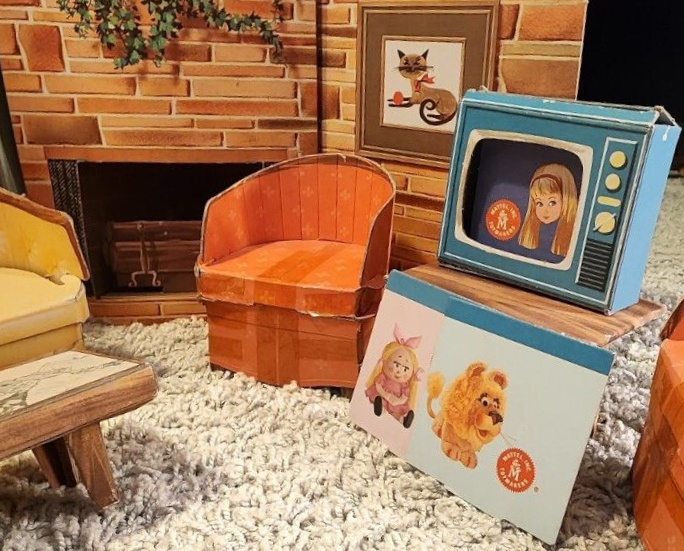
1964 Barbie and Skipper’s New Dream House television with alternate screens. Source: lovart on eBay. Barbie and Skipper got new digs in ’64 as well. For the first time, Barbie wasn’t on TV, but their color television offered a selection of different programs, some of which are shown above (there were more options on the backs of those cards, as well). This marks Skipper’s first television appearance.

1965 Skipper’s Dream Room television. Source: bigrackdaddy on eBay. Skipper got her own room, with its own TV, in 1965. Since this looks like no other Barbie illustration in that time period, including multiple pictures of Barbie that came with the room, we’re forced to conclude that this is, surprisingly, not Barbie on Skipper’s TV. It looks a little like what Tammy was watching two years ago, though.
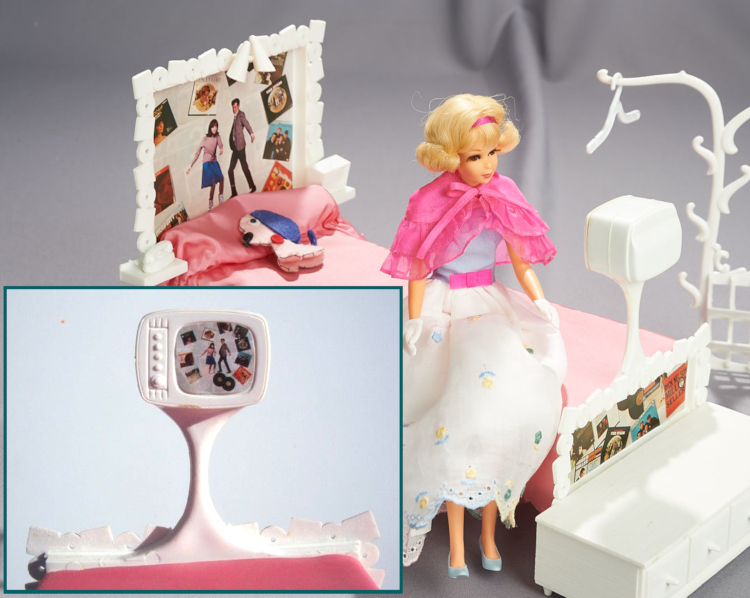
Francie’s 1966 Mod-a-Go-Go bed with built-in television. Sources: Theriault’s; Barbie List Holland. Francie’s 1966 bedroom set by Susy Goose included a small TV built into the bedframe. As shown in the inset, the collage on her headboard is repeated in miniature on TV. The collage includes photographs of teens dancing, record sleeves, and two record albums. Were there shows that looked this way in ’66?
Barbie and pals continued to own televisions after these years, but they were diminished in size, illustrated into the walls or shelving, and typically turned off. In the Seventies Barbie favored a more active lifestyle, which TV didn’t suit–except, of course, for her 1972 “busy” TV set, perfect for the girl on the go. That set was tuned, naturally, to a performance by Barbie.
Smile, ladies!

Where to next? This post is about Barbie’s early built environment. The most recent post in this category concludes the Barbie’s Seventies Travelogue series, and the most popular are those on Mattel Modern and Susy Goose furniture and on penthouse apartments. Otherwise, the overall most popular posts on this site are about Barbie shoes, 1959-67, and about Mattel fashion booklets. Or just head up to the Table of Contents to see more options.
-
Who wore it best? Airborne edition
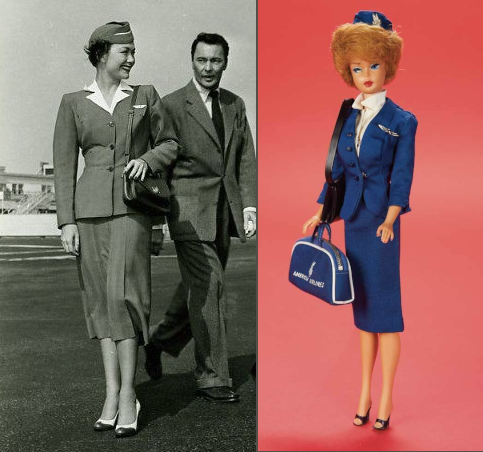
L: Jane Wyman as an American Airlines stewardess in MGM’s “Three Guys Named Mike,” 1951. R: Barbie as the same from 1961; source: kyoto-jky74 on eBay. 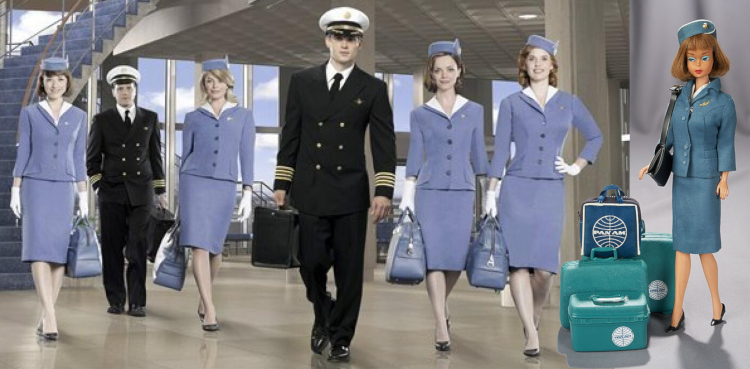
L: the cast of ABC’s “Pan Am,” set in 1963. R: Barbie as Pan Am stewardess (with extra luggage) from 1966; source: Theriault’s. The original Barbie Pan Am ensemble included white gloves and closed-toed black shoes. 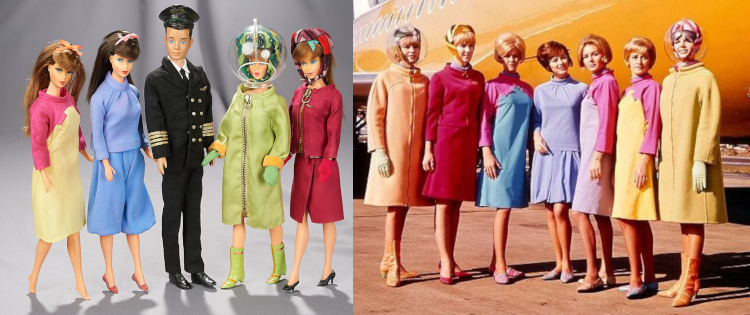
L: Barbie in Marx Braniff air hostess costumes from 1967, with Ken as pilot; source: Theriault’s. R: Braniff International Airlines uniforms designed by Emilio Pucci, 1965. 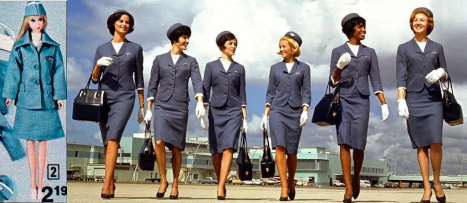
L: Barbie in Air Hostess/Stewardess costume from 1973 JC Penney catalog (advertised there since ’70); source: christmas.musetechnical .com. R: Delta airlines stewardesses, 1960s. 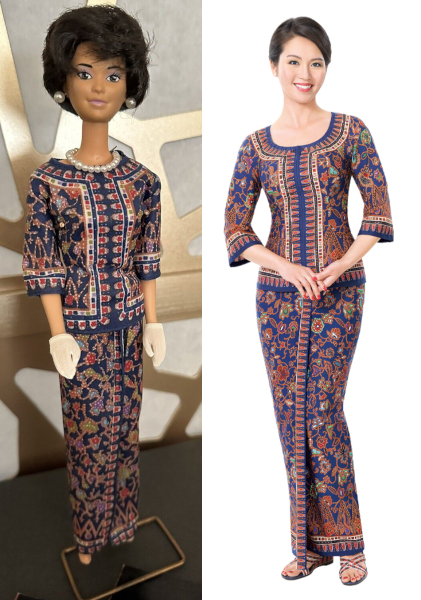
L: Barbie as Singapore Girl from 1993 (the gloves and pearls were added by the owner); source: fashionibly_favored on eBay. R: Model wearing sarong kebaya designed for Singapore Airlines by Pierre Balmain in 1972. 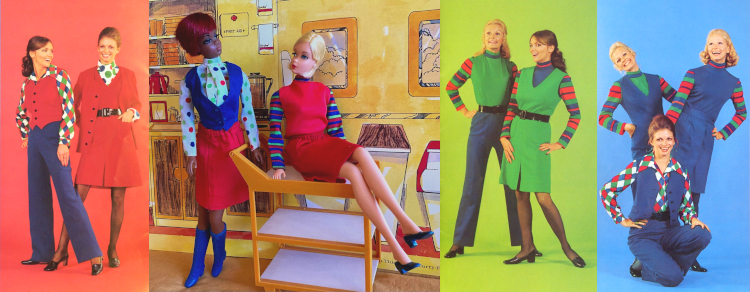
Left, right, and center right: 1973 United Airlines uniforms by Jean Louis. Center left: vintage Julia and repro Hair Fair in 1973 Get-Ups ‘N’ Go United Airlines ensembles (with pak boots for Julia–other historical shots of the flight attendant uniform show it styled that way). 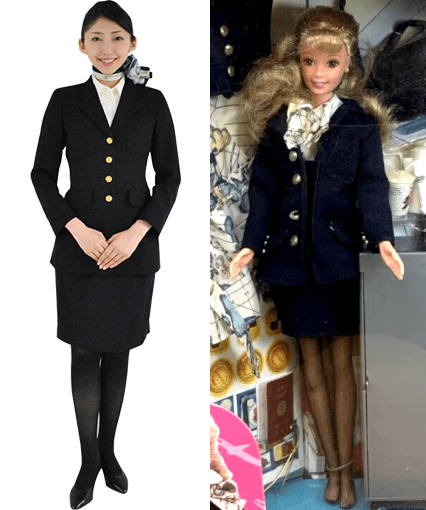
L: model wearing Japan Airlines’ flight attendant uniform designed by Yoshie Inaba, 1996. R: 1997 Barbie as Japan Airlines flight attendant; source: pioneer-land-japan on eBay.

Silken Flame
Vintage Barbie illustrations, built environment, clones and more
 Silken Flame