Penthouse Apartments, 1964-1976

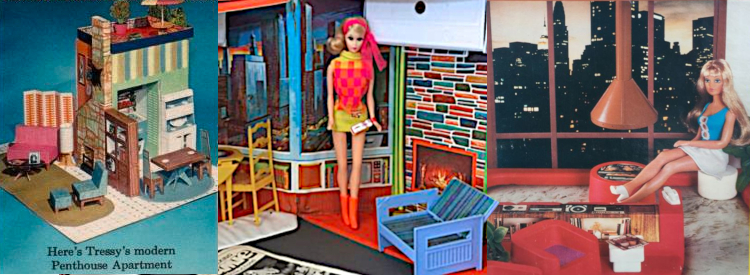
L: Chipboard structure featuring a stone fireplace, bookshelves, table and two chairs, orange screen, pink settee and blue chair with ottoman (especially similar to those in Barbie' first Dreamhouse) arranged around an interior block that is topped by a patio with sunshaded table and plants. The block and furniture sit on a board with tile look covered by large colored ovals representing rugs. The catalog's caption begins, "Here's Tressy's modern Penthouse Apartment." Further details are cropped off. Center: Blonde Jamie in her original pink, orange and yellow minidress, boots and headscarf stands before a plate glass window showing an illustration of skyscrapers. To one side is a fireplace covered in "fieldstone" in rainbow colors and an illustrated crackling fire. Before is an armchair made from blue plastic with vertical stripes painted on, and a drop-lead table and chair in gold plastic go to the edge of the frame on the other side. R: A blonde 1970's doll sits on a white stool next to a fireplace made from a firepit with detached overhanging hood. Behind them is a window showing a skyline with dark buildings and lighted windows before a brighter, clouded sky (the view seems to be a photograph). In the foreground can be seen red molded plastic chairs, and a photograph of deep pile carpet forms the base of the scene.
L-R: Tressy’s Penthouse Apartment from the 1964 Sears Christmas Catalog (source: wishbookweb.com); Jamie’s Party Penthouse (source: Apple Tree Auctions); Tuesday Taylor’s Penthouse Apartment (source: Savacool and Sons)

Skyline views, rooftop patios, luxe furnishings, maybe an elevator that doubles as your front door… A penthouse apartment is practically shorthand for glamorous living. As we’ve noted, Barbie was more bucolic. But throughout the vintage and mod years, her friends and rivals opted for lavish city living on a trio of occasions.

Tressy’s Penthouse (1964)
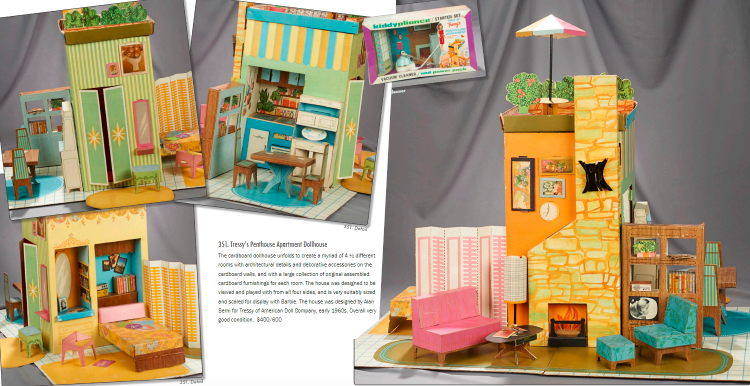
Colorful catalog photos show the four sides of Tressy's penthouse. Prominent colors in the shots are mint green, tangerine, teal, and rose pink. One side of the penthouse represents a living room with an orange and green stone fireplace (with illustrated fire), wall art, coffee table, shelves, settee and chair, lamp; another side shows a kitchenette with table and two chairs; another side is the bedroom with vanity and little pink stool (also similar to Barbie's), and the fourth side includes a closet and long "mirror." In an inset we see a boxed "working" vacuum cleaner in Tressy's scale. The vacuum cleaner is drop shaped unit with long hose attachments.
Four views of Tressy’s Penthouse Apartment, plus a powered toy vacuum cleaner that was sold as an accessory. Source: Theriault’s.

Tressy, by American Character (and later sold by Ideal Toy Corp.), was a Barbie competitor whose defining feature was her hair, which “grew” at the press of a button and receded with the turn of a key. Her sherbet-hued apartment had “everything a girl needs for gracious living,” including a kitchenette, Murphy-style bed, rooftop terrace and more. Like Barbie’s environs of this year, Tressy’s place was made of chipboard. We’re ever so fortunate that in 2008, Flickr user LaneyCummings assembled and photographed a mint-condition example; it’s so rare to find 1960s chipboard in this condition.
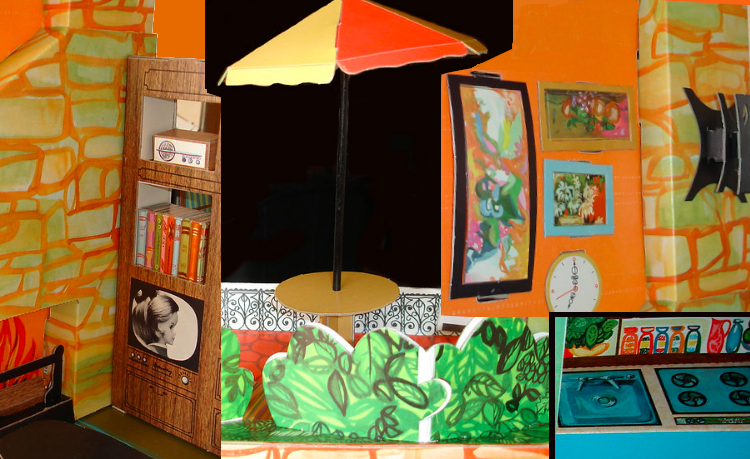
Close-ups on parts of Tressy's penthouse: abstract art hangs next to the fireplace; the shelves to the other side include a TV with what looks like Tressy on the screen, and a little unit that may be a radio; a low wall running around the edge of the rooftop patio has a wrought iron pattern; colorful spice jars and bottles illustrated behind the range and sink in the kitchenette.
Tiny details of Tressy’s Penthouse. Source: LaneyCummings on Flickr.

In the same vein as Barbie’s Deluxe Dream House of the same year, Tressy’s apartment had a floor plan “in the round”: a central block featured shelves, fireplace, foldaway bed and kitchenette; the rooftop terrace sat atop the central block, but the apartment had no entrances, exits or windows visible; all that was left to the user’s imagination.

Jamie’s Party Penthouse (1970)

Christmas catalog excerpts. Left side is the Jamie doll ("Cut $1, now $3.97"); to the right is the Penthouse itself, which folds into a 6-sided carrying case. The furniture shown includes the drop-leaf table with two chairs, an armchair and sofa in white plastic with vertical pink and orange striped, and a little table with a chess or checkerboard pattern atop. The catalog text reads, 'Jamie's Penthouse. With furniture, molded "fireplace"... even a "view." Opens to over 2 ft. long. $9.99. Jamie's luxury apartment opens up for fun. There's a comfortable den with couch, table and chair, and a bright dinette with table and chairs. Vinyl case opens to 6x13x26 in. long. Plastic furniture; handle for toting. Holds 4 dolls and accessories (not included).
Jamie and her penthouse as they appeared in the 1971 Sears Christmas Catalog. Source: wishbookweb.

Barbie’s friend Jamie was next to migrate to the metropolis. Around this time Barbie herself got a taste of city living through her case rooms, though we think she never fully committed. Jamie’s place had plastic furniture–although it was not ultra-chic, resembling the unapologetically suburban Go-Together furniture sets from years earlier–and, though it lacked a rooftop terrace, boasted fantastic views through tall windows alongside a fetching, multi-hued fieldstone fireplace.
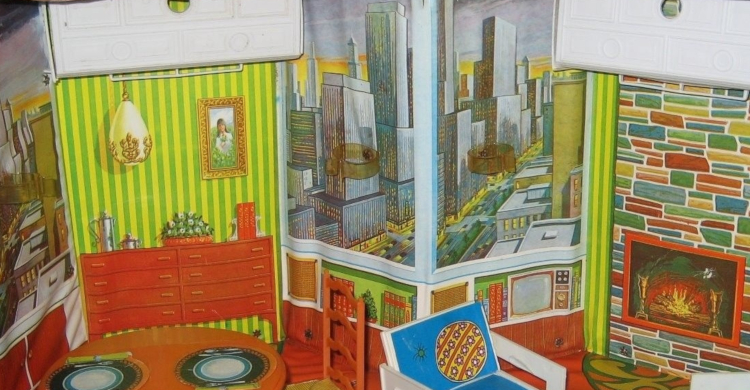
Closeup on the interior walls of Jamie's penthouse, showing city views on 3 of the 6 sides with shelving beneath, the fieldstone fireplace with stones in all the colors of the rainbow on one wall, and a dining room backdrop on one wall with green and yellow vertically striped wallpaper, an ornate hanging light fixture (illustrated, not lighted), and buffet. This covers 5 of the 6 facets of the hexagon-shaped case viewed from within.
Skyline views and a colorful fieldstone fireplace. Source: Barbie List Holland.

Outside Jamie’s windows it was always dusk or dawn: the party was in an eternal state of winding up or winding down. Further rooms glimpsed through doorways and windows added splendor to what may otherwise have seemed a cramped space.

At right is a closeup of the sixth and final interior "wall" which looks into a grandiose room as described in the text; top left, through a window, illustrated, we see an elevator door, a chair with side table before the window, and a mirror, lamp and hall table next to the elevator. Illustrated next to the window are porous spherical planters with greenery hanging out; lower left, another window--though this one looks more like a sliding door--into a room with an unlit fireplace, colorful abstract art hanging overhead, a yellow couch, green chair, coffee table, side table with lamp, and partial room divider of vertical wooden bars. None of the furniture in these views looks modern; generally the scenes look formal and not lived-in, compared to the inhabitable area inside the case.
Clockwise from top left: Seen on the case exterior, an elevator lets out either into a common area in the building, or into Jamie’s own rather impersonal antechamber; outside, hanging planters reminiscent of Architectural Pottery. Next, an interior panel depicts a doorway into a massive, formal drawing room and dining room, complete with curved staircase, mezzanine, and blazing chandelier. Finally, another exterior view peers in at a less-formal sitting room with a second fireplace. Sources: skeeterx8th on eBay, beanieblazer on eBay.

Tuesday Taylor’s Penthouse Apartment (1976)

The same height as Barbie, Tuesday was another Ideal fashion doll, this time with a 70s, disco aesthetic. Like Tressy before her, she had hair that changed–in her case, from blonde to brunette (and her Black doppelganger Taylor Jones changed her hair from black to deep red). At Tuesday’s apartment we find elevator access directly to the sitting room, as well as BOTH a rooftop patio and a wall of windows looking out at the skyline. This set came with two window options, so you could swap daytime views for night. The rooftop relaxation area, accessed via spiral staircase apparently on the building’s exterior, had a shaded seating area and a glass skylight that doubled as a table (the sun shade partially shaded the skylight).

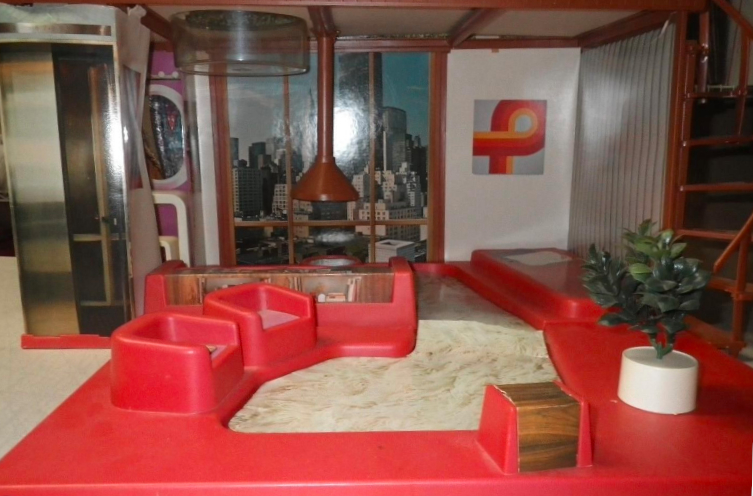
View looking down at a tiled rooftop patio with paper hedges running around the perimeter, two chairs with stools or ottomans under a red, black and white striped sunshade, and an easel displaying a bright white rectangle (other images of this set show a photograph of the city skyline sitting on the easel, probably intended to represent a drawing or painting, but it's either washed out in this image or replaced). Next to the chairs a long table appears to have printed-on food laid out, and in the opposite corner is a plastic molder grill. Before the chairs is a clear cylindrical table/skylight, as described in the main text, inverted to extend down into the floor. At right on the exterior of the piece a plastic spiral staircase leads down to the penthouse interior. The floor below can be seen to be a photograph of shag carpeting. The interior is not clearly shown here, but in frame are molded red plastic seating elements divided into two seating areas, one beneath the patio and one extending out. Some electronics can be vaguely discerned between them: possibly a turntable, 8-track, radio, etc. These are photographs applied to the surface between seating areas.
View facing in to the penthouse interior. The inverted skylight can be seen hanging down into the room; beyond, the fireplace hood sits midway across three panels of floor-to-ceiling windows showing a photographed view of the city by day; to the right is a piece of abstract art in typical seventies colorbars/curves. To the left an elevator is represented by a photograph on one exterior wall of a dressing room which is barely visible beyond and includes a "real" oval mirror and nested vanity and tool in white plastic with curved corners. A continuous piece of molded red plastic forms the interior, with two armchairs in the foreground molded facing away from the tall windows. Wood paneling of the electronics console can be seen beyond them, blocking the view of the couch which faces the fireplace and windows (again, all molded in place). In the very foreground is a little stool or table in the same wood paneling, and a potted plant with white plastic base sits to one side (not molded in place, and could also enhance the scene on the rooftop).
Upstairs (top) and interior of Tuesday Taylor’s place. The elevator entry is at left downstairs, with a Hollywood Regency style vanity behind; the spiral stair can be seen to the right in both shots. The photographed skylight was installed upside down. Source: Worthpoint.

Unlike its forebears, Tuesday’s apartment layout was mostly molded in place, with fewer loose bits of furniture to rearrange. Some unfortunate choices were made in this process: the fireplace, though standing free from the wall as two disjoint pieces (a fire pit on the floor and a hood descending from the ceiling–though there’s no evidence of it venting to the rooftop patio directly above), was molded to stand squarely in front of those tall windows, partially blocking the skyline view from almost every other point in the room, rather than ensconced amidst a large conversation pit as may have been preferred.
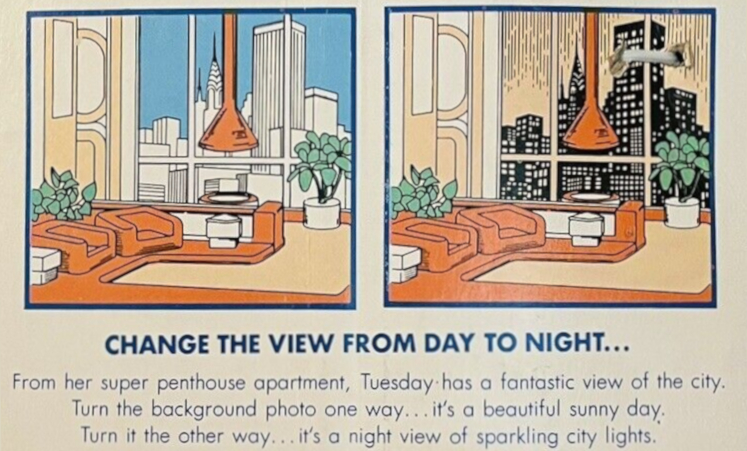
Line illustrations of Tuesday's penthouse with daytime views and nighttime. The familiar molded armchairs are in the foreground with white stools/tables to either side (these were up on the patio in the photographed set above); the fireplace and vanity are illustrated beyond, and a potted plant sits next to the window. The only difference between the two frames of this illustration is the scene outside, going from blue skies and light-colored buildings to a brown sky with black buildings and lighted windows. Text reads, "Change the view from day to night... From her super penthouse apartment, Tuesday has a fantastic view of the city. Turn the background photo one way... it's a beautiful sunny day. Turn it the other way... it's a night view of sparkling city lights."
Swappable skies and unalterable, view-wrecking fireplace as advertised on the Tuesday Taylor doll packaging. Source: kabai_881970 on eBay.

Still, Tuesday’s stylish pad, with its plentiful seating and other amenities, was perfect for entertaining or just sitting back and watching, as (paraphrasing Leslie Charteris) “the day fades, and the city dons her electric jewels and comes to life.”
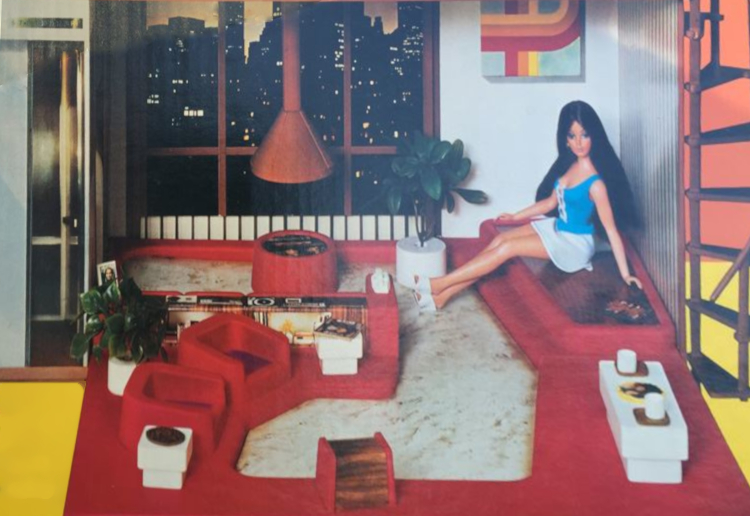
Same as the shot of Tuesday Taylor in her apartment used at the top of the post, but Tuesday's blonde hair has been flipped around to brunette. This shot has a wider frame including more of the seating in the foreground with potted plant, several small tables, and at the very edge the spiral staircase going up the exterior of the structure.
Brunette Tuesday in her nighttime penthouse, from the product packaging. Source: Savacool and Sons.

Where to next? This post is about Barbie’s early built environment. The most recent post in this category is Barbie’s Seventies Travelogue, Part 2, and the most popular are one on Mattel Modern and Susy Goose furniture and this one. The overall most popular post on this site is about shoes. Or just head up to the Table of Contents to see more options.

5 responses to “Penthouse Apartments, 1964-1976”

  1. […] Penthouse apartments, 1964-76 […]

    Like

  2. […] to serve many Tressys simultaneously. Speaking of design, Tressy’s Beauty Salon, like her Penthouse, is packed with modern touches including a room divider, potted plant, and tiered side table […]

    Like

  3. […] tile-topped coffee table are all variations on the furnishings common to ’70s sets including Jamie’s Party Penthouse and the Lively Living/Surprise […]

    Like

  4. […] 1964 the housing market cooled, but we did get one new “clone” house, Tressy’s Penthouse. Tressy’s chic city lifestyle allowed for a modestly-sized, black-and-white television built […]

    Like

  5. […] sunset4813 on eBay. 1964 Barbie’s New Dream House. Source: jbak4493 on eBay. 1964 Tressy’s Penthouse. Source: Theriault’s. 1964 Mattel Go Together Rooms. Source: Theriault’s (L), […]

    Like

Leave a reply to Not Barbie on TV – Silken Flame Cancel reply