
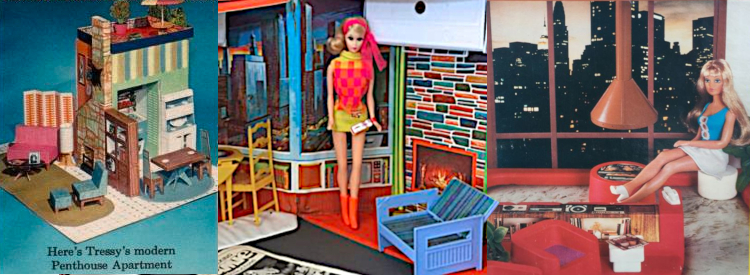
Skyline views, rooftop patios, luxe furnishings, maybe an elevator that doubles as your front door… A penthouse apartment is practically shorthand for glamorous living. As we’ve noted, Barbie was more bucolic. But throughout the vintage and mod years, her friends and rivals opted for lavish city living on a trio of occasions.
Tressy’s Penthouse (1964)
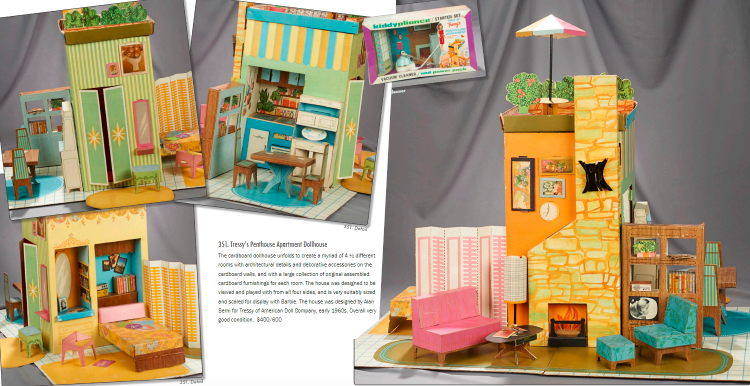
Tressy, by American Character (and later sold by Ideal Toy Corp.), was a Barbie competitor whose defining feature was her hair, which “grew” at the press of a button and receded with the turn of a key. Her sherbet-hued apartment had “everything a girl needs for gracious living,” including a kitchenette, Murphy-style bed, rooftop terrace and more. Like Barbie’s environs of this year, Tressy’s place was made of chipboard. We’re ever so fortunate that in 2008, Flickr user LaneyCummings assembled and photographed a mint-condition example; it’s so rare to find 1960s chipboard in this condition.
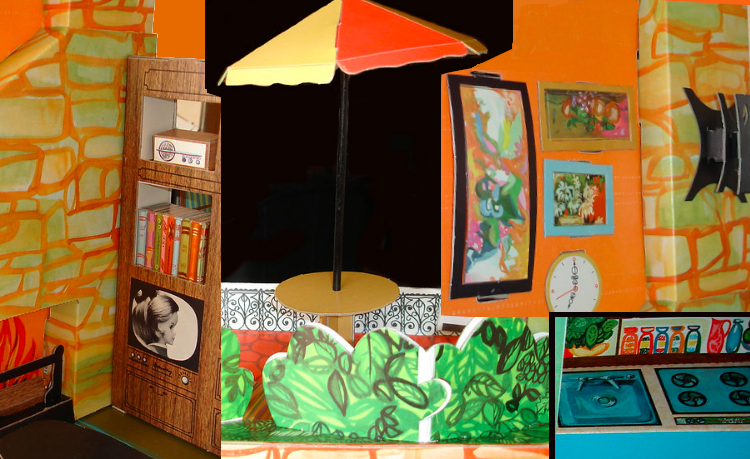
In the same vein as Barbie’s Deluxe Dream House of the same year, Tressy’s apartment had a floor plan “in the round”: a central block featured shelves, fireplace, foldaway bed and kitchenette; the rooftop terrace sat atop the central block, but the apartment had no entrances, exits or windows visible; all that was left to the user’s imagination.
Jamie’s Party Penthouse (1970)

Barbie’s friend Jamie was next to migrate to the metropolis. Around this time Barbie herself got a taste of city living through her case rooms, though we think she never fully committed. Jamie’s place had plastic furniture–although it was not ultra-chic, resembling the unapologetically suburban Go-Together furniture sets from years earlier–and, though it lacked a rooftop terrace, boasted fantastic views through tall windows alongside a fetching, multi-hued fieldstone fireplace.
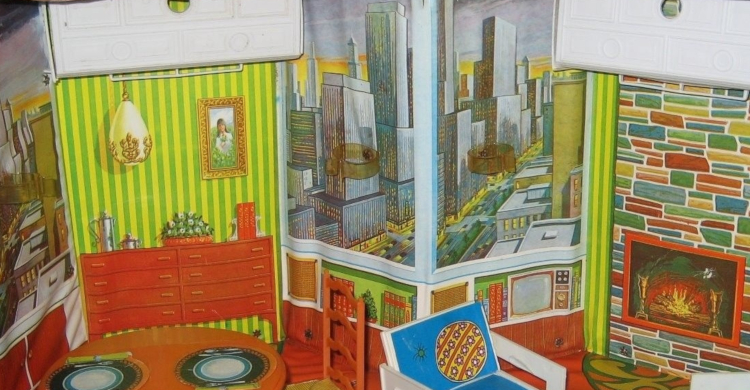
Outside Jamie’s windows it was always dusk or dawn: the party was in an eternal state of winding up or winding down. Further rooms glimpsed through doorways and windows added splendor to what may otherwise have seemed a cramped space.

Tuesday Taylor’s Penthouse Apartment (1976)
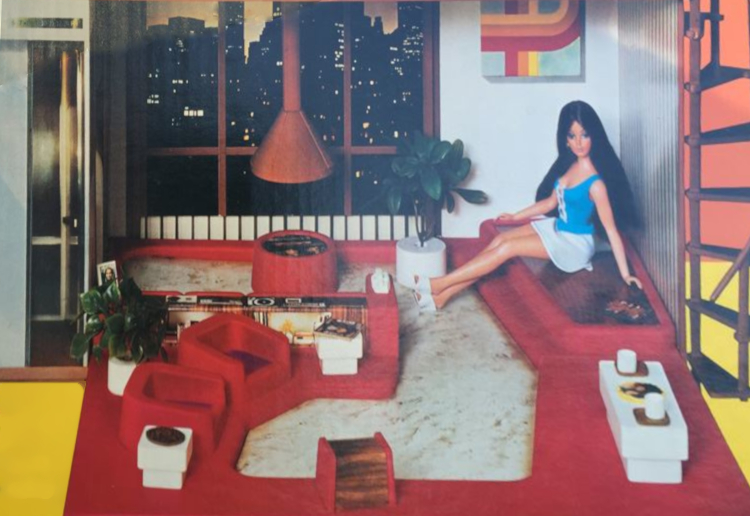
The same height as Barbie, Tuesday was another Ideal fashion doll, this time with a 70s, disco aesthetic. Like Tressy before her, she had hair that changed–in her case, from blonde to brunette (and her Black doppelganger Taylor Jones changed her hair from black to deep red). At Tuesday’s apartment we find elevator access directly to the sitting room, as well as BOTH a rooftop patio and a wall of windows looking out at the skyline. This set came with two window options, so you could swap daytime views for night. The rooftop relaxation area, accessed via spiral staircase apparently on the building’s exterior, had a shaded seating area and a glass skylight that doubled as a table (the sun shade partially shaded the skylight).

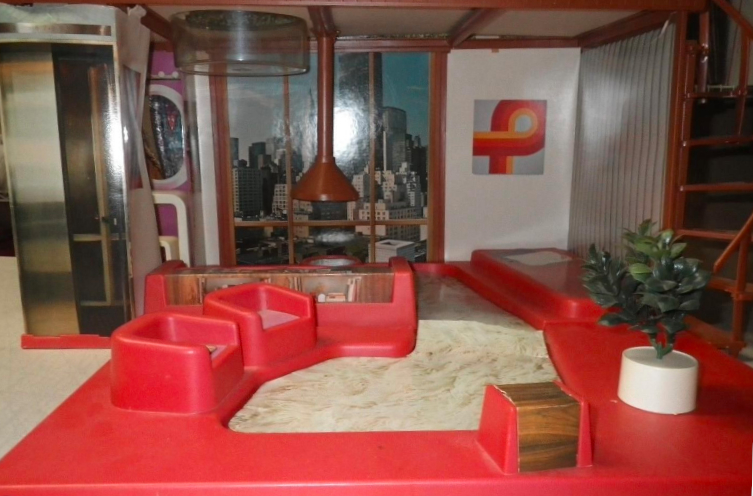
Unlike its forebears, Tuesday’s apartment layout was mostly molded in place, with fewer loose bits of furniture to rearrange. Some unfortunate choices were made in this process: the fireplace, though standing free from the wall as two disjoint pieces (a fire pit on the floor and a hood descending from the ceiling–though there’s no evidence of it venting to the rooftop patio directly above), was molded to stand squarely in front of those tall windows, partially blocking the skyline view from almost every other point in the room, rather than ensconced amidst a large conversation pit as may have been preferred.
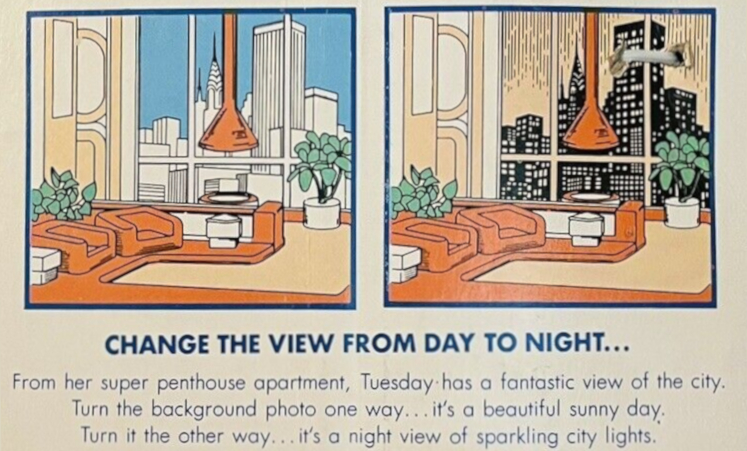
Still, Tuesday’s stylish pad, with its plentiful seating and other amenities, was perfect for entertaining or just sitting back and watching, as (paraphrasing Leslie Charteris) “the day fades, and the city dons her electric jewels and comes to life.”
Where to next? This post is about Barbie’s early built environment. The most recent post in this category is Barbie’s Seventies Travelogue, Part 2, and the most popular are one on Mattel Modern and Susy Goose furniture and this one. The overall most popular post on this site is about shoes. Or just head up to the Table of Contents to see more options.
 Silken Flame
Leave a reply to The Many Abodes of Barbie, Part VI: 1969 – Silken Flame Cancel reply