Barbie’s Fashion Shop (1963)

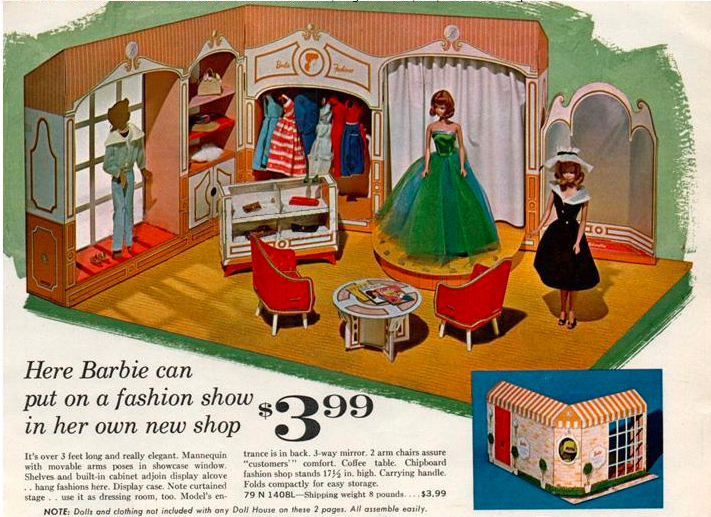
Color catalog image. Midge, wearing Senior Prom, poses on a low stage before two empty arm chairs in the Fashion Shop, while a second Midge in After Five stands staring in a different direction. In the shop window, a chipboard mannequin wears Mood for Music. Text reads, "Here Barbie can put on a fashion show in her own new shop; $3.99; It's over 3 feet long and really elegant. Mannequin with movable arms poses in showcase window. Shelves and built-in cabinet adjoin display alcove . . hang fashions here. Display case. Note curtained stage . . use it as a dressing room, too. Model's entrance is in back. 3-way mirror. 2 arm chairs assure "customers" comfort. Coffee table. Chipboard fashion shop stands 17 1/2 in. high. Carrying handle. Folds compactly for easy storage." Small inset image shows shop exterior with display window, bright red door, light red brick and striped awning.
1963 Sears Christmas catalog image. Source: christmas.musetechnical.com; digitally restored by the author

What is it that makes a doll boutique so desirable? I always wanted one as a child. Did my young mind subconsciously believe that the shop would refill with new designs as Barbie “purchased” them? Is it an aspiration to consumption, and a desire to incorporate the act into make-believe? Or would it simply render the experience of dressing and re-dressing a fashion doll more immersive? Perhaps it’s a little of each.

Color catalog image. Text reads, "Barbie's very own shop! Here's where the smart set meets!" The scene is as described in the main text. Note that Miss Barbie may be wearing her bathing suit! It's hard to be sure because she is seated, facing away, with most of her body obscured by the chair.
1964 JC Penney Christmas catalog image. Source: christmas.musetechnical.com

Speaking of dressing and re-dressing one’s dolls in a fashion shop setting, the 1963 Barbie’s Fashion Shop play set illuminates one difference between children sending their dolls shopping today and back in the mid-Sixties: in the catalog image directly above, the customer, Miss Barbie, is seated watching a shop model show Senior Prom, while Midge in After Five works the sales floor. In other catalog images we may see another shop model, or the shopper may be dressed for a fitting; it’s unclear. At any rate, women didn’t go in the dressing room and try on potential purchases at a shop like this one in 1963. More people–or dolls–had to be involved.
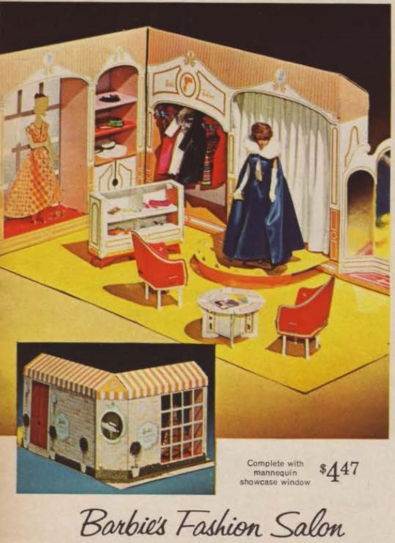
Color catalog image. Bubblecut Barbie stands on a low stage wearing Midnight Blue. Two red armchairs and a round white coffee table sit at the foor of the stage. A chipboard mannequin wearing Dinner at Eight stands in the window. Other garments hang on a rack at the back, and accessories, including the hat from After Five, line the shelves.
1964 Sears Christmas catalog image. Source: wishbookweb.com

The catalog’s descriptions fill in details of the Fashion Shop setting. According to the JC Penney catalog copy, “Here’s where high fashion rules–where Barbie’s friends meet to discuss new trends. Includes modeling stage with curtains, display corner, furniture for customers, display cases and hat rack, model’s entrance to dressing room, even a mannequin with movable arms–so handy for showing new styles to Barbie and her friends.” Over at Sears, the “Fashion Salon” was “tastefully designed with curtained stage, alcove for hanging clothes, built-in cabinets, dressing room entrance, even a mannequin with movable arms. Salon furnished with 3-way mirror, arm chairs, coffee table, display case, hat rack.”

Closeup of Fashion Shop details from an eBay listing. The mannequin is of unprinted, brown chipboard and looks like a ponytail Barbie's silhouette. there are multiple slots in the floor at the store window to insert the mannequin, possibly to reposition her or employ multiple. The shelving unit is empty but its shelves are colored pink, red and orange. Underneath them, a cabinet hangs partially open.
Mannequin in shop window and shelving units. Source: ringsforkim on eBay.

In the Christmas catalogs, this elegant set was advertised for just two years.

Where to next? Visit a beauty parlor; pick out shoes; read up on Barbie’s modeling career in the Random House books; or go to the table of contents to see more options.

3 responses to “Barbie’s Fashion Shop (1963)”

  1. […] Barbie’s Fashion Shop, 1963 […]

    Like

  2. […] didn’t add any new customization to styling Tressy–but, like Barbie’s Fashion Shop and New Dream House that were advertised the same year, it was a nicely detailed chipboard scene […]

    Like

  3. […] as the first Mattel play set where Barbie went only to work (she may have worked or shopped at the Fashion Shop, and the Little Theatre similarly had multiple uses), as well as the last public space introduced […]

    Like

Leave a reply to Hello world! – Silken Flame Cancel reply