

During the second half of the Sixties, Barbie was a total homebody: following the release of Skipper’s Schoolroom in 1965, Barbie went through about a dozen homes, but no more public spaces. When she was finally ready to reemerge in 1971, it was into a different world.
Between the years 1963, when Barbie’s Fashion Shop debuted, and 1971’s Unique Boutique, clothes shopping underwent a revolution. In Vintage Fashion: a Complete Sourcebook, Nicky Albrechtsen explains: “Music, art and fashion interlinked to create a new culture, epitomized by the renowned informal boutique shopping experience… Boutiques stayed open ad hoc, a party atmosphere prevailing until the early hours, as consumers shopped listening to the newest music and the celebrities of art, pop and rock mingled with young shoppers all seeking forward-looking fashion that broke with convention.”
An early and impactful boutique reimagining was Mary Quant’s Bazaar store in Chelsea, which faced legal trouble in the 1950s for staying open too late, placing an unfair burden on the competition to do likewise. The boutique of Marion Foale and Sally Tuffin was another Swinging London staple, where the clothes were hung on overhead rails that stretched from wall to wall, surrounded by bare lightbulbs in red and blue. In his book on the pair, Iain R. Webb quotes a contemporary journalist describing Carnaby Street boutiques such as theirs as “like a club–the assistants just smoke and lean against the wall and put records on.”
Reminiscing for The New Yorker on his time living upstairs from trendsetting London boutique Granny Takes a Trip, Salman Rushdie wrote, “Inside Granny’s, it was pitch dark. You went in through a heavy bead curtain and were instantly blinded. The air was heavy with incense and patchouli oil and also with the aromas of what the police called Certain Substances. Psychedelic music, big on feedback, terrorized your eardrums. After a time, you became aware of a low purple glow, in which you could make out a few motionless shapes. These were probably clothes, probably for sale. You didn’t like to ask. Granny’s was a pretty scary place.”
Meanwhile in New York, Paraphernalia, serving the Warhol set with designs by Quant, Tuffin and Foale in addition to American designers like Betsey Johnson and Diana Dew, leaned more Exploding Plastic Inevitable: a vast, chrome-and-white interior with slides of the fashions projected on the walls. Johnson described it as “like stepping into a spaceship or into the future.” In all cases, music was blaring.
Mirroring progress in the real world, Barbie’s Unique Boutique, unlike the earlier Fashion Shop, has no stage for the store’s models to occupy, no armchairs and magazines for its customers. The space is narrow, an explosion of color and texture; you can easily imagine the records spinning… and you can practically detect the heady scents, as well.
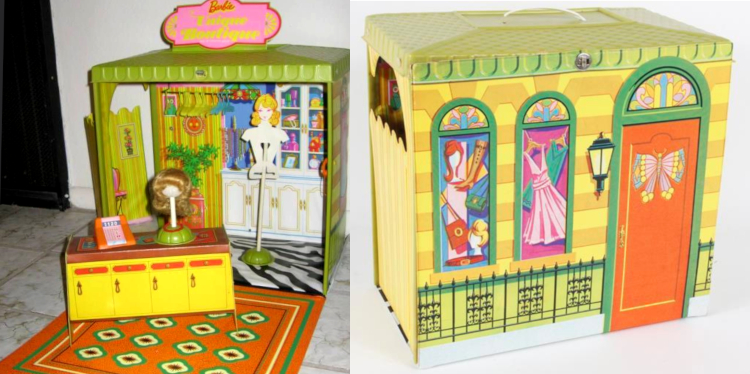
Of the real-life Sixties boutiques we surveyed, we think the Unique Boutique shares the most DNA with Granny Takes a Trip–or maybe Biba. But Barbie’s London boutique phase was fleeting; her next forays into consumerism, in the Superstar era, would take place at indoor malls and department stores of a decidedly more American persuasion.

Where to next? This post is about Barbie’s early built environment. The most recent post in this category concludes the Barbie’s Seventies Travelogue series, and the most popular are those on Mattel Modern and Susy Goose furniture and on penthouse apartments. Otherwise, the overall most popular posts on this site are about Barbie shoes, 1959-67, and about Mattel fashion booklets. Or just head up to the Table of Contents to see more options.


 Silken Flame
Leave a comment