Not Barbie on TV

In an earlier post, we reviewed a handful of Barbie’s television appearances on early Barbie sets. But Barbie, her friends, and rivals watched other programs, too. Let’s view a few.

Close up on chipboard TV on stand. The set is wood-look with gold-toned front. Smiling woman on front has short bouffant hair and high fur collar that merge together in the black-and-white color scheme.
1963 Ideal Doll House television set. Source: 608samolly on eBay.

First up is the 1963 Ideal house that was marketed for use by either Tammy or Barbie. This was a big house for its era, with kitchen, living room and bedroom in modern furnishings. On the black-and-white TV is a woman with Loretta Young looks and either a high fur collar or the most carefully-coiffured mullet on Earth.

1963 Ideal Doll House prototype in the ’63 Sears Christmas catalog. Source: christmas.musetechnical.com.

Midge reclines in a prototype of the same house in the 1963 Sears catalog, with a similar show airing on the small TV in the built-in shelving unit at back. What looks like a second set, facing Midge but lacking a screen, is in reality a bulky side table or storage unit.

Actually, the prototype TV show looks like a cross between the production version above and Tammy’s second television set, below.
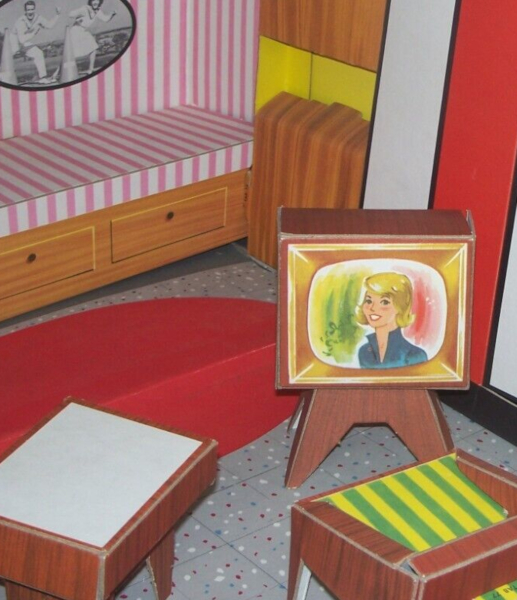
Close up on another wood-look chipboard TV with gold front, this one on four splayed legs. In color on screen is a blonde woman smiling, wearing navy with collar standing up. Behind her are washes of red and green. Surrounding we can see a dotted tile floor, a pink bench along the wall with drawers beneath, a wood-look chair with yellow-and-green striped upholstery, and a wood-look white-topped side table.
Tammy’s Ideal House / Tammy’s Playhouse television. Source: janetnmark2010 on eBay.

Ideal also made a house especially for their own doll, Tammy, in ’63. Tammy’s Ideal House, sometimes Tammy’s Playhouse, has color TV, and she’s watching an unknown blonde performer.
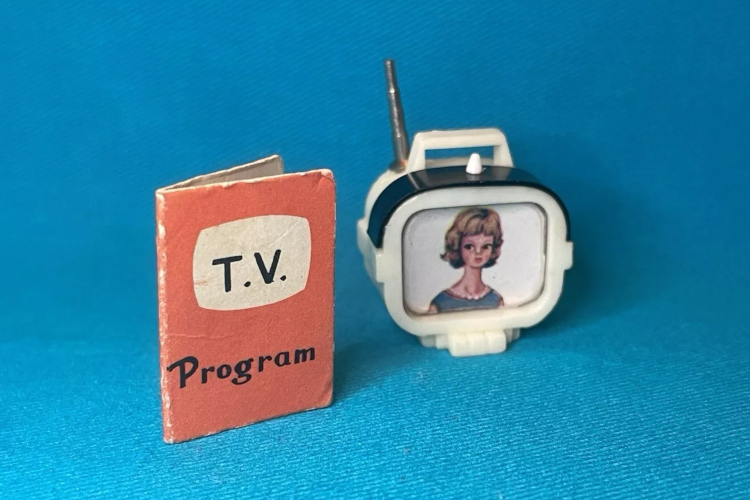
On a blue background, a folded piece of paper or cardboard says "T.V. Program" on a tV-screen-shaped blob with salmon background. Beside the TV program, a slightly ovoid plastic set in white plastic, with a handle and metal-look antenna on top, shows a girl or woman with a dirty blonde shot flip hairstyle and fringe, pearls, and a blue sleeveless top or dress.
Tammy’s pak TV. Source: pfmink on eBay.

Tammy, the girl next door, was less likely than Barbie to see herself on air; but a portable plastic television that came with some of her accessory paks did show a figure with Tammy’s trademark pout on screen.
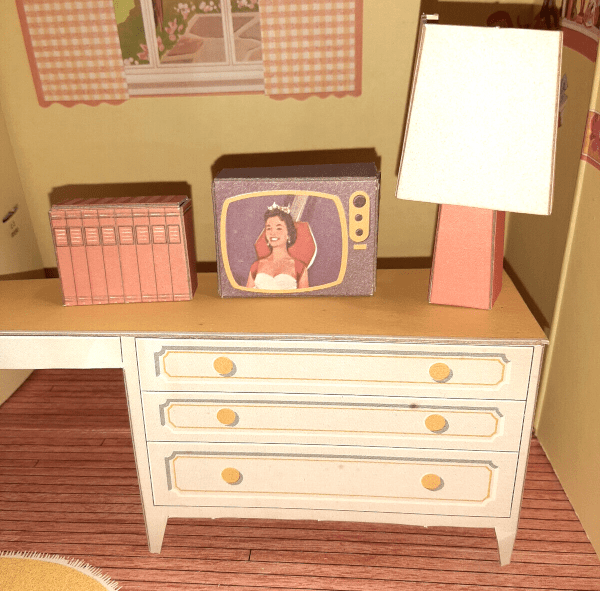
Purplish chipboard TV. On "screen" a dark-haired woman smiles brightly. She wears a tiara, a white gown with sweetheart neckline, and Elizabethan collar in red rising behind her head. She's shown to just below the bust, so we only assume that her garment is a gown; in a pageant scenario it could easily be a bathing suit.
Littlechaps’ Living Room TV set. Source: 2bdebtfree on eBay.

Over at the Littlechaps’ residence, still in ’63, the color TV shows a smiling brunette. This could be one of the Littlechap ladies, but we doubt it; like Tammy, they led private lives. This one looks a bit like a young Queen Elizabeth II, but for the lack of necklaces–maybe this is more of a homecoming queen, beauty queen or similar. The Bold Doll has an amazing article all about the Littlechaps, including images of the booklet advertising all their ephemera. Visible in the booklet (at the bottom of the article, but peruse the whole thing–it’s great) is a different (prototype) television, showing, in black and white, a possible newscaster or crooner before a microphone. The same version appeared on the Family Room’s packaging.

Two catalog items, one in black-and-white and one in color, for a one-room "house" in similar proportions to Barbie's first. Floor has tile look in white, black and teal; other furnishings include a bed or daybed with roll pillow, chair and couch in red and teal in similar shaped to Barbie's, TV set and lamp. Built into the back wall are clothes storage, shelves, and vanity, with small vanity stool, all similar to Barbie's first dream house. The furniture shown in the earlier black-and-white image and that in color differ somewhat, with the later one appearing less carefully crafted and more similar to Barbie's designs; possibly the difference between prototype and mass-produced reality. A small inset in the earlier image also shows a fences "patio" with indistinct furniture extending out from one side. The second listing mentions but does not show it.
1963 and ’64 Montgomery Ward catalog listings for a “Portable Doll House” or bungalow for Barbie and/or Tammy and/or Wendy and/or Tressy. Source: christmas.musetechnical.com

There was a glut of chipboard houses in 1963, imitators of Barbie’s original. Here’s a “Portable Doll House” we’ve only seen in Montgomery Ward’s catalogs, above. It looks like there’s a TV, but what’s on? Enhance!
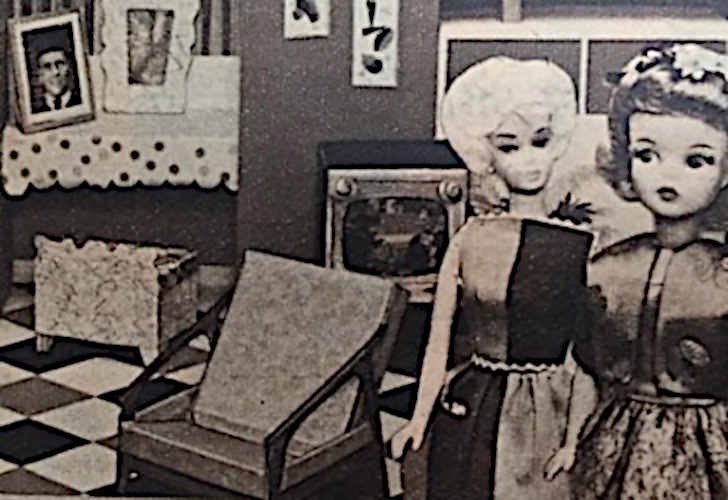
Close up on the black-and-white catalog image bove, The TV is in the background but may show evergreen trees and a crescent moon. Also in frame are an armchair with modern lines and a couple of framed pictures--one of a man in a necktie, one indistinct--on the vanity. Barbie and Tammy are both shown standing "in" the space, but possibly collaged on. Barbie looks like Fashion Queen in blonde wig, wearing Fancy Free.

We’ll venture that that’s a landscape at night–it could be anything, though.

Close up on wood-look chipboard shelves, with drawn-on drawers and colorful book spines, next to fireplace with orange and green fieldstone. Black-and-white TV is illustrated into the shelving and shows Tressy in profile, her hair grown out, wearing what looks like her original red-and-white dress (but only hear and shoulders are shown).
The telly in Tressy’s penthouse. Source: LaneyCummings on Flickr.

In 1964 the housing market cooled, but we did get one new “clone” house, Tressy’s Penthouse. Tressy’s chic city lifestyle allowed for a modestly-sized, black-and-white television built into the shelves, and that does appear to be Tressy on screen.
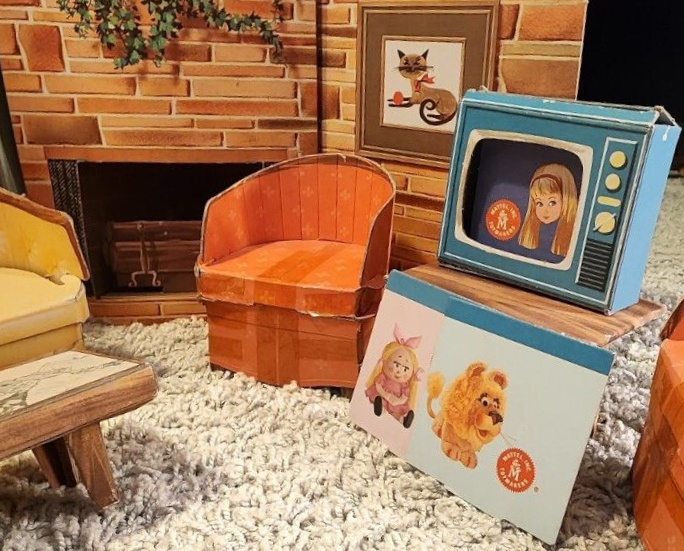
New Dream House chipboard living room. On blue "television" with insert screen, Illustrated Skipper's head floats on blue background next to Mattel logo. Alternate screens are propped against the table on which the TV sits. Both have white backgrounds; one shows a toy-looking lion and the other a little girl doll with blonde hair and pink frills. Also in frame are orange armchairs, yellow sofa, wood-look coffee table with marble-look top, and fieldstone fireplace with hanging greenery and cute framed cat picture.
1964 Barbie and Skipper’s New Dream House television with alternate screens. Source: lovart on eBay.

Barbie and Skipper got new digs in ’64 as well. For the first time, Barbie wasn’t on TV, but their color television offered a selection of different programs, some of which are shown above (there were more options on the backs of those cards, as well). This marks Skipper’s first television appearance.

Very close up image of greenish chipboard set. Smiling blonde woman with wide reddish collar, red beaded necklace, and bouffant/flip hairstyle appears on "screen" surrounded by music notes and asterisks.
1965 Skipper’s Dream Room television. Source: bigrackdaddy on eBay.

Skipper got her own room, with its own TV, in 1965. Since this looks like no other Barbie illustration in that time period, including multiple pictures of Barbie that came with the room, we’re forced to conclude that this is, surprisingly, not Barbie on Skipper’s TV. It looks a little like what Tammy was watching two years ago, though.
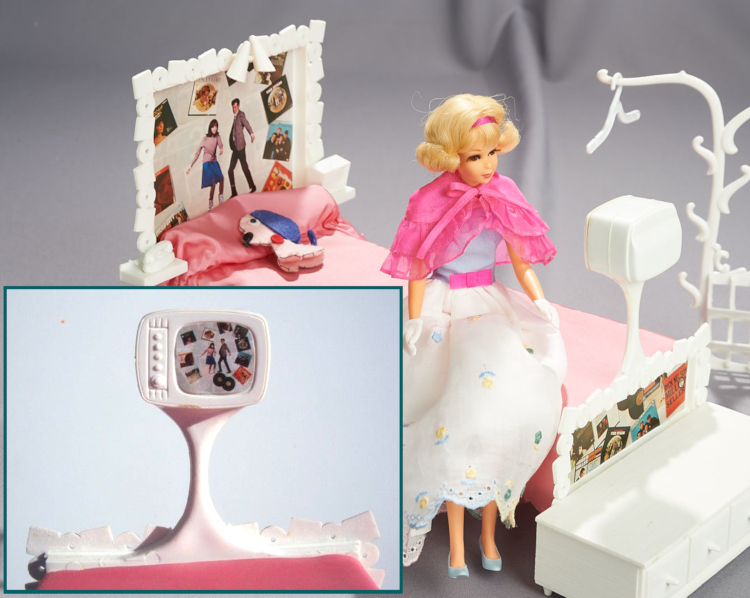
Large image of Francie seated on white plastic bed with pink sateen covering. On the head and baseboard are collaged photographic images including a pair of young people dancing, record covers, and records. From the top of the baseboard a thin, sinewy extension holds up a small, slightly rounded TV set. In an inset image the front of the TV is shown, and on its screen is a small version of the headboard art showing dances, record sleeves and records.
Francie’s 1966 Mod-a-Go-Go bed with built-in television. Sources: Theriault’s; Barbie List Holland.

Francie’s 1966 bedroom set by Susy Goose included a small TV built into the bedframe. As shown in the inset, the collage on her headboard is repeated in miniature on TV. The collage includes photographs of teens dancing, record sleeves, and two record albums. Were there shows that looked this way in ’66?

Barbie and pals continued to own televisions after these years, but they were diminished in size, illustrated into the walls or shelving, and typically turned off. In the Seventies Barbie favored a more active lifestyle, which TV didn’t suit–except, of course, for her 1972 “busy” TV set, perfect for the girl on the go. That set was tuned, naturally, to a performance by Barbie.

Smile, ladies!

Row of images showing the fronts of 4 TVs featured in the post, from: the 63 Ideal house, the Littlechaps' Family Room, Tammy's Playhouse, and Skipper's Dream Room.

Where to next? This post is about Barbie’s early built environment. The most recent post in this category is part three of the Barbie’s Seventies Travelogue series, and the most popular are those on Mattel Modern and Susy Goose furniture and on penthouse apartments. Otherwise, the overall most popular posts on this site are about Barbie shoes, 1959-67, and about Mattel fashion booklets. Or just head up to the Table of Contents to see more options.

2 responses to “Not Barbie on TV”

  1. […] Not Barbie on TV: Barbie and friends’ early TV sets that were tuned in to other programs […]

    Like

Leave a reply to Welcome! – Silken Flame Cancel reply