

When we last checked in on Barbie, she was living in a two-room “World of Barbie Family House,” her most sprawling home since her chipboard days. In 1969 life got better again for Barbie with the New Family House. At a glance the folded-up house, above, looks pretty similar to the old family house; but while that one compressed to a thin slab, the new house could only fold to an almost-cube; the extra space needed was due to its new third room.
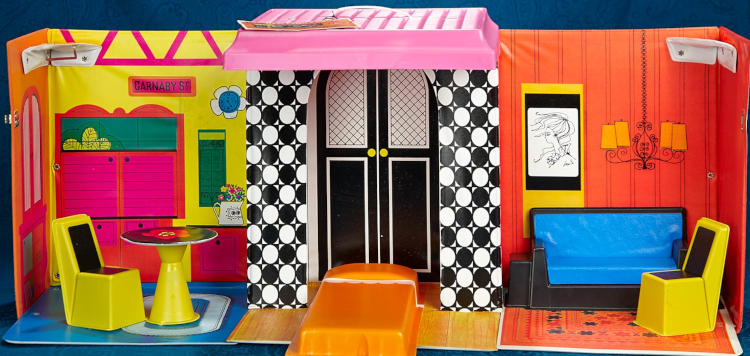
Another luxurious touch: unlike previous years, the 1969 house’s furniture (bed, sofa, table and two chairs) could be freely rearranged. Above, we see but one of many possible layouts, this one with the bed pushed up close to those double doors. A strange choice, but also the arrangement shown in some of Mattel’s promotional images, including the one printed on the tag tied to the handle on the roof above. At least some of Mattel’s images, including some from fashion booklets, show the bed in the leftmost room, and the table and both chairs in the middle space.
Other changes spoke less to luxury. Compared to earlier houses in the mod aesthetic, the New Family House’s walls are practically unadorned: a black-and-white sketch of Barbie with the wind in her hair, a wrought-iron-look chandelier, a flower-shaped clock and a street sign reading “Carnaby St.” are among the few eye-catching pieces lithographed to its vinyl walls (the area rugs and “hardwood” in the front room are nice touches, though). Maybe Barbie had started to grow tired of moving and decorating just to pack up and move again… or maybe her new “roommates” didn’t share her style sensibilities?
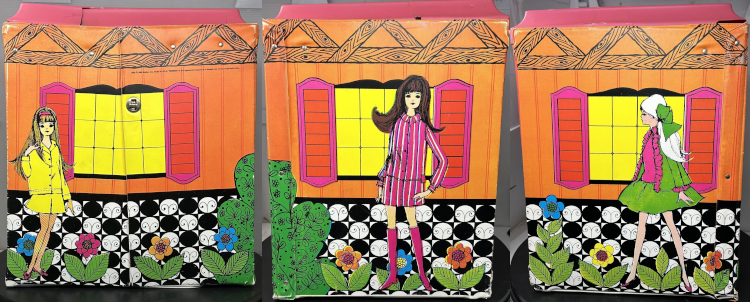
Perhaps the biggest change of all for Barbie is the suggestion that she and Ken had taken their relationship to the next level: shown at top, the pair pose like newlyweds in front of this new family house (though we know, of course, that they never officially married). On the other faces of the exterior, Barbie, Francie and Stacey creep through the flower beds and peer in at the windows. Like the interior, the exterior is otherwise lean on detail.
The New Family House stayed around until 1972. The following year, the Barbie Country Living Home was architecturally similar enough that we include it here.
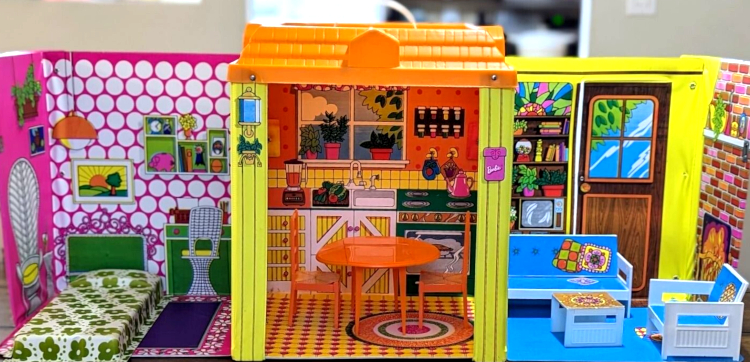
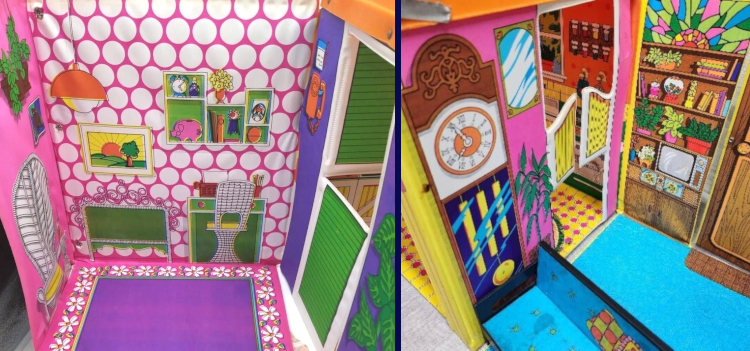
The structure was largely unchanged from the New Family House. The method for folding and carrying was identical; outside, the roof was slightly altered, and a functioning door opened out from the rear of the living room, above right. On the interior, the big architectural change was that full walls had been erected between the three rooms, with functional saloon doors connecting living room to kitchen and dutch doors between kitchen and bedroom.
The furniture was all-new, too, other than the bed, which was only recolored. The kitchen table and two chairs, sofa, easy chair and tile-topped coffee table are all variations on the furnishings common to ’70s sets including Jamie’s Party Penthouse and the Lively Living/Surprise House.
Unlike its predecessor, the Country Living Home’s rooms were indicated by the detailed illustrations on the walls: bookshelves, television and grandfather clock in the living room, cabinets and appliances in the kitchen, wicker chairs, headboard and wall phone (!) in the bedroom. The exterior was also rich with inviting and homey details in wood, brick, and greenery, but no characters–the characters’ appearances on the sides of structures ended with the mod period.

The New Family Home was the last of the mod abodes, but the Country Living Home wasn’t quite the first post-mod one. Next time, we’ll see what came between them.
 Silken Flame
Leave a reply to Welcome! – Silken Flame Cancel reply