

In Barbie’s mod housing saga, the parade of small houses continued in 1967 with additional Sears exclusives, the “House-Mates” for Barbie, Francie, and Tutti:

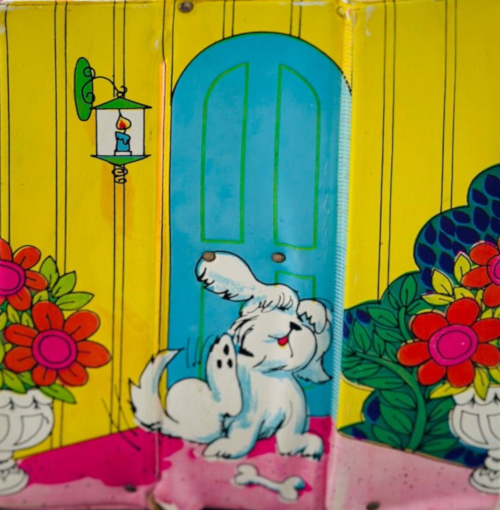
These cozy quarters, with their few furniture pieces mostly nailed to the floor, inhabited a grey zone between house and case room, with a couple aspects differentiating House-Mates from Sleep-‘n-Keep cases: first, they weren’t advertised to carry dolls, just to be portable themselves; second, their exteriors illustrate the house exteriors, while the case rooms’ exteriors simply illustrate the characters.

Convergent evolution at work: by adding fold-down vinyl beds and some lithographed features, the Sleep-n-Keep cases developed room-like complexity beyond the basic carrying case (which had had a closet-like component already), while the House-Mates continued the streamlining and simplification of the “deluxe” plastic houses of the previous two years.
(Note: A similar circa-67 offering, the Francie and Casey Studio House, we’ve ruled as more of a case-room and less of an abode–and no abode of Barbie’s, in any event. Its furniture folded down from the wall, Sleep-n-Keep style but with no floor; and on the outside its characters were posed before something like a cross between a building exterior and abstract Tiffany stained glass.)
But the main event in 1967 Barbie dwellings was the World of Barbie Family House. Finally, Barbie had a little space again–although this set still sported nailed-down furniture and folded up compactly, its two rooms were decently-sized for living and entertaining.
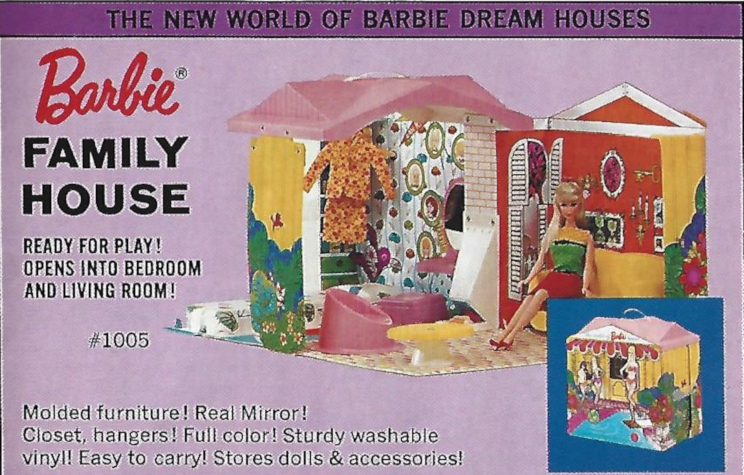
Barbie had a sofa, table, chair, vanity, ottoman (or “hassock seat,” as in the House-Mates description), bed, fireplace, and a place to hang her clothes: out in the open between the rooms, as seen above. A distinctive feature of this set is its pitched, pink roof.
In 1968 the set got a face lift with all new wall decor, inside and out, plus a redder roof.
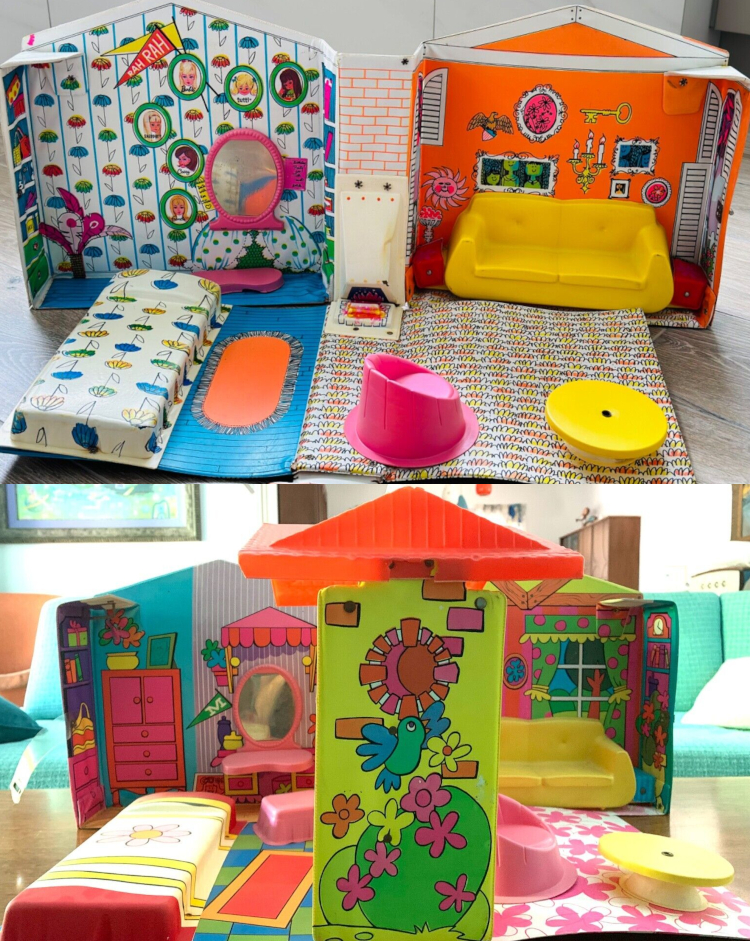
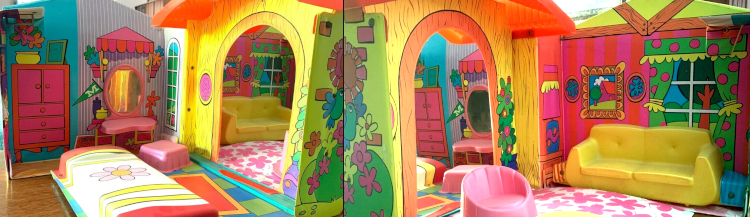
The new version of the house replaced the fireplace and iffy clothes storage with a wide arched doorway:
Also in 1968, a Dressing Room Case with a matching pitched pink roof was sold. Although not resembling a building on its exterior, and implausible as a standalone structure in any case, it made a nice addition to the World of Barbie houses and gave Barbie somewhere more appropriate to store her clothes.
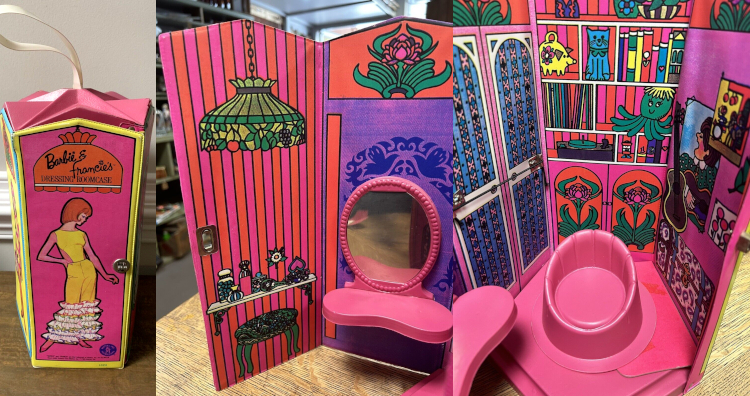
The dressing room’s richly psychedelic lithographed interior details include some of the nicer touches of late-60s Barbie habitations.
This entry covered two years in one go, and up to three separate Barbie abodes, depending on how you count them. Are we gaining speed as we spiral toward the conclusion of the “Abodes” series? Probably! Stick around to find out.
 Silken Flame
Leave a reply to The Many Abodes of Barbie, Part IV: 1966 – Silken Flame Cancel reply