

Tressy’s was first, in 1964. Introduced by American Character the year prior, she had the most sophisticated hair play for the time among Barbie and her rivals, with a lock of hair that lengthened and shortened by two separate mechanisms (a button to press and key to turn). Tressy’s Beauty Salon wasn’t functional–it didn’t add any new customization to styling Tressy–but, like Barbie’s Fashion Shop and New Dream House that were advertised the same year, it was a nicely detailed chipboard scene with almost too much furniture.

The two dryer-chairs and three other chairs suggest the salon was designed to serve many Tressys simultaneously. Speaking of design, Tressy’s Beauty Salon, like her Penthouse, is packed with modern touches including a room divider, potted plant, and tiered side table holding a lamp with tall cylindrical shade, all in what the catalog rightly calls “high-style colors.”
Misty’s Glamour Beauty Shop followed in 1965-66. Made by Ideal, Misty’s hair play innovation was a set of washable markers that could be used to tint her platinum-blonde hair a variety of shades. The Sears-exclusive Beauty Shop set came complete with doll and markers, but otherwise, like Tressy’s Salon, added no functionality.
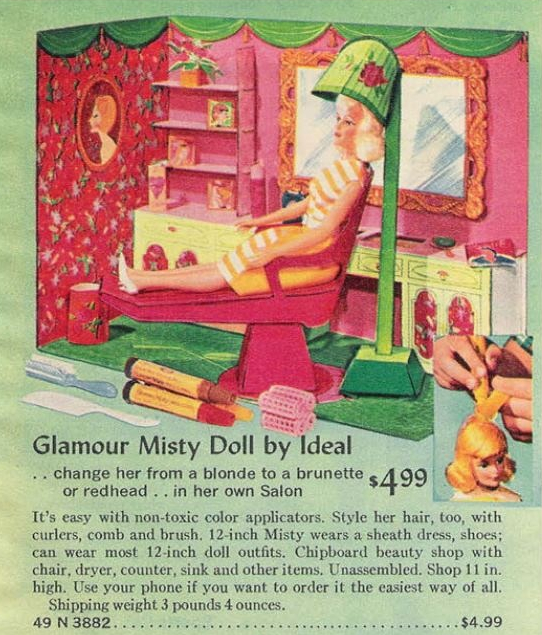
Compared to Tressy’s salon, Misty’s, with its single dryer chair and counter, looks pretty spare. However, some nice details are scattered over those shelves. While this set is rare, Flickr user Susan Hall archived eBay images from an unused set back in 2013, and Worthpoint has good images from a less-mint auction.
It would be years before Barbie got a hair salon of her own. Before we reach our destination, let’s pause to review a few Mattel releases that were not salons.

L-R: Barbie’s Wig Wardrobe (source: Theriault’s); Color ‘n Curl play set in the 1966 Sears catalog; Action Beauty Scene in the 1971 Sears catalog (both Wishbook Web).
Fashion Queen was Barbie’s first foray into hair customization, although the wigs were not meant for styling. They came on little wig stands like the one pictured, above (and Midge also had a set). The opportunity for a salon was there, but Mattel didn’t take that step. A couple years later, starting in 1965, they were again releasing doll heads and wigs as part of the Color ‘n’ Curl Color Magic play set. Now the styling aspect was very real, as the wigs were meant to be both colored and cut, and the set included extensive styling instructions; it even came with a little battery-operated dryer–innovative functionality preceded only by Tressy’s 1964 cool-air-blowing dryer–but still, no salon-like environs for Barbie to enjoy. In 1971 another set with battery-operated dryer, the Action Beauty Scene, DID feature basic environs (wall with wall outlets, counter, chair, wall mirror and separate lighted mirror), but the pieces suggest a domestic setting rather than a visit to the beauty parlor. As with other sets discussed here, the Action Beauty Scene was connected to hair play, being advertised alongside the Growin’ Pretty line of dolls whose hair lengthened and shortened in a manner similar to Tressy’s–although Growin’ Pretty Barbie and pals are not actually shown in promotional images like the one above.
In 1973 Barbie finally had her hair professionally styled at the Quick-Curl Boutique. This latest advancement in hair play added thin wires to Barbie’s and friends’ hair, enabling, as the name implies, rapid coiffurization. Along with the dolls a simple case room containing a vanity, chair and mirror was sold. These furnishings are not terribly different from what Barbie had enjoyed at home in ’71; however, the name Boutique indicates this set as a commercial shop.
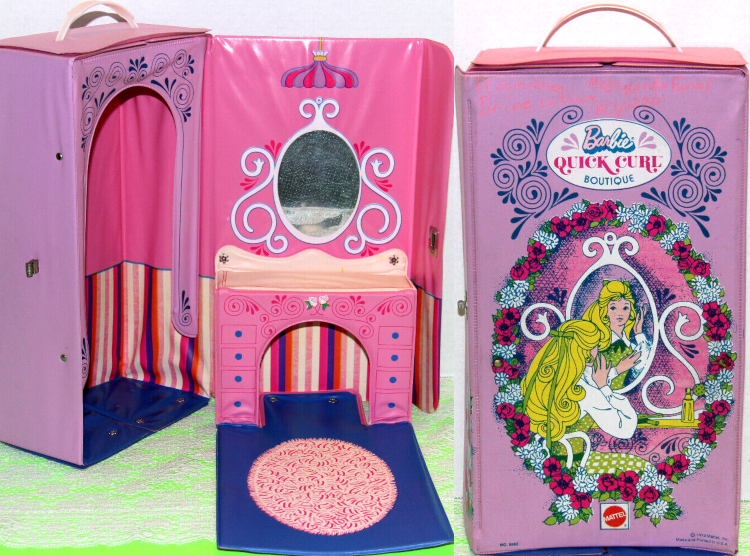
The case also had space for clothes storage, which further blurs the line between salon and home, but we’ll take what we can get.
Sears had another salon offering starting in 1973: the famous Sears Beauty Salon. Its dryer chair and other features distinguish it as a professional operation. Both the dryer and mirror lights were battery-operated. The set was advertised at least until 1977.
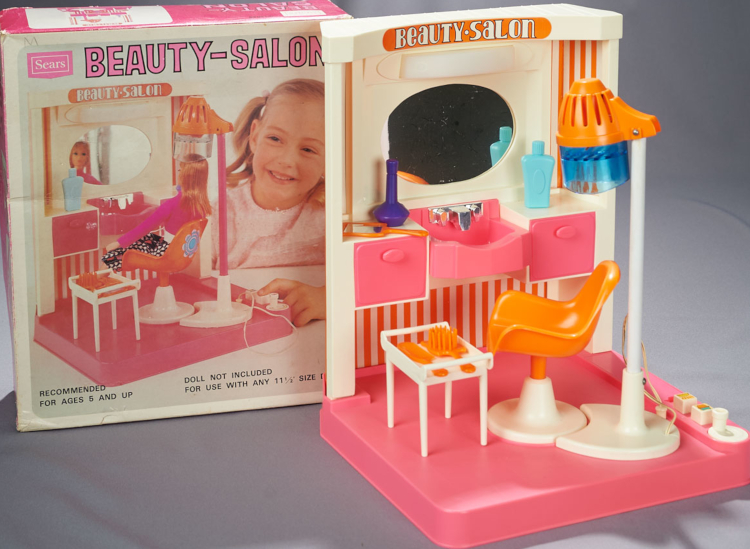
Sears Beauty-Salon and its original packaging. Source: Theriault’s.
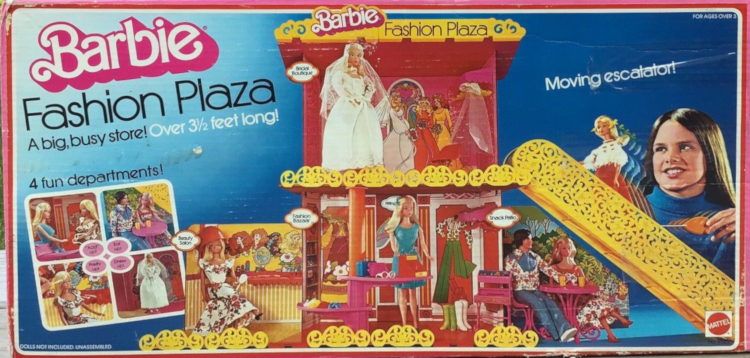
In the years that followed, Barbie kept getting better at going to the salon. The 1976 Barbie Fashion Plaza included a small salon, and during the Superstar years various beauty parlors competed for her custom.

Isn’t it strange that it took so long for Barbie to get to the hairdresser, considering what a difference that can make for a teenage fashion model’s career? Just look what it did for Twiggy! We’ll navigate other gaps in Barbie’s early built environment in future entries.
Where to next? This post is about Barbie’s early built environment. The most recent post in this category concludes the Barbie’s Seventies Travelogue series, and the most popular are those on Mattel Modern and Susy Goose furniture and on penthouse apartments. Otherwise, the overall most popular posts on this site are about Barbie shoes, 1959-67, and about Mattel fashion booklets. Or just head up to the Table of Contents to see more options.

 Silken Flame
Leave a reply to Taswegian1957 Cancel reply