
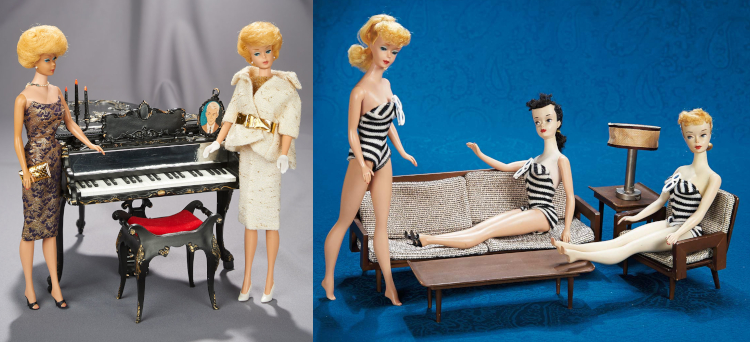
Mattel Modern (1958)
In 1958, Mattel debuted its Mattel Modern line of stylish, wooden doll furniture, and a year later Barbie was introduced to make use of it.
Wait, what? Okay, that’s not quite how it happened. Mattel Modern, a line of sleek, midcentury-styled, real wood furniture, was released before Barbie, but it was meant for (approximately) 9″, non-Mattel dolls–like those produced by the Alexander company. The images below, from Theriault’s auctions, show Barbie exploring the bedroom set–doesn’t she look just a little tall for that bed?–and the 10″ Cisette doll, made by Alexander, standing between a Mattel Modern queen bed and fold-out sofa bed. Per the official Mattel Modern literature, even Cisette is too tall for some of these furnishings.

Note that the cushions on these pieces weren’t always flat as in the above images, but deflated over the years. Otherwise, this line of solid-wood furniture seems to have held up very well.
The 1958 Mattel Modern furniture line included:
- a sofa, an easy chair, a coffee table and an end table with working (battery-powered) lamp, all as in the image at top right of this post, and also sold together as a living room set;
- a queen bed, open wardrobe (holds dresses for 8″ and 10 1/2″ dolls, per the brochure), and dresser with real glass mirror, all shown above left and sold, along with the lamp and end table, together as a bedroom set;
- a dining table with two chairs (below, with its original packaging) and a buffet (shown beside the bedroom set above left), also sold together as a dining room set, and
- a “studio set” consisting of two convertible sofa beds–one can be seen behind Cisette, above right–plus the end table and lamp.
The last set is intended for 8″ dolls only, the brochure cautions. Scroll to the bottom of the post for a shot of Ken and Ricky standing amidst Mattel Modern furniture, including the studio set; the sofa beds might fit Ricky lying down, but not Ken.
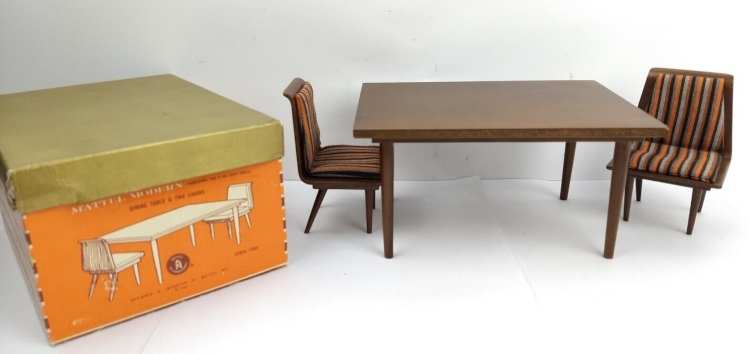
Most of these pieces are stamped Mattel Japan, 1958. However, there is at least one example of the dining set marked instead with a sticker reading “Tahei Mokko Ltd. Co.” It’s likely that Mattel outsourced production to the Japanese company, and they may have also sold these and similar items under their own branding, possibly to foreign markets. This could explain the similarity between the real-deal Mattel Modern pieces and the TV and stereo also displayed with Cisette, above, as well as the two luggage stands mixed into the bedroom set pictured with Barbie to Cisette’s left. Of course, other stylish furniture sets for 8″-10″ dolls were also available in the years leading up to Barbie’s debut.
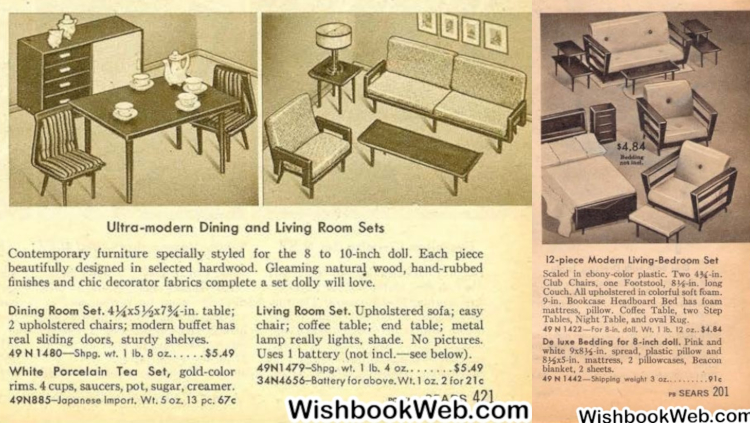
So the year before Barbie is introduced, we find Mattel with the means to produce gorgeous, solid-wood furniture for similarly-sized dolls. Why didn’t they scale up a little for Barbie’s height, and carry on? Maybe the price point was wrong for Barbie’s customers, or maybe the manufacturing couldn’t have kept pace with Barbie’s audience. Whatever the case, when Barbie did get her own furniture it bore little resemblance to Mattel Modern.
Susy Goose (1962-1966)
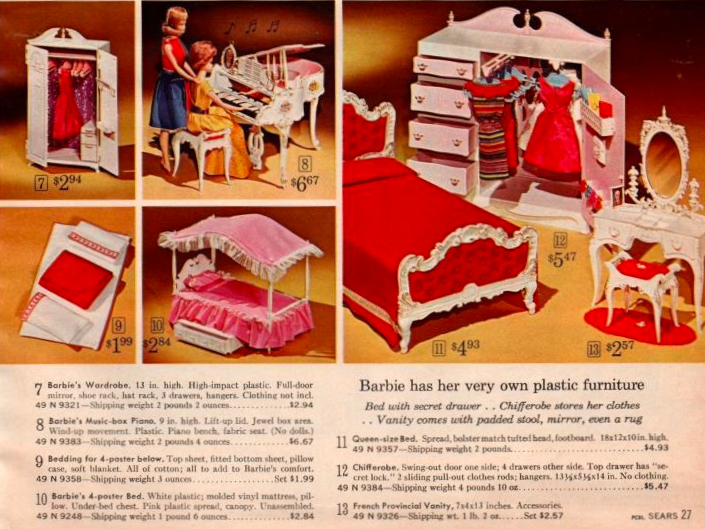
When Barbie debuted and for her first couple of years, she had no furniture of her own. Once the time came to fill out Barbie’s little world, Mattel could have revived the Mattel Modern concept. Instead, they went a different route: licensing the Barbie trademark to Susy Goose, a division of Kiddie Brush & Toy Co of Jonesville, Michigan, along with starting production of their own play sets of the chipboard variety, both in 1962.
The Susy Goose line first appeared in the 1962 Sears Christmas catalog as a wardrobe and four-poster canopy bed with an under-bed storage drawer. By 1964, below, a set of bed linens, music box piano (in white or black–see top of post), queen-sized bed, queen-sized chifferobe, and vanity with stool (same as the piano’s stool) had been added. Ken had a wardrobe of his own in a taupe plastic, not pictured.
Plastic furniture development moved in-house at Mattel around this time with the Go-Together rooms and subsequent plastic-y play sets. In 1965, the Susy Goose Skipper’s “jewel”-trimmed bed, vanity and wardrobe competed with the Go-Together Skipper’s Bunk Bed set–see the collage of catalog listings below. The Go-Together Bunk Beds (left) appeared alongside the jeweled bedroom set (middle and top right) in the 1965 Sears Christmas catalog, while a different bedroom set “for Skipper, Skooter, other 9-in dolls,” lower right, shared the Bunk Beds’ page in the Montgomery Ward ’65 catalog.

Skipper’s “jewel-studded” bed was an uncharacteristically gauche design from Susy Goose, with the “photo insets” of smiling children, haphazardly arranged on a plain background, badly undercutting the elegance. Barbie also had a jeweled bedroom set (below left), sans photographs, around this time, and the final Susy Goose design under Mattel’s trademarks may have been Francie’s 1966 Mod-a-Go-Go bedroom (below right), where the decoupage-style embellishments are a much better fit.
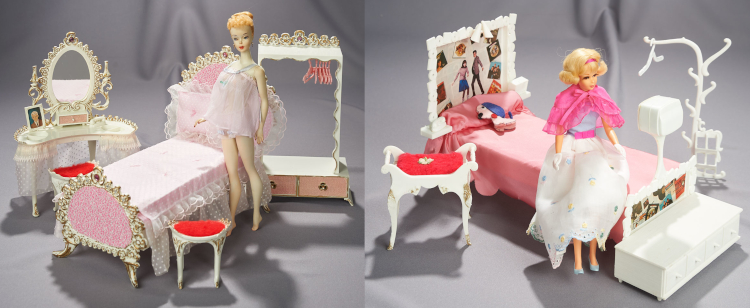
Want to know what’s playing on the far-out, amoeboid television attached to the base of Francie’s bed? Images we browsed on eBay suggest it’s a smaller version of those “pin ups” scattered across the headboard.
There, we suppose, the licensing agreement with Mattel comes to an end. An off-brand, Susy-Goose-lookalike bedroom set was advertised in JC Penney and Montgomery Ward Christmas catalogs from about 1970-75.

For the first three years the set was advertised, the JC Penney catalog description claimed that the suite “opens up into [luxurious/glamorous/pretty] bedroom,” with the flattering adjective varying from year to year. This seems like a copy-paste error coming from a case room or other play set description; the reference to “opening out” was removed in 1973 and in subsequent years. As pictured above, the JC Penney version of the set was of white plastic, like many Susy Goose pieces, while the Montgomery Ward version was dark brown or possibly black. The copy in the 1974 Montgomery Ward catalog (not shown) asserts that their set is “pretty and feminine” and that its dark plastic is “wood grain.”
Maybe these were Susy Goose or Kiddie Brush & Toy Co. products, but maybe not: after all, most of the Susy Goose designs were pretty timeless, and many would be rehashed by other manufacturers, including Mattel, over the years. Just look at how 11.5″ fashion dolls were living in 1982:

The pink canopy bed in particular seems to echo across time: following the ’60s version at the top of this section and the ’82 Dream Bed above center, Barbie also slept in a Dream Glow bed (1985), a Starlight bed (1991), and a Glitter ‘n’ Glow bed (1996), ranging from romantically lit to radioactive, during the late 20th century,:
The Mattel Modern furnishings celebrate their 65th anniversary this year. Although we’ve seen a smattering of other modern-styled Barbie furniture over the years, as far as we know Mattel never produced, nor licensed their trademarks for the production of, real wooden Barbie furniture.

Where to next? This post is about Barbie’s early built environment. The most recent post in this category is Barbie’s Seventies Travelogue, Part 2, and the most popular are this one and one on penthouse apartments. The overall most popular post on this site is about Mattel fashion booklets. Or just head up to the Table of Contents to see more options.
 Silken Flame
Leave a reply to Not Barbie on TV – Silken Flame Cancel reply