Doll Carrying Cases (1961-1972)

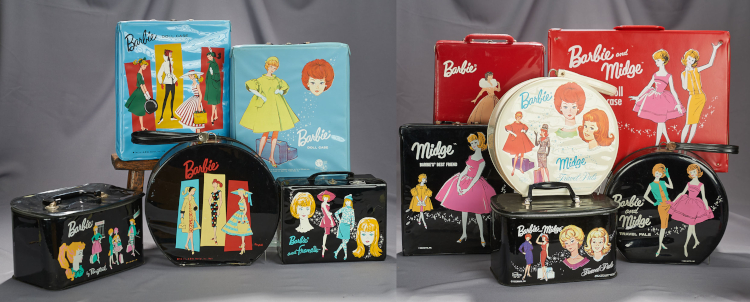
Two photographs including a total of eleven cases. In the left image are two cases that use the jazzy off-kilter rectangles mentioned in the post; most others have trails of white sparkles running behind the figures, and the others have floating heads in addition to full-length dressed figures. The cases themselves are light blue, black, white and red vinyl. Most cases have the limited color palette discussed in the post, while two on the right hand side are full color.
1961-63 Barbie travel cases and children’s luggage. Source: Theriault’s.
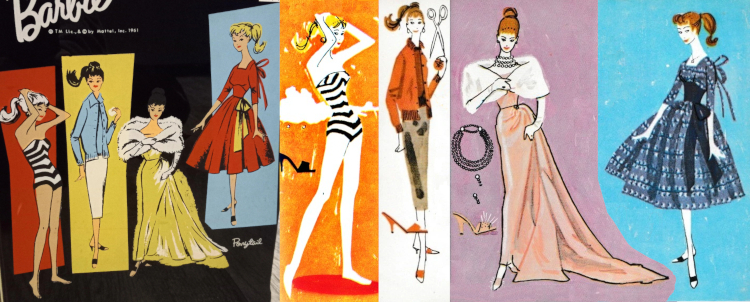
As described in the caption, noting that on the carrying case, Sweater Girl has a pale blue cardigan set and white skirt, Enchanted Evening has a gold dress, Let's Dance is a solid red dress with gold sash; in the booklet images Sweater girl has an orange cardigan set and brown skirt, Enchanted Evening is pink, and Let's dance is a blue patterned dress with darker blue sash.
Left: detail from the front of a 1961 Barbie carrying case, showing Barbie dressed in her original swimsuit, Sweater Girl, Enchanted Evening, and Let’s Dance. Source: iwish-iwish on Reddit. Right: composited images from the 1961 fashion booklet, showing the same fashions. Source: Constance Ruppender on Flickr.

The very first cases, released in 1961, tend to show Barbie modeling her various fashions before colorful quadrilaterals. The silkscreened graphics use only a handful of hues per case, although the palette is switched out from case to case–meaning we get to experience familiar fashions in a variety of surprising shades. As mentioned in the introduction, the poses here are the same as the ones in the fashion booklets–redrawn, but possibly traced–though the color schemes may be unfamiliar (as in the image above, where Sweater Girl, Enchanted Evening, and Let’s Dance all get fresh paint jobs). The one “original” fashion that I have seen shows Barbie in profile, in a full skirt, holding a roundish case of her own. This pose may have been traced from Sweet Dreams in the 1961 fashion booklet–a highly similar stance for a totally unrelated fashion.

Four fashion booklet illustrations, as descried in the figure caption, plus two white carrying cases each showing four figures posed before colorful quadrilaterals. The cases are close to identical with differences described in the caption. The Suburban Shopper dress is shown with red and white stripes on both cases; the stripes on the skirt are vertical on the case at left. The looks not discussed in the text are Winter Holiday and Peachy Fleecy. The case at left shows the Peachy Fleecy model with her elbow bent and hand at her chest, as in fashion booklets (not shown), while the figure at right has her hand in her coat pocket. One further difference: all the figures on the case at right, with Commuter Set, have closed-toed shoes, while they are accurately open-toed on the left case. The exception is Winter Holiday who appears to wear cork wedges on both cases.
Two 1961 Barbie carrying cases by Ponytail. On the case at left, the leftmost figure models the “original” carrying case fashion, and the 1961 Sweet Dreams fashion booklet depiction is included at the top left corner for reference. At right, on a highly similar case, the “original” fashion is exchanged for Commuter Set, which was out of production by 1961. Commuter Set from a 1960 fashion booklet (via aA Walk Thru Time on eBay) is included to the righthand side for pose comparison. Lastly, the pose used for the red-and-white striped dress varies between the cases; on the left it matches 1960-61 illustrations of Suburban Shopper, as shown to the left; the pose used on the righthand case version may be a variation on the Suburban Shopper stance, but is certainly not the later Busy Morning pose, top right corner, despite the dresses’ similarity.

Sometimes, the similarities between the 1961 illustrations in booklets and on carrying cases can help us identify an ensemble whose details were changed or simplified for the case illustration, as in the example below, where we can establish that the top Barbie fashion on the Ken case is Cotton Casual, rather than the somewhat similar Suburban Shopper and Movie Date fashions, based on the model’s pose: arms akimbo, face shown in profile.
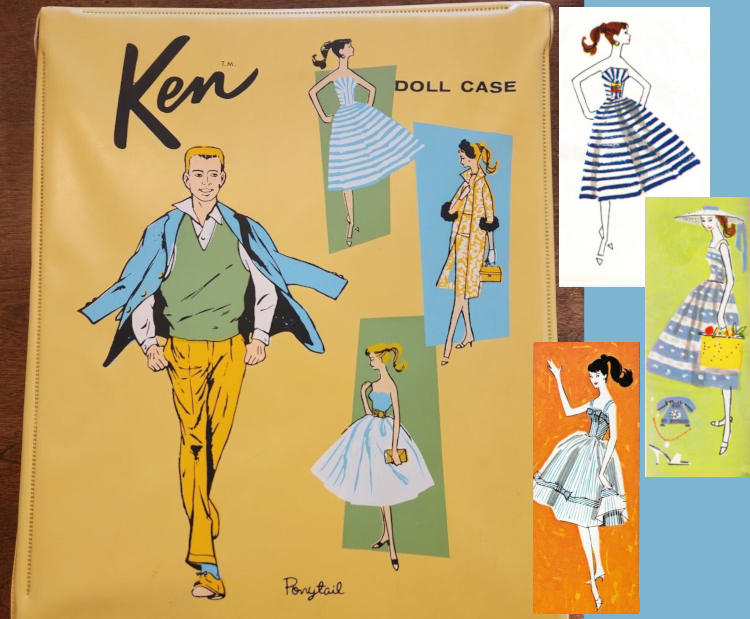
At left is a yellow case featuring Ken. in smaller insets against that jaunty quadrilateral shapes are Barbie in 3 ensembes. At top, a sundress of white and pale blue stripes doesn't look exactly like any known ensemble. Below that, Evening Splendor looks more or less as the real garments do, and at bottom, Silken Flame is recognizable despite the bodice having changed from red to pale blue. At right, three booklet images are shown to illustrate that the top dress at left must be Cotton Casual, due to the model's pose (although the Cotton Casual illustration shows much darker navy stripes and colorful bows on the bodice). The other candidates depicted are Movie date and Suburban Shopper, both with blue and white stripes and similar silhouettes--but the poses are wrong.
Left: cover of a 1961 carrying case featuring Ken. Source: heidihofromidaho on eBay. Right: Fashion booklet images of Cotton Casual, Suburban Shopper, and Movie Date. Sources: Constance Ruppender on Flickr, thevintagetoyadvertiser blog.

Now that we’ve seen it once, it’s easy to recognize Cotton Casual when it appears on the ’61 record totes shown below. But what about the polka dotted dress below that? It reminds me of Party Date, which didn’t exist yet. Pose analysis indicates that I was close: the figure is copied from Silken Flame as it appears in the booklets (and you can see another color-altered Silken Flame on the Ken case above).
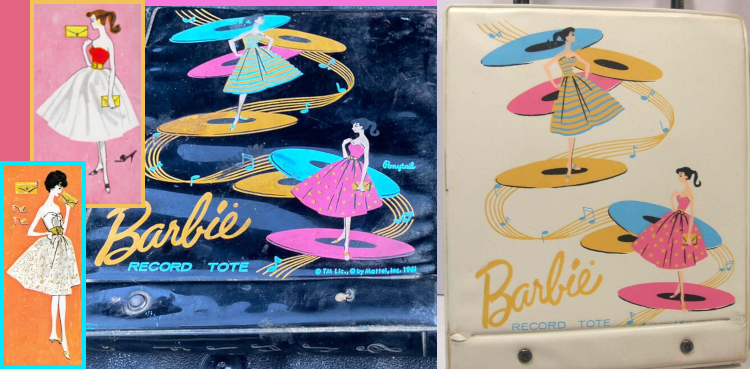
A pair of record totes are identical except one has a black background and one a white. Two Barbies dressed for dancing are standing on oversized records amidst a trail of similar records and a twisting staff with music notes. Colors are silkscreened in pink, blue and gold. One of the two Barbies is recognizable, in pose, as the Cotton Casual figure but with blue and gold stripes on her dress. The second has an all-pink dress with what look like gold polka dots on the skirt. Her pose is the same as the Silken Flame model on the Ken case in the previous image. At left, a Silken Flame image from the 1961 is shown along with a Party Date figure from 1962. The Silken Flame booklet illustration matches that on the record totes, although the dress is a better match for Party Date, in the author's opinion.
Two 1961 record totes, a 1961 fashion booklet illustration of Silken Flame, and a 1962 illustration of Party Date. The Silken Flame and Cotton Casual (above) sketches match the figures on the record cases. Sources: jasperman111 on eBay, Constance Ruppender on Flickr, thevintagetoyadvertiser blog

In addition to doll carrying cases and record totes, the same imagery appeared on lunchboxes, pencil cases, scrapbooks, children’s luggage, and more.

In the 1963 iteration of the cases, Midge joined the scenes and both she and Barbie adopted all-new poses. Sometimes the color palette was expanded to allow richer illustration, but not always. Sparkle trails and floating heads replaced the off-kilter rectangles.

The set of three pieces of children’s luggage below, still utilizing the limited color scheme, feature Sorority Meeting in three different color combos made from mostly the same colors (teal with white trim and reddish hat and shoes, orange dress with teal sweater, shoes and gloves, orange dress with teal sweater but no gloves), while Movie Date, on Midge, is consistently pink.
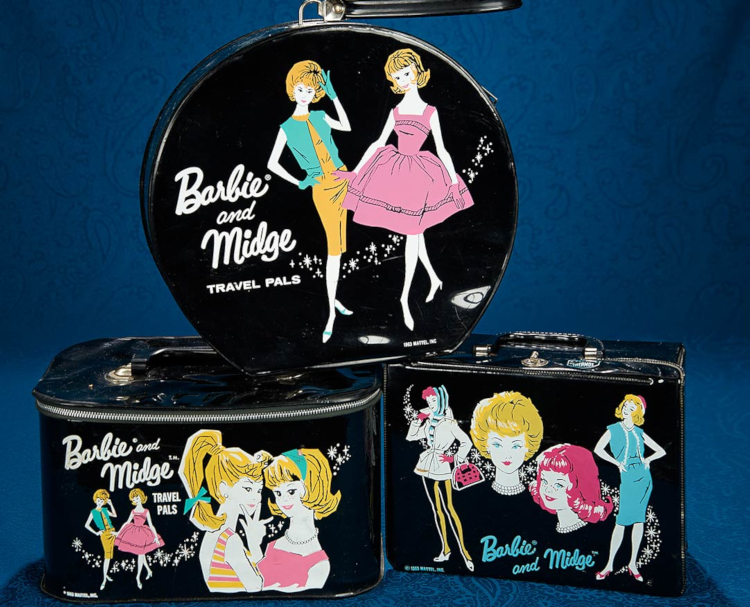
Three pieces of vinyl children's luggage are shown. All three are black and feature the sparkle trail and floating heads discussed in the post. At the top of the pile, a circular case bears an illustration of Midge, in a pink copy of Movie Date, alongside bubble cut Barbie in Sorority Meeting with an orange dress and teal sweater and accessories. At bottom right, Midge wears Sorority Meeting in all teal with white trim and red accessories, while Barbie wears Open Road in its proper color scheme. At bottom left, Barbie and Midge are posed and painted exactly as they were on the top case, except Barbie's gloves are not painted. In close up, Barbie and Midge stand very close together, possibly hugging. Either Midge or Barbie is gripping Barbie's chin, to either side of the her mouth, with two fingers. Midge seems to be looking downward at Barbie's mouth while Barbie glances off to the side. Their foreheads nearly touch. Midge may still be wearing Movie Date, but Barbie, here with a blonde ponytail, is wearing an unknown sleeveless dress with pink and orange stripes. This case and the top case say "Barbie and Midge, Travel Pals" while the third case says only "Barbie and Midge."
1963 Barbie and Midge children’s luggage with limited color palette. Source: Theriault’s.

The case at lower left raises a question: was “Travel Pals” a sort of euphemism?

Even with unlimited colors available, sometimes the outfits were recolored to add visual interest, as happened to Sophisticated Lady, below right, and “Red” Flare in the image that opened this post.
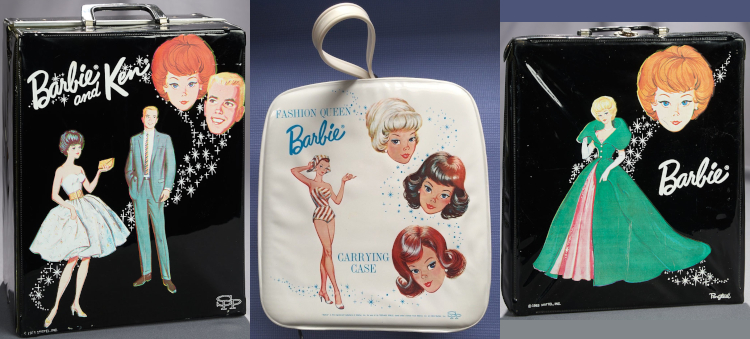
Three doll carrying cases. At left, on a black background, brunette bubble cut Barbie wears Party Date and gestures toward a suited Ken with her clutch. Red bubble cut and blond Ken heads float at the end of a sparkle trail. At center, on a white vinyl case, Fashion Queen Barbie stands next to three floating heads: platinum blonde bubble-on-bubble, dark brunette, and reddish short flip. At right, blonde bubble cut Barbie in Sophisticated Lady stands on a black background with sparkle trail. Her dress is pink as in the real ensemble but her evening coat is green. A red-haired bubble cut head floats nearby.
1963 Barbie doll cases with full-color palettes. Source: Theriault’s.

Starting in 1965, the mod years came in with an explosion of color and form, as the sparkle trails and floating heads were supplanted by colorful art-nouveau-by-way-of-Swinging-London flourishes:
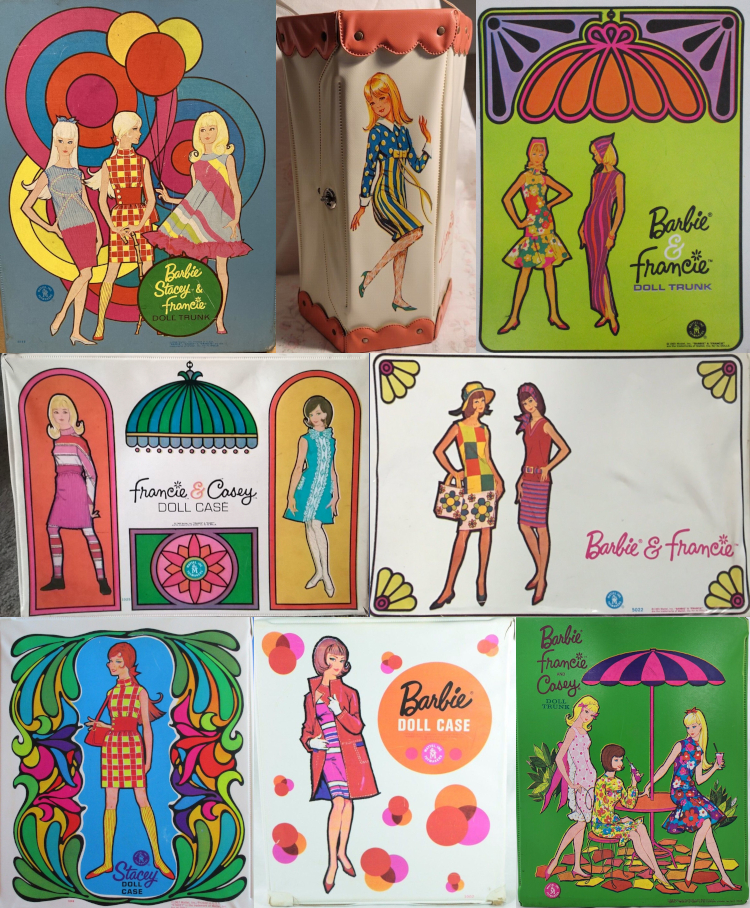
Eight doll cases starting from 1965. In addition to Barbie, Francie, Casey and Stacey are depicted. Colorful abstract decoration resembles Tiffany stained glass.  Three illustrations running down the righthand side of the collage all show Barbie and Francie or Casey dressed in Color Magic Fashions. All fashions shown are recognizable and in the known color schemes, including Knit Hit, Floating In, Iced Blue, Fashion Shiner and others in addition to the Color Magic ensembles.
Eight later-60s carrying cases from eBay users including shisha dolls, babyandbro, and szepie77.

Out of step with the Barbie carrying case aesthetic of these years, one 1967 lunch box was decidedly non-mod:

Lunchbox with what looks like an American Girl Barbie, in a pink evening gown with a red cloak and white fur trim, escorted by a tuxedoed Ken. In smaller illustrations other figures appear in long gowns and tuxedos. Text reads Campus Queen Magnetic Game Kit. A pink sparkle trail runs behind the text and figures.
1967 King Seeley Campus Queen Lunch Box. Source: Smithsonian Institute

That’s because the Campus Queen lunch box, above, is not licensed by Mattel. Though the resemblance to American Girl Barbie, Ken, and Queen of the Prom was undeniable (the back of the box features a little “board game” played with magnetic pieces, and the sides show scenes of characters engaging in dress shopping and other activities), this item has no Barbie affiliation whatsoever.

Back in Barbie’s milieu, it was during the mod era that Sleep-n-Keep cases were introduced. One half of the case resembled a standard carrying case, with compartments for dolls and hanging clothes and drawers for accessories, while the other half was painted up to look like a bedroom, with vinyl bed(s) and tables that folded down from the wall like elements in a pop-up book.
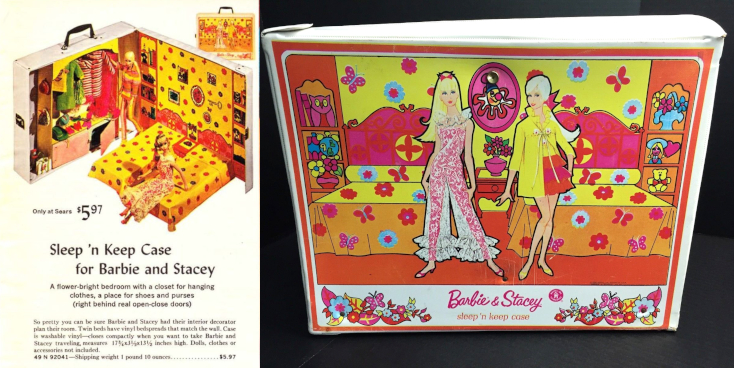
Left is a color catalog entry for the Sleep-n-Keep case as described in the text. The text is too small to read, except "Sleep 'n Keep Case for Barbie and Stacey; A flower-bright bedroom with a closet for hanging clothes, a place for shoes and purses (right behind real open-close doors); Only at Sears $5.97." The bedroom has bright yellow, flowered wallpaper and bedspreads with reddish backboards. At right, the exterior of the case is an illustration of the room pictured at left, including Barbie in Jump Into Lace and Stacey in Night Clouds.
Left: 1968 Sears catalog listing for the Sleep-n-Keep Barbie and Stacey case; Right, the exterior of the case. Sources: Wishbook Web, eBay

The first Sleep-n-Keep case we’ve observed is the ’68 Barbie and Stacey case shown above. The catalog text at left asserts that the room is “So pretty you can be sure Barbie and Stacey had their interior decorator plan their room.” It wasn’t so pretty that the girls wanted to keep living there, though, because by the following year they had a new “Romantic Victorian bedroom,” per the ’69 Sears catalog (not shown).
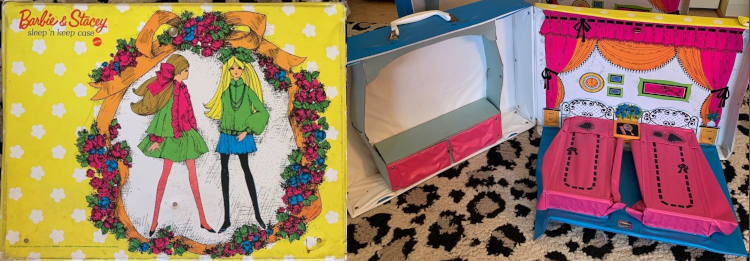
Barbie and Stacey Sleep 'n Keep Case exterior shows the two inhabitants--one in Fancy Dancy--but no room. At right, the open case shows blue flooring (the material of the case), bright pink bedsreads, curtains and cabinets with illustrated wrought iron headboards. Details include flamed art on the wall. The set is displayed on top of someone's animal print rug, but that's not part of the case (though it is referenced in the text).
Exterior and interior of the 1969 Barbie and Stacey Sleep-n-Keep case room. Source: rhondazimmerman on eBay.

Barbie and Stacey’s interior decorator was not consulted about the animal print carpet seen in the eBay listing above.

Left: case exterior shows Barbie and PJ in neon colors. Right: blue flooring, orange and floral bedspreads, a stained glass illustrated hanging lamp, multicolored throw pillows, and wall art that says "LOVE" and "SMILE" in funky text.
Exterior and interior of Barbie and P.J.’s Sleep-n-Keep case room. Source: pure-9 on eBay.

Why did Barbie have so many different roommates? Was she difficult to live with? I choose to believe that these rooms represent some of her many pieds-a-terre, as her swinging modeling career and jet-setting lifestyle took her from London to New York to Pairs to LA, where she had dedicated space to crash with pals, all while maintaining her idyllic suburban lifestyle in some less fashionable burg. But who knows?

I like to go out on notes of sparkles and rainbows, when possible:
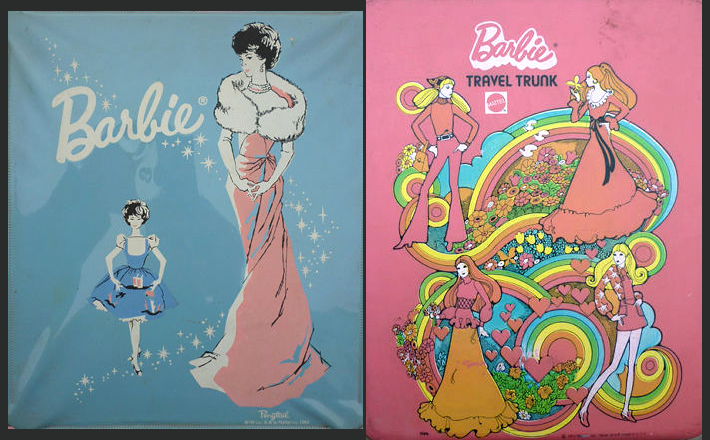
Left: light blue carrying case showing dark-haired Barbie in Enchanted Evening and Friday Night Date, in a limited palette but essentially the correct colors, on a white sparkle trail. Right: A sort of rainbow trail with pink hearts on a pink case. One figure wears a minidress, one wears bell bottoms, and two are dressed in long flowing pilgrim/bucolic fashions; this illustration is exiting the mod era on the other side.

Where to next? Check out our post on off-brand carrying cases; see more portable homes in the Many Abodes of Barbie; get into Basic and Dressed Doll Boxes; or make your way to the table of contents to view more options.

12 responses to “Doll Carrying Cases (1961-1972)”

  1. […] sewing patterns, whose illustrations fit the style of the era’s fashion booklets. Unlike the carrying case illustrations, they don’t seem to be traced; but the art styles are, to say the least, in harmony. Here are […]

    Like

  2. […] at the top of the post. The illustrations have a technique and sophistication similar to the early carrying cases, augmented by some simple decorative […]

    Like

  3. […] migrate to the metropolis. Around this time Barbie herself got a taste of city living through her case rooms, though we think she never fully committed. Jamie’s place had plastic […]

    Like

  4. […] Doll Carrying Cases, 1961-72 […]

    Like

  5. […] previously discussed some of the gorgeous fashion illustrations that graced the lids of Barbie’s early carrying […]

    Like

  6. […] Barbie illustrations is, of course, the fashion booklet. When we assess the drawings on items like carrying cases, doll packaging, and sewing patterns, our evaluations often center on similarities and differences […]

    Like

  7. […] 1960 Solo in the Spotlight fashion and variant prototype. Source: Theriault’s. 1962 Barbie doll carrying case by Ponytail. Source: pfmink on eBay. 1963 Barbie doll carrying case by Mattel. Source: […]

    Like

  8. […] with their few furniture pieces mostly nailed to the floor, inhabited a grey zone between house and case room, with a couple aspects differentiating House-Mates from Sleep-‘n-Keep cases: first, they […]

    Like

  9. […] first box featured a large illustration of herself and Barbie in the “Travel Pals” pose on the front. The sides reuse many of the same drawings as Barbie’s second box, just with new […]

    Like

  10. […] art and costumes. The originals almost certainly also provided inspiration for the off-brand Campus Queen lunchbox in the later Sixties. But neither of these compares to the original game, with its rich mid-century […]

    Like

  11. […] a 1963 Whitman Barbie paper doll, both as reproduced by eBay user onceagain34 1963 Barbie and Midge lunch box. Source: member_12364 on eBay. Illustration included in a 1963 Whitman Barbie, Midge and Ken paper […]

    Like

  12. […] more habitable case illustrations, see the Sleep-n-Keep section in our entry on carrying cases. Elsewhere in mod section of that article you’ll also find examples of repeated character […]

    Like

Leave a comment