
Recently, while sourcing various, specific vintage shoes for a custom project, I began to realize there were basic facts about Barbie’s early shoes that were not known to me. What year was Barbie’s first pair of closed-toe shoes produced? (The answer surprised me, but maybe you already know.) What were the most common “gold” open-toed heels? So I sat down with Sarah Sink Eames’ books on Barbie fashions and did a little elementary data science.
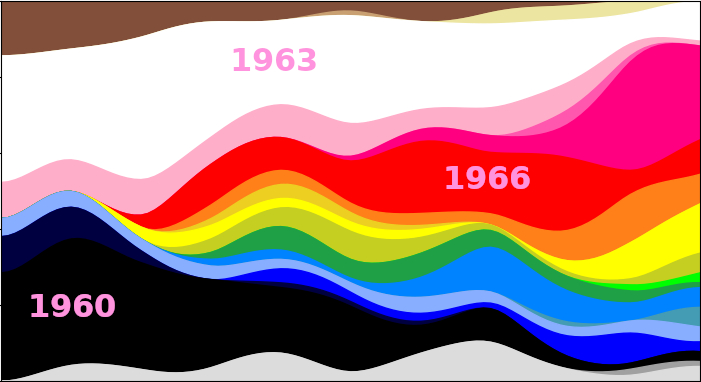
The chart above shows the proportion of occurrences of shoes in each color, per year, over the period 1959-1969 (although I’ll mostly conclude my analysis at 1967–you’ll know why later). The horizontal direction represents a timeline; the depth of any given color in the vertical direction represents the ratio of outfits available with shoes in that color at a given time, relative to the total number of outfits available at that time. The white ripple running along toward the top isn’t empty space, but rather white-colored shoes, and the light gray at the very bottom actually represents clear shoes.
The figure below shows stacked total numbers instead of proportions, counting only the outfits or sets introduced each year instead of counting over all the outfits that were available that year (the differences between introduced shoes and available shoes are generally small, since most fashions lasted 1-2 years during this time period). I didn’t number my axes, but the red vertical bar inside the white filled contour at 1964 represents the maximum number of white shoe occurrences in ensembles or paks introduced in a given year (13 paks or ensembles with white shoes were introduced in ’64), and the white vertical bar in the red filled contour shows the location of the maximum number of occurrences of red shoes in sets introduced in a year: 11 in 1965. Overall I prefer the stacked proportions because we could go back and forth about how to count sets that came in variations or with multiple pairs of shoes, but by looking strictly at proportions or ratios (top plot), most of that stuff should wash out.
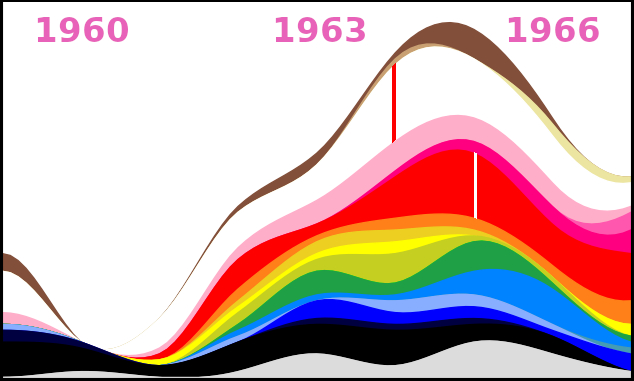
What can we learn from the ratios? I notice that black, navy, and brown, three colors that were around in 1959, are extinct or threatened with extinction by 1969. Other 1959 hues have also lost market share, but that’s to be expected as the variety of available colors increases. In fact, white and pale pink both gained in real numbers in the mid-Sixties (second plot), although they truly do seem to be waning by ’69. Red, nonexistent in 1959, experiences a heyday around 1966 but also seems to be losing ground at the end of the timeline. Meanwhile hot pink and yellow are posed to explode–but we’ll get to that. Here’s what happened in the mean time:
1959
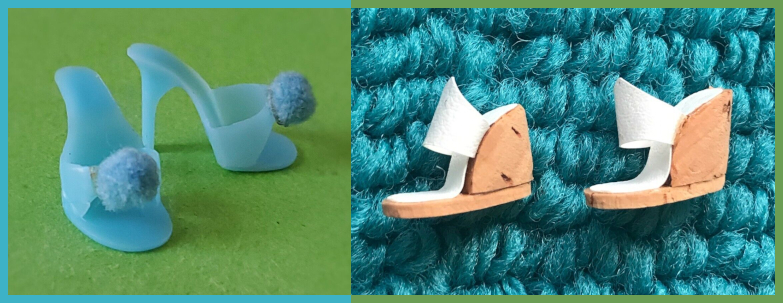
Before 1959 Barbie had no shoes, because there was no Barbie. During the first year of Barbie’s existence she had a decent footwear assortment–though it’s notable that she had no closed-toed pumps, which were certainly in fashion at the time. I’ll hazard a guess that there were manufacturing challenges. Anyway, in the first year of her life Barbie wore open-toed pumps and cork wedge sandals. Some of the open-toed pumps had pompons on top, to be worn with nightgowns and negligees; these came from a slightly different mold than the regular open-toed heels, having a hole at top center in which to affix the pompon. Her shoes came in black, brown, navy, white, pale pink and pale blue.
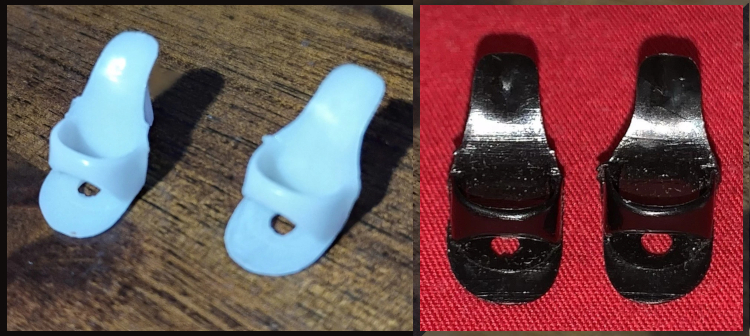
In fact, the very first, first Barbie shoes had holes in the soles to poke her stand through. This arrangement lasted less than a year.
Two sets offered in the first year, Undergarments and Floral Petticoat, were sold with no shoes, while 21 ensembles were complete with footwear.
1960
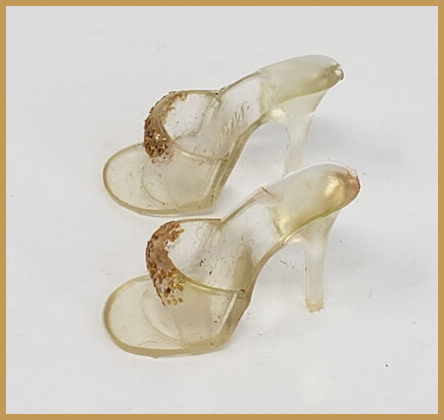
Barbie got no new shoe styles in 1960, but she did get a new color, one of my favorites: the clear open-toed pump. These shoes all came with either gold or silver glitter painted on, and in 1960 the glitter was gold. The shoes were exclusive to the Enchanted Evening ensemble in their first year, but they’d find their way into many fashions over time and were still well-represented by 1967-1969, when many of Barbie’s other classic styles were falling out of favor. They also represent the first option for a “gold” open-toe heel for my purposes. Mattel has a spotty record for including accurate versions of these in repros: the 1996 Enchanted Evening reproduction came with gold glitter open-toed shoes, but the glitter was embedded in the plastic instead of painted over the top, while the 2007 Evening Gala reproduction included accurately-reproduced gold glitter heels; the 2013 Invitation to Tea reproduction included accurate silver glitter heels, while the 2004 Sparkling Pink gift set reproduction included pale pink open-toed heels (the original set included both clear with silver glitter heels, and pale pink heels).
As seen below, only the silver glitter versions–not the gold–tended to have glitter on the heel, too.
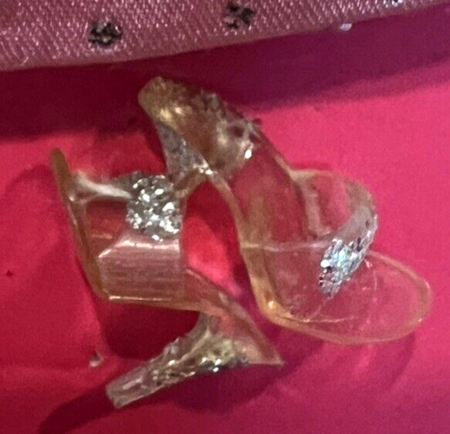
Ambiguity: According to multiple Mattel fashion booklets we checked throughout the time Enchanted Evening was advertised, the ensemble should have included pale pink open-toed heels with silver glitter.
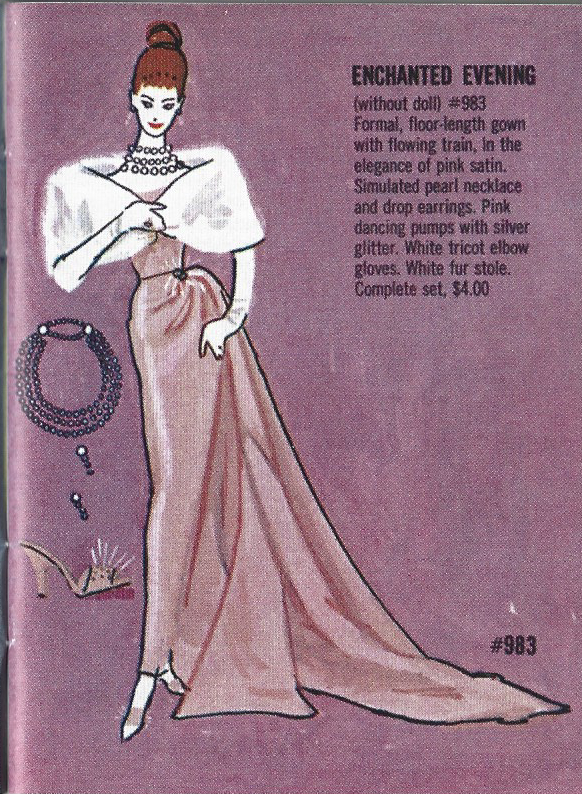
If the set was ever sold this way it changed at some point, since NRFB examples exist with clear shoes. Opaque glitter shoes did exist in the 60s, however: in addition to the (purported) Enchanted Evening pale pink glitter heel, 1964’s Satin ‘n’ Rose gift set had darker pink heels with silver glitter (like their clear counterparts, they were glittered on both the upper and the heel).

If the pale pink glitter shoe ever existed, its ultra-rarity today suggests that the clear shoe was more common for Enchanted Evening despite the booklet description, though it is interesting that no other pak or ensemble appears to have included clear shoes until ’62. At any rate, this means Barbie’s new shoe in ’60 may not have been the clear heel, but rather the elusive opaque glitter heel.
1961
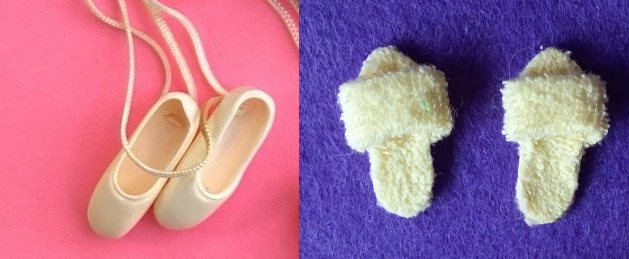
Barbie got two new styles in 1961: terry scuffs for wearing with a bathrobe, and ballet slippers to accompany the long-lived Ballerina fashion. Not much was new for evening, however.
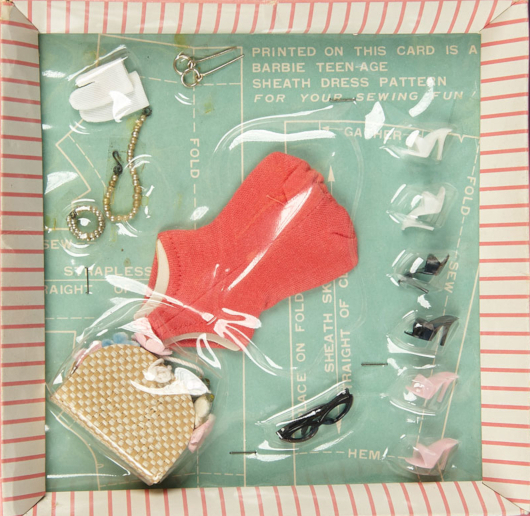
The first set containing multiple pairs of shoes was introduced: Barbie Doll Accessories. The set included open-toed heels in black, white and pale pink, as well as a swimsuit, tote bag, gloves, jewelry and glasses. Pak fashions had not been offered yet in ’61, so this set of odds and ends is a sort of proto-pak.
1962
In 1962 paks were introduced, bringing with them for the first time a wide variety of Barbie fashions (including dresses and shirt/shorts sets) sold without shoes. Many pak fashions did include shoes, and one 1962 ensemble–Movie Date–appears to be the first non-underclothes Barbie ensemble offered sans footwear. Paks ushered in variations, in which a single set, like Gathered Skirt or Lingerie Pak, would be offered in different colors, including with differently-hued shoes. This explains the 1962 blowup in total number of shoe selections offered that we saw in the second plot.
The cork wedge, around since 1959, now came with a metallic gold upper in the ensemble Mood for Music and with the Helenca swimsuit pak. This could serve as a gold open-toed heel for my quest, although I was after something more evening-appropriate.
New colors of shoe plastic were also added to the roster. Despite the red-forwardness of Barbie’s early wardrobe, the only “red” shoes I counted pre-’62 were cork wedges with a red upper in a leather-like material, like the ones worn with Open Road. In 1962 red open-toed heels became the default shoe for dolls sold wearing the new red jersey swimsuit; they also accompanied Red Flare and some of that year’s pak fashions. Other new hues were orange and one of my favorites: mustard, the other candidate for a “gold” open-toed heel for my project.
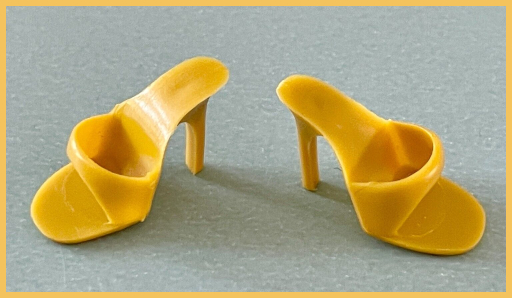
I believe the mustard shoe color is somewhat unique in that it was offered almost exclusively with paks, the one exception being 1964’s Golden Evening ensemble, which was composed entirely of various pak outfit elements. The orange open-toed heel was a true pak exclusive, but orange closed-toed pumps and other shapes would eventually come into wide use.
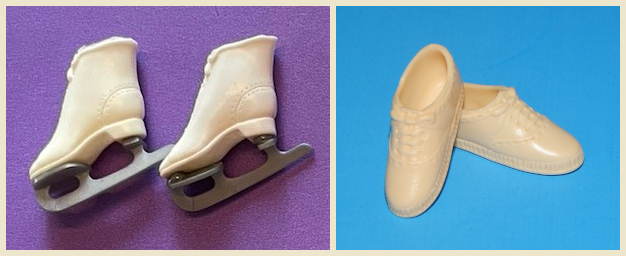
Finally, in 1962 Barbie added ice skates and sneakers to her recreational wardrobe. Her footwear for evening was still limited to open-toed heels.
1963
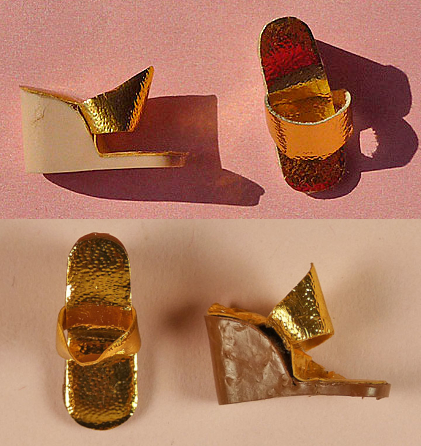
A couple small changes to Barbie’s shoe collection occurred in 1963: cork wedges started to be phased out in favor of plastic wedges, which came in either tan plastic or dark brown; and a unique variation on the open-toed heel made its lone appearance.
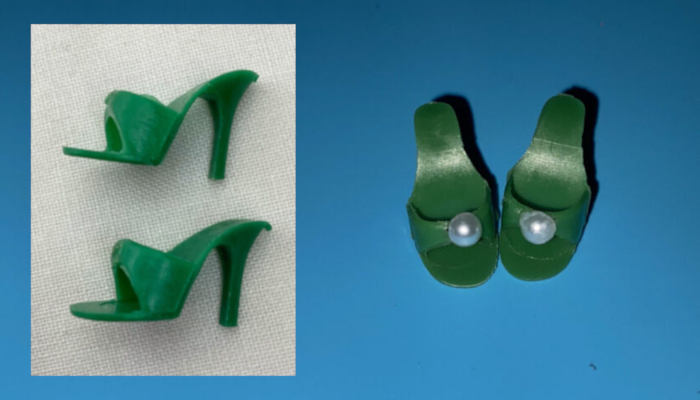
The Senior Prom formalwear ensemble came with pearl-accented shoes, as seen above. The shoe mold was again modified, this time to include a setting for the pearls. Unfortunately, so many pearls have been lost or damaged over the years that it’s hard to find a pristine pair outside of unopened ensembles; many of the nicer-looking pairs available are refurbished, as in the righthand image above. I wonder if the pearls were already causing trouble in the 60s; that could explain why this appealing design was never repeated for other fashions. Evidence suggests that this has also been an issue for the reproduction versions that were offered with the 35th anniversary Midge gift set (when those two eBay links break, note that they pointed to one opened repro set, and one NRFB, both with one shoe’s pearl detached or missing).
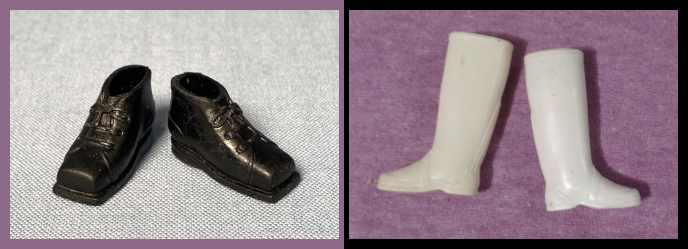
’63 also saw ski boots and rain boots added to the roster, but still no closed-toed shoes for evening. Mysteriously, a Whitman Barbie paper doll set this year included an illustration of Barbie standing by her closet, wearing and surrounded by closed-toed heels. A shoe pak advertised in the booklets around this time also showed a similar, unexplained abundance.
1964
What a year was ’64, for wacky one-off Barbie shoes.
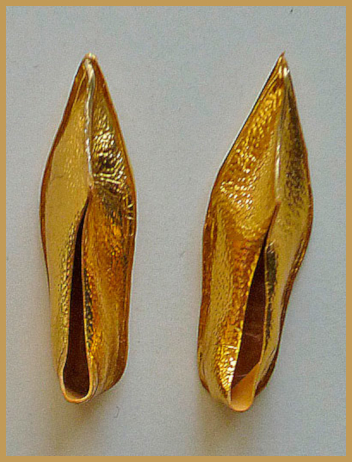
Between the Little Theatre costumes and the travel costumes, Barbie had thong sandals (Japan), clogs (Holland), brocade slippers (as Guinevere), the Arabian Nights shoes above, and the Little Red Riding Hood shoes below that, to me, are the most unexplained aspect of Barbie footwear and the pair of shoes that look most like a manufacturing error.
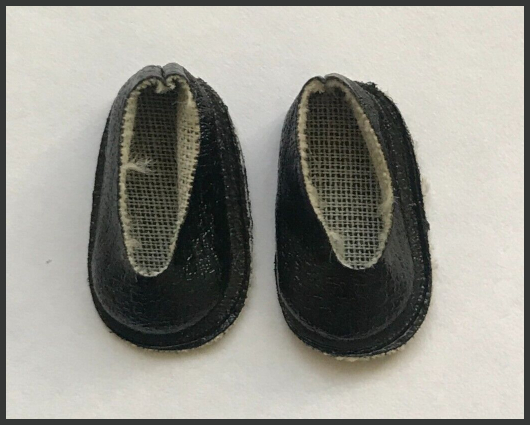
Yes, Barbie could acquire leather-look flats shaped like the disposable shoe covers you might wear to process a crime scene, before she could have a decent pair of closed-toed shoes for evening.
She also got a pair of roller skates in the For Rink and Court set, and two sets this year also came with majorette boots, a new style that would be repeated in at least two future years.

Besides the majorette boots, none of 1964’s new designs would recur with any other fashions during the years covered herein. The travel costumes were available for just one year, while For Rink and Court and all of the Little Theatre costumes besides Red Riding Hood survived for one additional year.
1965
In 1965, Barbie got closed-toed heels.
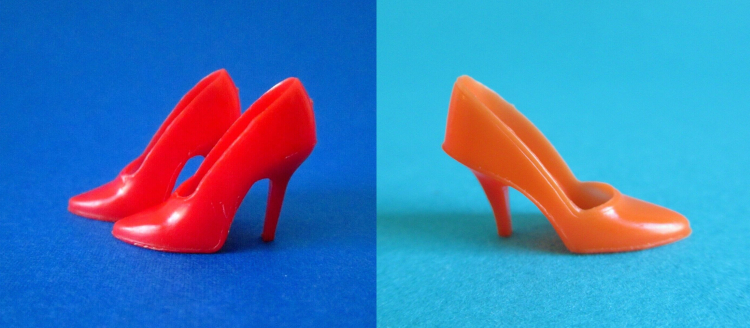
Overnight, Barbie went from no such shoes to at least sixteen occurrences in the first year, all with ensembles that debuted that year (closed-toed pumps also became available in paks the following year). The birth of the closed-toed shoe for evening is actually pretty famous, because for a very short time “spike” heels (above left) were produced, to be replaced by the less-ambitious pump at right before the first year ended.

Here, at last, are timelines of styles per year–above shows the total number in sets introduced by year, and below is the proportion of different styles in sets available by year. While I think the proportions give more intuition, the figure below is not entirely pleasing to the eye with that great blue whale (open-toed pumps) filling most of the space. It almost suggests using a log scale for this dataset. Anyway, the open-toed pumps dominate most of the timeline–with some of that mid-Sixties bulge, above, due to pak variants–and then are suddenly swept aside in 66-67 by everyone’s new favorite, the closed-toed pump (indicated in red). Interesting that the pompon open-toed shoe, light blue in the figures, seems resilient to changes in fashion; I guess Barbie’s fraction of nightgowns and negligees is fairly stable over time.
In these figures the “MISC” category (miscellaneous, grey filled contour at the very bottom) covers everything that only appeared in one set during ’59-’67: all the inventive articles from 1964 (that’s the big grey bump at the bottom, just past the halfway point in time), the pearl-accented heels, et cetera. At the tops of the plots, in two shades of brown, we can see the cork wedges supplanted by the plastic wedges which then diminish by the end.

Mattel’s cobblers had a couple more surprises for us in ’65: in addition to the closed-toe heel and its spiky variant, the Miss Astronaut set came with unique zippered boots, and plastic slip-on flats made their first appearances, in a handful of more casual ensembles like “Vacation Time.”
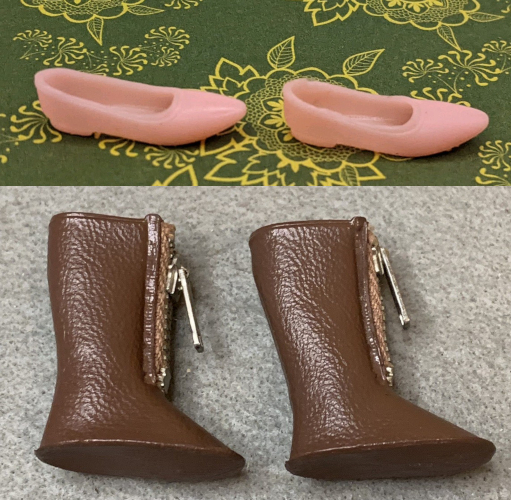
Now that we’ve properly introduced closed-toed heels, it’s time to circle back to one more Little Theater oddity from 1964: the single “glass slipper” for Barbie, that came with Ken’s Prince costume. While Barbie as Cinderella wore a pair of silver-glittered, clear, open-toed heels, Ken’s costume came with a single, unglittered, closed-toed heel for Barbie as Cinderella to try on. Doesn’t that make too many glass slippers? Oh well. This also means a closed-toed shoe for evening was technically available to Barbie already in ’64, but you had to buy two copies of the Ken ensemble to make a pair.

Is someone defiling these rarities with silver glitter? There are a couple such pairs on eBay right now, listed as 1966 Shimmering Magic shoes. NRFB Shimmering Magic examples we found had red closed-toed shoes, which is also what Sink Eames lists. Mattel’s ’66 toy catalog for retailers doesn’t describe the shoes in text but shows red closed-toe pumps (the fashion booklet for that year lacks text descriptions); but it’s possible the silver glitter closed-toed variant also existed, maybe to use up extra glass slippers. In any case, the variant is at least rare, and we’d advise caution around those eBay listings.
1966-67
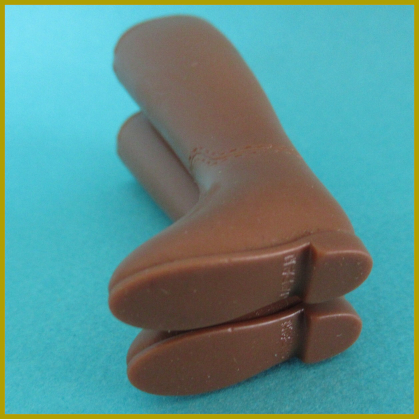
After the many innovations of the previous year, 1966 was a quiet year for Barbie’s shoe styles (not counting the Shimmering Magic controversy described in the previous section). She did get a new pair of riding boots. Francie debuted with closed-toed shoes, boots and skates of her own.
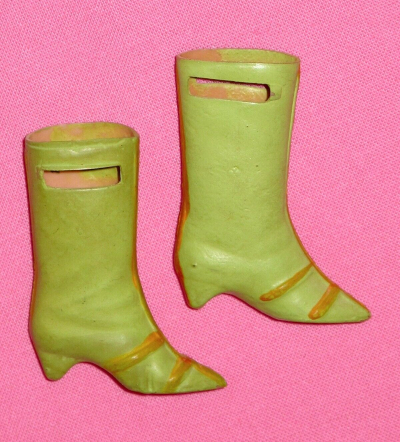
We end our story at 1967 because it’s where Sink Eames’ first book ends, and also where Joe Blitman’s mod Barbie book begins, and when Barbie shoe life was just getting too complicated. Case in point: the 1967 fashion “Weekenders,” which Sink Eames lists as including green ankle boots–if so, the only ankle boots in the period 1959-1967. However, Blitman lists pink flats, and a photographed NRFB set spotted online sides with Blitman.
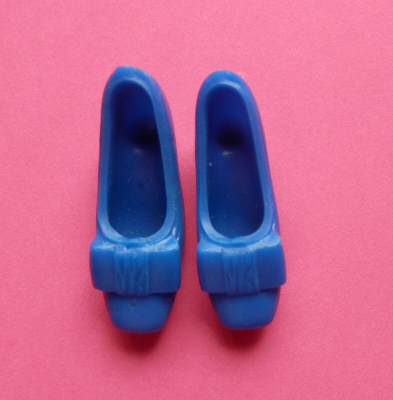
Before the tale ends, the first bow shoes entered the fray in ’67, heralding the new mod era that impacted shoes in addition to garments, hair and just about everything else. Bow shoes were made of a squishy material, and these shoes’ colors may not line up exactly with those of hard plastic shoes–yet another late-Sixties complication for cataloging and indexing.
One more bold footwear trend manifested in ’67: the swimsuit doll came barefoot for the first time, and she’d continue to be barefoot for years, essentially until the “swimsuit doll” concept diminished and dressed dolls became the main mode of Barbie-buying.
Included in Sink Eames’ book but omitted from the present study are the Braniff air hostess costumes of 1967, which included shoes of almost indescribable, painted-on color and unique design, being manufactured in Hong Kong by Marx Toys, not Mattel. Though collectors do seem to regard these as legitimate Barbie fashions, the shoes exist outside Mattel footwear trends.
…and beyond
I kept toiling away doing data entry until 1970 but found more and more discrepancies between Sink Eames and Blitman with each passing year, and Blitman also indicated that many outfits came with variant shoe styles, especially beginning in 1969. By ’70 it seemed like practically every outfit could include bow shoes OR T-strap heels OR pilgrim shoes, and viewing the commonness of the different styles in terms of appearances in different sets was losing meaning. Then I saw the JC Penney exclusive 64-piece Shoe Bag of 1970 and knew I was beat. That’s why I ended up considering color trends out to 1969 and style trends only to ’67.
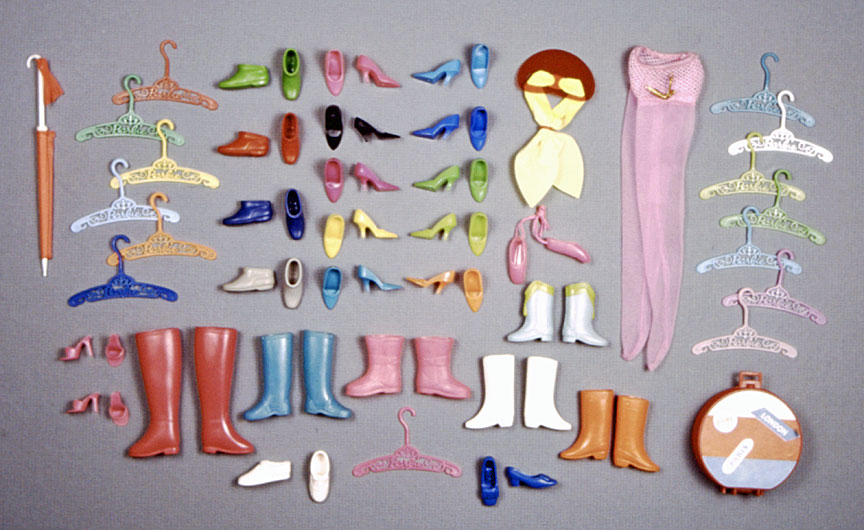
Blitman has said that four of the closed-toed pump colors were exclusive to the set above. Can you spot them?
Before throwing in the towel, I observed that almost every outfit in ’70 has either hot pink or yellow shoes, and that the closed-toed pumps, so dominant in 1967, were fast being replaced by bow shoes, t-strap heels and pilgrim shoes (some of which are, admittedly, closed-toed heels themselves). The same winds of change pushing the basic closed-toed pumps out of favor were also eroding away past favored shoe colors like red, as noted at the top of the post.
Applying what we learned
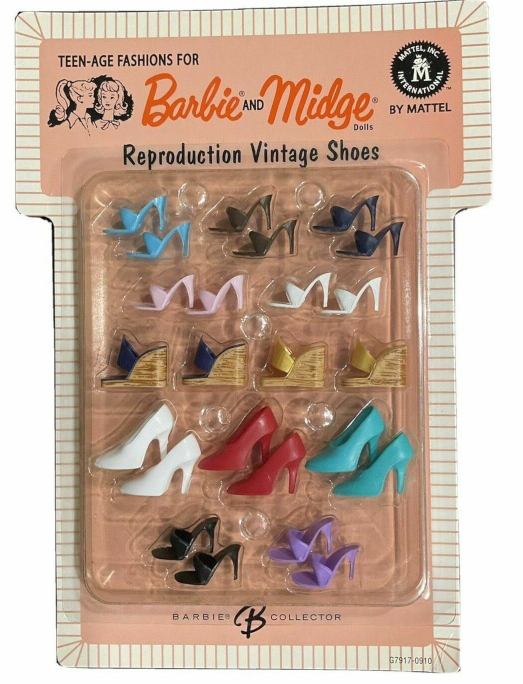
Based on the shoe trends covered here, which shoes in the 2004 “reproduction” shoe pak shown below are NOT based on a 1960s offering?
Where to next? Learn about our favorite reference books, like those by Sink Eames and Blitman; view one more graph in the piece on Deluxe Reading Dream Kitchen; read our thoughts on nostalgic Black Barbies; study up on Mattel Modern and Susy Goose furniture; or see more options in the table of contents.
 Silken Flame
Leave a reply to Hello world! – Silken Flame Cancel reply