
![Small newspaper blurb in black and white. At left, a model wearing a life-size copy of Silken Flame (holding her gold clutch and opera-length gloves in her hands) looks at a human-sized copy of Fashion Editor displayed on a mannequin. At right, text reads:
"21 Dress Salute
"Barbie has finally achieved cult status. Along with a revival in sixties music and fashion has come renewed interest in Mattel's 1959 doll. Leading this revival is Timothy Dunleavy, a children's-clothing designer, who has done his first couture collection inspired by Barbie's own wardrobe. 'Barbie embodies the spirit of sixties American Elegance,' says Dunleavy, 'whether it is Roman Holiday, or Fashion Editor and Silk & Flame [sic] [both pictured[. Barbie's wardrobe contains a microcosm of an entire era of American style, sensibility, and tradition." To celebrate Barbie's twenty-first birthday, Hurrah is throwing a party that will be highlighted by a fashion show of 21 outfits from Dunleavy's collection--modeled on great big beautiful dolls. -Richard Buckley
The Barbie Fashion Show/Hurrah April 21 at 9 p.m. and midnight
36 West 62nd Street/541-4909
Admission, $6"](https://silkenflame.net/wp-content/uploads/2022/09/nymagazine-1.png?w=416)
It’s a paradox: she was a teen-age fashion model in 1959, and she turned 21 in 1980. For Barbie, both are true. And in 1980 Barbie held her 21st birthday bash, where else? in a nightclub: “Hurrah” in Manhattan, a “new wave disco,” per the Charlotte Observer. Befittingly, the party was punctuated by a fashion show that ran twice, once at 9 p.m. and again at midnight. The life-size fashions were created by designer Timothy Dunleavy, who hoped to bring Barbie’s vintage styles back as couture. And it worked, sort of: in addition to the birthday to-do, a couple of fashionable women wore his interpretations to society events. According to a contemporary account in the New York Daily News, Solo in the Spotlight was worn to a wedding by one Enid Geller, while Gay Parisienne was worn by Nathalie Perr, herself a designer, to a “black tie dinner” at the Met.
Unfortunately, hardly a trace of material seems to remain from Barbie’s 1980 fêting. I’ve assembled here the accounts I could find, from New York Magazine, New York Daily News, The New Yorker, and the Charlotte Observer (Dunleavy hailed from North Carolina, perhaps explaining the last publication’s interest).
The venue was a mirrored room bisected by a red-carpeted runway; to one side were folding chairs for the press and fashion industry types, while to the other side the audience who’d paid $6 admission could mingle. Barbie’s Dream House was on display. A total of 21 dresses were shown to mark Barbie’s 21 years, though the time period covered was said to be just 1959-64 and the designer expressed partiality for fashions from the years 1959-61.
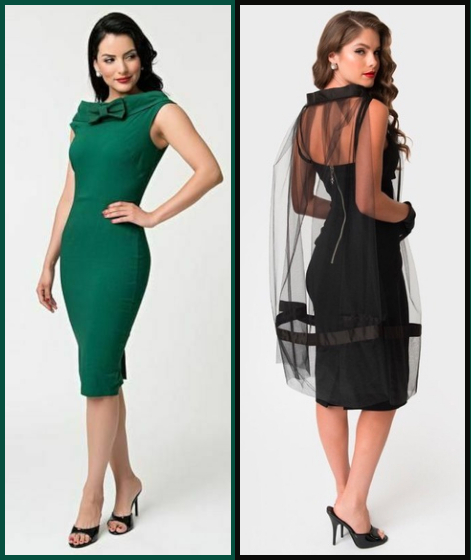
The show opened, appropriately, with Barbie’s original attire: the zebra-striped swimsuit. Although The New Yorker claimed that the proceedings were videotaped, there seems to be no evidence remaining of most of the looks. However, nearly forty years later Unique Vintage would also remake some of Barbie’s iconic fashions in life size. The Unique Vintage versions are not especially well made–no one’s wearing these to a black-tie affair at the Met–but we can still substitute a couple of their images to help set the mood.
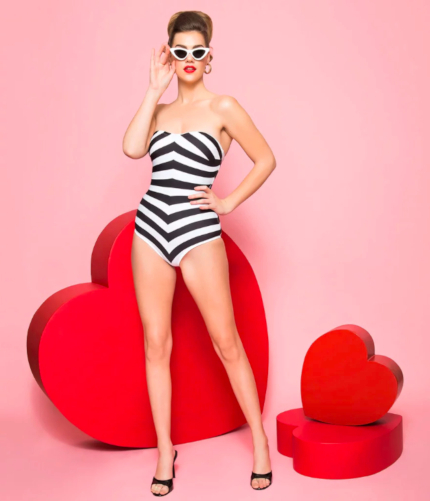
The ensuing show was, shall we say, tongue-in-cheek: the model showing Sweater Girl (1959) did a mock striptease while balancing her basket of colorful balls of yarn; the Winter Holiday (1959) model came out to the James Bond theme brandishing a pistol; and the model clad in a bejeweled take on Ballerina (1961) danced to a disco version of Swan Lake. Some of the doll-like elements were exaggerated, such as the gold beads representing buttons on Sweater Girl, which became “big gold ball buttons” in Dunleavy’s interpretation. Attention was paid to details: the designer resorted to painting pin-dots on Gay Parisienne (1959) himself when the right fabric wasn’t available, and in addition to the yarn balls mentioned above, history tells us that Fashion Editor (1965!) included its vintage camera, although Solo in the Spotlight (1960) lacked accessories.

So far we’ve encountered the Zebra swimsuit, Gay Parisienne, Winter Holida,y and Sweater Girl (all 1959), Silken Flame and Solo in the Spotlight (both ’60), Ballerina (’61), and Fashion Editor (’65). Other fashions on display that night include Roman Holiday and Barbie-Q (both ’59), Friday Night Date (’60), American Airlines hostess (’61), and one of the brocade sheaths–let’s say Golden Girl (’59). Mood for Music and Sorority Meeting (both ’62) were probably also shown, as both are mentioned by the Charlotte Observer.

That leaves five additional, unknown ensembles before the finale. An attendee pointed out to The New Yorker‘s reporter that Registered Nurse (1961) was not among the fashions shown, but beyond that it’s anyone’s guess what other ensembles were paraded. Surely one of the journalists present would have told us if the striking Red Flare (’62) swing coat had sashayed by. The Charlotte Observer mentioned skirts so tight the models “had to mince down the runway.” That describes Solo in the Spotlight but may also allude to Enchanted Evening (’60). I’d like to think all my favorite sheaths (Sheath Sensation, Silk Sheath, Apple Print Sheath…) appeared, as well as the legendary Black Magic (’64).
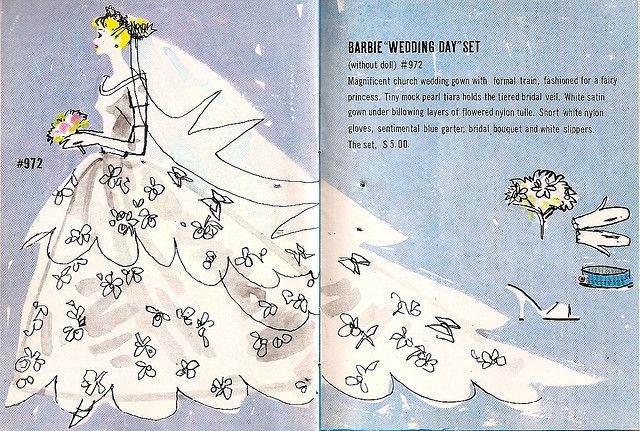
In Barbie’s early years it was typical for fashion shows to end with a wedding gown, and this show closed with “Barbie” in Wedding Day (1959), festooned with rhinestones and escorted by a tuxedo-clad “Ken.” But what happened after the lights dimmed on Barbie’s soirée? Dunleavy would take another stab at retro Barbie camp in 1982, designing the costumes for a short-lived off-Broadway show called “Livin’ Dolls,” a send-up of the ’60s Beach Party genre. The show’s visual design received praise, both its sets by John Lee Beatty–“a huge vinyl Barbie Doll carrying case that opened up to become the set all done in 1960s colors: aqua, orange, pink and hot pink” (American Set Design by Arnold Aronson)–and Dunleavy’s “wild array of loud-to-louder beach costumes” (The New York Times). Their efforts weren’t enough, though, and the show lasted only 25 performances. I found no images of the costumes, and only one image of the set, online.
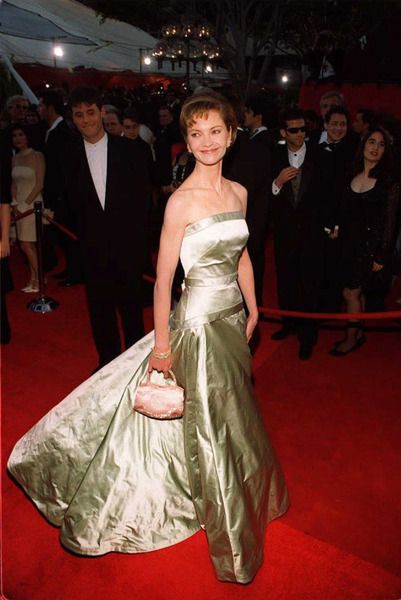
Dunleavy also designed red carpet fashions, including a piece worn by Joan Allen to the 1996 Academy Awards that I think looks just a bit like Enchanted Evening.
UPDATE: In Summer 2023, vintage-Barbie-based couture has entered the mainstream. People says the Margot Robbie looks below were created by the fashion houses of Vivienne Westwood and and Elsa Schiaparelli, while the 1980s Day-to-Night interpretation Margot also wore recently (not shown) was created by Versace.

In 1994 Mattel revisited the concept of a birthday party/fashion show for Barbie at Disney’s EPCOT theme park. If the birthday party described above sounds like your scene, this one may not be:
As different in tone as the Orlando version of Barbie’s birthday fashion show seems to be from the Manhattan original, it does still end with a wedding ensemble. We should do the same.
Where to next? Peruse a Chronicle of Barbie shoes, 1959-67; visit Barbie’s Fashion Shop; browse the early fashion booklets; have Visions of Solo in the Spotlight; or pop up to the Table of Contents to see more options.
 Silken Flame
Leave a reply to Hello world! – Silken Flame Cancel reply