

Soft hues suffuse a 1962 fashion booklet for Ideal’s Tammy. Clothes are shown worn by the character in detailed scenes, with accessories, background figures, and other immersive touches. See the booklet cover above, left; just a few of its charming fashion illustrations are below.

The following year, another booklet advertised all the same fashions and added many more. In addition to brand new drawings of all the previous offerings, I counted seven new (what I would call) ensembles, as well as sixteen new “pak” type outfit pieces, all illustrated on Tammy. Tammy’s family is introduced; Tammy’s mom gets six all-new ensembles, which also fit Tammy. Tammy’s little sister gets six for herself, and Tammy’s father and brother get a dozen to share.
Perhaps the glut of new fashions to present, including basic separates and menswear, drove the art style’s shift to cleaner lines. While cartoonish, the limited finesse of the second book could serve as an opportunity to detail the fashions more accurately. Since all the fashions from the first book were still available and represented, we can do some side-by-side comparisons.

Unless otherwise specified, all department store catalog images in this post come from the lovely christmas.musetechnical.com.

On the first booklet’s cover, Tammy wore Dream Boat. A second, layered illustration appeared within.

While the ’62 Ward’s catalog shows the jacket in white, the booklets keep it the same blue as the dress. The booklets are correct based on examples I’ve seen.
One of my absolute favorite Tammy fashions is Pizza Party. Imagine if you saw someone wearing this.

Model Miss is another favorite. While the booklets agree that the coat is blue with white trim, the catalogs sometimes show red with white trim. Both versions have been found in the wild (the hatbox is always white with red accents).

As mentioned, there were also new ensembles, including two for skating (different types of skating), one for golf, one of knitwear, one non-knitwear to be worn while knitting, some foundation garments, and Fur ‘n Formal, the party dress Tammy models on her Evening in Paris carrying case.

And in 1963 Sindy was introduced across the pond. Adapted from Tammy, she had her own wardrobe. While both Sindy and Tammy may own a school outfit, a rainy day outfit, a party dress, et cetera, almost all differ. I did find one matching ensemble in their ’63 wardrobes: Sleepytime, through which we can observe how Sindy’s illustrations also have their very own style.

The Sindy booklet image above right comes from sindydoll.wordpress.com, who also compare the illustrations to photographs of the outfits on dolls and thoughtfully contextualize the designs alongside real-life fashions of the time.
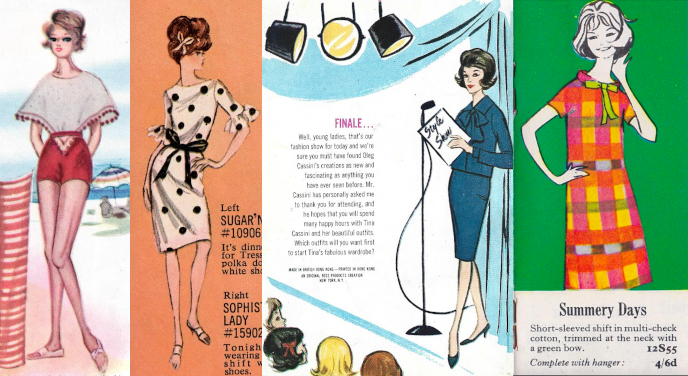
Another, shorter-lived Tammy “clone” was Tina Cassini. Her booklet illustrations, via Toy-Addict, strike just the right balance of chicness and sharpness.

Though the Tammy illustrations lost some charm in between booklets, the later, cartoony version was also used for some paper dolls that I think are just divine. We’ll discuss them sometime, but for now let’s turn our attention to Tressy.
In contrast to Tammy, the girl next door, American Character’s Tressy–like Tina–was all glamour all the time. Only, her 1964 fashion booklet was light on sophistication, its uncolored pencil sketches produced by a seemingly amateur hand.

Evening Jewel was only offered in this booklet. The sketch looks a bit similar to Barbie’s After Five, although the finished product does not.

Chic Shift and Neat Knit were only illustrated in this booklet (of four we reviewed, at least), though they were still available for purchase in later volumes.

Those later volumes, including this 1965 one, brought Tressy’s illustrations some much-needed color and quality. This one also introduced her little sister, Cricket. Outfits were divided into categories: Playtime, Daytime, and Party.
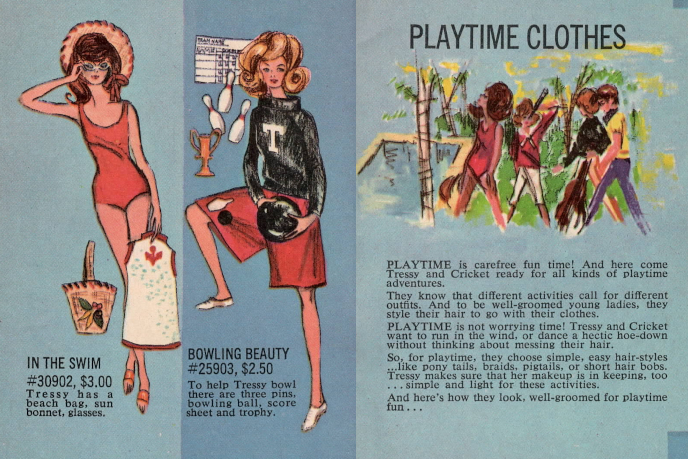
In the Swim was also the name of a Barbie number.
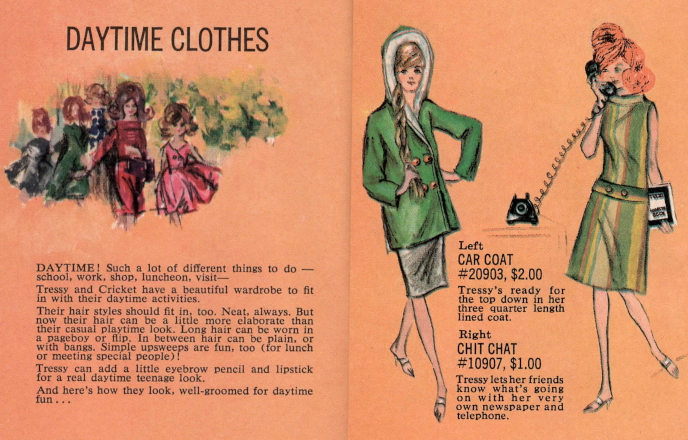
New for daytime, the youthful Chit Chat is one of my favorite Tressy looks.
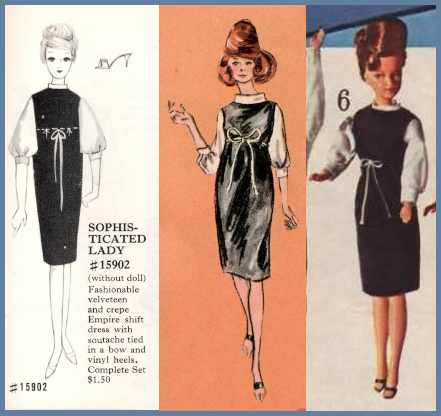
Tressy’s Sophisticated Lady, a daytime ensemble, is altogether unlike Barbie’s.
In Tressy’s first, grayscale booklet, the “Surprise” of her Surprise Party fashion must have been what the dress looked like–the naked eye cannot perceive it. In the color version we see it and Cricket’s version, too.

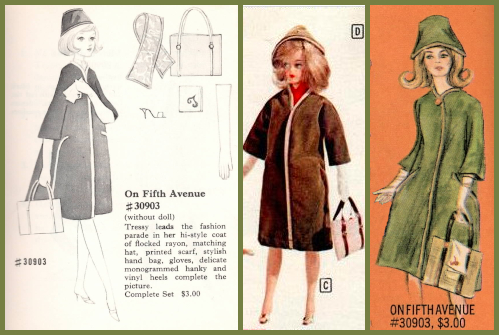
A recurring fashion was On Fifth Avenue. Barbie’s On the Avenue refers to the same avenue.
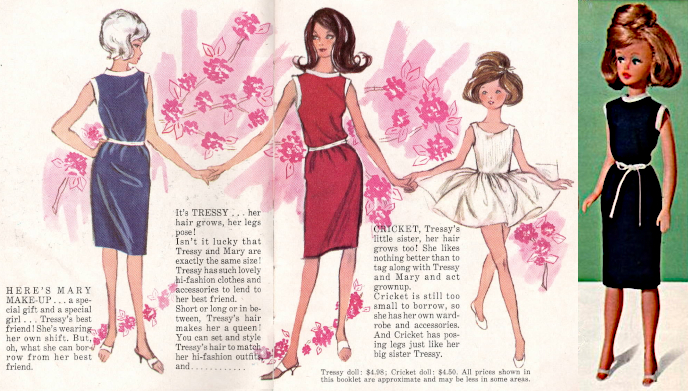
Another booklet of the same year added Tressy’s friend Mary Make-Up to the mix. Like an early Tressy appearance in the ’63 Sears catalog, Mary modeled the dark-colored version of their dress.
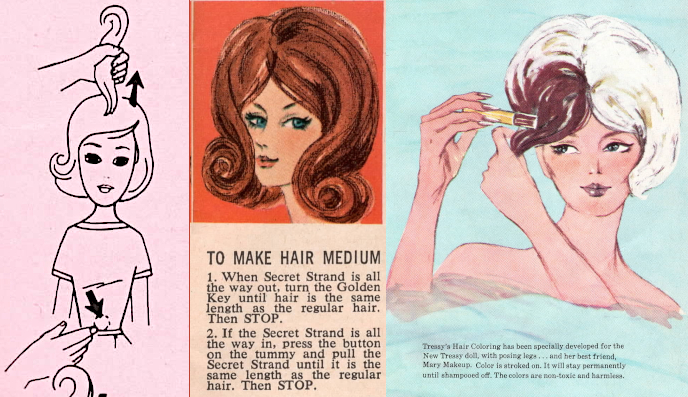
Unlike most competitors, all Tressy booklets include instructions for hair styling. The art style evolved for the styling instructions, too.
Whereas Tammy’s later booklet iteration pared down its decorative elements, Tressy’s became more elaborate, the three characters inhabiting detailed scenes. In case the premise wasn’t immediately clear, one scene emphasized how Mary could wear Tressy’s outfits–even carrying a hatbox with Tressy’s name prominently of the front–while showcasing several of their modish looks.

On the rack above, Sugar ‘n Spice seems inspired by a ’64 Mary Quant design.
Barbie and Tressy both have ensembles named Black Magic. On this occasion, Mary struts her stuff in Tressy’s.

Both Barbie and Tressy have a Hootenanny, too. While Barbie’s, in the Sew-Free line, seems bound for a barn dance, Tressy very clearly wears hers to perform anti-establishment anthems at some smoky Greenwich Village coffeehouse.

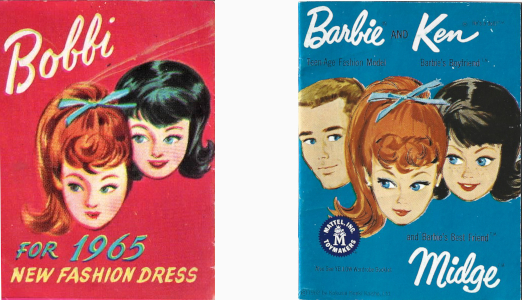
None of which is to say that Tressy borrowed from Barbie, or vice versa. Some lesser characters and clothing lines definitely did borrow, though. This 1965 Bobbi book is positively shameless:


This round of 1963 Sindy booklet pics comes from the extensive collection over at The Little Sindy Museum.
Other “lesser” fashion booklets of the time period tended to use photography or simple sketches of the garments laid flat. One even used photographs of the dressed dolls to trace from.
Tressy and Cricket had one last fashion flutter in 1966 with a new mod look. (Mary, sadly, was out of the picture.) The booklet was in the style of the earlier volume for Tressy and Cricket, with categories for play, day, and party. The boundaries between “play” and “day” had eroded–can you tell which ensembles, below, are for play, and which for day?

After her mod refresh, Tressy was advertised in department store Christmas wishbooks for two more years. Much of the clothing advertised for her in these catalogs did not appear in any American Character Tressy booklet that I could find, but booklets for the European Tressy versions help to fill in the gaps.

Above left, the ’66 Sears catalog archived by Wishbook Web advertises a collection of five mod Tressy fashions, at least some of which were listed and priced in the mod Tressy catalog sans illustration. Four of the five appear in a single “budget fashions” spread from a Palitoy (U.K.) pamphlet that employs a flatter, cleaner art style than the U.S. Tressy booklets, reminiscent of Saturday morning cartoons.
The ’66 Montgomery Ward catalog advertises a different set of five mod fashions (and also shows Tressy in Serendipity). Two for Tea and Good News, both from American Character’s mod booklet, are among the five. The other three are unknowns–except they appear in a Schildkroet booklet from Germany which someone amazing scanned at high resolution and shared. In Germany, the characters Tressy, Mary, and Cricket are replaced by Gaby, Kessy, and Babsy respectively. I’m in love with the cover of their booklet:

The German names for the fashions Gaby and Kessy, in the inset below, share with Tressy’s mod Montgomery Ward-robe are Derby, Abend in Gold (Evening in Gold) and Rummelplatz (Fairground).
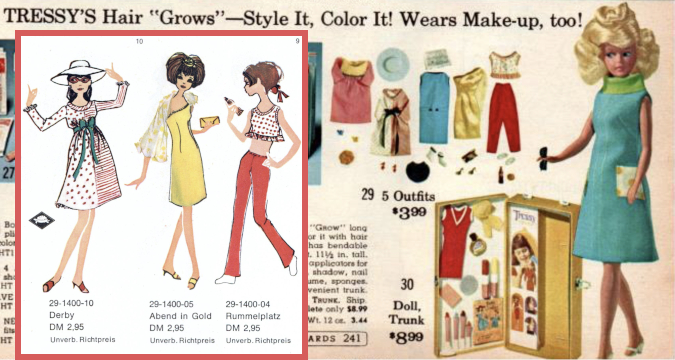
I assume Derby does not refer to the city in England. However, diverse place names do pop up in the international booklets. It’s interesting to see, for example, the first U.S. On Fifth Avenue which became On Park Lane in the U.K.; and the second On Fifth Avenue version which became, in Germany, Kurfuerstendamm (per Wikipedia, the “Champs-Elysees of Berlin”).

The children of Germany also visited Piccadilly, New York, and Paris through Gaby’s fashions. The French Tressy by Bella had many fashions with place names too, all located in France: Martinique, Saint-Tropez, chez Maxim’s…
Tressy’s story ended abruptly in ’67, at least her American Character arc did. As for the many international Tressy versions, we’ve browsed only these couple booklets–others have proven hard to track down.
Tammy’s tale continued well past what we’ve covered, but those booklets too are elusive. In particular, I couldn’t find any that showcase her fashionable friend Glamour Misty, who made the scene in ’65 right after most of Tammy’s family disappeared. (Hmmm…) And did Uneeda’s Suzette or the eerie but beautiful Wendy Ward ever merit an illustrated booklet? So many rival fashion booklets, yet so many (hopefully) still to see… I’m keeping an eye out.
Where to next? This is the most recent post on Barbie’s clones and rivals. We previously encountered Tressy at her penthouse and beauty parlor. We previously encountered Tammy in her suburban havens. We’ve also discussed Mattel’s fashion booklets for Barbie at some length. Or just head up to the Table of Contents to see more options.
 Silken Flame
Leave a comment