
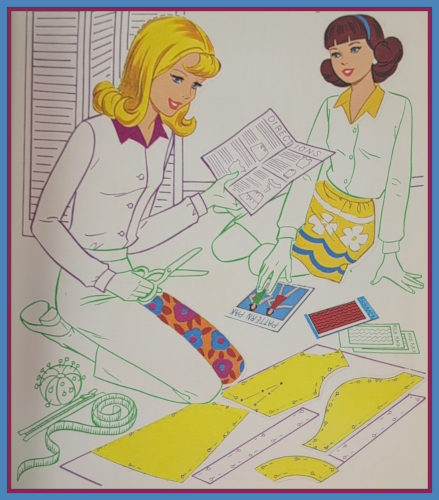
In past entries we’ve seen how Whitman broadened the early Barbie illustration space through their paper doll sets and coloring books, but those are just the tip of the iceberg; here are some other Whitman products that helped define Barbie visually during the first dozen-ish years.
“Barbie and Ken” jigsaw puzzles were produced starting in 1963. One featured a storybook scene of Ken and Barbie before a wishing well, a castle looming in the distance; a second depicted a much more contemporary romantic setting:
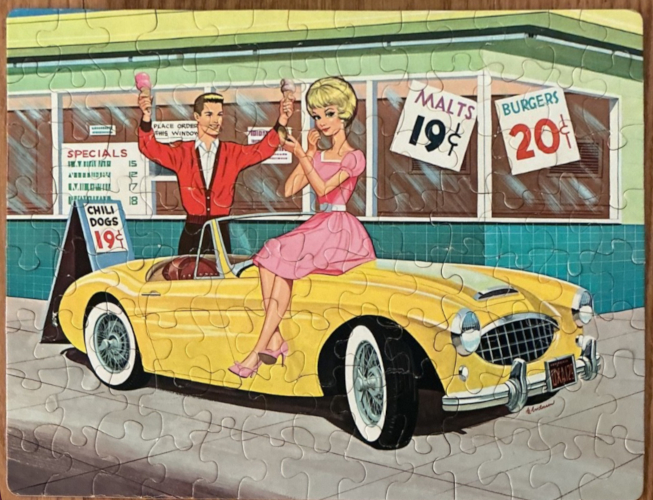
The characters were drawn in the style of early Whitman Barbie paper dolls and look like multiple artists may have contributed to them; Barbie’s head and body particularly don’t quite match.
The next round of puzzle offerings, which tied in the recent Little Theater and Fashion Shop playsets, adopted a more thoughtful artistic technique. (Is it weird that the figures in the catalog listing atop that Fashion Shop link are all dressed identically to those in the puzzle illustration below?)
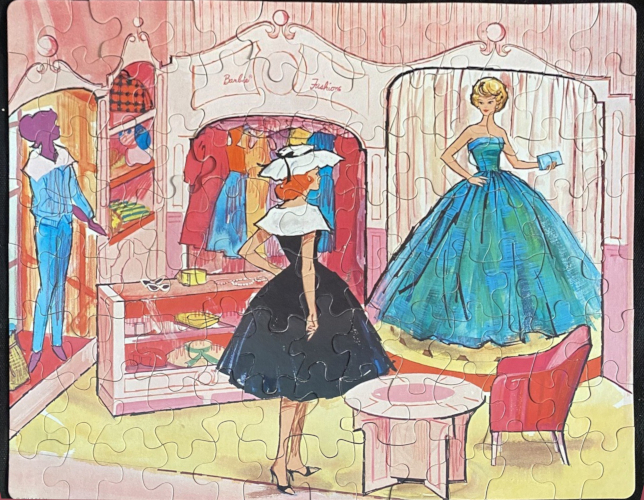
This refined art style would be also be used for handful of Skipper-centric puzzles through the mid-Sixties.
The fun does not stop at puzzles. There were color-by-number books and paint-with-water sets (called “Magic Window” in 1964). The lines are very faint on the color-by number pages, but I tried to dial up the definition on a couple sample images for us:

The lefthand image marks the second appearance in this post of the ever-popular and oft-illustrated After Five ensemble.
Though far rarer, the 1964 Magic Window set is pretty cool, surveying assorted modes of transit.
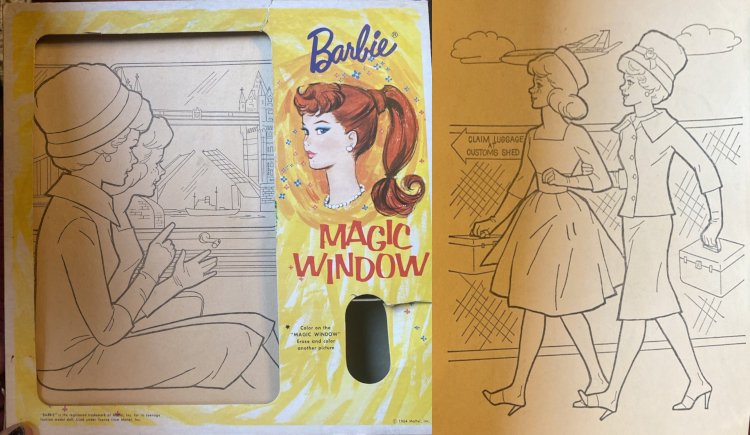
Versions of these activities would recur in later decades, as well.
The sticker book was yet another enduring activity. One from 1971 spins the tale of Barbie and friends as they enter a fashion design and modeling competition. Once again, the characters are a match for the same year’s paper dolls:

In this style, a lot of the girls looked similar. If you’re curious, the characters are, from left to right: Barbie, Stacey, P.J., Francie, Christie, and Casey.
Before stickers are incorporated, the narrative is populated by ghostly forms:
![Three offwhite pages with line drawings in green, blue, and red. In the first, five characters are lined up next to a sign announcing a "Fashion Fair Style Show. All girls will design and model their own clot[the rest of this word is blocked by a figure]. Enter now." In the middle, a character holding scissors cutous out pattern pieces on a table while another looks at a fashion on a dressform. In the third, four characters stand around three dressforms displaying garments. All of the characters' heads are blank, just surrounded by a dotted outline, as are various other elements in the images such as skirts and some tops and accessories. These are waiting to be filled with included stickers (not shown).](https://silkenflame.net/wp-content/uploads/2025/10/whitman_mvlvr2007.jpg?w=750)
Spooky, right? But I kinda think they’re perfect as they are.
It turns out adding the detailed sticker heads to the composition can make them more creepy, instead of less, as Barbie’s knife-wielding mom so ably demonstrates in this played-with sticker book from 1963:
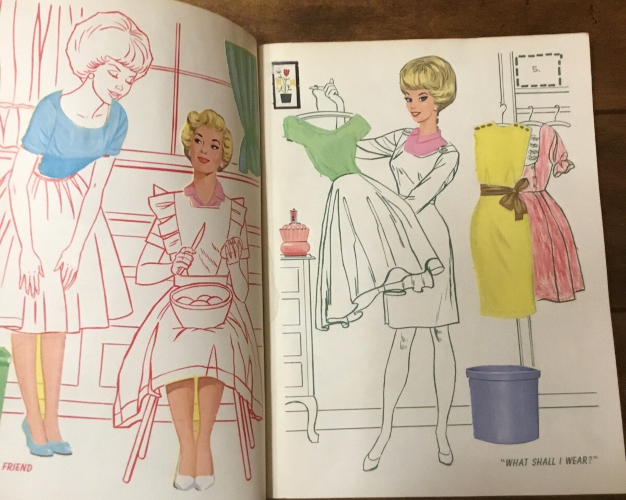
The used 1971 sticker page that kicked off this post looks slightly less eerie.
This wraps up our investigation into early Whitman Barbie illustrations. There were other miscellaneous offerings both Whitman and non-, but from an artwork perspective we feel we’ve covered the major styles and themes.
Where to next? This post is about vintage Barbieillustrations. Our most popular post in the category is on Mattel fashion booklets. The most recent post in the category is on the World of Fashion board game. Other popular posts on this site include the Many Abodes of Barbie series (currently covering 1962-1970) and our Chronicle of Barbie shoes, 1959-67. Or just head up to the Table of Contents to see more options.
 Silken Flame
Leave a comment