
We talk a lot about Barbie illustrations here, and we talk a lot about Barbie’s play sets and furniture, but what about the built environments within Barbie illustrations? In our posts on Whitman paper dolls we featured some paper doll folder interiors that show Barbie’s home or place of work; in fact, there are many such folders worthy of consideration. These illustrations provided a backdrop against which to dress and re-dress paper dolls, adding a little immersion to the 2D doll experience. The set below is a perfect example.
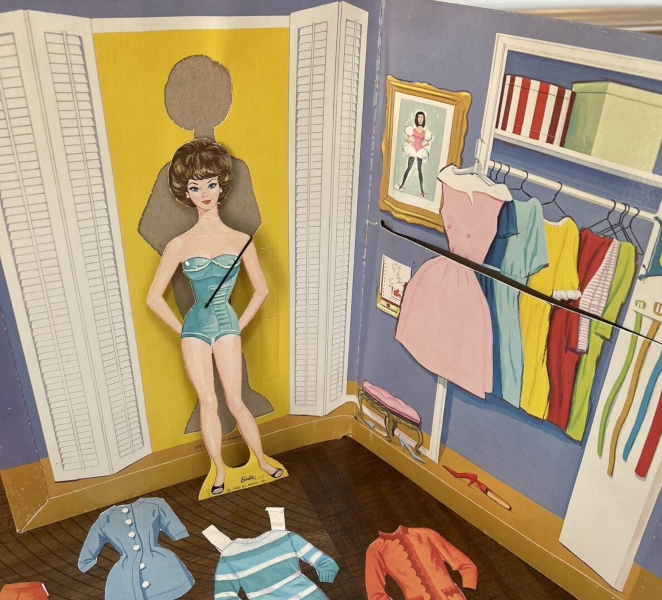
The illustrated interiors often show places where Barbie might dress, like this one depicting a changing room and closet. On the back of this folder is an illustration of Barbie posing before a full-length mirror, which we highlighted in our first post on the Whitman paper dolls.
A thematically similar design from 1966 shows either a boudoir scene or a store dressing room (since there are tags on all the dresses). We used this backdrop for a Francie/Casey photo shoot in a recent post.

Midge’s changing area was decorated in a romantic style. As a backdrop for diorama or for imaginative play, this piece loses some immersivity due to its paper-doll-shaped holes (the missing Midges of this set are very cute, by the way).
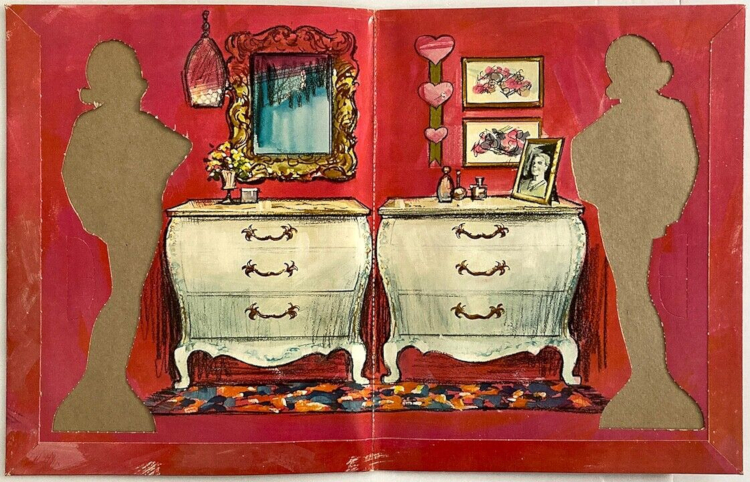
A different type of dressing room appeared inside the Little-Theatre-themed “Costume Dolls” set, which also included small versions of the Little Theatre’s stage backdrops. Since the Little Theatre itself has no backstage area, this folder makes a valuable addition.

Barbie’s early-Sixties career as a fashion designer provided another setting in which dolls might get changed, below. We’re especially fond of all the sketches of authentic Mattel Barbie fashions shown, when the paper doll set itself contained few or no recognizable Barbie ensembles.
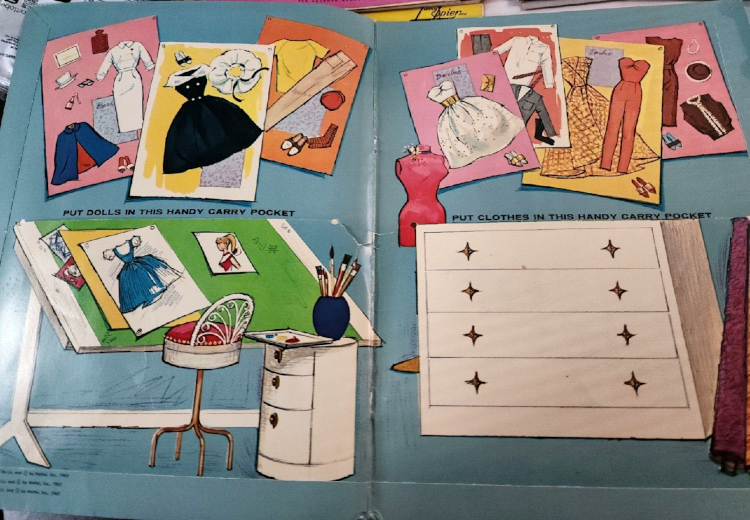
At least once, a Barbie career was featured that did not immediately suggest dressing:
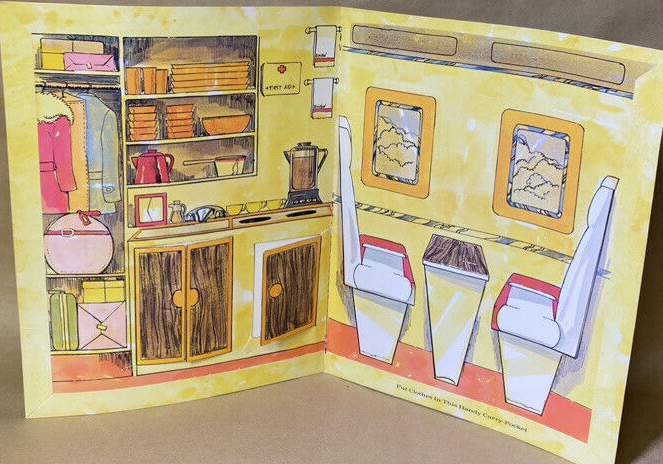
although the Braniff air hostesses from a couple years earlier did have three costume changes per flight! We’ve demonstrated the use of this folder as a diorama backdrop in a couple of posts.
And other times, the illustrated setting was neither work nor home, as in the case of this drive-in burger joint:
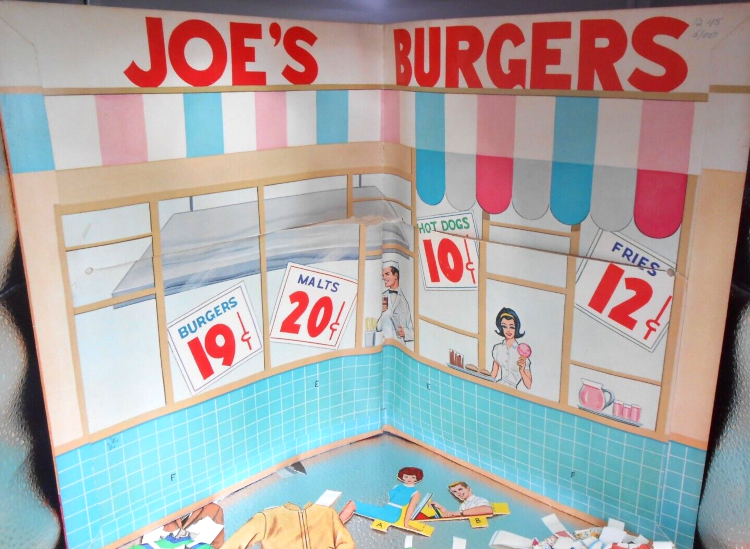
To use it with dolls, paper or otherwise, the user must supply the car. The set did come with a small-scale paper car and small-scaled Barbie and Ken (lying in front of the folder shown above) to sit in it.
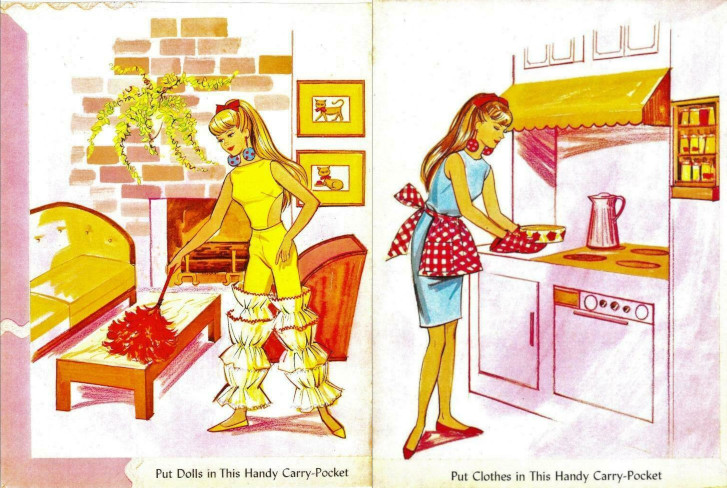
Lastly, at least one folder featured Barbie’s house with Barbie squarely in the scene. These illustrations, on a 1967 folder, show that year’s new T’n’T Barbie inhabiting the New Dream House, first available in 1964:
This is surely not an exhaustive list of built environments in the Whitman paper doll folders, although many folders featured illustrations less suited as a setting for imaginative play; in the Seventies the folders were phased out in favor of books with fewer ancillary illustrations.
Where to next? This post is about Barbie’s early built environment. The most recent post in this category concludes the Barbie’s Seventies Travelogue series, and the most popular are those on Mattel Modern and Susy Goose furniture and on penthouse apartments. Otherwise, the overall most popular posts on this site are about Barbie shoes, 1959-67, and about Mattel fashion booklets. Or just head up to the Table of Contents to see more options.
 Silken Flame
Leave a comment