

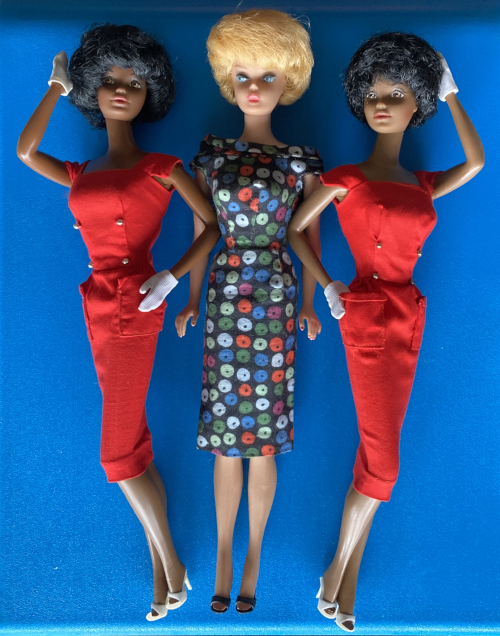
We’ve got a lot to cover today, but first let’s clarify what’s meant here by a nostalgic doll. Since you’re on this page, chances are you’re already aware of Mattel’s reproductions, re-releases of Barbie and family doll+outfit designs that were originally produced decades ago. These are examples of nostalgic dolls, but they are not the only nostalgic dolls. Nostalgic dolls, for this discussion, are those which are styled to evoke a past era, but also styled to evoke the way that Barbie was designed and produced during that same era. For example, the dolls in the Mod Friends gift set are circa-1968 reproductions; they are nostalgic dolls for the mod era. On the other hand, this year’s 55th anniversary Christie references the mod era in a very 2023 way and thus is not a (Barbie-)nostalgic doll. Looking strictly at the vintage Barbie era preceding the mod era, one example of a nostalgic doll that is not a reproduction is the 2008 convention-exclusive Joie de Vivre: though the gown, chignon hairstyle and makeup are all new-to-Barbie designs (also referencing the “Take the picture!” scene from the 1957 film Funny Face, starring Audrey Hepburn), it has the vintage head+body and a face paint style that riffs on the vintage era .

The 2023 12 Days of Christmas doll is another example along these lines.
We’ll stay in the pre-mod, vintage era for the remainder of this post. The Inspiring Women series entry for Katherine Johnson is another 1960s-inspired doll, but its head mold, body, and facial screening are all modern. The body is too slender and long-limbed to model most vintage ensembles flatteringly, and the face detailing stands out amidst a gaggle of vintage dolls, so for today’s discussion this doll is historical, but in terms of Barbie, is not nostalgic. Finally, the Barbie Fashion Model Collection (BFMC) or Silkstone dolls walk the perimeter of nostalgia: their faces are similar to vintage dolls’, but their shapes, too, tend to be unsuited to vintage attire. Toujours Couture (2008), shown above right, somewhat resembles a Swirl Ponytail doll from the 1960s, while her garments come from no era at all but straight out of the BFMC alternate universe where no quantity of bows and trim is too much. Ultimately, because of the bad fit of vintage clothes and because some vintage collectors dislike the Silkstone material (we don’t notice it that much), we’ve ruled BFMC/ Silkstone dolls as not Barbie-nostalgic. Now, let’s dive in to our “needs”:
Dolls we need: 1. Ponytail Barbie
The original conception of Barbie is THE icon. Barbie in her black-and-white striped swimsuit, cat eye sunglasses, ponytail swinging, is the image we associate most with vintage Barbie. Based on what I’ve seen on fan forums, this is also the doll others most want to see revisited with darker complexion.
As you see below, this doll already exists in “swirl ponytail” form and is called 60th Sparkles (2019), a platinum label, convention-exclusive doll released in an edition of no more than 1,500. That’s right: Mattel has produced this doll once and sold her through exclusive channels, treating their own imposed scarcity as a selling point. That’s not serving the majority of fans and collectors, and honestly, as their lone* offering of a non-White, early-1960s nostalgic fashion doll sized to the vintage fashions, treating this release not as an acknowledgment of Barbie’s broad fan base or as a long overdue correction, but rather as an insiders-only variant that a precious few collectors deserve to own… it’s a little embarrassing for Mattel. So we’ll specify that the doll we need is a widely available ponytail/zebra swimsuit nostalgic Black Barbie doll.

*In fact, 60th Sparkles has not been the lone offering of a doll meeting the criteria listed above: another convention-exclusive Black ponytail doll was released for the 75th anniversary, this one with a Silkstone body in vintage proportions, and with curly bangs like the first Barbie dolls. It is unspeakably rare today.
Dolls we need: 2. Bubble Cut Barbie
As noted above, everyone’s clamoring for ponytail dolls. But Barbie had other early-’60s iconic looks that, in my opinion, were better suited to her glamorous fashions, and also open up new possibilities in diverse hair representation.
Except for their curly bangs, the ponytail dolls’ hair was smooth, flat, and fine. Certainly, the same can be said of individuals’ hair from any race or ethnicity, and in the ’60s it was the fashion in the Black community to chemically straighten one’s hair: Ta-Nehisi Coates tells how his mother, at age 12 in 1962, started going to the salon to achieve “the locks of Lena Horne.” Earlier, Malcolm X and others in his social circle were doing the same chemical-straightening thing at home, and in the early 1960s he observed that the practice was still in vogue within the Black community, including among celebrities and members of the fashionable classes. (He further noted contemporary women “wearing these green and pink and purple and red and platinum-blonde wigs.”) So yes, it is accurate for an early-’60s Black fashion doll to have smooth hair, as 60th Sparkles does and as other nostalgic Black ponytail dolls likely would.
On the other hand, Coates’ mother realized in college, and Malcom X realized in jail, that frying your hair and scalp to meet a standard of beauty that was not designed for you–that just maybe was designed to exclude you–is a form of self-loathing. Though historically accurate, should these trends be celebrated uncritically today? Yes, some Black women’s hair is naturally smooth, and others may choose to straighten their hair with no dearth of self-esteem, and collectors love and desire the ponytail dolls. But let’s not overlook the bubble cut style and the opportunity it provides to depict fashionable, early-’60s Black women with texture and volume in their hair. I am aware of no Mattel offerings along these lines to date.
Dolls we need: 3. Midge
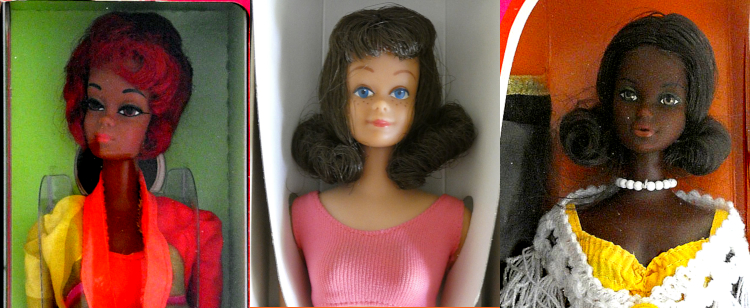
How have we still never been introduced to Barbie’s best friend from the early 1960s, Midge, who is Black? To me this seems like a slam dunk. The original Midge mold can be used, or maybe the variant that was created for Julia and Christie–but Midge’s wide-eyed gaze, girlish pink lip shade, carefully coiffured curls and smattering of freckles are musts.
A few existing alternatives
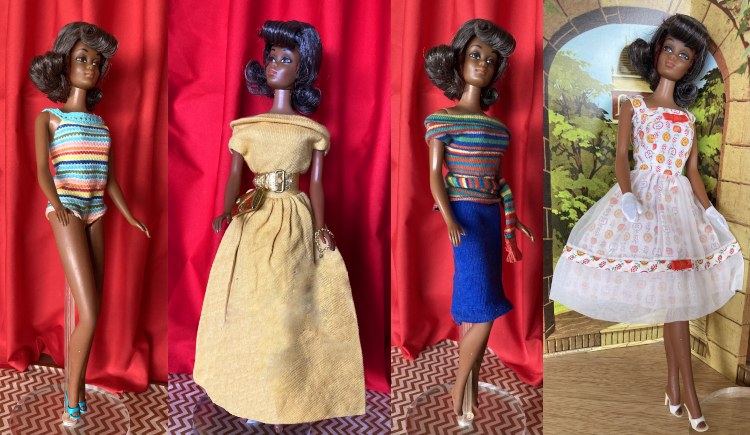
- Restyle a Julia or Christie: As you saw above, Julia or Christie may stand in for Midge. A face-up and rerooting would help a lot, especially for the vintage dolls whose hair has oxidized to bright red over time. However, both the dolls and their reproductions are rare; it absolutely requires resources to acquire one of these dolls and then pay a pro to restyle it. Price: $50-$100 for vintage Julia in fair condition before any OOAK; more for Christie.
- The first Black Barbie, or the reproduction, as a bubble cut: The hair is not quite right, the face is not ’60s vintage (though along the lines of the discussion on hair texture above, there are some upsides to using the Steffie face in place of Barbie’s original mold), and the body is just a bit curvier, making some of the clothes a squeeze–the Sheath Sensations pictured above are literally bursting at the seams! For purists, the bent arms are bound to be another sticking point. Otherwise, these dolls are available to serve as bubbles in a pinch. Price: $70 (deboxed repro)-$140
- Along the same lines as the first Black Barbie, Deluxe Quick Curl Cara (1976) has a great no-bangs Midge hair style and the Steffie face. She’s rare, especially with her hair in good condition. I don’t know how high on Mattel’s to-do list we’d find reproduction Quick Curl dolls, but I’m keeping my fingers crossed for 2026–they’re probably higher on the list than a true nostalgic Black Midge, anyway. Price: $275-$500 in display-ready condition.
- Barbie Fashion Model Collection “Silkstone” dolls: Besides those already discussed, various other Black Silkstone dolls exist. Debut is a no-bangs riff on the original chevron-suited Barbie and another rare, expensive con exclusive. The nostalgic face mold has also been used for several Black dolls in the BFMC line that don’t reference specific vintage Barbie styles, including Toujours Couture, the more moderately priced #5 Lingerie doll with chin-length hair, and more. Besides the price, drawbacks include that their rail-thin figures often don’t fill out the vintage clothes, their face details are more stylized, their limbs are sometimes posed peculiarly, and, as noted above, the Silkstone material.
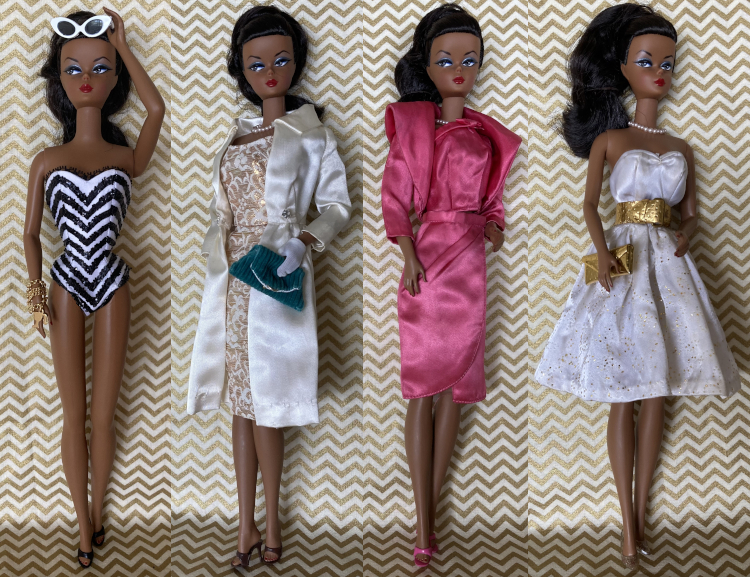
BFMC Debut models a Silkstone swimsuit and some 1960s fashions. L-R: Debut’s own papery, glittered-up version of the zebra-stripe swimsuit; Golden Girl’s stiff brocade maintains its shape on her slender physique, while loose-fitting garments like the pak satin coat are always safe choices (note, her inflexible, splayed right hand wouldn’t fit into the second glove); other pak satin items sit loosely on her frame; the strapless Party Date dress stays up long enough to take the photo with the help of a stiff belt and a slight lean. Substitute shoes used in all vintage ensembles because stiff Silkstone feet will cause splits in vintage shoes.
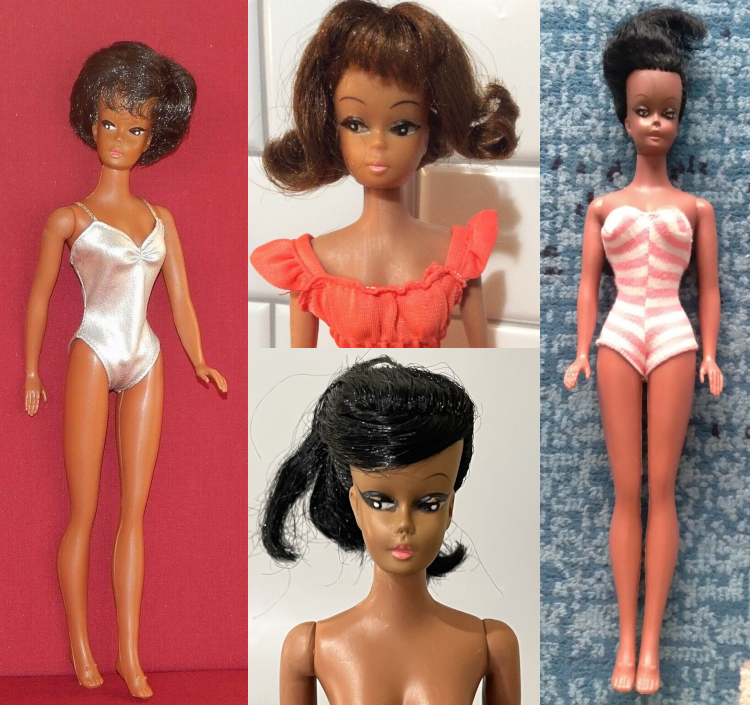
- Sixties clones, including the Uneeda/Hong Kong Lilli varieties and the Twistee/Totsy dolls, introduced glamorous Black Barbie counterparts before Mattel did. These are again rare, not cheap, and quite uncommon to find “minty.” Furthermore, there will be fit issues, especially with shoes, when using them to model vintage Mattel fashions. In addition to the sampling of dolls below, take a gander at the examples included in The Bold Doll’s article on clones, particularly the gorgeous Peggy Ann about halfway down (note: the “Evening Splendour copy” she wears is by Premier Doll Togs!). Price: $250-$500 in fair condition.
- If you’re crafty, you can dye common dolls. The blogger at this link got nice results from the more-affordable 35th ponytail repro… just make sure the dye doesn’t bleed onto your vintage fashions! This is also a buyer-beware moment for those shopping for ’60s clones and other rarities: dyed dolls are out there, some masquerading as originals. If you get a doll whose look you love, there should be no issue; just don’t wildly overpay, and beware of bleeding dye, if you’re not sure of a doll’s provenance.
Why so few recent dolls? Starting when Barbie went disco in the Superstar era, face detailing became a little more cartoonish. Although it has evolved many times since, it has not returned to the classic style except for deliberate purposes like the repros. (2026 update: we can no longer trust Mattel’s “repros” to sport “classic” face styling.) Dolls like Pop Life Christie and Nichelle Nichols as Uhura, while referencing the (mod) Sixties, are omitted from these considerations because they don’t sit comfortably alongside vintage and faithfully-rendered, Barbie-nostalgic dolls.
What about some WHITE nostalgic dolls? They are plentiful… multitudinous.
Beyond Black and White
In the early Sixties, about 1 in 10 Americans was Black, while no more than about 1 in 100 was from any other given non-White ethnicity. For this reason, and because of the apparent popularity of the idea in the Barbie fan community, we’ve prioritized Black representation for Barbie as a vintage-era American young lady. Expansion of the nostalgic line to other ethnicities should happen, too.
Besides overlooking the demand for non-White nostalgic Barbie dolls, another and related glaring error that Mattel continues to make is dressing every Asian collector fashion doll in embroidered silk, as if she’s stepping not from the 1960s or later, but from an earlier century; as if she is not American. A customer worded the issue rather well, way back in 2003 when the Chinoiserie Silkstone was released. Mattel’s response on that page was dismissive, and we can see from their output over the next two decades that they did not learn from this very valid criticism: outside the playline, Asian Barbie dolls rarely reflect modern fashions as their White and Black counterparts are free to do. The customer’s mention of Anna May Wong is particularly rich, since this year an Anna May Wong Inspiring Women doll was released. Wong was California-born and -raised, and in her personal life was entirely modern and fashionable; but she was typecast by Hollywood, only allowed to play “dragon lady” characters, foreigners. Was Mattel sensitive to Wong’s struggles in designing the new doll? Yes but no. They put her in a red satin dress with a great big metallic dragon plastered across the front as an acknowledgment of the stereotypes that stifled her a century ago.

As we wrap up I’ll note that not every Asian American woman looks Chinese or is of Chinese extraction, and today the most populous ethnic minority group in America is neither Black nor Asian; in other words, there’s plenty of identity to explore in collector and nostalgic dolls representing fashionable, American women.
 Silken Flame
Leave a reply to Hello world! – Silken Flame Cancel reply