
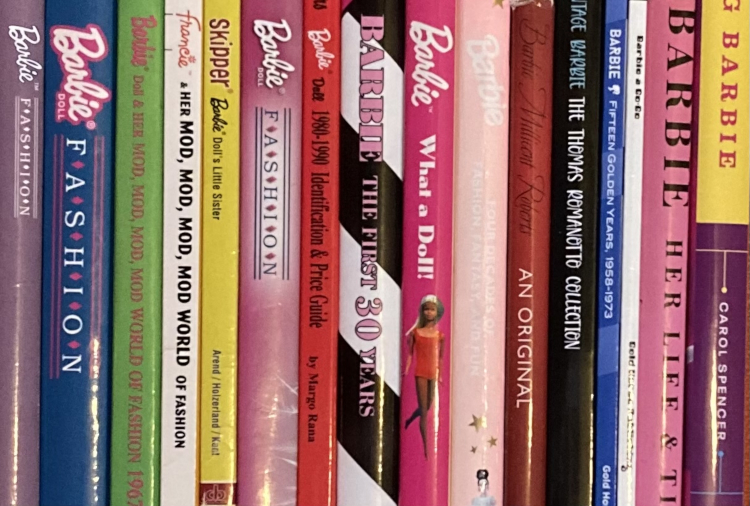
Recently, in a series of hilariously escalating blunders, someone at Mattel slipped on a banana peel, stepped on a rake, ran headlong through a sheet of plate glass being carried across the street by men in coveralls, and then accidentally ordered only two hundred copies printed of a new book on Barbie Dream Houses–all in a single day! Dream Houses are kind of our beat–although the elusive Mattel volume features only a handful spanning vintage to present, while we’re more of the strictly-vintage, thorough persuasion–but we’ll never see the Mattel book, so let’s say no more about it.
Fortunately, competent publishers have released so many wonderful books in sufficient quantities over the years. I have none to recommend specifically on houses or other play sets (hence, one of the main motivations for this blog), but hopefully anyone can find something to their tastes in this (partial) list of great works of Barbie scholarship.
Identification Guides

Barbie Fashion Vols. I-II by Sarah Sink Eames
A comprehensive listing of fashions not just for Barbie, but also for Francie, Ken, Skipper and Ricky, through the vintage and mod years. Long out of print, the first volume, at least, is not too hard to track down. Each year is covered by a chapter, with sections for the differently-sized dolls’ fashions. Ensemble entries are accompanied by color photos of the garments and accessories, either loose, on a doll, or mint in package, along with a description and some light narrative: “Election time! Barbie doll was nominated for president of her sorority! She could hardly uncross her fingers long enough to get dressed for the big decision!” begins the description of 1962’s Sorority Meeting, before launching into a detailing of the outfit elements. When I felt anxious after seeing a couple wedding dresses in Francie’s chapters, Sink Eames reassured me that the teenaged Francie had merely modeled them. There are also segments on prototype outfits and overseas exclusives. In the second volume, gift sets each get a page to themselves, to display the cover illustration as well as the boxed contents.

A third volume also exists, covering 1975-1979. It is the rarest of the three, covering the shortest time span, and, to me, the least interesting fashion. In the third volume almost everything is photographed in its original packaging, which is an accomplishment from the collectors’ point of view but perhaps the worst way to display the contents. To me, the third book is not must-have but still nice-to-have.
Francie & Her Mod, Mod, Mod, Mod World of Fashion; Barbie Doll & Her Mod, Mod, Mod, Mod World of Fashion, 1967-1972 by Joe Blitman
Beyond the fact that they are limited to mod fashions, Blitman’s books are distinct from Sink Eames’ in a few ways. First, almost every fashion gets its own page, with a cleverly-posed doll (or dolls) modeling the ensemble (Blitman has also reproduced these images on playing cards), in addition to a photograph of the loose outfit pieces. Second, the entries are peppered with entertaining commentary like “Take a sedative before you try getting the jumpsuit on a bend-legged doll,” describing Twiggy Gear (I think the strategy is to turn the garment inside out and roll it onto her legs); “The robe proves that there is an afterlife for old bathroom carpeting,” describing Barbie’s 1969 Dream-Ins; “You really have to work at it to make this jumpsuit look good on a doll,” referring to Firelights; and commenting on 1972’s Pants-Perfect Purple, a single, very punctuated word: “PURPLE!!!!!!!!???????”
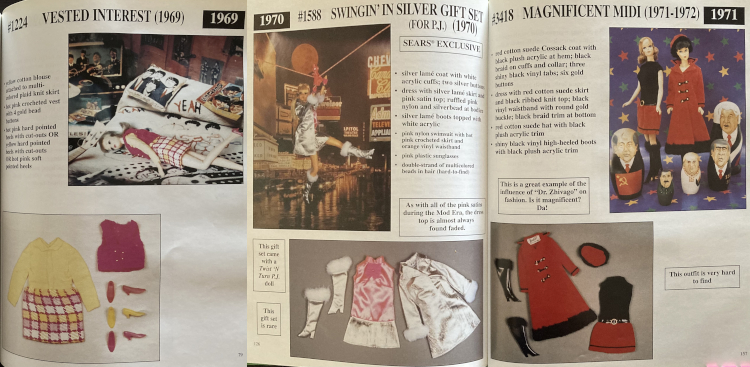
Blitman is thorough in detailing variants (though Sink Eames is no slouch in that department, either), and sections at the backs of the books grouping together all the dolls’ original ensembles can do double duty, in a pinch, to help track down a doll ID. Alphabetized indices of the fashions are also extremely helpful. Overall, when I need a mod Barbie or Francie outfit ID I reach for Blitman’s books first.
The Collectible Barbie Doll and Identifying Barbie by Janine Fennick
Janine Fennick’s book, The Collectible Barbie Doll, and its “study guide” follow-up, are both great resources. Identifying Barbie is a small-sized volume with an exclusive focus on doll IDs, including some super-rarities. For the many gorgeous photos, she took the opportunity to showcase some rare fashions, as well.

Skipper: Barbie Doll’s Little Sister by Arend, Holzerland and Kent
I have to admit I’m no Skipper expert, but this book is notable for its thoroughness. In addition to covering Skipper and her same size friends’ dolls and fashions with a wealth of excellent color photos and descriptions, the book also has sections on Tutti and Todd, Skipper-sized clones, vinyl cases, play sets and furniture, paper dolls, and even more. If you’re not a Skipper collector yet, this well-wrought volume might make you one.
Barbie: The First 30 Years by Stefanie Deutsch
Another volume with a focus on doll identification, this work is a good resource for learning the distinctions between, say, #3 and #5 ponytail dolls, or learning how Ken, Francie and the rest of Barbie’s circle evolved across the decades. The author hails from Germany and the extensive sections on Bild Lilli and on Barbie variations for foreign markets (and foreign play sets and carrying cases!) are particularly worthwhile. One drawback to this book is that its photographs are not at the level of quality of those in the rest of this post; frankly, many look like they were taken with flash on. However, this book is still an excellent reference containing a trove of unique material.
Barbie Doll Structures & Furniture by Marl Davidson
A niche topic but one of our favorites, Davidson’s rare book covers Mattel’s Barbie structures through 1972 and furniture sets through 1975, with detailed component lists and color photographs of carefully costumed and posed dolls inhabiting the structures (The photography is amateur but fun). This book is likely to cost more than many on this list, but much of its information can be found nowhere else.

Histories

Barbie: Her Life & Times by BillyBoy*
THE history of Barbie, in my view. Published in 1987 to coincide with The New Theatre of Fashion–a traveling show for which seemingly every couturier in the industry designed a one-of-a-kind Barbie fashion–this book covers Barbie’s life by mining novels, comic books, marketing materials and more for the details of Barbie’s personal affairs, and covers her times through author BillyBoy*’s encyclopedic style knowledge. If you need to know that Barbie’s 1960s charm bracelets are “a la Calder” or that Alexandre invented the bubble cut hairstyle in Paris, this book is for you.

If you just want to browse sumptuous color images spanning 1959-1987, some of which are as tall as Barbie herself (the pages measure about 12″ on their longer edge), including a lengthy section on the designs for the New Theatre show… still your book.
Dressing Barbie by Carol Spencer
A personal history of Spencer’s career designing Barbie fashions, spanning decades from the early ’60s into the ’90s. Among her many adventures, read how Spencer designed Barbie-sized swimwear prototypes for her job interview; developed novelty lines like the Color Magic ensembles and Sew-Free fashions; created Country Club Dance and Holiday Dance to use up surplus Fashion Queen fabric; designed Black Magic based on Ruth Handler’s own wardrobe; pieced together the Rainbow Wraps mosaic pattern by hand; weathered changes in fashion trends and at Mattel; ghost-designed for Oscar de la Renta; and much more.

Centered on Spencer’s own work, Skipper, Francie and Ken don’t factor into the tale, nor do the couture looks Charlotte Johnson created in the early years. But the inside perspective Spencer shares, coupled with her long career, makes for a singular narrative.
Doll Fashion Anthology by A. Glenn Mandeville
Not a lush photo book like the first two in this category, but a thorough history of Barbie, including influences, chapters on contemporary clones, extras like store displays, board games, packaging, and much more, lined with images, many in color. I felt there should be a “citation needed” next to some of the author’s claims about the minds of the buying public and the minds of the designers at various intervals, but on the whole this little book is a treasure trove of Barbie information, including many details that slide past the more fashion-focused volumes. My copy of this book ends in the Nineties, with the author expressing some enthusiasm for then-recent collector dolls. He predicts the holiday dolls will be popular with collectors, while stopping short of suggesting that they will be valuable. Well played, Mr. Mandeville.
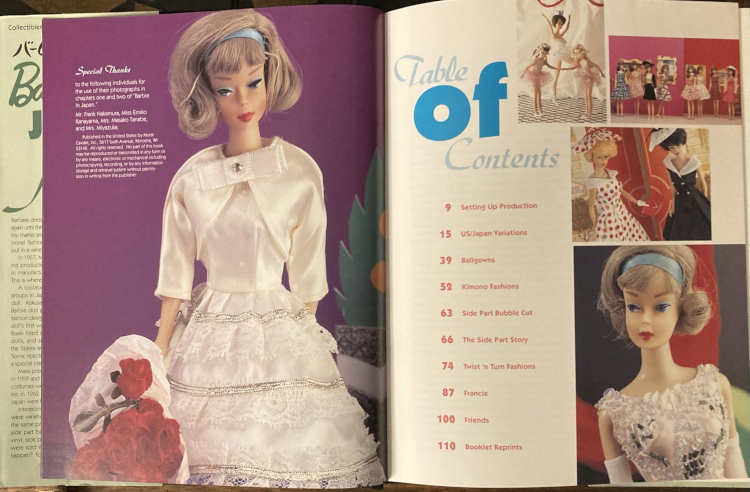
Barbie in Japan by Keiko Kimura Shibano
The topic of 1960s Japanese-exclusive Barbie fashions and dolls is a bit niche, but for the curious, this well-written volume, festooned with gorgeous photographs, is a joy to read. Furthermore, the introductory chapter on initial Barbie development as a collaboration between Mattel and Japanese manufacturers will be of interest to any fan of Barbie’s early history.
Coffee Table Books

Barbie: Four Decades of Fashion, Fantasy, and Fun by Marco Tosa
Two of the histories in the preceding section are also coffee table books, and this coffee table book is also a history. The book kicks off with a critical analysis of Barbie’s place in our culture, including some modern fine art ruminations on the doll in question, before delving into a history that starts with some of Barbie’s earliest antecedents, from about 150 AD, and continuing through Victorian fashion dolls and Bild Lilli, to Barbie’s inception and up through most of the ’90s. The focus is almost entirely on fashion, with some play sets mentioned as they relate to fashion lines and almost no other Barbie ephemera discussed. Barbie’s ’60s style is placed in the context of Balenciaga, Dior, Grace Kelly, Doris Day, Jackie Kennedy, and more, continuing through Oscar de la Renta and Bob Mackie to the (then-)current period. Separate sections on more recent movie-based dolls (including the Marilyn Monroe doll on the book’s cover) and Dolls of the World round out her evolution up to the date of publication.
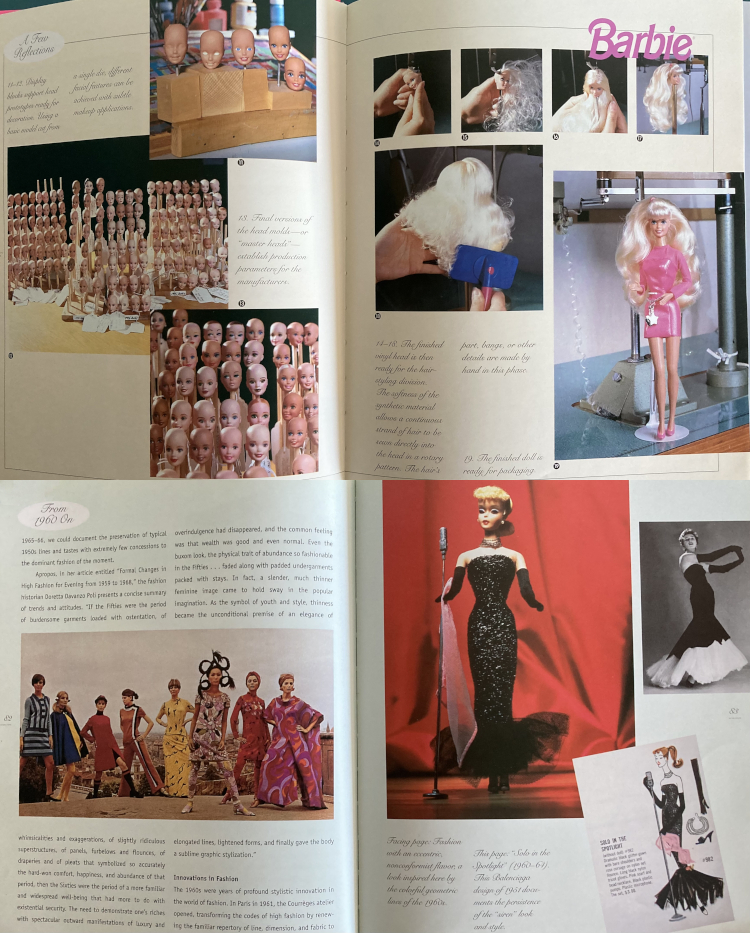
A more serious work than the others we categorize as coffee table books, it boasts a bibliography (including some of the books already listed here as well as many others) and an index of the dolls and fashions appearing in its many high-quality photographs.
Barbie: What a Doll! by Laura Jacobs
A 1994 book of Barbie fashions on posed dolls with neutral backgrounds, stretching from Barbie’s earliest years through the Eighties. Fashions are grouped thematically (“Trouser Styles,” “Outer Wear,” “Party Girl”) and within those chapters by color palette, so that 1960s tailored suits sit comfortably alongside similar designs from the Eighties, while late Sixties switched-on mod minis mingle with late Eighties neon and glitter (the Seventies are mostly flyover territory). If you’ve collected or at least browsed the trading cards released a couple years before this work, you’ll see images you recognize. One thing that might drive the aspiring collector crazy about this book: each picture is captioned with a year and a description of the garments, but not the ensemble names!
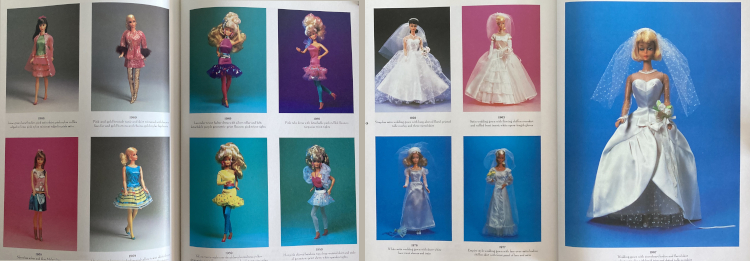
The introduction was written from Barbie’s perspective, and some just-for-fun appendices include a family tree, a list of Barbie’s careers, and a list of nationalities Barbie has assumed–the last of which draws attention to the fact that almost every ’70s and ’80s doll appearing in the book is blonde. Maybe this choice was intended to emphasize the individual Barbie narrator, but it wasn’t really working for me. Regardless, I enjoyed the pairings of ’60s and ’80s fashions, which you don’t often see.
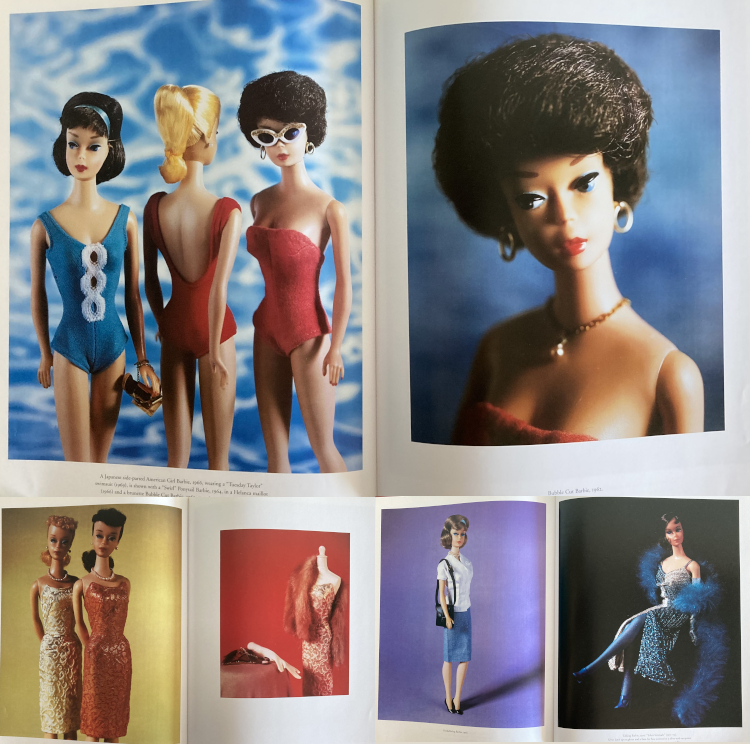
Barbie Millicent Roberts: an Original by David Levinthal
This nearly text-free book explores the concept of Barbie fine art photography, posing, lighting and framing her as she would have appeared in 1960s advertisements for gowns, jewels, furs and perfumes. The fashions are drawn from the glamorous vintage years beginning in 1959, stretching to some of the more fabulous styles of the mod years up to about 1972, with occasional offroading into, for example, a Tuesday Taylor bathing suit (below). A prefacing essay by Valerie Steele, longtime curator of the incredible Museum at the Fashion Institute of Technology, explores 1950s and ’60s fashions as they’re reflected in Barbie’s wardrobe and in photographs.
Catalogues
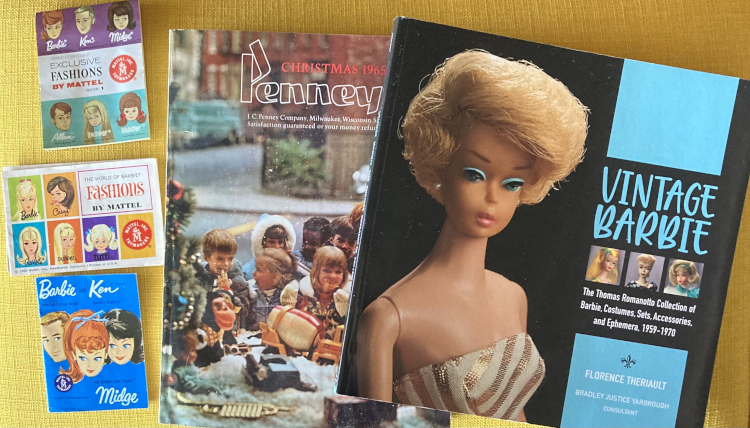
Okay, it’s a bit of a stretch to call most of the entries in this section “works of scholarship,” but read other entries in this blog to see how we depend on them for “research”–and all are enjoyable to browse for eye candy and inspiration.
Auction catalogs
You can browse recent Barbie auction catalogs from Theriault’s for free online, or you can invest in physical versions–or do both, as I do. The search feature online is invaluable, but the page layouts and high-resolution photos are so enjoyable in their physical form. These catalogs do contain a number of errata–misnamed ensembles, some Mattel outfits left unidentified, 1950’s Mattel furniture for 9″ dolls labeled as Barbie furniture, a Deluxe Reading Dream Kitchen incorrectly attributed to Mattel–as well as a general lack of specificity about complete sets or matching exactly the right accessories to garments. Identification guides, they aren’t. However, both the online catalogs and those you purchase from Theriault’s after the auction include both estimated and realized prices, so if you do want value estimates they provide an up-to-date source alongside the stunning visuals: gorgeous full-color, professional-quality photographs of dressed dolls, furniture, Bild Lillis and other clones, Japanese and European exclusives, carrying cases, and countless other treasures.

Mattel booklets
They’re our primary source for the most fundamental Barbie fashion illustrations and contemporary documentation, straight from the source, of what products were offered in a given year. And plenty were printed–we’re looking at 50-year-old examples that are still in circulation and affordable.

Are they an awkward fit for your bookshelf? Yes. Is that because they’re in fact not books? Also yes.
Vintage mail order store catalogues
Both rarer and brittler than the Mattel booklets, and mostly concerned with non-Barbie topics, these will give you the least bang for your buck of all the options presented here and also are not genuine books. What’s more, sources exist online for decent quality scans of many of them.
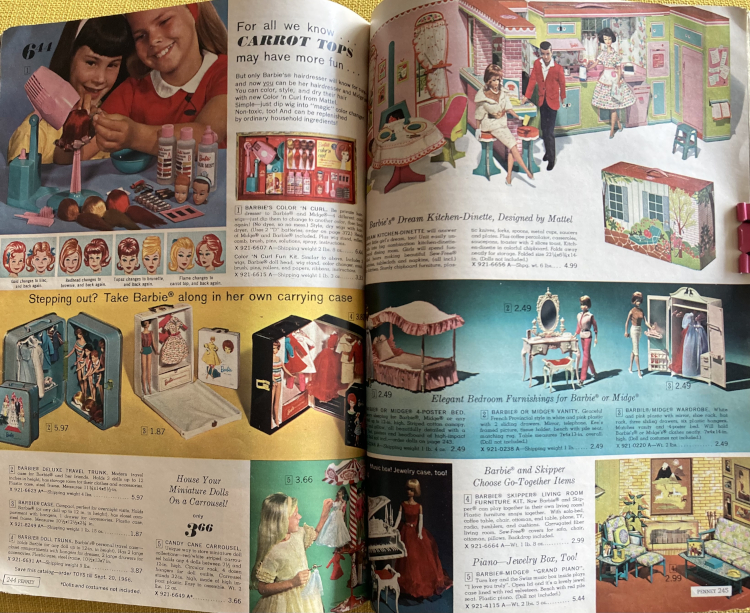
Still, if you happen upon a bargain, or you find one that’s missing from the online repositories, a vintage catalogue can be very rewarding to thumb through.
And that’s a wrap
Thanks for rifling through my bookcase with me! Do you have a favorite Barbie volume that wasn’t mentioned here? We’d love to hear about it.
Where to next? In our Deep Dives and Musings category, the most popular post is our Chronicle of Barbie Shoes, 1959-1967. The most recent musing is about Barbie-sized luggage, and a severely underappreciated musing is When Barbie Turned 21. We’ve recently been enjoying writing Barbie’s Seventies Travelogue in the “built environment” category; or just head up to the Table of Contents for more options.
 Silken Flame
Leave a comment