
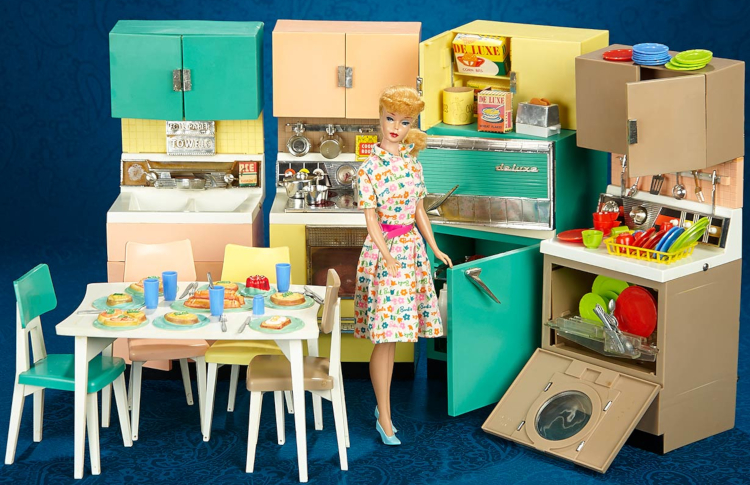
Barbie’s earliest abodes may suggest that she was not much of a cook: neither the ’62 Dream House nor her ’64 Campus dorm room provided kitchen facilities (predictably, in the latter case); the Go-Together rooms offered a dining room, but no kitchen; and the ’64 New Dream House had a very minimal kitchen in the bedroom. Perhaps Mattel reasoned that a teen-age fashion model/full-time college student had little time to cook, but someone else was looking out for Barbie’s culinary concerns: the Deluxe Reading Corp., who produced a kitchen that was not affiliated with any doll, but was advertised for “popular teen-age dolls” in general. The set appears to have been a Montgomery Ward catalog exclusive.

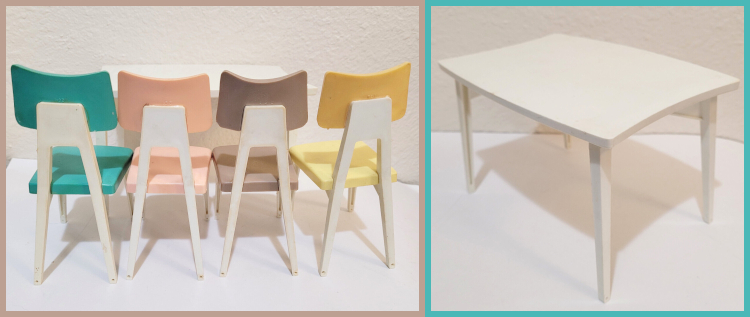
Today this set is highly-sought, even by collectors who are otherwise Mattel purists, and it’s no wonder: the Dream Kitchen is technologically sophisticated, realistically detailed, and candy-colored mid-century fabulous. I’d argue that Mattel has never made a play set that combined so much style and functionality. Running water, a motor-operated rotisserie and light-up burners were just a few of its cutting-edge features, and with all the dishware, cookware, and tiny food, 176 pieces were included. The lines of the table and chairs were positively atomic, with A-shaped silhouettes forming the chair backs and back legs, and a jaunty, bowtie-shaped top for the table.
But many who dreamed of the Dream Kitchen probably had to settle for less–its price was prohibitive. At $11.88 in 1963 and $10.88 in ’64 (about $105-$115 in 2022 dollars), the Kitchen cost around twice was much as the most expensive Mattel play sets did during the years the Kitchen was available. A “Copper Kitchen” available during the same years also included food and dishes–no table, chairs, or functioning appliances–and came in at less than half the price. When another technologically-dazzling off-brand kitchen, the Karosel Kitchen, came on the scene in 1971, even it was cheaper at $9.99 (about $75 in 2022 dollars). I surveyed the catalog prices of a couple dozen Mattel and non-Mattel play sets available in the early-mid Sixties and summarized them in the plot below (the Karosel Kitchen falls outside this time frame).

This survey is not exhaustive but includes twelve Mattel sets (rightmost column of the figure legend), six Ideal or American Character sets (for Tammy, Tressy, Misty and Pepper), the Dream and Copper Kitchens (top left column), and five other Brand-X “clone” houses (grey entries at the bottom of the left column); in all, about 60 unique data points contribute to the averages shown. I did omit the (fifteen-inch-tall) Littlechaps’ furniture in 1963. The Littlechap family had three standalone rooms available at $3.33 apiece, or the posh consumer could get all 3 for $8.99. This uber-set approaches the Kitchen in price but still falls short. Mattel’s Deluxe House, a couple years after the Dream Kitchen, came closest in price of all sets surveyed but also did not arrive, and when the Karosel Kitchen finally increased in price to $13.99 in 1974, it was still cheaper than the Deluxe Reading Dream Kitchen in inflation-adjusted dollars.

All of which is to say, the Dream Kitchen was expensive. However, its matchless style, abundant detail and many technical flourishes certainly justified its intimidating price tag.
Where to next? This post is about Barbie’s early built environment. The most recent post in this category is part three of the Barbie’s Seventies Travelogue series, and the most popular are those on Mattel Modern and Susy Goose furniture and on penthouse apartments. Otherwise, the overall most popular posts on this site are about Barbie shoes, 1959-67, and about Mattel fashion booklets. Or just head up to the Table of Contents to see more options.
 Silken Flame
Leave a comment