
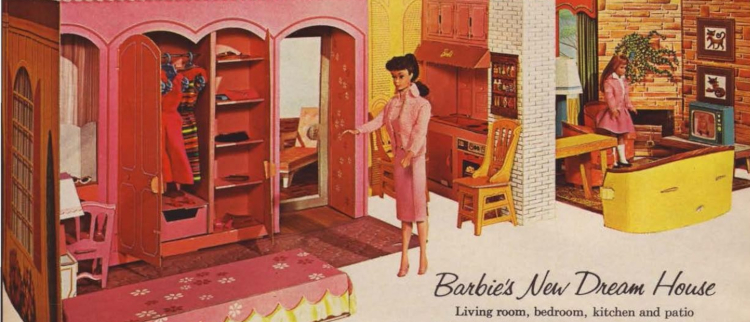
The New Dream House
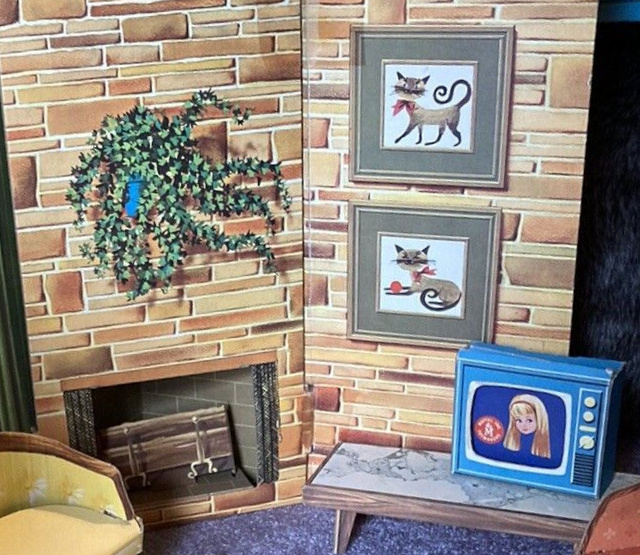
In 1964 Barbie’s style of living got a major upgrade in the form of a new house, rich with detail, packed with almost too much furniture, and separated into four living spaces: living room, bedroom, kitchen and patio. The new home was furnished with a sofa, two armchairs, an end table, a coffee table, a television, two lamps, a vanity chair, a bed, two kitchen chairs, a kitchen table, and a chaise longue for the patio, in addition to smaller details like books for the bookshelves, flooring, and extra screens for the TV, so Barbie could watch different programs. The walls, too, were rich with textures and details, like the white-painted brick in the kitchen, the fieldstone fireplace, and those two gorgeous, midcentury-style framed cats hanging in the living room.

The bedroom had built-in storage with working doors and drawers, and almost everything in the kitchen opened and closed, including cabinets, the oven, and the shutters of the pass-through window (just like the Petries had on Dick Van Dyke). Given the fragility of chipboard, it’s breathtaking to behold some of the pieces still in circulation today.
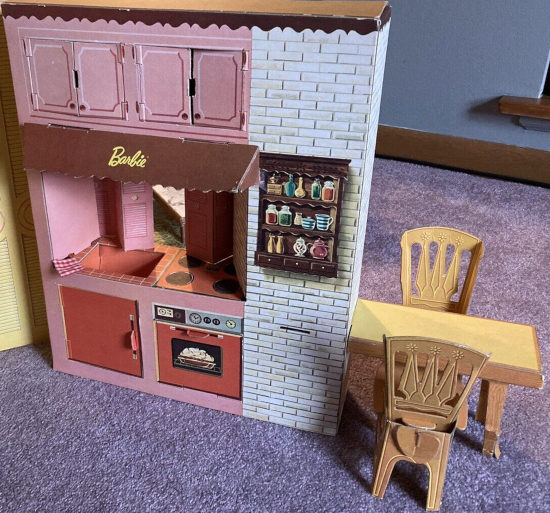
A “screen” door adjacent to the kitchen and bedroom could open onto the patio. The two-legged kitchen table was made to affix to a wall and could be placed in at least five locations: three sides of the half-wall between the kitchen and living room (preceding images), into the louvered doors next to the kitchen to create a breakfast nook, and out on the patio (following image).

After evaluating the outdoor spaces, I have ruled this home a second suburban sanctuary. However, the kitchen’s being in the bedroom (top image) was Very New York. Of course, the structure could be transformed to give more or less space to certain areas as they were needed, so the bedroom/kitchen area could be made less cramped, as in the second image.
Go Together Furniture Sets

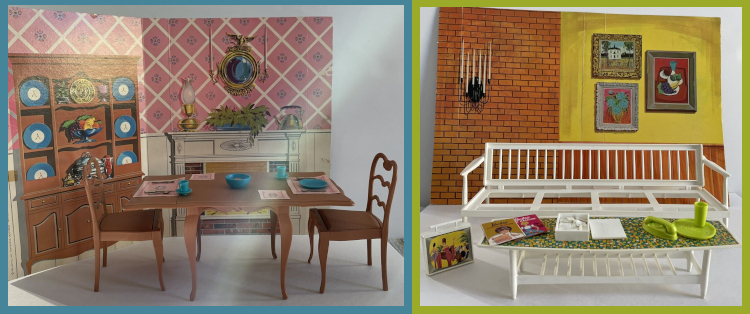
Populuxe author Thomas Hine, who was right about so many things, alleged in his landmark work that Barbie owned a split-level home (all the rage at mid-century). I haven’t seen the proof. However, if youngsters in the Sixties wanted to construct a split-level or multi-level home for Barbie, the Go Together sets made it easier. Each set consisted of one printed wall and several pieces of plastic furniture–including foam cushions and textured inserts–to make up a room. With these sets, one could add to an existing Barbie home or just enjoy a single space.
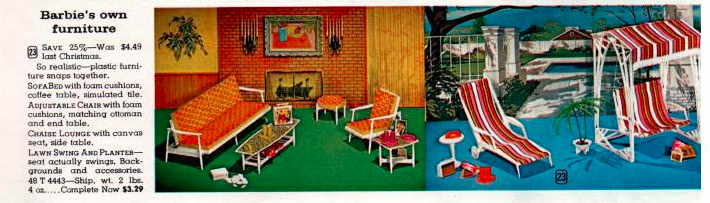
The Go Together sets were marketed alongside Miss Barbie in 1964 and included decor for the living room and patio; the dining room and Skipper’s bedroom were added a short time later, and all with backdrops to match. The advent of plastic introduced innovations like drop-leaf tables, convertible sofa-beds, a standing swing, and Skipper’s bunk beds that converted to single beds. Little extras like dishes, telephones, radios, and magazines were also included. Nowadays, partial sets are much easier to track down than complete ones–some of those foam cushions must have deteriorated, while the hard plastic furniture has endured.
We adore illustrations here at Silken Flame, and the Go Together walls were bursting with illustrated detail. Skipper’s bedroom featured several of what I would call Easter Eggs: sitting on her vanity is a framed photograph of, I think, Midge wearing Fancy Free; on the wall are a framed photograph of Skipper herself in Silk ‘n’ Fancy, and photographs of Ken and Allan baring their chests (?); on the shelves are, I believe, a bend-leg Midge doll, an Allan doll, a Barbie guitar, the megaphone from Barbie’s Cheerleader ensemble, plus Skipper’s own hat from Red Sensation; and peering through the bed frame in the below photo like Bob from Twin Peaks, is what appears to be Bugs Bunny–if we moved the bed we’d find he even has a carrot.
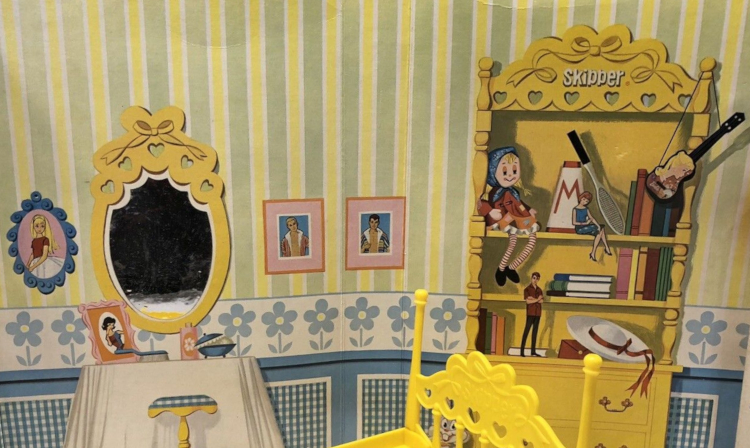
The walls that came with the outdoor furniture also confirm that Barbie is still trying to have it all in the suburbs. But she still has one more housing adventure to embark on this year…
Barbie goes to College
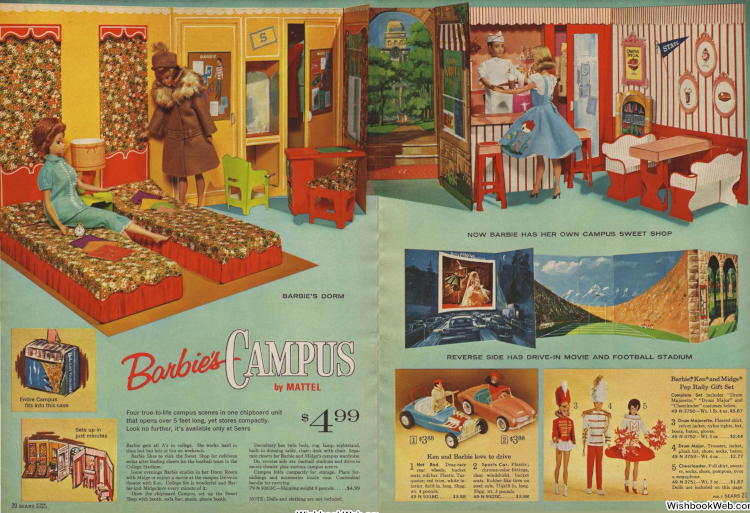
In 1964 the Teen-Age Fashion Model was ready to attend college. That year’s Cheerleader and Drum Majorette fashions hint at her involvement in campus life, and the campus play set provides the setting. Barbieworld.it has many excellent photographs of this set, which included a dorm room, a campus sweet shop, an exterior wall depicting the football field, and other scenes that suggest college but not really hitting the books. This set was a Sears exclusive.
Like many of us, Barbie went to college for a few years. In ’64, Midge is ubiquitous on campus, appearing both in the dorm room she and Barbie share, and in the campus sweet shop, in the catalog images above. By ’66 it is known that Midge and Barbie had grown apart. That year, although Midge was still seen patronizing the Sweet Shop, Barbie’s roommate was alleged to be… Francie? Francie was advanced for her age.

In all, 1964 was a watershed year for Barbie’s housing options. Will she be satisfied dividing her time between her newer, larger dream house, her individual go-together rooms, and her shared campus accommodations? Or will she, like a true member of the American middle class in the 1960s, aspire ever onward and upward? Find out in the next installment.
 Silken Flame
Leave a reply to Penthouse Apartments, 1964-1976 – Silken Flame Cancel reply