

During Barbie’s mod years, the Whitman illustrators experimented with a diversity of art styles, demonstrated in the collage of Barbie paper dolls above. (If a couple of them look like Stacey to you, let me reassure you that Whitman identified all as Barbie herself–we’ll see Stacey in a moment.)
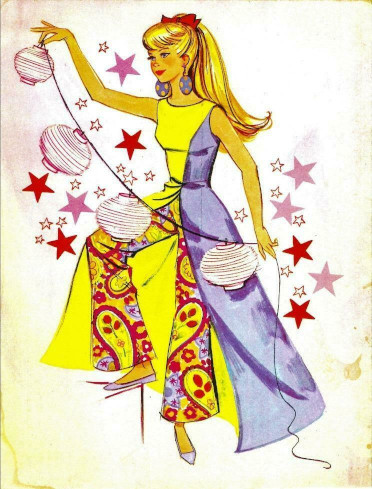
Starting with the “Barbie has a New Look” set in 1967, fresh illustration styles were demonstrated on the folder art as well as on the dolls and fashions.
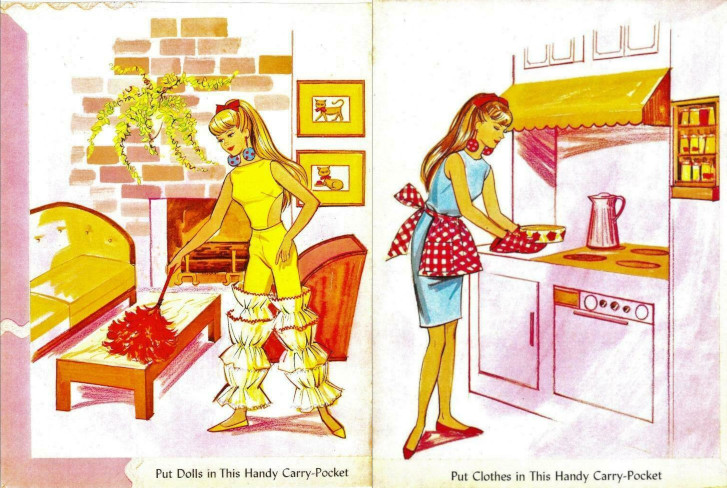
At the far end of the timeline, departing the mod era, a 1973 set called Barbie’s Friend Ship depicted the same-named play set from that year and can be used for dioramas recreating everyone’s favorite setting, the golden age of air travel.
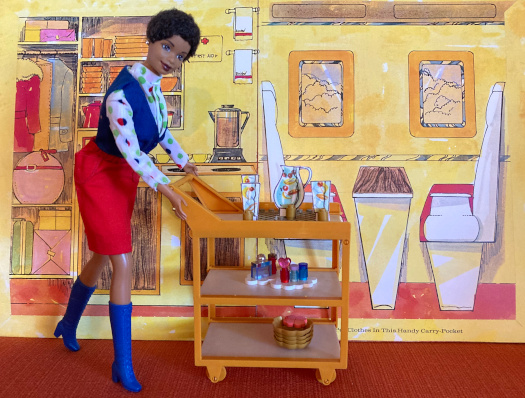
In addition to its range of artistic sensibilities, the mod years also introduced an unprecedented number of friends for Barbie. In the paper doll world, she explored fashion alongside Christie, Stacey, P.J., Francie, Casey and Ken (Skipper made her return with the Malibu look in ’73). A Francie and Casey set from 1967 reproduced many of the same outfits as the “Barbie has a New Look” set–but now they were Francie-sized.
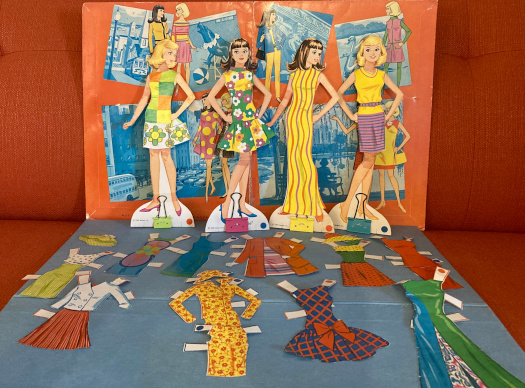
Of course, Francie and Casey still dressed like themselves, sometimes, too.
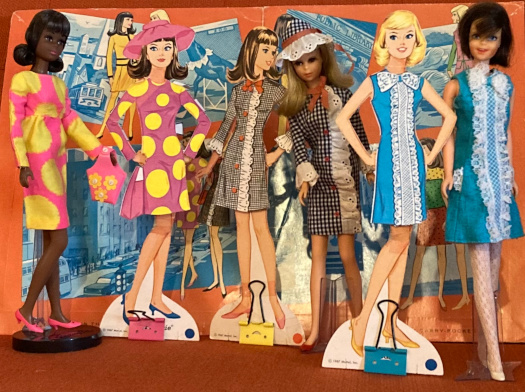
A 1968 “Barbie Christie Stacey” set claimed that “All fashions fit each doll.” However, a couple of the fashions revealed distinctly lighter skin. I overlaid Fancy Dancy and Extravaganza on Stacey and Christie, below, and digitally corrected the skin tone on Extravaganza to suit Christie.
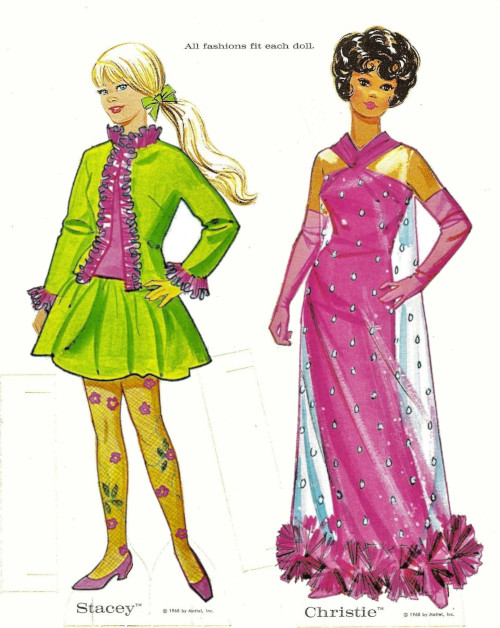
Both Fancy Dancy and Extravaganza appeared in multiple paper doll sets during the mod years.
Barbie’s friend P.J. had multiple Whitman sets all to herself for some reason.

While the fashion booklets switched to using photographs in the late Sixties, the paper doll sets remained a resource for illustrated fashions. The sets I surveyed from 1967-1971 depicted a higher proportion of genuine Mattel Barbie fashions than did the sets I previously surveyed from 1965 and earlier; we can revisit some of our favorite mod looks as we explore the variety of art styles.
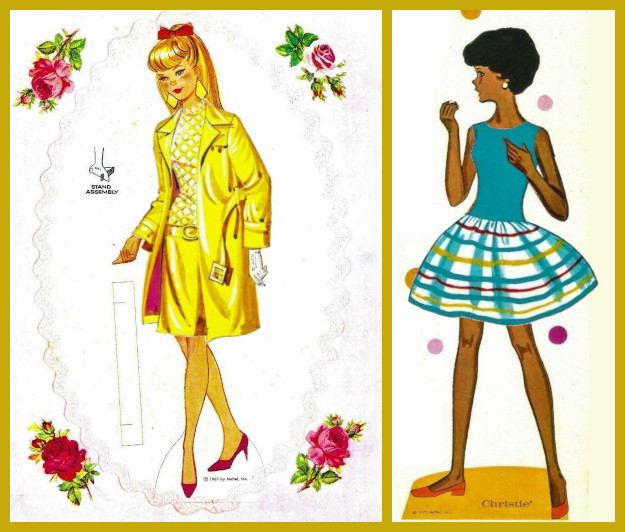
Above, the lushness of the 1967 “Barbie has a New Look” set is contrasted with the flat graphic style of the 1971 “World of Barbie” set, with the 1967 doll modeling the “Intrigue” fashion and 1971’s Christie modeling the 1968 fashion “Twinkle Togs.” Both of these fashions were available in other late Sixties Whitman sets, as well.
1969 brought us at least two renderings of the Sears exclusive Twinkle Town, these two demonstrating the loosest and tightest art styles I found in the mod years:

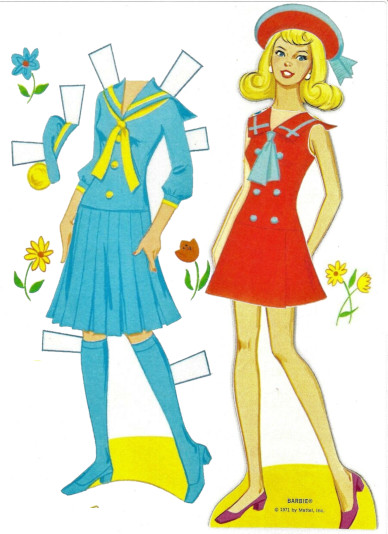
In 1971 Barbie got very nautical, wearing her own See Worthy fashion and Francie’s Land Ho!, both from 1969, in a single Whitman set. See Worthy occurred several times in these sets.
Barbie’s licensed acquaintances had non-Mattel Whitman sets of their own: Julia (Diahann Carroll’s television character) and Twiggy each had at least two sets in 1968 and 1967, respectively, and Truly Scrumptious appeared in a Chitty Chitty Bang Bang set in 1968.
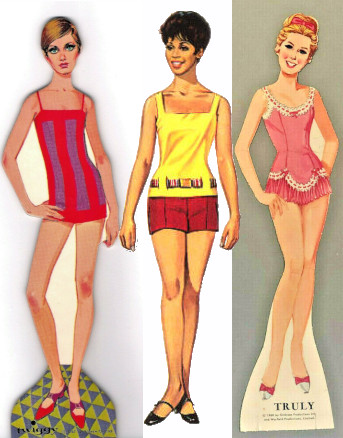
You can also find Marlo Thomas as “That Girl,” regarded by many as an inspiration for Barbie’s late-Sixties look, in a 1967 set, along with countless other fashion icons of the era. I won’t belabor the point since it’s veering off topic, but one of Twiggy’s sets in particular is a mod dream. The Chitty Chitty Bang Bang Set, as you may imagine, is not especially modern.
Play us out, 1967 Barbie has a New Look!
Where to next?
- Read the post on earlier Barbie Whitman paper dolls or Barbie Whitman coloring books
- dig into mod houses, starting with the 1966 entry in our Many Abodes of Barbie series
- survey some mod-era carrying cases, including case rooms
- or go up to the table of contents.
 Silken Flame
Leave a reply to Hello world! – Silken Flame Cancel reply