
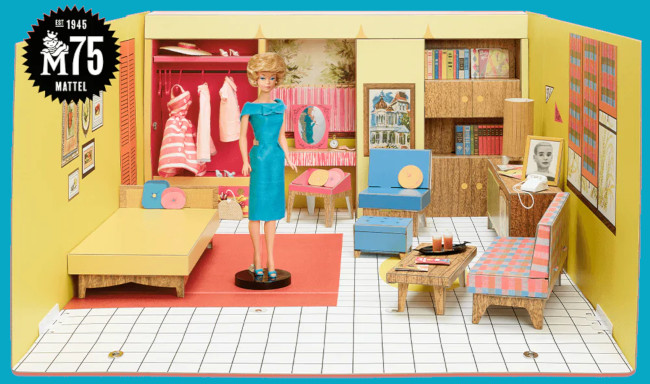
It’s 1962 and the Teen-Age Fashion Model is moving into her Dream House. One might be surprised to learn that the home of Barbie’s dreams consists of just one room, equipped with a twin bed, an entertainment system and a variety of seating. It’s breathtakingly modest–but then, for a single young woman of the time period, it’s quite luxurious in another sense.
Respectable young women of the early ’60s did not simply move into their own homes to live alone. When young Betsey Johnson completed a Mademoiselle internship in the summer of 1964 and accepted a full-time role at the magazine, her parents insisted that she continue living in a “hotel for women” like the Barbizon, where Mademoiselle had housed her cohort. In her memoir, Johnson remembers the hotel (which was really short-term housing) this way:
The Barbizon was like a fortress. There were signs all over the place: No Men Allowed! It was all very uptown and white gloves, a very ladylike, straight-arrow type of place.
-Betsey Johnson, Betsey: A Memoir
Johnson doesn’t devote too much space to the Barbizon or her subsequent lodging (which was similarly strait-laced; she struggled with the curfew and was eventually evicted for smoking), but Sylvia Plath went through the Mademoiselle internship a decade earlier and described life at the Barbizon in The Bell Jar. In Plath’s time the rooms were singles–Johnson had a roommate–and the bathroom was down the hall; meals were held in a communal space.
(Another Mademoiselle internship alumna from the Fifties who’s written about her experiences is iconic Barbie designer Carol Spencer.)
A couple of years after Johnson was hired at Mademoiselle, in 1966, protagonist Ann Marie’s solo move to the city to pursue an acting career drives much of the tension on the sitcom “That Girl.” Marie’s disapproving parents make frequent visits and phone calls to assure themselves she hasn’t fallen into prostitution (Plath remembered the Barbizon’s clientele as “girls my age with wealthy parents who wanted to be sure their daughters would be living where men couldn’t get at them and deceive them” while they attended secretarial school or worked in office jobs, waiting for marriage proposals). Played by Marlo Thomas, Marie has a fully-equipped, multi-room apartment all to herself, but clearly the idea seemed quite daring to the show’s creators. Incidentally, the Barbizon was used for exterior shots of Marie’s building, although she did not reside in a hotel for women: her neighbors included men and families.
Back in 1962, Barbie enjoyed an unusual level of freedom.
So, was Barbie’s very first Dream House located in a hotel for women? On reflection, the answer is probably not–those accommodations were hardly “houses,” and the exterior of Barbie’s house suggests a suburban home with a grassy lawn. Barbie’s original Dream House would be better described as a cottage.

During the first US Census taken after the opening of the Barbizon, in 1930, one of the hotel’s residents was a fashion model (along with a singer, a statistician and others; per “A Room of her Own” by Qianye Yu). It’s notable that Barbie was able to keep her career going from this suburban sanctuary… but maybe that was the dream.
Next time: Barbie gets a roommate (or two).
 Silken Flame
Leave a reply to Hello world! – Silken Flame Cancel reply