
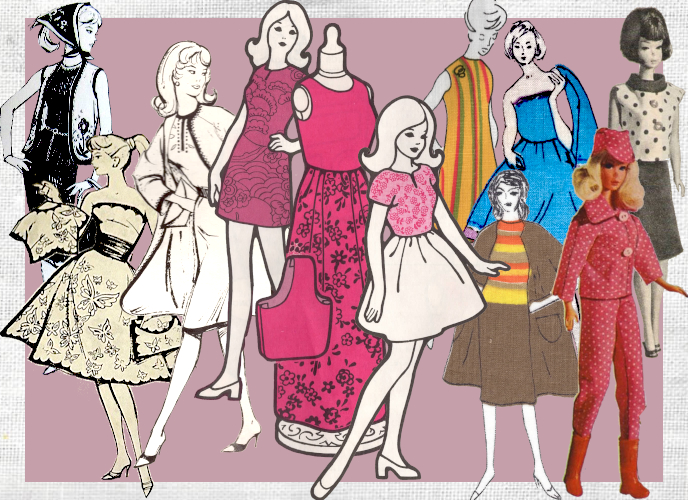
Today we tackle the great mysteries of vintage Barbie collecting, to wit:
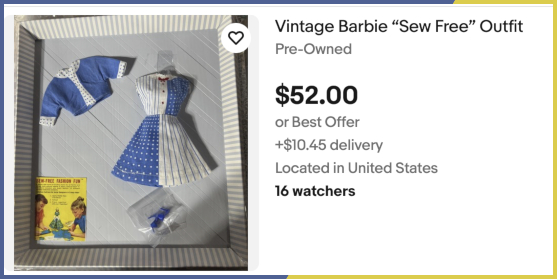
Is the below a Vintage Barbie “Sew Free” Outfit?
What about these, are they Vintage Mattel Sew Free Sew Magic Barbie Doll Clothes 1960s Very Rare?
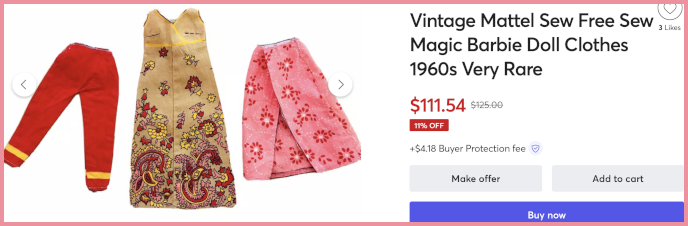
No, and also no. So what are they? How can one tell? And what do all these terms mean? If you’re not sure but curious, read on!
Sew-Free: Sew-Free Fashion Fun Kits were a kids’ craft sold by Mattel around 1965-1966. Garment pieces were printed on a variety of fabrics, to be cut out and assembled by children using included adhesive strips. It’s Sew-Free because no sewing is required. While printing was an important aspect of the Sew-Free style, both to define the garment shapes and for decorative elements (and possibly to prevent fraying, as well), the kits also contained many other details including zippers, buttons, trims, and stickers to enhance the fashions; shoes, belts, and purses–sometimes matching fabric purses to assemble–completed the looks.
It’s pretty easy to know when you’re looking at a Sew-Free ensemble, even if some of those extra details have been lost over time: only fifteen outfits or sets exist, so if you have one of these, you have a Sew-Free Fashion.
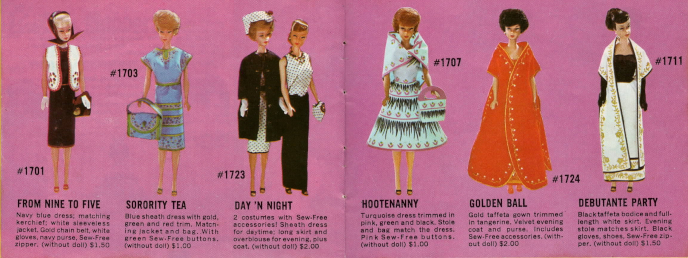
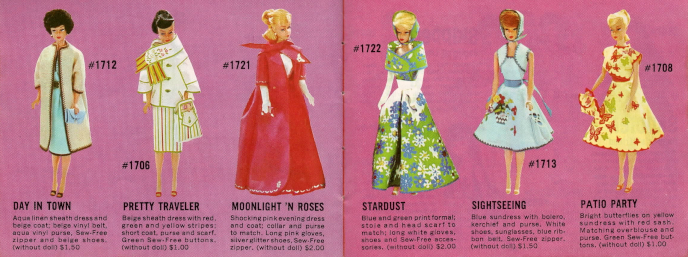
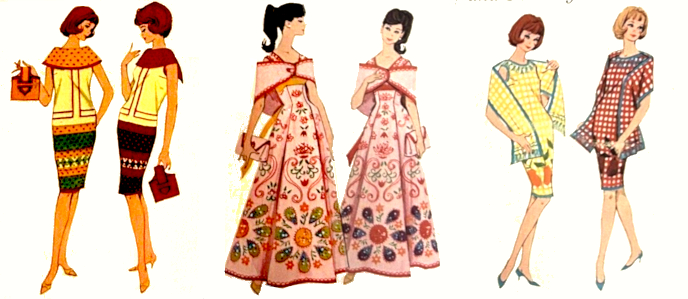
The last row are from the Color Magic Fashion Designer set. “Sew Free Color Magic” sounds almost like the word salad “Sew Free Sew Magic” listing title that kicked off this post, but it’s legit.
Around this time, a few play sets–Skipper’s Go-Together Bedroom and Dream Room; Barbie’s Dream Kitchen–included “Sew-Free” curtains, linens and the like. The Dream Kitchen’s apron, below via Red Stick Retro, counts as one last Sew-Free wearable piece.
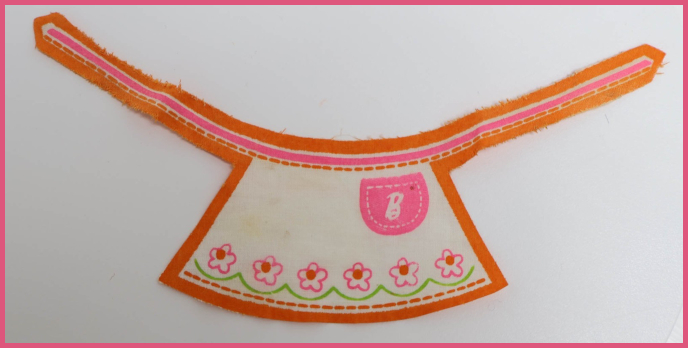
If your fashion is none of the above, it’s not Sew-Free. Simple as that!
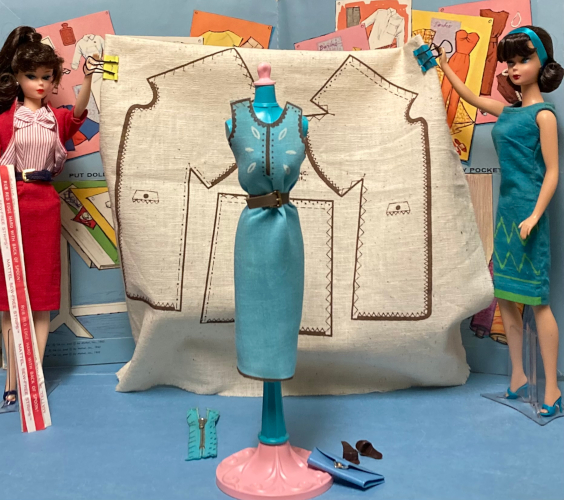
Sew Magic: Mattel revisited the Sew-Free concept in 1973 with modifications. This time around, there was no bespoke textile printing; just ordinary fabric swatches and paper pattern pieces. And there were no adhesive strips: instead, the Sew Magic “sewing” machine, a sort of standing glue gun, deposited adhesive onto fabric pieces guided by the user, who then pressed the fabric pieces together along the glue lines.
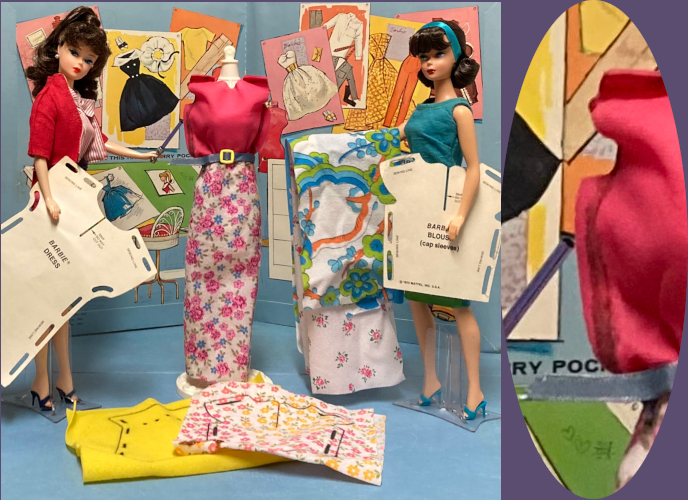
Without the uniquely printed designs of Sew-Free, Sew Magic fashions are less obvious to identify. What’s more, the Sew Magic instructions specifically say to use your own fabric as well as the provided swatches, so the finished product can look any kind of way. The signature feature of the Sew Magic garment, therefore, is that it’s glued together–for an example, see the glued seams on the inside-out shirt that the fashion-designing Barbies have on display above.
While my search has been far from exhaustive, I have yet to see, on any selling platform, clothing pieces listed as Sew Magic that actually were Sew Magic–with the exception of those constructed pieces that come bundled in with the larger Sew Magic machines and kits. If you see clothing lots or individual pieces labeled as Sew Magic being sold without a craft kit, in my experience, they are never glued together, are always sewn with thread, and they are nearly always Cut & Sew. Which brings us to…
Cut & Sew: Neither licensed nor official Mattel products, Cut and Sew panels were sold at fabric stores, cut from bolts, with Barbie’s usually labeled as being for 11″-12″ fashion dolls. (Skipper-sized and Ken-sized dolls had their own Cut & Sew panels.) They are undated and absent from department store and doll catalogs, but I reckon them to about 1966: their aesthetics resemble the Sew-Free line, and the 11″-12″ range may imply the coexistence of Francie and Tammy.
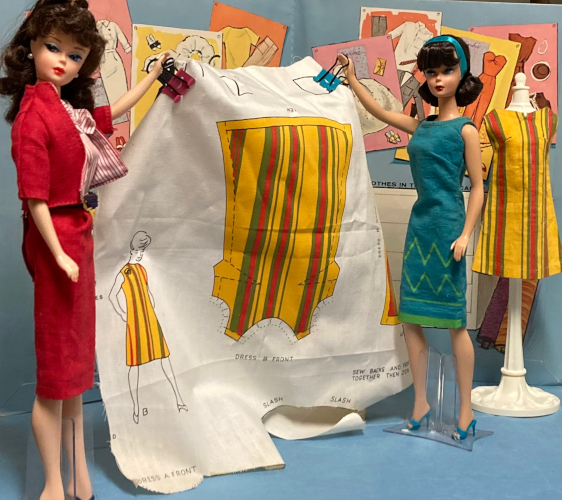
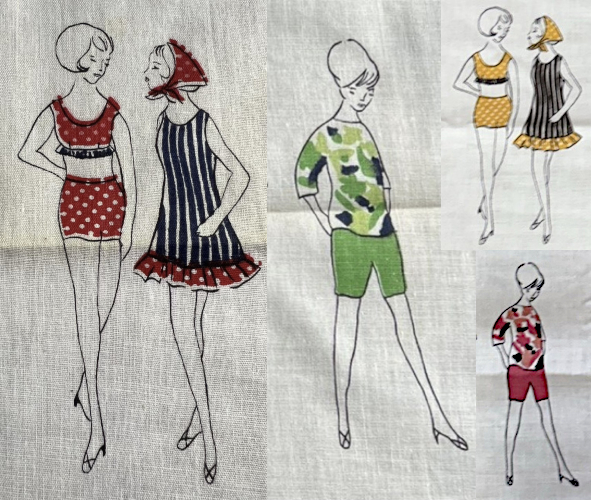
Cut and sew panels were made of craft cotton with outfit pieces, instructions, and fun little fashion illustrations printed on. They didn’t come with any embellishments or accessories, so elements like closures and thread color (matching, contrasting or somewhere in between) were at the crafter’s discretion. Whereas Sew-Free Fashions incorporated velvety and satiny materials alongside their cottons, Cut and Sew was limited to a single texture. And because garments of multiple hues were printed onto a single panel, the fabric itself had to be white; the outfits’ colors were entirely screened on–in contrast to Sew-Free and Sew Magic made from dyed textiles.
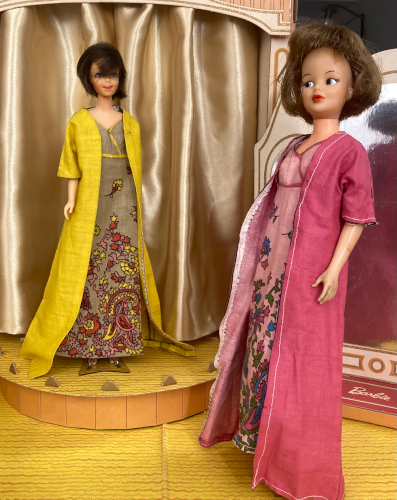
Many of the Cut & Sew designs are quite cute. However, the finished products inhabit a gray area between doll fashion and simple crafting project. They long for buttons and trim, for linings, and to not be made of basic cotton. The evening attire worn by Tammy and Casey above, in particular, could read as casual Seventies maxi dresses and house coats if you didn’t know better. Some others resemble a toile made from bedsheets.
Panels were offered for many categories of attire: Daywear, Eveningwear, Sportswear, Streetwear, Beachwear, Nightwear, and at least one panel that was a catch-all “Wardrobe.” All designs came in multiple colorways. Let’s meander through outfits and color combos drawn from my collection, as well as some foraged from a recent search of sales.
We saw quite a bit of Eveningwear already, modeled by Tammy, Casey, and Kelley above. One Eveningwear panel included two looks in three possible colorways, the first look being the long dress with coat and the second a sort of baffling hostess pyjama or patio ensemble.
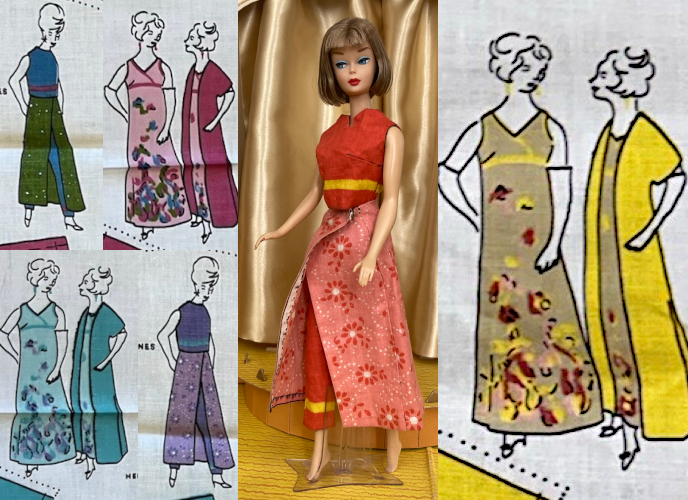
A second eveningwear panel type consisted of three looks in two colorways, including the “toile” we already saw and an interesting cocktail dress with cape. The third look is just mystifying, apparently a sundress and bonnet for evening.
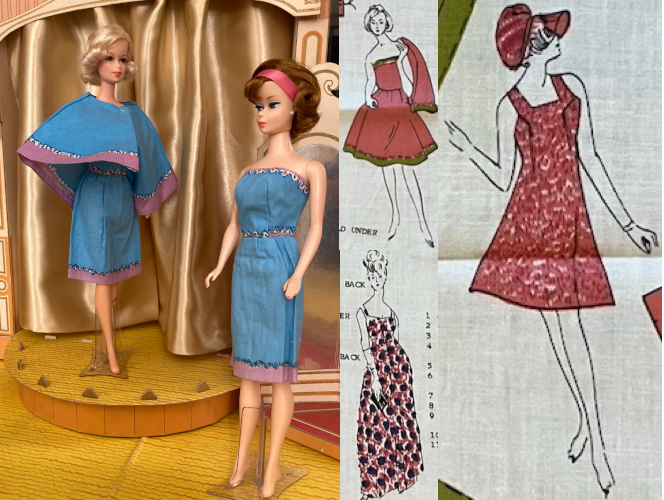
The Daywear collections contain some of the best Cut ‘n’ Sew designs. There was one set of three looks in three colorways, and a second with two looks in (as far as I know) two colorways.
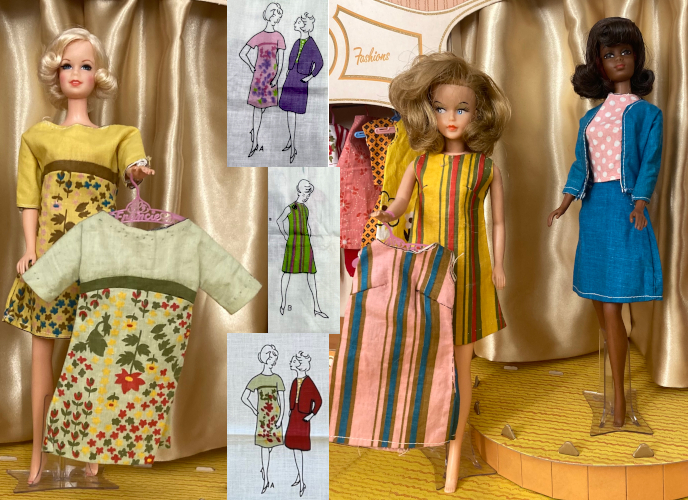
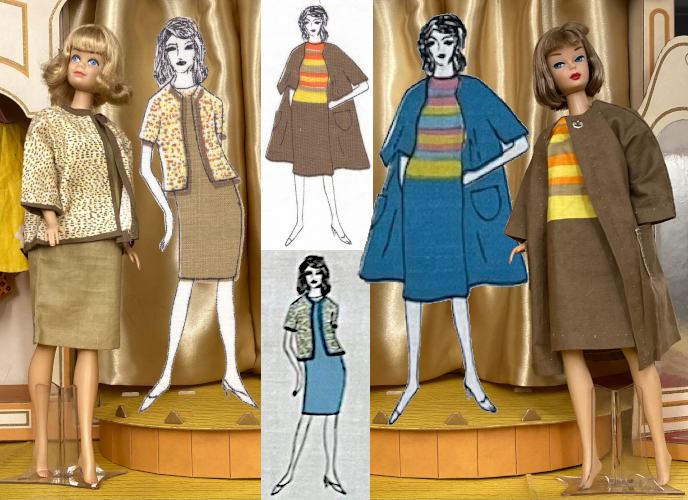
Sportswear was similarly offered in three colorways for one panel, and (evidently) two colorways for the second.
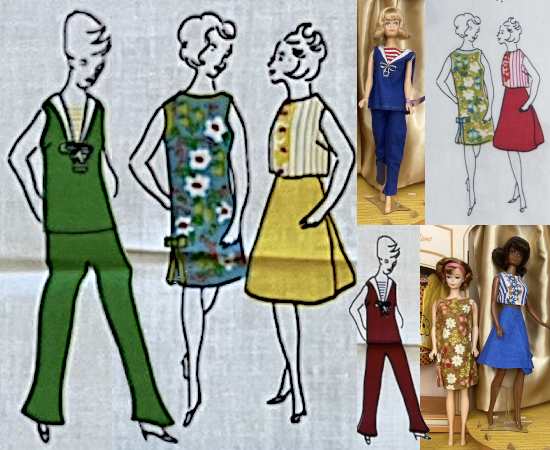
Skirts were a bigger part of sports back then, as were capes, it appears:
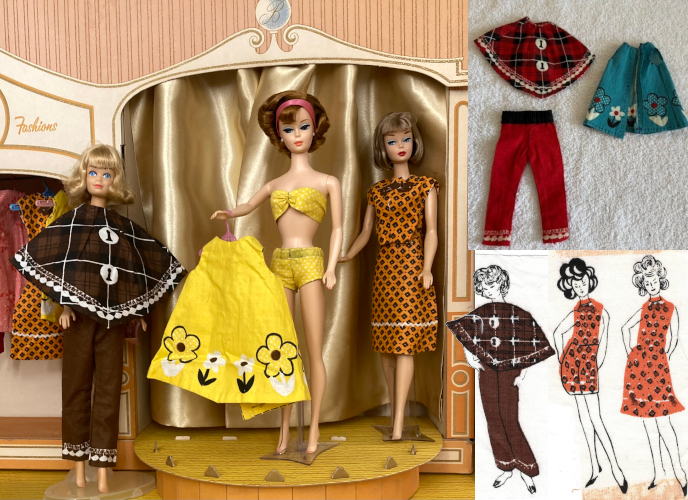
Up to this point, one panel version in each clothing category has been available in three colorings. If you’ve paid attention to the little illustrations, you’ve probably noticed the same three figures appear on all of these panels: the character with bouffant hair facing the viewer’s right, and the two characters with chin-length hairstyles standing grouped together, each with one arm bent to the outside. To my knowledge, there are just two colorways of the below Nightwear panel design, but based on the trend so far it’s likely there’s a third color combo I just haven’t encountered.
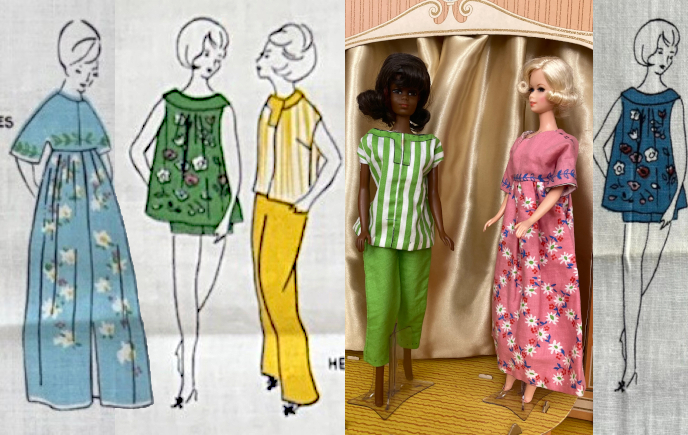
Here’s the Streetwear set sketched in one colorway and constructed in a second. Again, there’s likely to be a third combination out there somewhere, based on these sketched figures being the same ones from all the panels that have had three variations.
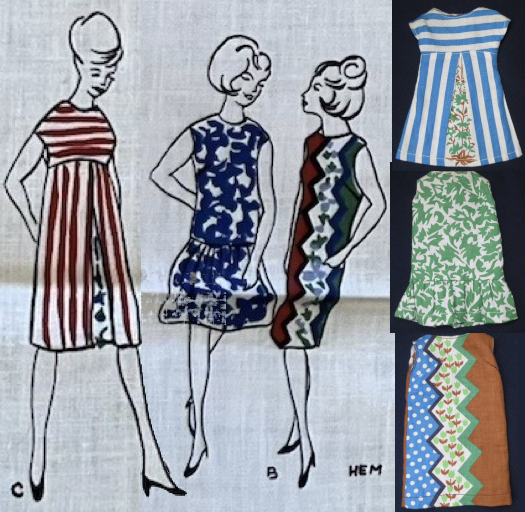
I’m also aware of one panel design for Beachwear in two colorways, but yet again, a third colorway may exist.
Finally, the Wardrobe panel for 11 1/2″ dolls came in at least two color schemes and consisted of an evening gown, a day dress, a bikini and coverup.
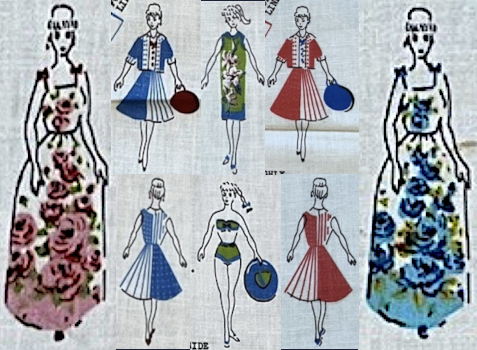
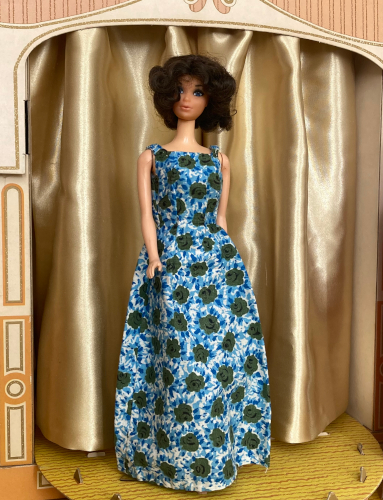
We saw the blue version of the wardrobe’s colorblocked daywear suit mislabeled as “Sew Free” at the very top of the post. Here’s the evening gown on Mercari, attributed to Premier Togs:
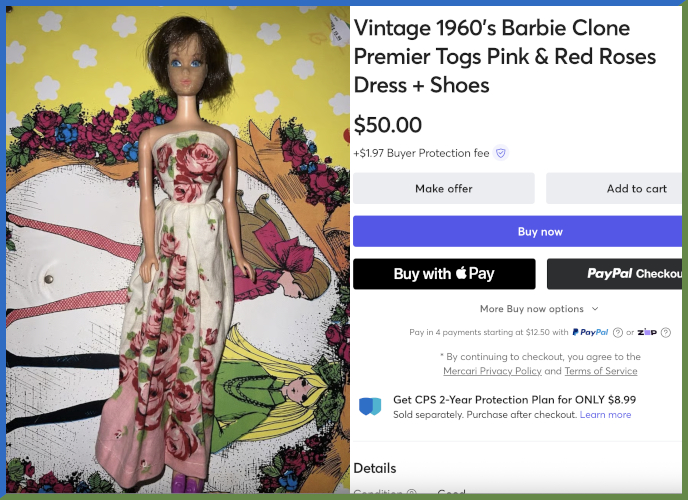
Both this pink gown version and the green beach coverup are common (far rarer is the two-piece swimsuit that the coverup covered), and both can frequently be found mislabeled as one of the Mattel craft kits.
That’s the Cut and Sew line as I know it. As noted, there could be more designs and colorations than I’ve observed; there just can’t be less. For right now, let’s take a gander at one last category of vintage doll fashion/craft.
Sew Simple sets by Coats and Clark were advertised in department store catalogs for at least 10 years, starting in 1964. Whereas Mattel’s crafts freed the user from the burden of sewing but did require some pieces to be cut out, the Sew Simple innovation was pre-cut pieces that required sewing. Unlike Cut & Sew, some finishing touches were included with the sets.
From 1964 through 1967, a single Barbie-sized (and allegedly Francie-sized) set of six fashions was offered:
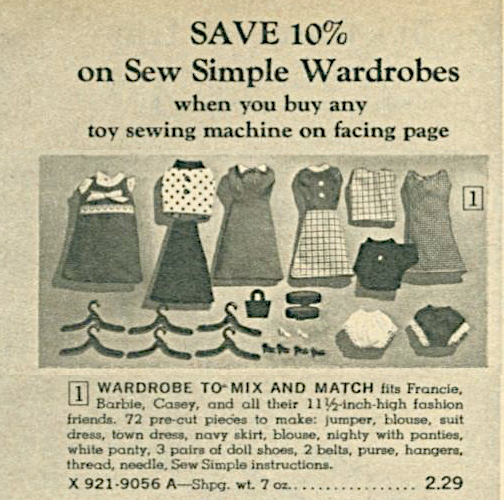
The set would continue to be sold for a few years with some fabric variations. in 1968 it was joined by the Bride’s Trousseau and London Look sets, and in 1969 the sporty Sun Valley set was introduced.
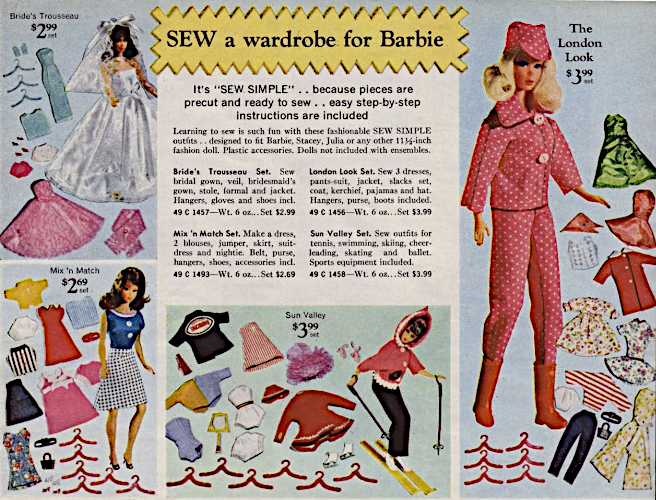
In the 1971 Wishbook, Sears highlighted their exclusive Barbie friend, Walking Jamie. While Barbie still modeled the trousseau (now named Wedding Bells), Jamie modeled new Merrily Mod and Snappy Separates offerings,
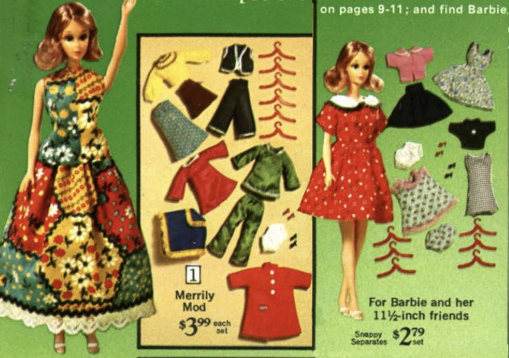
and she also modeled a Skipper-sized set which appeared to include Jamie’s own clothing:
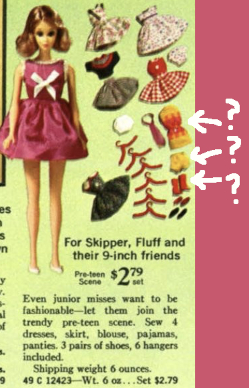
Counting the dress and shoes modeled by Jamie in the image, we can get to the listed number of garments without those that look like Jamie’s own, which seem to have been included in the spread by mistake!
But I digress. The following year, the sets Simply Super and Jet Set Trousseau (with rick-rack aplenty for Barbie’s chic high-flying lifestyle) were new.
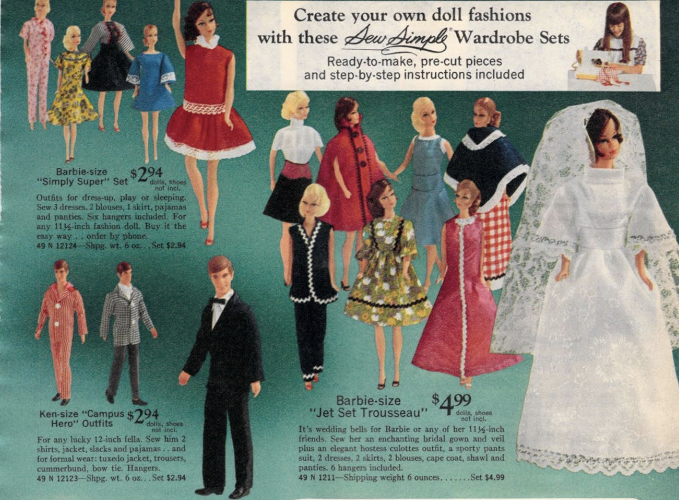
The Trousseau and Ken’s set hung on for at least one more year.
That exhausts my Sew Simple knowledge. A couple unassembled sets are floating around the selling platforms. However, I suspect other, assembled pieces are hiding in plain sight in listings labeled Premier Togs, Shillman, Sew Magic, or even Cut ‘n’ Sew. Let me know if you’ve spotted any of these!
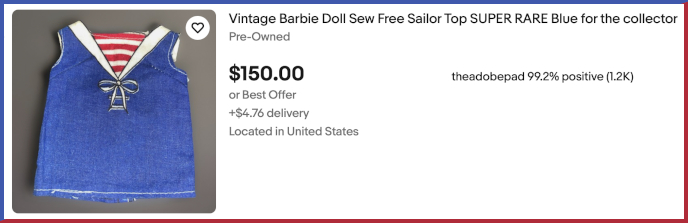
Meanwhile, who can tell me whether this is a Vintage Barbie Doll Sew Free Sailor Top SUPER RARE Blue for the collector?
 Silken Flame
Leave a comment