
Barbie’s Swinging Fashions, 1980-2020
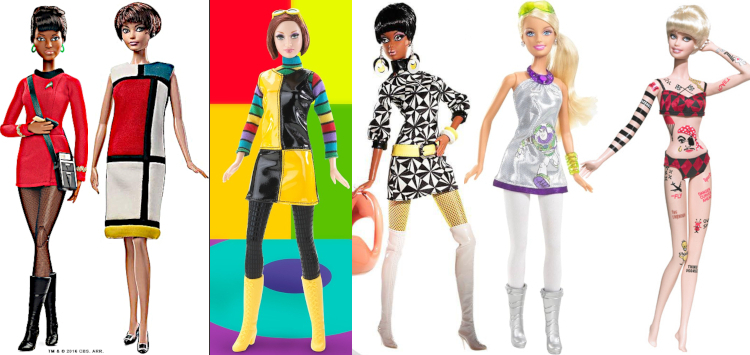
The mod era–the Swinging Sixties, the Youthquake, fashion’s Space Age–was a time of major style upheaval. Short skirts with high boots, vibrant patterns and colors, and rejection of tradition reigned. Street fashion led the new trends while couturiers rushed to keep up. For Barbie, the period spanned approximately 1967 to 1973 (or earlier), following her couture-focused early years that some refer to as the vintage period (for this piece we take “vintage” to mean anything made for Barbie through 1973).
Since those heady days, various aspects of the mod look have come in and out of fashion, and Barbie’s wardrobe has reflected that. In this post we highlight those times since 1980 (and ending in 2020, for symmetry about the millennium) when Barbie’s designers have deliberately referenced Sixties mod fashion. We’ll place the newer looks in the context of their classic counterparts and explore similarities and differences in the design approaches.
1985 Galaxy a Go Go
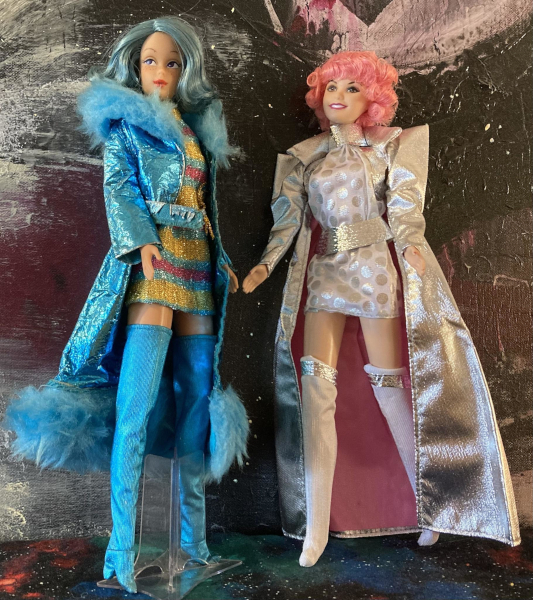
Barbie’s mod years were still receding in the rearview mirror when the futuristic Astro Fashions were released alongside the controversial Astronaut Barbie. Galaxy a Go Go, in particular, references the Swinging Sixties in both name and design. The short dress paired with long coat and high boots in metallic fabrics, shown at right above, may be an explicit nod to 1970’s Maxi ‘n Mini, left. Just as easily, the two could drink independently from the same space age fountain. Without prior knowledge, is it easy to pick out which of the above is a mod design, and which is Eighties? We think not. The pointed shoulders on Galaxy a Go Go, which occur on both dress and jacket, are one hint, though that oversized fur collar on Maxi ‘n Mini is nothing to sniff at in terms of shoulder fullness. (Note, Carol Spencer credits designer Thierry Mugler as the inspiration for the Astro Fashions line, including its sharp shoulders.)
It would take a few more years for mod style to become appealingly nostalgic, so this early example, using mod-era futuristic notions for an updated spacey look, is our lone Eighties mod entry. Popular retro looks of this period tended toward the early Sixties (Barbie and the Sensations) and prior.
1992 Hollywood Premiere
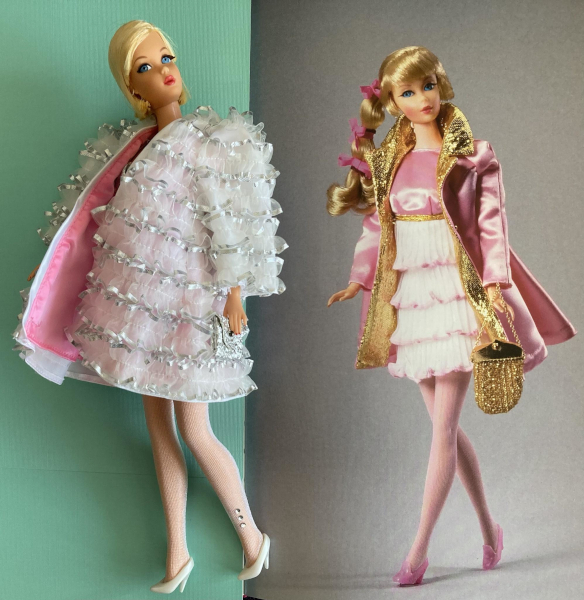
1992 was still a little early to revisit mod ideals, but we think this Carol Spencer design contains not-so-subtle references to 1969’s Pink Premiere. Hollywood Premiere was part of the collector-targeting Classique series, which was meant to highlight Mattel’s designers for the first time. In her book Dressing Barbie, Carol Spencer states that her concept for the Benefit Ball Classique doll was inspired by the 1966 Benefit Performance fashion, one of her personal favorites–though the designs themselves are dissimilar. She further indicates that the other designs were also informed by past episodes in Barbie’s life: the Classique Uptown Chic fashion referenced Barbie’s earlier experiences shopping on Fifth Avenue–think On the Avenue (1965), and other fashions from that glamour year–and it stands to reason that Hollywood Premiere refers to 1969’s Pink Premiere, a Spencer design highlighted in her book, shown above right. While Hollywood Premiere’s bodycon silver minidress is more Jean Paul Gaultier, the ruffled, trapeze-shaped, mini-length coat alludes both to Pink Premiere and to the ’60s more generally.
The similarity in color schemes between Hollywood Premiere and Galaxy a Go Go–white, silver, and pink, with the pink jacket linings apparently identical–is an interesting coincidence. Like Galaxy a Go Go, Hollywood Premiere also sported formidable shoulders.
1996 Star Trek 30th Anniversary
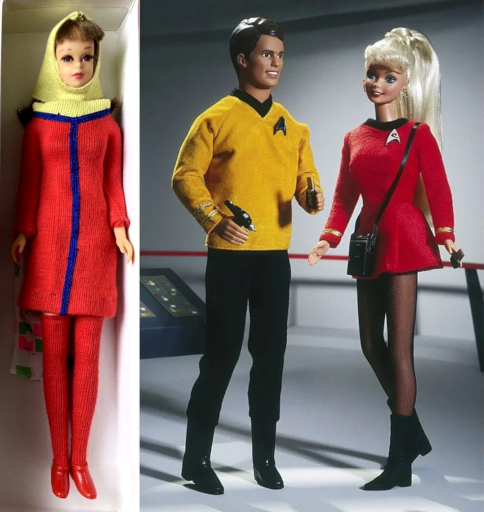
Not a fresh perspective on swinging style, but a fairly accurate interpretation of a 1966 TV costume for 1996 Barbie. Those of us familiar with the original television series may experience burning of the eyes when we see blonde Barbie modeling the Star Trek female crew member’s uniform. Ken resembles Captain Kirk, more or less. Why doesn’t Barbie look like Uhura? Perhaps because this model or a similar one was used time and time again for mid-’90s gift sets and special editions. For what it’s worth, with her tricorder and plaited hair she’s deliberately styled like Yeoman Janice Rand, originally a core, blonde character and Kirk’s love interest, whose role was reduced due to budget constraints and to free up the Captain for romantic (mis)adventures on alien planets. Still, these explanations fall short of satisfying.
Whatever the case may be, we’re comparing the Star Trek uniform to Francie’s Swingin’ Skimmy (via raisingfour on eBay), another ’66 design that’s clearly influenced by the Cosmocorps and Moon Girl uniforms proposed by Sixties visionaries Cardin and Courreges–notably in the hood/helmet department.
1996, the 30th anniversary for both Star Trek and Francie, is also the year Mattel started releasing mod Francie reproductions, though Swingin’ Skimmy hasn’t had its moment yet.
1997 Teen Skipper Fashion Avenue (and Sticker Fun Barbie)
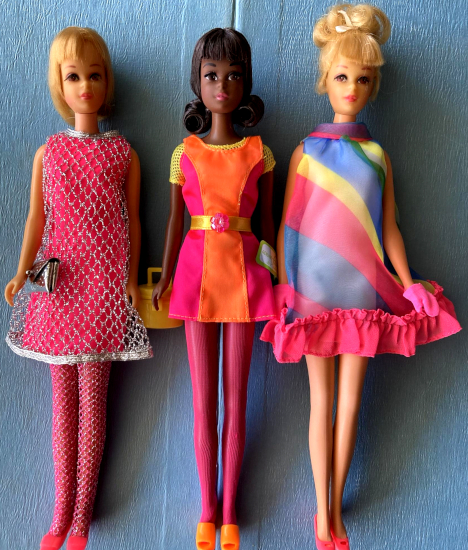
Mod made the mainstream again in 1997 with a couple flower-forward Mattel creations: a Teen Skipper design for Fashion Avenue, modeled by repro Francie, above center, and a highly similar design for Barbie under the name Sticker Fun (not shown). Teen Skipper’s ensemble above is surrounded by vintage Francies in 1968’s Silver Cage and Floating In (repro shown). With platform shoes, day-glow colors and a daisy-shaped belt accent, the only really ’90s thing about the Teen Skipper outfit, to me, is the mesh shirt; but even that has precedent in Silver Cage.
Fashion Avenue also offered a pink-and-orange baby doll dress for Barbie with very Sixties daisies along the waistline. Its silhouette and accessories are overall regrettable, but for the completionist the ensemble still merits a gander (not shown here).
1997 Sixties Fun and 1998 Far Out
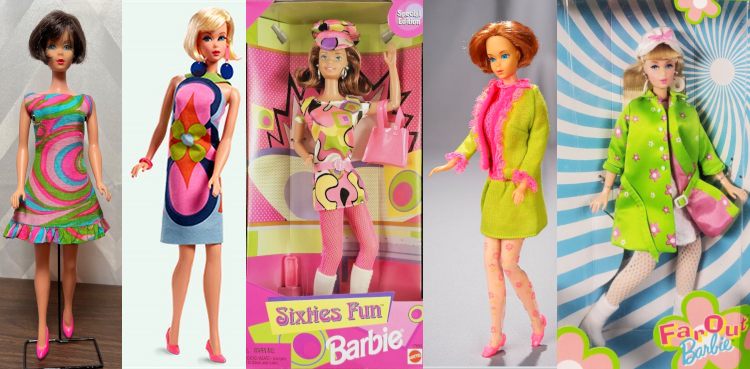
The mod parade continues! Above, two more ’90s mod interpretations (via Super Thrift and claudia_attic_17 on eBay) are lined up with vintage designs Swirly Cue (1968, via Mimi Collects It on eBay), Sunflower (1967; 2016 repro product photo shown), and Fancy Dancy (1968, via Theriault’s).
Somehow, Sixties Fun Barbie’s patterned fabric looks more postmodern: it exists in a world where Jean-Michel Basquiat and Keith Haring are known. Otherwise, the white boots the two ’90s dolls wear come straight from Courreges–strange that Barbie seldom wore white ones in her original mod phase–and the big chunky earrings are on point. Far Out Barbie’s big plastic discs a la Paco Rabanne are reminiscent of those included with the Sunflower ensemble, seen above, and Swirly Cue also came with chunky plastic ear hardware.
1998 Pretty in Plaid and 2000 Hip 2 Be Square
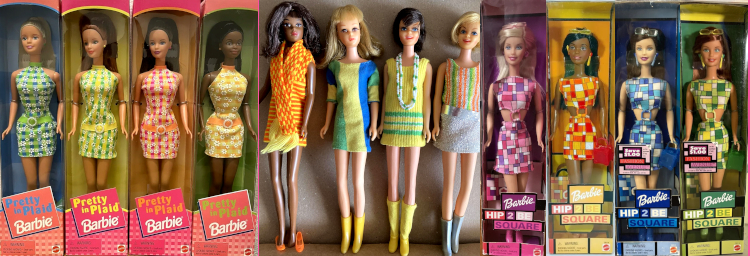
Here, at the turn of the millennium, mod has infested the playline. As shown above, both of these outfits came in four color palettes on four dolls, and all featured the micro-minidress. The hemline is true to the Sixties–we compare to the four minidresses Mattel designed for their Twiggy doll in 1968, modeled by Francie and Casey above–as are the bright, bold patterns–but the skintight, bodycon aspect is more Nineties. The double waistline of curve-clinging silhouette and drop-waisted belt on Pretty in Plaid isn’t working for us, but the cutouts on Hip 2 Be Square’s dress are authentic to the original mod time period.
1999 Fun to Dress Fashions
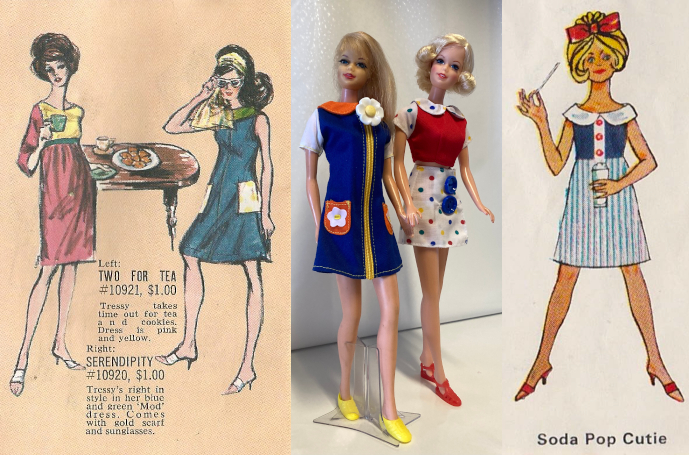
A quartet of fashion packs taught youngsters how to zip, button, buckle, and tie in colorful, playful mod style. Two, for zipping and buttoning, are displayed on a pair of Staceys above. The outfits that aren’t shown, both flower-powered minidresses, were groovy in their own right, particularly the buckling ensemble with its wide, white belt at hip height. For a change of pace we offroad a little, comparing the ’99 fashions to illustrated looks from circa-1966 Tressy fashion booklets with similar color blocking and even flowered patch pockets.
2000 Groovy 60’s Barbie
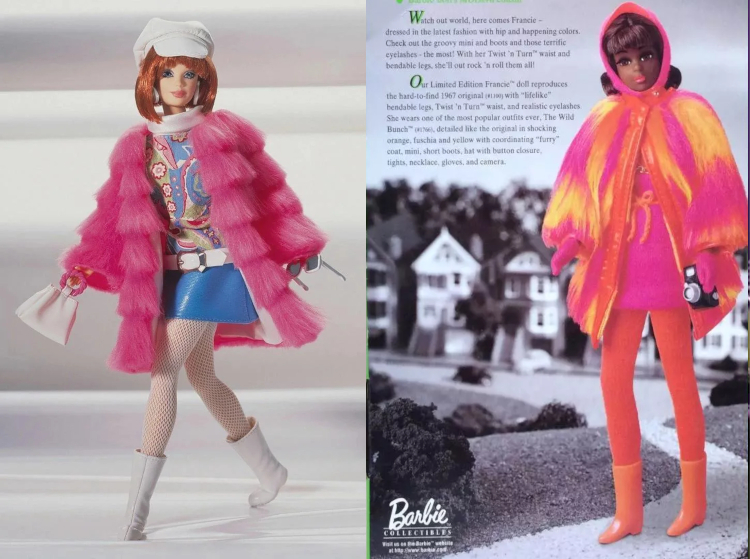
Part of a Great Fashions of the 20th Century line, Groovy 60’s Barbie, at left, fits right in with the earlier Far Out and Sixties Fun dolls–right down to her chunky earrings and white boots. Her novelty-colored faux fur reminded us of Francie’s the Wild Bunch (1970; 1997 repro shown above), and really, the whole look is in harmony. A faithful, detailed Sixties evocation.
2001 Sunshine Day Barbie
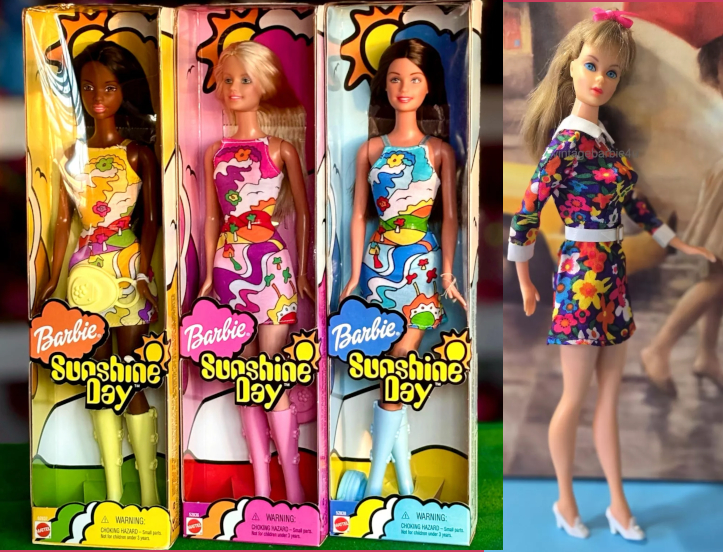
Hat tip to Scarlett-Crypt on Reddit! Here’s another turn-of-the-century swinging playline series with different color schemes for each doll. “It’s a Sunshine Day” was, of course, a hit for the Brady Bunch in 1972. In ’73 Mattel released the unnamed Barbie fashion #3347, shown at right (via eBay seller vintagebarbie4u), colloquially known as the Marsha Brady dress. The dress came with white knee socks, in the patterned version above and in solid red.
2002 Scooby Doo Daphne
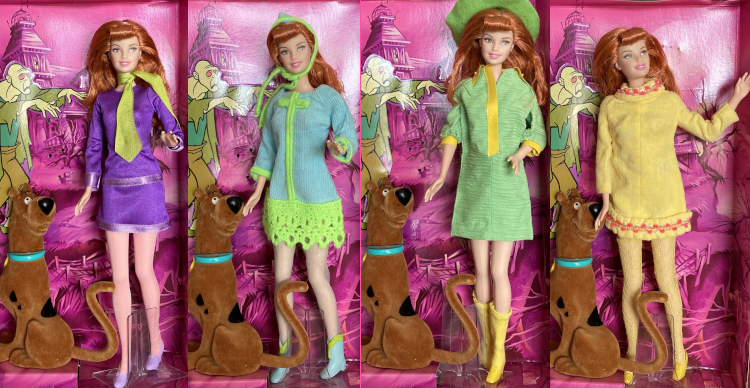
Two Daphnes were released around this time, one based on Sarah Michelle Gellar’s character in the then-new live action film, and one based on the cartoon from 1970. Either could suit this list, although we opted for the more-authentic cartoon version. Daphne in her original outfit, above left, has total mod Barbie style as evidenced by the doll redressed in, from left to right, Now Wow, Snap Dash, and Mellow Yellow (all 1968-69). Except for one small detail: maybe because the hue was granny-coded circa 1960, Barbie wore almost no violet from her creation at least through the end of the original mod era in 1972. Thus Daphne’s outfit makes a great supplement to our vintage collections.
2002 Rocky Mountain Mod Convention Doll
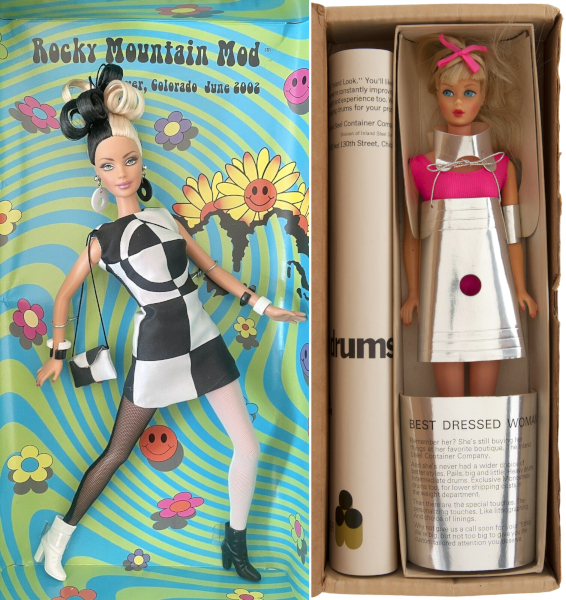
This one’s kind of a cheat, because Mattel didn’t release the Rocky Mountain Mod doll; it was produced for the convention without Mattel/Barbie branding. However, its mod-ness is undeniable: the boots, chunky jewelry, and op-art design are all on point. It could be a John Bates design for Emma Peel (Diana Rigg) on the original BBC TV show, The Avengers.
Due to its unofficial nature, we compare Rocky Mountain Mod to Barbie Loves the Improvers: a Sixties concoction by Inland Steel, circulated among their salesmen and/or customers, featuring a mod Standard Barbie wearing an outlandish, space-age metal tube. The “Improvers” garment is based on an avant garde design by Paco Rabanne and includes a belly-button-revealing circular cutout at the navel (the doll pictured above wears her metal tube too low), while the “Rocky Mountain” dress features a circle design at chest level. Captioning an assortment of solar-plexus-adorning or navel-indicating circle patterns on vintage dresses in Vintage Fashion: A Complete Sourcebook, Nicky Albrechtsen wrote that “the circle is the identifying shape of the sixties. Metallic, plastic, PVC and easy-care synthetic fabrics were the basis of Space Age modernist designs of mid-sixties boutique culture.” These dolls concur.
2003 A Nod for Mod and 2004 Mod Redux
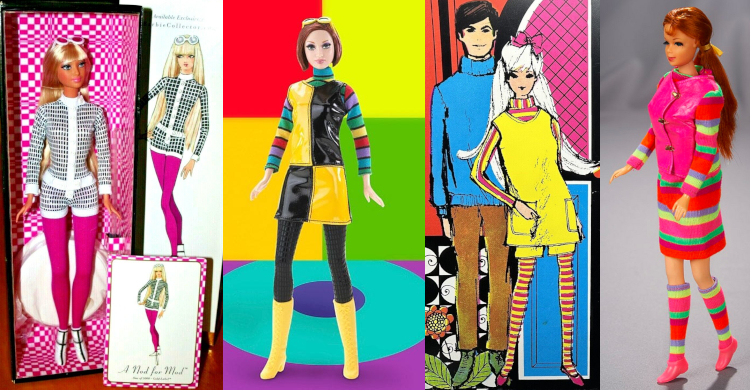
The two collector’s editions shown above left, released as a series, must rank among Mattel’s best original mod designs in the millennial timeframe. They are of a piece with the vintage fashions, represented above by the 1968 ensembles Tunic ‘n’ Tights (as illustrated on the Barbie Family House) and Stripes Are Happening (via Theriaults). Red White and Warm (1969) and Color Kick (1971), not shown, are also compatible, especially with the Gernreich-flavored Mod Redux. The major difference is that Barbie’s classic mod wardrobe tended to avoid black.
2008 Goldie Hawn Blonde Ambition
The only design on this list that’s an absolute miss for us, Goldie Hawn’s doll was based on an outfit she wore once on Laugh-In, the variety show that debuted in 1968 and launched her to stardom. A promotional photograph of this pirate-inspired, body-painted bikini look from the show is widely available, but Laugh-In had so many great, colorful costumes, it seems criminal to make a single Laugh-In fashion doll and let this be the “fashion.” Add some sequins and spangles to Swirly Cue, Sunflower, Flower Wower, or Two Way Tiger, vintage fashions shown elsewhere in this post, and you get much closer to the psychedelic look of Laugh-In. An opportunity squandered. Mattel’s 2008 choices appear in the header image for this post.
2009 Barbie Loves Buzz
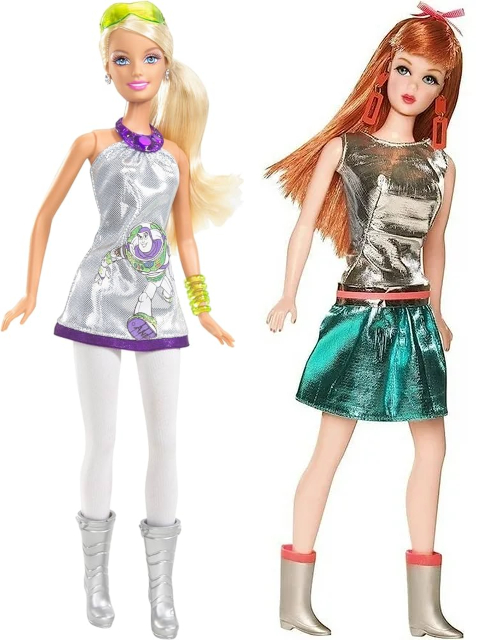
One of a series of dolls wearing Toy-Story-inspired fashions, Barbie Loves Buzz has great futuristic go-go style with metallic fabric, silver boots, chunky plastic accessories, and the most micro of micro-minis (with white leggings to complement). We compare her to 1968’s Zokko!, Barbie’s spaciest classic mod look. A recent book claimed Zokko! must be a BBC tie-in, because BBC aired a children’s show with a similar name. If Zokko! refers to anything, it seems most likely that this outfit was inspired by Johnny Sokko and his Flying Robot, the Japanese children’s show that was syndicated in the US, and maybe in Britain, too. In the Sixties the BBC would have partnered with Pedigree’s Sindy, not Barbie–but that’s a tale for another time. Anyway, Barbie Loves Buzz is a great nod to the futuristic visions of an earlier era.
2009 Pop Life
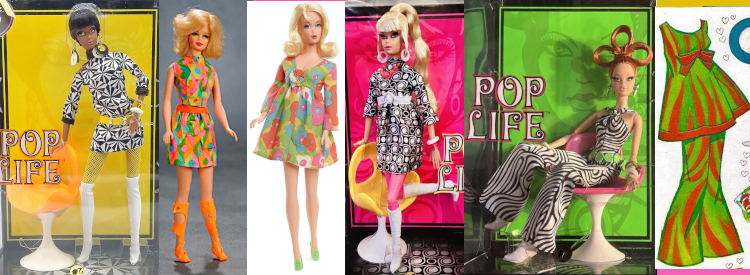
We have entered the nigh-priceless stage of our review: this series and the collector dolls coming up in the next ten years are some of the most hard-to-find, most expensive millennial-mod looks, despite being the most recent. The Pop Life dolls were meticulously period-authentic, with boots, chunky jewelry, op-art prints and modern tulip chairs. Some even used retro face molds. For all these reasons, along with limited production and circulation, they are highly sought. We compare them with the vintage fashions Wild ‘n Wonderful (1968, image from Theriault’s), Flower Wower (1970; 2018 repro shown), and Two Way Tiger (1971; paper doll version shown) to show how similar the silhouettes and patterns of the newer fashions really were to the late Sixties/early Seventies creations. Barbie’s earliest mod adventures, the Color Magic ensembles, would also suit. However, the vintage examples also highlight a difference we’ve noted at least once before: vintage mod Barbie did not wear black and white. Carol Spencer has spoken about adapting then-current trends to children’s tastes, and that’s probably part of the story. Without question, vibrant color palettes were also in fashion and Barbie’s designers focused their energy there. The recent dolls, made for adult collectors, face no such constraints.
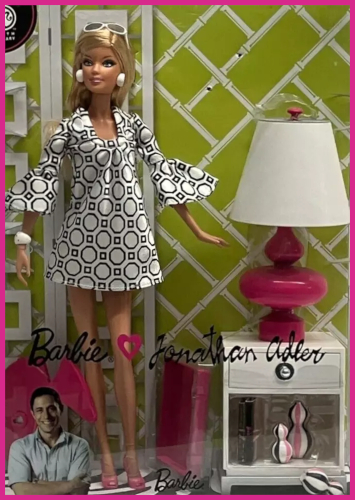
Update: We just learned about this Jonathan Adler Barbie, also from 2009. Style-wise, she’s a bit of a fourth Pop Life; and her furniture is a suitable accompaniment to the Pop Life chairs.
2016 Star Trek Lieutenant Uhura
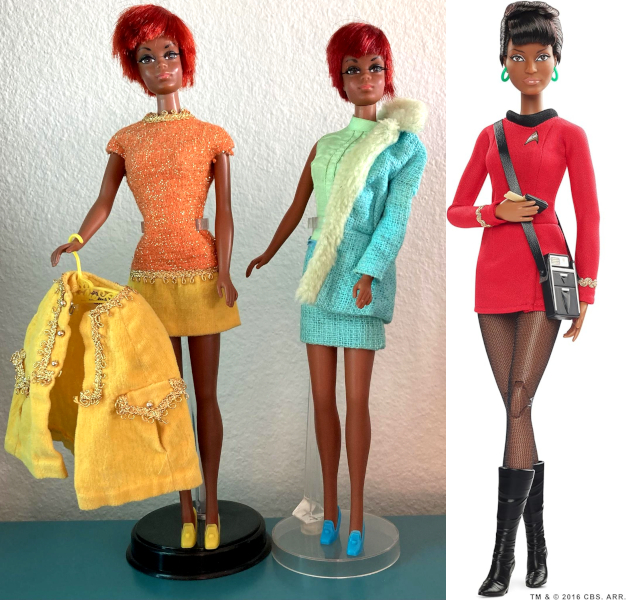
Twenty years on, Mattel corrected course and released the Star Trek doll they should have made in 1996. The fashion is little changed from the ’96 release, but is now worn by the most memorable female crew member from the original series. This time around we compare her to Mattel’s 1968 Julia doll, based on Diahann Carroll’s TV character, wearing two fashions marketed for that doll. Note that Diahann Carroll did not have red hair; the vintage dolls’ hair has oxidized (they look sharp redressed as Star Trek officers, by the way). Julia and Uhura were both pioneering characters: Julia as series lead and title character who was not a broad stereotype (unlike the earlier Beulah); Uhura as a high-ranking officer in a professional, technical role–firsts for Black women, and in Uhura’s case, possibly for any woman.
And, as depicted above, both characters were associated with miniskirts. The Star Trek pilot episodes show female crew in trousers, but the tunic-like minidresses arrived when the show went to series. Grace Lee Whitney (Yeoman Janice Rand, mentioned above) recalled appealing to the costume department to let her wear skirts, and producers concurred. In 1966 hemlines had been rising for a few years, so a costume designer envisioning the future had nowhere to go but up. The skirts of Star Trek are about as short as they get. Two years later, when Julia debuted, hems had indeed risen as far as they could; at the close of the decade they plunged, the mini supplanted by the midi. This caused turmoil over at Julia, where the miniskirt was regarded as her “signature look.” Should she stay on-trend or maintain her image?
It’s easy for commentators today to overlook the fact that, like trousers, miniskirts in the ’60s were associated with women’s liberation. Before the swinging revolution, women’s options were movement-constricting pencil skirts or weighty yards of fabric with oppressive undergarments, a la Dior; thus the mini represented freedom, both literal freedom of movement and figurative choice and autonomy. Nichelle Nichols (Lt. Uhura) later said, “I was wearing them on the street. What’s wrong with wearing them in the air? I wore ’em on airplanes. It was the era of the miniskirt. Everybody wore miniskirts. It amazes me that people still make some remark about ‘the revealing’. They revealed nothing. I had long black stockings on and boots up to my knees and the skirts and panties on and a skirt that gave you freedom to move in.”
2018 Yves Saint Laurent “Mondrian”
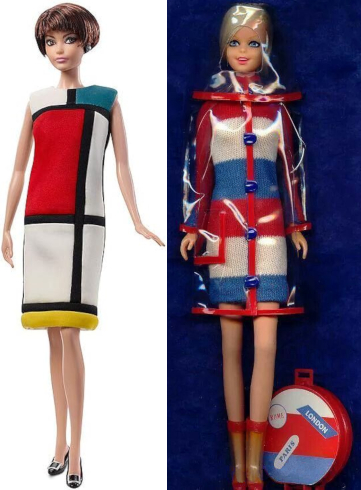
Yves Saint Laurent’s 1965 “Mondrian” series saluted the mod aesthetic with simple lines, bold colors and strong geometry. Mattel reproduced it faithfully, even going so far as to design a doll with the mod-essential “five point bob” haircut by Vidal Sassoon; everyone from Mary Quant to Nancy Kwan had a Vidal Sassoon cut. The doll’s features are further reminiscent of fashion model Peggy Moffitt, best known for her work with Rudi Gernreich, another proponent of sharp color palettes. See a few models sporting Mondrian dresses with Sassoon-style bobs in promotional images on display at the PatternVault blog.
At right above we find Mattel’s Twiggy rocking the color block in Clear Out (1967), the dress from which resembled, in different colors, Twiggy doll’s original ensemble (shown in a collage with ’90s playline fashions a few sections up). Coincidentally, Twiggy had one of the most famous Sixties hair cuts that wasn’t by Sassoon.
Miscellaneous Millennial Repros: peppered through this article have been mod reproductions created starting in 1996, including Zokko!, Sunflower, Flower Wower, and Wild Bunch. Older designs, they are still Millennium Mod in their production, as are further repros summarized in the image below.
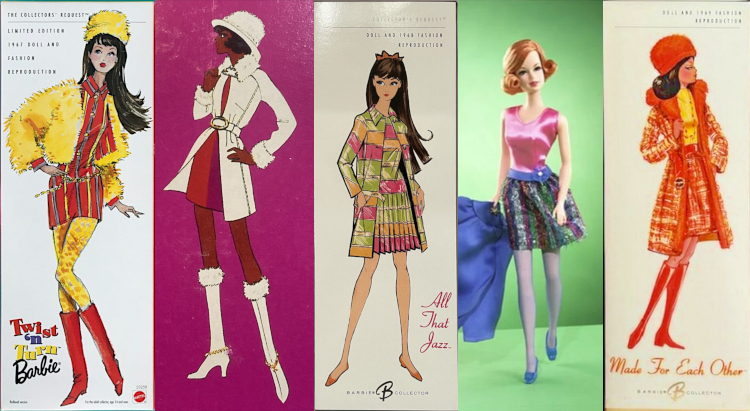
Did we miss any critical Millennial Mod designs? Having spent a good bit of effort assembling these examples, we still find more from time to time and would love to know of other gems we’ve so far overlooked!
 Silken Flame
Leave a comment